June 2019: A level Paper 4A: Further Pure Mathematics 2

75 marks · 23 question parts · Question paper, mark scheme and examiner's report on Pearson's site

Question by question

QTopicMarksDifficulty
1(a) Further complex numbers: regions and transformations of the plane 2 —
1(b) Further complex numbers: regions and transformations of the plane 3 —
2(a) Eigenvalues, eigenvectors, diagonalisation and Cayley-Hamilton 5 —
2(b) Eigenvalues, eigenvectors, diagonalisation and Cayley-Hamilton 4 —
2(c) Eigenvalues, eigenvectors, diagonalisation and Cayley-Hamilton 2 —
3(a) Recurrence relations and proof of closed forms 1 —
3(b) Recurrence relations and proof of closed forms 5 —
3(c) Recurrence relations and proof of closed forms 2 —
4(i) Number theory: Euclid, Bezout, modular arithmetic and Fermat 5 —
4(ii)(a) Combinatorics: counting, permutations and combinations 1 —
4(ii)(b) Combinatorics: counting, permutations and combinations 2 —
4(ii)(c) Combinatorics: counting, permutations and combinations 2 —
4(ii)(d) Combinatorics: counting, permutations and combinations 2 —
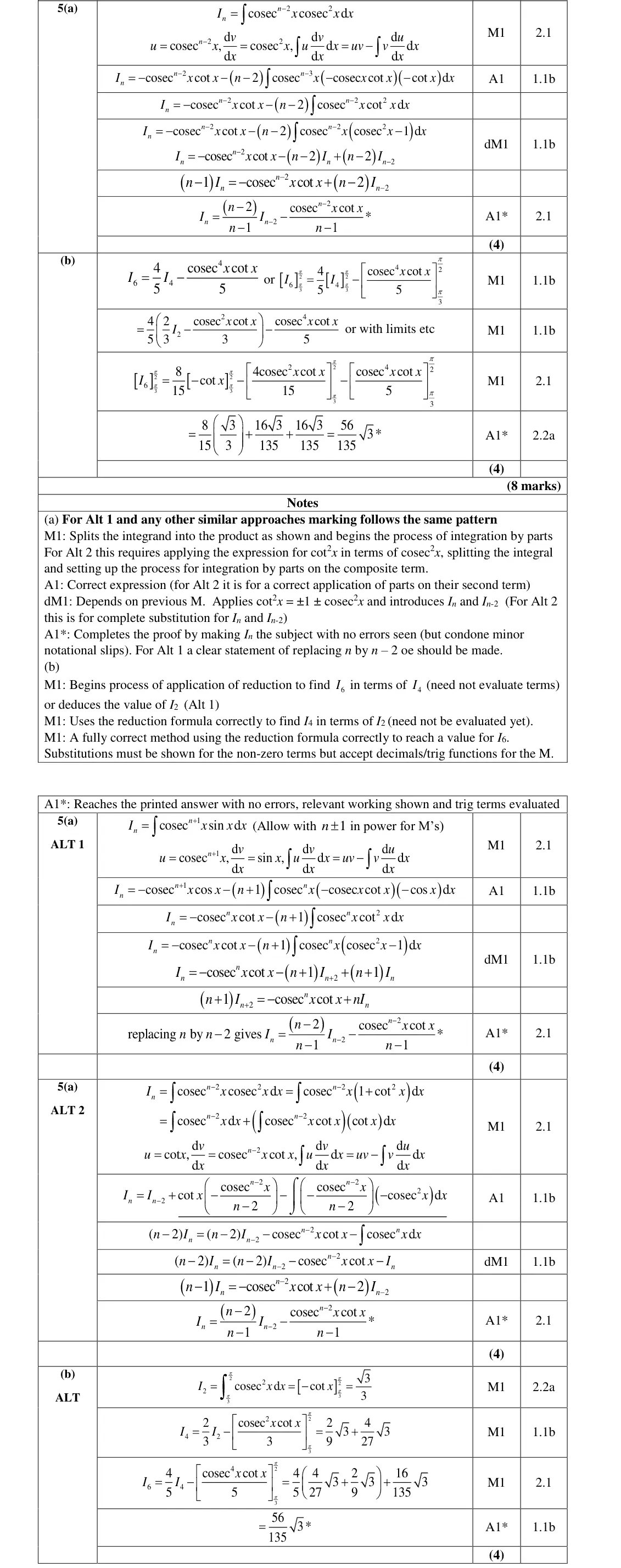
5(a) Reduction formulae, arc length and surface area 4 —
5(b) Reduction formulae, arc length and surface area 4 —
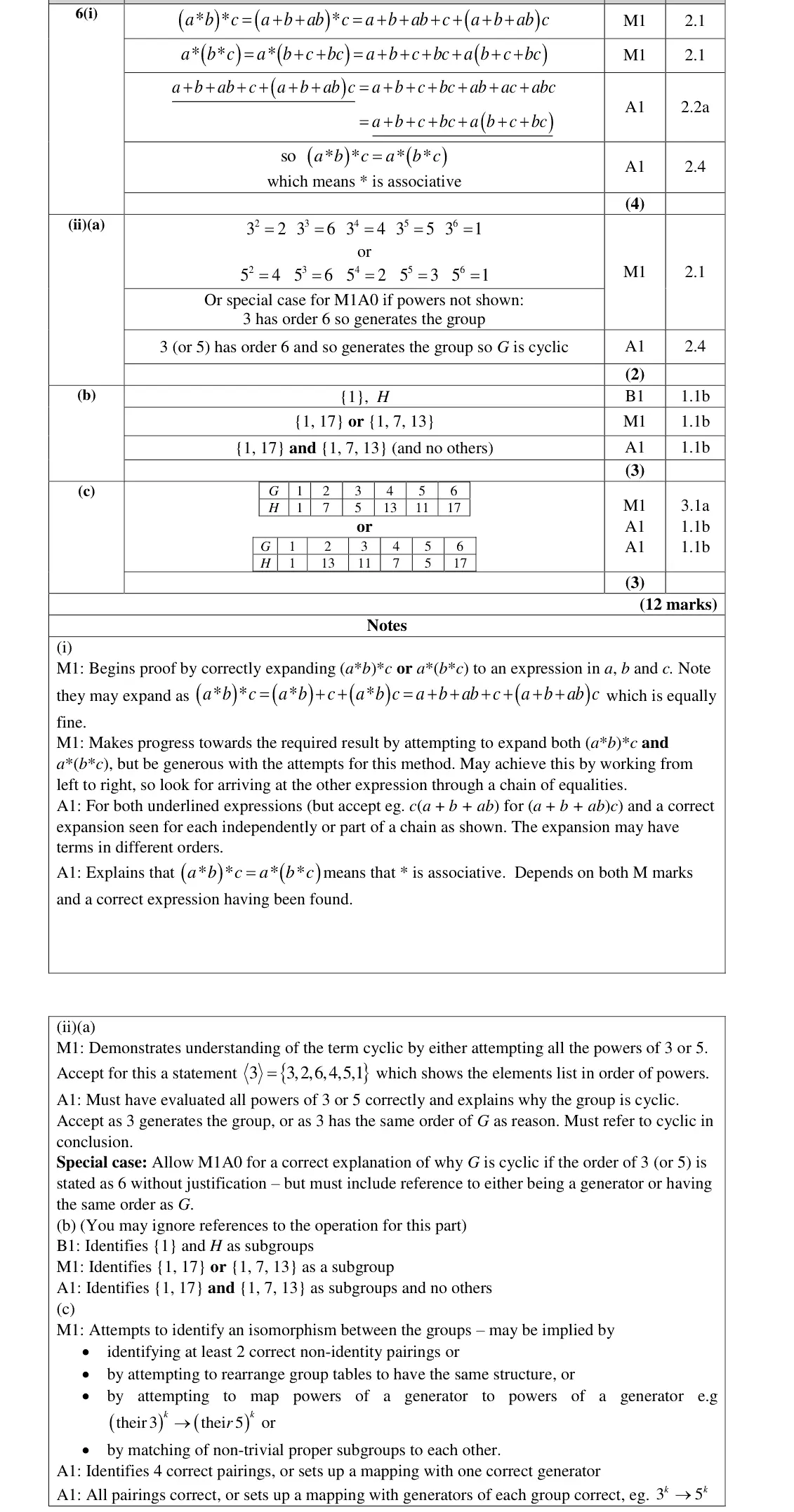
6(i) Groups: axioms, Cayley tables, subgroups, Lagrange and isomorphism 4 —
6(ii)(a) Groups: axioms, Cayley tables, subgroups, Lagrange and isomorphism 2 —
6(ii)(b) Groups: axioms, Cayley tables, subgroups, Lagrange and isomorphism 3 —
6(ii)(c) Groups: axioms, Cayley tables, subgroups, Lagrange and isomorphism 3 —
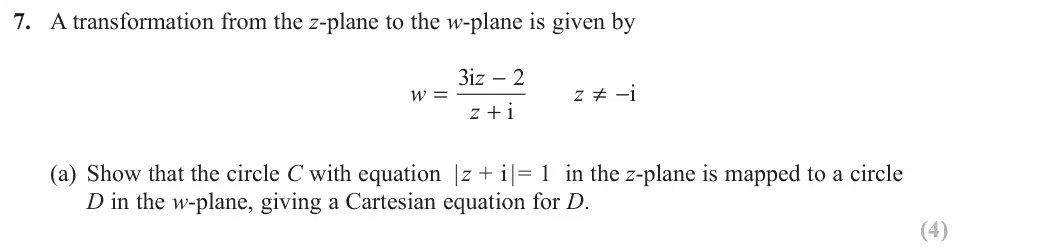
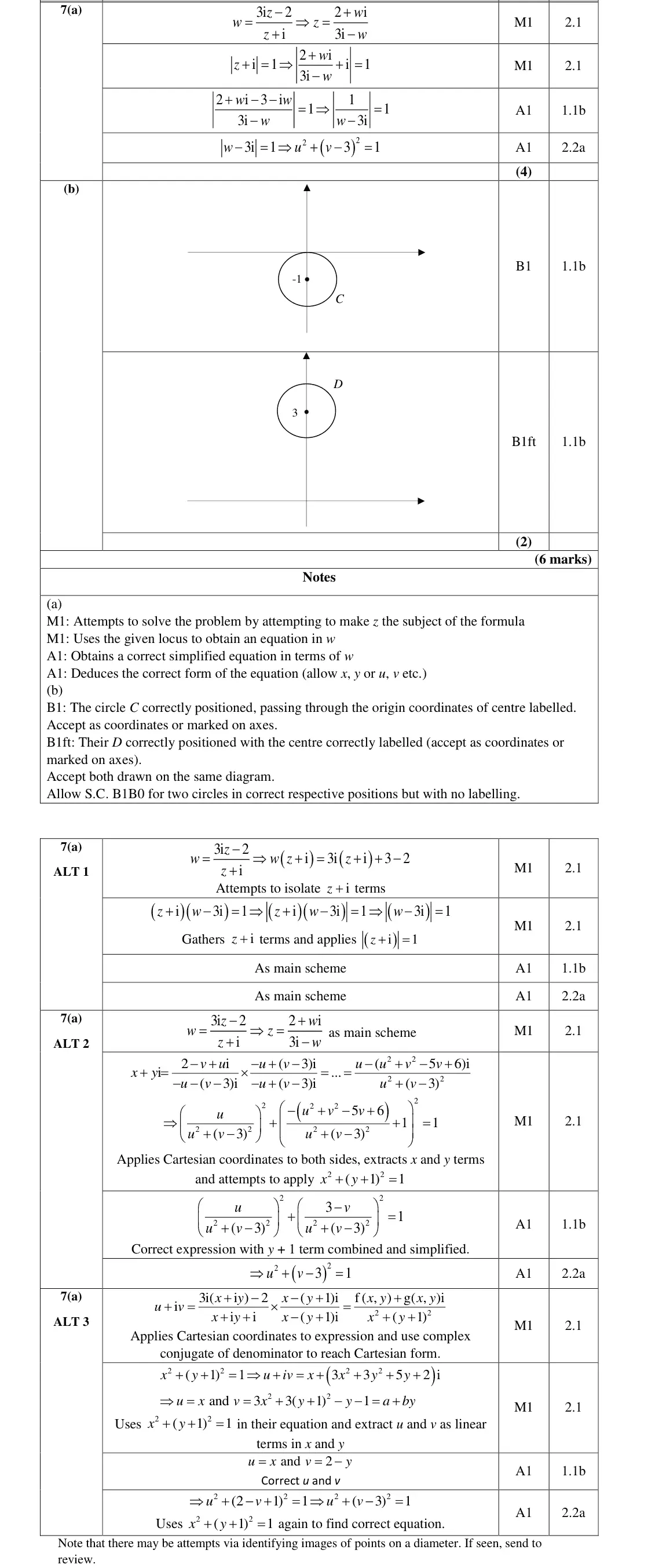
7(a) Further complex numbers: regions and transformations of the plane 4 —
7(b) Further complex numbers: regions and transformations of the plane 2 —
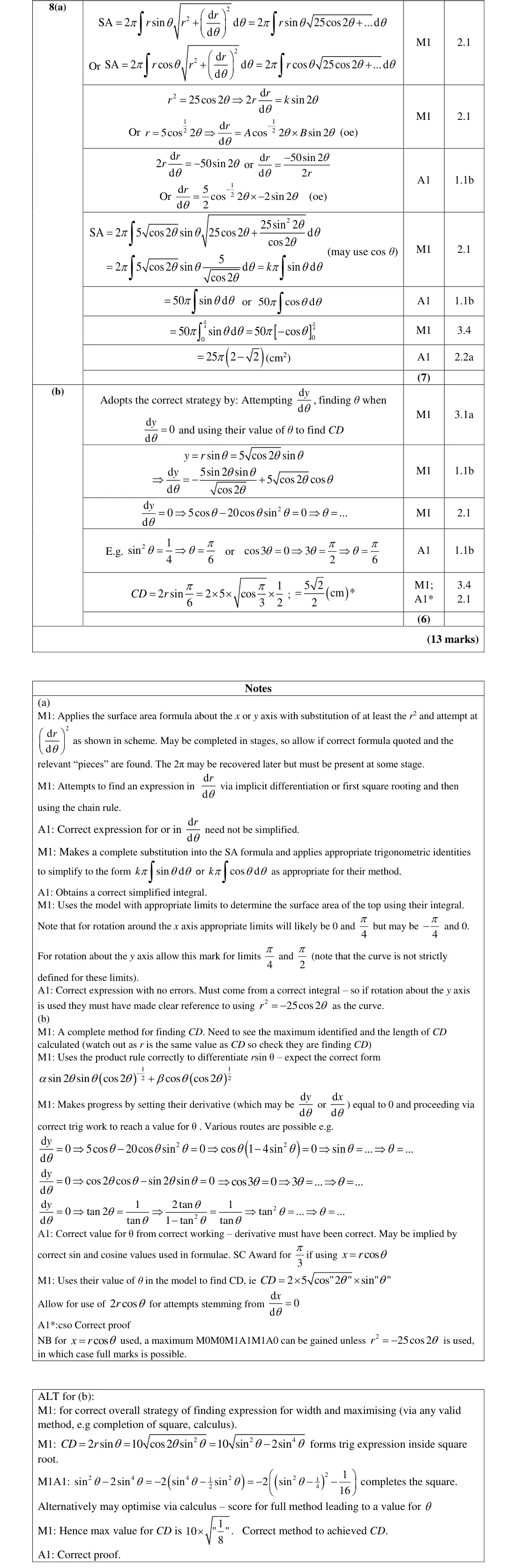
8(a) Reduction formulae, arc length and surface area 7 —
8(b) Reduction formulae, arc length and surface area 6 —

The questions

1(a)1(b)2(a)2(b)2(c)3(a)3(b)3(c)4(i)4(ii)(a)4(ii)(b)4(ii)(c)4(ii)(d)5(a)5(b)6(i)6(ii)(a)6(ii)(b)6(ii)(c)7(a)7(b)8(a)8(b)
June 2019 · Paper 4A (Further Pure 2) · Q1(a) 2 marks complex transformations
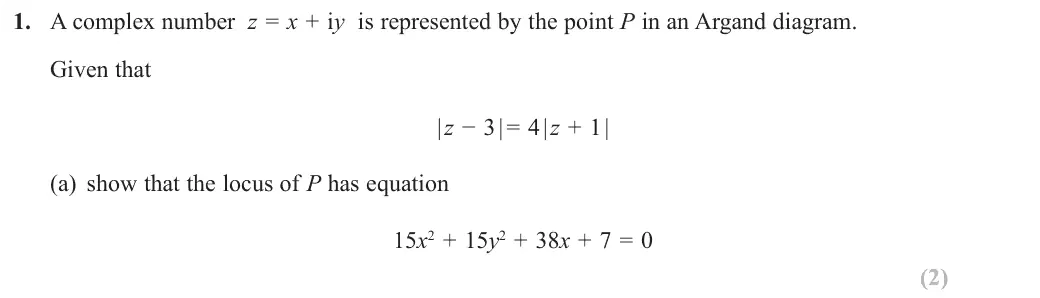
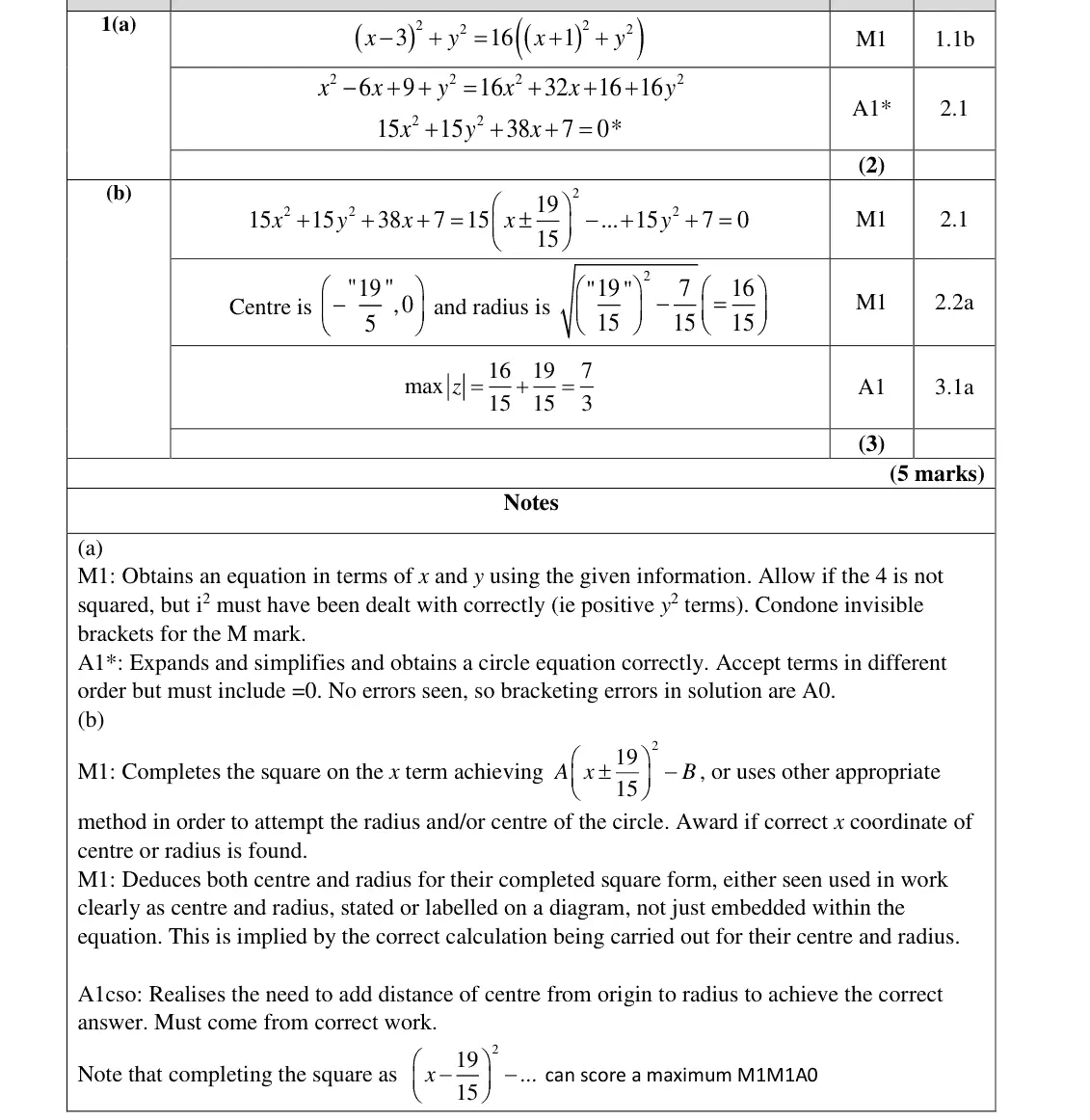
1. A complex number z = x + iy is represented by the point P in an Argand diagram. Given that | z í 3 | = 4 | z + 1 | (a) show that the locus of P has equation 15x2 + 15y2 + 38x + 7 = 0 (2)
June 2019 · Paper 4A (Further Pure 2) · Q1(b) 3 marks complex transformations
(b) Hence find the maximum value of | z | (3)
June 2019 · Paper 4A (Further Pure 2) · Q2(a) 5 marks eigenvalues and eigenvectors
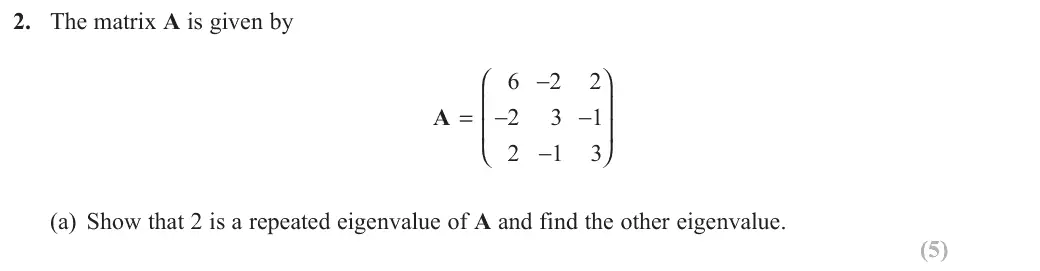
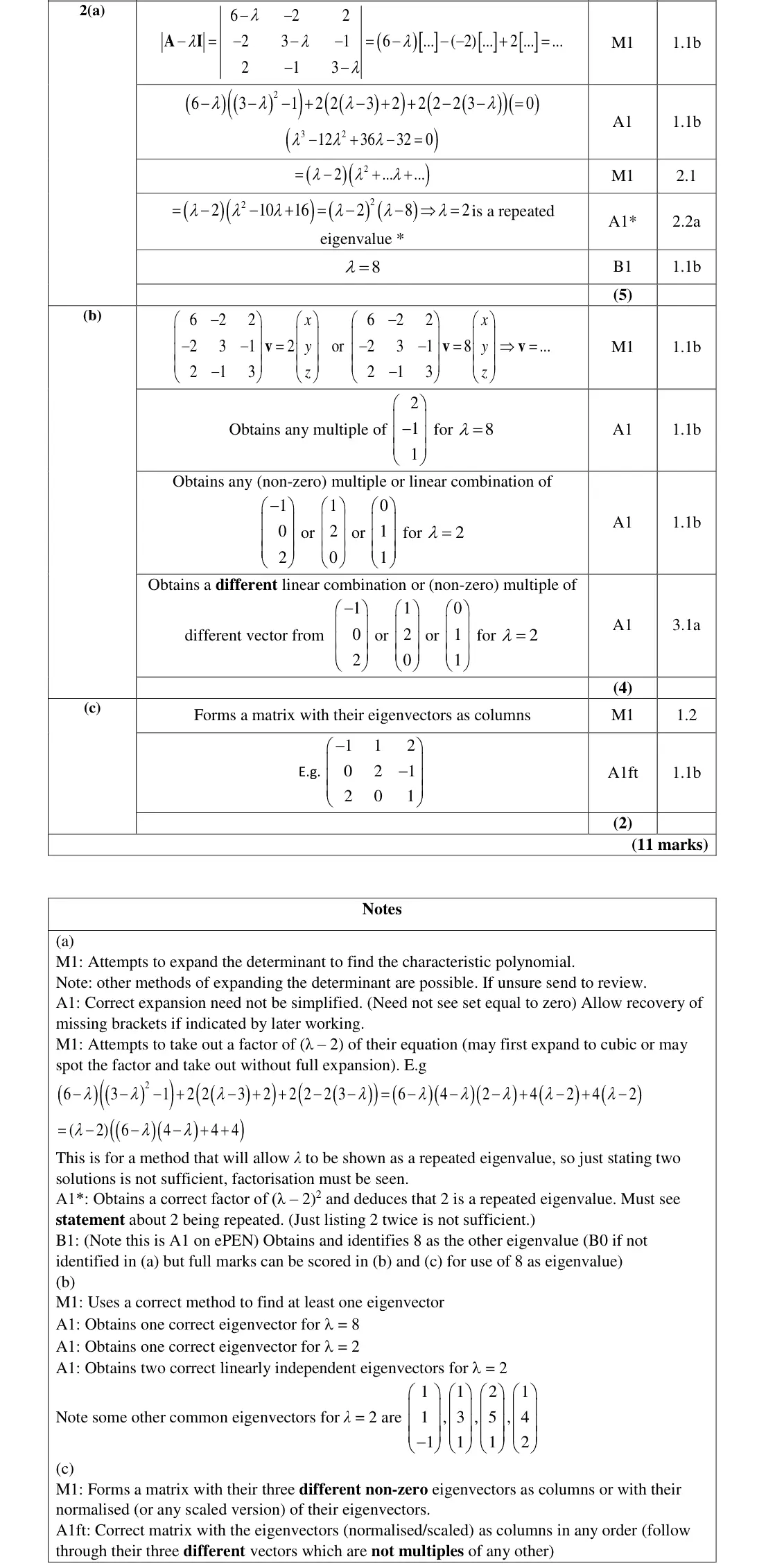
2. The matrix A is given by - ⎛ ⎞ ⎜ ⎟ A = - - ⎜ ⎟ ⎝ - ⎠ (a) Show that 2 is a repeated eigenvalue of A and find the other eigenvalue. (5)
June 2019 · Paper 4A (Further Pure 2) · Q2(b) 4 marks eigenvalues and eigenvectors
(b) Hence find three non-parallel eigenvectors of A. (4)
June 2019 · Paper 4A (Further Pure 2) · Q2(c) 2 marks eigenvalues and eigenvectors
(c) Find a matrix P such that Pí1AP is a diagonal matrix. (2)
June 2019 · Paper 4A (Further Pure 2) · Q3(a) 1 mark recurrence relations fp2
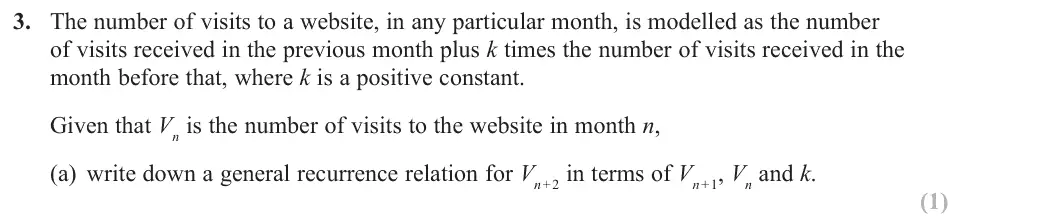
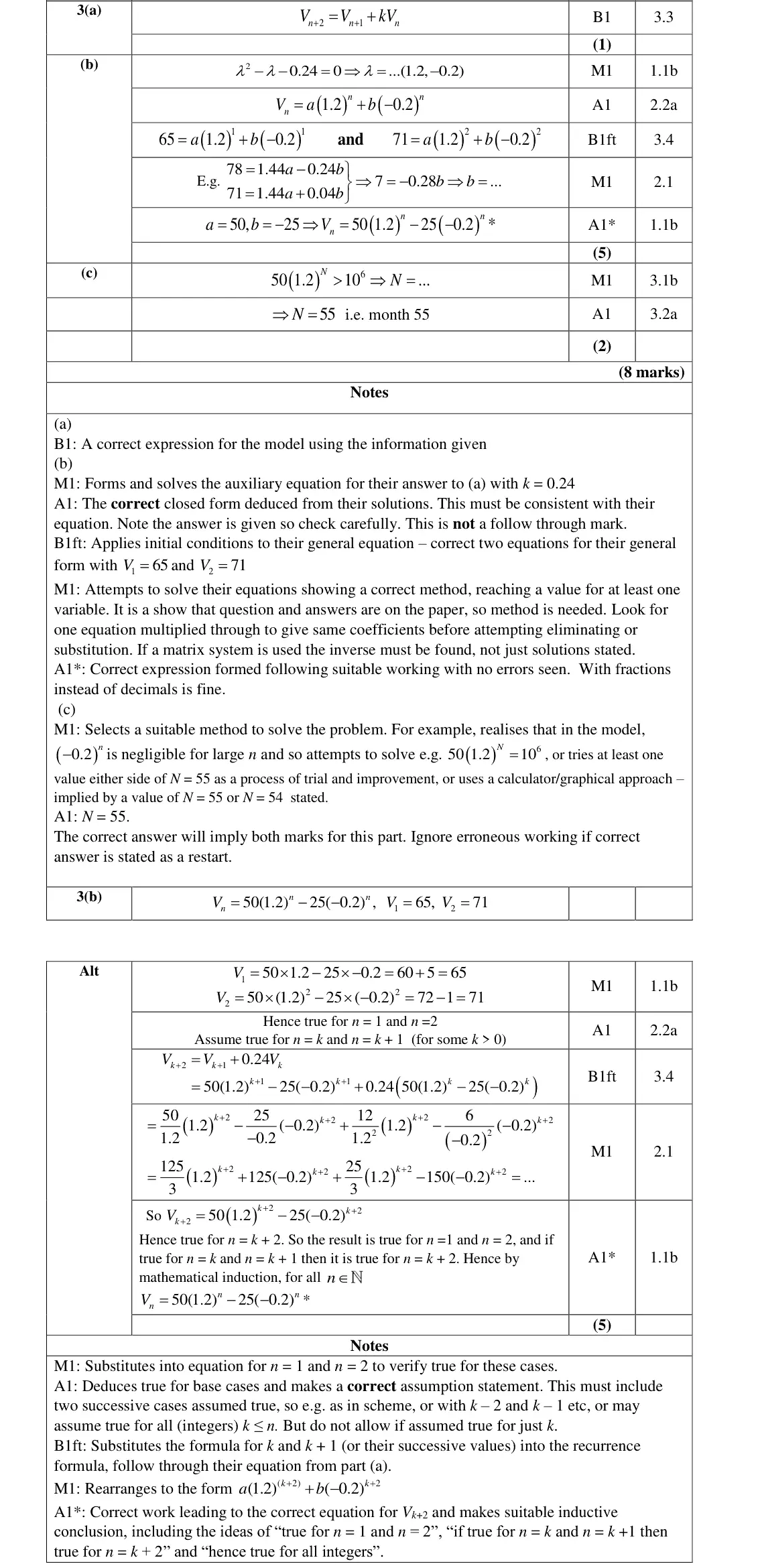
3. The number of visits to a website, in any particular month, is modelled as the number of visits received in the previous month plus k times the number of visits received in the month before that, where k is a positive constant. Given that Vn is the number of visits to the website in month n, (a) write down a general recurrence relation for Vn + 2 in terms of Vn + 1, Vn and k. (1)
June 2019 · Paper 4A (Further Pure 2) · Q3(b) 5 marks recurrence relations fp2
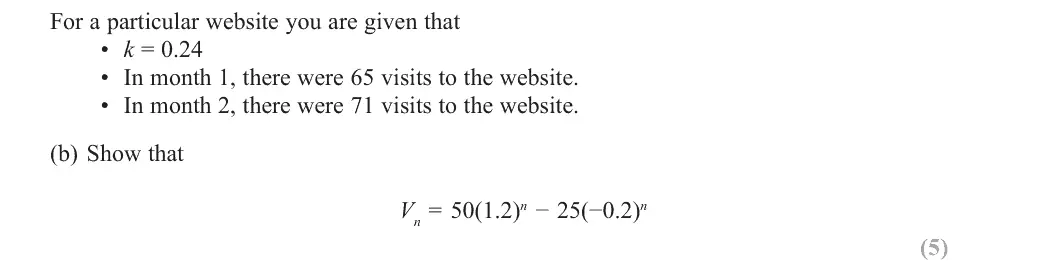
For a particular website you are given that • k = 0.24 • In month 1, there were 65 visits to the website. • In month 2, there were 71 visits to the website. (b) Show that Vn = 50(1.2)n í 25(í0.2)n (5)
June 2019 · Paper 4A (Further Pure 2) · Q3(c) 2 marks recurrence relations fp2
This model predicts that the number of visits to this website will exceed one million for the first time in month N. (c) Find the value of N. (2)
June 2019 · Paper 4A (Further Pure 2) · Q4(i) 5 marks number theory
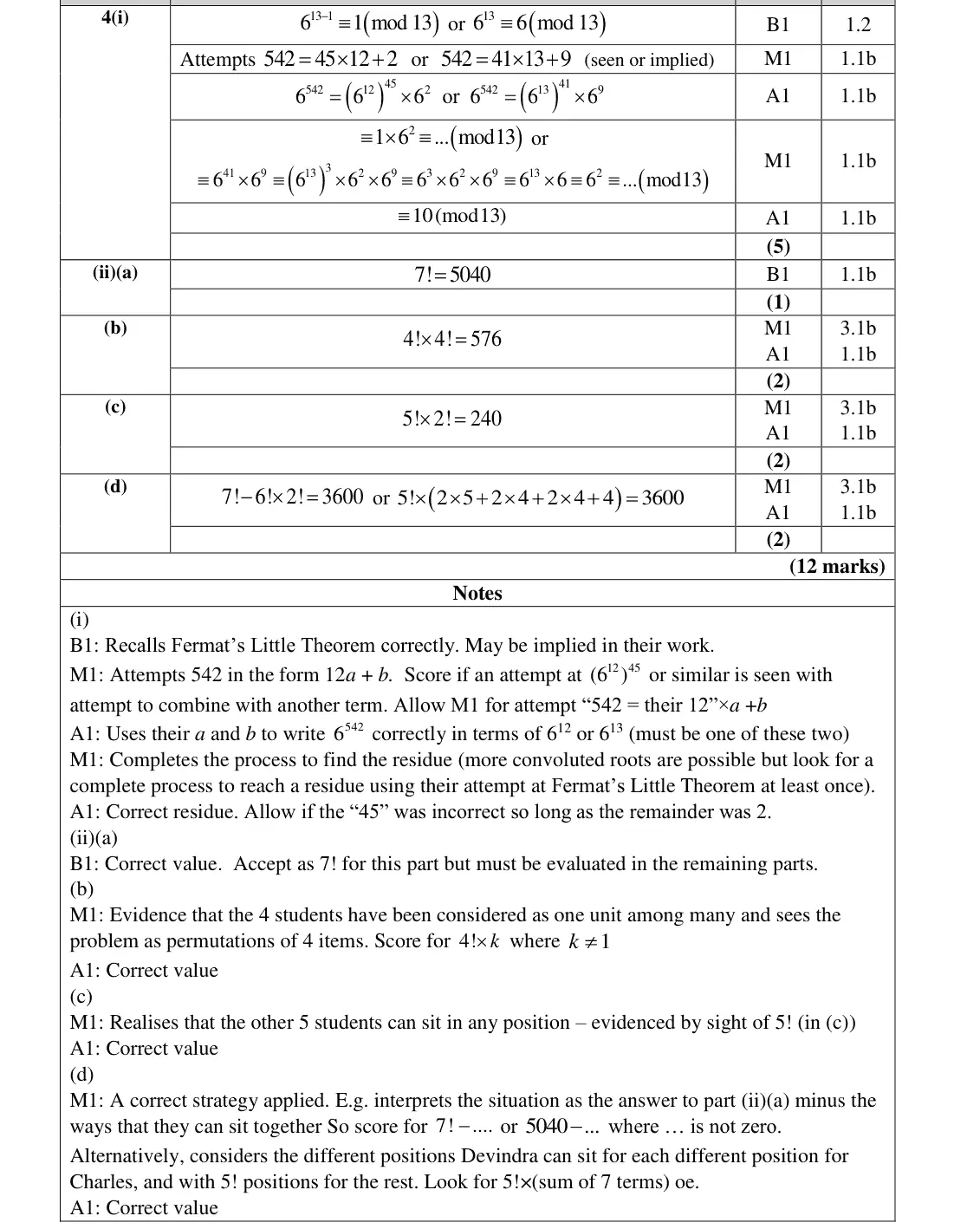
4. (i) Use Fermat’s Little Theorem to find the least positive residue of 6542 modulo 13 (5)
June 2019 · Paper 4A (Further Pure 2) · Q4(ii)(a) 1 mark combinatorics
(ii) Seven students, Alan, Brenda, Charles, Devindra, Enid, Felix and Graham, are attending a concert and will sit in a particular row of 7 seats. Find the number of ways they can be seated if (a) there are no restrictions where they sit in the row, (1)
June 2019 · Paper 4A (Further Pure 2) · Q4(ii)(b) 2 marks combinatorics
(b) Alan, Enid, Felix and Graham sit together, (2)
June 2019 · Paper 4A (Further Pure 2) · Q4(ii)(c) 2 marks combinatorics
(c) Brenda sits at one end of the row and Graham sits at the other end of the row, (2)
June 2019 · Paper 4A (Further Pure 2) · Q4(ii)(d) 2 marks combinatorics
(d) Charles and Devindra do not sit together. (2)
June 2019 · Paper 4A (Further Pure 2) · Q5(a) 4 marks reduction formulae arc length
5. ∫cosec I x x d n ] = n ∈ n (a) Prove that, for n . 2 n cosec x cot x - n - I I = - n n n - n - - (4)
June 2019 · Paper 4A (Further Pure 2) · Q5(b) 4 marks reduction formulae arc length
(b) Hence show that pi ∫ cosec d x x = pi (4)
June 2019 · Paper 4A (Further Pure 2) · Q6(i) 4 marks groups
6. (i) A binary operation * is defined on positive real numbers by a * b = a + b + ab Prove that the operation * is associative. (4)
June 2019 · Paper 4A (Further Pure 2) · Q6(ii)(a) 2 marks groups
(ii) The set G = {1, 2, 3, 4, 5, 6` forms a group under the operation of multiplication modulo 7 (a) Show that G is cyclic. (2)
June 2019 · Paper 4A (Further Pure 2) · Q6(ii)(b) 3 marks groups
The set H = {1, 5, 7, 11, 13, 17` forms a group under the operation of multiplication modulo 18 (b) List all the subgroups of H. (3)
June 2019 · Paper 4A (Further Pure 2) · Q6(ii)(c) 3 marks groups
(c) Describe an isomorphism between G and H. (3)
June 2019 · Paper 4A (Further Pure 2) · Q7(a) 4 marks complex transformations
7. A transformation from the z-plane to the w-plane is given by i z - w z i = ≠- z i + (a) Show that the circle C with equation | z + i | = 1 in the z-plane is mapped to a circle D in the w-plane, giving a Cartesian equation for D. (4)
June 2019 · Paper 4A (Further Pure 2) · Q7(b) 2 marks complex transformations
(b) Sketch C and D on Argand diagrams. (2)
June 2019 · Paper 4A (Further Pure 2) · Q8(a) 7 marks reduction formulae arc length
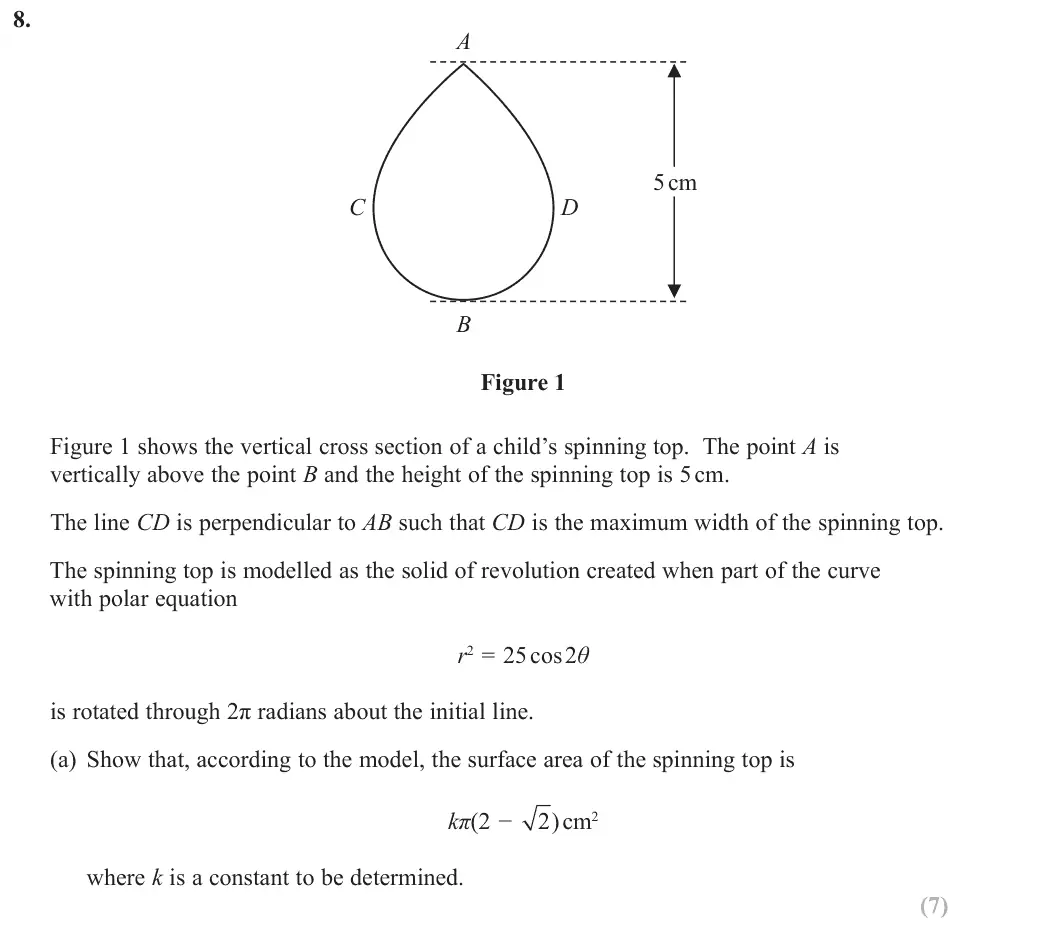
8. A 5 cm C B Figure 1 Figure 1 shows the vertical cross section of a child’s spinning top. The point A is vertically above the point B and the height of the spinning top is 5 cm. The line CD is perpendicular to AB such that CD is the maximum width of the spinning top. The spinning top is modelled as the solid of revolution created when part of the curve with polar equation r2 = 25 cos 2ș is rotated through 2ʌ radians about the initial line. (a) Show that, according to the model, the surface area of the spinning top is Nʌ(2 í 2) cm2 where k is a constant to be determined. (7)
June 2019 · Paper 4A (Further Pure 2) · Q8(b) 6 marks reduction formulae arc length
(b) Show that, according to the model, the length CD is 5 2 2 cm. (6)

Find an Edexcel Further Maths tutor

Want this paper marked and gone through with a Further Maths tutor? Message us.

Prefer email? Send an enquiry

If you are under 18, please include a parent's contact details. Enquiries go to enquiries@alevelfurthermathstutor.com and are deleted once handled.