June 2022: AS Paper 27: Decision Mathematics 1

40 marks · 13 question parts · Question paper, mark scheme and examiner's report on Pearson's site

Question by question

QTopicMarksDifficulty
1(a) Algorithms, sorting, bin packing and graph theory 4 —
1(b) Minimum spanning trees (Prim, Kruskal) and shortest paths (Dijkstra, Floyd) 3 —
1(c) Minimum spanning trees (Prim, Kruskal) and shortest paths (Dijkstra, Floyd) 2 —
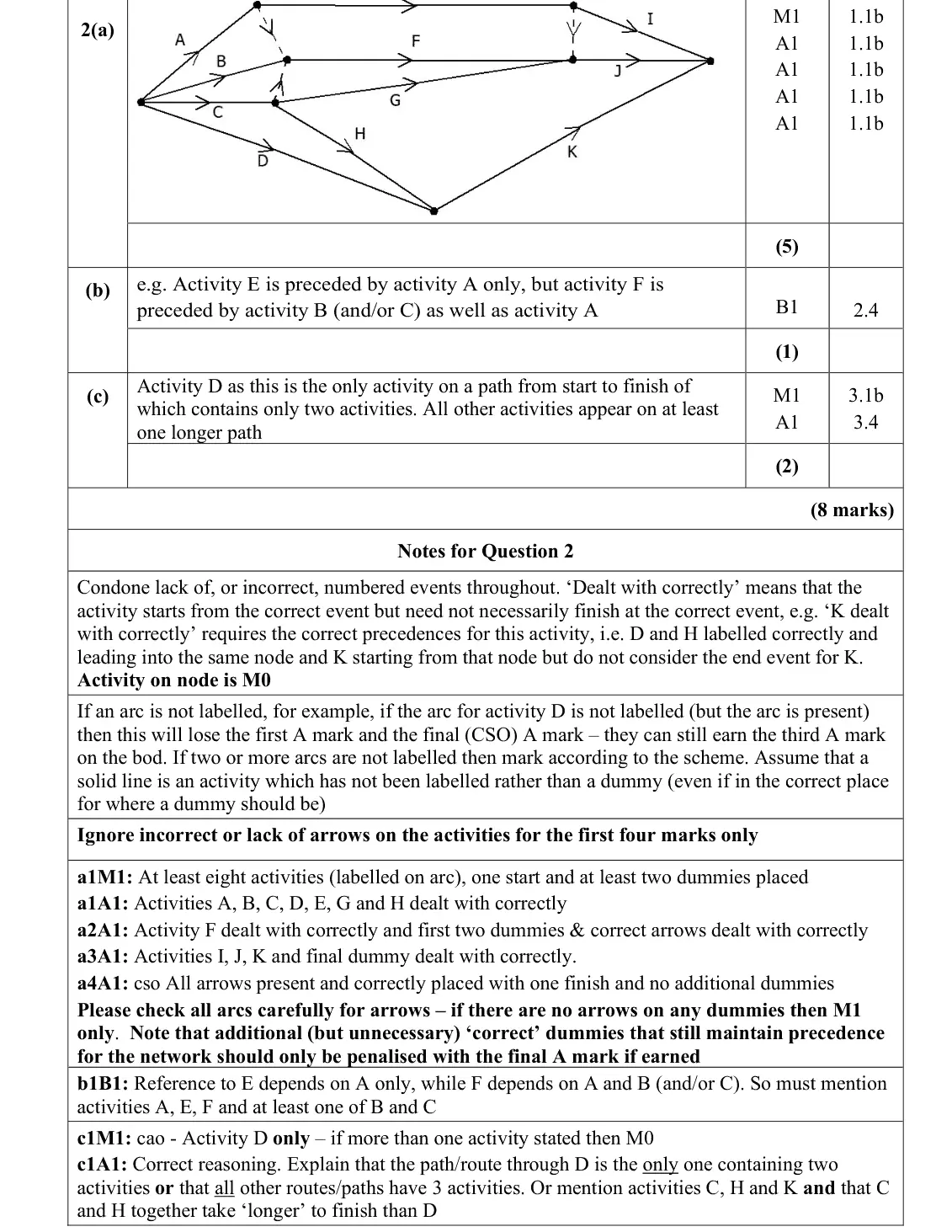
2(a) Critical path analysis 5 —
2(b) Critical path analysis 1 —
2(c) Critical path analysis 2 —
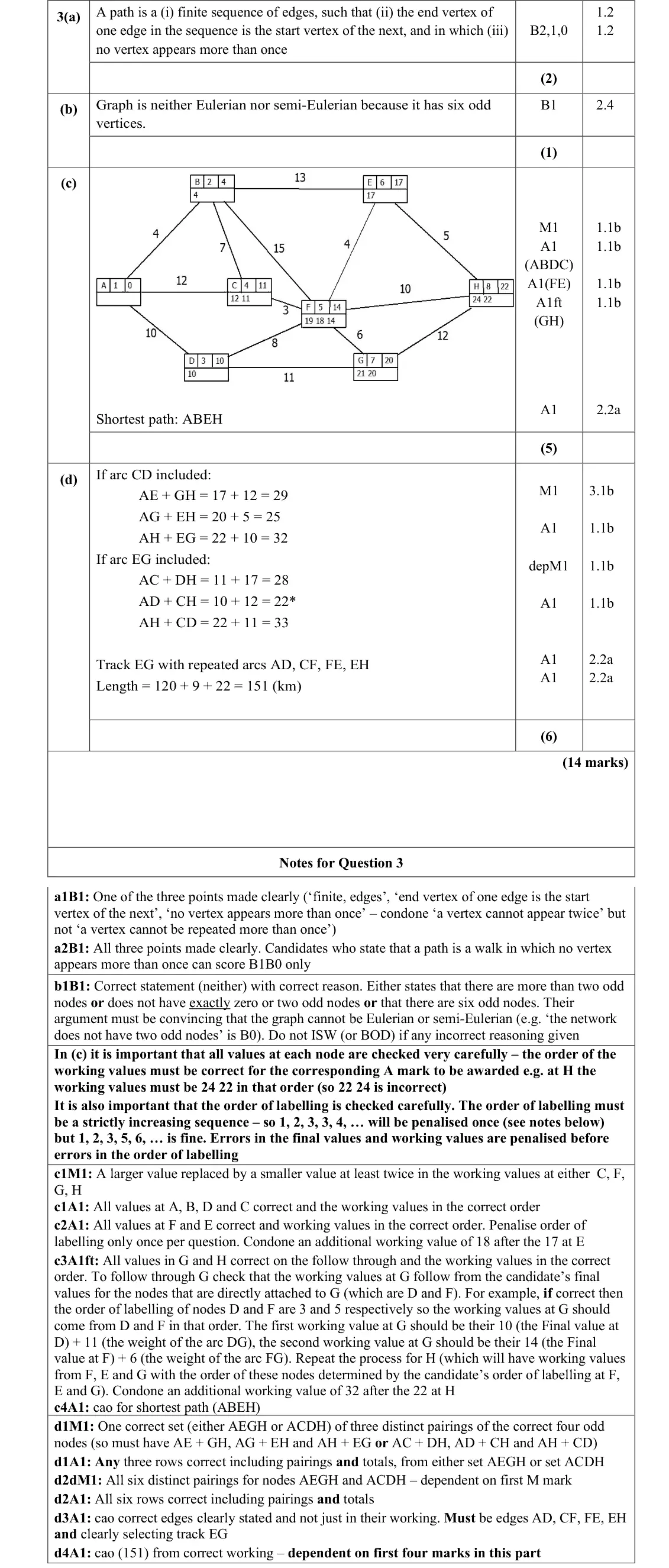
3(a) Algorithms, sorting, bin packing and graph theory 2 —
3(b) Algorithms, sorting, bin packing and graph theory 1 —
3(c) Minimum spanning trees (Prim, Kruskal) and shortest paths (Dijkstra, Floyd) 5 —
3(d) Route inspection and the travelling salesman problem 6 —
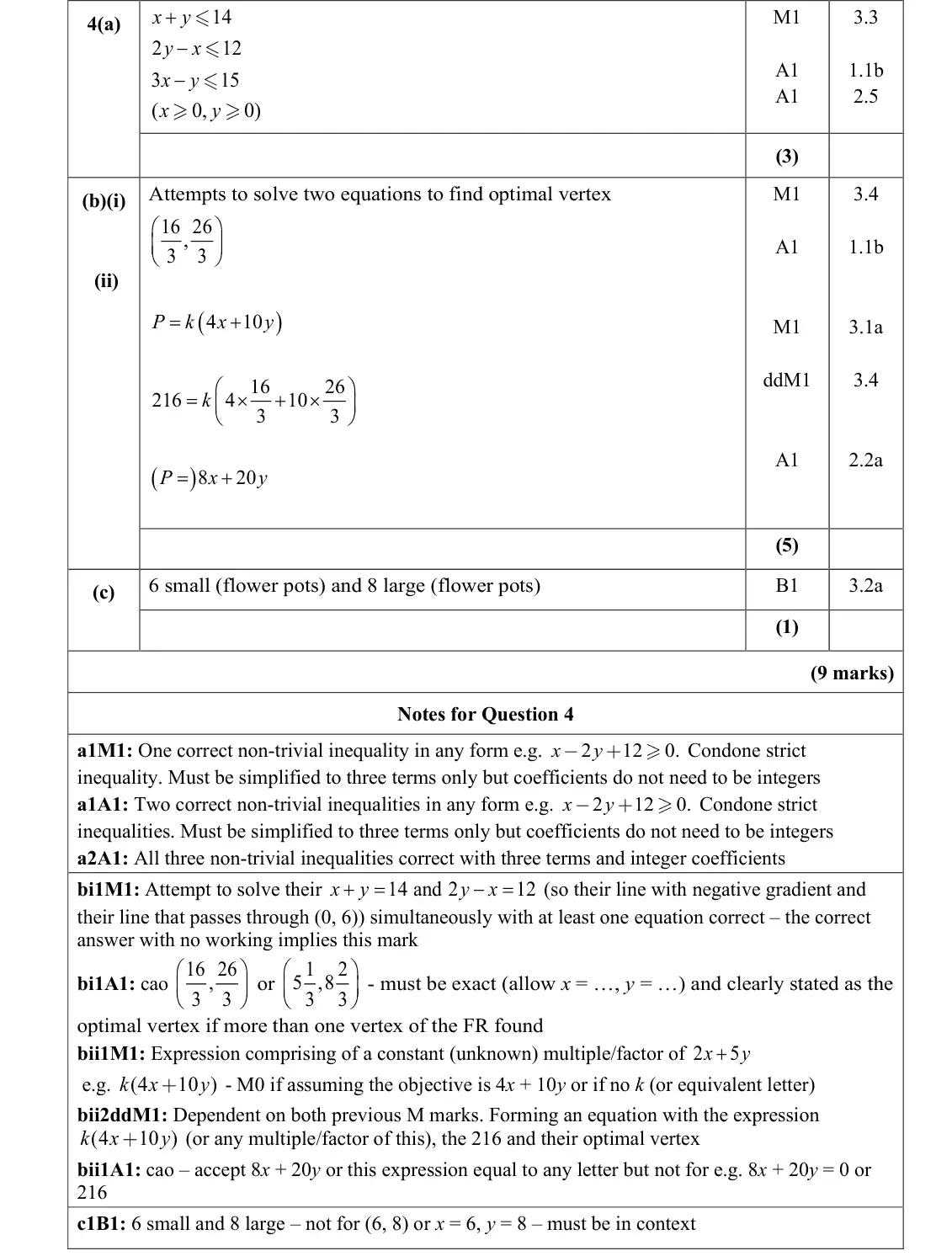
4(a) Linear programming: formulation, graphs and the Simplex algorithm 3 —
4(b) Linear programming: formulation, graphs and the Simplex algorithm 5 —
4(c) Linear programming: formulation, graphs and the Simplex algorithm 1 —

The questions

1(a)1(b)1(c)2(a)2(b)2(c)3(a)3(b)3(c)3(d)4(a)4(b)4(c)
June 2022 · AS Paper 2 (Decision 1) · Q1(a) 4 marks algorithms and graph theory
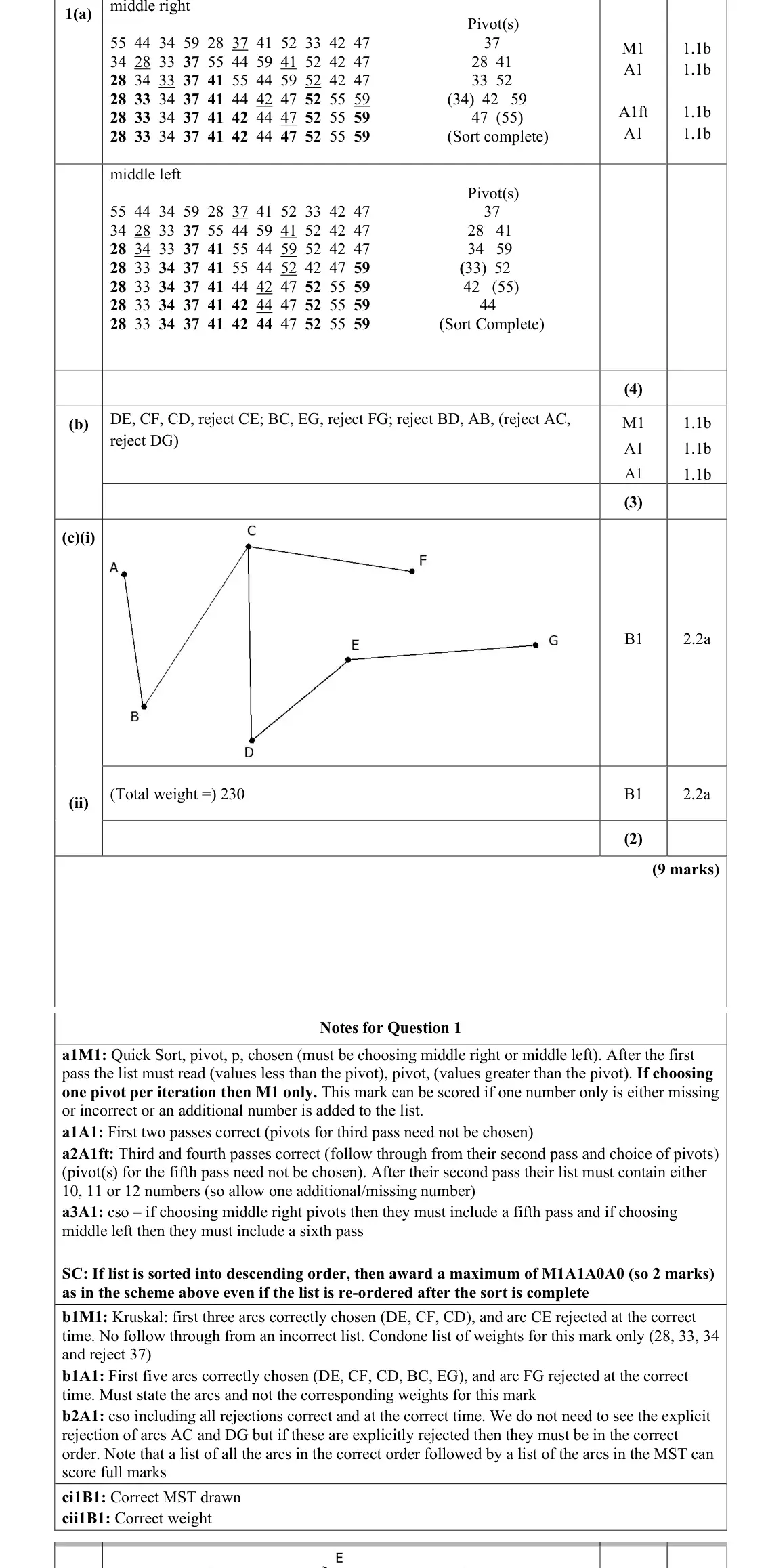
1. 55 44 34 59 28 37 41 52 33 42 47 The list of eleven numbers shown above is to be sorted into ascending order. (a) Carry out a quick sort to produce the sorted list. You should show the result of each pass and identify your pivots clearly. (4)
June 2022 · AS Paper 2 (Decision 1) · Q1(b) 3 marks minimum spanning trees and shortest paths
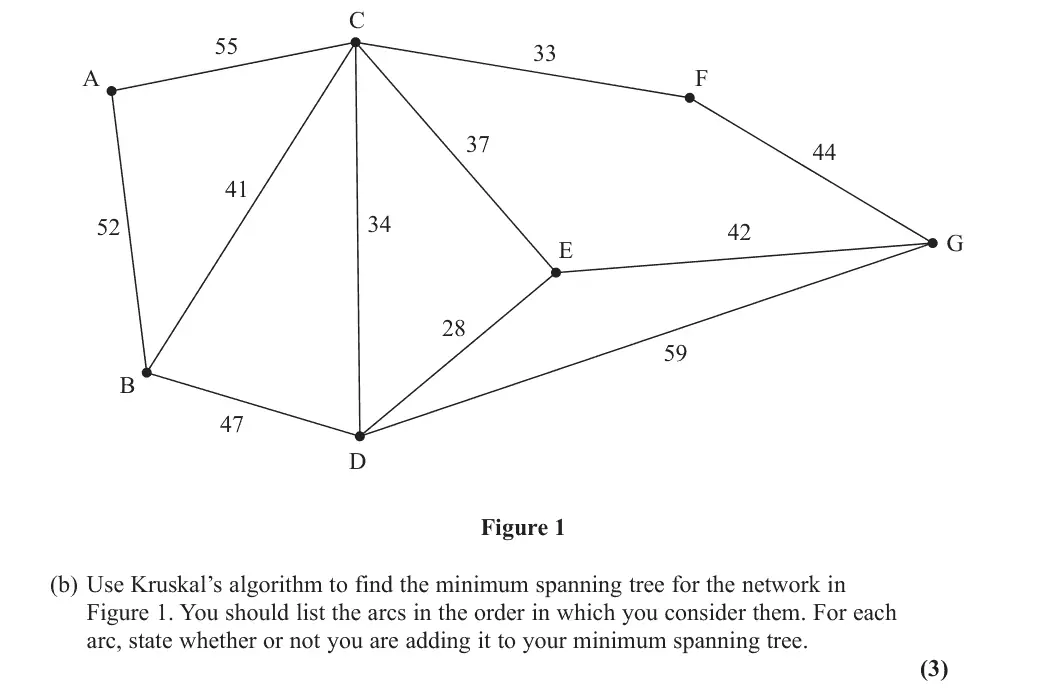
C A F G E B Figure 1 (b) Use Kruskal’s algorithm to find the minimum spanning tree for the network in Figure 1. You should list the arcs in the order in which you consider them. For each arc, state whether or not you are adding it to your minimum spanning tree. (3)
June 2022 · AS Paper 2 (Decision 1) · Q1(c) 2 marks minimum spanning trees and shortest paths
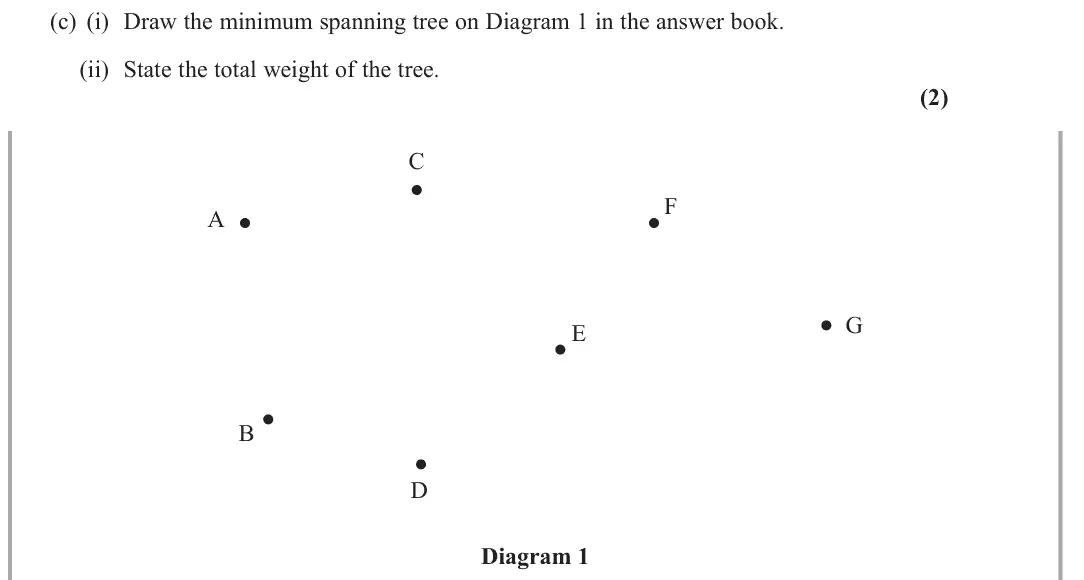
(c) (i) Draw the minimum spanning tree on Diagram 1 in the answer book. (ii) State the total weight of the tree. (2)
June 2022 · AS Paper 2 (Decision 1) · Q2(a) 5 marks critical path analysis
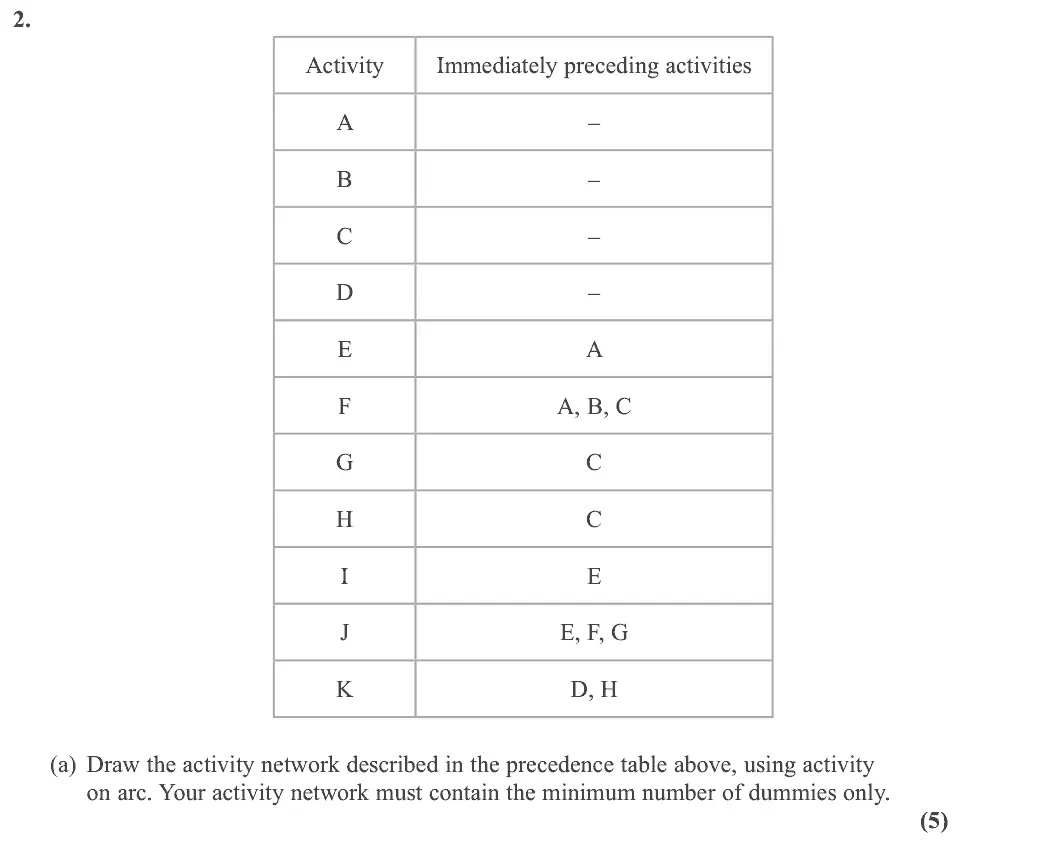
2. Activity Immediately preceding activities A – B – C – – E A F A, B, C G C H C I E J E, F, G K D, H (a) Draw the activity network described in the precedence table above, using activity on arc. Your activity network must contain the minimum number of dummies only. (5)
June 2022 · AS Paper 2 (Decision 1) · Q2(b) 1 mark critical path analysis
(b) Explain why it is necessary to draw a dummy from the end of activity A. (1)
June 2022 · AS Paper 2 (Decision 1) · Q2(c) 2 marks critical path analysis
Every activity shown in the precedence table has the same duration. (c) State which activity cannot be critical, justifying your answer. (2)
June 2022 · AS Paper 2 (Decision 1) · Q3(a) 2 marks algorithms and graph theory
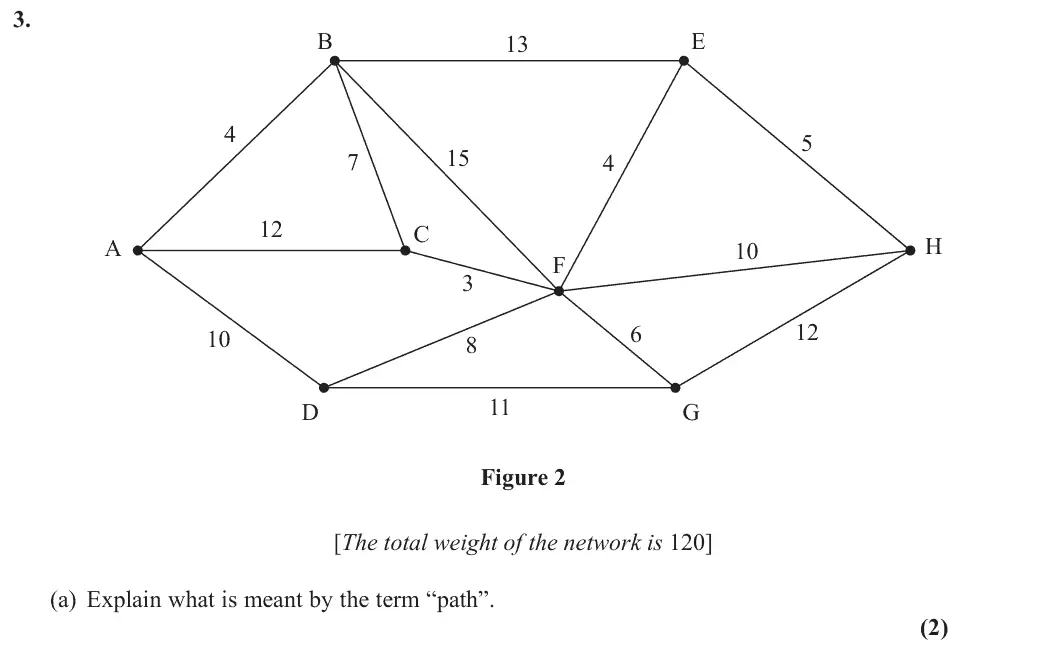
3. B E C H A F G Figure 2 [The total weight of the network is 120] (a) Explain what is meant by the term “path”. (2)
June 2022 · AS Paper 2 (Decision 1) · Q3(b) 1 mark algorithms and graph theory
(b) State, with a reason, whether the network in Figure 2 is Eulerian, semi-Eulerian or neither. (1)
June 2022 · AS Paper 2 (Decision 1) · Q3(c) 5 marks minimum spanning trees and shortest paths
Figure 2 represents a network of cycle tracks between eight villages, A, B, C, D, E, F, G and H. The number on each arc represents the length, in km, of the corresponding track. Samira lives in village A, and wishes to visit her friend, Daisy, who lives in village H. (c) Use Dijkstra’s algorithm to find the shortest path that Samira can take. (5)
June 2022 · AS Paper 2 (Decision 1) · Q3(d) 6 marks route inspection and travelling salesman
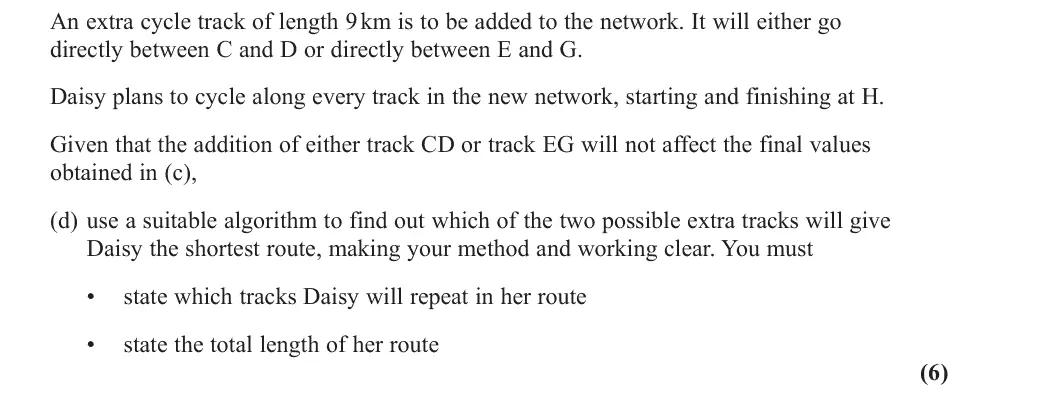
An extra cycle track of length 9 km is to be added to the network. It will either go directly between C and D or directly between E and G. Daisy plans to cycle along every track in the new network, starting and finishing at H. Given that the addition of either track CD or track EG will not affect the final values obtained in (c), (d) use a suitable algorithm to find out which of the two possible extra tracks will give Daisy the shortest route, making your method and working clear. You must • state which tracks Daisy will repeat in her route • state the total length of her route (6)
June 2022 · AS Paper 2 (Decision 1) · Q4(a) 3 marks linear programming
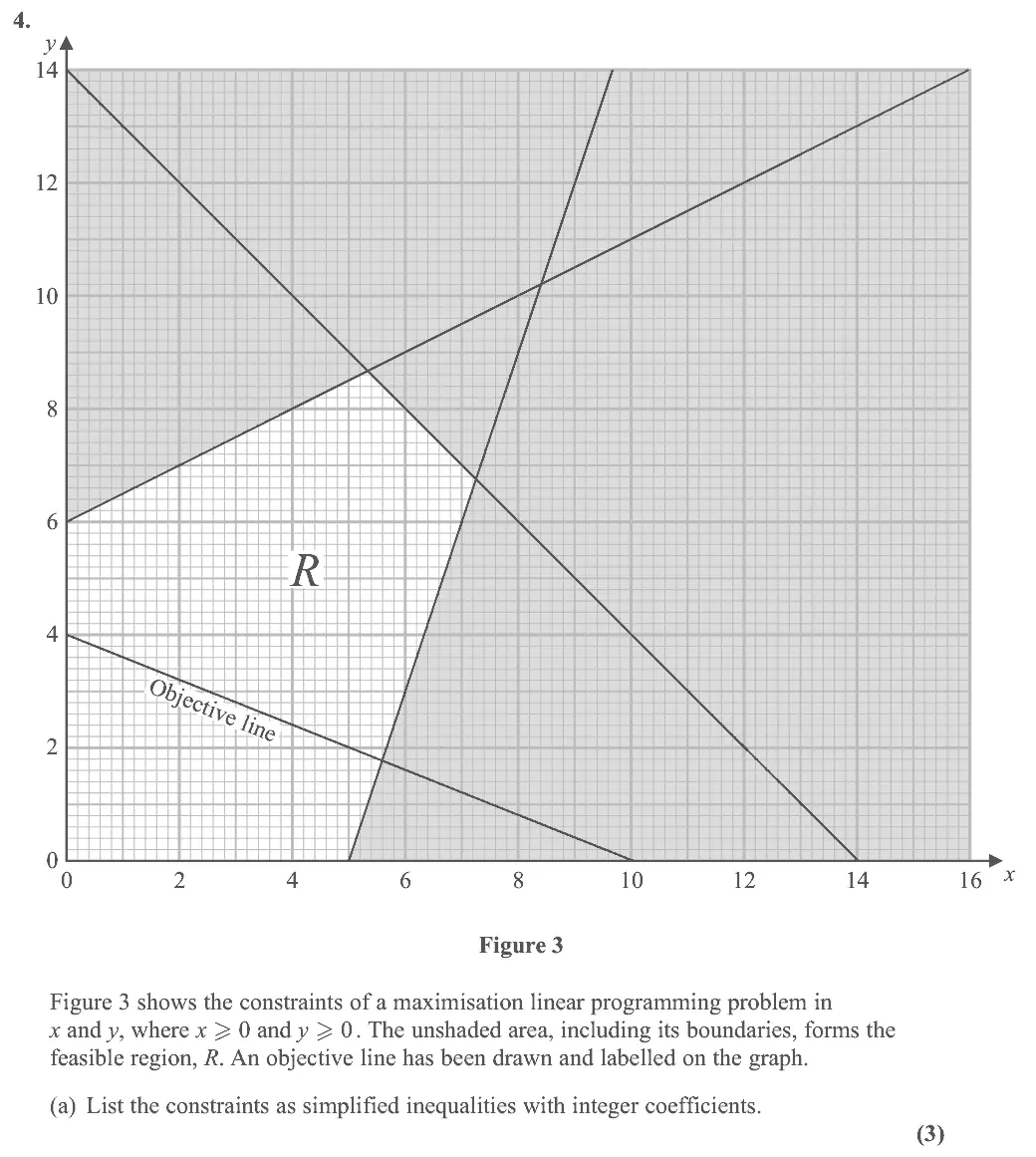
4. y 14 12 10 R Objective line x Figure 3 Figure 3 shows the constraints of a maximisation linear programming problem in x and y, where x 0 and y 0 . The unshaded area, including its boundaries, forms the feasible region, R. An objective line has been drawn and labelled on the graph. (a) List the constraints as simplified inequalities with integer coefficients. (3)
June 2022 · AS Paper 2 (Decision 1) · Q4(b) 5 marks linear programming
The optimal value of the objective function is 216 (b) (i) Calculate the exact coordinates of the optimal vertex. (ii) Hence derive the objective function. (5)
June 2022 · AS Paper 2 (Decision 1) · Q4(c) 1 mark linear programming
Given that x represents the number of small flower pots and y represents the number of large flower pots supplied to a customer, (c) deduce the optimal solution to the problem. (1)

Find an Edexcel Further Maths tutor

Want this paper marked and gone through with a Further Maths tutor? Message us.

Prefer email? Send an enquiry

If you are under 18, please include a parent's contact details. Enquiries go to enquiries@alevelfurthermathstutor.com and are deleted once handled.