June 2023: A level Paper 4A: Further Pure Mathematics 2

75 marks · 24 question parts · Question paper, mark scheme and examiner's report on Pearson's site

Question by question

QTopicMarksDifficulty
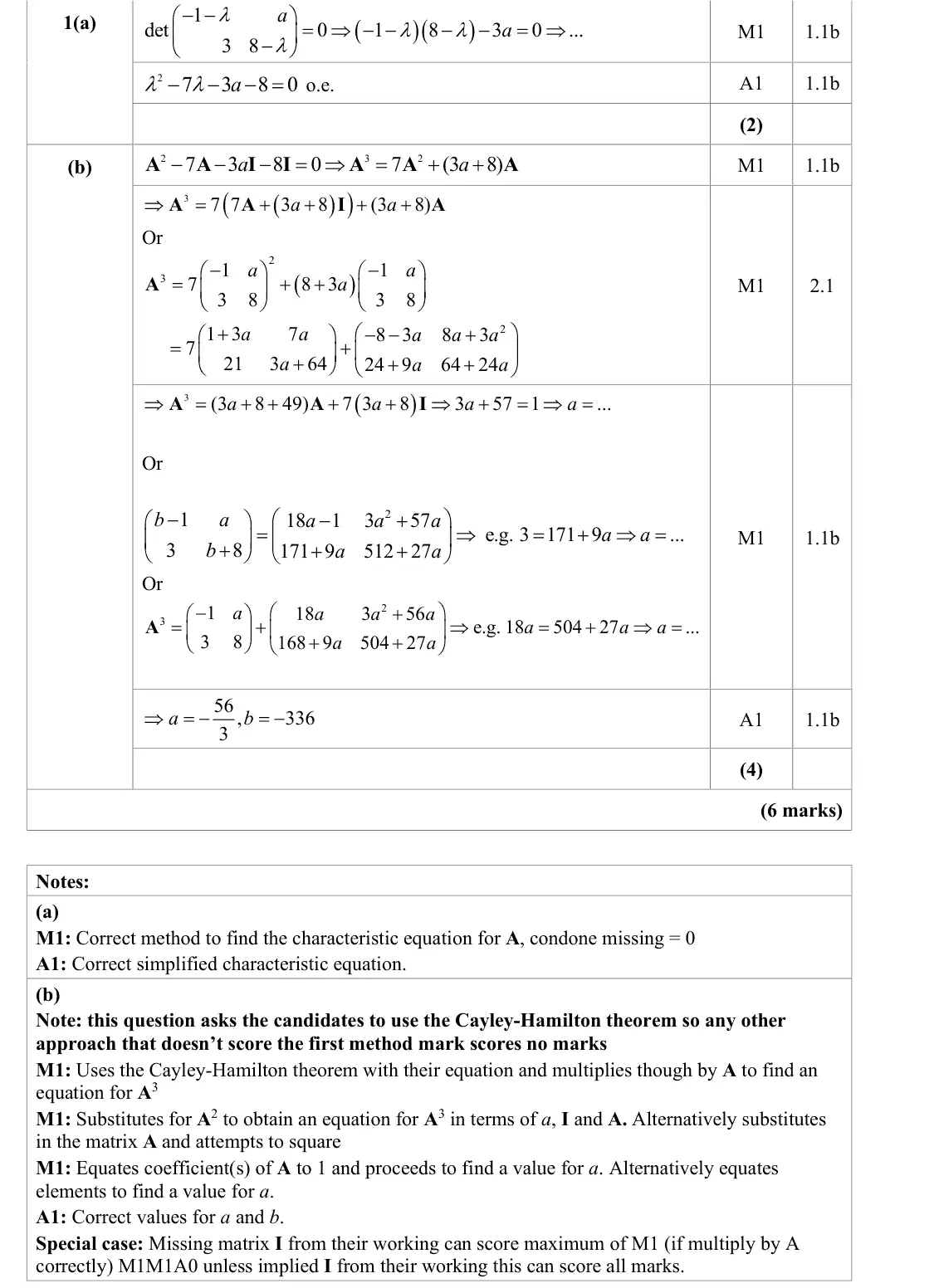
1(a) Eigenvalues, eigenvectors, diagonalisation and Cayley-Hamilton 2 —
1(b) Eigenvalues, eigenvectors, diagonalisation and Cayley-Hamilton 4 —
2(a) Further complex numbers: regions and transformations of the plane 2 —
2(b) Further complex numbers: regions and transformations of the plane 2 —
2(c) Further complex numbers: regions and transformations of the plane 2 —
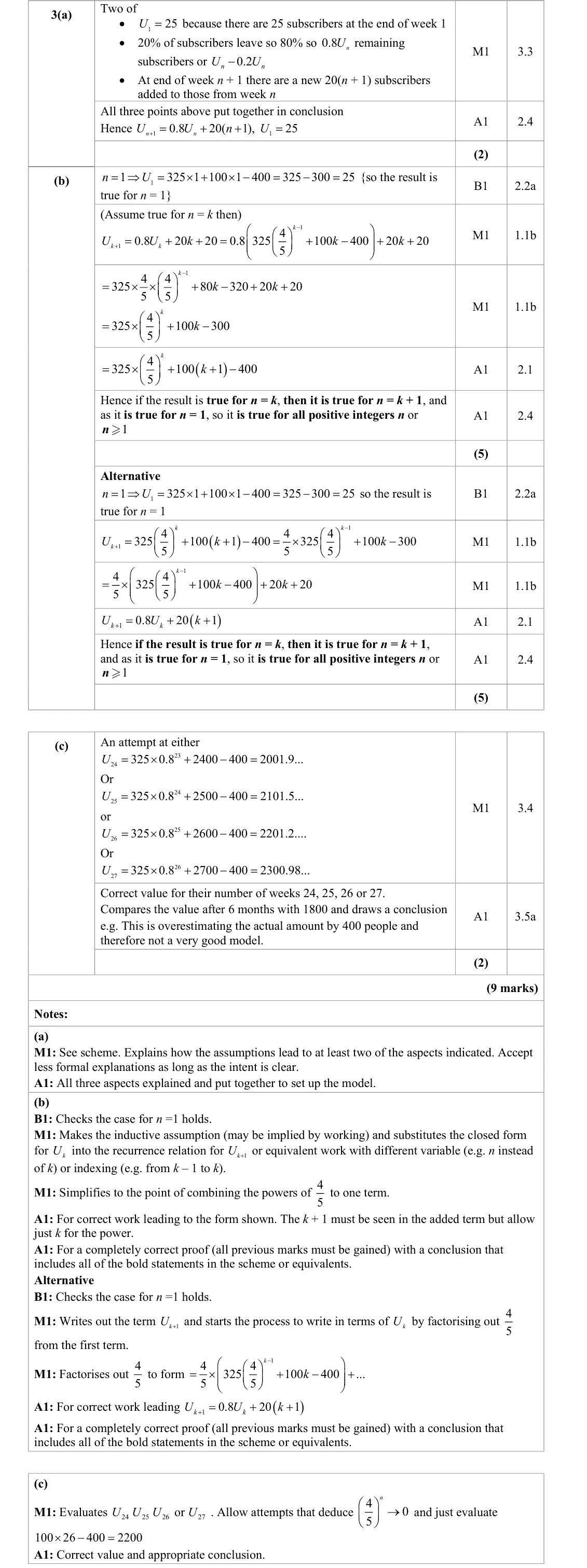
3(a) Recurrence relations and proof of closed forms 2 —
3(b) Recurrence relations and proof of closed forms 5 —
3(c) Recurrence relations and proof of closed forms 2 —
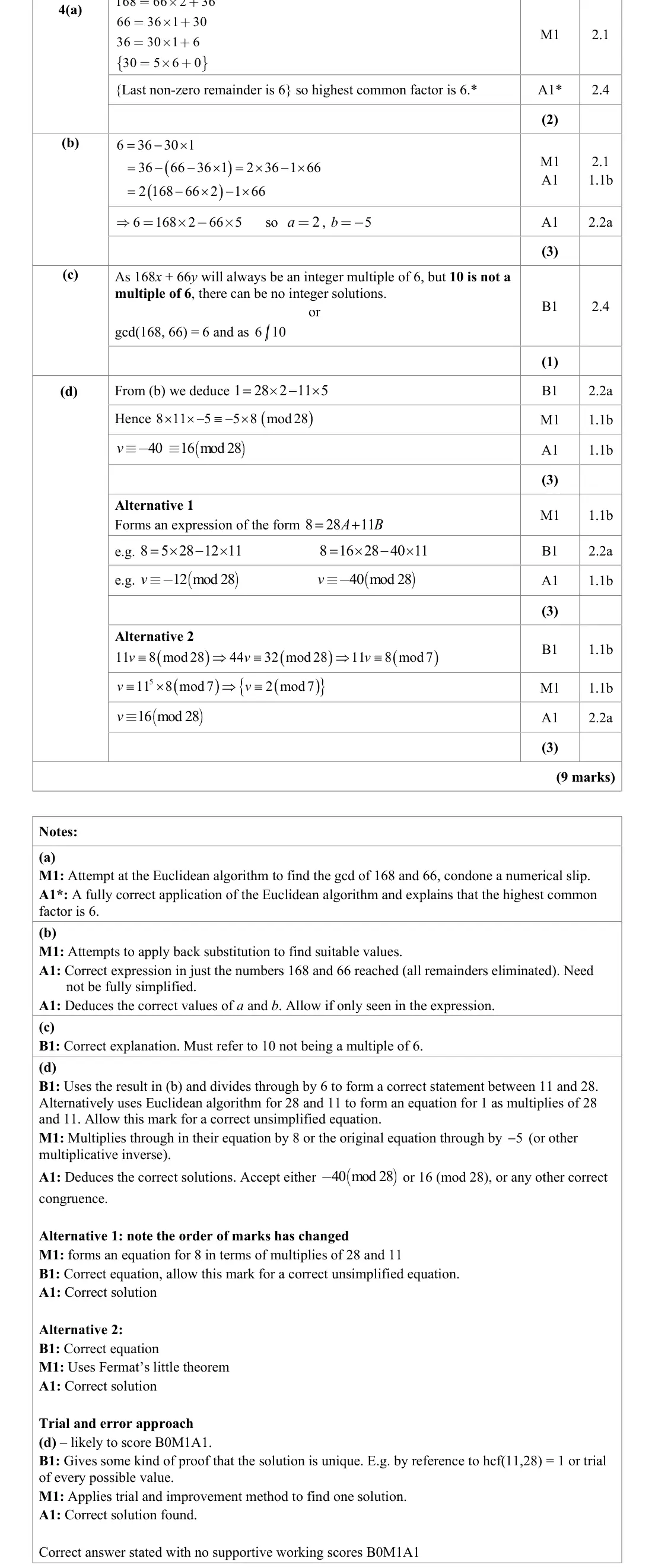
4(a) Number theory: Euclid, Bezout, modular arithmetic and Fermat 2 —
4(b) Number theory: Euclid, Bezout, modular arithmetic and Fermat 3 —
4(c) Number theory: Euclid, Bezout, modular arithmetic and Fermat 1 —
4(d) Number theory: Euclid, Bezout, modular arithmetic and Fermat 3 —
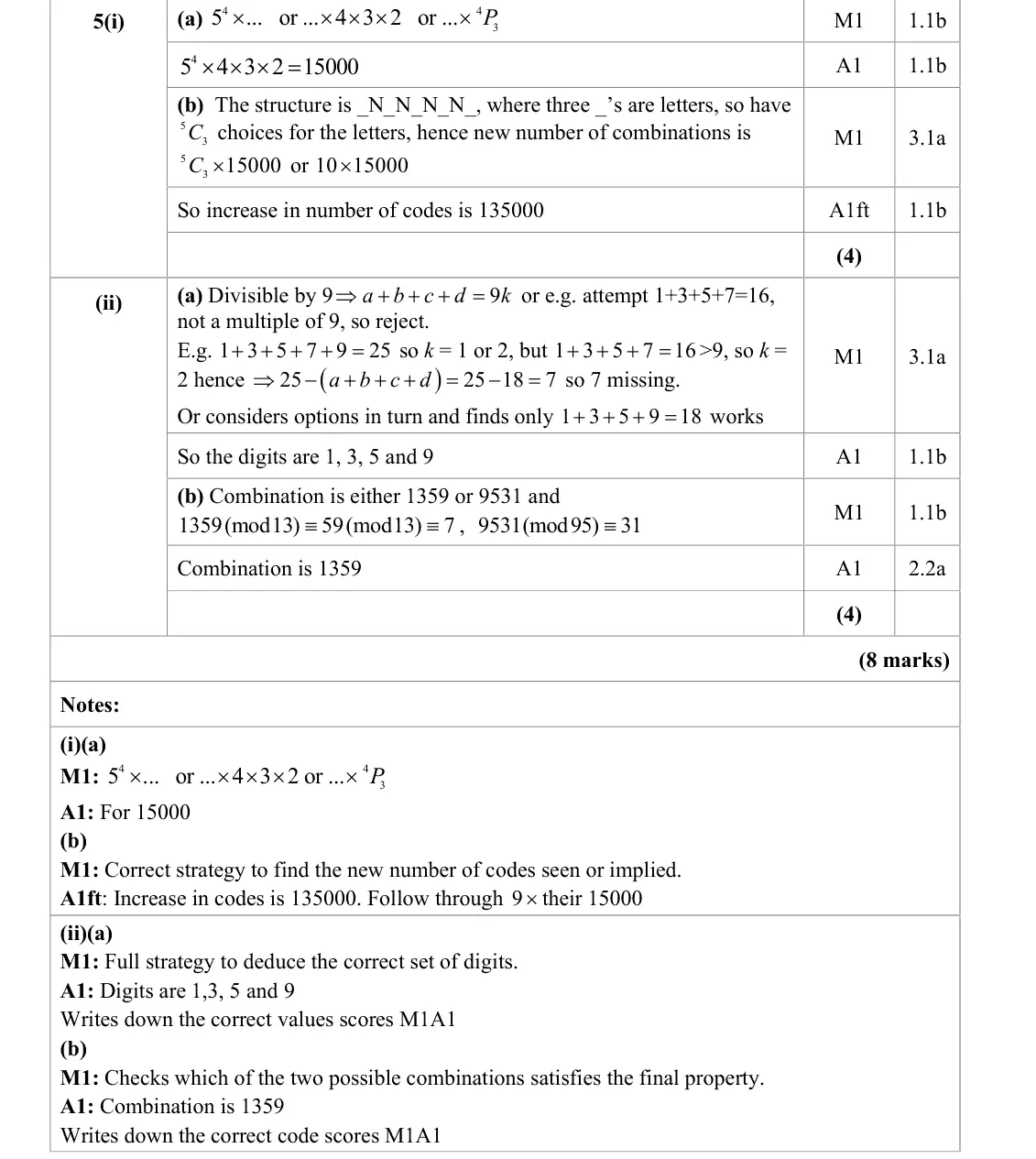
5(i) Combinatorics: counting, permutations and combinations 4 —
5(ii) Number theory: Euclid, Bezout, modular arithmetic and Fermat 4 —
6 Recurrence relations and proof of closed forms 7 —
7(a) Groups: axioms, Cayley tables, subgroups, Lagrange and isomorphism 2 —
7(b) Groups: axioms, Cayley tables, subgroups, Lagrange and isomorphism 3 —
7(c) Groups: axioms, Cayley tables, subgroups, Lagrange and isomorphism 1 —
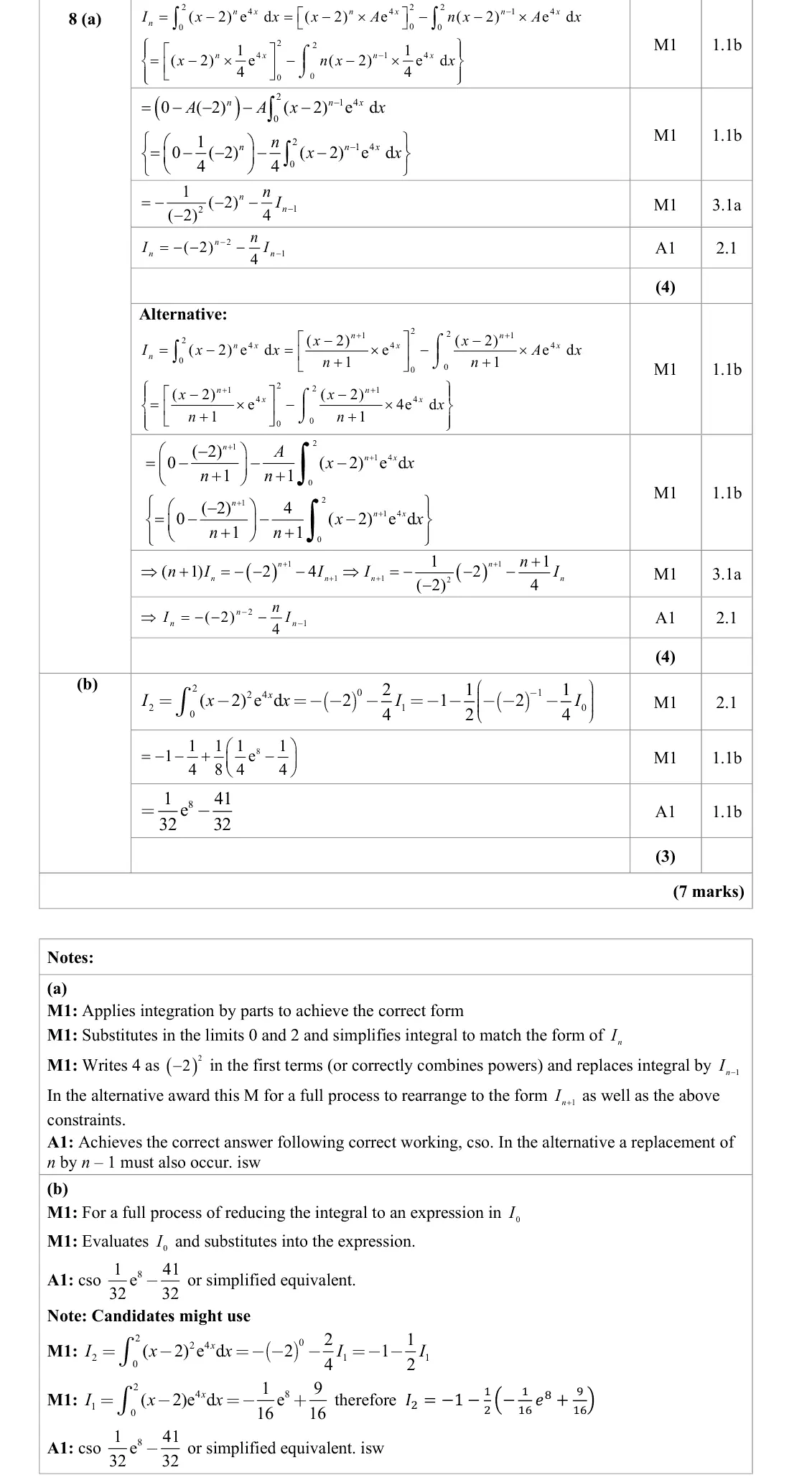
8(a) Reduction formulae, arc length and surface area 4 —
8(b) Reduction formulae, arc length and surface area 3 —
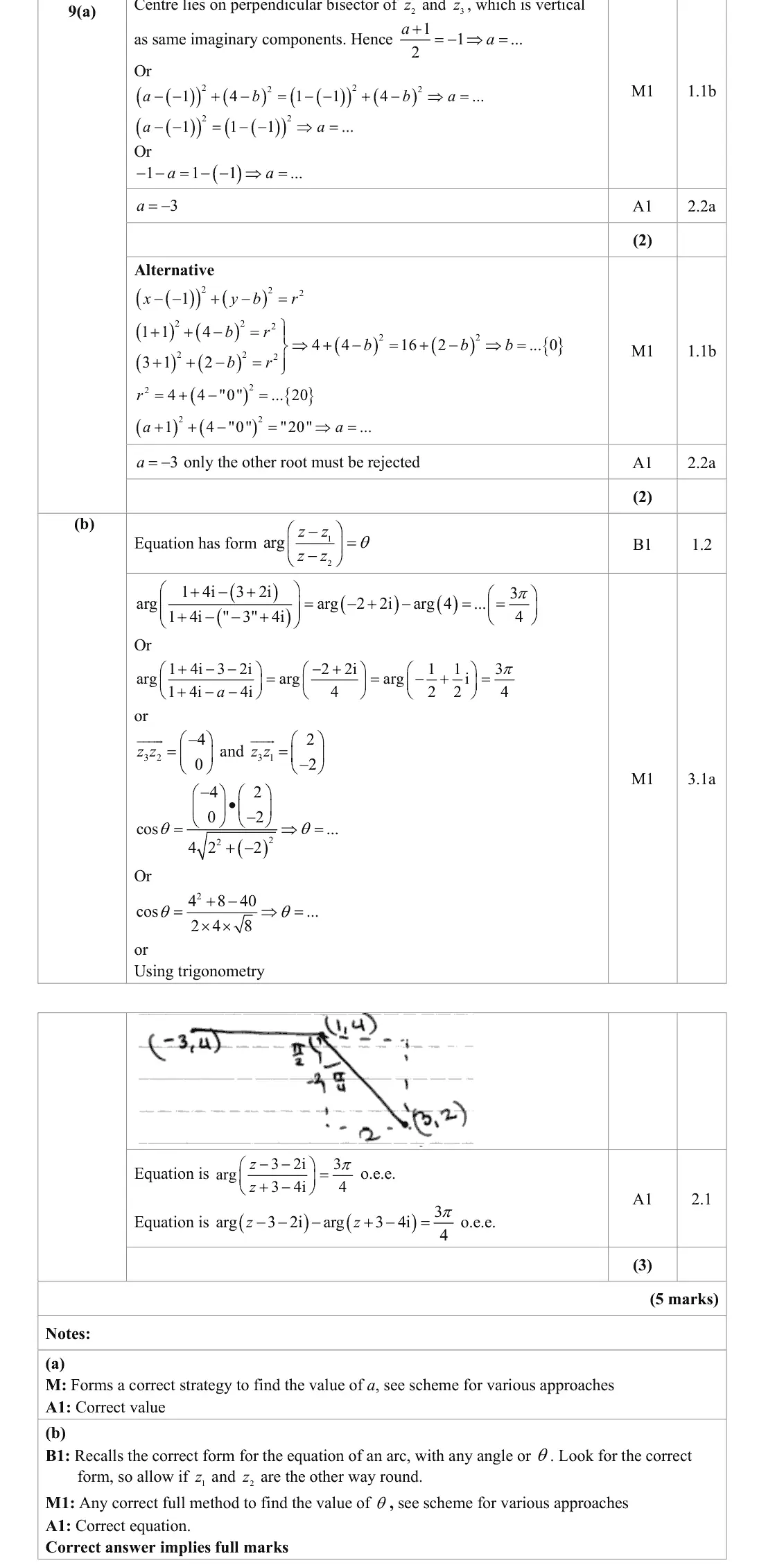
9(a) Further complex numbers: regions and transformations of the plane 2 —
9(b) Further complex numbers: regions and transformations of the plane 3 —
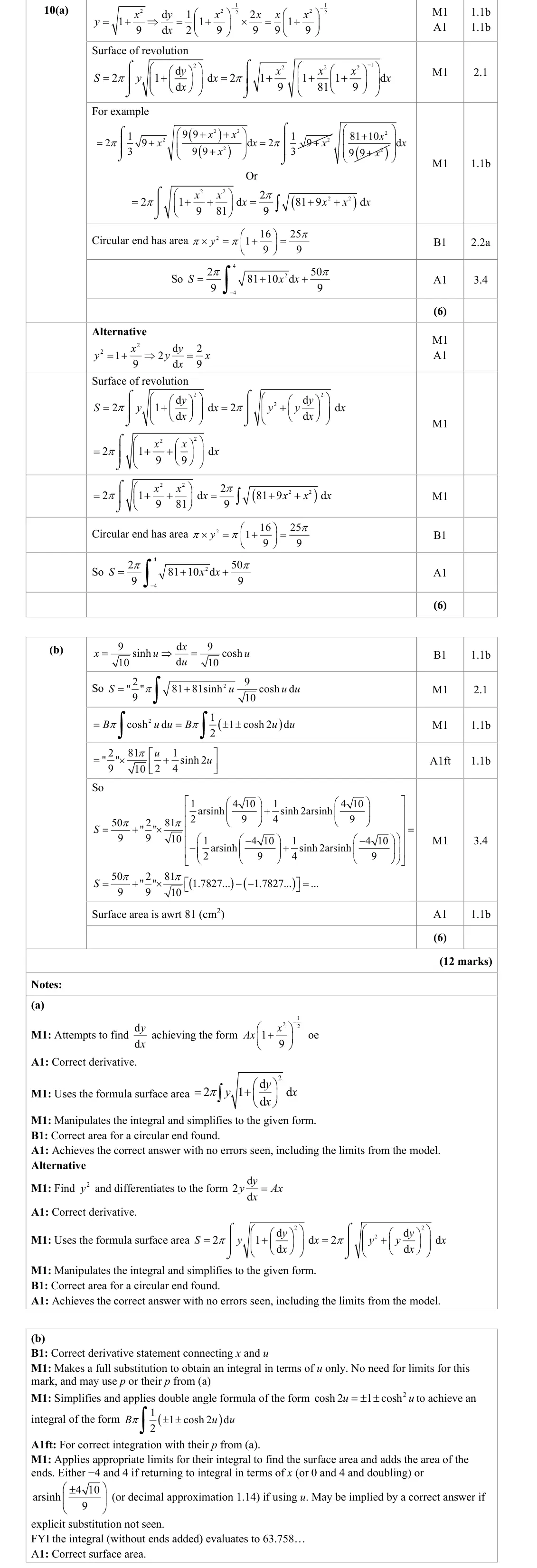
10(a) Reduction formulae, arc length and surface area 6 —
10(b) Reduction formulae, arc length and surface area 6 —

The questions

1(a)1(b)2(a)2(b)2(c)3(a)3(b)3(c)4(a)4(b)4(c)4(d)5(i)5(ii)67(a)7(b)7(c)8(a)8(b)9(a)9(b)10(a)10(b)
June 2023 · Paper 4A (Further Pure 2) · Q1(a) 2 marks eigenvalues and eigenvectors
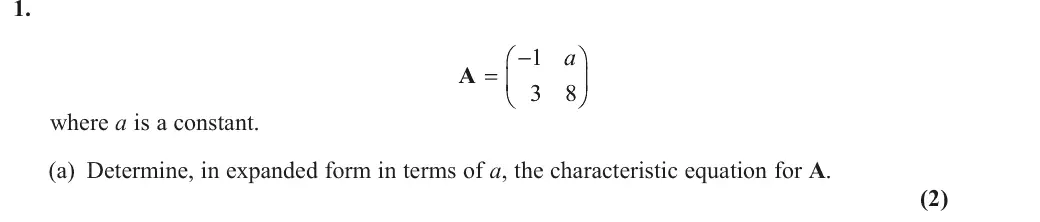
1. a : A O where a is a constant. (a) Determine, in expanded form in terms of a, the characteristic equation for A. (2)
June 2023 · Paper 4A (Further Pure 2) · Q1(b) 4 marks eigenvalues and eigenvectors
(b) Hence use the Cayley-Hamilton theorem to determine values of a and b such that 3 O A A 1 b I where I is the 2 x identity matrix. (4)
June 2023 · Paper 4A (Further Pure 2) · Q2(a) 2 marks complex transformations
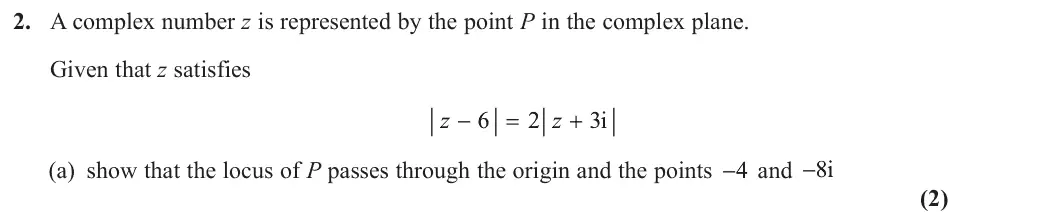
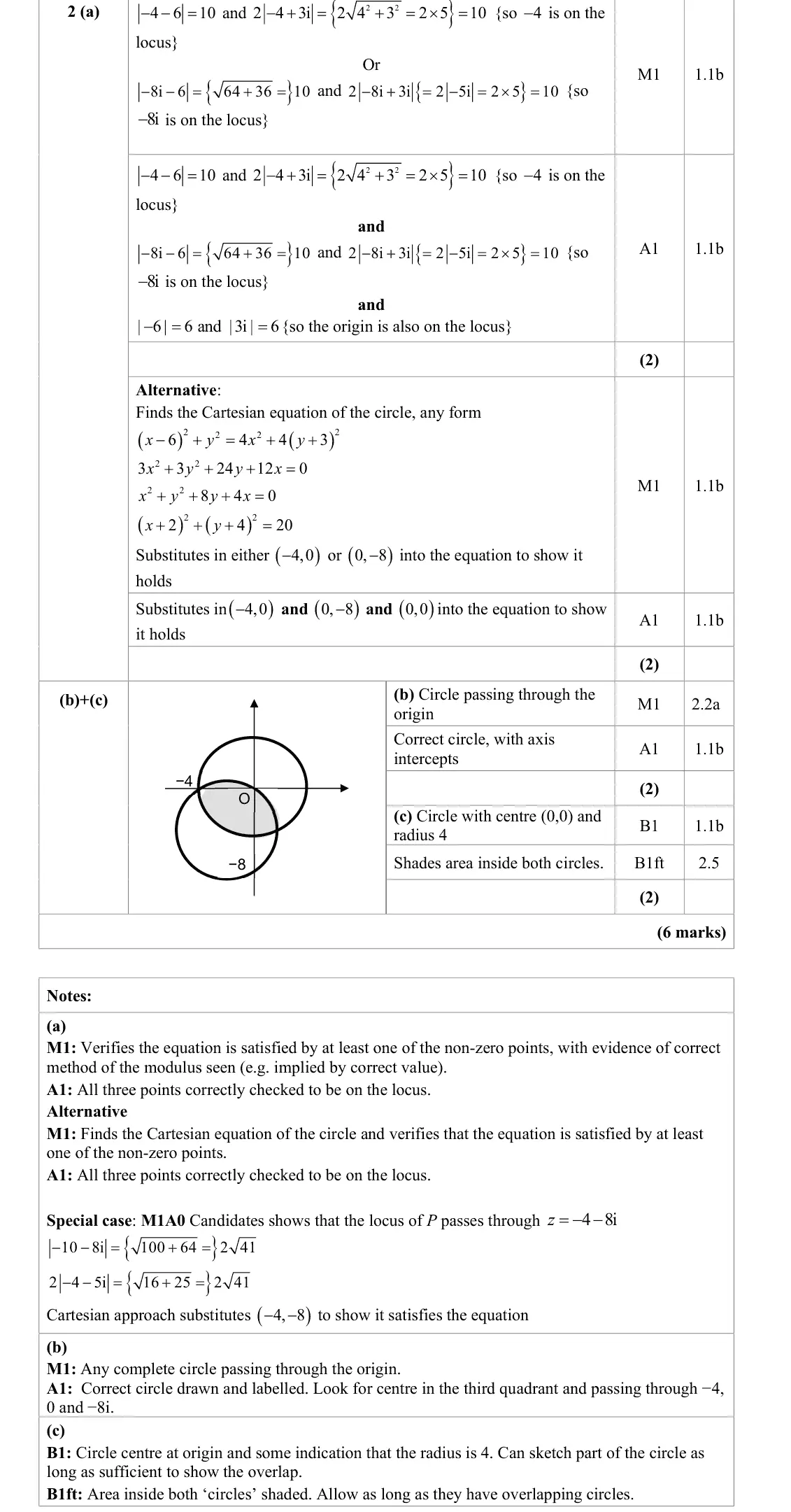
2. A complex number z is represented by the point P in the complex plane. Given that z satisfies z z 3i (a) show that the locus of P passes through the origin and the points -4 and -8i (2)
June 2023 · Paper 4A (Further Pure 2) · Q2(b) 2 marks complex transformations
(b) Sketch on an Argand diagram the locus of P as z varies. (2)
June 2023 · Paper 4A (Further Pure 2) · Q2(c) 2 marks complex transformations
(c) On your sketch, shade the region which satisfies both z z i and z 4 (2)
June 2023 · Paper 4A (Further Pure 2) · Q3(a) 2 marks recurrence relations fp2
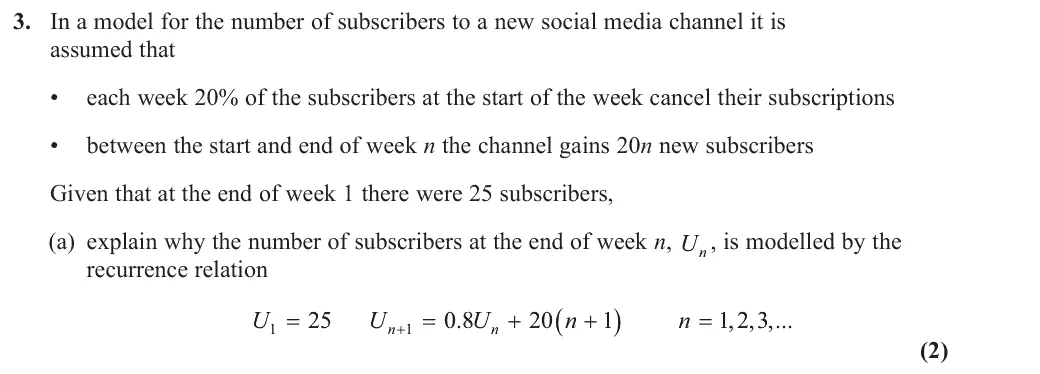
3. In a model for the number of subscribers to a new social media channel it is assumed that • each week 20% of the subscribers at the start of the week cancel their subscriptions between the start and end of week n the channel gains 20n new subscribers • Given that at the end of week 1 there were 25 subscribers, (a) explain why the number of subscribers at the end of week n, Un , is modelled by the recurrence relation / U U 0 8 U n n 1 2 3 , , ,... n n (2)
June 2023 · Paper 4A (Further Pure 2) · Q3(b) 5 marks recurrence relations fp2
(b) Prove by induction that for n 1 n 325 4 ; U n :9 n (5)
June 2023 · Paper 4A (Further Pure 2) · Q3(c) 2 marks recurrence relations fp2
Given that 6 months after starting the channel there were approximately 1800 subscribers, (c) evaluate the model in the light of this information. (2)
June 2023 · Paper 4A (Further Pure 2) · Q4(a) 2 marks number theory
4. (a) Use the Euclidean algorithm to show that the highest common factor of 168 and 66 is 6 (2)
June 2023 · Paper 4A (Further Pure 2) · Q4(b) 3 marks number theory
(b) Use back substitution to determine integers a and b such that a b (3)
June 2023 · Paper 4A (Further Pure 2) · Q4(c) 1 mark number theory
(c) Explain why there are no integer solutions to the equation x y (1)
June 2023 · Paper 4A (Further Pure 2) · Q4(d) 3 marks number theory
(d) Solve the congruence equation v ≡ (mod ) (3)
June 2023 · Paper 4A (Further Pure 2) · Q5(i) 4 marks combinatorics
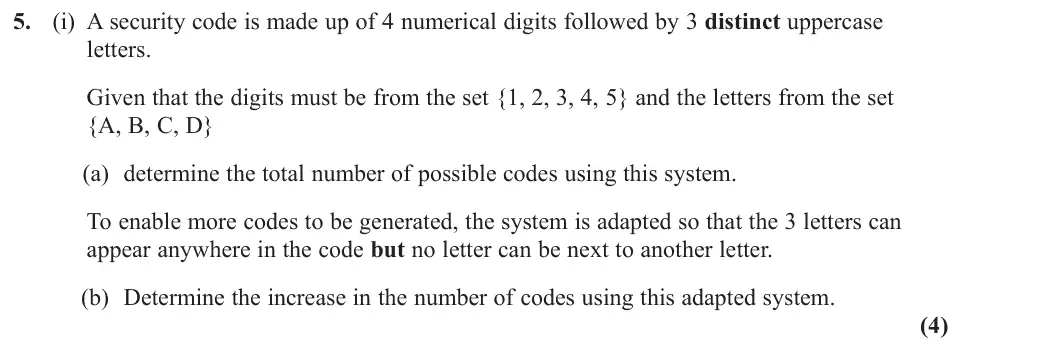
5. (i) A security code is made up of 4 numerical digits followed by 3 distinct uppercase letters. Given that the digits must be from the set {1, 2, 3, 4, 5} and the letters from the set {A, B, C, D} (a) determine the total number of possible codes using this system. To enable more codes to be generated, the system is adapted so that the 3 letters can appear anywhere in the code but no letter can be next to another letter. (b) Determine the increase in the number of codes using this adapted system. (4)
June 2023 · Paper 4A (Further Pure 2) · Q5(ii) 4 marks number theory
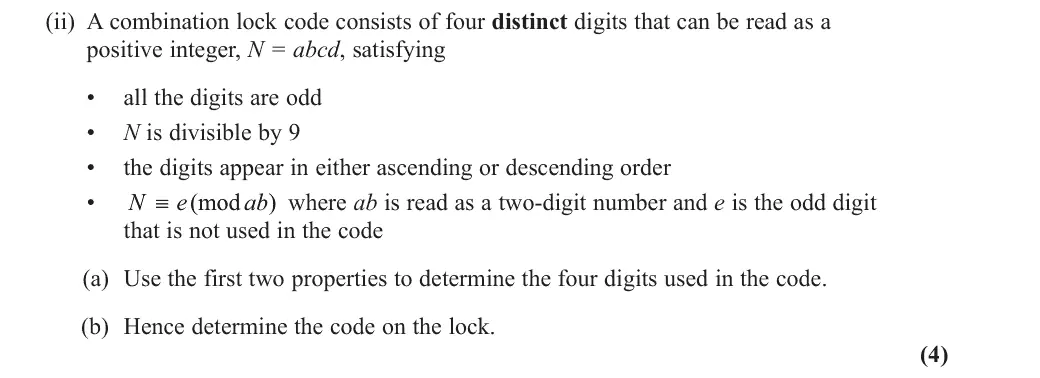
(ii) A combination lock code consists of four distinct digits that can be read as a positive integer, N = abcd, satisfying • all the digits are odd • N is divisible by 9 • the digits appear in either ascending or descending order • N ≡ e (mod ab ) where ab is read as a two-digit number and e is the odd digit that is not used in the code (a) Use the first two properties to determine the four digits used in the code. (b) Hence determine the code on the lock. (4)
June 2023 · Paper 4A (Further Pure 2) · Q6 7 marks recurrence relations fp2
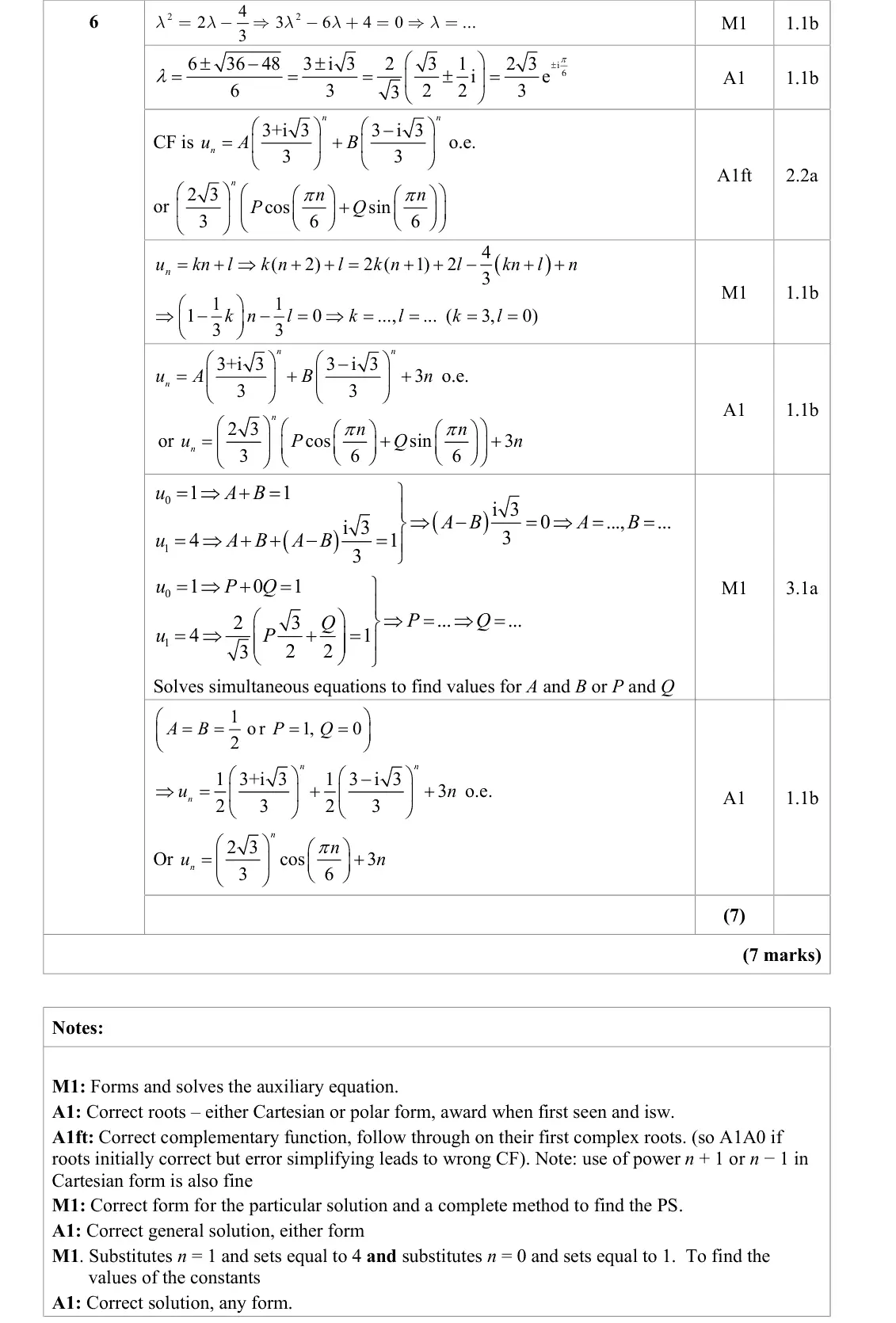
6. Determine a closed form for the recurrence relation u u u u u n n (7) n n n
June 2023 · Paper 4A (Further Pure 2) · Q7(a) 2 marks groups
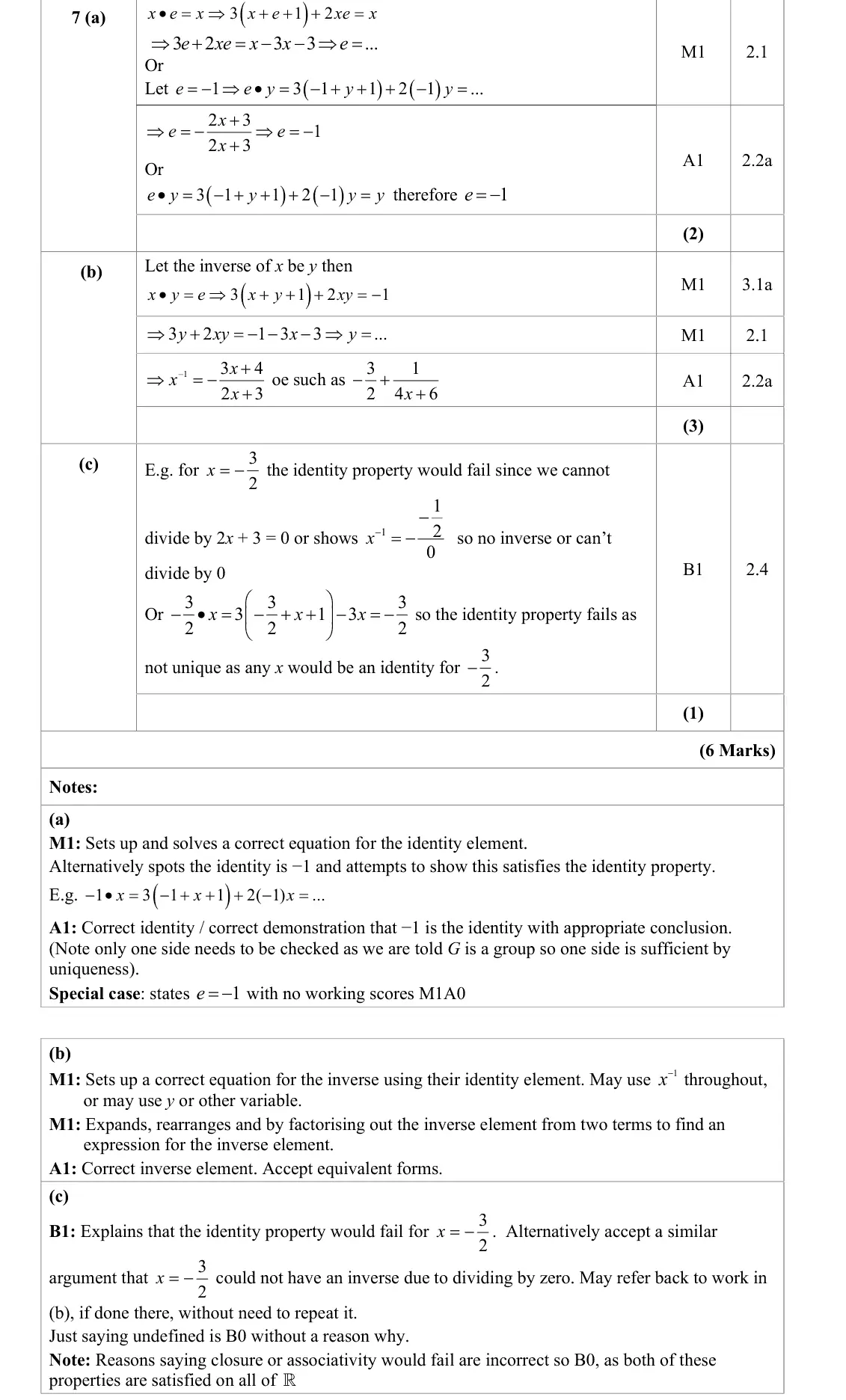
/ 1 7. The set G 2 with the operation of x < y x y xy forms a group. < (a) Determine the identity element of this group. (2)
June 2023 · Paper 4A (Further Pure 2) · Q7(b) 3 marks groups
(b) Determine the inverse of a general element x in this group. (3)
June 2023 · Paper 4A (Further Pure 2) · Q7(c) 1 mark groups
(c) Explain why the value -3 must be excluded from G in order for this to be a group. (1)
June 2023 · Paper 4A (Further Pure 2) · Q8(a) 4 marks reduction formulae arc length
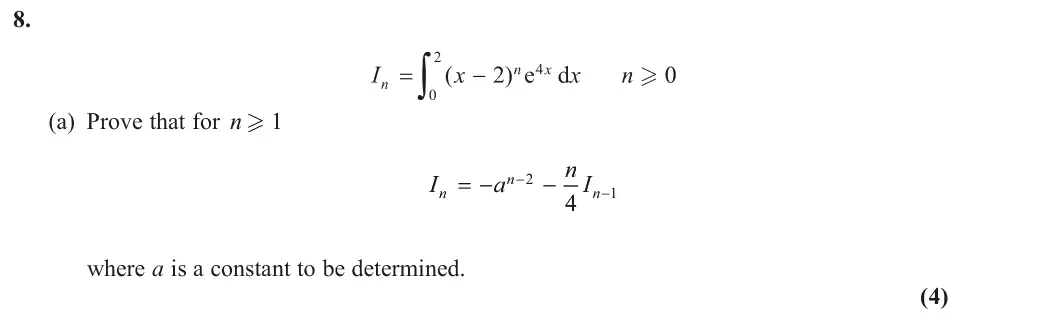
8. (a) Prove that for n 1 n I I O 3 a n n n where a is a constant to be determined. (4)
June 2023 · Paper 4A (Further Pure 2) · Q8(b) 3 marks reduction formulae arc length
(b) Hence determine the exact value of (3)
June 2023 · Paper 4A (Further Pure 2) · Q9(a) 2 marks complex transformations
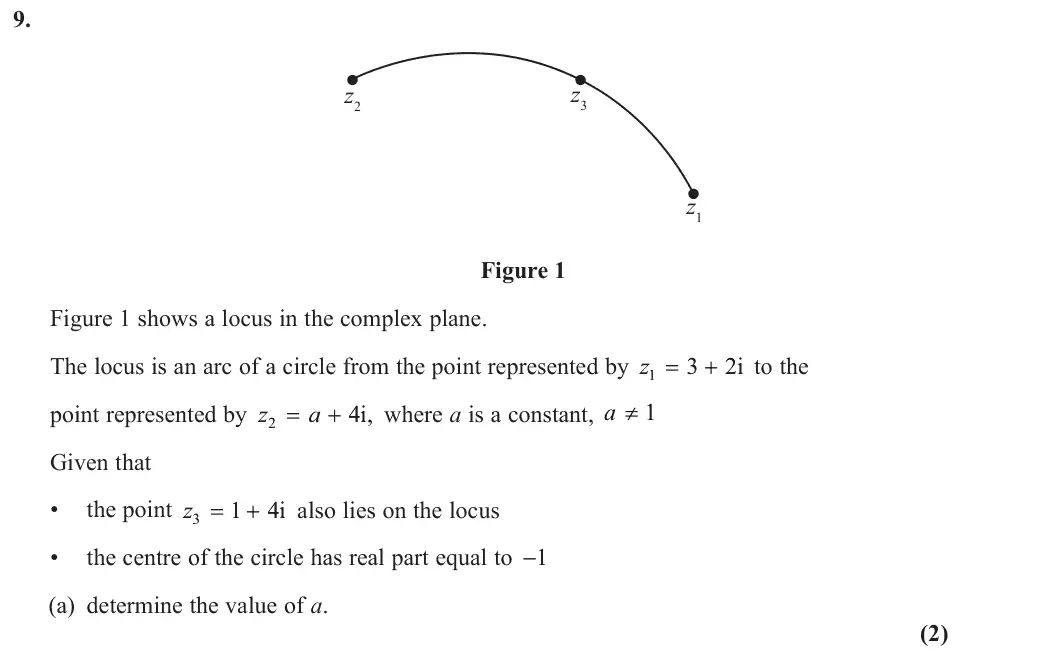
9. z2 z3 z1 Figure 1 Figure 1 shows a locus in the complex plane. The locus is an arc of a circle from the point represented by z1 1 i to the 1 i, where a is a constant, a ≠1 point represented by z a Given that the point z3 • 1 i also lies on the locus • the centre of the circle has real part equal to -1 (a) determine the value of a. (2)
June 2023 · Paper 4A (Further Pure 2) · Q9(b) 3 marks complex transformations
(b) Hence determine a complex equation for the locus, giving any angles in the equation as positive values. (3)
June 2023 · Paper 4A (Further Pure 2) · Q10(a) 6 marks reduction formulae arc length
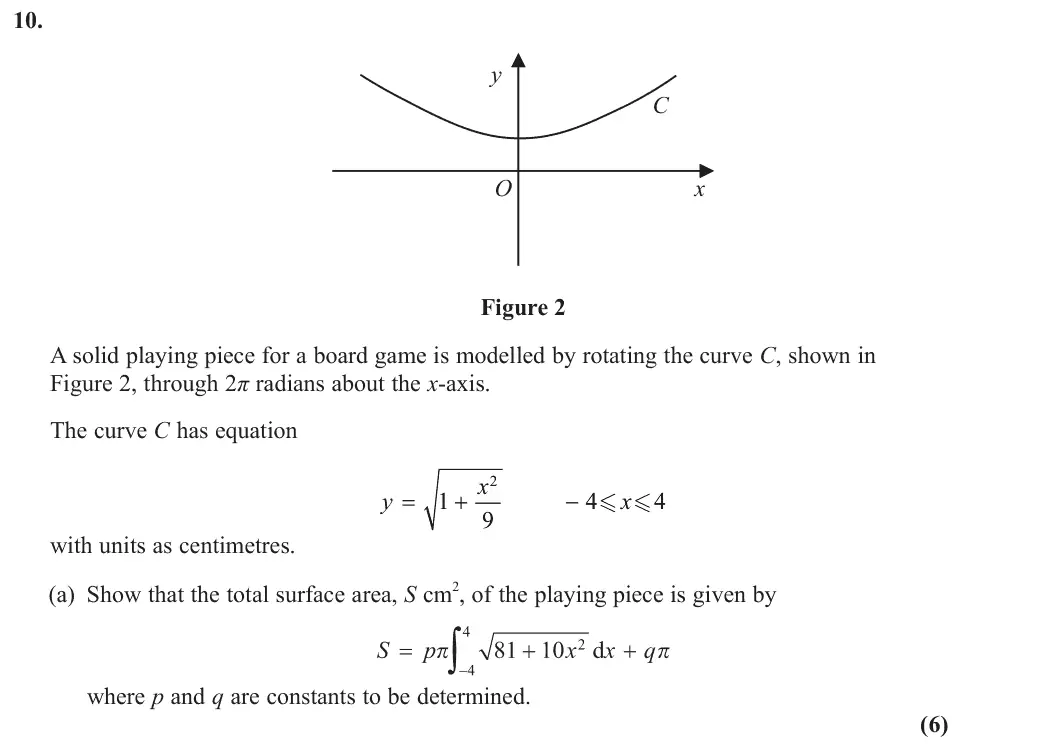
10. y C x Figure 2 A solid playing piece for a board game is modelled by rotating the curve C, shown in Figure 2, through 2 pi radians about the x-axis. The curve C has equation x y x with units as centimetres. (a) Show that the total surface area, S cm2, of the playing piece is given by where p and q are constants to be determined. (6)
June 2023 · Paper 4A (Further Pure 2) · Q10(b) 6 marks reduction formulae arc length
Using the substitution x u = sinh , or another algebraic integration method, and showing all your working, (b) determine the total surface area of the playing piece, giving your answer to the nearest cm2 (6)

Find an Edexcel Further Maths tutor

Want this paper marked and gone through with a Further Maths tutor? Message us.

Prefer email? Send an enquiry

If you are under 18, please include a parent's contact details. Enquiries go to enquiries@alevelfurthermathstutor.com and are deleted once handled.