June 2024: AS Paper 27: Decision Mathematics 1

40 marks · 17 question parts · Question paper, mark scheme and examiner's report on Pearson's site

Question by question

QTopicMarksDifficulty
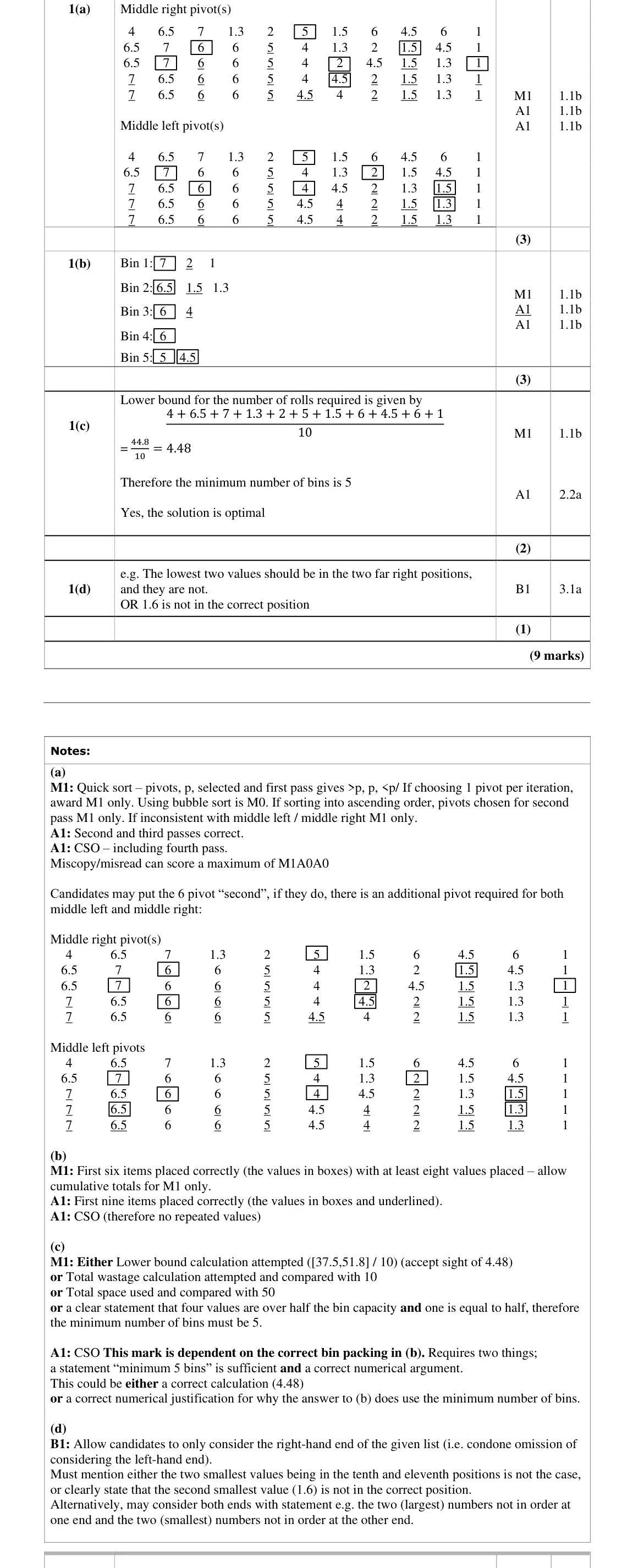
1(a) Algorithms, sorting, bin packing and graph theory 3 —
1(b) Algorithms, sorting, bin packing and graph theory 3 —
1(c) Algorithms, sorting, bin packing and graph theory 2 —
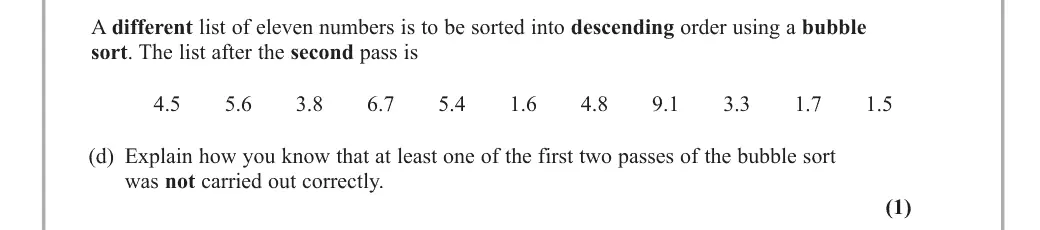
1(d) Algorithms, sorting, bin packing and graph theory 1 —
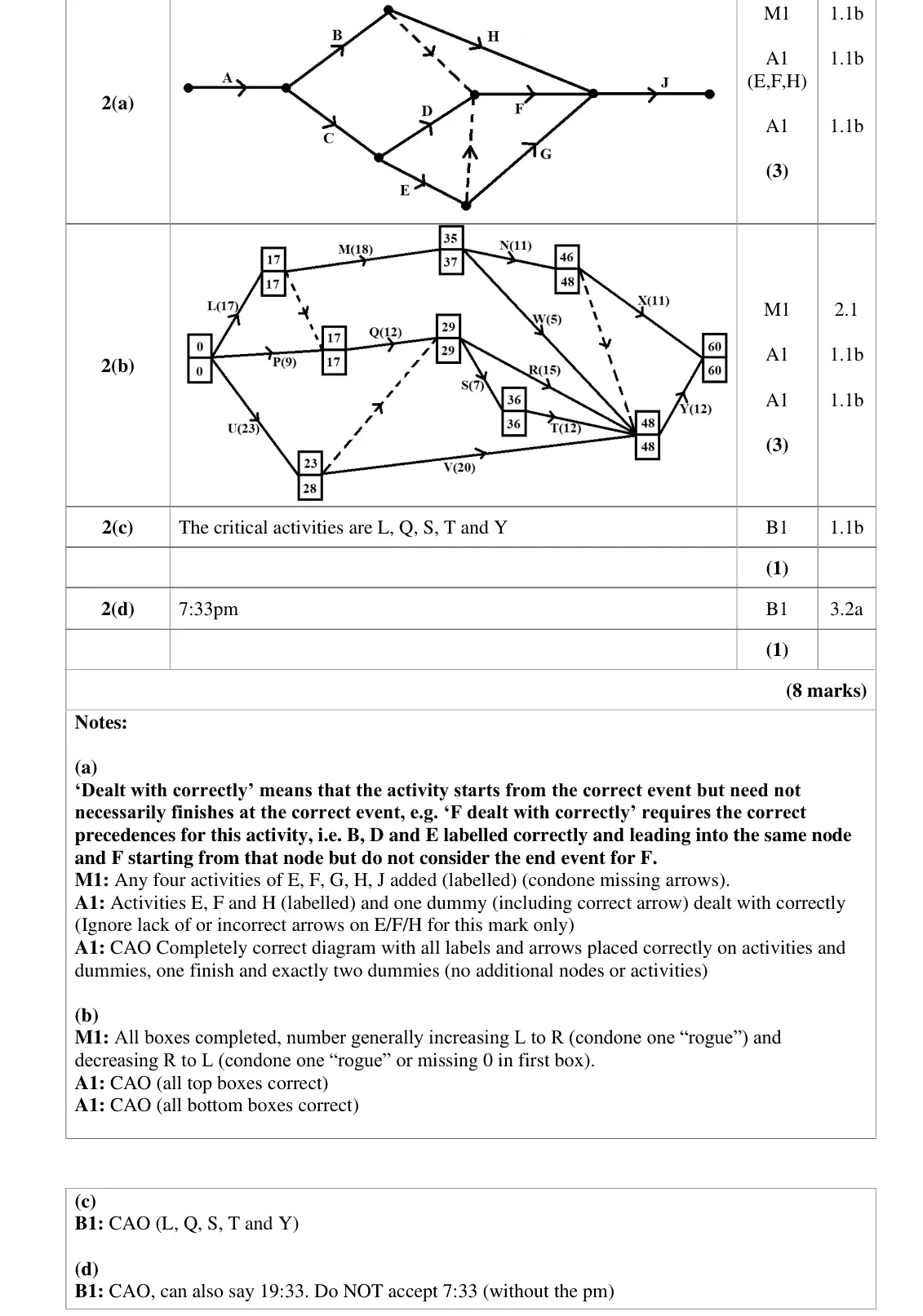
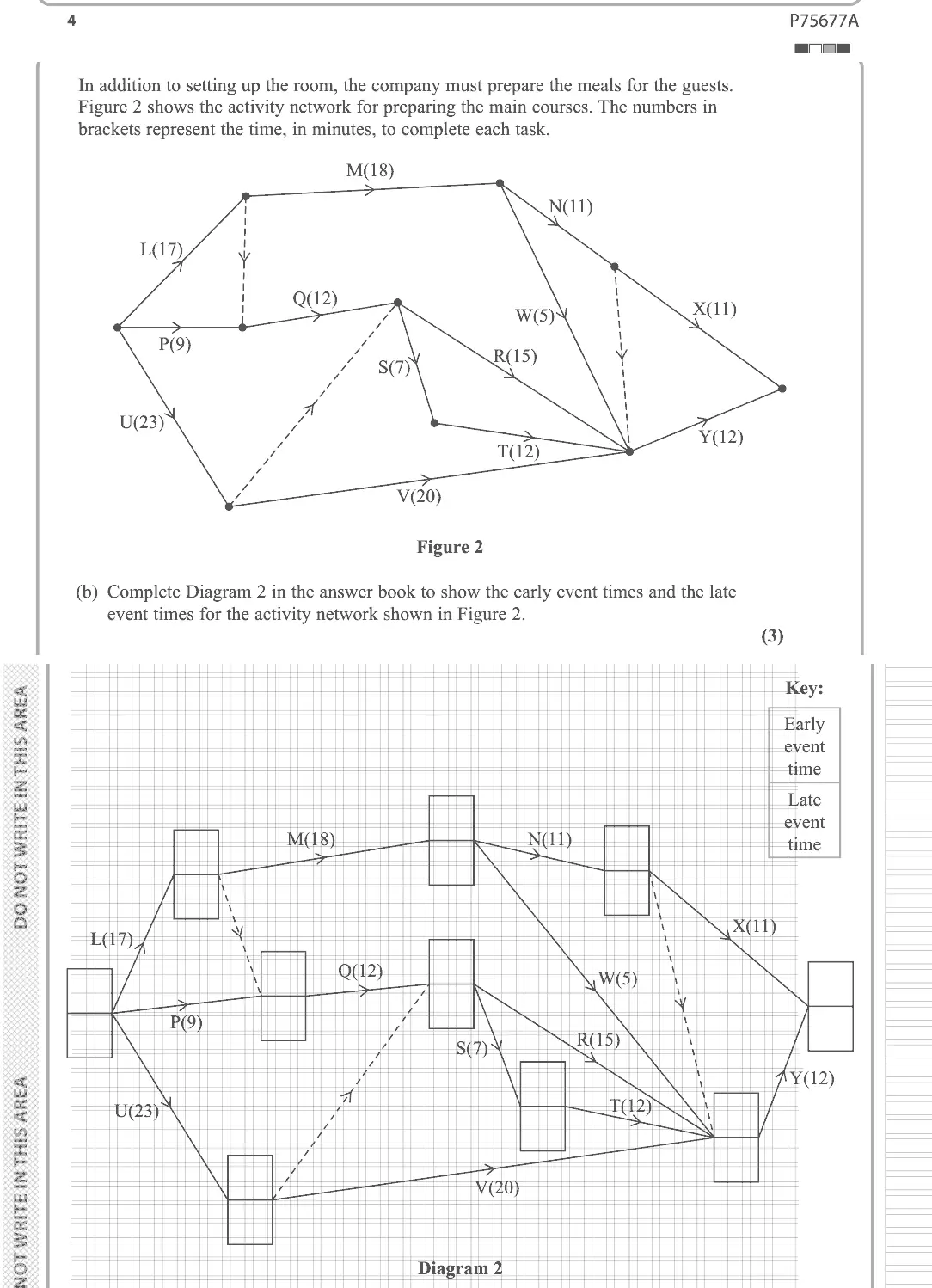
2(a) Critical path analysis 3 —
2(b) Critical path analysis 3 —
2(c) Critical path analysis 1 —
2(d) Critical path analysis 1 —
3(a) Algorithms, sorting, bin packing and graph theory 1 —
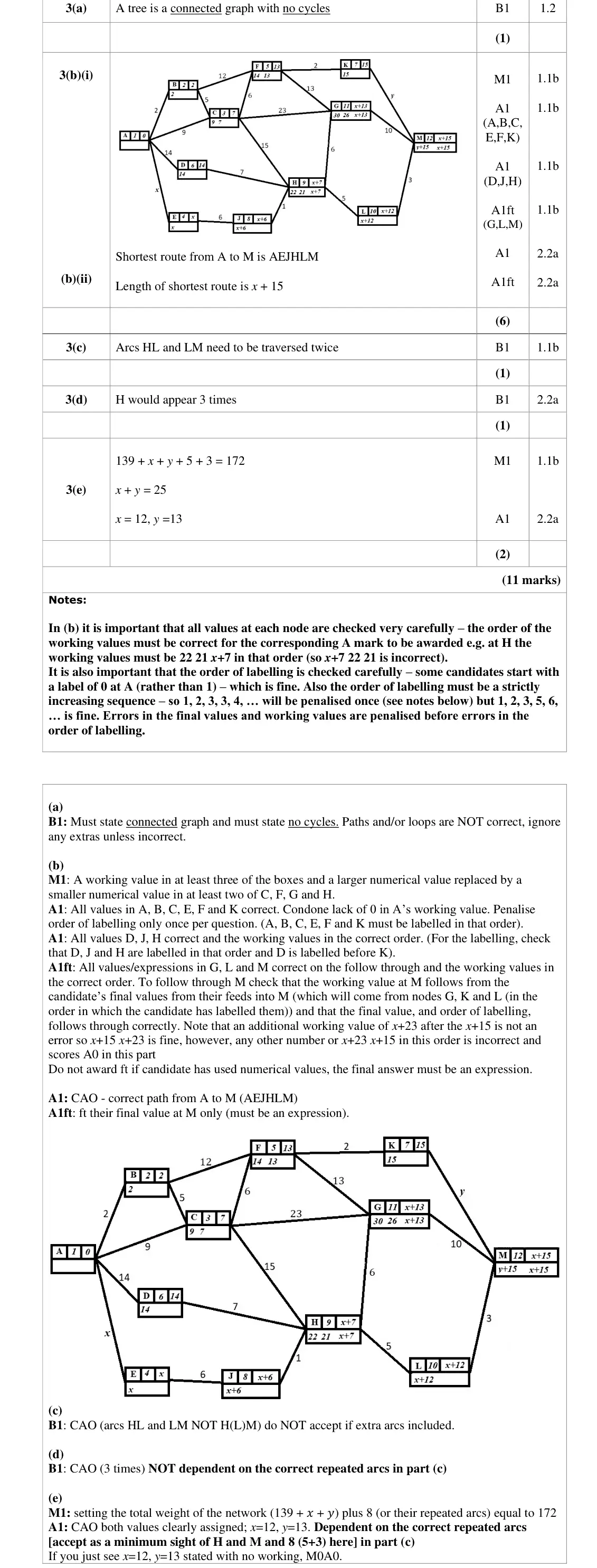
3(b) Minimum spanning trees (Prim, Kruskal) and shortest paths (Dijkstra, Floyd) 6 —
3(c) Route inspection and the travelling salesman problem 1 —
3(d) Route inspection and the travelling salesman problem 1 —
3(e) Route inspection and the travelling salesman problem 2 —
4(a) Linear programming: formulation, graphs and the Simplex algorithm 3 —
4(b) Linear programming: formulation, graphs and the Simplex algorithm 2 —
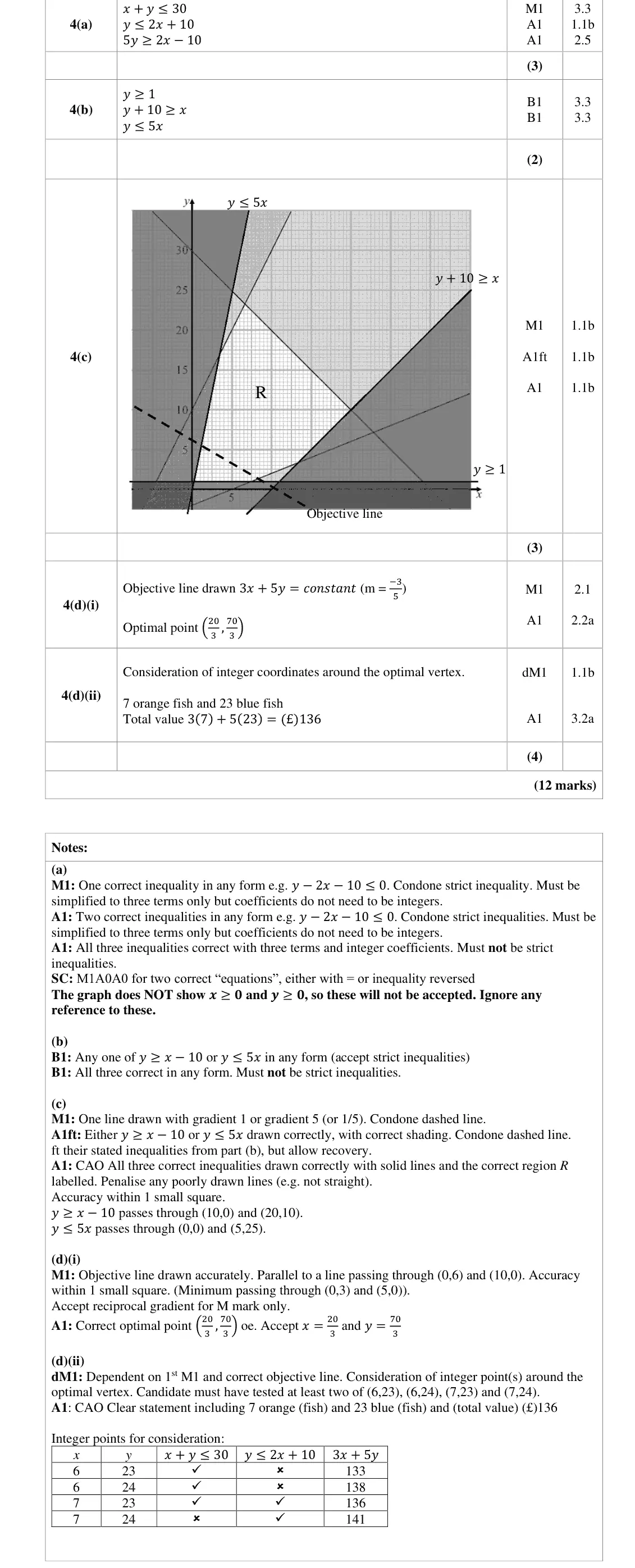
4(c) Linear programming: formulation, graphs and the Simplex algorithm 3 —
4(d) Linear programming: formulation, graphs and the Simplex algorithm 4 —

The questions

1(a)1(b)1(c)1(d)2(a)2(b)2(c)2(d)3(a)3(b)3(c)3(d)3(e)4(a)4(b)4(c)4(d)
June 2024 · AS Paper 2 (Decision 1) · Q1(a) 3 marks algorithms and graph theory
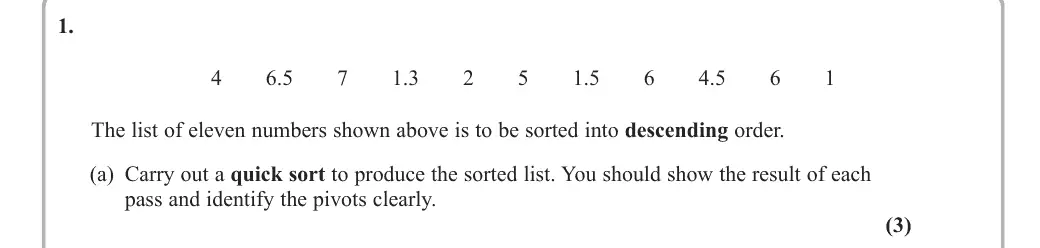
1. 4 6.5 7 1.3 2 5 1.5 6 4.5 6 1 The list of eleven numbers shown above is to be sorted into descending order. (a) Carry out a quick sort to produce the sorted list. You should show the result of each pass and identify the pivots clearly. (3)
June 2024 · AS Paper 2 (Decision 1) · Q1(b) 3 marks algorithms and graph theory
(b) Use the first‑fit decreasing bin packing algorithm to pack the numbers into bins of size 10 (3)
June 2024 · AS Paper 2 (Decision 1) · Q1(c) 2 marks algorithms and graph theory
(c) Determine whether your answer to part (b) uses the minimum number of bins. You must justify your answer. (2)
June 2024 · AS Paper 2 (Decision 1) · Q1(d) 1 mark algorithms and graph theory
A different list of eleven numbers is to be sorted into descending order using a bubble sort. The list after the second pass is 4.5 5.6 3.8 6.7 5.4 1.6 4.8 9.1 3.3 1.7 1.5 (d) Explain how you know that at least one of the first two passes of the bubble sort was not carried out correctly. (1)
June 2024 · AS Paper 2 (Decision 1) · Q2(a) 3 marks critical path analysis
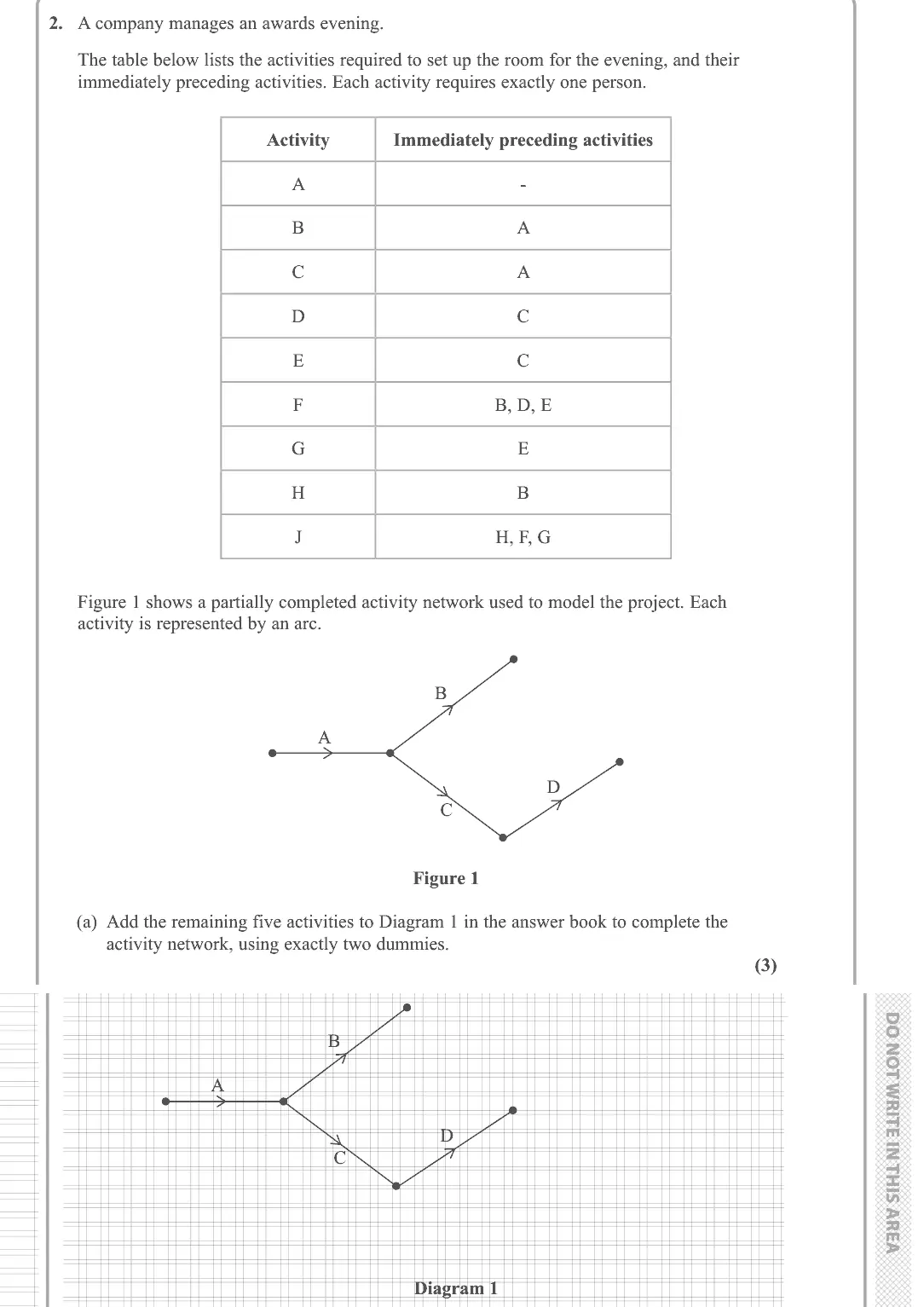
2. A company manages an awards evening. The table below lists the activities required to set up the room for the evening, and their immediately preceding activities. Each activity requires exactly one person. Activity Immediately preceding activities A ‑ B A C A C E C F B, D, E G E H B J H, F, G Figure 1 shows a partially completed activity network used to model the project. Each activity is represented by an arc. B A C Figure 1 (a) Add the remaining five activities to Diagram 1 in the answer book to complete the activity network, using exactly two dummies. (3)
June 2024 · AS Paper 2 (Decision 1) · Q2(b) 3 marks critical path analysis
P75677A In addition to setting up the room, the company must prepare the meals for the guests. Figure 2 shows the activity network for preparing the main courses. The numbers in brackets represent the time, in minutes, to complete each task. M(18) N(11) L(17) Q(12) X(11) W(5) P(9) R(15) S(7) U(23) Y(12) T(12) V(20) Figure 2 (b) Complete Diagram 2 in the answer book to show the early event times and the late event times for the activity network shown in Figure 2. (3)
June 2024 · AS Paper 2 (Decision 1) · Q2(c) 1 mark critical path analysis
(c) State the critical activities. (1)
June 2024 · AS Paper 2 (Decision 1) · Q2(d) 1 mark critical path analysis
(d) Given that the main courses need to be ready to be served (with all activities completed) at 8 pm, state the latest time that activity R can start. (1)
June 2024 · AS Paper 2 (Decision 1) · Q3(a) 1 mark algorithms and graph theory
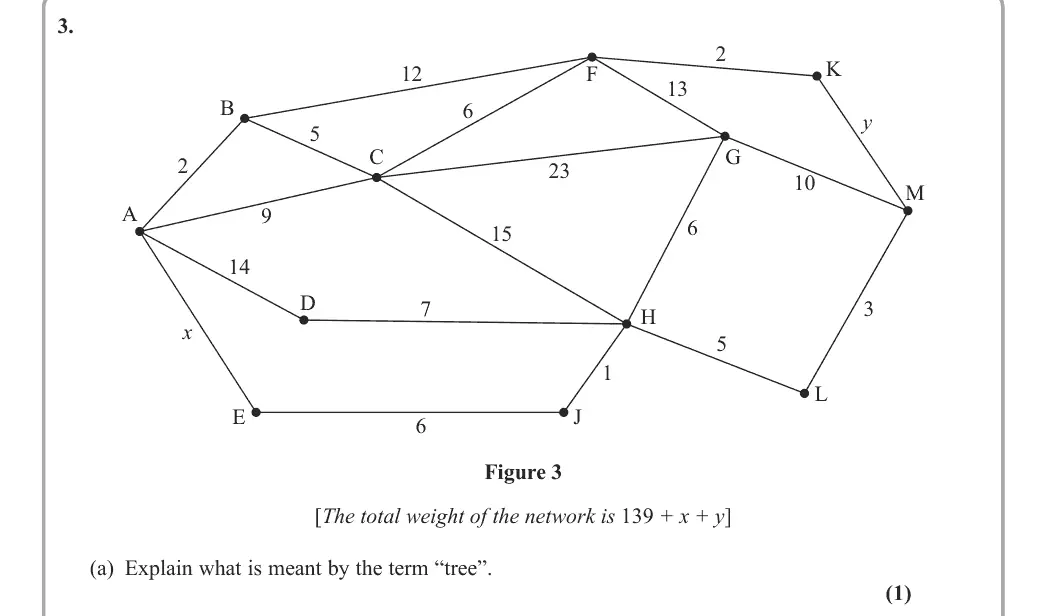
3. K F B y C G M A H x L E J Figure 3 [The total weight of the network is 139 + x + y] (a) Explain what is meant by the term “tree”. (1)
June 2024 · AS Paper 2 (Decision 1) · Q3(b) 6 marks minimum spanning trees and shortest paths
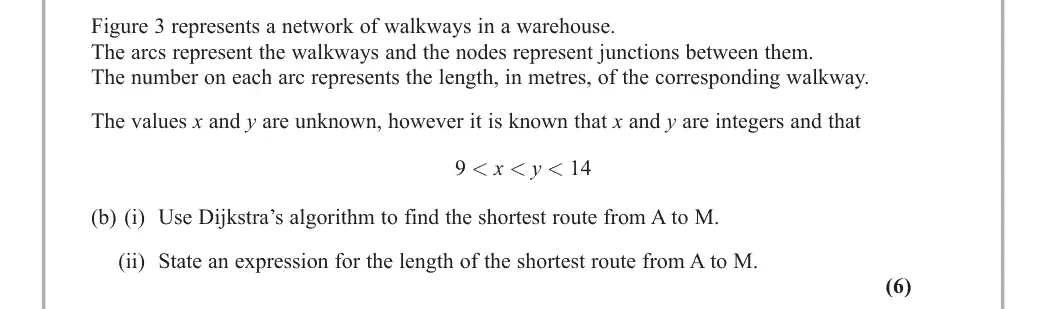
Figure 3 represents a network of walkways in a warehouse. The arcs represent the walkways and the nodes represent junctions between them. The number on each arc represents the length, in metres, of the corresponding walkway. The values x and y are unknown, however it is known that x and y are integers and that 9 < x < y < 14 (b) (i) Use Dijkstra’s algorithm to find the shortest route from A to M. (ii) State an expression for the length of the shortest route from A to M. (6)
June 2024 · AS Paper 2 (Decision 1) · Q3(c) 1 mark route inspection and travelling salesman
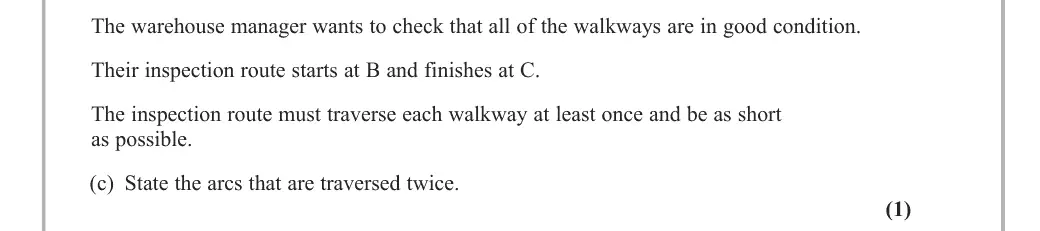
The warehouse manager wants to check that all of the walkways are in good condition. Their inspection route starts at B and finishes at C. The inspection route must traverse each walkway at least once and be as short as possible. (c) State the arcs that are traversed twice. (1)
June 2024 · AS Paper 2 (Decision 1) · Q3(d) 1 mark route inspection and travelling salesman
(d) State the number of times that H appears in the inspection route. (1)
June 2024 · AS Paper 2 (Decision 1) · Q3(e) 2 marks route inspection and travelling salesman
The warehouse manager finds that the total length of the inspection route is 172 metres. (e) Determine the value of x and the value of y (2)
June 2024 · AS Paper 2 (Decision 1) · Q4(a) 3 marks linear programming
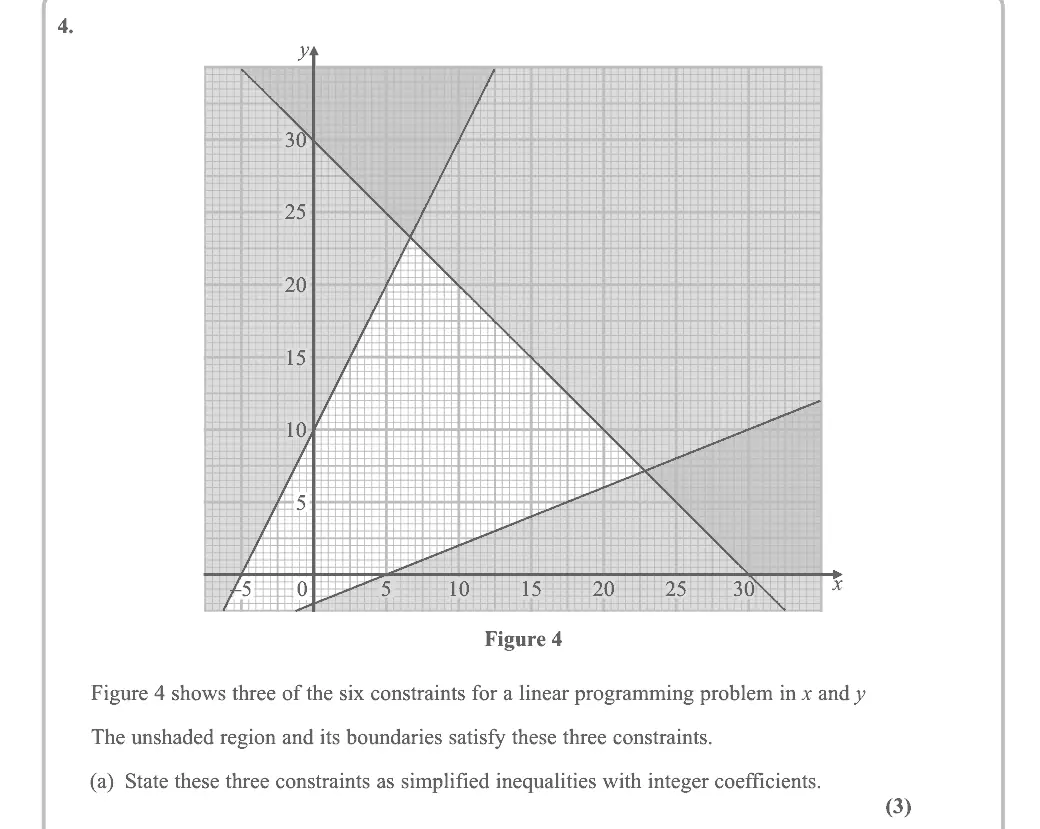
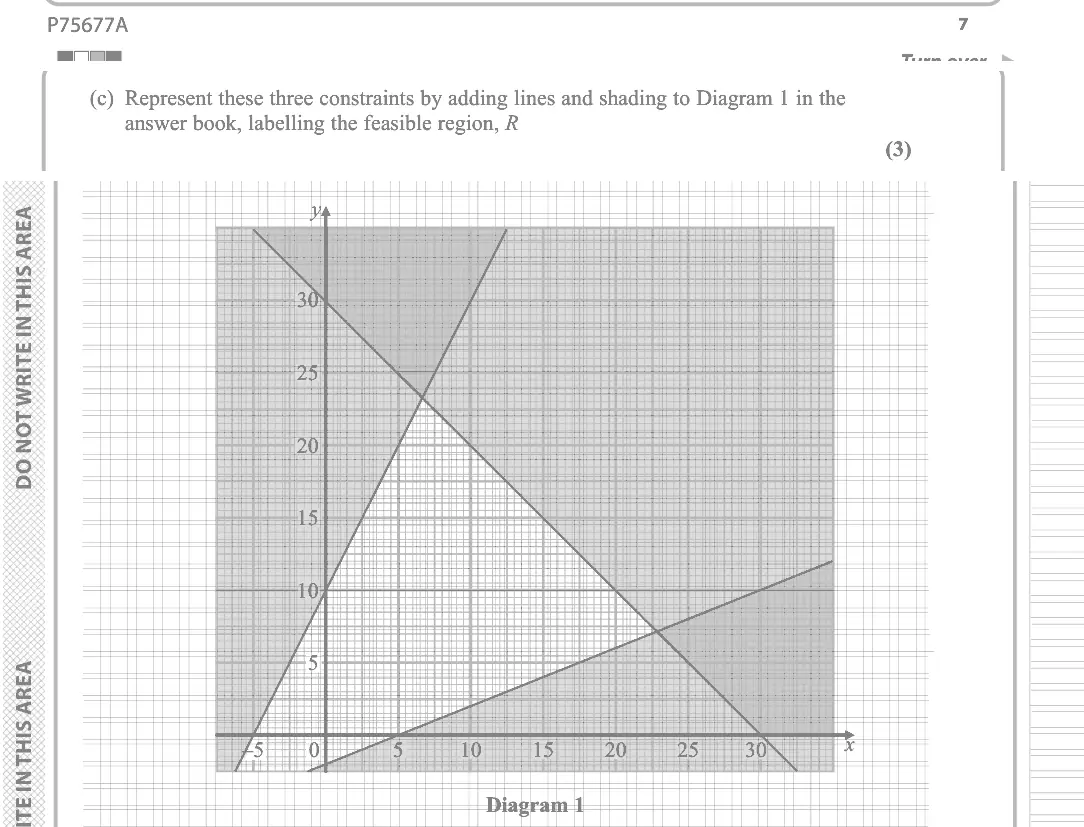
4. y x –5 Figure 4 Figure 4 shows three of the six constraints for a linear programming problem in x and y The unshaded region and its boundaries satisfy these three constraints. (a) State these three constraints as simplified inequalities with integer coefficients. (3)
June 2024 · AS Paper 2 (Decision 1) · Q4(b) 2 marks linear programming
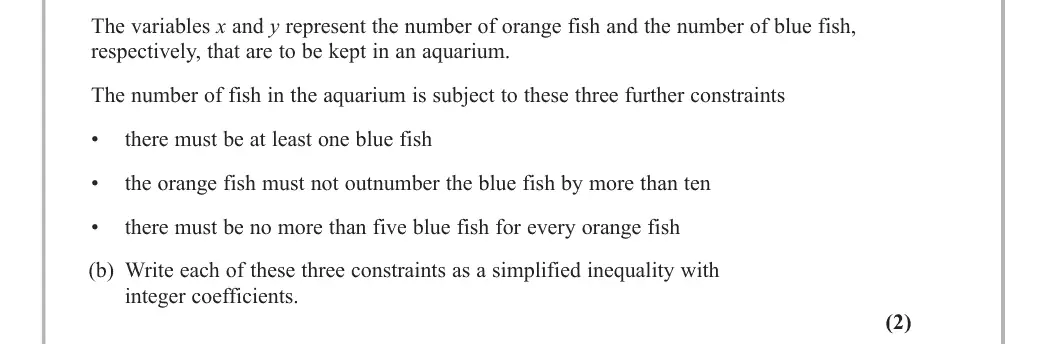
The variables x and y represent the number of orange fish and the number of blue fish, respectively, that are to be kept in an aquarium. The number of fish in the aquarium is subject to these three further constraints • there must be at least one blue fish • the orange fish must not outnumber the blue fish by more than ten • there must be no more than five blue fish for every orange fish (b) Write each of these three constraints as a simplified inequality with integer coefficients. (2)
June 2024 · AS Paper 2 (Decision 1) · Q4(c) 3 marks linear programming
P75677A (c) Represent these three constraints by adding lines and shading to Diagram 1 in the answer book, labelling the feasible region, R (3)
June 2024 · AS Paper 2 (Decision 1) · Q4(d) 4 marks linear programming
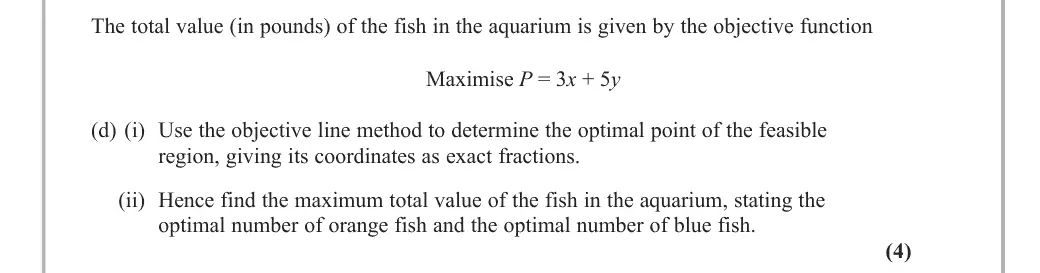
The total value (in pounds) of the fish in the aquarium is given by the objective function Maximise P = 3x + 5y (d) (i) Use the objective line method to determine the optimal point of the feasible region, giving its coordinates as exact fractions. (ii) Hence find the maximum total value of the fish in the aquarium, stating the optimal number of orange fish and the optimal number of blue fish. (4)

Find an Edexcel Further Maths tutor

Want this paper marked and gone through with a Further Maths tutor? Message us.

Prefer email? Send an enquiry

If you are under 18, please include a parent's contact details. Enquiries go to enquiries@alevelfurthermathstutor.com and are deleted once handled.