June 2024: A level Paper 4A: Further Pure Mathematics 2

75 marks · 22 question parts · Question paper, mark scheme and examiner's report on Pearson's site

Question by question

QTopicMarksDifficulty
1 Number theory: Euclid, Bezout, modular arithmetic and Fermat 4 —
2 Recurrence relations and proof of closed forms 5 —
3(a) Number theory: Euclid, Bezout, modular arithmetic and Fermat 3 —
3(b) Number theory: Euclid, Bezout, modular arithmetic and Fermat 3 —
3(c) Number theory: Euclid, Bezout, modular arithmetic and Fermat 5 —
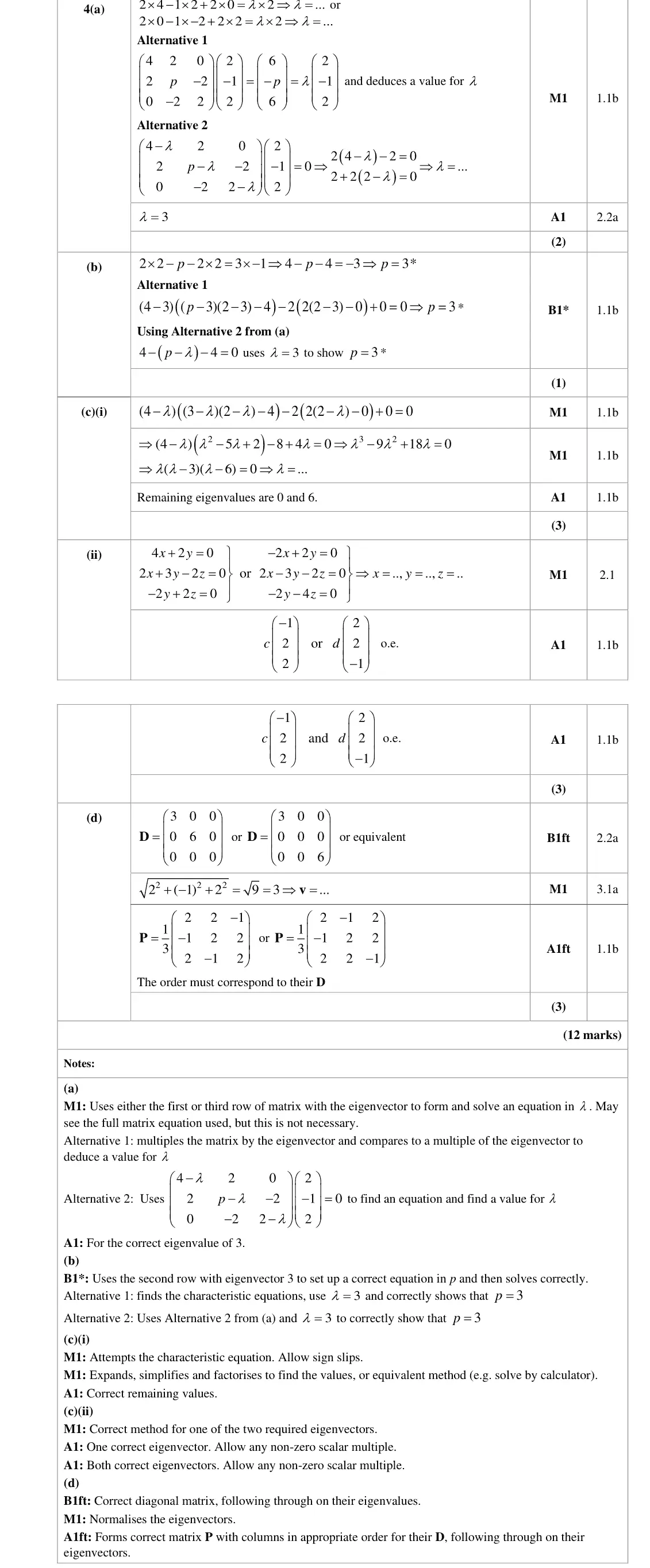
4(a) Eigenvalues, eigenvectors, diagonalisation and Cayley-Hamilton 2 —
4(b) Eigenvalues, eigenvectors, diagonalisation and Cayley-Hamilton 1 —
4(c) Eigenvalues, eigenvectors, diagonalisation and Cayley-Hamilton 6 —
4(d) Eigenvalues, eigenvectors, diagonalisation and Cayley-Hamilton 3 —
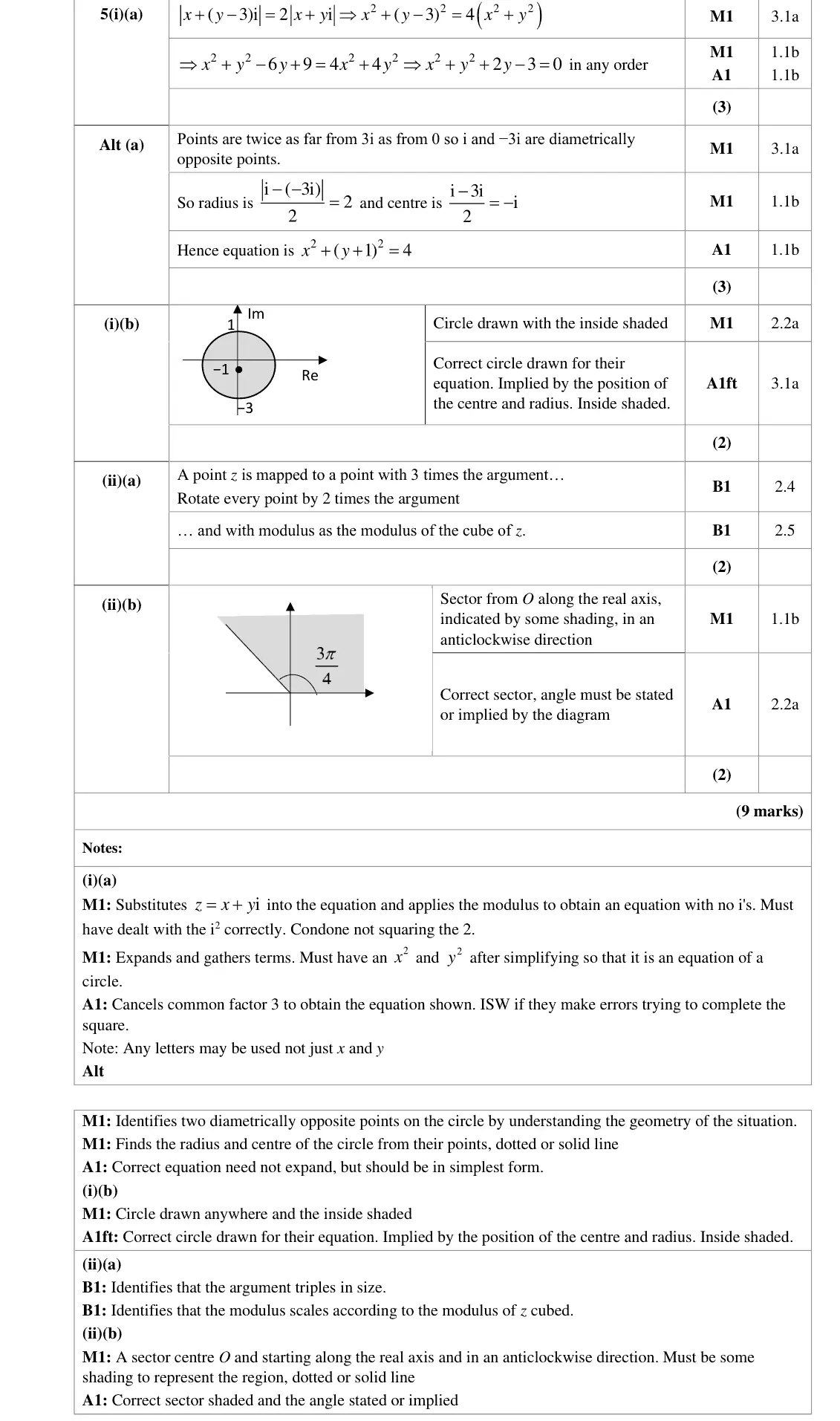
5(i)(a) Further complex numbers: regions and transformations of the plane 3 —
5(i)(b) Further complex numbers: regions and transformations of the plane 2 —
5(ii)(a) Further complex numbers: regions and transformations of the plane 2 —
5(ii)(b) Further complex numbers: regions and transformations of the plane 2 —
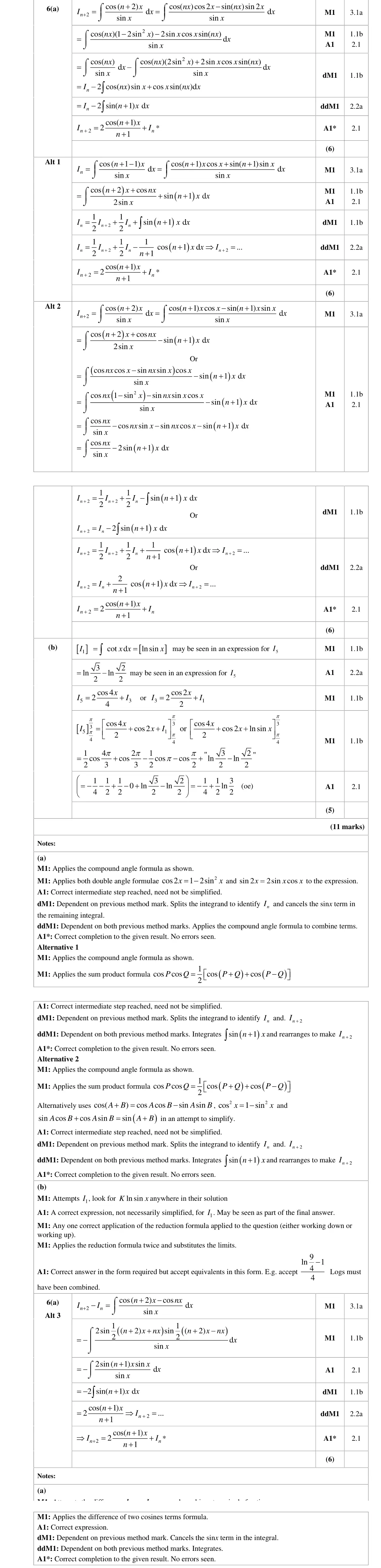
6(a) Reduction formulae, arc length and surface area 6 —
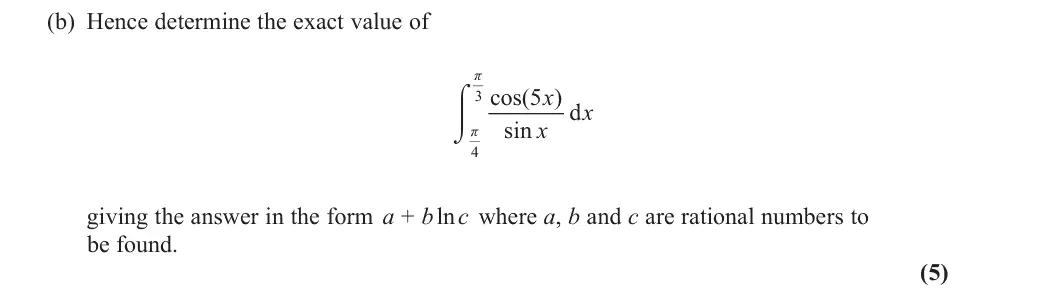
6(b) Reduction formulae, arc length and surface area 5 —
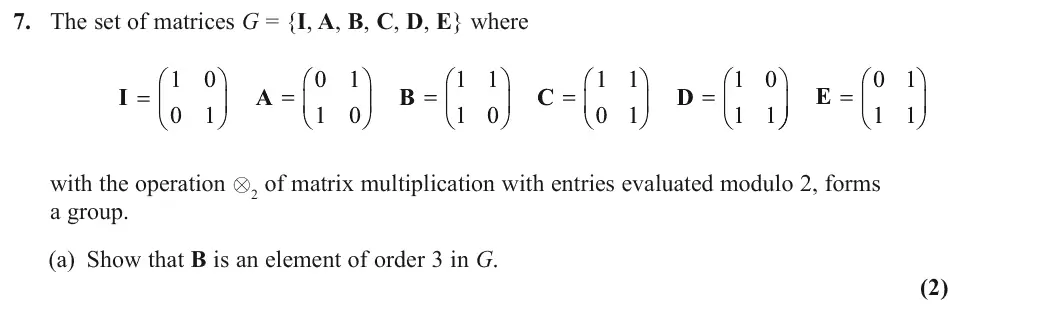
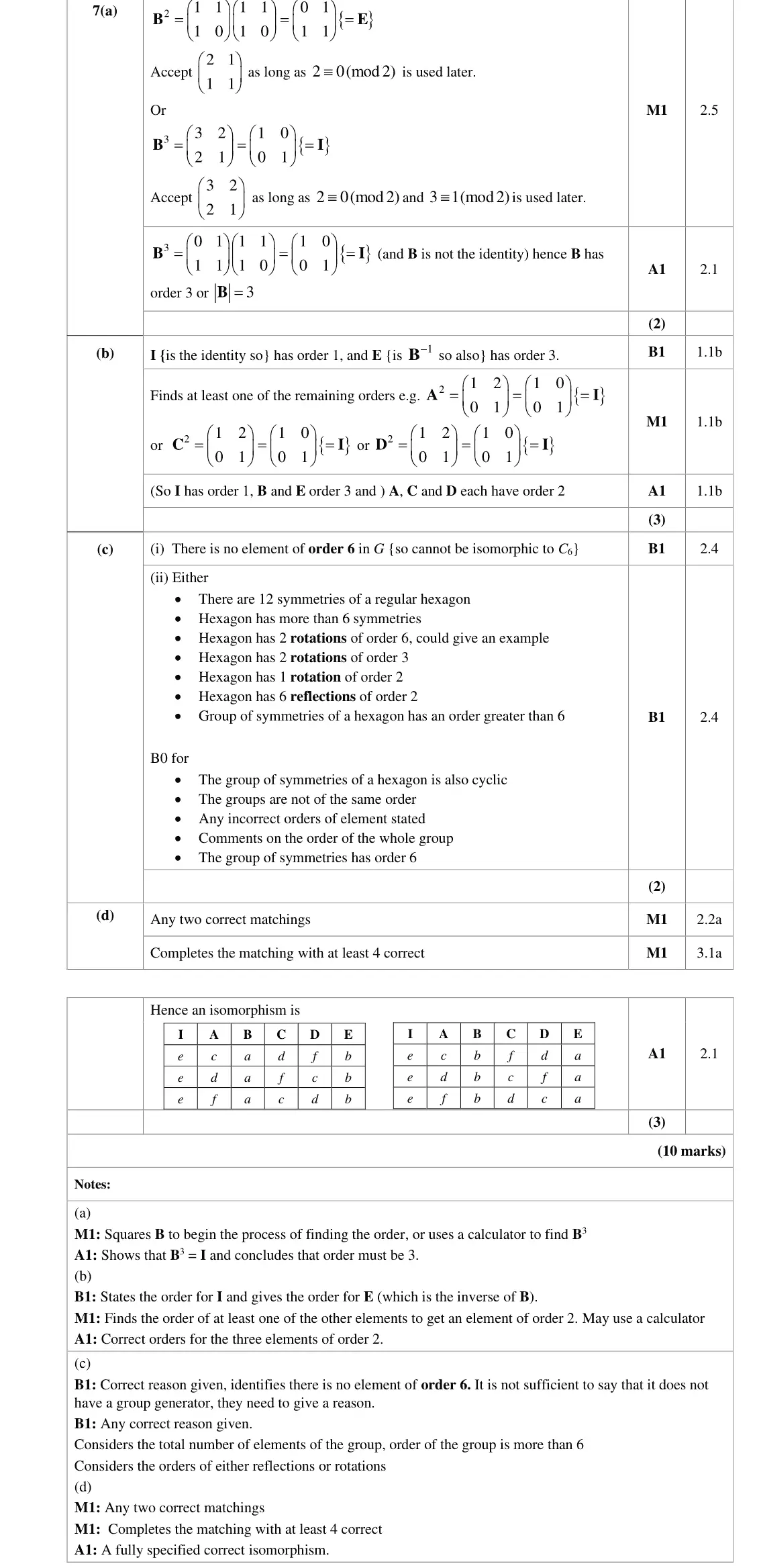
7(a) Groups: axioms, Cayley tables, subgroups, Lagrange and isomorphism 2 —
7(b) Groups: axioms, Cayley tables, subgroups, Lagrange and isomorphism 3 —
7(c) Groups: axioms, Cayley tables, subgroups, Lagrange and isomorphism 2 —
7(d) Groups: axioms, Cayley tables, subgroups, Lagrange and isomorphism 3 —
8(a) Reduction formulae, arc length and surface area 3 —
8(b) Reduction formulae, arc length and surface area 5 —
8(c) Reduction formulae, arc length and surface area 5 —

The questions

123(a)3(b)3(c)4(a)4(b)4(c)4(d)5(i)(a)5(i)(b)5(ii)(a)5(ii)(b)6(a)6(b)7(a)7(b)7(c)7(d)8(a)8(b)8(c)
June 2024 · Paper 4A (Further Pure 2) · Q1 4 marks number theory
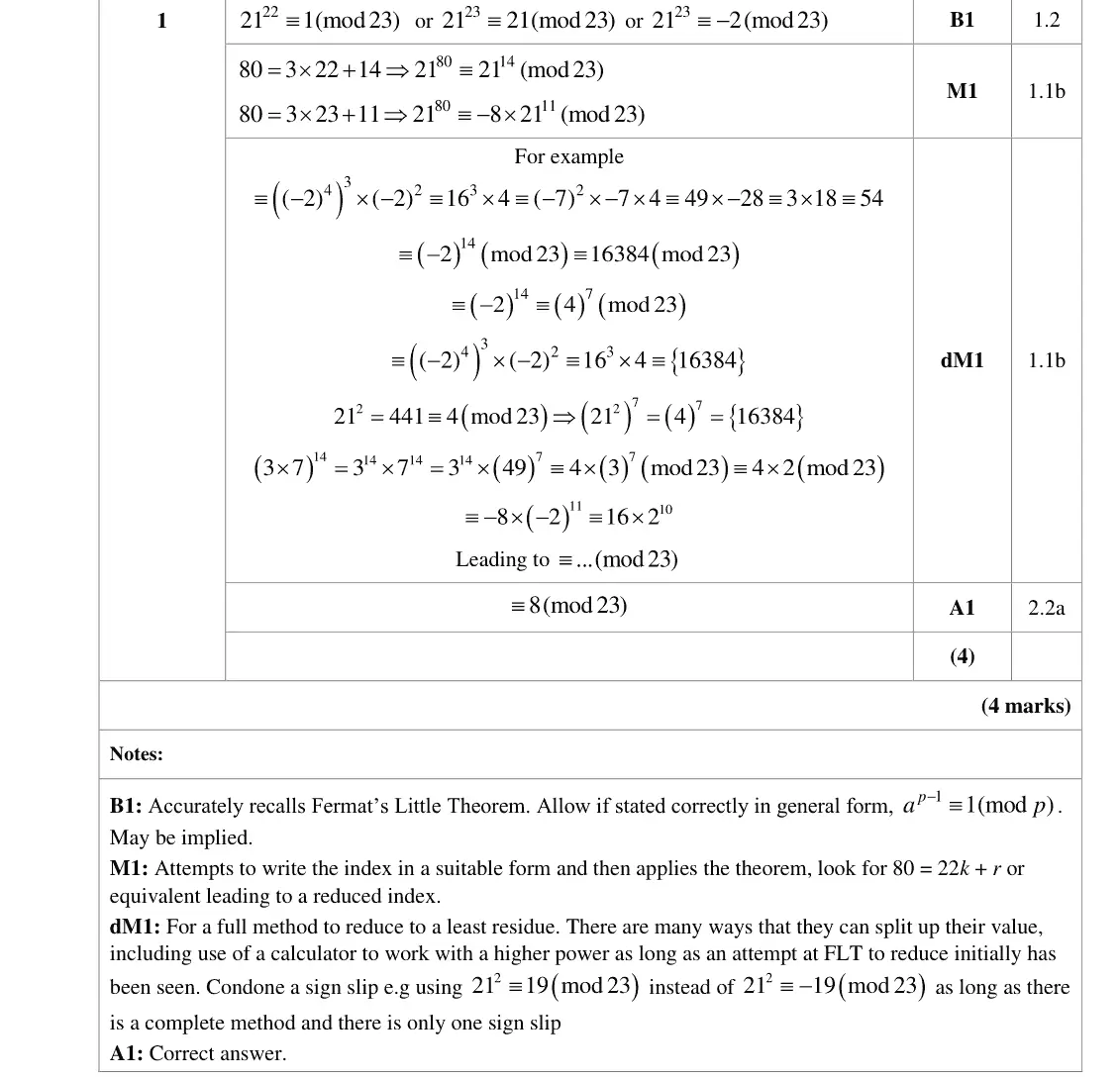
1. In this question you must show detailed reasoning. Use Fermat’s Little Theorem to determine the least positive residue of 80 (mod 23) (4)
June 2024 · Paper 4A (Further Pure 2) · Q2 5 marks recurrence relations fp2
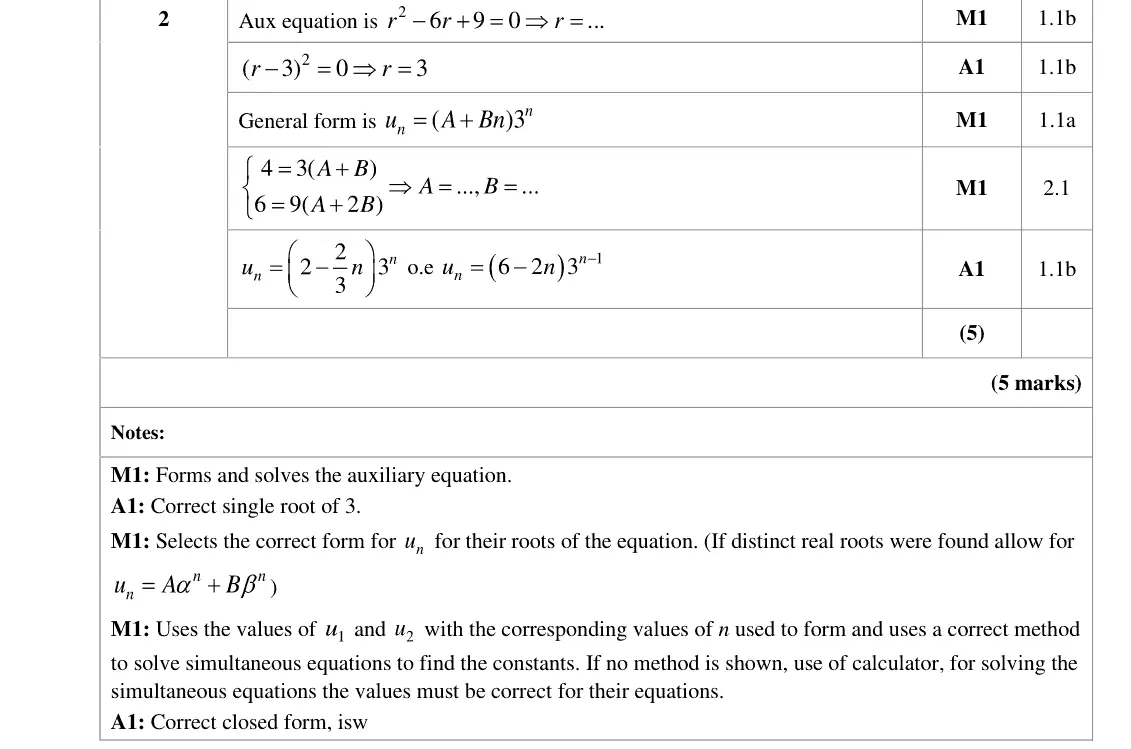
2. Determine a closed form for the recurrence system u u u u u n : ( 1 2 3 , , , ) n n n (5)
June 2024 · Paper 4A (Further Pure 2) · Q3(a) 3 marks number theory
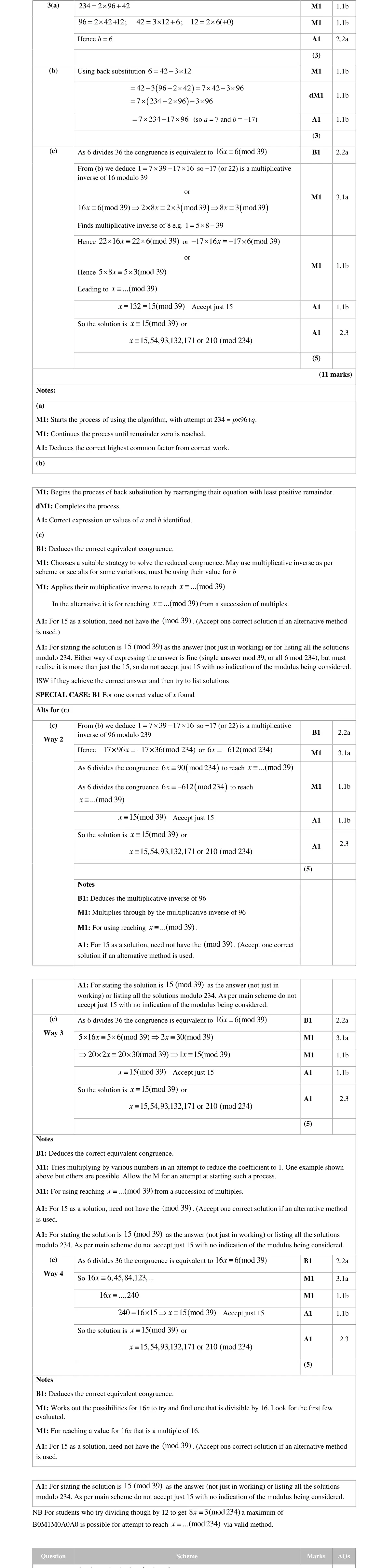
3. In this question you must show all stages of your working. Solutions relying on calculator technology are not acceptable. (a) Use the Euclidean Algorithm to determine the highest common factor h of 234 and 96 (3)
June 2024 · Paper 4A (Further Pure 2) · Q3(b) 3 marks number theory
(b) Hence determine integers a and b such that 234a + 96b = h (3)
June 2024 · Paper 4A (Further Pure 2) · Q3(c) 5 marks number theory
(c) Solve the congruence equation 96x ≡ 36 (mod 234) (5)
June 2024 · Paper 4A (Further Pure 2) · Q4(a) 2 marks eigenvalues and eigenvectors
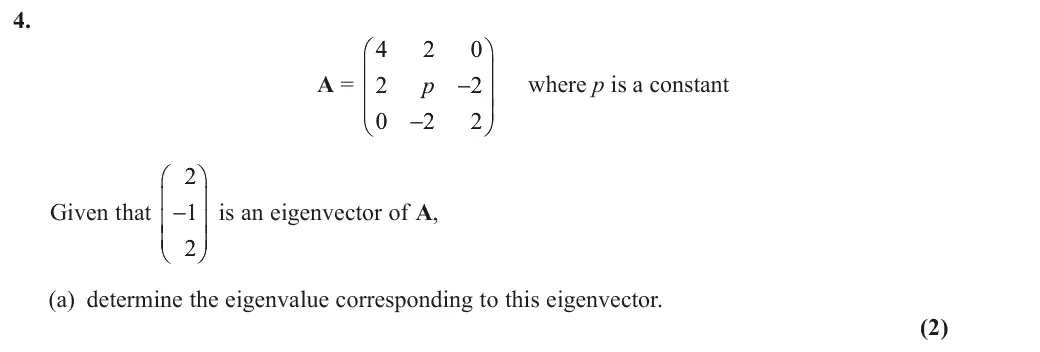
4. ; A = where p is a constant p : ; Given that is an eigenvector of A, : (a) determine the eigenvalue corresponding to this eigenvector. (2)
June 2024 · Paper 4A (Further Pure 2) · Q4(b) 1 mark eigenvalues and eigenvectors
(b) Hence show that p = 3 (1)
June 2024 · Paper 4A (Further Pure 2) · Q4(c) 6 marks eigenvalues and eigenvectors
(c) Determine (i) the remaining eigenvalues of A, (ii) corresponding eigenvectors for these eigenvalues. (6)
June 2024 · Paper 4A (Further Pure 2) · Q4(d) 3 marks eigenvalues and eigenvectors
(d) Hence determine a matrix P and a diagonal matrix D such that A = PDP T (3)
June 2024 · Paper 4A (Further Pure 2) · Q5(i)(a) 3 marks complex transformations
5. (i) A circle C in the complex plane is defined by the locus of points satisfying z z i (a) Determine a Cartesian equation for C, giving your answer in simplest form. (3)
June 2024 · Paper 4A (Further Pure 2) · Q5(i)(b) 2 marks complex transformations
(b) On an Argand diagram, shade the region defined by <= ¥ z < : z i > z (2)
June 2024 · Paper 4A (Further Pure 2) · Q5(ii)(a) 2 marks complex transformations
(ii) The transformation T from the z‑plane to the w‑plane is given by w = z (a) Describe the geometric effect of T. (2)
June 2024 · Paper 4A (Further Pure 2) · Q5(ii)(b) 2 marks complex transformations
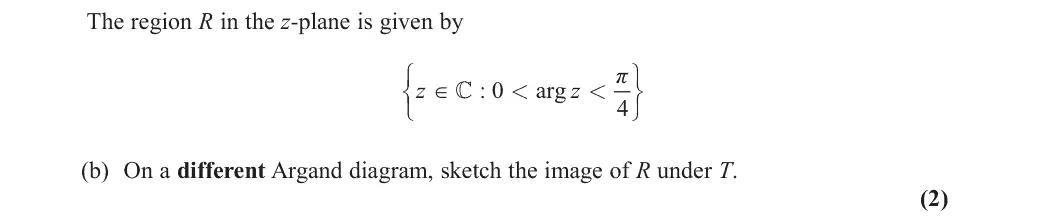
The region R in the z‑plane is given by pi < ; z 6=< : 0 arg z < < : (b) On a different Argand diagram, sketch the image of R under T. (2)
June 2024 · Paper 4A (Further Pure 2) · Q6(a) 6 marks reduction formulae arc length
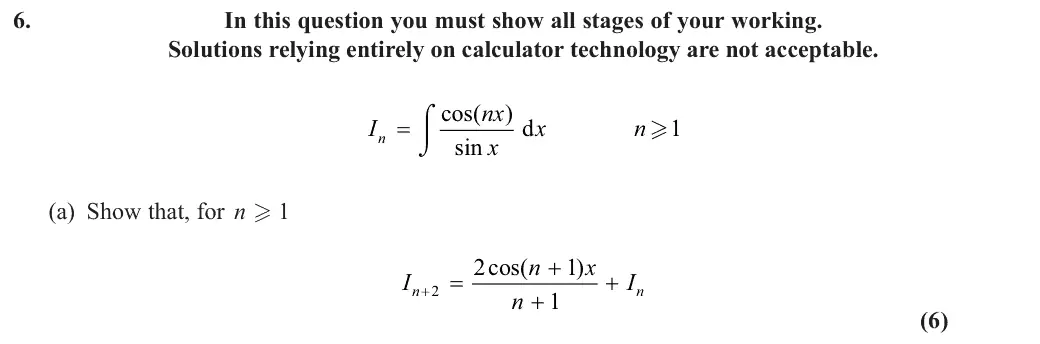
6. In this question you must show all stages of your working. Solutions relying entirely on calculator technology are not acceptable. nx n O ; :9 cos( ) I x n 1 d x sin (a) Show that, for n 1 n x cos( ) I I n n n (6)
June 2024 · Paper 4A (Further Pure 2) · Q6(b) 5 marks reduction formulae arc length
(b) Hence determine the exact value of pi cos(5 ) d x < x ;: sin x pi giving the answer in the form a + b ln c where a, b and c are rational numbers to be found. (5)
June 2024 · Paper 4A (Further Pure 2) · Q7(a) 2 marks groups
7. The set of matrices G = {I, A, B, C, D, E} where O ; O ; O ; O ; O ; O ; I A B C E :9 :9 :9 :9 :9 :9 with the operation Ä2 of matrix multiplication with entries evaluated modulo 2, forms a group. (a) Show that B is an element of order 3 in G. (2)
June 2024 · Paper 4A (Further Pure 2) · Q7(b) 3 marks groups
(b) Determine the orders of the other elements of G. (3)
June 2024 · Paper 4A (Further Pure 2) · Q7(c) 2 marks groups
(c) Give a reason why G is not isomorphic to (i) a cyclic group of order 6 (ii) the group of symmetries of a regular hexagon. (2)
June 2024 · Paper 4A (Further Pure 2) · Q7(d) 3 marks groups
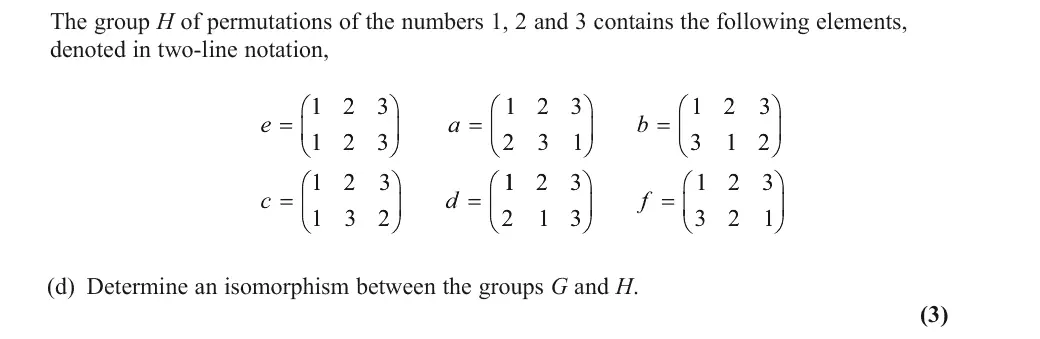
The group H of permutations of the numbers 1, 2 and 3 contains the following elements, denoted in two‑line notation, O ; O ; O ; e a b :9 :9 :9 O ; ; O ; c d f :9 :9 :9 (d) Determine an isomorphism between the groups G and H. (3)
June 2024 · Paper 4A (Further Pure 2) · Q8(a) 3 marks reduction formulae arc length
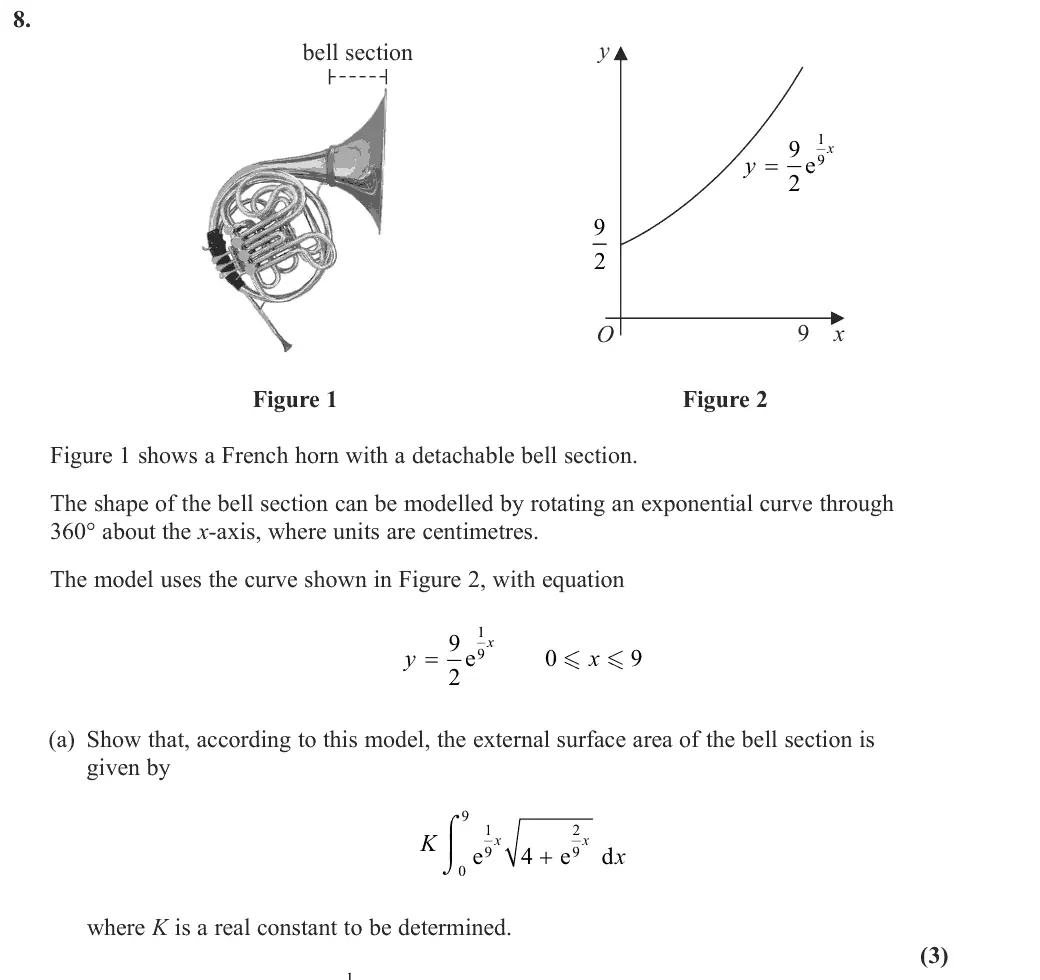
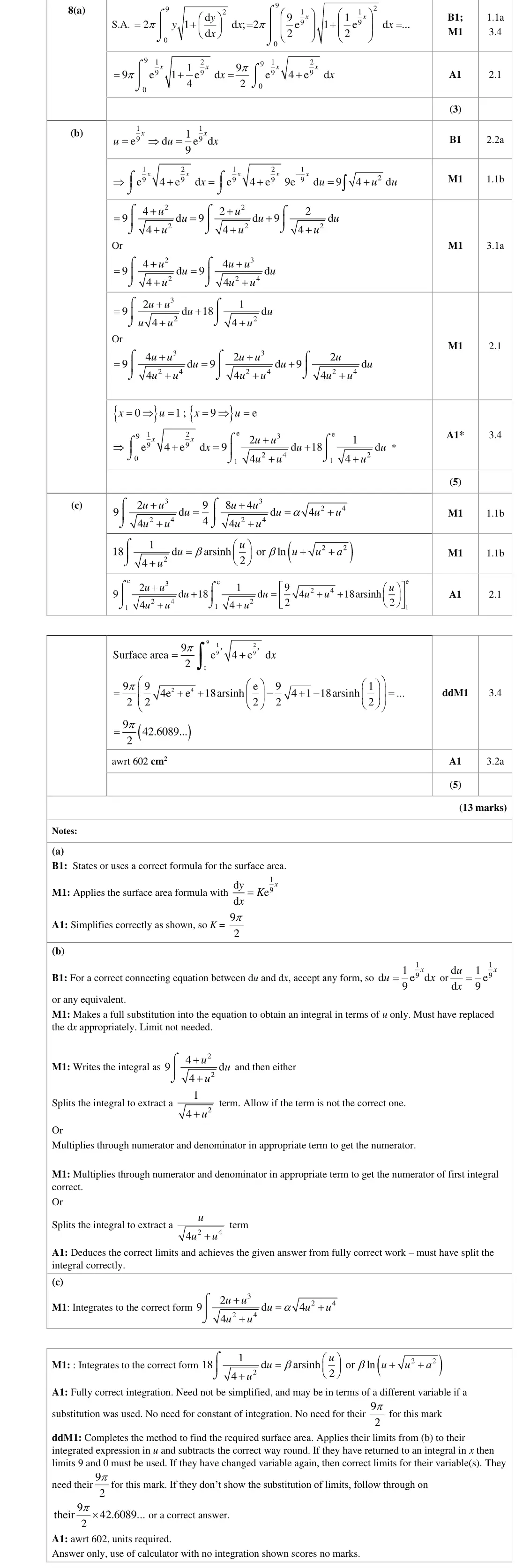
8. y bell section x = 9 y e x Figure 1 Figure 2 Figure 1 shows a French horn with a detachable bell section. The shape of the bell section can be modelled by rotating an exponential curve through 360° about the x‑axis, where units are centimetres. The model uses the curve shown in Figure 2, with equation = 9 x y x e (a) Show that, according to this model, the external surface area of the bell section is given by ; K x x :9 4 1 x e e d where K is a real constant to be determined. (3)
June 2024 · Paper 4A (Further Pure 2) · Q8(b) 5 marks reduction formulae arc length
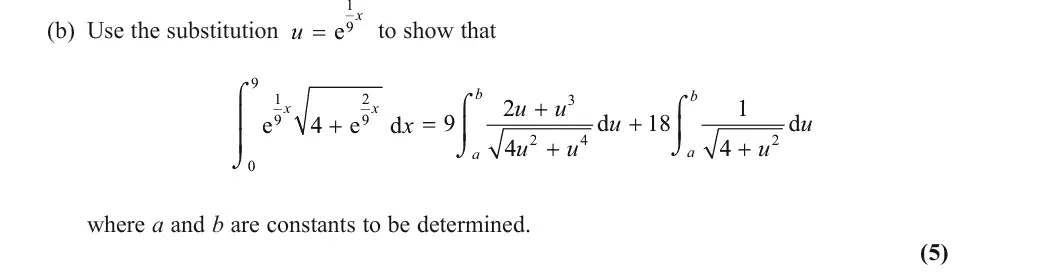
x 9 to show that (b) Use the substitution u = e : b b : u u : x x u u x d d e e d u u u a a where a and b are constants to be determined. (5)
June 2024 · Paper 4A (Further Pure 2) · Q8(c) 5 marks reduction formulae arc length
Hence, using algebraic integration, (c) determine, according to the model, the external surface area of the bell section of the horn, giving your answer to 3 significant figures. (5)

Find an Edexcel Further Maths tutor

Want this paper marked and gone through with a Further Maths tutor? Message us.

Prefer email? Send an enquiry

If you are under 18, please include a parent's contact details. Enquiries go to enquiries@alevelfurthermathstutor.com and are deleted once handled.