Oct 2020: AS Paper 27: Decision Mathematics 1

40 marks · 13 question parts · Question paper, mark scheme and examiner's report on Pearson's site

Question by question

QTopicMarksDifficulty
1(a) Algorithms, sorting, bin packing and graph theory 3 —
1(b) Algorithms, sorting, bin packing and graph theory 3 —
2(a) Critical path analysis 2 —
2(b) Critical path analysis 3 —
2(c) Critical path analysis 2 —
2(d) Critical path analysis 1 —
2(e) Critical path analysis 2 —
2(f) Critical path analysis 3 —
2(g) Critical path analysis 1 —
3(a) Algorithms, sorting, bin packing and graph theory 2 —
3(b) Minimum spanning trees (Prim, Kruskal) and shortest paths (Dijkstra, Floyd) 3 —
3(c) Route inspection and the travelling salesman problem 6 —
4 Linear programming: formulation, graphs and the Simplex algorithm 9 —

The questions

1(a)1(b)2(a)2(b)2(c)2(d)2(e)2(f)2(g)3(a)3(b)3(c)4
Oct 2020 · AS Paper 2 (Decision 1) · Q1(a) 3 marks algorithms and graph theory
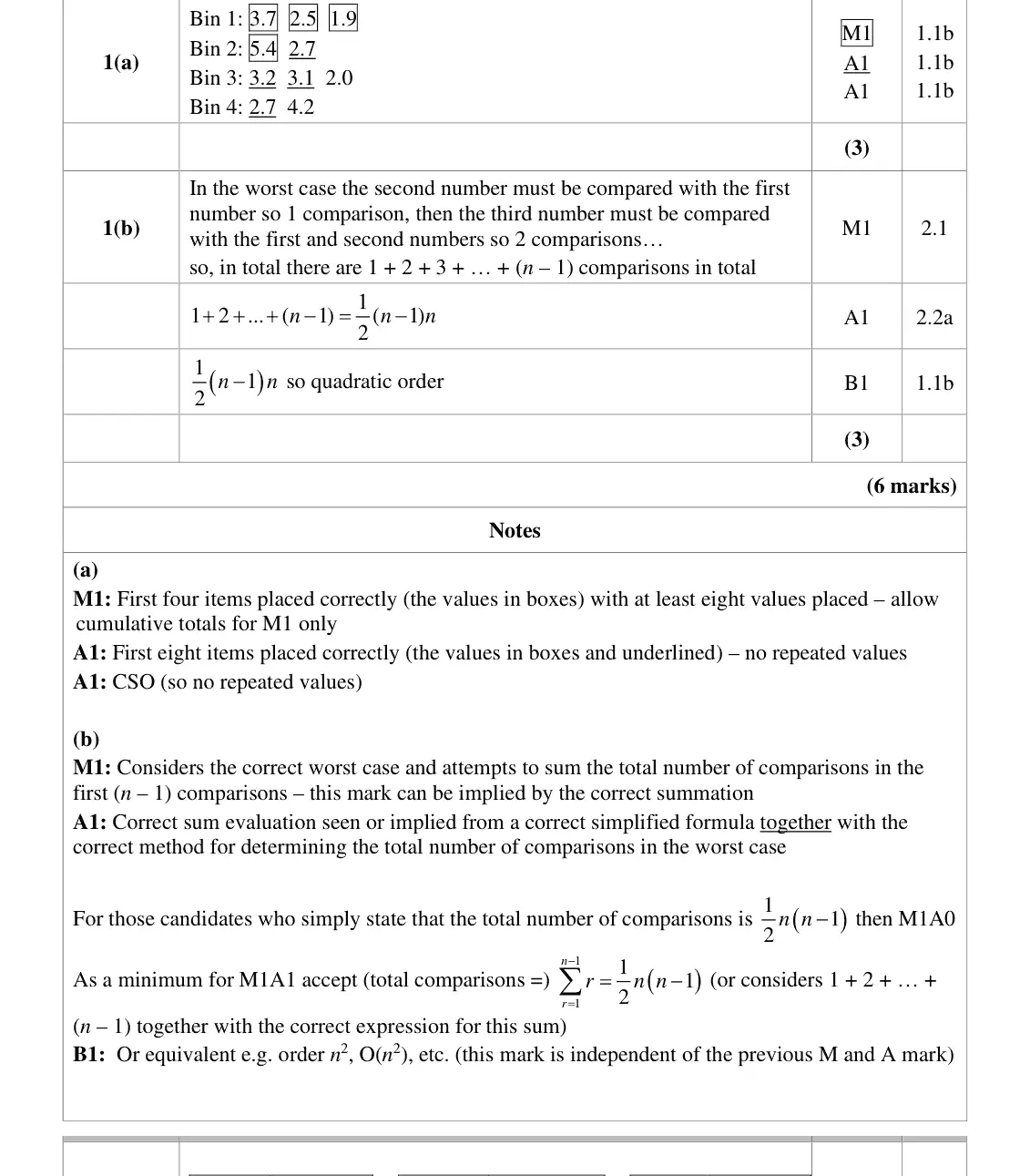
1. 3.7 2.5 5.4 1.9 2.7 3.2 3.1 2.7 4.2 2.0 (a) Use the first‑fit bin packing algorithm to determine how the numbers listed above can be packed into bins of size 8.5 (3)
Oct 2020 · AS Paper 2 (Decision 1) · Q1(b) 3 marks algorithms and graph theory
The first‑fit bin packing algorithm is to be used to pack n numbers into bins. The number of comparisons is used to measure the order of the first‑fit bin packing algorithm. (b) By considering the worst case, determine the order of the first‑fit bin packing algorithm in terms of n. You must make your method and working clear. (3)
Oct 2020 · AS Paper 2 (Decision 1) · Q2(a) 2 marks critical path analysis
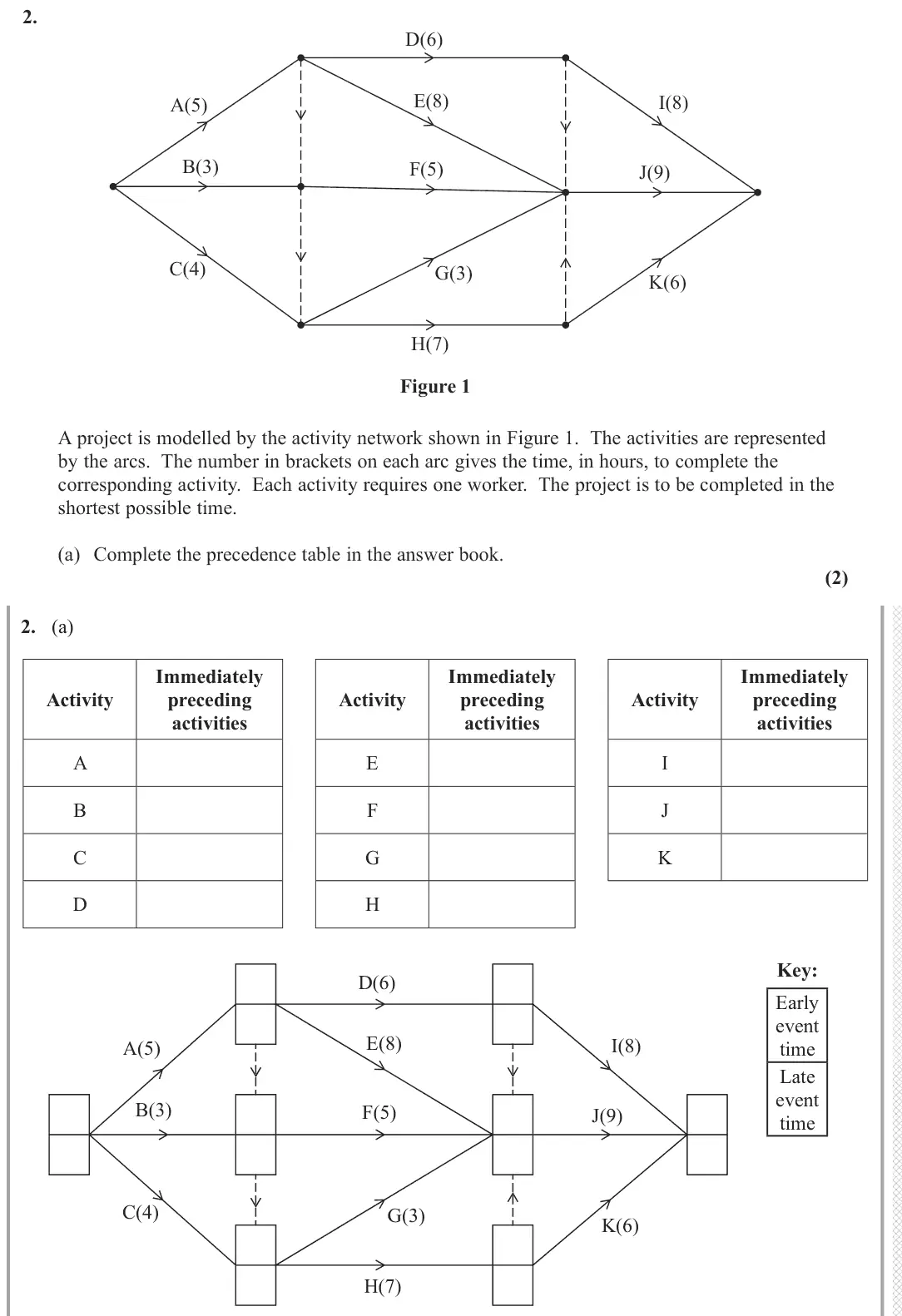
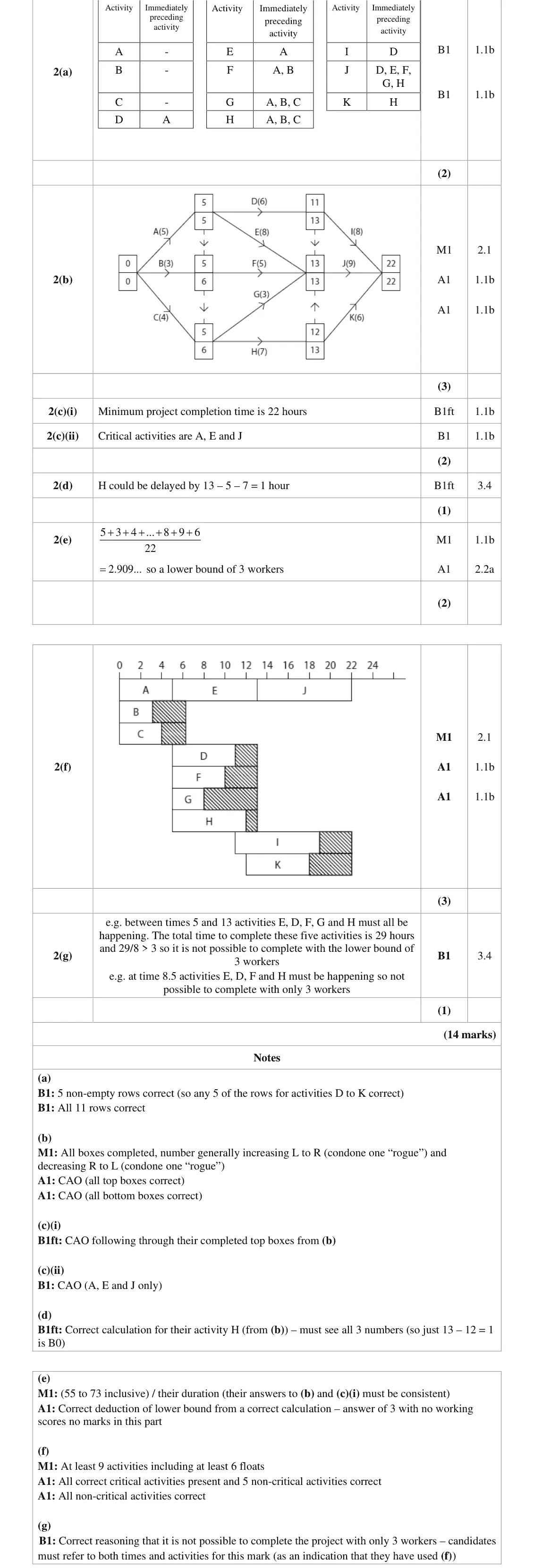
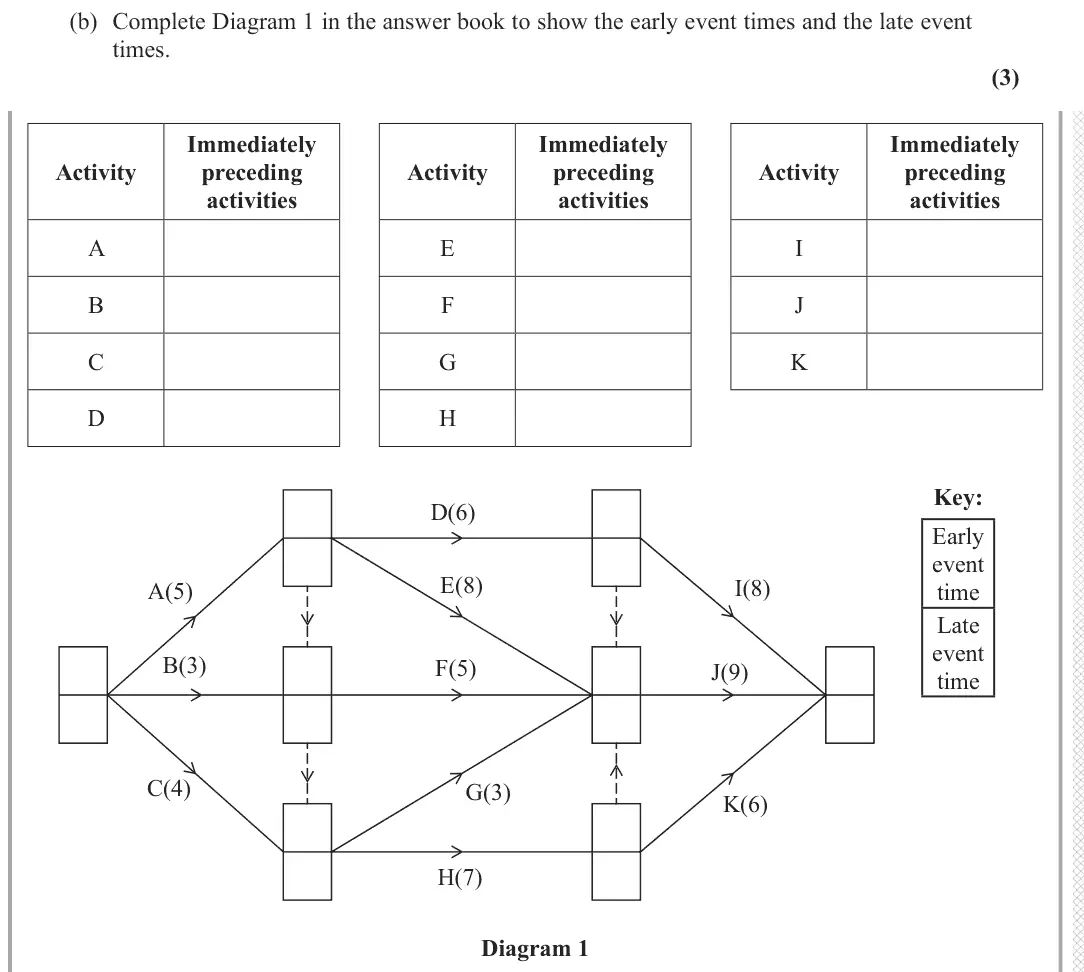
2. D(6) E(8) I(8) A(5) B(3) F(5) J(9) C(4) G(3) K(6) H(7) Figure 1 A project is modelled by the activity network shown in Figure 1. The activities are represented by the arcs. The number in brackets on each arc gives the time, in hours, to complete the corresponding activity. Each activity requires one worker. The project is to be completed in the shortest possible time. (a) Complete the precedence table in the answer book. (2)
Oct 2020 · AS Paper 2 (Decision 1) · Q2(b) 3 marks critical path analysis
(b) Complete Diagram 1 in the answer book to show the early event times and the late event times. (3)
Oct 2020 · AS Paper 2 (Decision 1) · Q2(c) 2 marks critical path analysis
(c) (i) State the minimum project completion time. (ii) List the critical activities. (2)
Oct 2020 · AS Paper 2 (Decision 1) · Q2(d) 1 mark critical path analysis
(d) Calculate the maximum number of hours by which activity H could be delayed without affecting the shortest possible completion time of the project. You must make the numbers used in your calculation clear. (1)
Oct 2020 · AS Paper 2 (Decision 1) · Q2(e) 2 marks critical path analysis
(e) Calculate a lower bound for the number of workers needed to complete the project in the minimum time. You must show your working. (2)
Oct 2020 · AS Paper 2 (Decision 1) · Q2(f) 3 marks critical path analysis
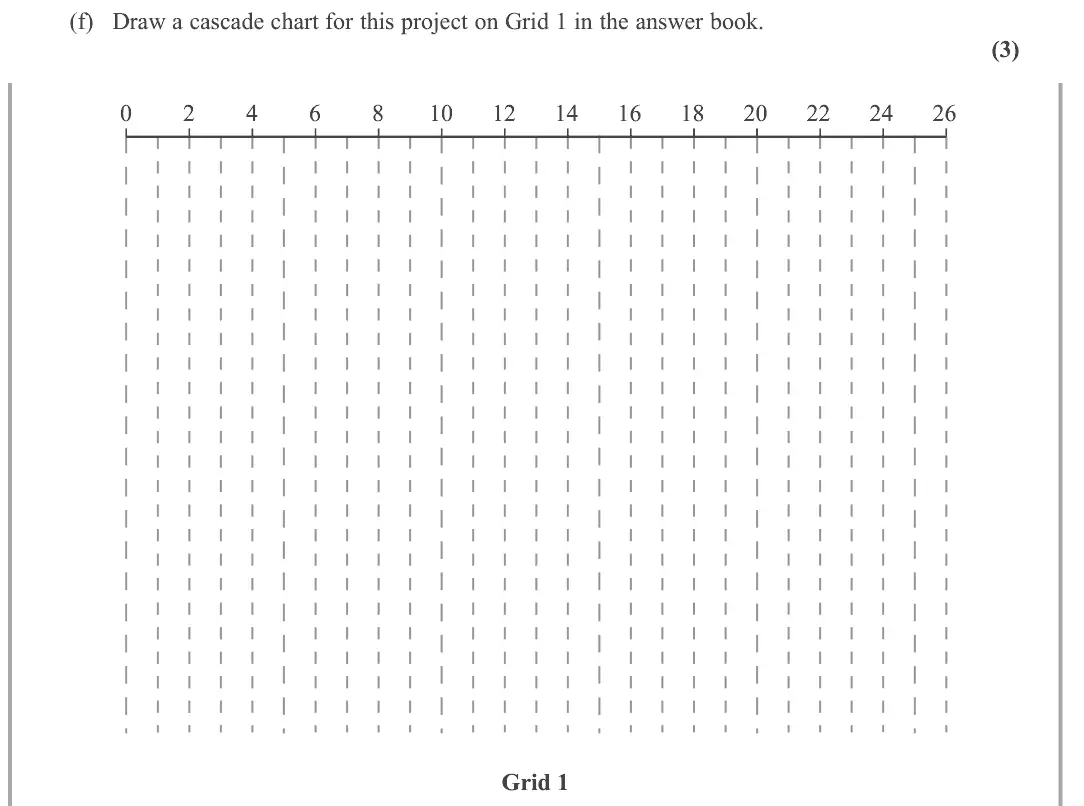
(f) Draw a cascade chart for this project on Grid 1 in the answer book. (3)
Oct 2020 · AS Paper 2 (Decision 1) · Q2(g) 1 mark critical path analysis
(g) Using the answer to (f), explain why it is not possible to complete the project in the shortest possible time using the number of workers found in (e). (1)
Oct 2020 · AS Paper 2 (Decision 1) · Q3(a) 2 marks algorithms and graph theory
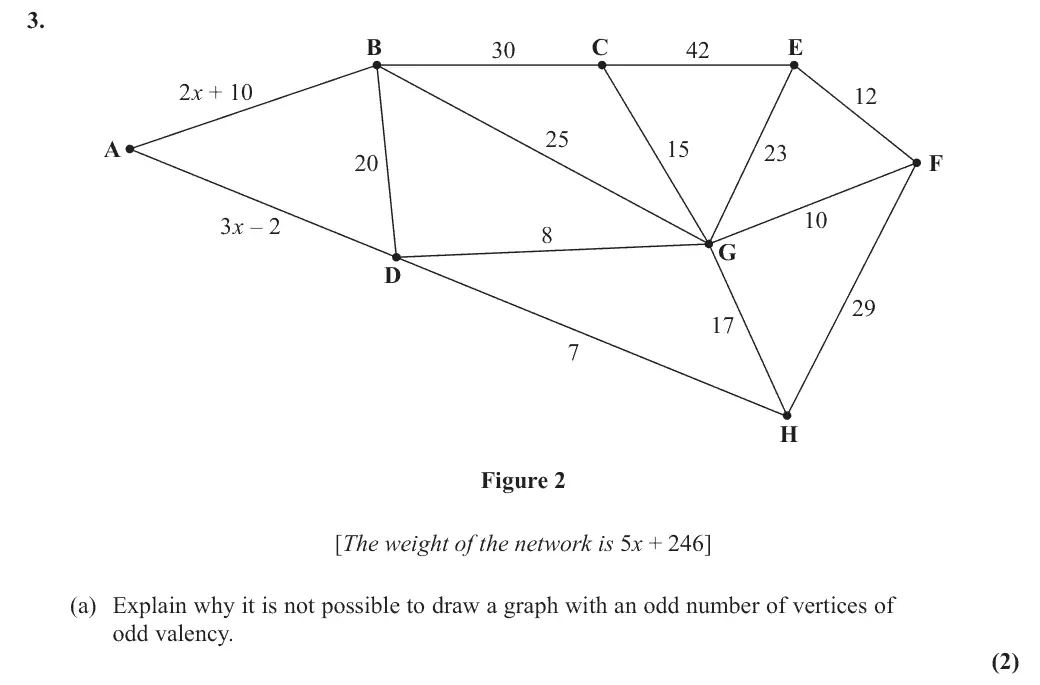
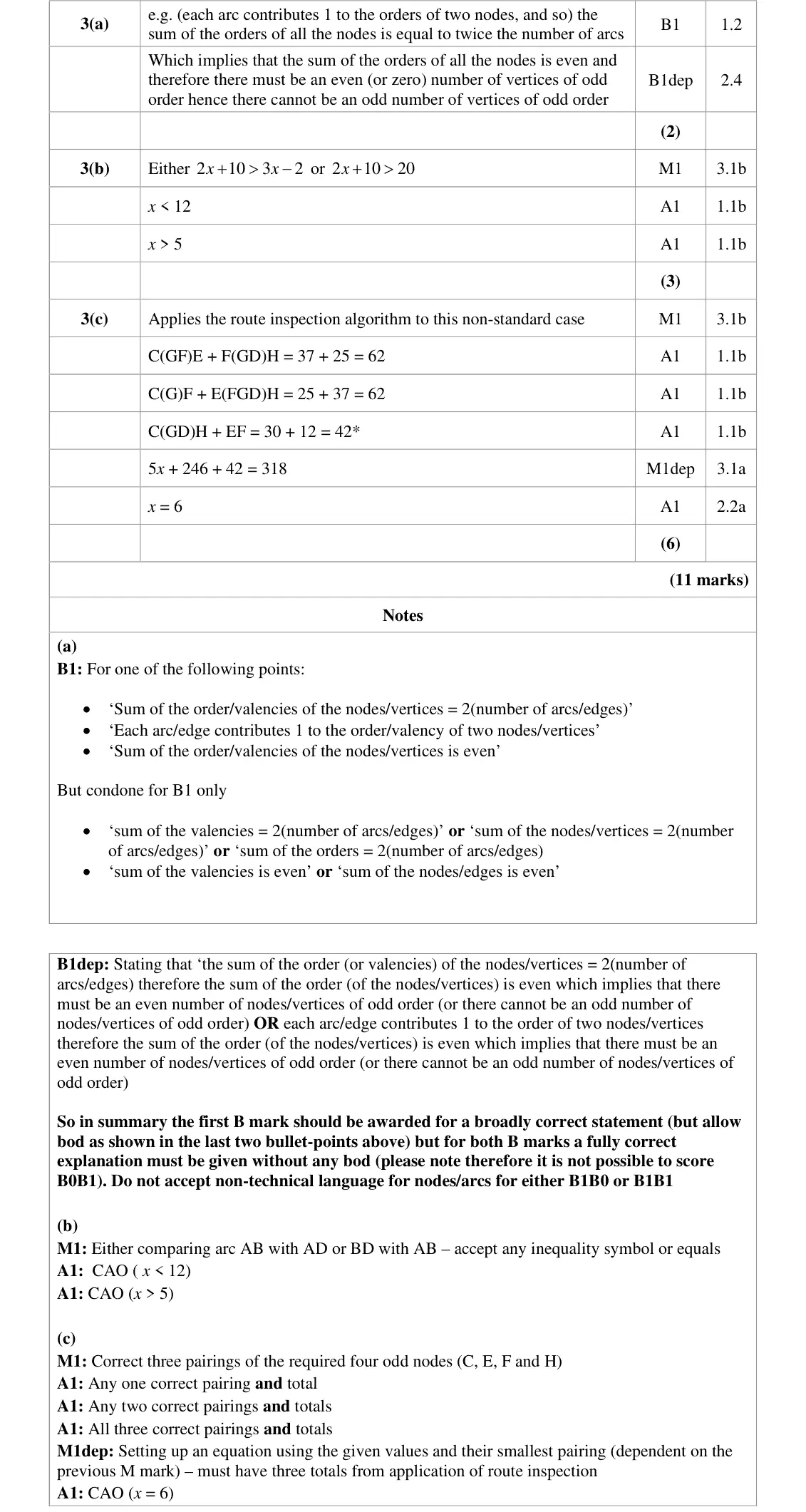
3. B C E 2x + 10 A F 3x – 2 G H Figure 2 [The weight of the network is 5x + 246] (a) Explain why it is not possible to draw a graph with an odd number of vertices of odd valency. (2)
Oct 2020 · AS Paper 2 (Decision 1) · Q3(b) 3 marks minimum spanning trees and shortest paths
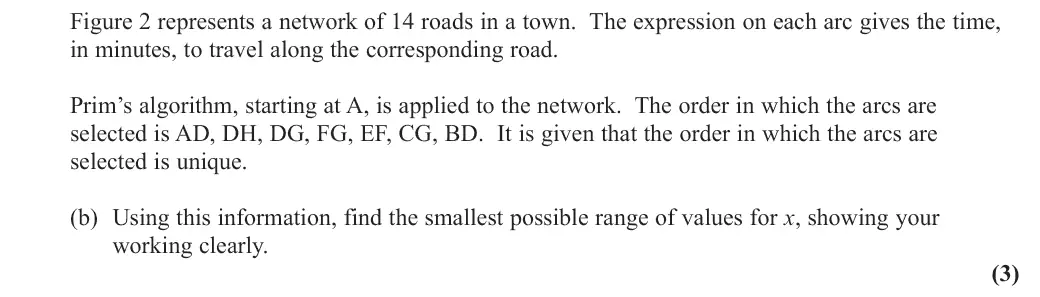
Figure 2 represents a network of 14 roads in a town. The expression on each arc gives the time, in minutes, to travel along the corresponding road. Prim’s algorithm, starting at A, is applied to the network. The order in which the arcs are selected is AD, DH, DG, FG, EF, CG, BD. It is given that the order in which the arcs are selected is unique. (b) Using this information, find the smallest possible range of values for x, showing your working clearly. (3)
Oct 2020 · AS Paper 2 (Decision 1) · Q3(c) 6 marks route inspection and travelling salesman
A route that minimises the total time taken to traverse each road at least once is required. The route must start and finish at the same vertex. Given that the time taken to traverse this route is 318 minutes, (c) use an appropriate algorithm to determine the value of x, showing your working clearly. (6)
Oct 2020 · AS Paper 2 (Decision 1) · Q4 9 marks linear programming
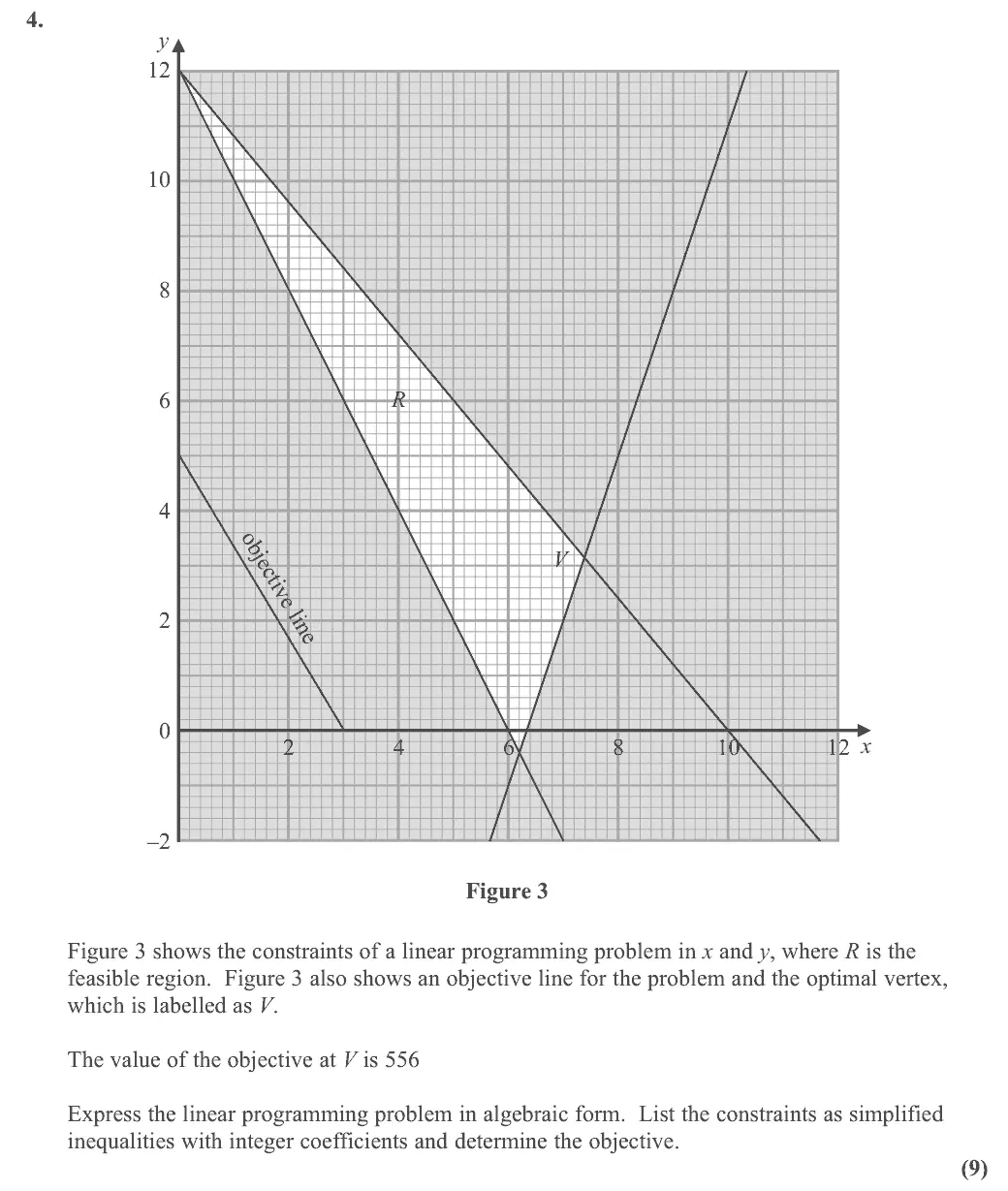
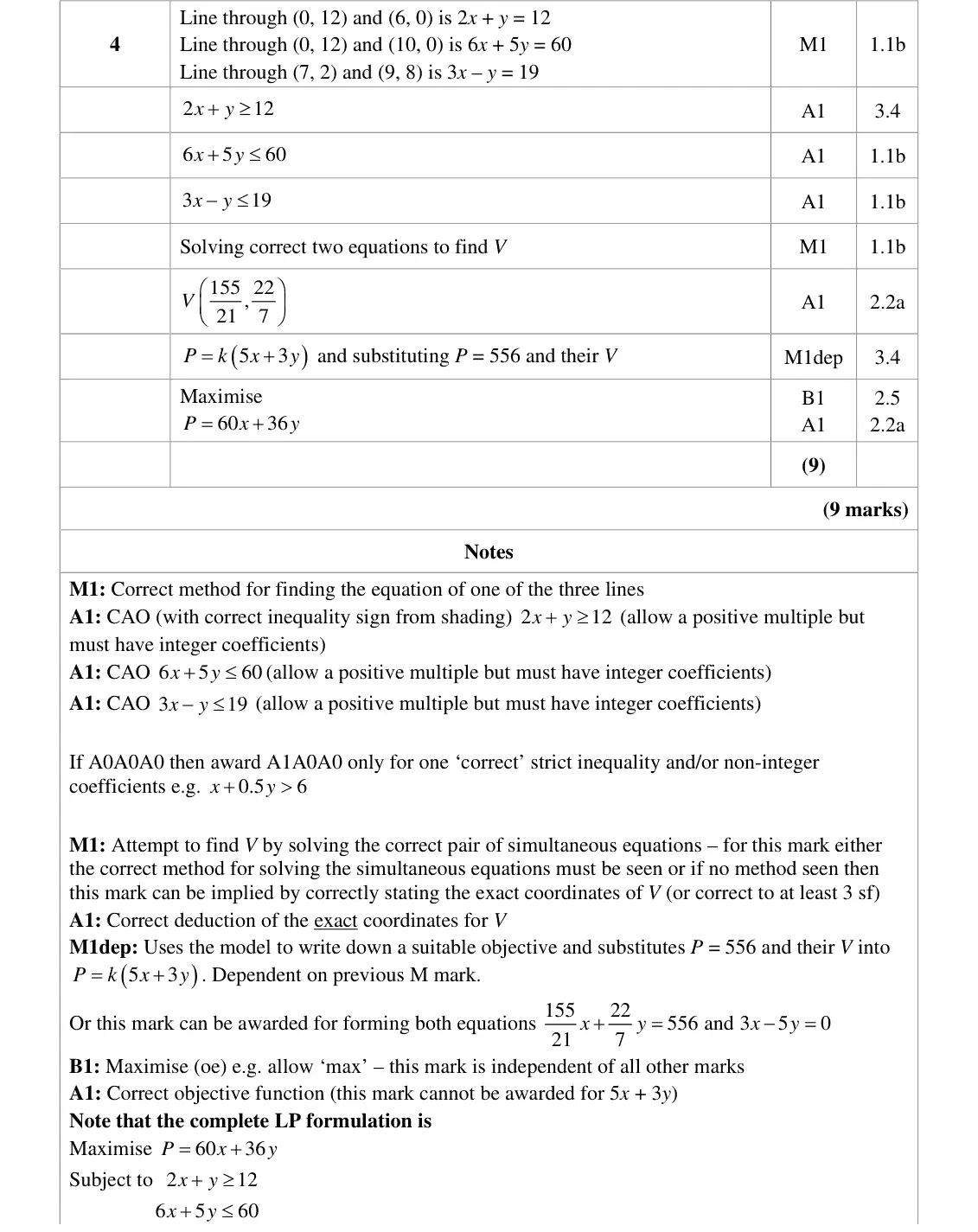
4. y R objective line V x –2 Figure 3 Figure 3 shows the constraints of a linear programming problem in x and y, where R is the feasible region. Figure 3 also shows an objective line for the problem and the optimal vertex, which is labelled as V. The value of the objective at V is 556 Express the linear programming problem in algebraic form. List the constraints as simplified inequalities with integer coefficients and determine the objective. (9)

Find an Edexcel Further Maths tutor

Want this paper marked and gone through with a Further Maths tutor? Message us.

Prefer email? Send an enquiry

If you are under 18, please include a parent's contact details. Enquiries go to enquiries@alevelfurthermathstutor.com and are deleted once handled.