Oct 2020: A level Paper 4A: Further Pure Mathematics 2

75 marks · 19 question parts · Question paper, mark scheme and examiner's report on Pearson's site


Question by question

QTopicMarksDifficulty
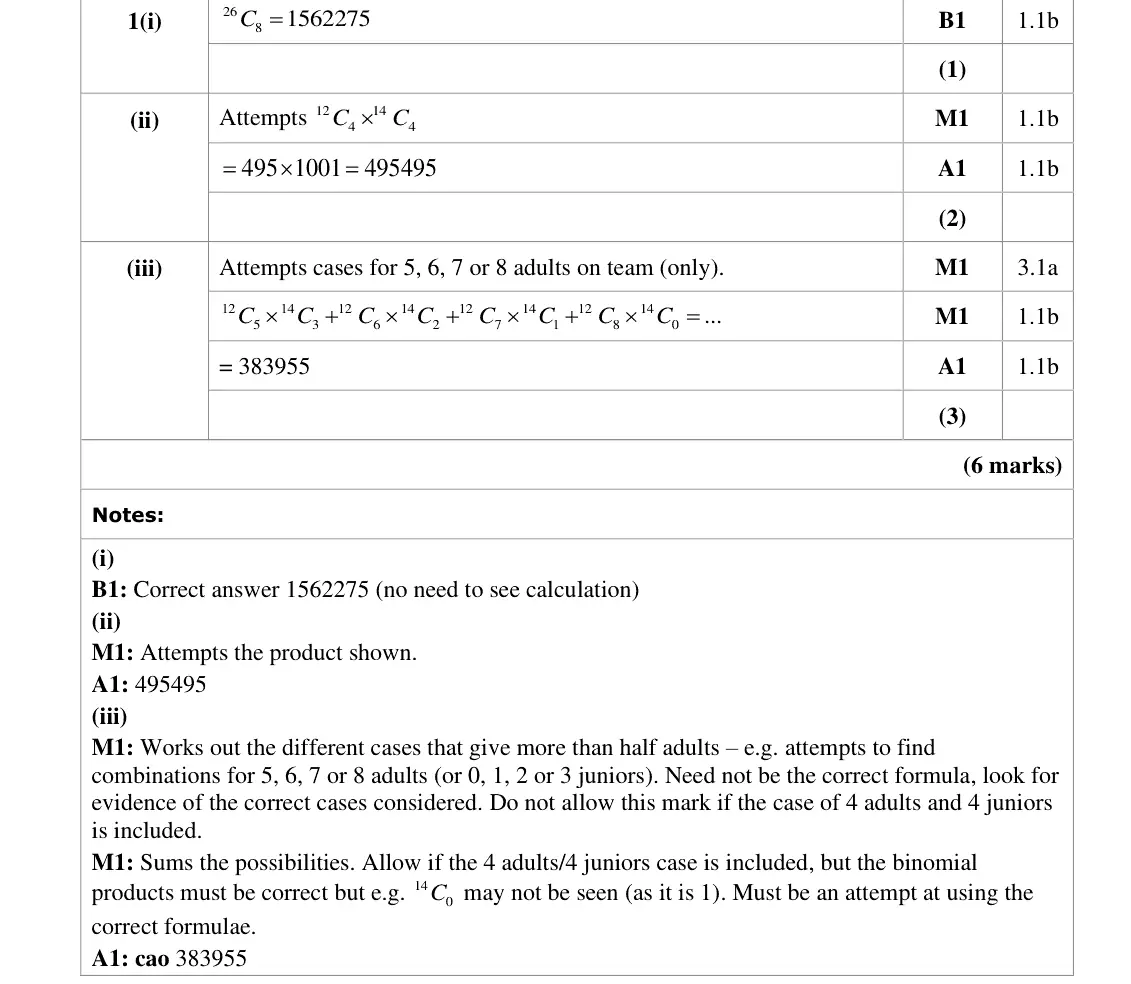
1(i) Combinatorics: counting, permutations and combinations 1 —
1(ii) Combinatorics: counting, permutations and combinations 2 —
1(iii) Combinatorics: counting, permutations and combinations 3 —
2 Recurrence relations and proof of closed forms 9 —
3(a) Eigenvalues, eigenvectors, diagonalisation and Cayley-Hamilton 3 —
3(b) Eigenvalues, eigenvectors, diagonalisation and Cayley-Hamilton 7 —
4 Reduction formulae, arc length and surface area 10 —
5(a) Further complex numbers: regions and transformations of the plane 4 —
5(b) Further complex numbers: regions and transformations of the plane 6 —
6(a) Groups: axioms, Cayley tables, subgroups, Lagrange and isomorphism 2 —
6(b) Groups: axioms, Cayley tables, subgroups, Lagrange and isomorphism 4 —
6(c) Groups: axioms, Cayley tables, subgroups, Lagrange and isomorphism 2 —
6(d) Groups: axioms, Cayley tables, subgroups, Lagrange and isomorphism 2 —
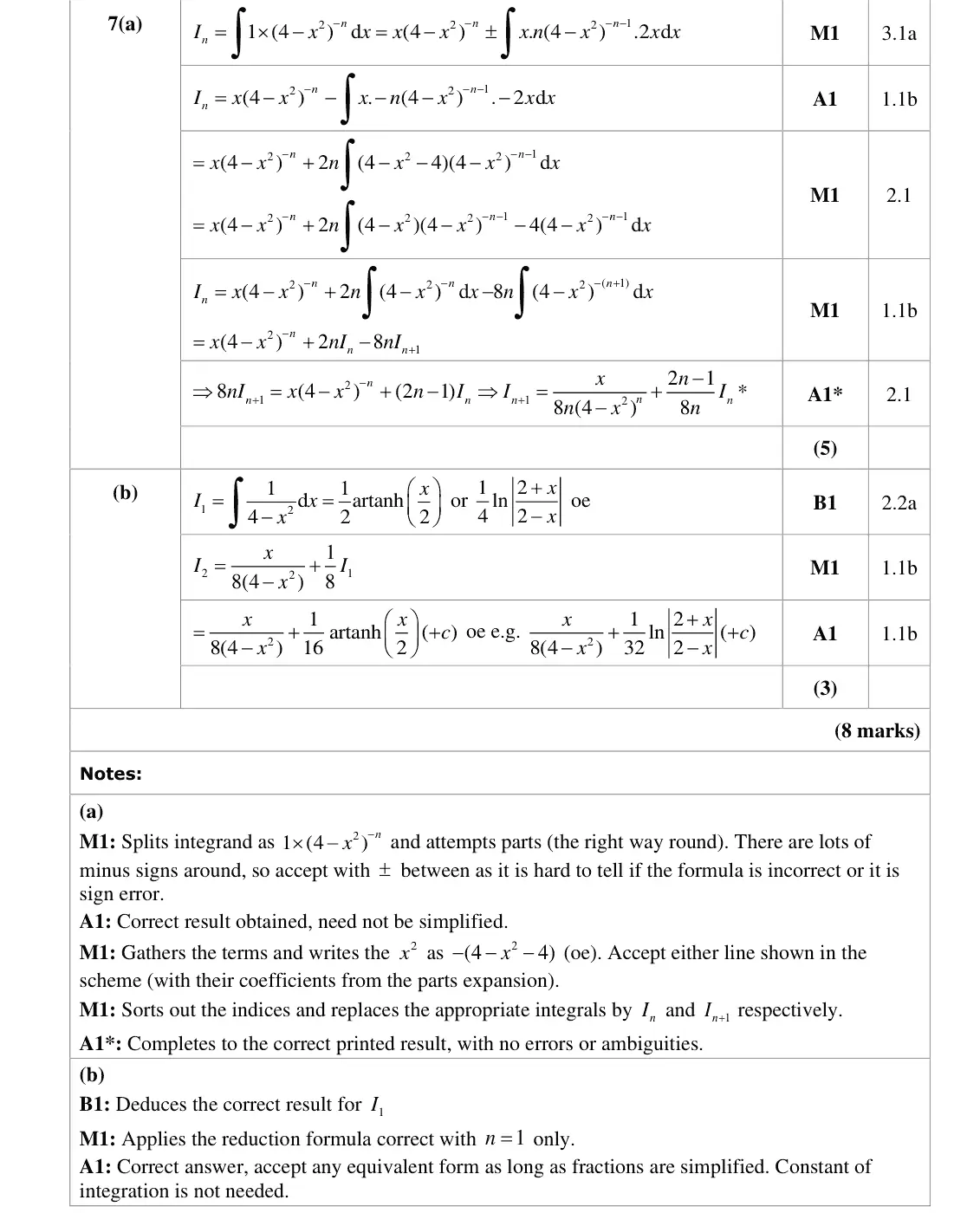
7(a) Reduction formulae, arc length and surface area 5 —
7(b) Reduction formulae, arc length and surface area 3 —
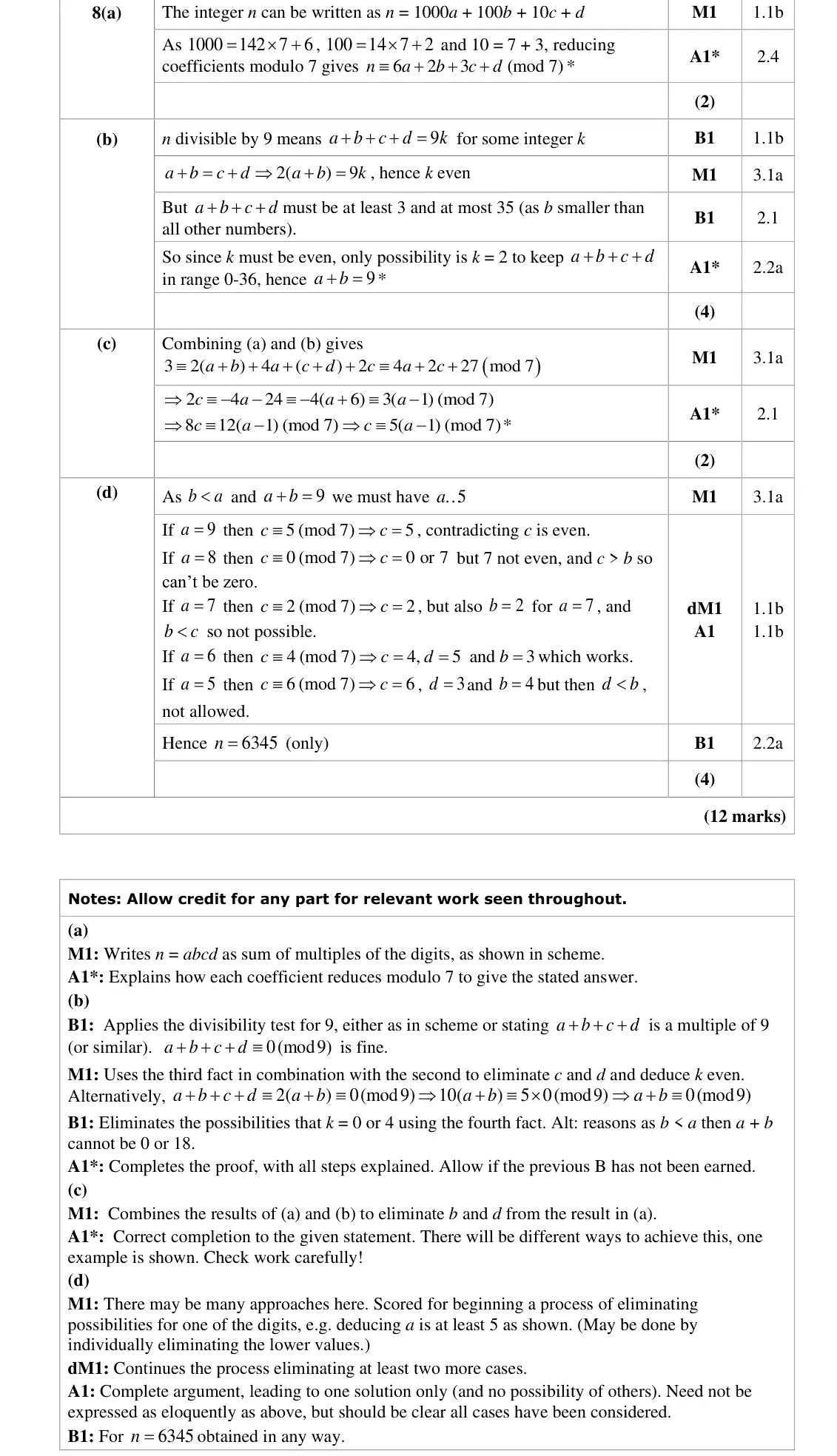
8(a) Number theory: Euclid, Bezout, modular arithmetic and Fermat 2 —
8(b) Number theory: Euclid, Bezout, modular arithmetic and Fermat 4 —
8(c) Number theory: Euclid, Bezout, modular arithmetic and Fermat 2 —
8(d) Number theory: Euclid, Bezout, modular arithmetic and Fermat 4 —

The questions

1(i)1(ii)1(iii)23(a)3(b)45(a)5(b)6(a)6(b)6(c)6(d)7(a)7(b)8(a)8(b)8(c)8(d)
Oct 2020 · Paper 4A (Further Pure 2) · Q1(i) 1 mark combinatorics
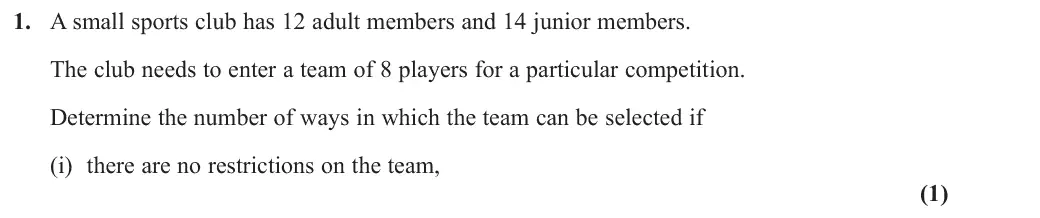
1. A small sports club has 12 adult members and 14 junior members. The club needs to enter a team of 8 players for a particular competition. Determine the number of ways in which the team can be selected if (i) there are no restrictions on the team, (1)
Oct 2020 · Paper 4A (Further Pure 2) · Q1(ii) 2 marks combinatorics
(ii) the team must contain 4 adults and 4 juniors, (2)
Oct 2020 · Paper 4A (Further Pure 2) · Q1(iii) 3 marks combinatorics
(iii) more than half the team must be adults. (3)
Oct 2020 · Paper 4A (Further Pure 2) · Q2 9 marks recurrence relations fp2
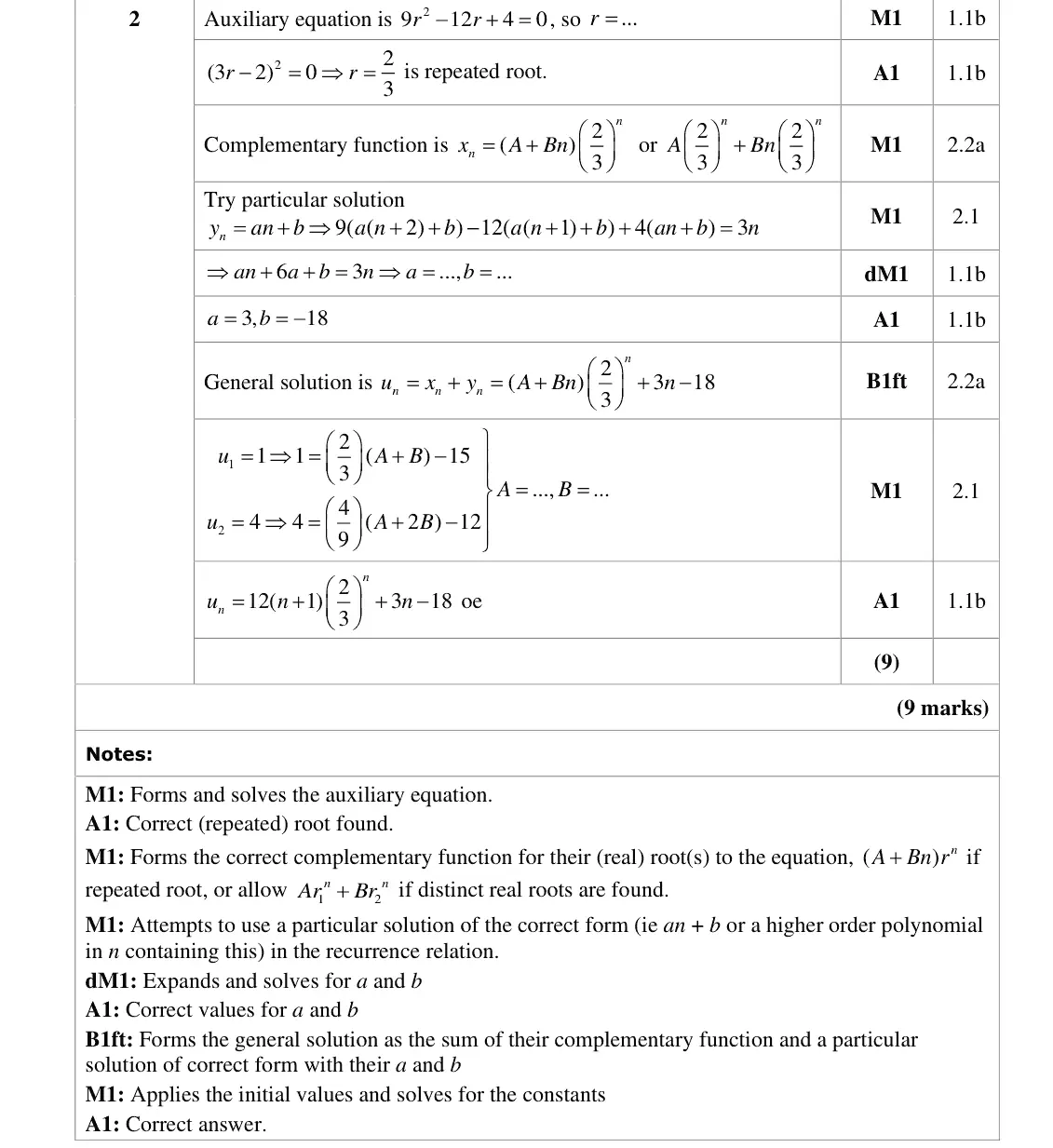
2. Solve the recurrence system u1 = 1 u2 = 4 9un + 2 – 12un + 1 + 4un = 3n (9)
Oct 2020 · Paper 4A (Further Pure 2) · Q3(a) 3 marks eigenvalues and eigenvectors
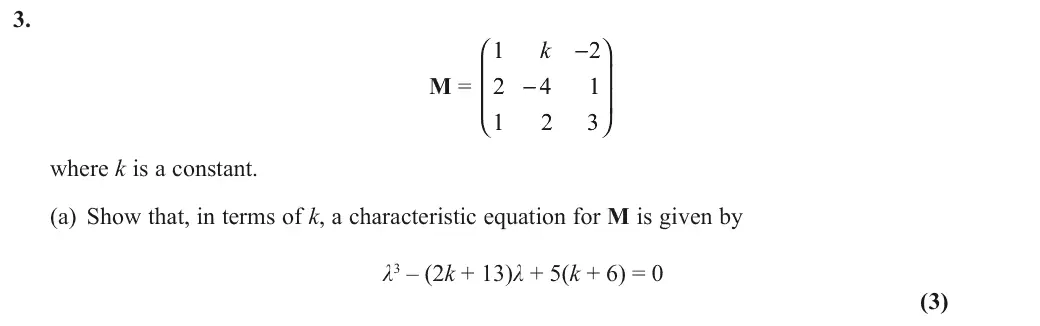
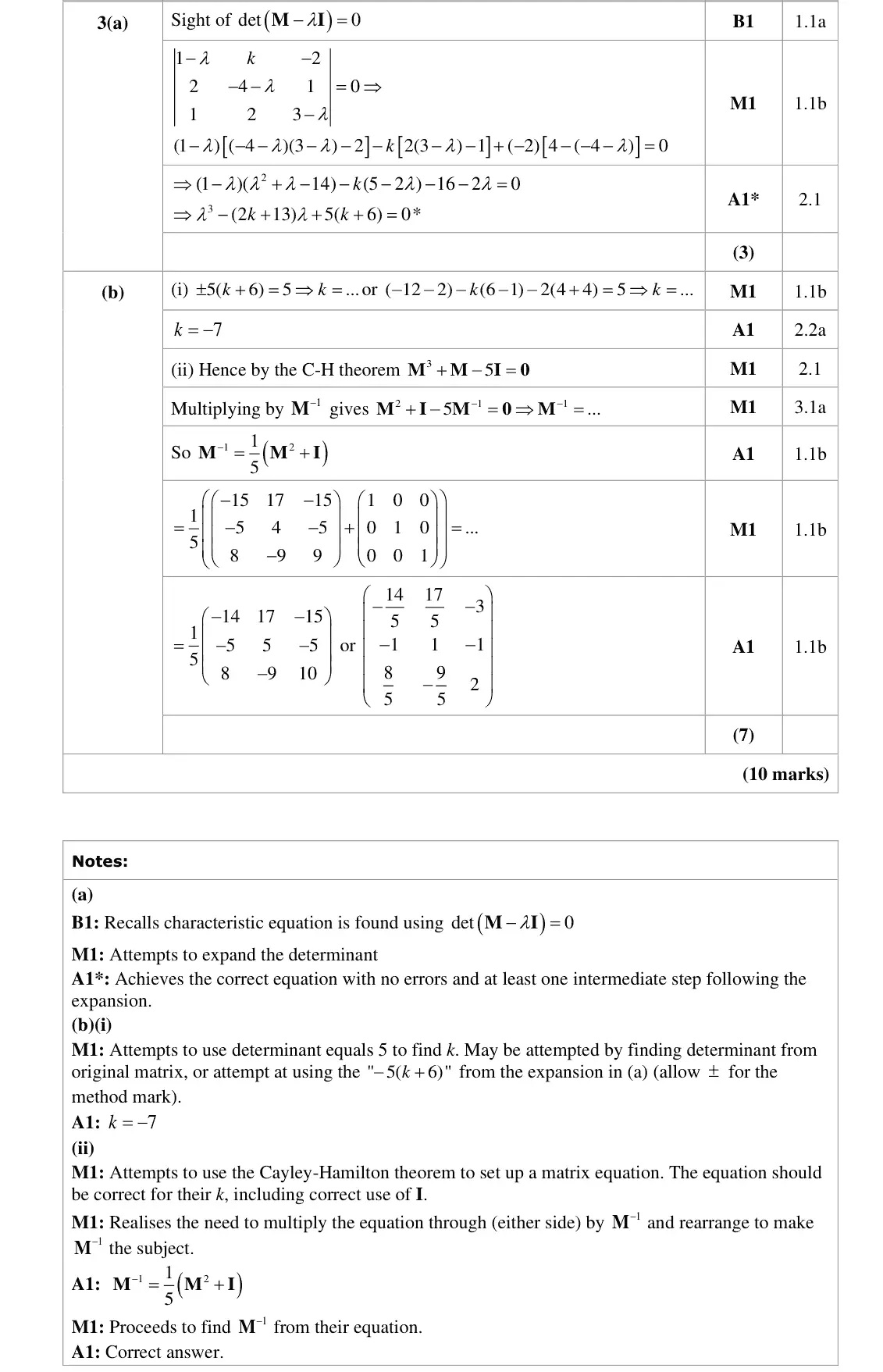
3. k - M = - where k is a constant. (a) Show that, in terms of k, a characteristic equation for M is given by λ3 – (2k + 13)λ + 5(k + 6) = 0 (3)
Oct 2020 · Paper 4A (Further Pure 2) · Q3(b) 7 marks eigenvalues and eigenvectors
Given that det M = 5 (b) (i) find the value of k (ii) use the Cayley‑Hamilton theorem to find the inverse of M. (7)
Oct 2020 · Paper 4A (Further Pure 2) · Q4 10 marks reduction formulae arc length
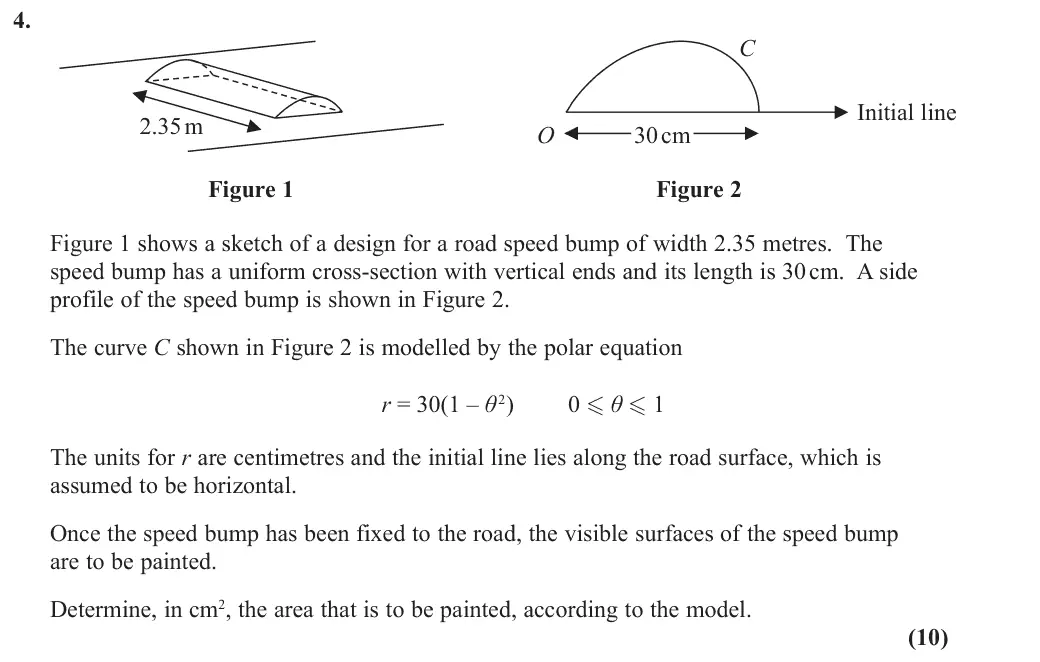
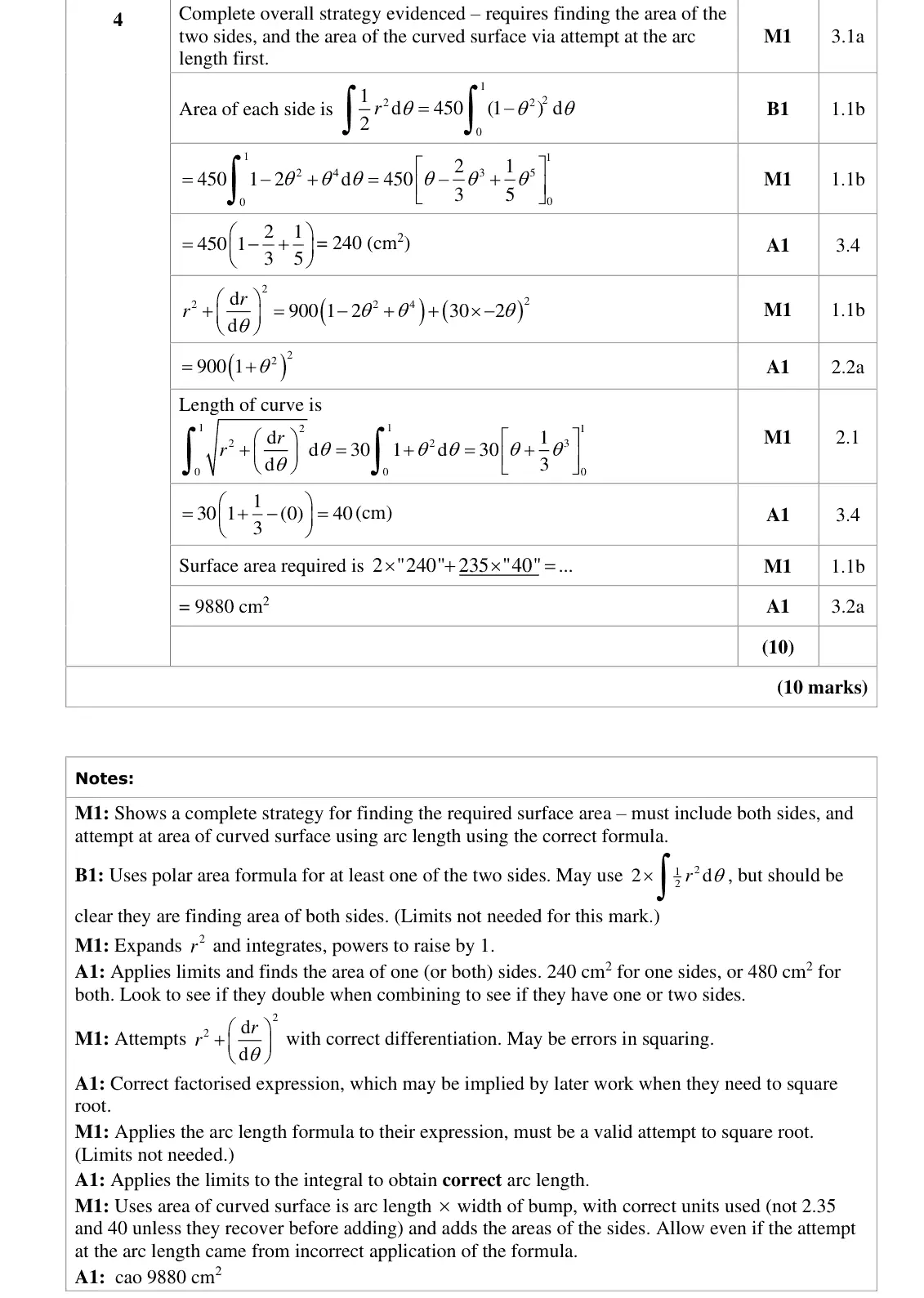
4. C Initial line 2.35 m 30 cm Figure 1 Figure 2 Figure 1 shows a sketch of a design for a road speed bump of width 2.35 metres. The speed bump has a uniform cross‑section with vertical ends and its length is 30 cm. A side profile of the speed bump is shown in Figure 2. The curve C shown in Figure 2 is modelled by the polar equation r = 30(1 – theta 2) 0 theta 1 The units for r are centimetres and the initial line lies along the road surface, which is assumed to be horizontal. Once the speed bump has been fixed to the road, the visible surfaces of the speed bump are to be painted. Determine, in cm2, the area that is to be painted, according to the model. (10)
Oct 2020 · Paper 4A (Further Pure 2) · Q5(a) 4 marks complex transformations
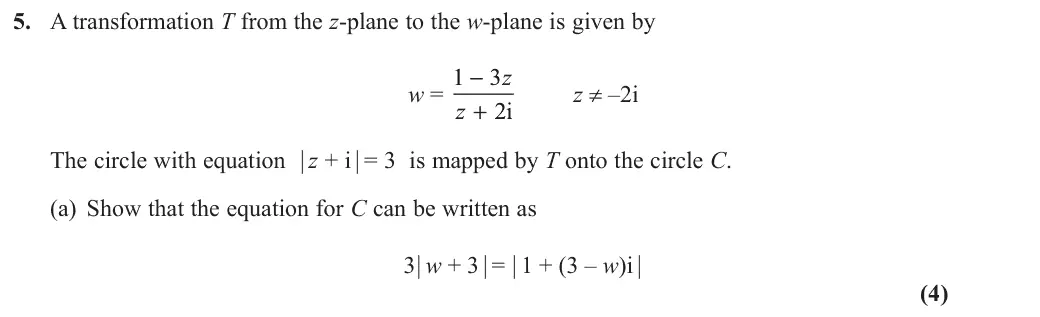
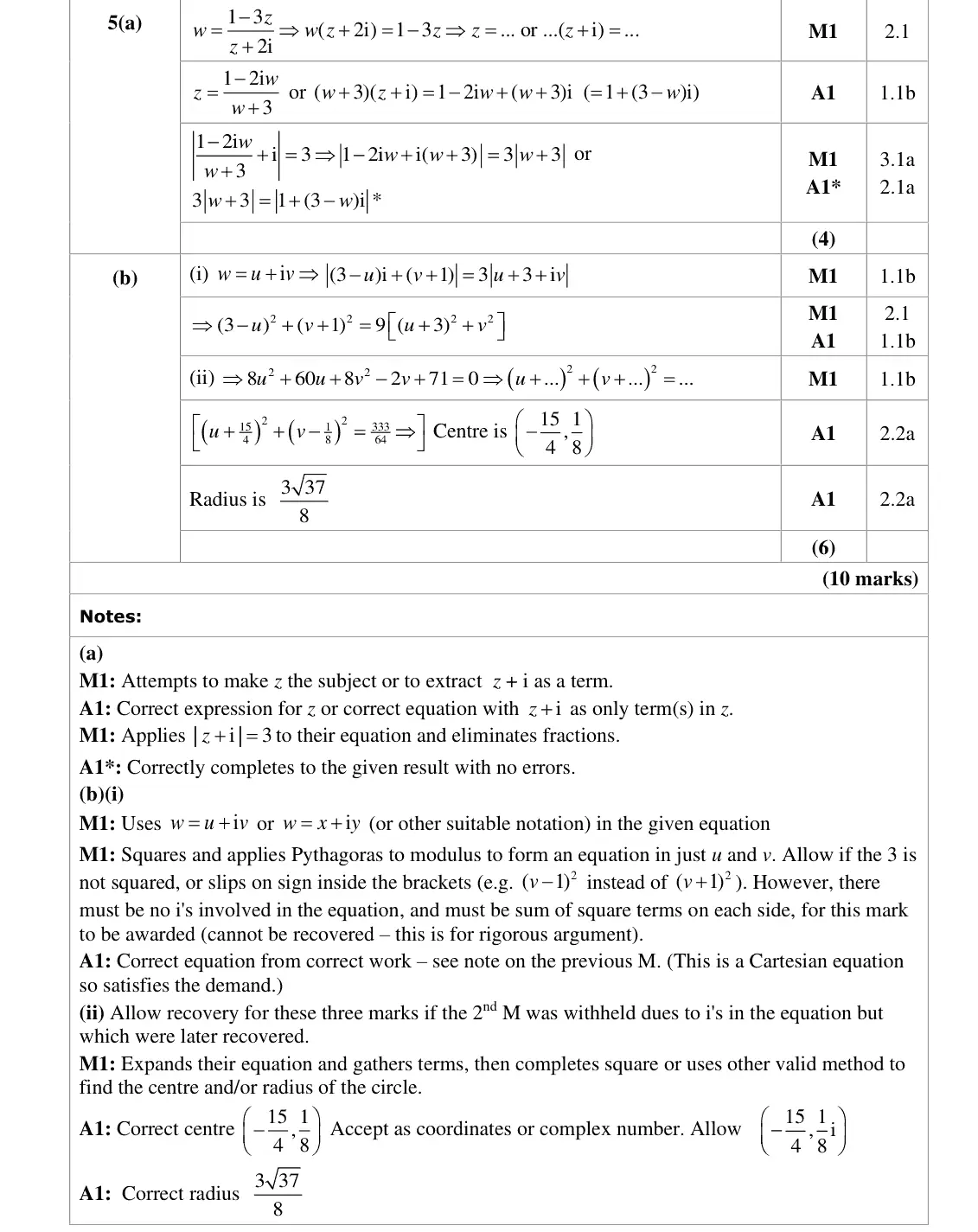
5. A transformation T from the z‑plane to the w‑plane is given by - z w = 1 i z ≠ –2i z + The circle with equation ½ z + i ½ = 3 is mapped by T onto the circle C. (a) Show that the equation for C can be written as 3½ w + 3 ½ = ½ 1 + (3 – w)i ½ (4)
Oct 2020 · Paper 4A (Further Pure 2) · Q5(b) 6 marks complex transformations
(b) Hence find (i) a Cartesian equation for C, (ii) the centre and radius of C. (6)
Oct 2020 · Paper 4A (Further Pure 2) · Q6(a) 2 marks groups
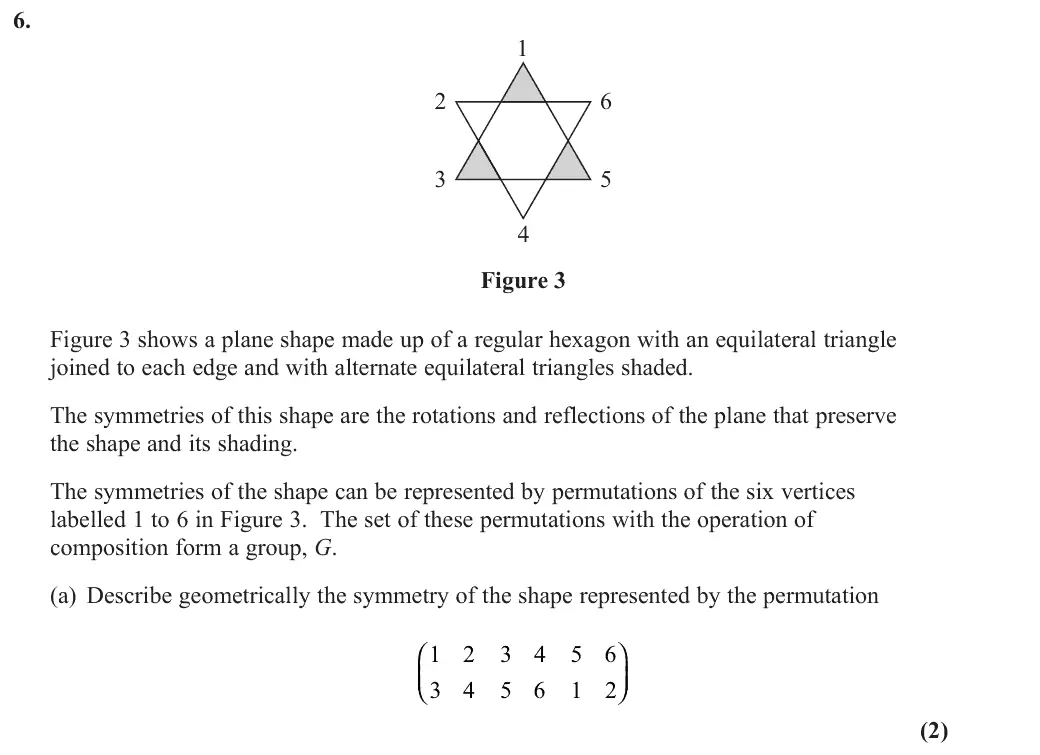
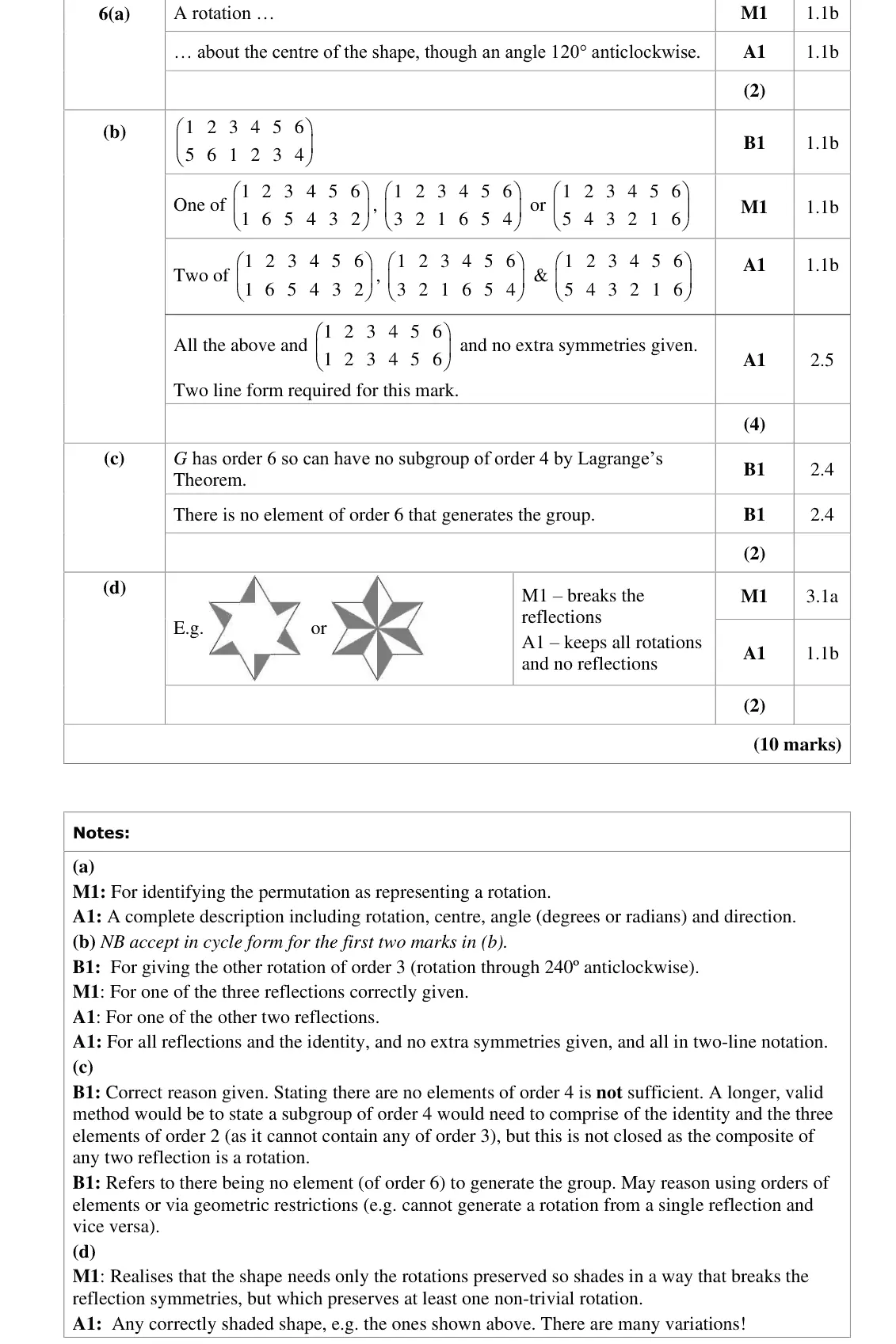
6. Figure 3 Figure 3 shows a plane shape made up of a regular hexagon with an equilateral triangle joined to each edge and with alternate equilateral triangles shaded. The symmetries of this shape are the rotations and reflections of the plane that preserve the shape and its shading. The symmetries of the shape can be represented by permutations of the six vertices labelled 1 to 6 in Figure 3. The set of these permutations with the operation of composition form a group, G. (a) Describe geometrically the symmetry of the shape represented by the permutation (2)
Oct 2020 · Paper 4A (Further Pure 2) · Q6(b) 4 marks groups
(b) Write down, in similar two‑line notation, the remaining elements of the group G. (4)
Oct 2020 · Paper 4A (Further Pure 2) · Q6(c) 2 marks groups
(c) Explain why each of the following statements is false, making your reasoning clear. (i) G has a subgroup of order 4 (ii) G is cyclic. (2)
Oct 2020 · Paper 4A (Further Pure 2) · Q6(d) 2 marks groups
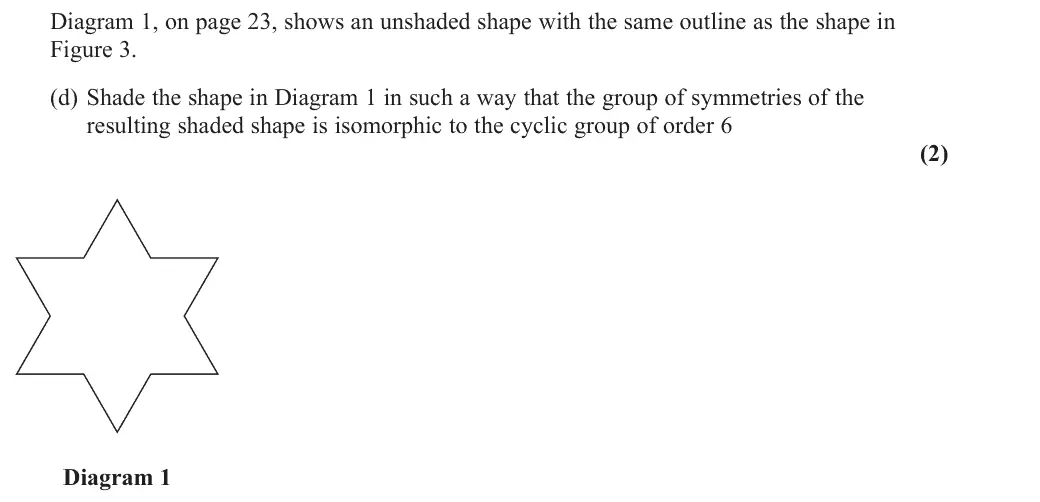
Diagram 1, on page 23, shows an unshaded shape with the same outline as the shape in Figure 3. (d) Shade the shape in Diagram 1 in such a way that the group of symmetries of the resulting shaded shape is isomorphic to the cyclic group of order 6 (2)
Oct 2020 · Paper 4A (Further Pure 2) · Q7(a) 5 marks reduction formulae arc length
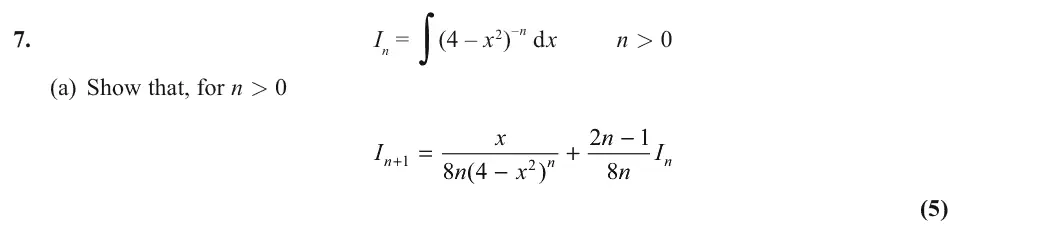
In = ∫(4 – x2) 7. –n dx n > 0 (a) Show that, for n > 0 x n - I + = + I n n n n x n ( - ) (5)
Oct 2020 · Paper 4A (Further Pure 2) · Q7(b) 3 marks reduction formulae arc length
(b) Find I2 (3)
Oct 2020 · Paper 4A (Further Pure 2) · Q8(a) 2 marks number theory
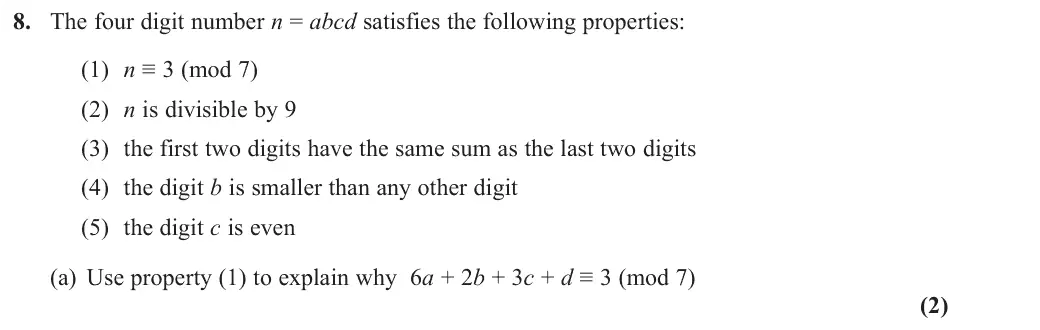
8. The four digit number n = abcd satisfies the following properties: (1) n ≡ 3 (mod 7) (2) n is divisible by 9 (3) the first two digits have the same sum as the last two digits (4) the digit b is smaller than any other digit (5) the digit c is even (a) Use property (1) to explain why 6a + 2b + 3c + d ≡ 3 (mod 7) (2)
Oct 2020 · Paper 4A (Further Pure 2) · Q8(b) 4 marks number theory
(b) Use properties (2), (3) and (4) to show that a + b = 9 (4)
Oct 2020 · Paper 4A (Further Pure 2) · Q8(c) 2 marks number theory
(c) Deduce that c ≡ 5(a – 1) (mod 7) (2)
Oct 2020 · Paper 4A (Further Pure 2) · Q8(d) 4 marks number theory
(d) Hence determine the number n, verifying that it is unique. You must make your reasoning clear. (4)

Find an Edexcel Further Maths tutor

Want this paper marked and gone through with a Further Maths tutor? Message us.
Prefer email? Send an enquiry

If you are under 18, please include a parent's contact details. Enquiries go to enquiries@alevelfurthermathstutor.com and are deleted once handled.