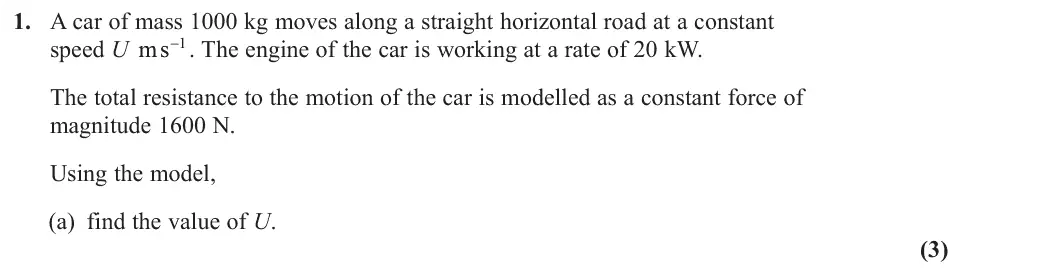
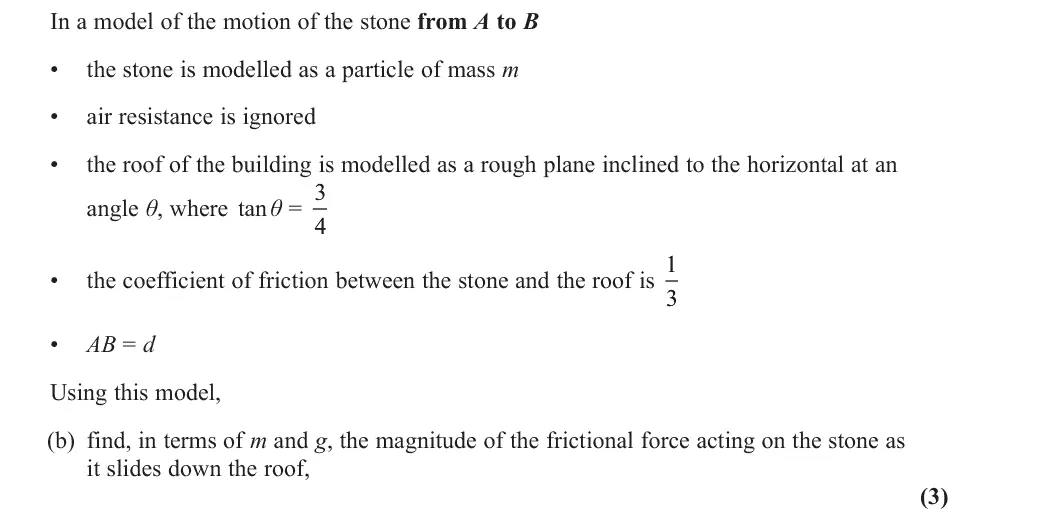
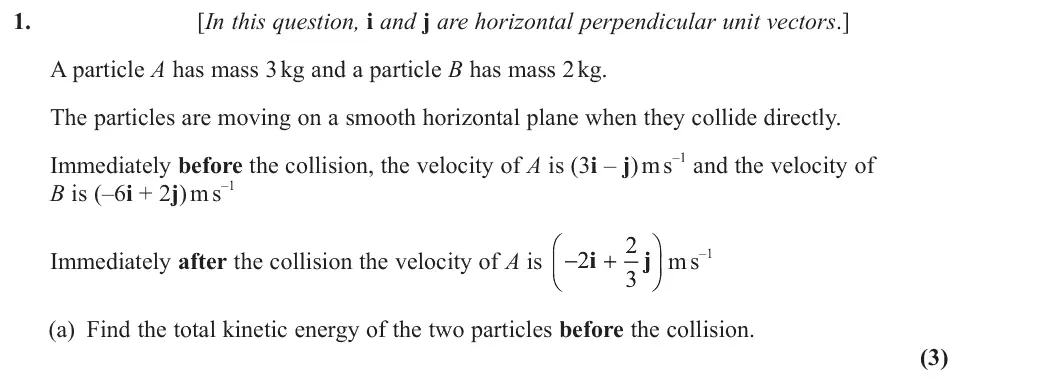
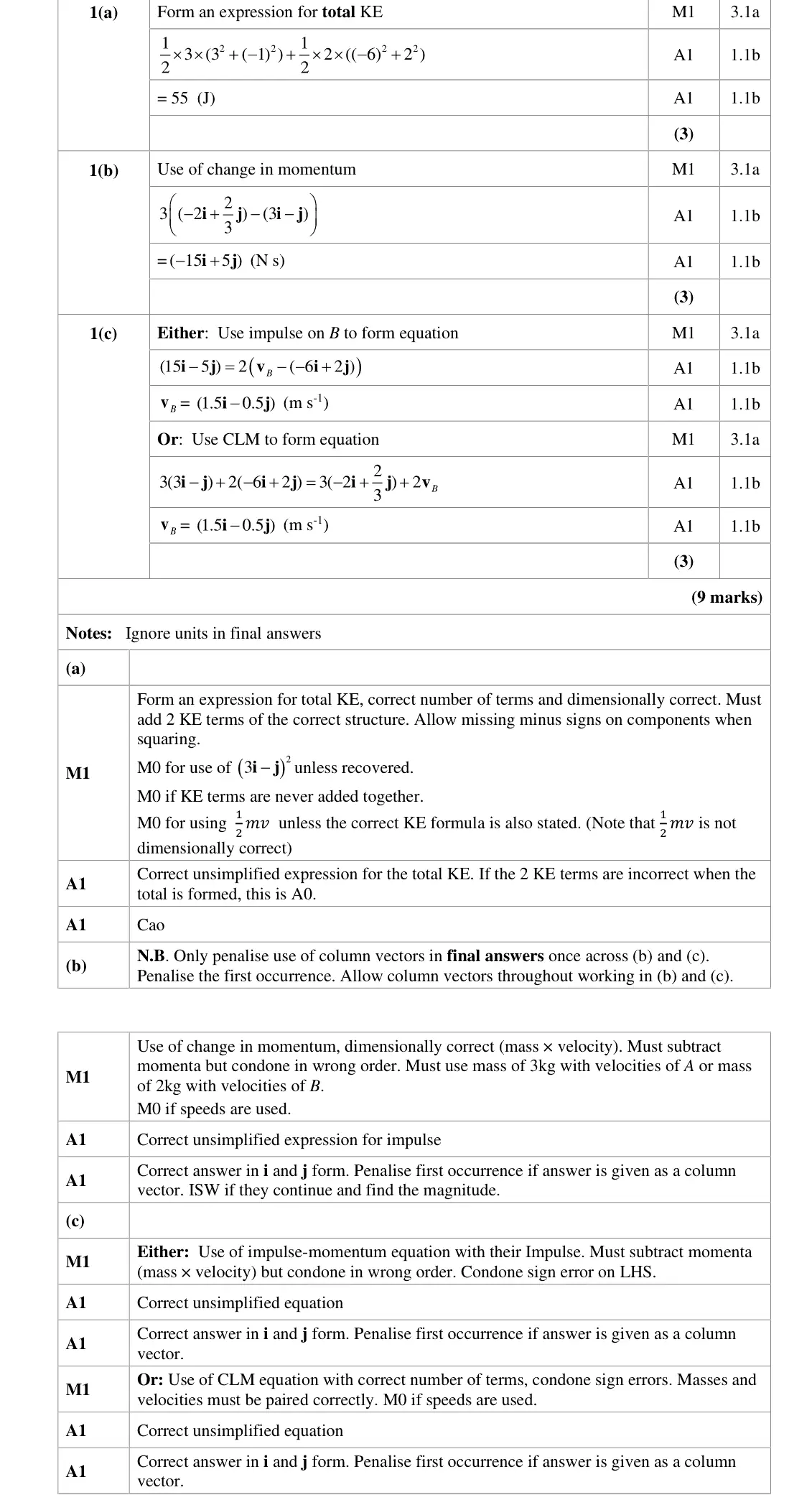
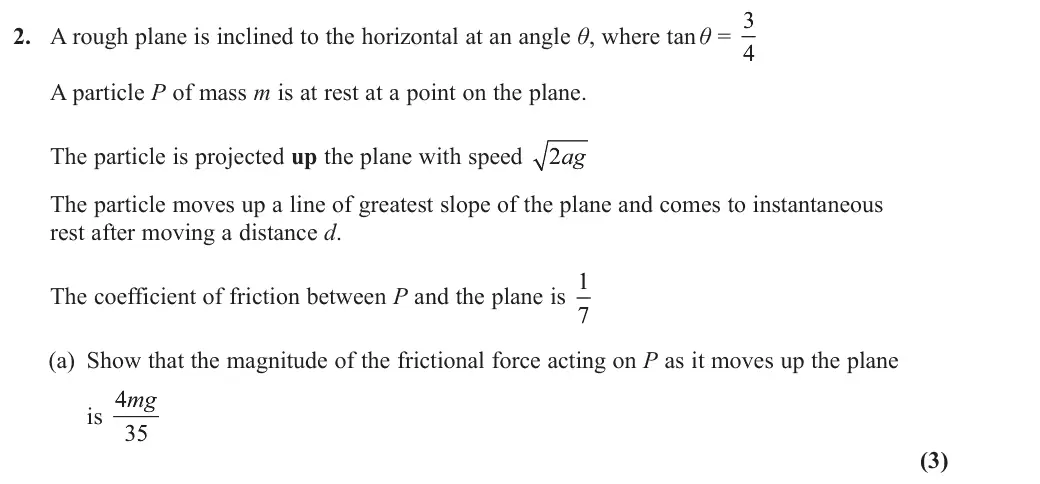
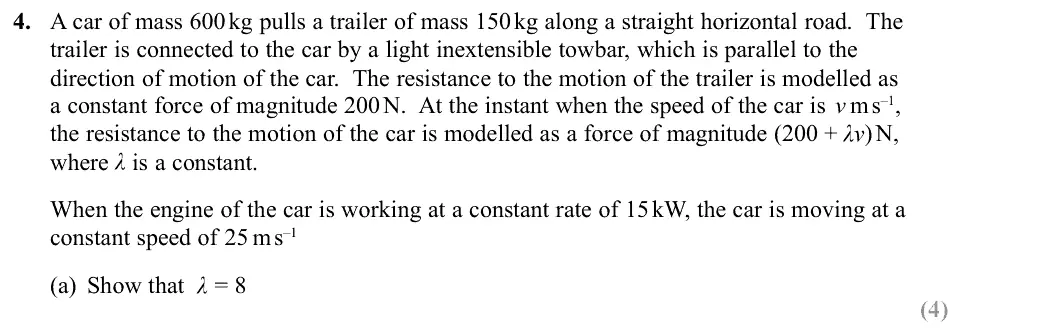
June 2025 · AS Paper 2 (Further Mechanics 1) · Q1(a)3 marks
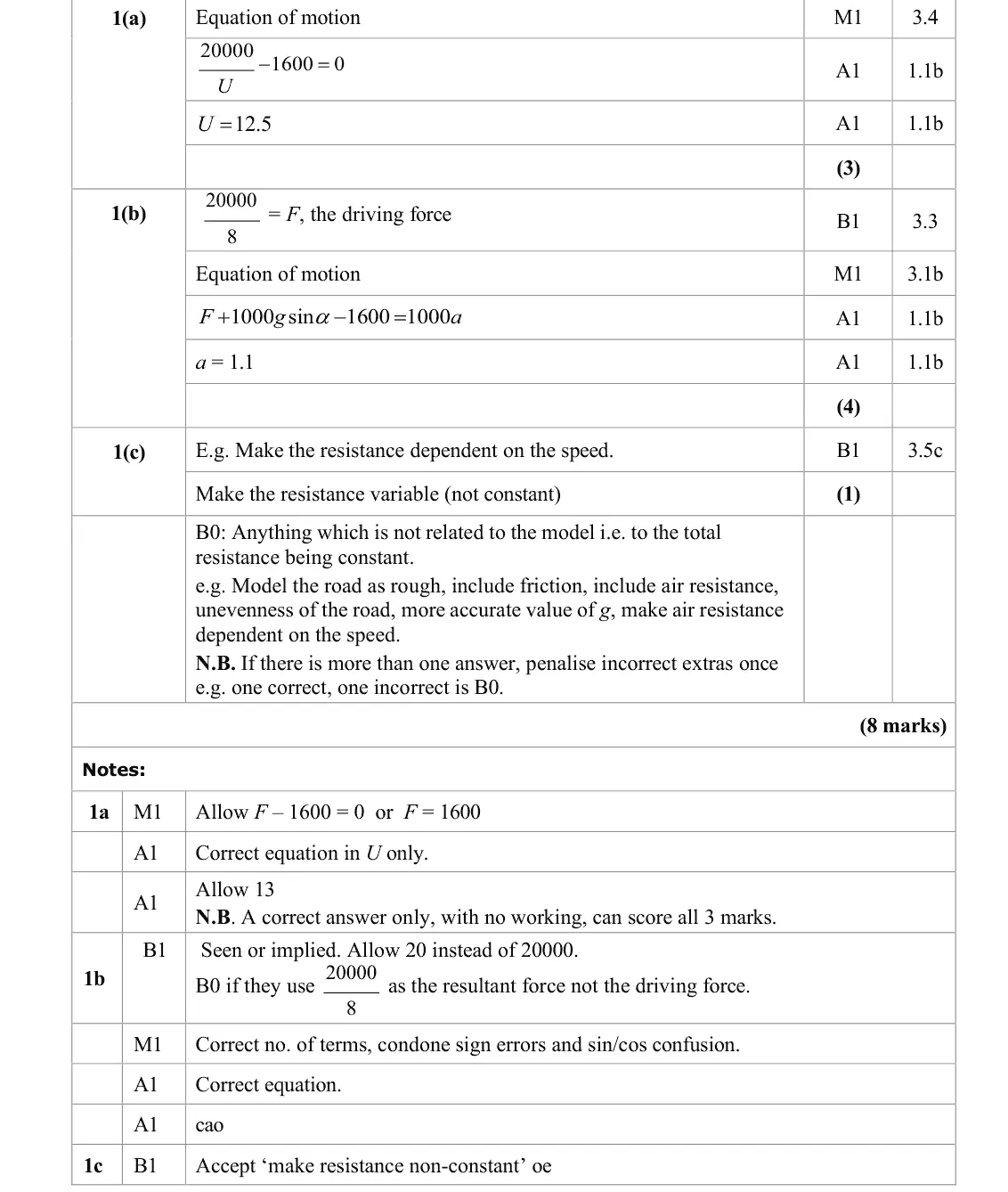
Mark scheme (whole question; this part is marked with the orange bar)
Examiner's comment
There were many fully correct responses and in part (a), almost all equated 20000/U to the resistance and found the value of U. A few missed the reference to constant speed and had an a in their equation of motion and were unable to make any progress.
Key points from the mark scheme and examiner's report
constant speed so 20000/U − 1600 = 0, U = 12.5
including an acceleration term blocks progress
June 2025 · AS Paper 2 (Further Mechanics 1) · Q1(b)4 marks
Mark scheme (whole question; this part is marked with the orange bar)
Examiner's comment
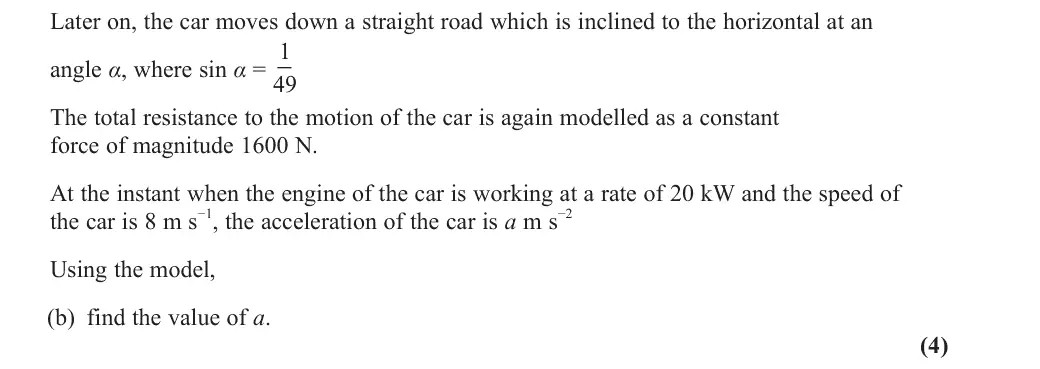
In part (b), again there were few errors, the most common being omission of the weight component from the equation of motion or including it but with a wrong sign. There were many correct answers to the final part with most picking up on the fact that the
Key points from the mark scheme and examiner's report
driving force 20000/8 = 2500 (not the resultant force)
F + 1000g sin α − 1600 = 1000a gives a = 1.1
weight component omitted or with the wrong sign (car moves downhill)
June 2025 · AS Paper 2 (Further Mechanics 1) · Q1(c)1 mark
Mark scheme (whole question; this part is marked with the orange bar)
Examiner's comment
There were many correct answers to the final part with most picking up on the fact that the resistance was unlikely to be constant. A few did not appreciate that the total resistance to motion had been modelled and felt the need to add others.
Key points from the mark scheme and examiner's report
make the resistance vary (e.g. with speed)
adding friction or air resistance scores B0 because the total resistance is already modelled
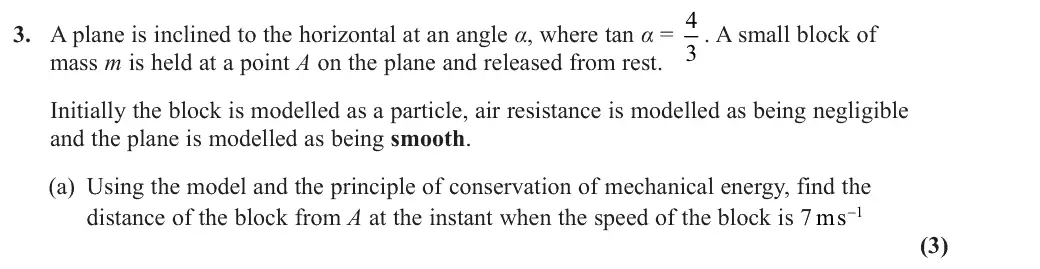
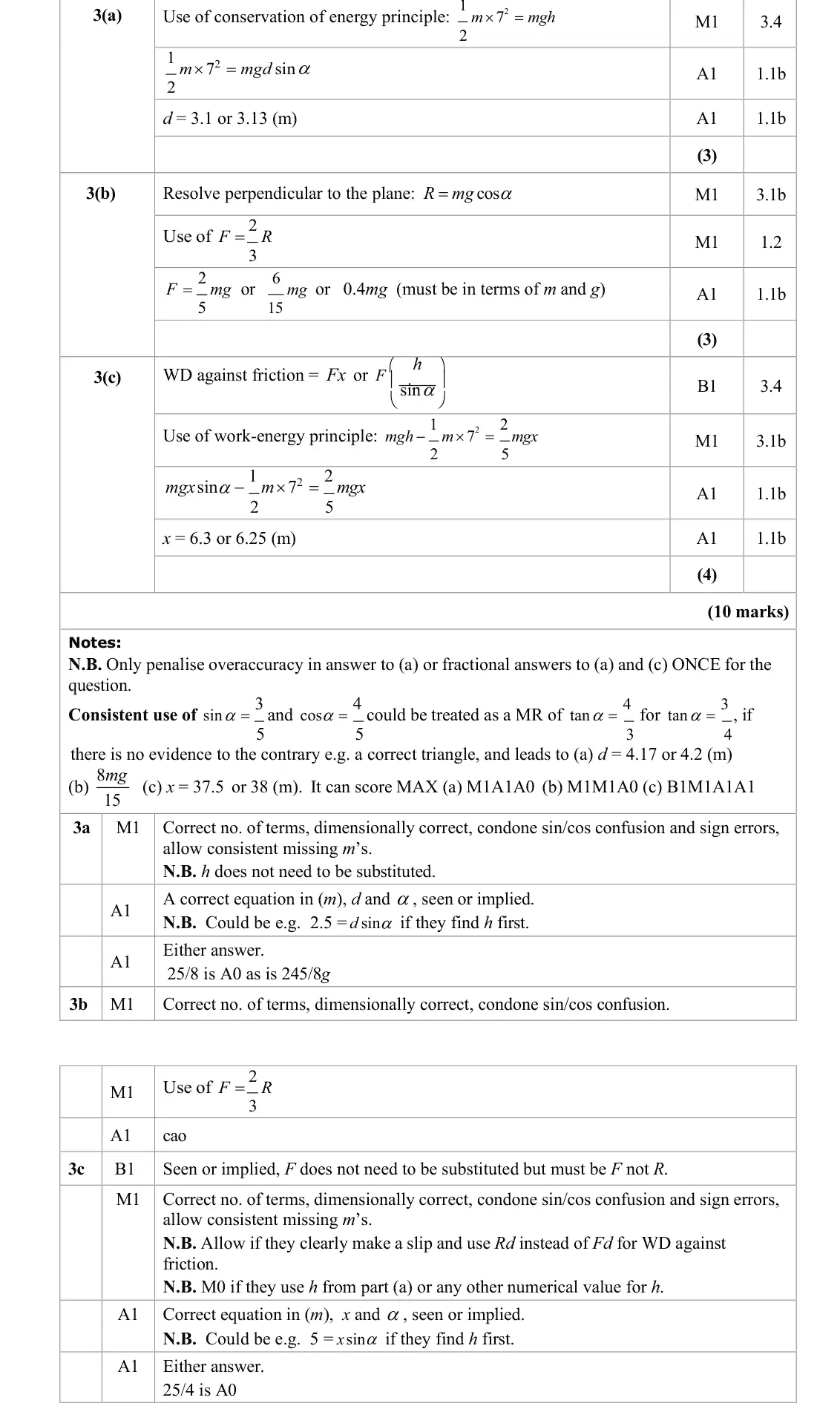
June 2025 · AS Paper 2 (Further Mechanics 1) · Q3(a)3 marks
Mark scheme (whole question; this part is marked with the orange bar)
Examiner's comment
Part (a) was well answered but many otherwise correct solutions were not rounded to 2 or 3 sf and 3.125 was a very common wrong answer, with a few giving 25/8. Most were able to write down an energy equation and solve it but a few ignored the question and used suvat formulae and scored nothing. A common error was to use h = d/sin alpha in the PE term. The second part was accessible to all but the least abled and often learners who scored poorly in (a) and (c), achieved full marks here. There were many correct solutions for part (c) and oddly, some learners who didn’t use conservation of energy for (a), were quite happy using the work-energy principle here. Again there were those who used suvat instead and scored nothing although these were relatively few in number. Common errors here included using F rather than Fd for the WD against friction, giving it the wrong sign in the equation or omitting the WD against friction altogether. A few over complicated their solutions by using two vertical heights rather than the change in vertical height when dealing with the PE, often resulting in mistakes being made.
Key points from the mark scheme and examiner's report
½m × 7² = mgd sin α with sin α = 4/5: d = 3.13 m (3.125 or 25/8 over-specified)
h = d/sin α is wrong
suvat scores 0
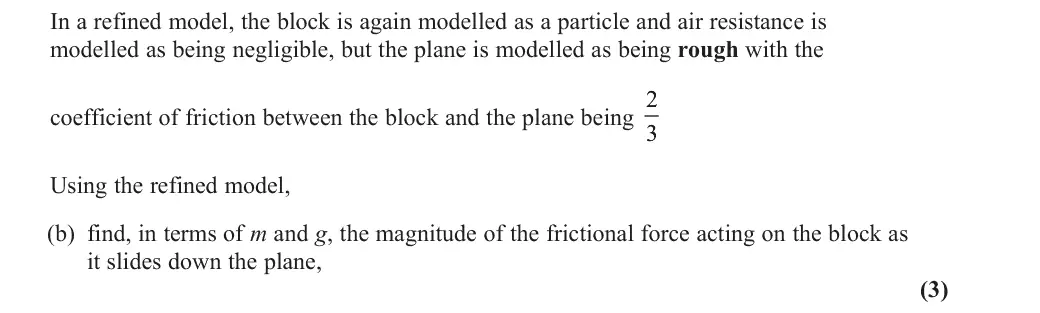
June 2025 · AS Paper 2 (Further Mechanics 1) · Q3(b)3 marks
Mark scheme (whole question; this part is marked with the orange bar)
Examiner's comment
The second part was accessible to all but the least abled and often learners who scored poorly
Key points from the mark scheme and examiner's report
R = mg cos α with cos α = 3/5
F = (2/3)R = 2mg/5
set-up for the work-energy step in (c)
June 2025 · AS Paper 2 (Further Mechanics 1) · Q3(c)4 marks
Mark scheme (whole question; this part is marked with the orange bar)
Examiner's comment
in (a) and (c), achieved full marks here. There were many correct solutions for part (c) and oddly, some learners who didn’t use conservation of energy for (a), were quite happy using the work-energy principle here. Again
Key points from the mark scheme and examiner's report
work-energy: mgx sin α − ½m × 7² = (2/5)mgx, x = 6.25 m (6.3)
using F instead of Fx for work against friction, wrong sign, or reusing h from (a)
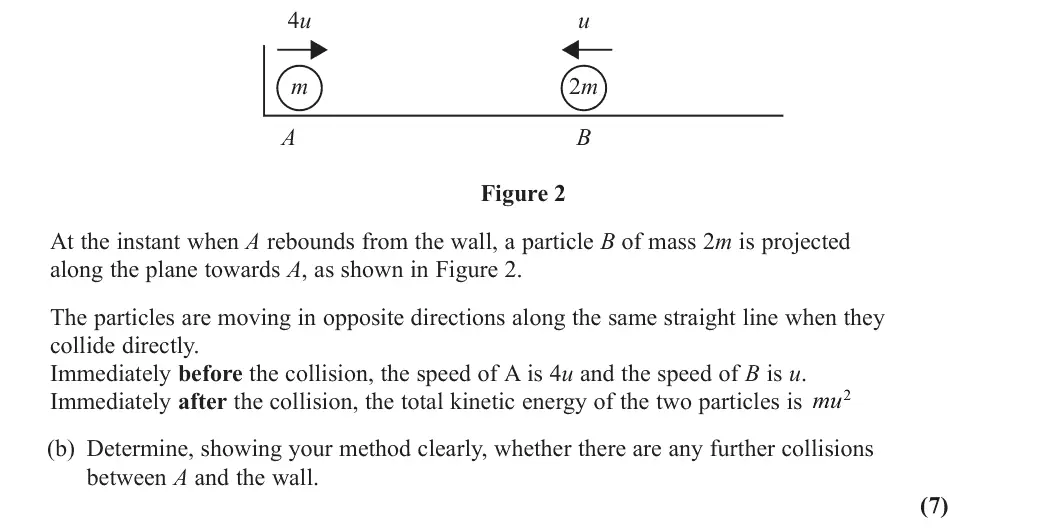
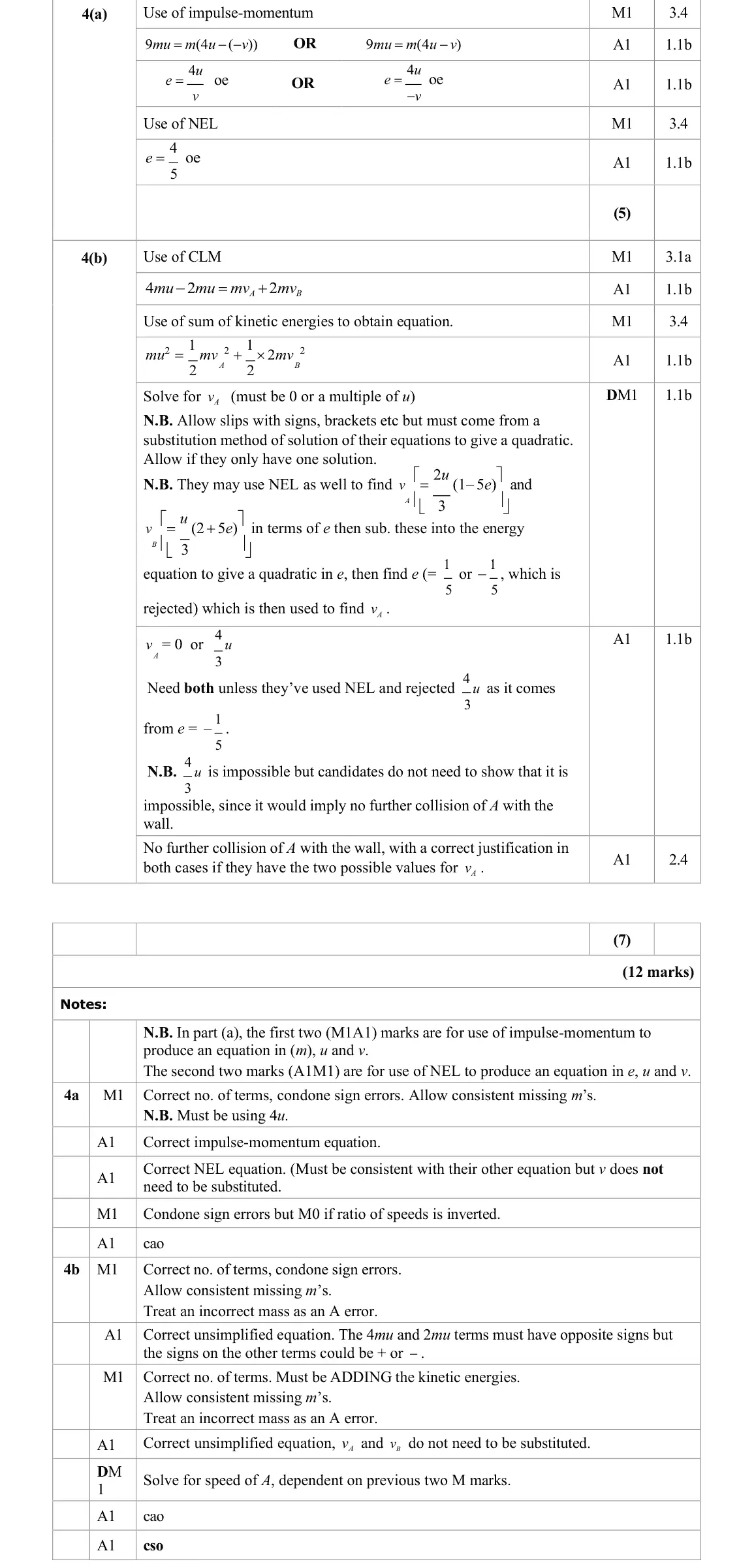
June 2025 · AS Paper 2 (Further Mechanics 1) · Q4(b)7 marks
Mark scheme (whole question; this part is marked with the orange bar)
Examiner's comment
The second part proved to be challenging for all but the very best students and there were very few completely correct solutions. The first 4 marks were very straightforward but a surprisingly large number omitted the 2 in one or other of the CLM and KE equations. This often then led to pages of incorrect algebra. Learners would be well advised to check their equations carefully 2 before using them. Another common error was to treat mu as the KE loss rather than the final KE which again resulted in lots of unnecessary algebra. This often wasn’t helped by some very 2 2 basic fundamental mistakes being made – a common one being . A few chose u v u v + = + to include NEL, despite not being given the coefficient of restitution between the particles and made life a lot more difficult for themselves. However, some of these did struggle through, found the correct values for e, and went on to produce fully correct solutions. Some learners, who were close to producing a fully correct answer, fell at the final hurdle by cancelling the variable from their quadratic (forgetting that it could be zero). This left only one solution which unfortunately was the wrong one.
Key points from the mark scheme and examiner's report
CLM 4mu − 2mu = mv_A + 2mv_B with total KE ½mv_A² + ½(2m)v_B² = mu²
quadratic gives v_A = 0 (or 4u/3, impossible): A is at rest so no further collision with the wall
mu² is the final KE, not the loss
the 2 often dropped from a mass
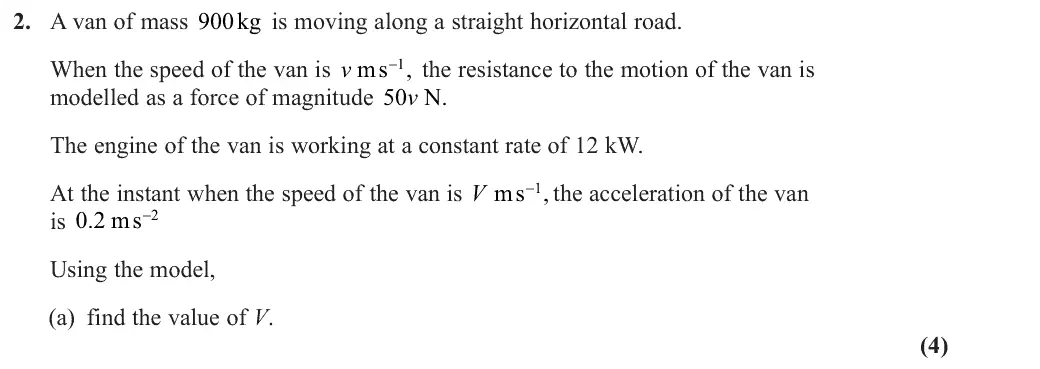
June 2025 · Paper 3C (Further Mechanics 1) · Q2(a)4 marks
Mark scheme (whole question; this part is marked with the orange bar)
Examiner's comment
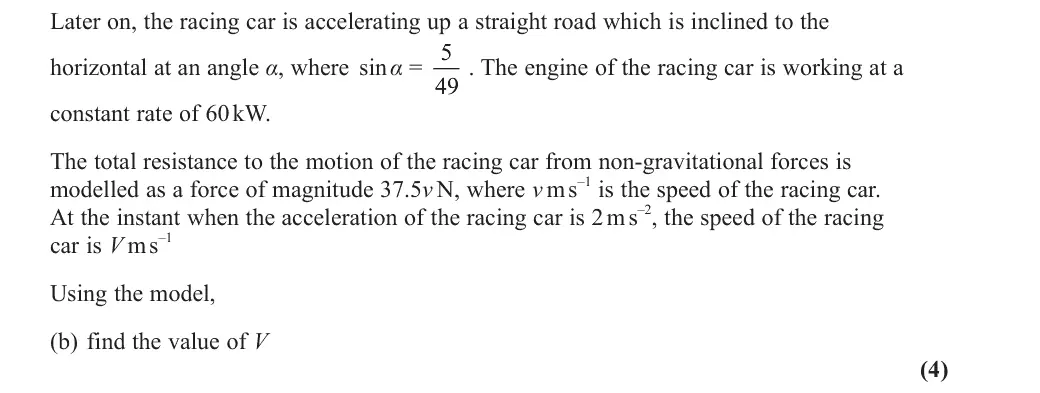
The vast majority were able to demonstrate an excellent understanding of the relationship between the power and the driving force of an engine. In both parts the most successful solutions established an equation of motion first, made D the subject, and then substituted D into the power equation. After forming and solving a quadratic equation, the negative value of V was either rejected or completely ignored. Those with low attainment often had conceptual errors, confusing the force in the power equation with the resultant force in F = ma and therefore losing crucial method marks. In
Key points from the mark scheme and examiner's report
12000/V − 50V = 900(0.2)
50V² + 180V − 12000 = 0, V = 14.0
confusing the driving force with the resultant force
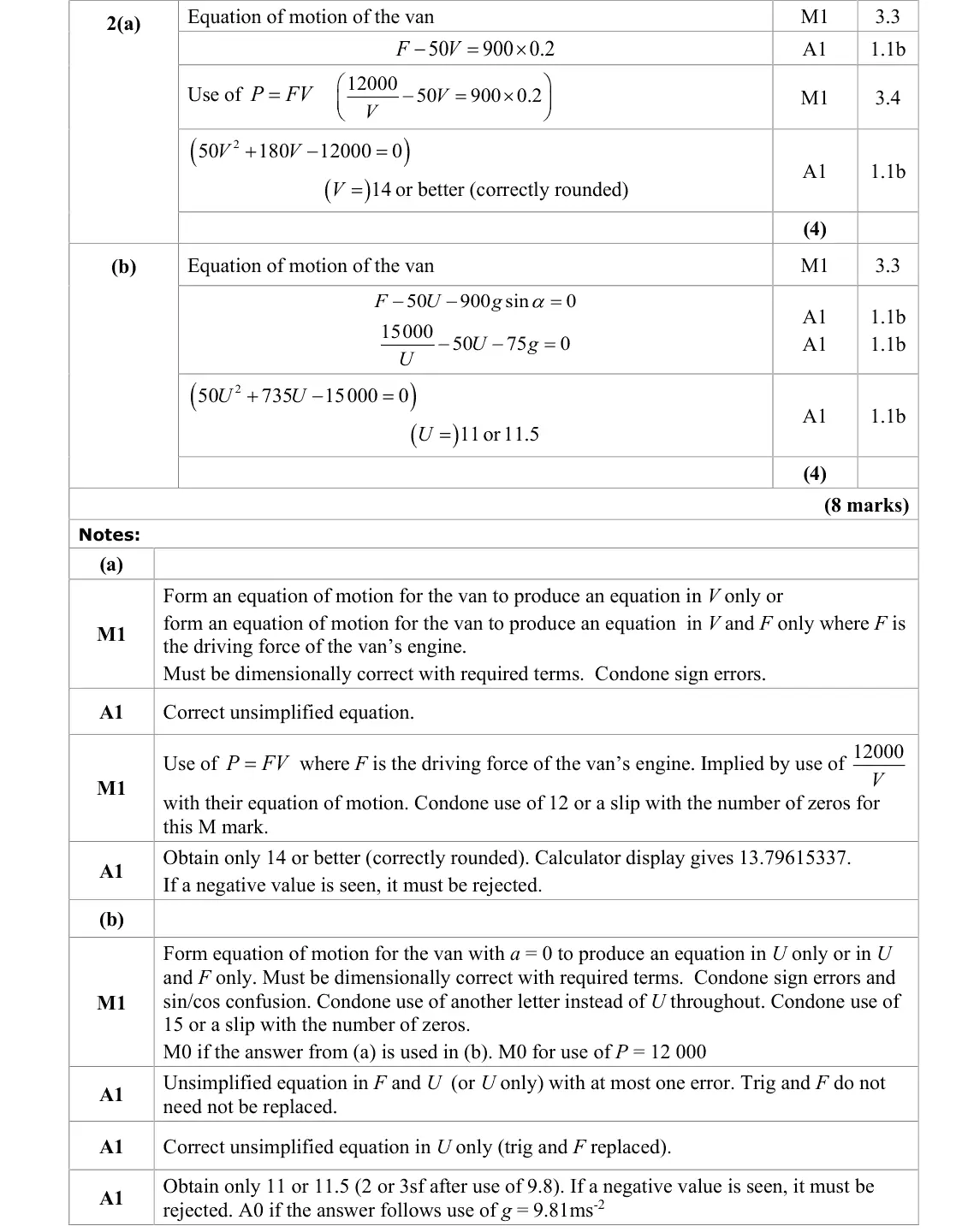
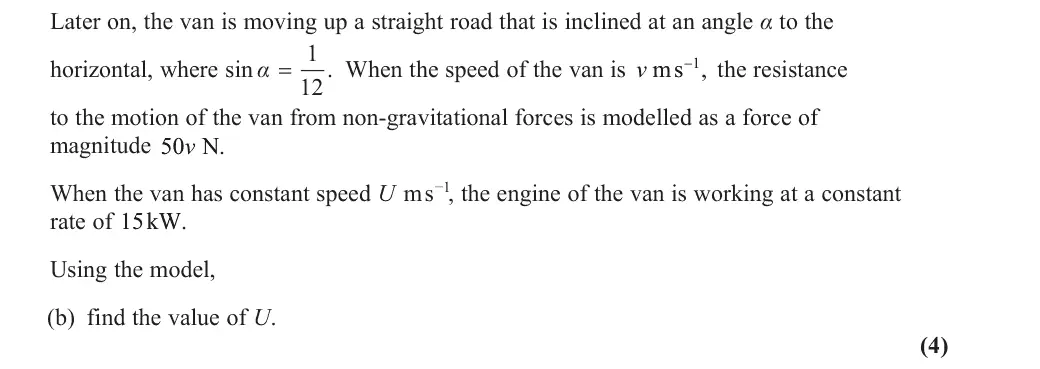
June 2025 · Paper 3C (Further Mechanics 1) · Q2(b)4 marks
Mark scheme (whole question; this part is marked with the orange bar)
Examiner's comment
general, learners remembered to resolve the weight force in part (b), rarely forgot g and even less showed any cos/sin confusion. However, accuracy marks were still lost by some who did not follow the instructions on the front of the paper and did not round to 2 or 3 significant 2 9.8ms-for g. figures after using
Key points from the mark scheme and examiner's report
constant speed: 15000/U − 50U − 900g/12 = 0
U = 11.5 (2 or 3 sf after g = 9.8)
reject the negative root
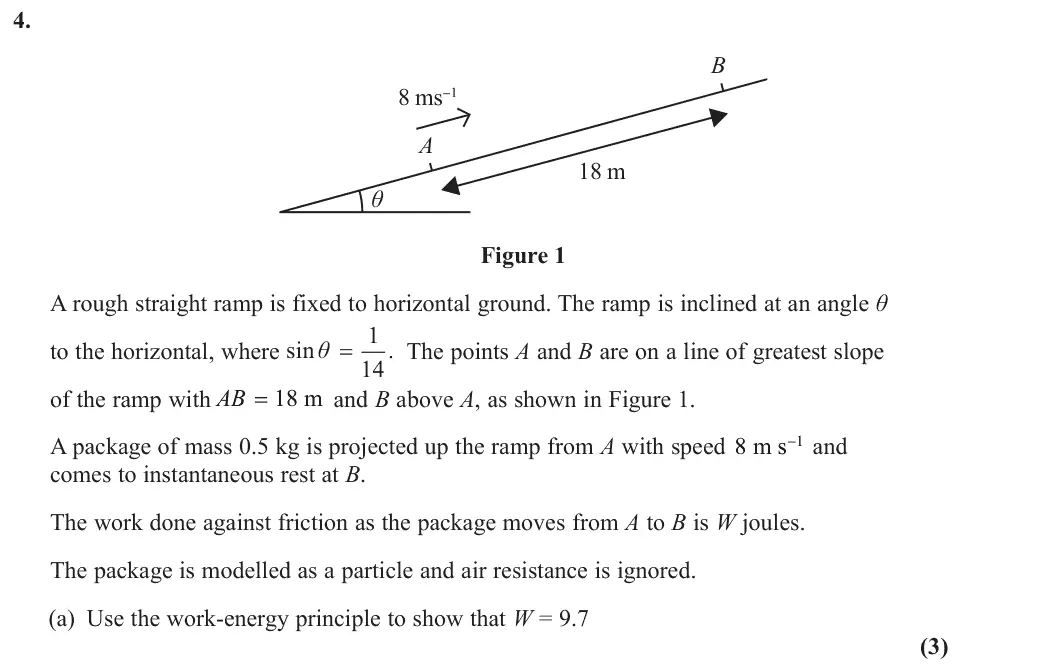
June 2025 · Paper 3C (Further Mechanics 1) · Q4(a)3 marks
Mark scheme (whole question; this part is marked with the orange bar)
Examiner's comment
With the first ‘show that’ question on the paper, some solutions lacked the rigor required to earn all marks in part (a), scoring 2 out of the 3 available. Those who were well-rehearsed, understood the requirements of a ‘show that’ question and established a work-energy equation in terms of W. After showing clearly how the energy terms were formed, they subtracted to reach the expression for W as printed in the paper. The most common incomplete solutions either did not show how the energy terms combined or did not find an expression for W, simply . stating 16 6.3 9.7 - = Confidently resolving forces on a slope, the vast majority used the work-energy principle in
Key points from the mark scheme and examiner's report
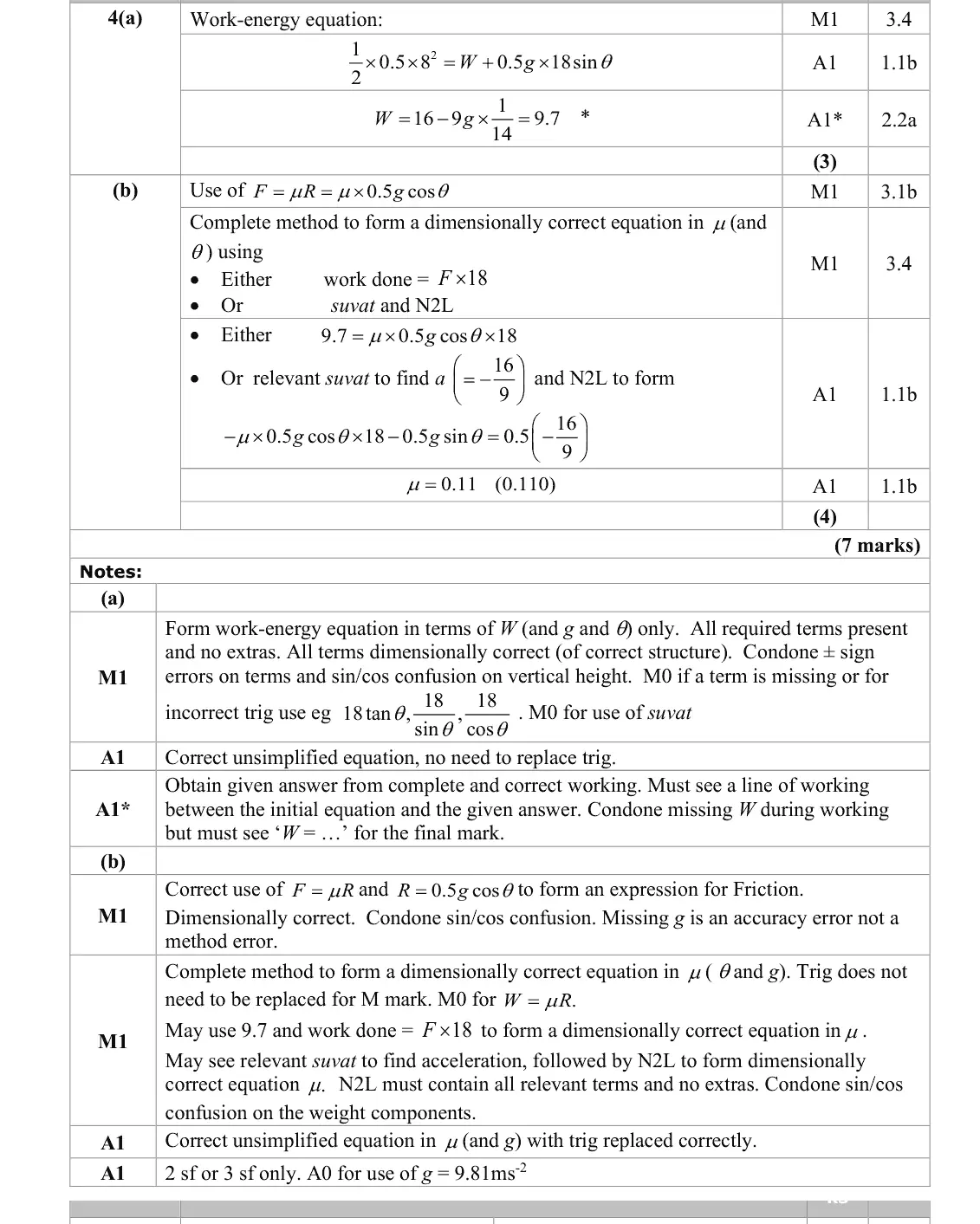
½(0.5)(8²) = W + 0.5g(18)sin θ, W = 16 − 6.3 = 9.7
must show how the energy terms combine and state W =
suvat scores 0
June 2025 · Paper 3C (Further Mechanics 1) · Q4(b)4 marks
Mark scheme (whole question; this part is marked with the orange bar)
Examiner's comment
With the first ‘show that’ question on the paper, some solutions lacked the rigor required to part (b) to form an equation in mu . It was rare for learners to confuse sin and cos and most 2 correctly rounded the answer to 2 or 3 significant figures, following the use of 9.8ms-for g.
Key points from the mark scheme and examiner's report
R = 0.5g cos θ
9.7 = μ(0.5g cos θ)(18): μ = 0.110 (2 or 3 sf)
W = μR scores M0
June 2025 · Paper 3C (Further Mechanics 1) · Q6(c)3 marks
Mark scheme (whole question; this part is marked with the orange bar)
Examiner's comment
The final part of the question required use of the principle of conservation of mechanical energy and no marks were available for use of suvat. Well-rehearsed learners completed part (c) with ease, using their answer to part (b) and “Energy Loss = Energy Gain” to find an expression for or (c).
Key points from the mark scheme and examiner's report
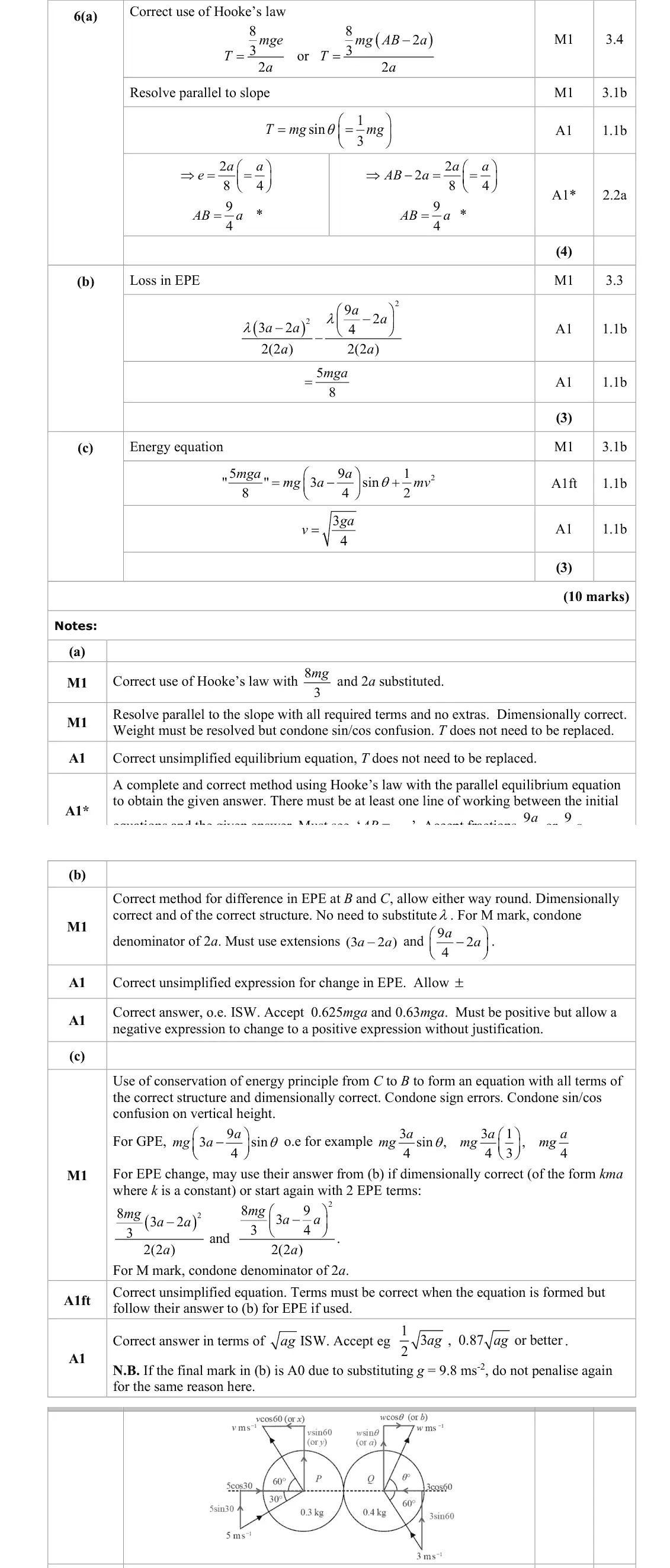
5mga/8 = mg(3a/4)sin θ + ½mv²: v = √(3ga/4)
suvat scores 0
June 2025 · Paper 3C (Further Mechanics 1) · Q8(a)6 marks
Mark scheme (whole question; this part is marked with the orange bar)
Examiner's comment
As expected, the final question on the paper brought with it a significant level of challenge to stretch the most able and there were several blank responses. The information was given in vector form and those who were confident working with vectors were far more successful. Those who insisted on changing all vectors to speeds and directions made the process far more complicated and often introduced sign errors or was working with unnecessarily complicated algebra. Part (a) awarded 6 marks for showing the kinetic energy lost by B. However, since the answer was given in the question, clear reasoning with sufficient working was required to earn all 6 available marks. Those who clearly labelled the diagram and used vectors usually scored higher than those who did not. For example, learners who used speeds and angles rarely stated that the component parallel to the surface is unchanged. Learners should use the number of marks available for questions to ensure they show sufficient workings. In this question, some learners treated the instructions as ‘find’ rather than ‘show that’.
Key points from the mark scheme and examiner's report
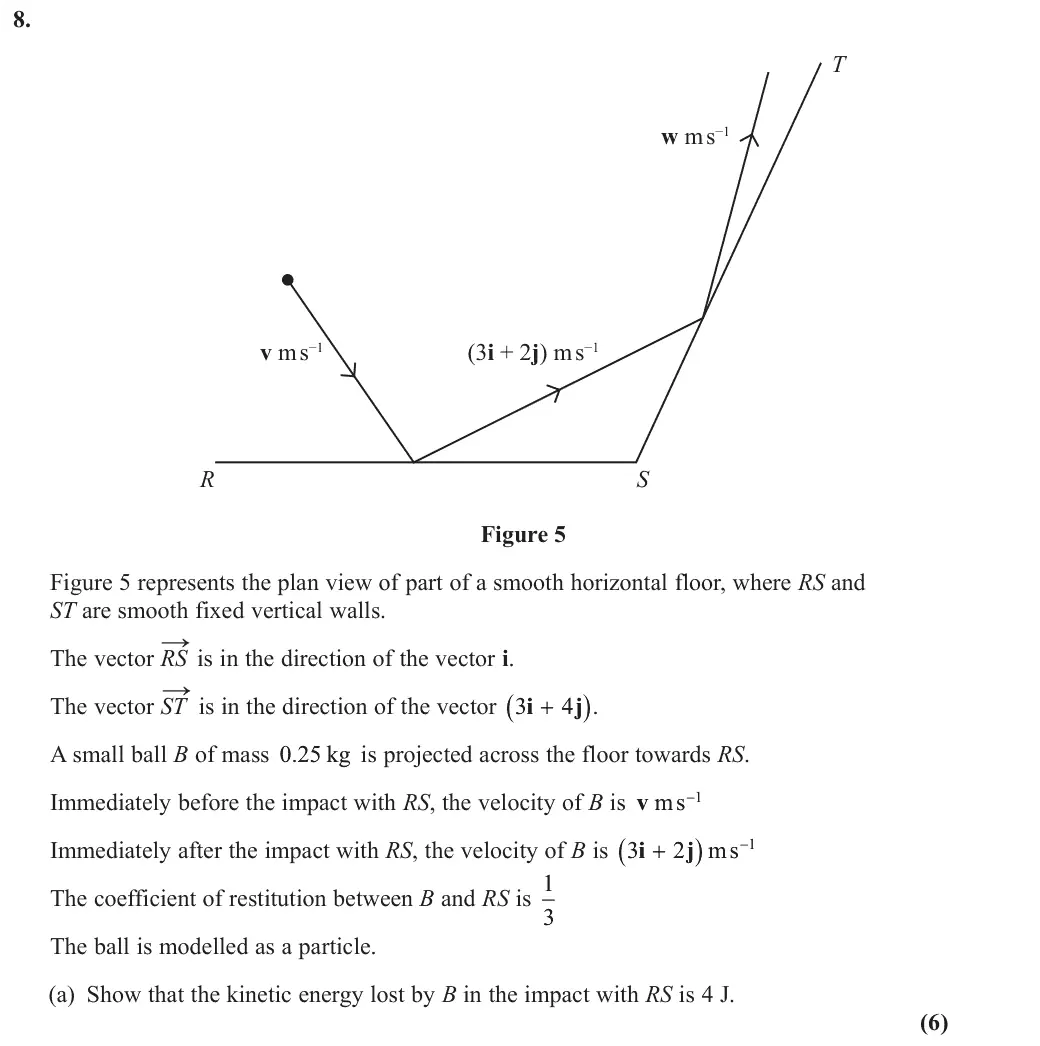
v = 3i − 6j (parallel component unchanged, perpendicular 2 ÷ 1/3 = 6 towards RS)
KE loss ½(0.25)(45) − ½(0.25)(13) = 4 J
only perpendicular-component KE is incomplete
vector working far easier than speeds and angles
June 2024 · AS Paper 2 (Further Mechanics 1) · Q2(a)4 marks
Mark scheme (whole question; this part is marked with the orange bar)
Examiner's comment
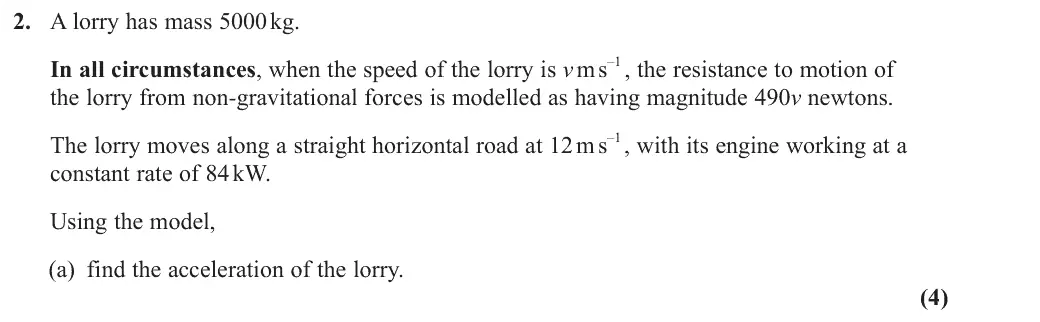
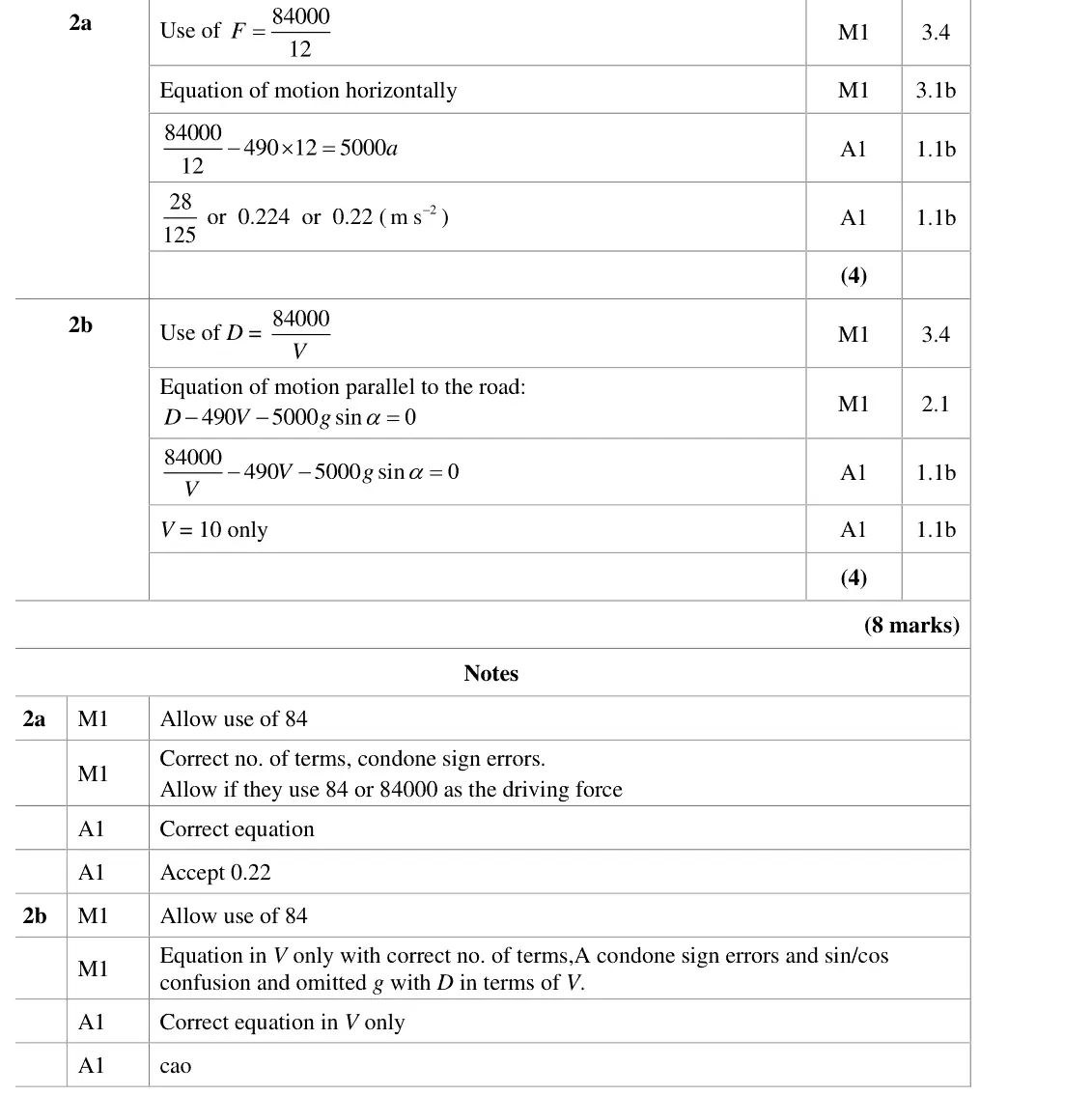
Some candidates seemed tested by part (a) but answered part (b) perfectly. In part (a), almost all used 84000/12 for the driving force with the occasional loss of a zero and then set up a correct equation of motion which led to the correct answer.
Key points from the mark scheme and examiner's report
F = 84000/12 = 7000
7000 − 490 × 12 = 5000a gives a = 28/125 = 0.224 m s⁻²
occasional lost zero in 84000
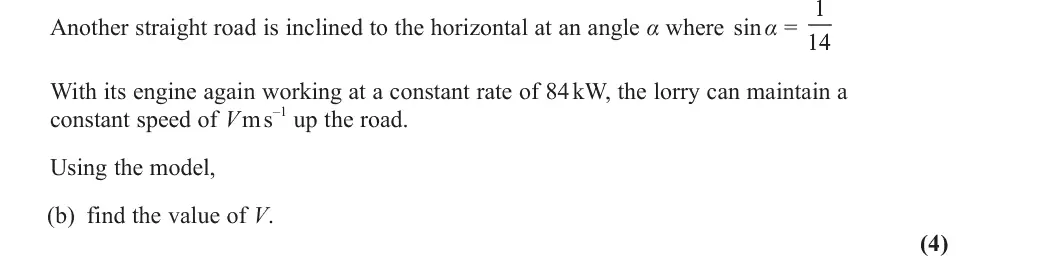
June 2024 · AS Paper 2 (Further Mechanics 1) · Q2(b)4 marks
Mark scheme (whole question; this part is marked with the orange bar)
Examiner's comment
Most candidates scored full marks in part (b), although there were a few sign errors in their equation of motion or a missing g. A minority omitted the component of the weight, a handful used cos instead of sin and a few used 84000 instead of 84000/V for the driving force. Almost all correctly rejected the negative value for V.
Key points from the mark scheme and examiner's report
constant speed: 84000/V − 490V − 5000g sin α = 0 gives V = 10 only (reject the negative root)
omitted weight component, cos for sin, or 84000 used as the force
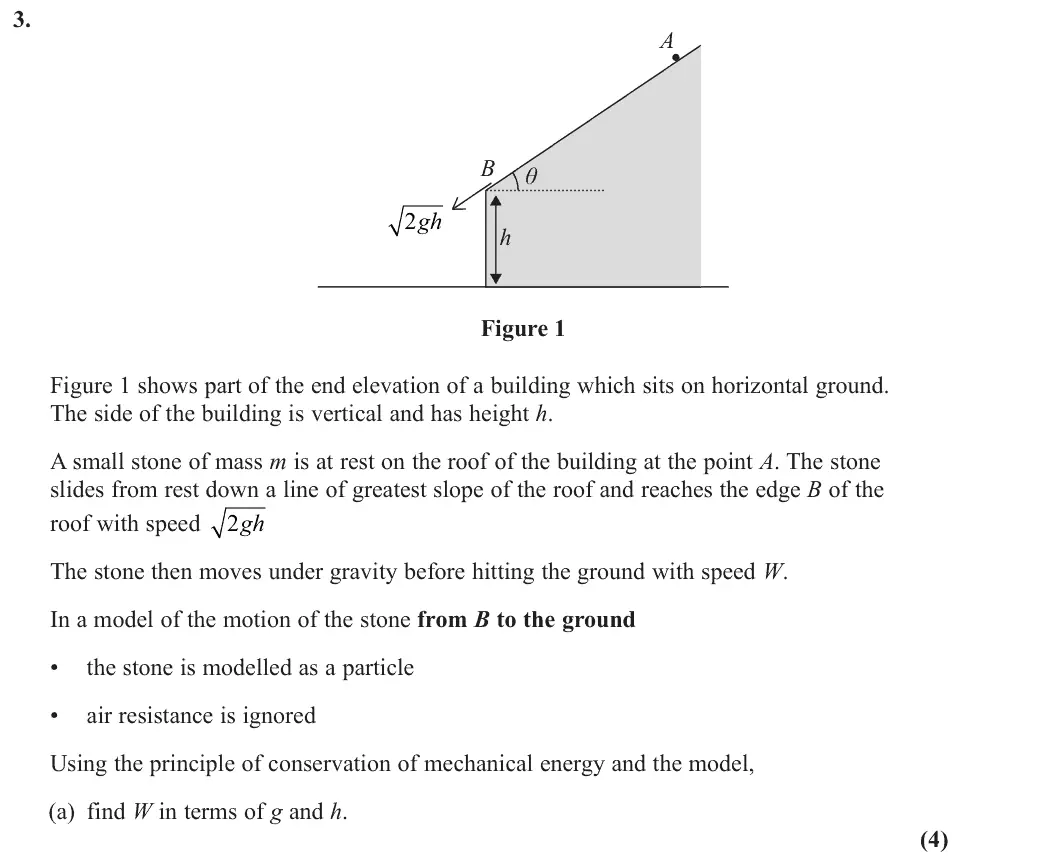
June 2024 · AS Paper 2 (Further Mechanics 1) · Q3(a)4 marks
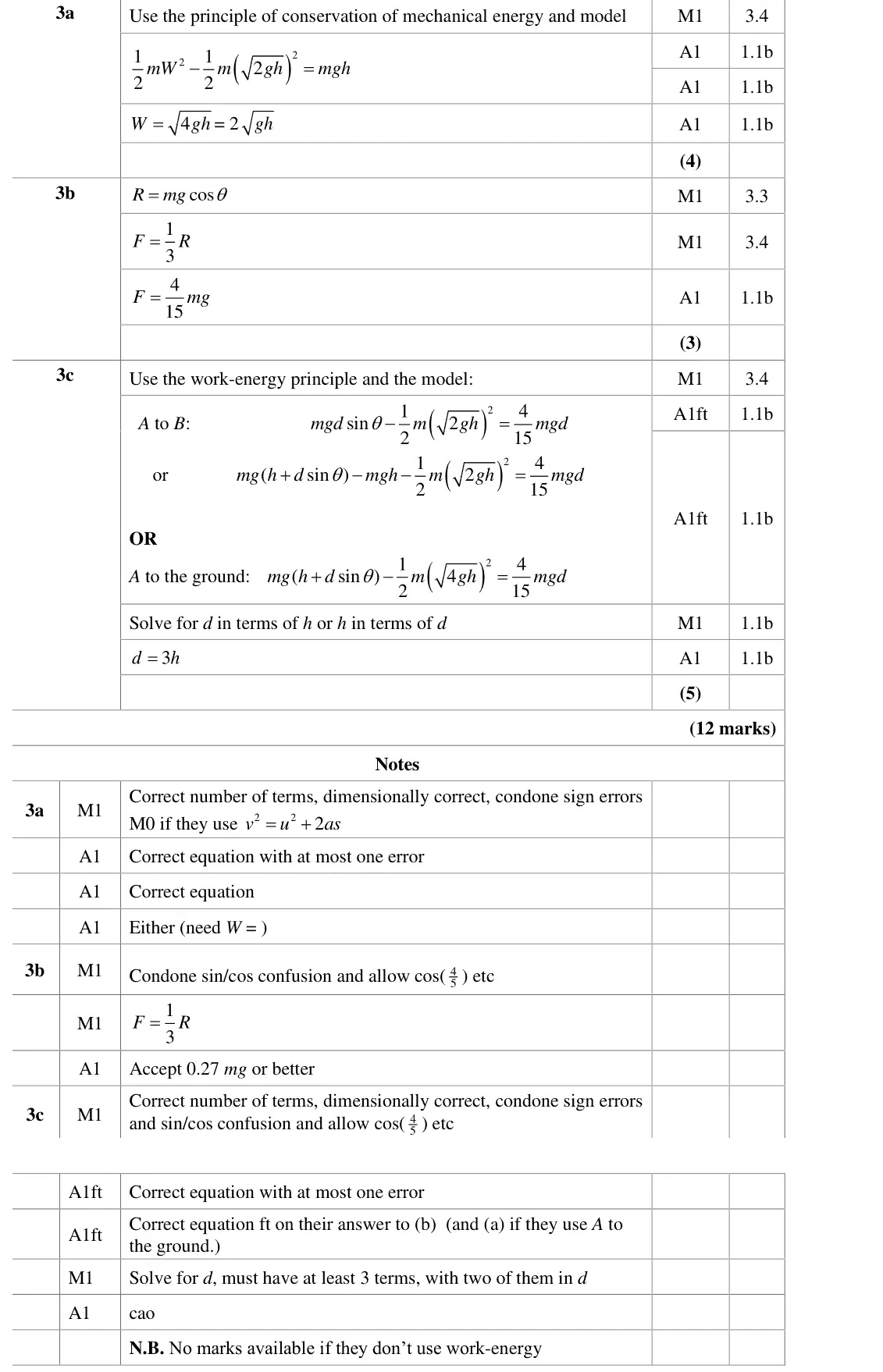
Mark scheme (whole question; this part is marked with the orange bar)
Examiner's comment
= + 2 2 In the first part, some candidates used and scored no marks but then went on to do v 2 u as
Key points from the mark scheme and examiner's report
conservation of energy B to ground: ½mW² − ½m(2gh) = mgh, W = 2√(gh)
v² = u² + 2as scores 0
June 2024 · AS Paper 2 (Further Mechanics 1) · Q3(b)3 marks
Mark scheme (whole question; this part is marked with the orange bar)
Examiner's comment
In part (b), a few candidates interpreted the question as requiring them to use the conservation of energy principle to answer this part and occasionally some candidates failed to answer this part correctly but, oddly, used the correct expression for the friction in (c). Most, however, were able
Key points from the mark scheme and examiner's report
R = mg cos θ with cos θ = 4/5, F = R/3 = 4mg/15 (0.27mg)
sin/cos confusion or use of tan
A-level Maths friction skill as preparation for the work-energy step in (c)
June 2024 · AS Paper 2 (Further Mechanics 1) · Q3(c)5 marks
Mark scheme (whole question; this part is marked with the orange bar)
Examiner's comment
part (c) using work-energy perfectly well. Occasionally some used an initial speed of zero but still used only h for the change in height. They often continued to answer the rest of the question correctly. correctly but, oddly, used the correct expression for the friction in (c). Most, however, were able to obtain a correct expression for the friction. Common errors were sin/cos confusion and the occasional use of tan. In the final part, the most common error was to omit the work done against friction and occasionally mghsin theta was used instead of mgdsin theta . Also the d was sometimes missed off the 4 mgd term and there were also sign errors in the work-energy equation. 15
Key points from the mark scheme and examiner's report
work-energy A to B: mgd sin θ − ½m(2gh) = (4/15)mgd (or A to the ground), d = 3h
omitting the work against friction, mgh sin θ for mgd sin θ, d missing from the friction term
non-energy methods score 0
June 2024 · Paper 3C (Further Mechanics 1) · Q1(a)3 marks
Mark scheme (whole question; this part is marked with the orange bar)
Examiner's comment
In part (a) the question asked for the total KE and therefore those who found KE terms but did not add them together were unable to gain any marks. Pythagoras was almost always used correctly to find the speed from the velocity vectors. However, some candidates forgot to square the speed when calculating KE. Unfortunately, without evidence of a correct KE formula, marks were unavailable. It is good exam technique to state a correct formula before its use, providing evidence of a correct method if computational errors occur. The vast majority chose to use column vectors in parts (b) and (c) with great success. Column
Key points from the mark scheme and examiner's report
total KE ½(3)(3² + 1²) + ½(2)(6² + 2²) = 55 J
must add both
forgetting to square the speed
June 2024 · Paper 3C (Further Mechanics 1) · Q2(a)3 marks
Mark scheme (whole question; this part is marked with the orange bar)
Examiner's comment
This question tested candidates on the work-energy principle, and it was incredibly rare to see an attempt using suvat, for which no marks were available. The scaffolded parts ensured that candidates considered friction from the outset and were using a correct expression moving into
Key points from the mark scheme and examiner's report
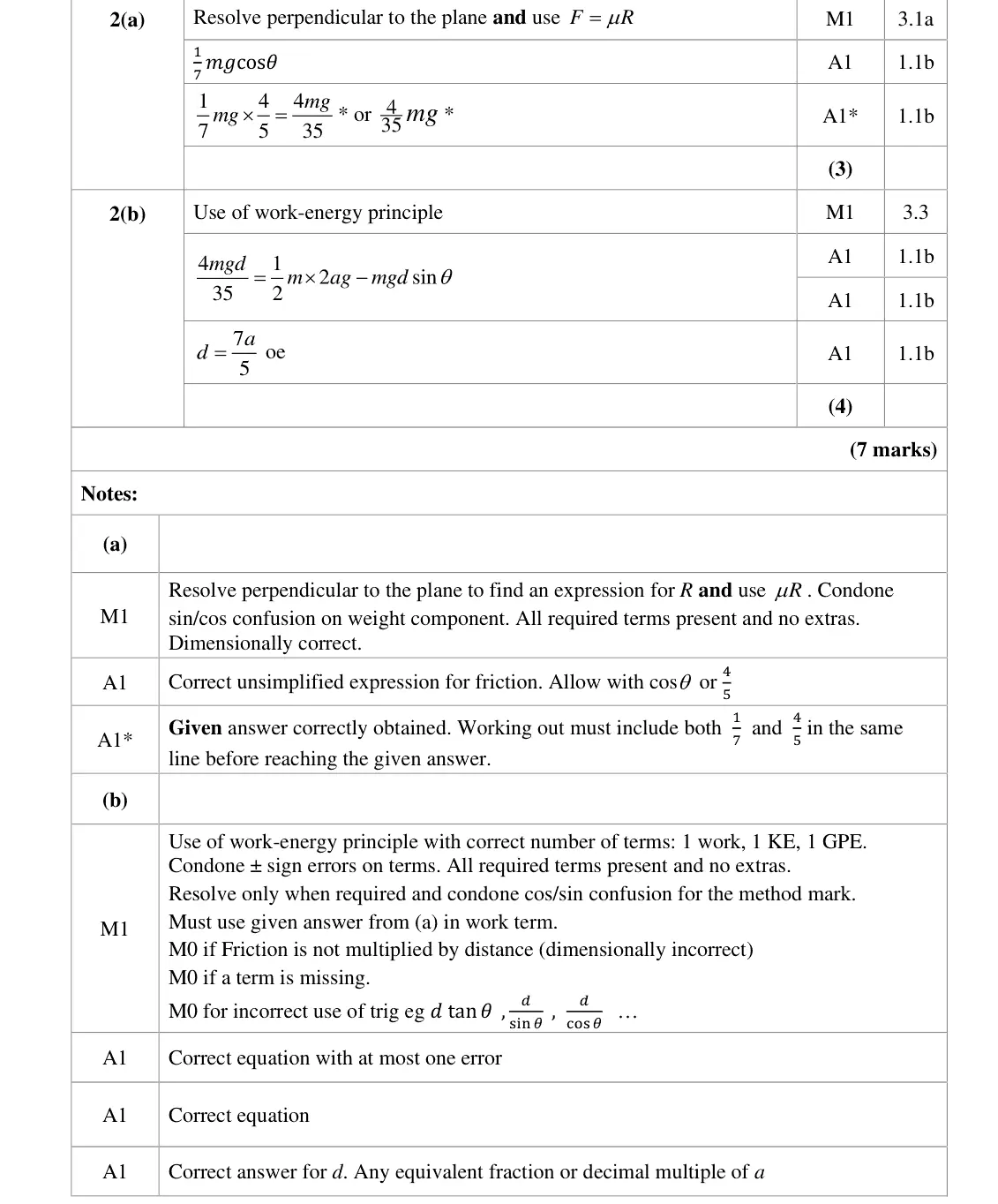
R = mg cos θ = (4/5)mg, F = μR = 4mg/35
both 1/7 and 4/5 must be seen
June 2024 · Paper 3C (Further Mechanics 1) · Q2(b)4 marks
Mark scheme (whole question; this part is marked with the orange bar)
Examiner's comment
part (b). Although most, at this level, are capable of writing down a correct expression for friction immediately, it was pleasing to see that candidates understood ‘show that’ requirements, resolving R correctly and using both 1 7 and 4 5 in their working before reaching the given answer. Most made a confident start to part (b), establishing a work-energy equation with all required terms: GPE, KE and work-done against friction. Mistakes were rarely seen with signs or sin/cos confusion and candidates were clearly well-rehearsed, immediately stating the vertical height in terms of d. The most common error was to produce an equation with inconsistent units, using friction (newtons) instead of work-done against friction (joules). This is a costly mistake as there are no marks available for an equation that is dimensionally incorrect.
Key points from the mark scheme and examiner's report
work-energy: ½m(2ag) = mgd sin θ + (4mg/35)d, d = 7a/5
using friction (a force) instead of work done against it
suvat scores 0
June 2024 · Paper 3C (Further Mechanics 1) · Q3(a)3 marks
Mark scheme (whole question; this part is marked with the orange bar)
Examiner's comment
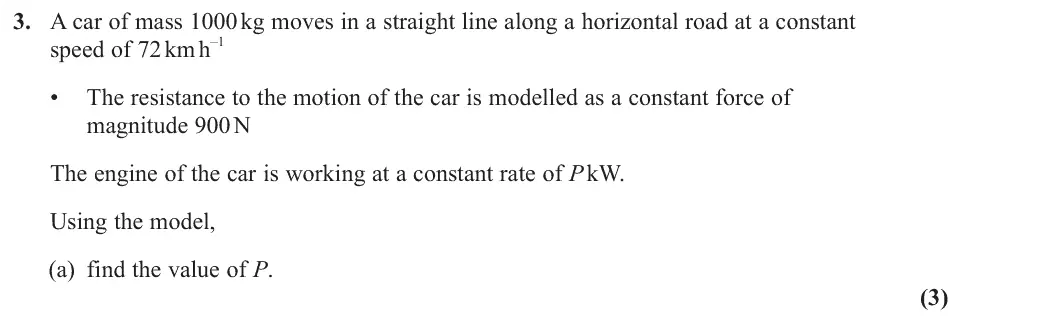
The vast majority were able to demonstrate a good understanding of the relationship between the driving force and the power of an engine as they worked through this question. Errors were most likely to occur in (a) and usually arose from a failure to convert the speed in the question from 1 km h-to 1 m s-which led to an incorrect answer of 64.8kW. Others forgot to give their final answer in kilowatts. Candidates should always check that they have answered the question fully and given their final answer in the required form.
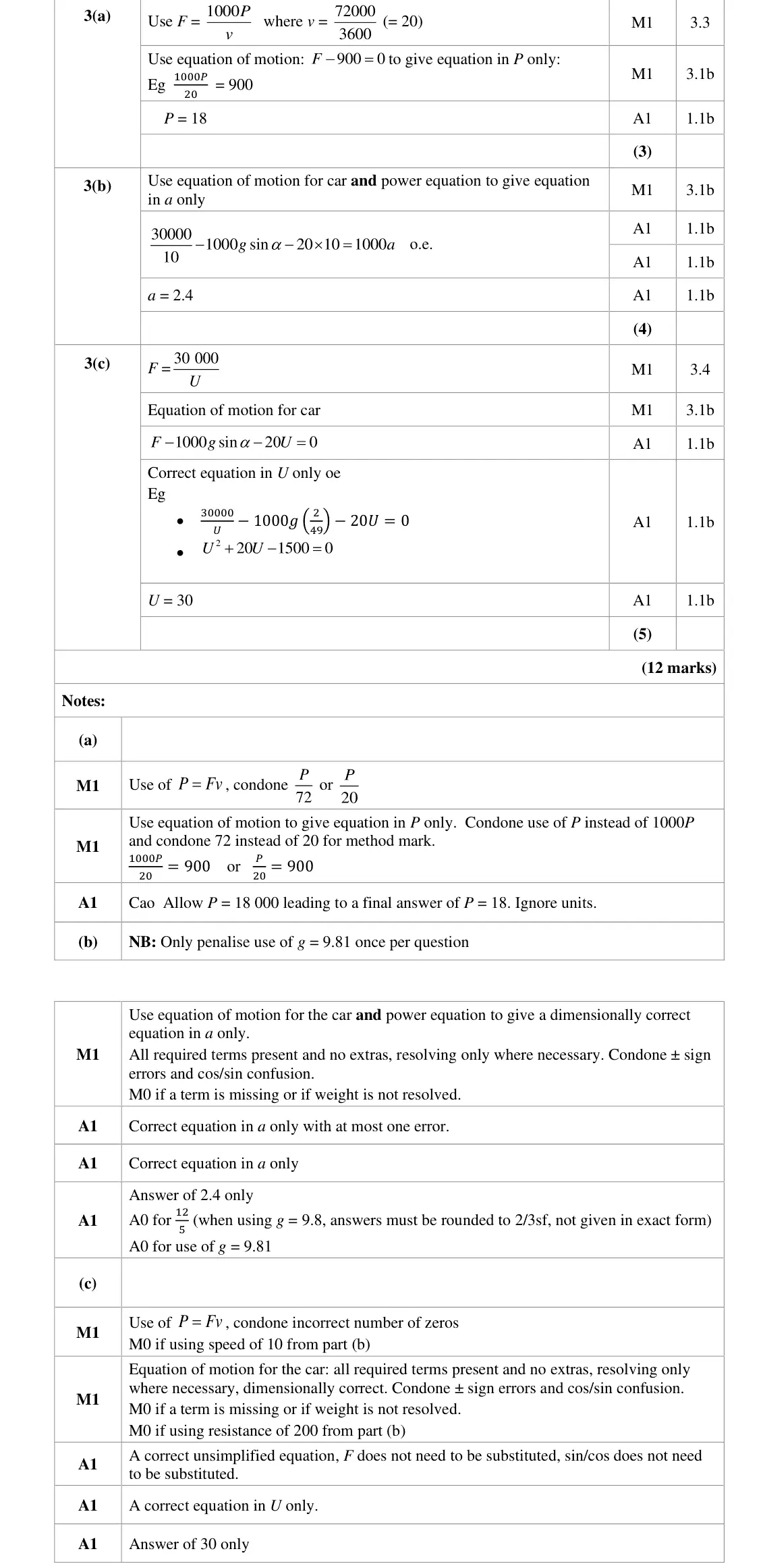
Key points from the mark scheme and examiner's report
convert 72 km h⁻¹ to 20 m s⁻¹
1000P/20 = 900, P = 18 (kW)
64.8 from not converting, or answer not in kW
June 2024 · Paper 3C (Further Mechanics 1) · Q3(b)4 marks
Mark scheme (whole question; this part is marked with the orange bar)
Examiner's comment
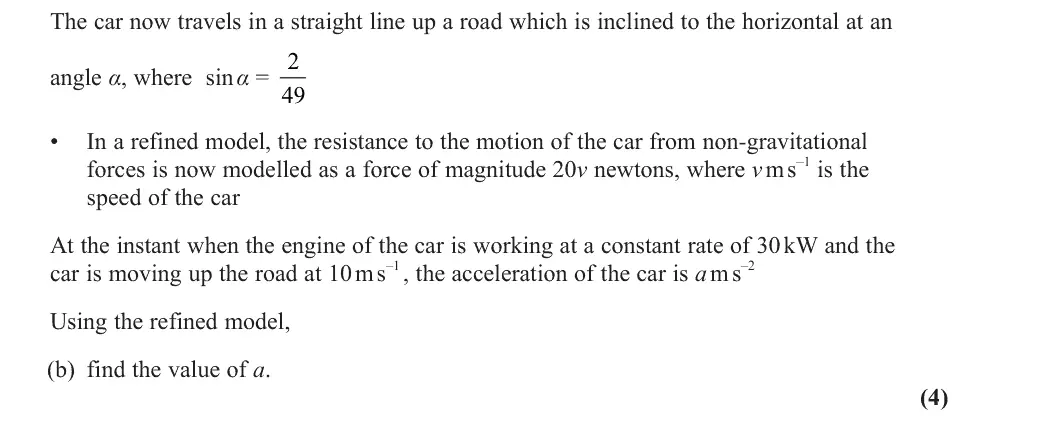
The vast majority were able to demonstrate a good understanding of the relationship between the driving force and the power of an engine as they worked through this question. Parts (b) and (c) were routine power problems based on a car travelling up an inclined plane. The power equation and N2L were used together successfully to find the acceleration in part (b) and the speed in part (c). It was very pleasing to see that the negative value for speed was either clearly rejected or never written down, demonstrating good exam technique. In part (b) weak candidates were more likely to calculate the resultant force separately and then divide by mass to find the acceleration. The method mark is awarded when the relevant forces, mass and acceleration are correctly combined in one equation; delaying this puts marks at risk because any error made simplifying the resultant force, will bring an error into the equation of motion. High attainers are more likely to set up an equation of motion with all the force terms present and unsimplified on the LHS, and with mass acceleration on the RHS, before processing.
Key points from the mark scheme and examiner's report
refined model: 30000/10 − 1000g sin α − 20(10) = 1000a, a = 2.4
must combine forces in one equation of motion
June 2024 · Paper 3C (Further Mechanics 1) · Q3(c)5 marks
Mark scheme (whole question; this part is marked with the orange bar)
Examiner's comment
The vast majority were able to demonstrate a good understanding of the relationship between the driving force and the power of an engine as they worked through this question. Parts (b) and (c) were routine power problems based on a car travelling up an inclined plane. The power equation and N2L were used together successfully to find the acceleration in part (b) and the speed in part (c). It was very pleasing to see that the negative value for speed was either clearly rejected or never written down, demonstrating good exam technique. For success in part (c), both the power and the resistance to motion were required in terms of U. Errors were rare but often the result of continuing to use 200 newtons from part (b) as the resistive force in part (c). Using an incorrect force in an equation of motion is a method error which can result in a significant loss of marks.
Key points from the mark scheme and examiner's report
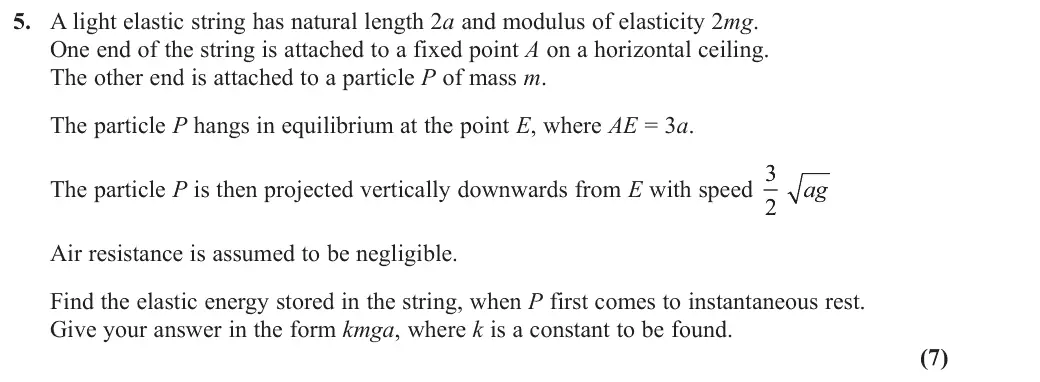
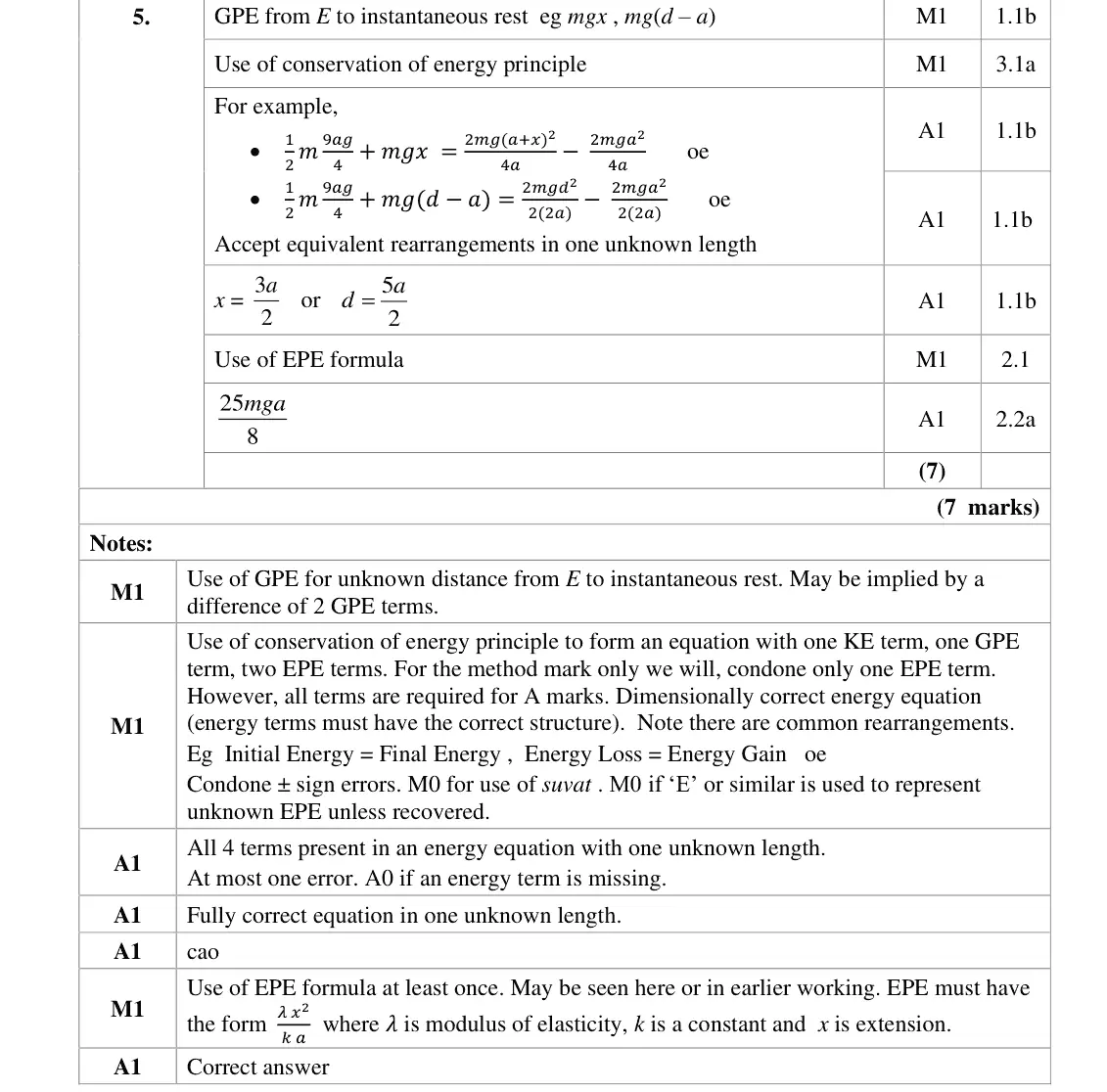
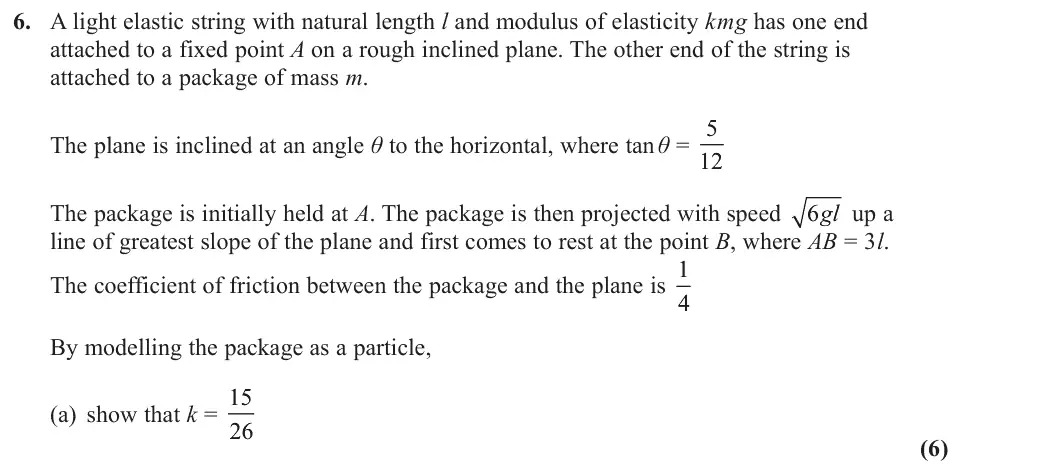
June 2024 · Paper 3C (Further Mechanics 1) · Q57 marks
Mark scheme (whole question; this part is marked with the orange bar)
Examiner's comment
This question presented candidates with the first major challenge of the paper and whilst there were many excellent solutions, scores of 0 and 1 were not unusual. The unstructured format of this elasticity problem, and lack of a given answer, discriminated between the grades. Well-prepared candidates successfully produced a clear diagram and presented energy terms in a table. This approach would usually avoid mistakes with lengths and prompted the need for two EPE terms. The conservation of energy could lead quickly to a quadratic equation in an unknown length and the required EPE could follow in just a few lines of working. When solving problems involving EPE, it is recommended to state the EPE formula and show the full substitution. When candidates form an energy equation with simplified expressions, it can be very difficult for examiners to determine a valid method if mistakes are made. Errors in energy terms were frequent amongst weaker candidates; the initial EPE was often forgotten, the GPE term was not in terms of an unknown distance and the final EPE was written as ‘E’ rather than in terms of an unknown length. Despite the difficulties, candidates were reluctant to leave this question, instead producing pages of incorrect and crossed out working. Many appeared determined to complete the problem showing a confidence in the topic despite being unable to identify their error. This 7-mark question gave two pages for working and some re-attempts were made elsewhere in the script rather than on additional sheets. A surprising number did so without any direction to the examiner. Examiners must be alerted to working elsewhere in the script otherwise candidates are at risk of losing marks.
Key points from the mark scheme and examiner's report
a diagram and a table of energy terms avoided length errors
many scored 0 or 1
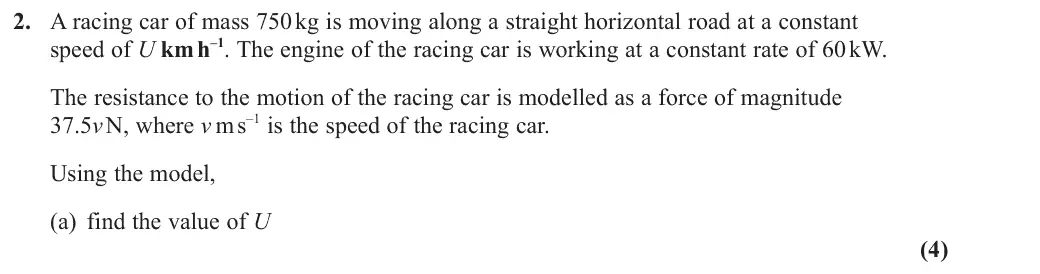
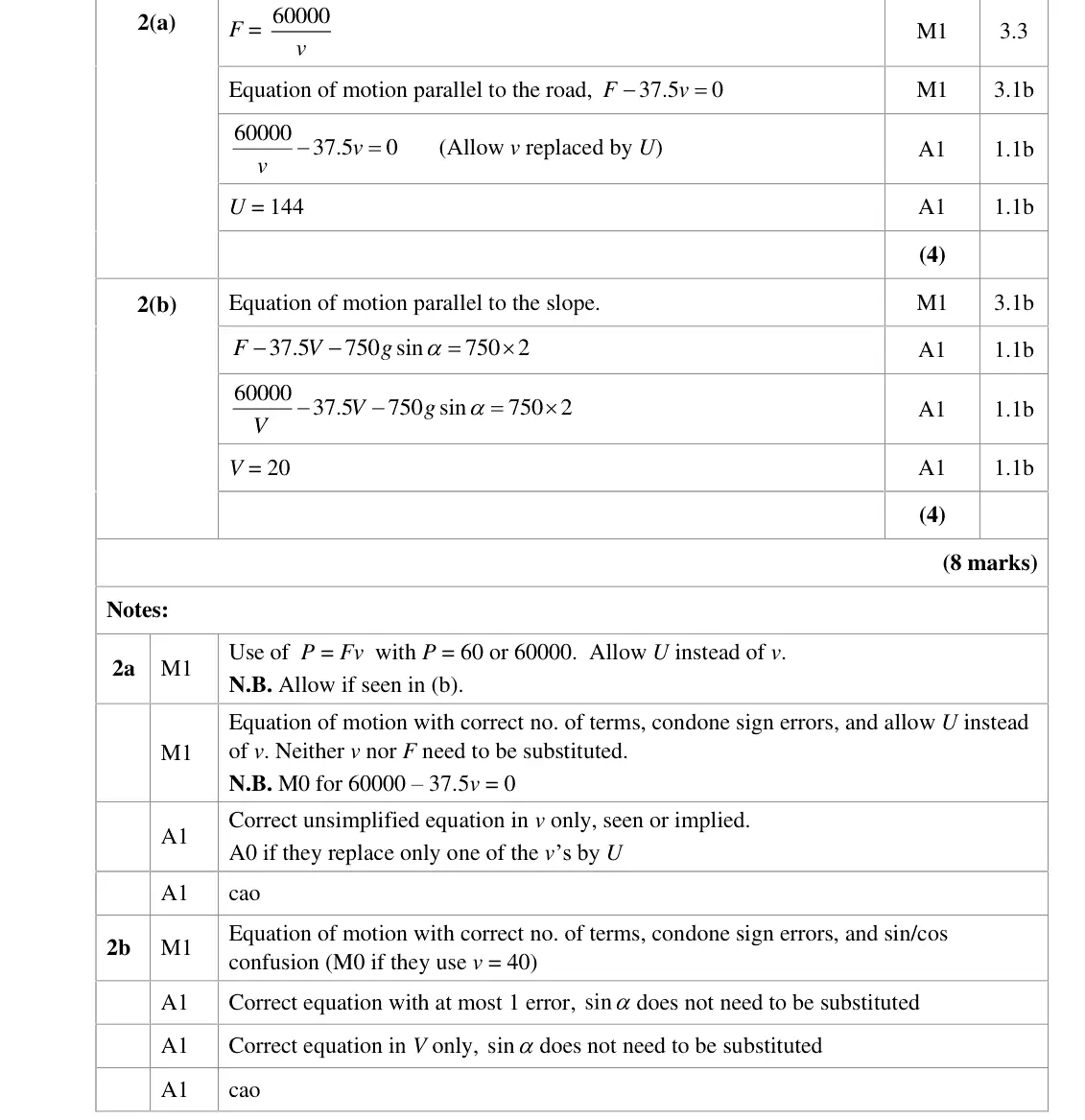
June 2023 · AS Paper 2 (Further Mechanics 1) · Q2(a)4 marks
Mark scheme (whole question; this part is marked with the orange bar)
Examiner's comment
In part (a), almost all used 60000 P v = and then set up a correct equation of motion. Most realised that they need to convert the units, although some left the answer as 40. Most of those who scored full marks found v in m/s as 40 and then converted to km/h at the end. A few used an incorrect conversion factor, so lost the final A mark. Many successfully converted U in km/h to v in m/s at the start and then went on to obtain a correct value for U. A few replaced only one of the v’s in their equation by U, so lost an A mark.
Key points from the mark scheme and examiner's report
F = 60000/v
60000/v − 37.5v = 0 gives v = 40 m s⁻¹, so U = 144 km h⁻¹
leaving the answer as 40 or using a wrong conversion factor
M0 for 60000 − 37.5v = 0
June 2023 · AS Paper 2 (Further Mechanics 1) · Q2(b)4 marks
Mark scheme (whole question; this part is marked with the orange bar)
Examiner's comment
Most candidates scored full marks in part (b), although there were a few sign errors in their equation of motion or a missing g. A minority omitted the component of the weight, a handful used cos instead of sin and a few used 60,000 instead of 60000 v for the driving force.
Key points from the mark scheme and examiner's report
60000/V − 37.5V − 750g sin α = 750 × 2 gives V = 20
omitted weight component, sin/cos confusion, or 60000 used as the driving force
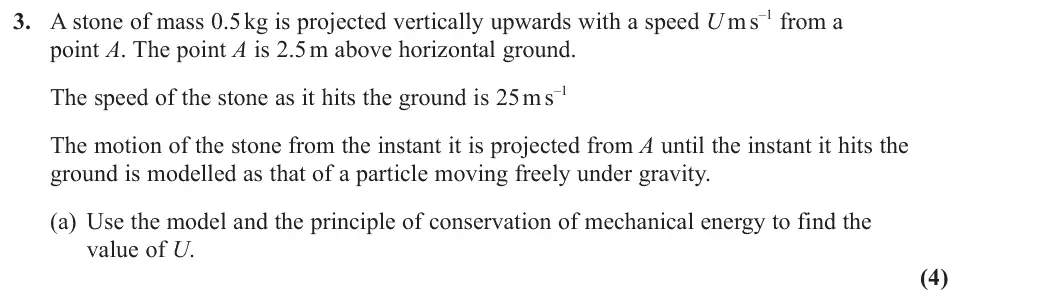
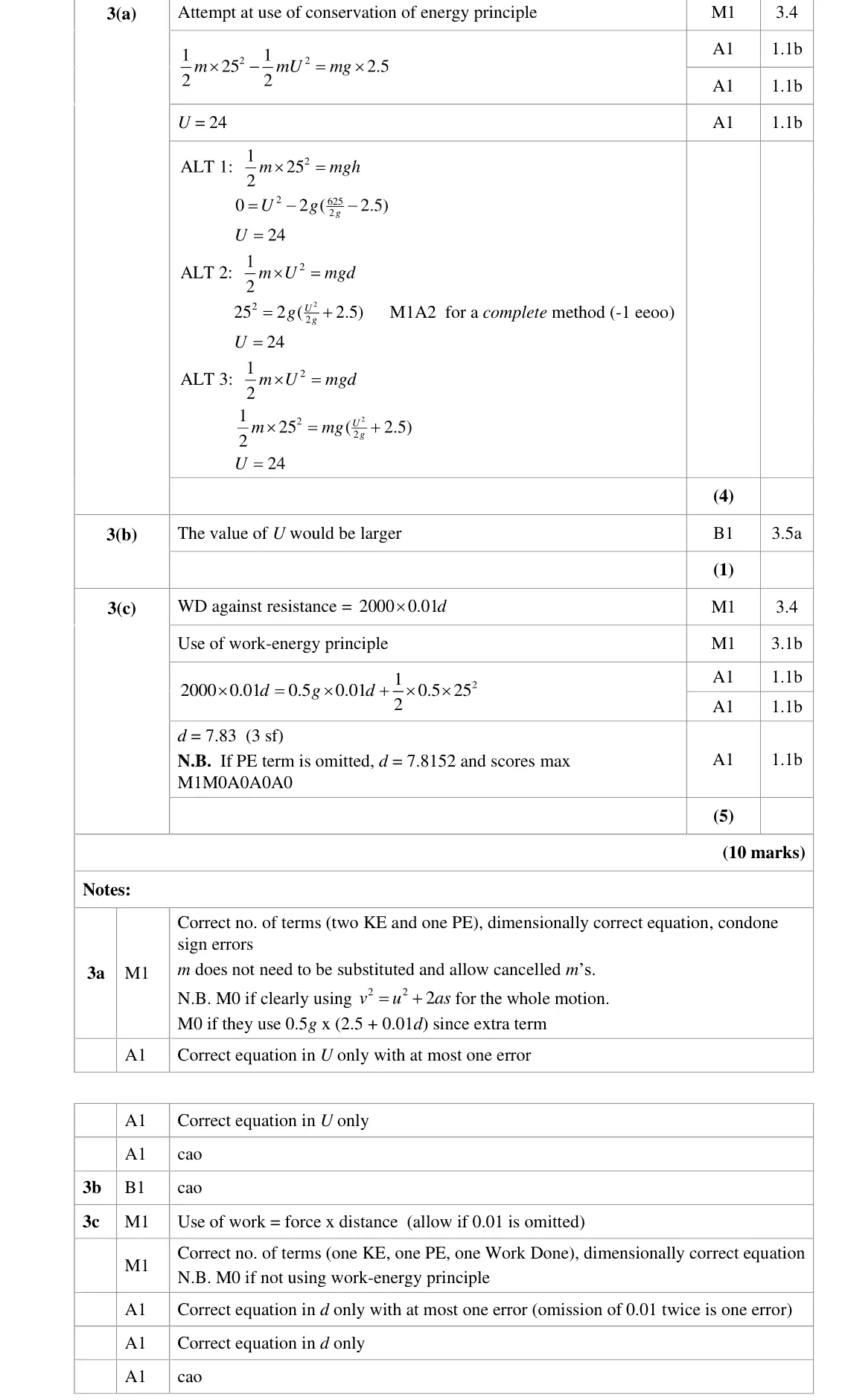
June 2023 · AS Paper 2 (Further Mechanics 1) · Q3(a)4 marks
Mark scheme (whole question; this part is marked with the orange bar)
Examiner's comment
In the first part, most set up a correct equation using conservation of energy, although there were a few with sign errors. Some omitted the ½ m x 252 term and obtained U = 7. A few obtained ¼ U2 = 144 from a correct equation but then went on to divide 144 by 4 instead of multiplying. A = + 2 2 v u 2 as substantial number only used to get U = 24, and so scored no marks, since the question had specified the use of conservation of energy. Some used one of the alternative methods by considering the upwards and downwards motion separately and then found the distance from the top to the ground and/or from the point of projection to the top and then used these in an energy conservation equation.
Key points from the mark scheme and examiner's report
conservation of mechanical energy: ½m × 25² − ½mU² = mg × 2.5, U = 24
suvat for the whole motion scores 0
omitting ½m × 25² gives U = 7
June 2023 · AS Paper 2 (Further Mechanics 1) · Q3(b)1 mark
Mark scheme (whole question; this part is marked with the orange bar)
Examiner's comment
In part (b), candidates who remembered that they had just calculated the initial speed of the stone realised that resistance would need to be overcome and so answered correctly. However, most candidates just considered the slowing effect of the resistance and said that the stone would lose speed so the answer would be less. In the final part, most scored the first M1. The majority of those who set up a dimensionally
Key points from the mark scheme and examiner's report
U would be larger (more energy needed to overcome resistance and still land at 25 m s⁻¹)
most wrongly said smaller
June 2023 · AS Paper 2 (Further Mechanics 1) · Q3(c)5 marks
Mark scheme (whole question; this part is marked with the orange bar)
Examiner's comment
In the final part, most scored the first M1. The majority of those who set up a dimensionally correct equation with the correct number of terms did not divide d by 100, so lost the last two A marks. Sign errors were also common and quite a few candidates only scored the first M1 as they omitted the PE term from their equation. However, there was a significant number of fully correct answers.
Key points from the mark scheme and examiner's report
work-energy: 2000 × 0.01d = 0.5g × 0.01d + ½ × 0.5 × 25², d = 7.83 (3 sf)
convert cm to m (d/100)
omitting the PE term (d = 7.82) loses most marks
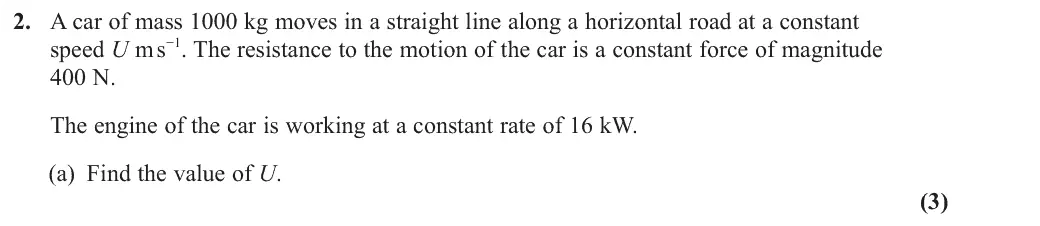
June 2023 · Paper 3C (Further Mechanics 1) · Q2(a)3 marks
Mark scheme (whole question; this part is marked with the orange bar)
Examiner's comment
Performing best on the paper, this question proved to be a good source of marks with a good proportion of candidates achieving all available marks. The majority made a confident start in part (a), often substituting 16000 directly into an equilibrium equation and gaining 3 marks in v just two lines of working. It was incredibly rare for candidates to use 16 instead of 16000 showing an improvement in the use of kW. Part (b) presented more challenge. Many candidates
Key points from the mark scheme and examiner's report
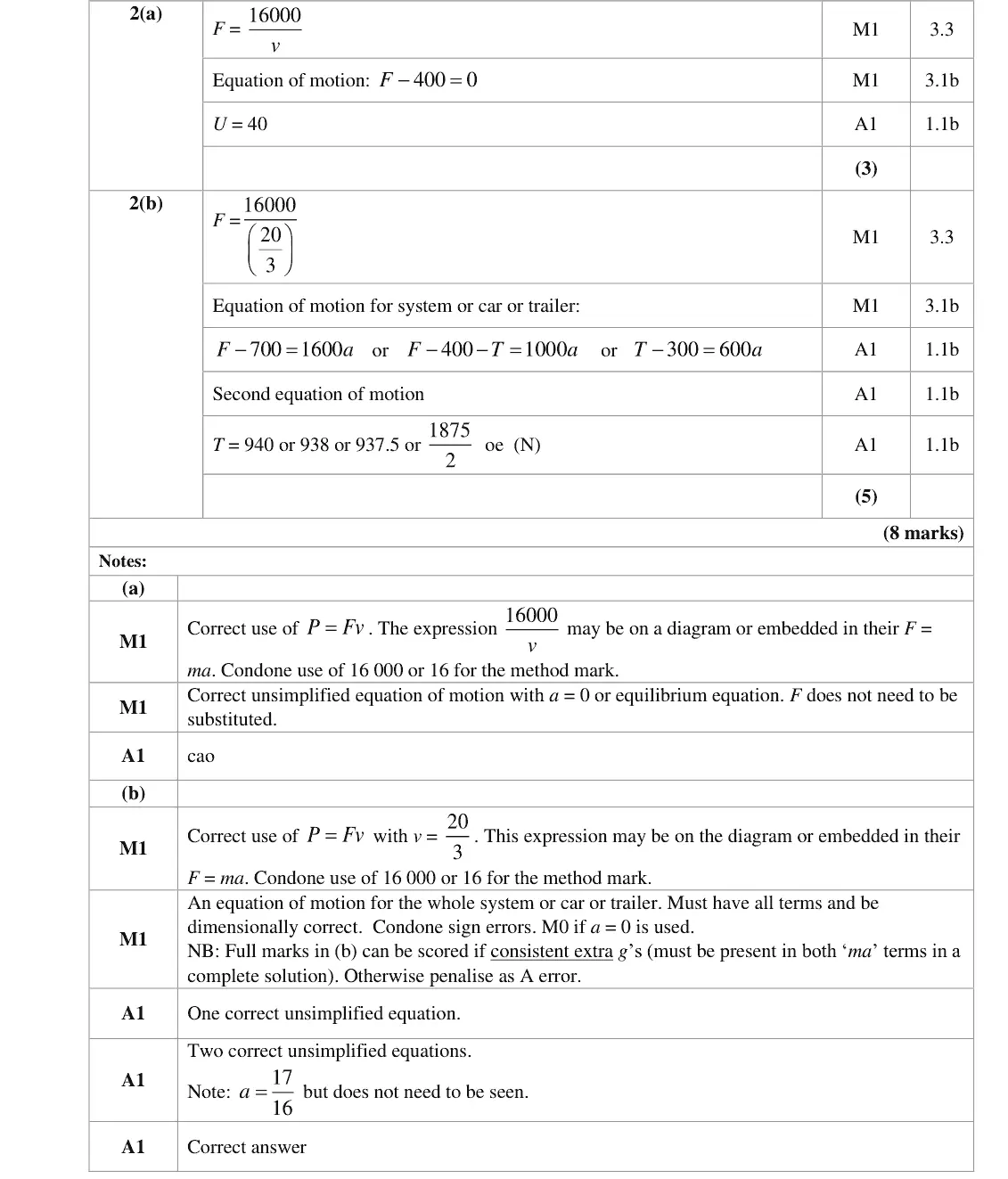
constant speed: 16000/U − 400 = 0, U = 40
June 2023 · Paper 3C (Further Mechanics 1) · Q2(b)5 marks
Mark scheme (whole question; this part is marked with the orange bar)
Examiner's comment
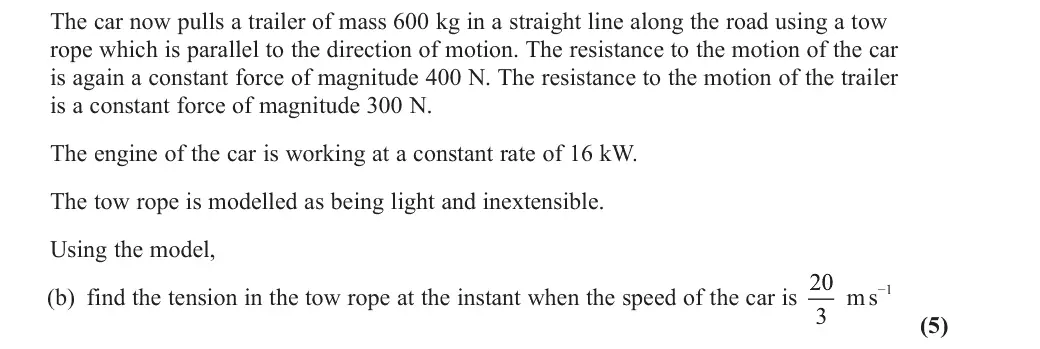
Performing best on the paper, this question proved to be a good source of marks with a good proportion of candidates achieving all available marks. The majority made a confident start in showing an improvement in the use of kW. Part (b) presented more challenge. Many candidates assumed the equilibrium and did not set up an equation of motion, gaining only 1 mark for finding the new driving force. Two equations of motion were required, and errors made were predictable: using the driving force in the trailer equation, using both resistances in the car equation and sign errors.
Key points from the mark scheme and examiner's report
F = 16000/(20/3) = 2400
F − 700 = 1600a (a = 17/16) and T − 300 = 600a: T = 937.5 N
many assumed equilibrium
errors: driving force in the trailer equation, both resistances in the car equation
June 2023 · Paper 3C (Further Mechanics 1) · Q4(b)7 marks
Mark scheme (whole question; this part is marked with the orange bar)
Examiner's comment
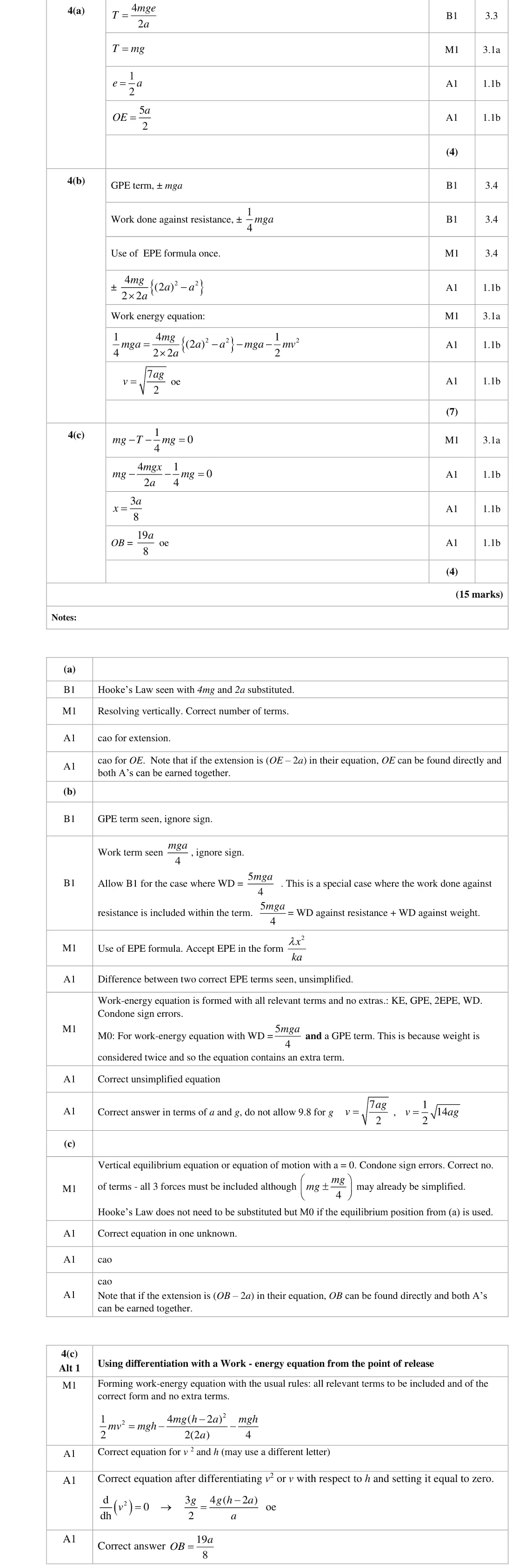
Although many candidates achieved full marks on this question, the later parts proved to be discriminatory. good progress in (b). It was pleasing to see that solutions were well-organised with terms often listed in a table which made awarding interim marks much easier when a correct answer was not reached. Candidates using a table rarely made sign errors which was a common cause of lost marks. Another common error was using 2a in the EPE denominator, which was the natural length, rather than 2(2a). Although less frequent, some candidates missed an EPE term or the work term. This mistake was almost exclusively amongst candidates who formed an energy equation straight away rather than listing in a table.
Key points from the mark scheme and examiner's report
work-energy from extension 2a to a: EPE lost (4mg/4a)((2a)² − a²) = mga + ¼mga + ½mv²: v = √(7ag/2)
using 2a not 2(2a) in the EPE denominator
tabulating terms avoided sign errors
June 2022 · AS Paper 2 (Further Mechanics 1) · Q15 marks
Mark scheme (whole question; this part is marked with the orange bar)
Examiner's comment
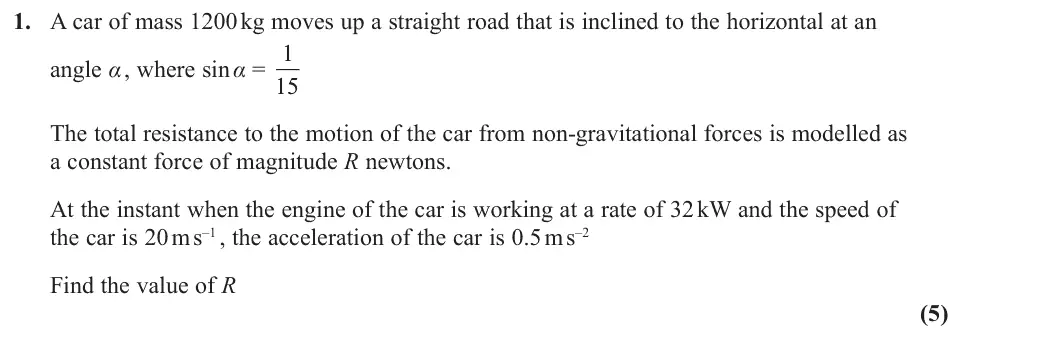
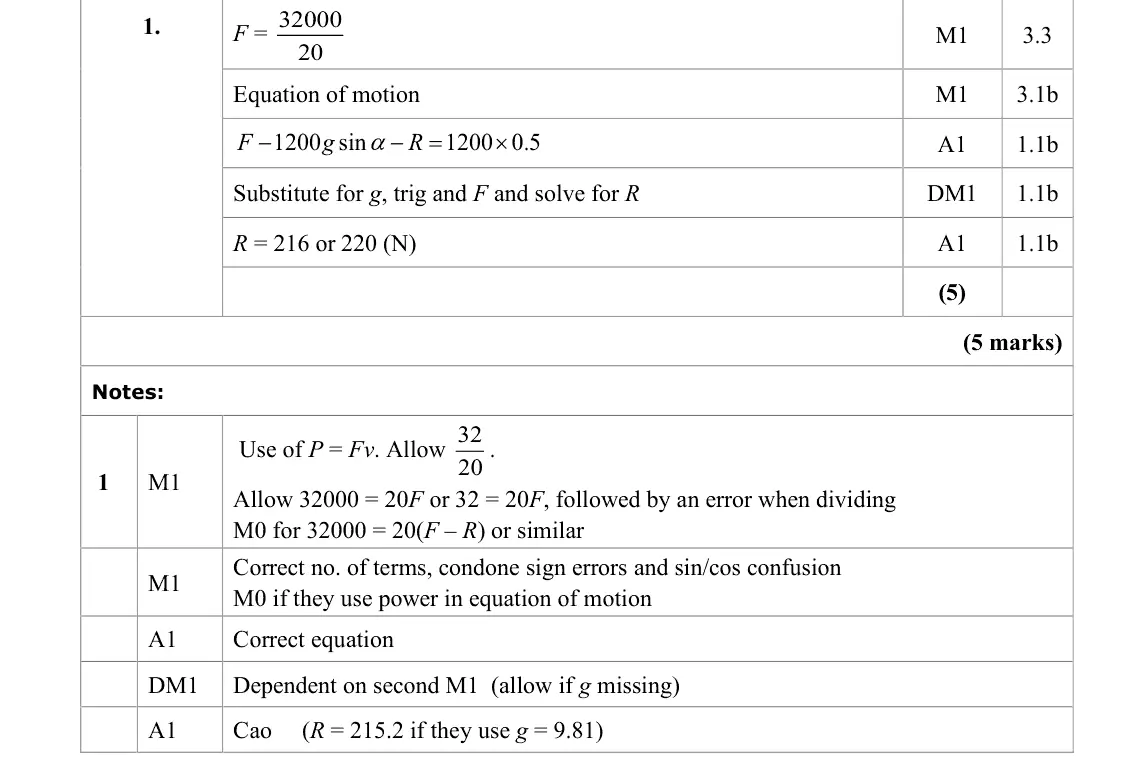
This question was very well answered with P = Fv being used correctly by nearly all. Many simply wrote down their equation of motion, made their substitutions and solved for R. Others worked their way through each stage, calculating forces as they went. The most common error was to ignore the relevant component of the weight. Incorrect resolutions and omission of g were only seen occasionally.
Key points from the mark scheme and examiner's report
F = 32000/20 = 1600
F − 1200g sin α − R = 1200 × 0.5 gives R = 216 (or 220) N
commonest error omitting the weight component
M0 for putting power directly in the equation of motion
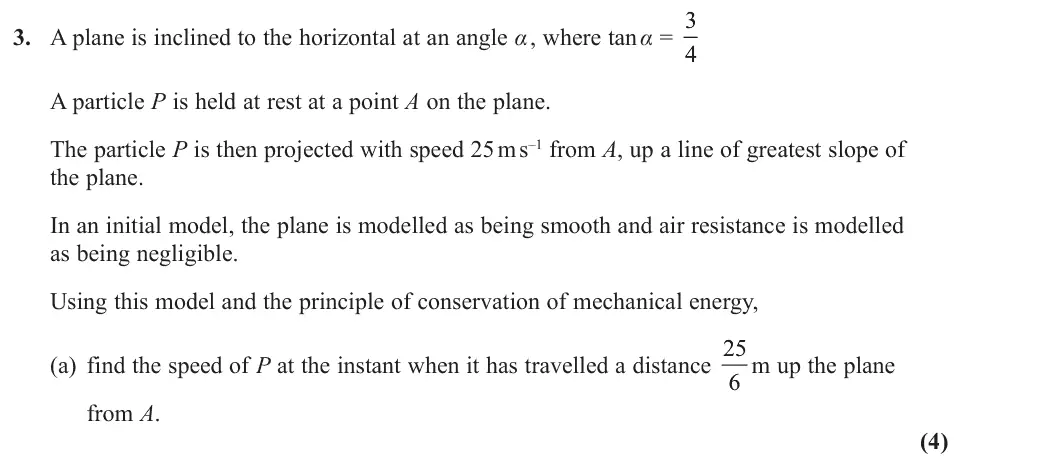
June 2022 · AS Paper 2 (Further Mechanics 1) · Q3(a)4 marks
Mark scheme (whole question; this part is marked with the orange bar)
Examiner's comment
In part (a), most candidates scored the first B1 for a correct expression for the change in GPE and then went on to write down a correct equation for the conservation of mechanical energy, which they solved correctly to get v = 24. However, some omitted ½ m x 252 from their equation or had a sign error, often as a result of having the KE terms the wrong way round. Some found the deceleration and then used a suvat equation instead of the work- energy principle and scored nothing. In the second part, most resolved perpendicular to
Key points from the mark scheme and examiner's report
conservation of mechanical energy: ½m × 25² − ½mv² = mg(25/6) sin α with sin α = 3/5, v = 24 m s⁻¹
suvat methods score 0
KE terms reversed or ½m × 25² omitted
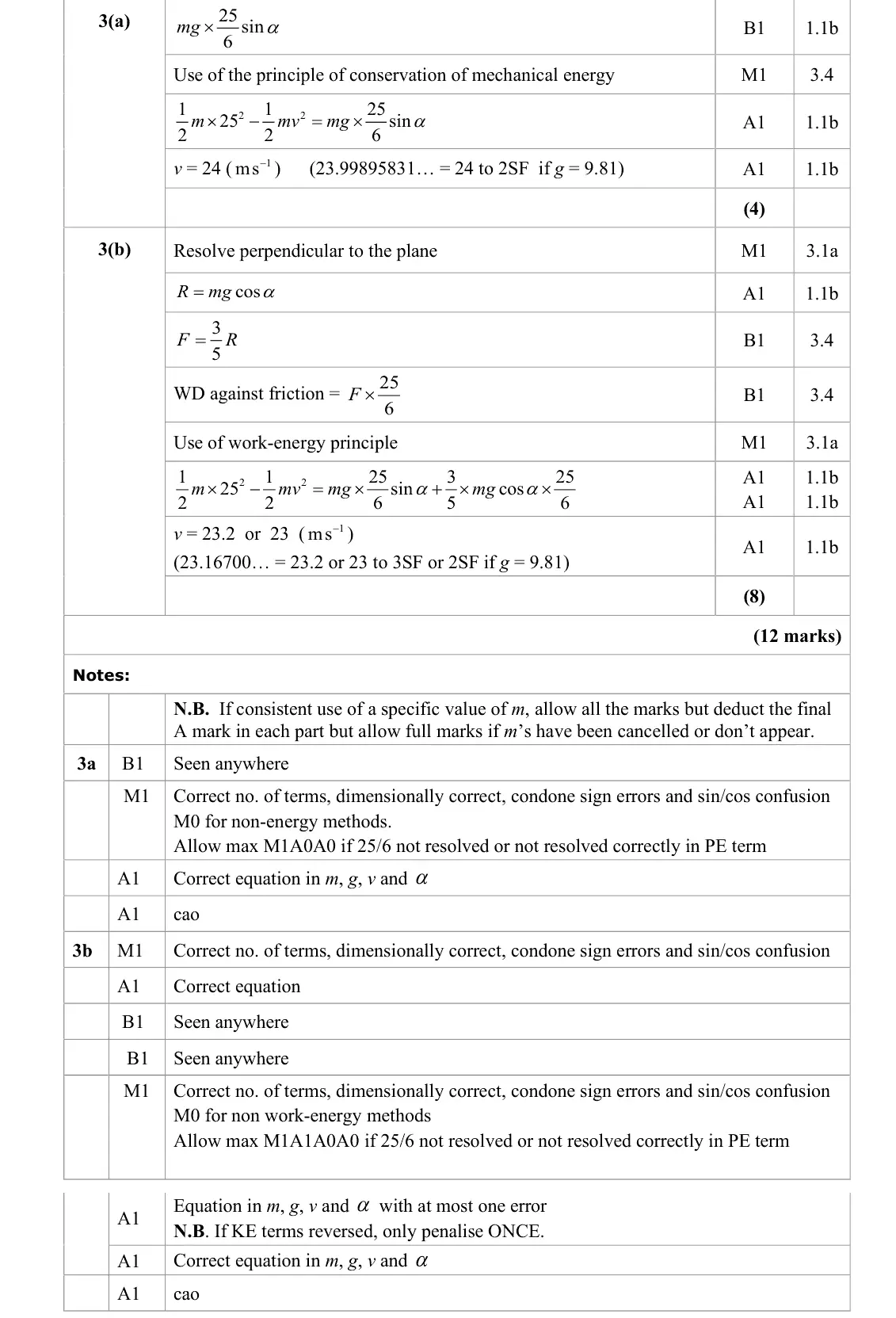
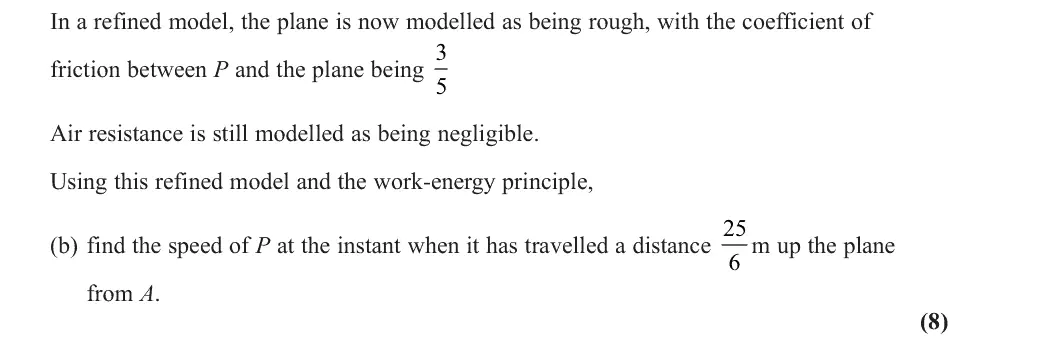
June 2022 · AS Paper 2 (Further Mechanics 1) · Q3(b)8 marks
Mark scheme (whole question; this part is marked with the orange bar)
Examiner's comment
energy principle and scored nothing. In the second part, most resolved perpendicular to the plane correctly but a few used sin instead of cos and a few omitted g. The majority went on to use F = 3/5 R and then multiplied their F by 25/6 to find the work done against friction. A few multiplied R by 25/6. A common error was to use F in the work-energy equation which lost the M mark. A few multiplied mgsin alpha by 25/6 and then included this in their work-energy equation to get an extra term and so lost the M mark. Some candidates lost the final mark after rounding to 2 d.p. rather than 2 or 3 s.f. after the use of g = 9.8
Key points from the mark scheme and examiner's report
R = mg cos α, F = (3/5)R, work against friction F × 25/6
work-energy: v = 23.2 (or 23) m s⁻¹
using the force F instead of work done, or adding an extra weight-component work term, lose the M mark
final answer to 2 or 3 sf
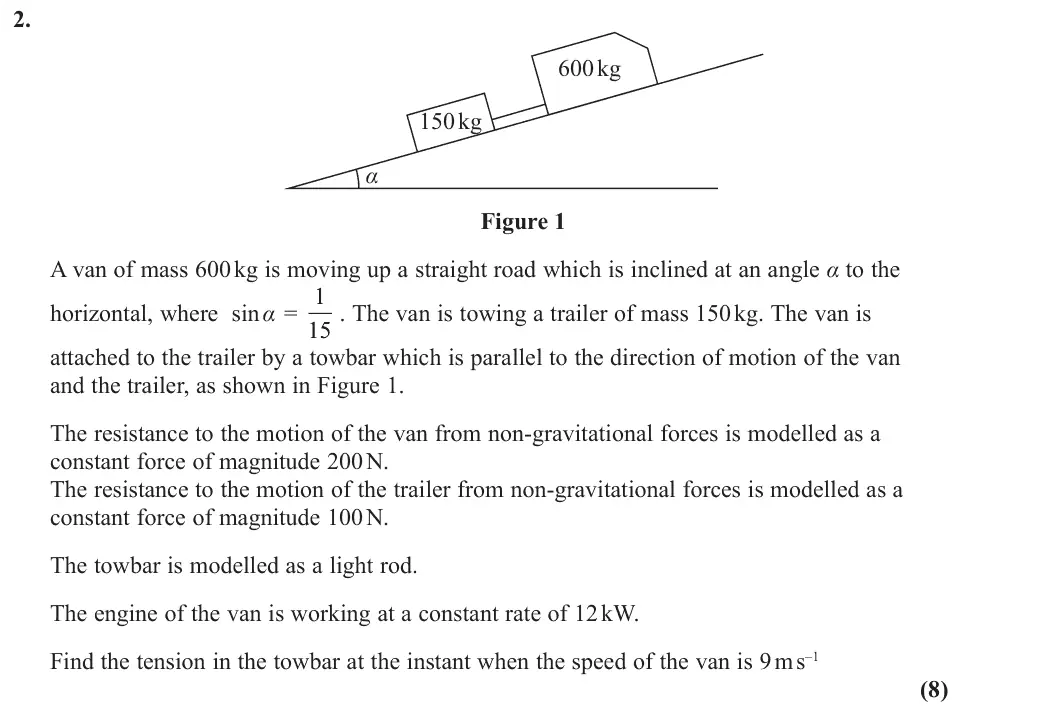
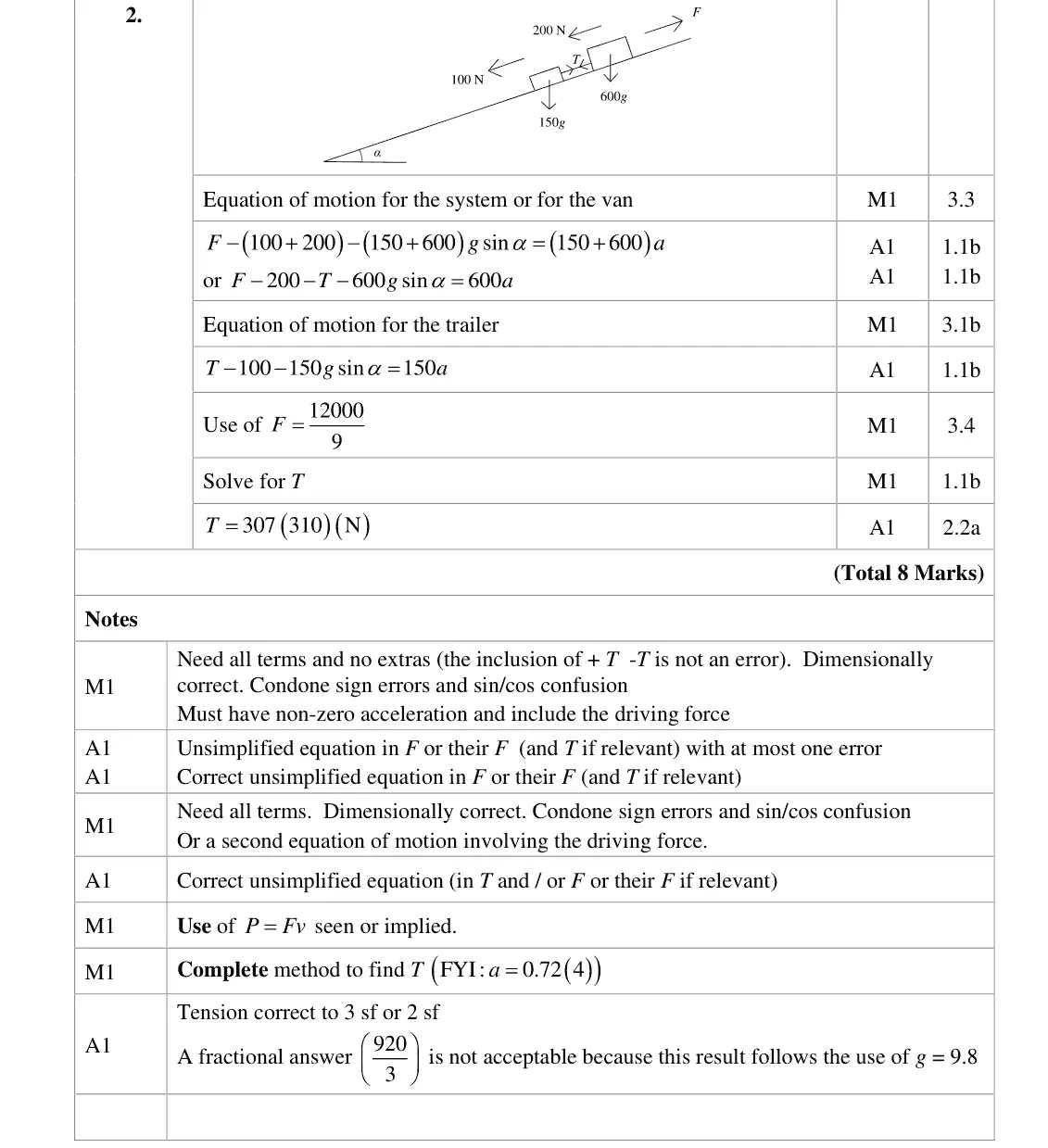
June 2022 · Paper 3C (Further Mechanics 1) · Q28 marks
Mark scheme (whole question; this part is marked with the orange bar)
Examiner's comment
This proved to be a straightforward question for the majority of candidates with many gaining full marks. Almost all candidates understood the relationship between power, driving force and velocity. There were some sign errors in forming the equations of motion for the vehicles, and some errors in using the correct resistances. Those candidates who used the given diagram or their own copy and marked on all the forces clearly tended to form accurate equations. Several candidates assumed that the vehicles were moving at constant speed, and consequently used an acceleration equal to zero. Many candidates lost the final accuracy mark by giving an over-specified answer following the use of an approximate value for g.
Key points from the mark scheme and examiner's report
F = 12000/9
equations for the system (or van) and the trailer: T − 100 − 150g sin α = 150a
T = 307 N (2 or 3 sf, not 920/3)
some wrongly assumed constant speed
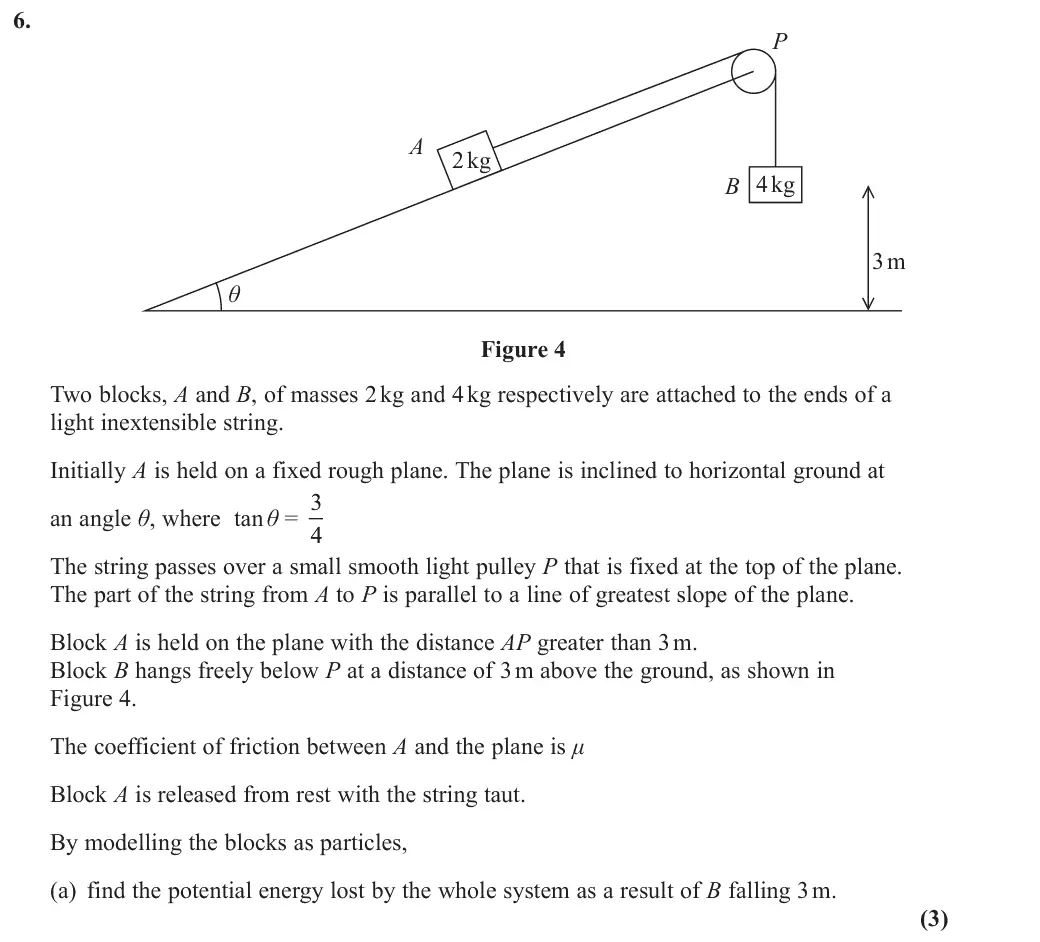
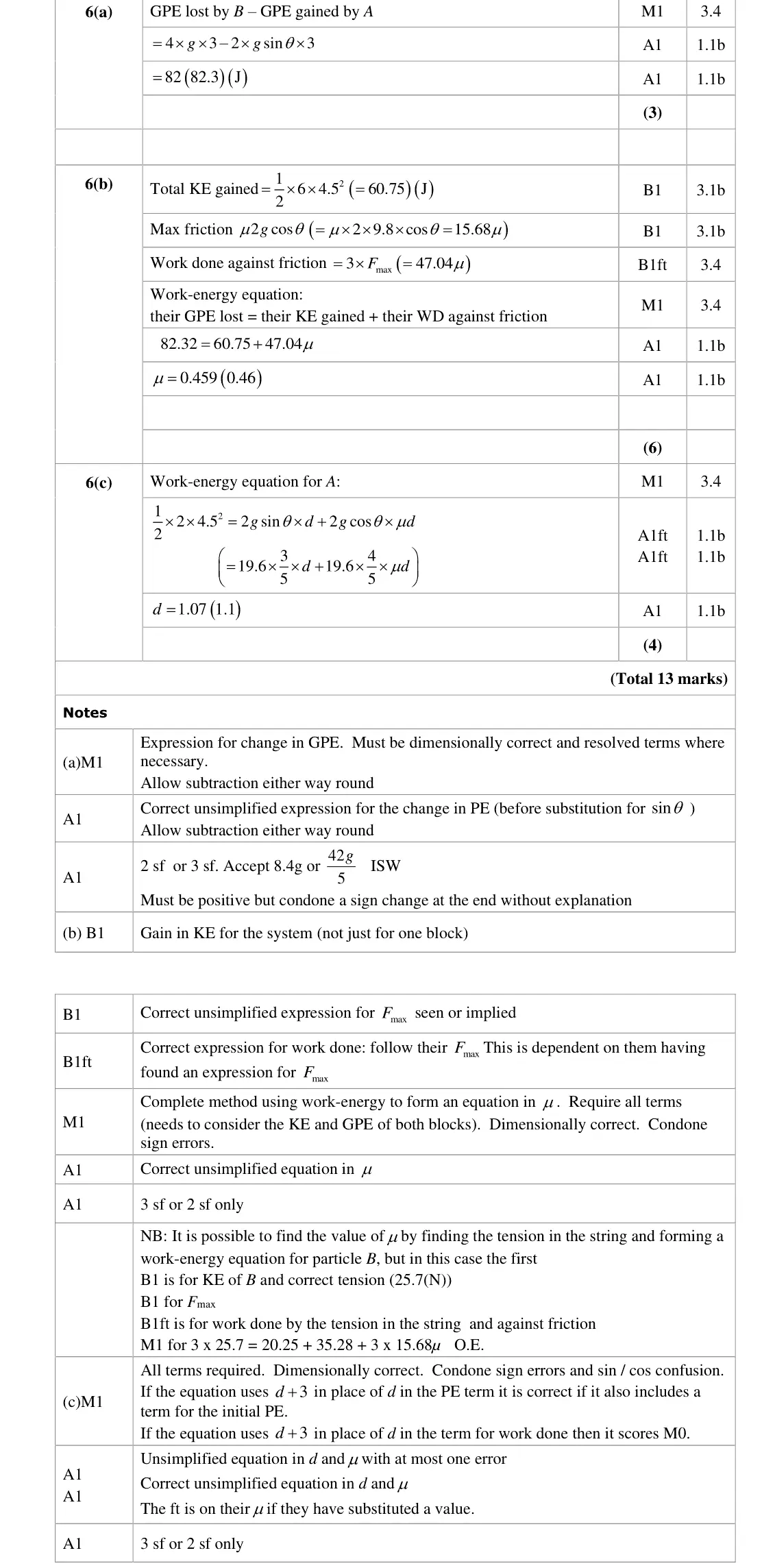
June 2022 · Paper 3C (Further Mechanics 1) · Q6(a)3 marks
Mark scheme (whole question; this part is marked with the orange bar)
Examiner's comment
(a) There were many correct solutions to this part of the problem. The most common error was not to round the final answer to 2 or 3 significant figures following the use of an approximate value for g. There were also some errors in resolving to find the GPE gained by A.
Key points from the mark scheme and examiner's report
GPE lost by B minus GPE gained by A: 4g(3) − 2g sin θ(3) = 82.3 J (2 or 3 sf)
errors resolving the GPE of A
June 2022 · Paper 3C (Further Mechanics 1) · Q6(b)6 marks
Mark scheme (whole question; this part is marked with the orange bar)
Examiner's comment
(b) Most candidates gained marks for finding the work done against friction. Some candidates only found the gain in kinetic energy for one of the blocks. There were some sign errors, but many candidates did consider all the relevant components in forming their work energy equation. A few candidates did not answer part (a) correctly but then used the correct values for the change in GPE of both blocks in part (b).
Key points from the mark scheme and examiner's report
PE lost = KE of BOTH blocks ½(6)(4.5²) + WD against friction 3 × 2gμ cos θ: μ = 0.459
KE of one block only was common
June 2022 · Paper 3C (Further Mechanics 1) · Q6(c)4 marks
Mark scheme (whole question; this part is marked with the orange bar)
Examiner's comment
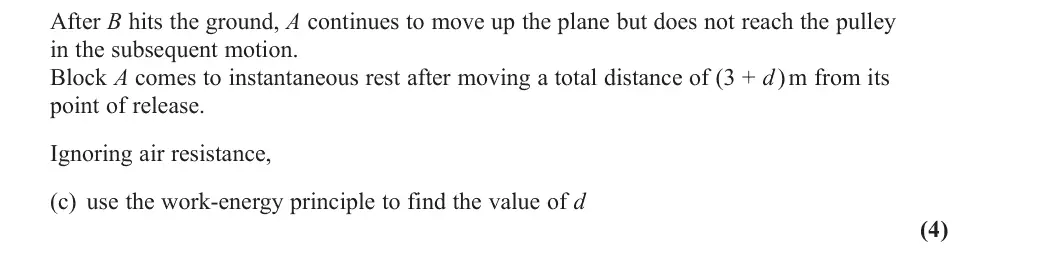
(c) The most successful approach was to consider the motion from the instant that B hit the ground. When another energy approach was attempted, it often had a term missing and was therefore unsuccessful. The most common error was to use d + 3 in place of d in the term for work done against friction. A small number of responses obtained correct answers to parts (b) and (c) by using equations of motion. The question directed candidates to use energy and no marks were available for the use of alternative methods.
Key points from the mark scheme and examiner's report
A alone after B lands: ½(2)(4.5²) = 2g sin θ d + 2gμ cos θ d, d = 1.07
using d + 3 in the friction term is wrong
energy method required
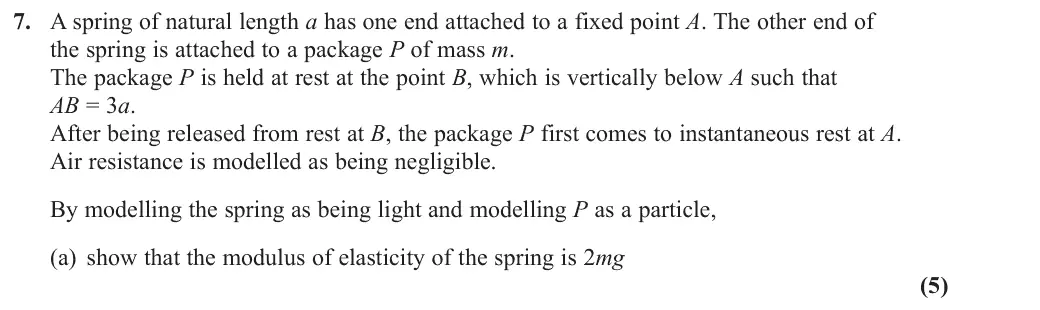
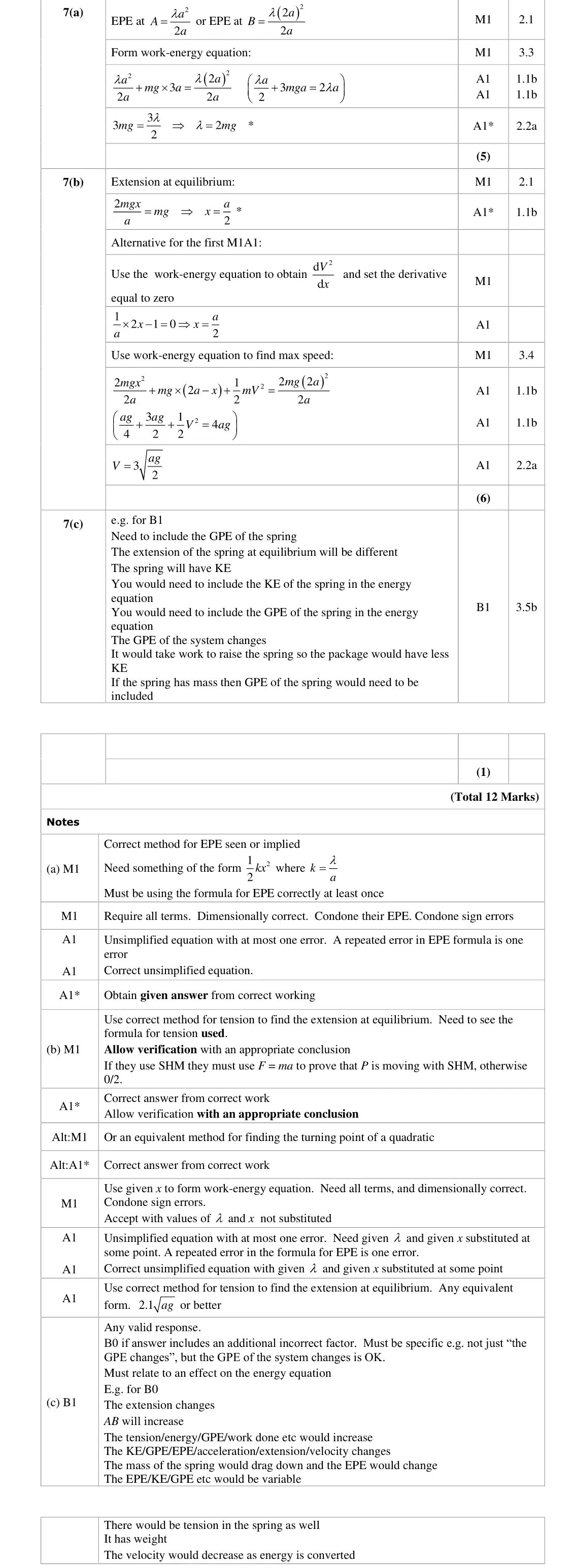
June 2022 · Paper 3C (Further Mechanics 1) · Q7(a)5 marks
Mark scheme (whole question; this part is marked with the orange bar)
Examiner's comment
(a) Most candidates scored the first mark for a correct expression for the EPE at A or B. Combining the relevant terms for a correct energy equation was more challenging. Some candidates possibly did not appreciate that they were dealing with a spring and not a string and so two EPE terms were required. Those candidates who did set up the correct equation were able to deduce the given result.
Key points from the mark scheme and examiner's report
two EPE terms (it is a spring): λa²/2a + 3mga = λ(2a)²/2a, λ = 2mg
treating it as a string (one EPE term) was the common error
June 2022 · Paper 3C (Further Mechanics 1) · Q7(b)6 marks
Mark scheme (whole question; this part is marked with the orange bar)
Examiner's comment
(b) Almost all candidates gained the first two marks by recognising that the package is at its maximum speed when in equilibrium. Several responses then omitted a term when forming their equation for conservation of mechanical energy, or made slips in substituting and simplifying their equations.
Key points from the mark scheme and examiner's report
(i) max speed at equilibrium: 2mgx/a = mg, x = a/2
(ii) energy equation from release to x = a/2: V = 3√(ag/2)
terms missed or slips in simplifying
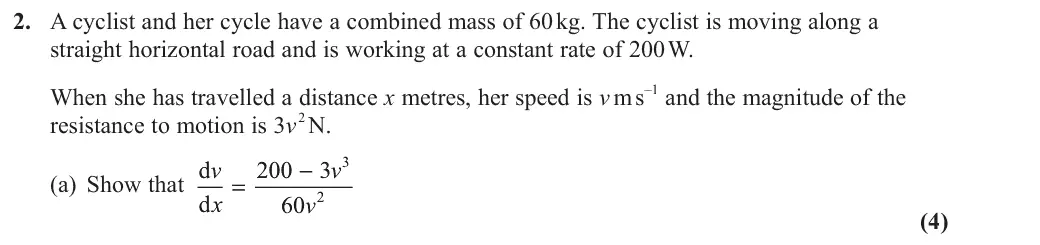
June 2022 · Paper 4C (Further Mechanics 2) · Q2(a)4 marks
Mark scheme (whole question; this part is marked with the orange bar)
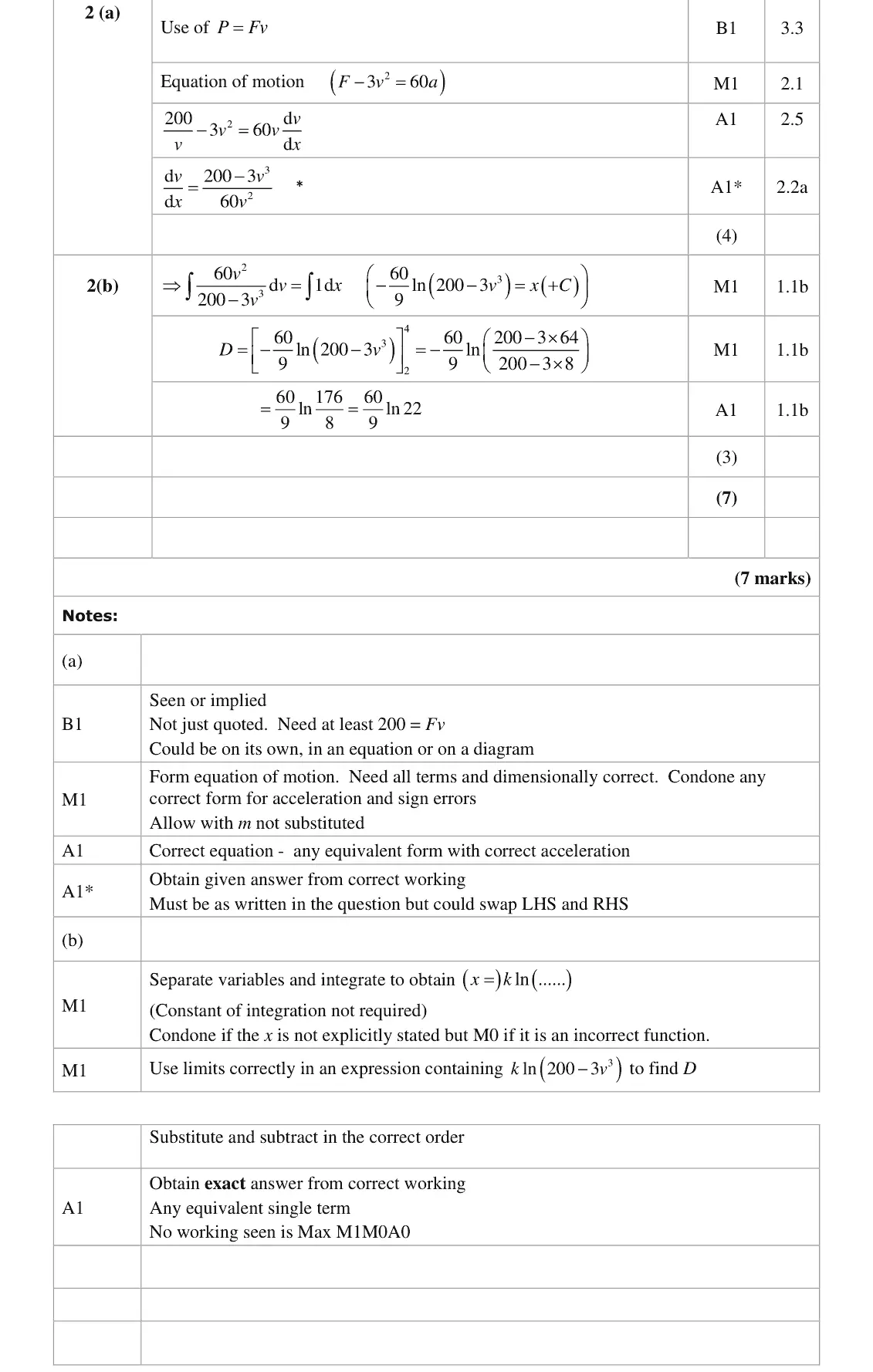
Examiner's comment
(a) This was another question that most candidates approached with confidence. They combined an expression for the driving force (obtained from the given rate of working) with a correct equation of motion to obtain the given differential equation. The most common route was to form the equation of motion in terms of a or d d v t and then substitute d d v v x , with many showing use of the chain rule to justify this step. The most common error was to use 200 as a force in the equation of motion.
Key points from the mark scheme and examiner's report
driving force 200/v from P = Fv
200/v − 3v² = 60v dv/dx
commonest error using 200 as a force
show a = v dv/dx
Nov 2021 · Paper 3C (Further Mechanics 1) · Q1(a)5 marks
Mark scheme (whole question; this part is marked with the orange bar)
Examiner's comment
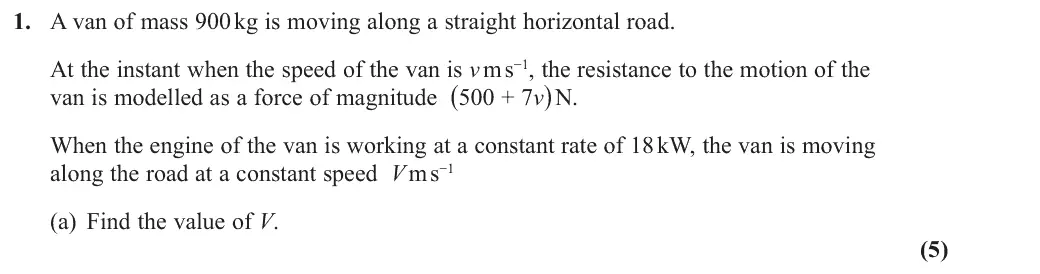
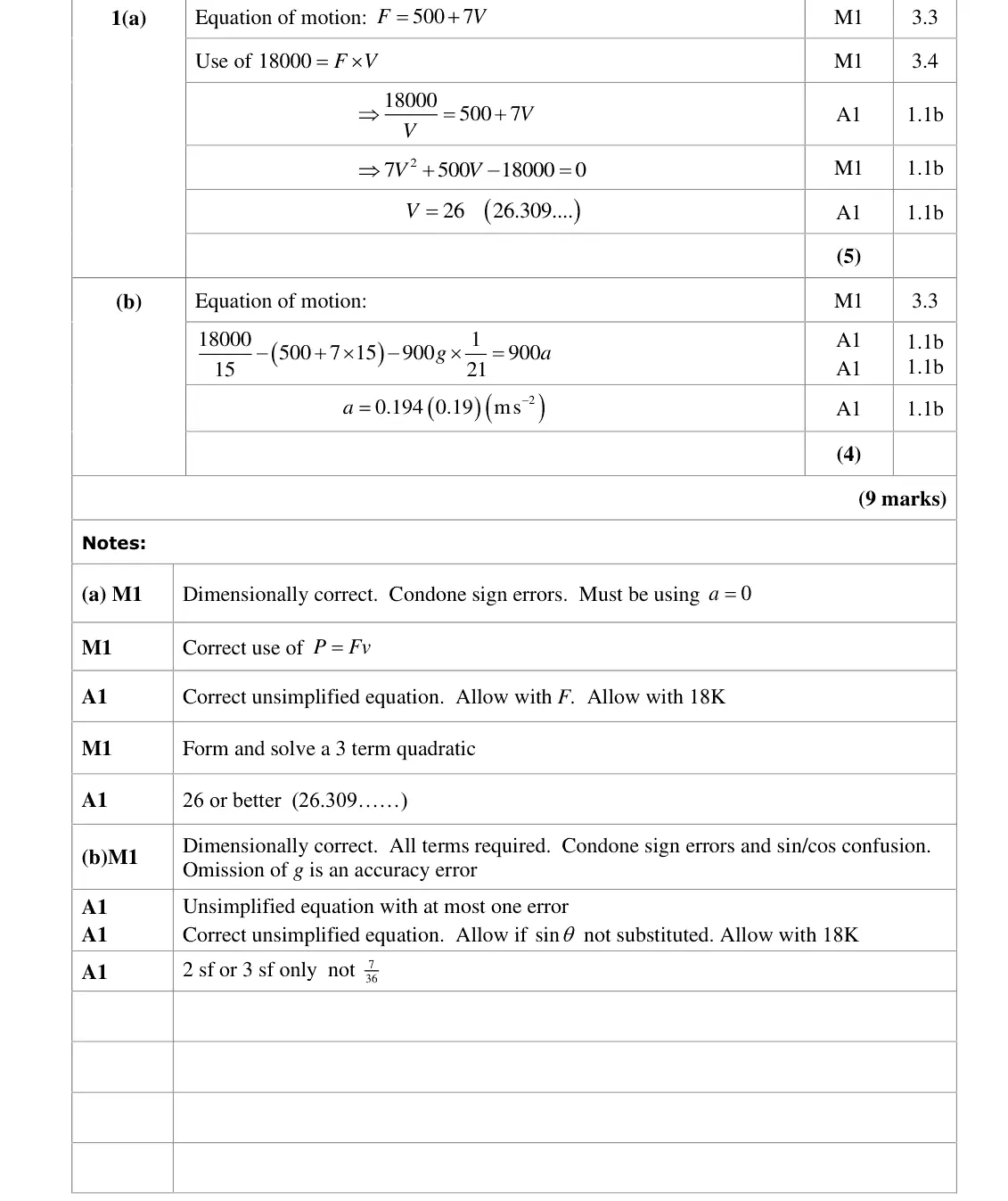
This question was quite standard for this topic and the better candidates showed a good understanding. (a) There were several fully correct solutions. Some candidates gave more figures than necessary in their final answer. The most common problem was not to interpret "constant speed" as implying no acceleration..
Key points from the mark scheme and examiner's report
constant speed so a = 0: 18000/V = 500 + 7V
7V² + 500V − 18000 = 0, V = 26.3
commonest error was not taking constant speed as zero acceleration
Nov 2021 · Paper 3C (Further Mechanics 1) · Q1(b)4 marks
Mark scheme (whole question; this part is marked with the orange bar)
Examiner's comment
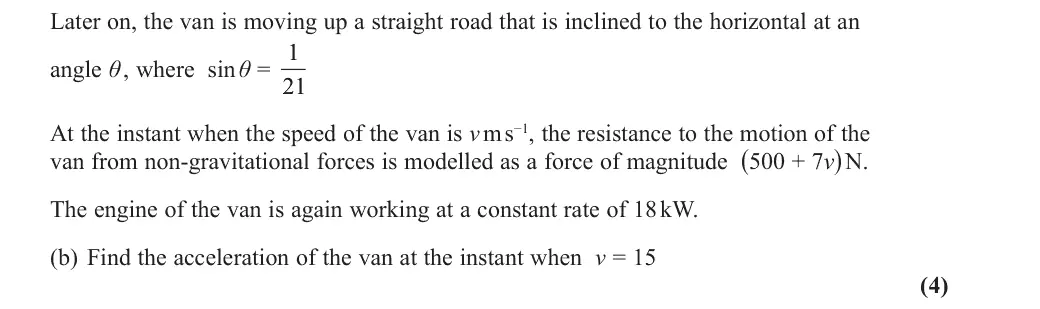
This question was quite standard for this topic and the better candidates showed a good understanding. (b) This is a familiar scenario and several candidates formed an equation of motion including all the correct terms. There were some sign errors in the equations. The final answer depends on the use of an approximate value for g, so although calculator work will lead to an exact fraction, candidates should remember that answers not given to 2 significant figures or to 3 significant figures will not score the final accuracy mark.
Key points from the mark scheme and examiner's report
18000/15 − (500 + 105) − 900g/21 = 900a
a = 0.194 m s⁻² (2 or 3 sf only, not 7/36)
sign errors
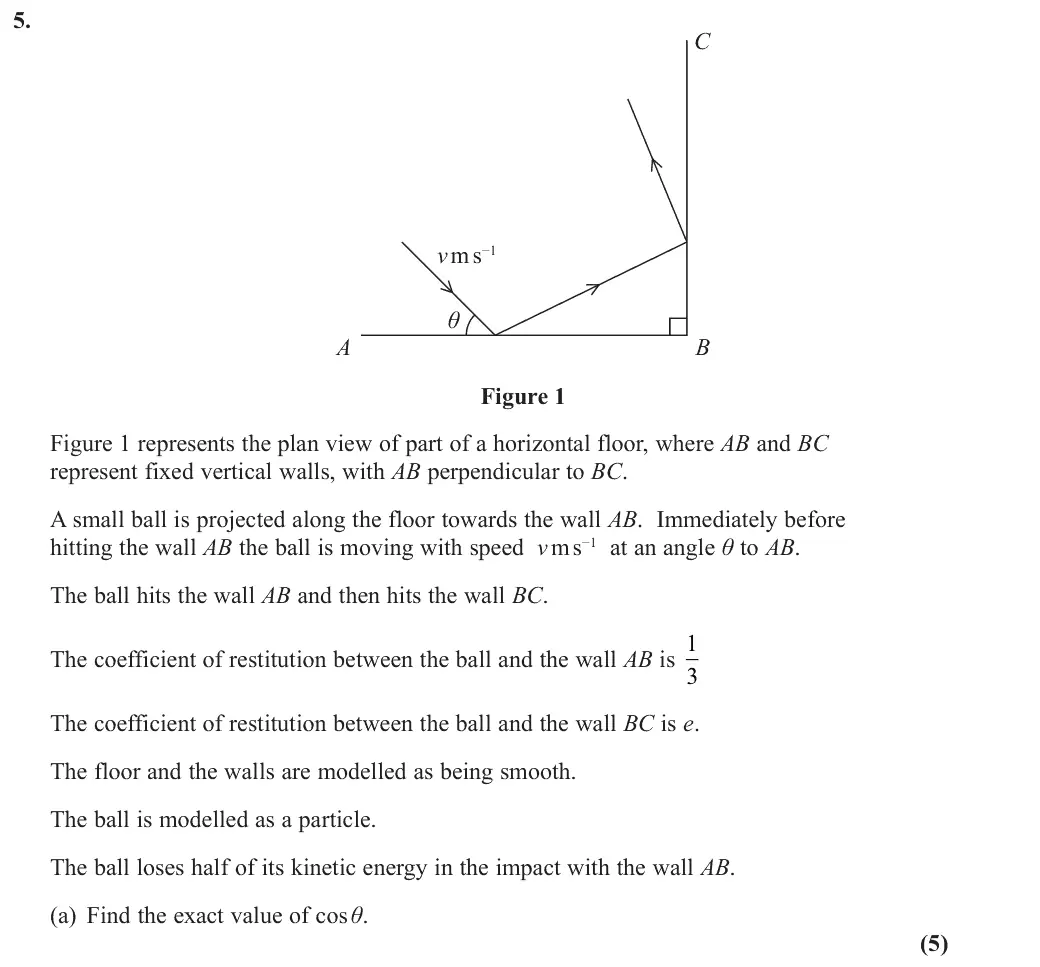
Nov 2021 · Paper 3C (Further Mechanics 1) · Q5(a)5 marks
Mark scheme (whole question; this part is marked with the orange bar)
Examiner's comment
(a) Those candidates who started by giving the components of the velocity after the impact with AB in terms of v and theta were noticeably more successful than those who introduced a new speed and a new angle. Some candidates started by introducing unit vectors parallel and perpendicular to AB and working with an initial velocity j v i : x y = - if worked through correctly this was very efficient and effective.
Key points from the mark scheme and examiner's report
after AB: v cos θ and (1/3)v sin θ
half KE lost: 1/2 = 1/9 + (8/9)cos²θ, cos θ = √7/4
introducing a new speed and angle made it harder
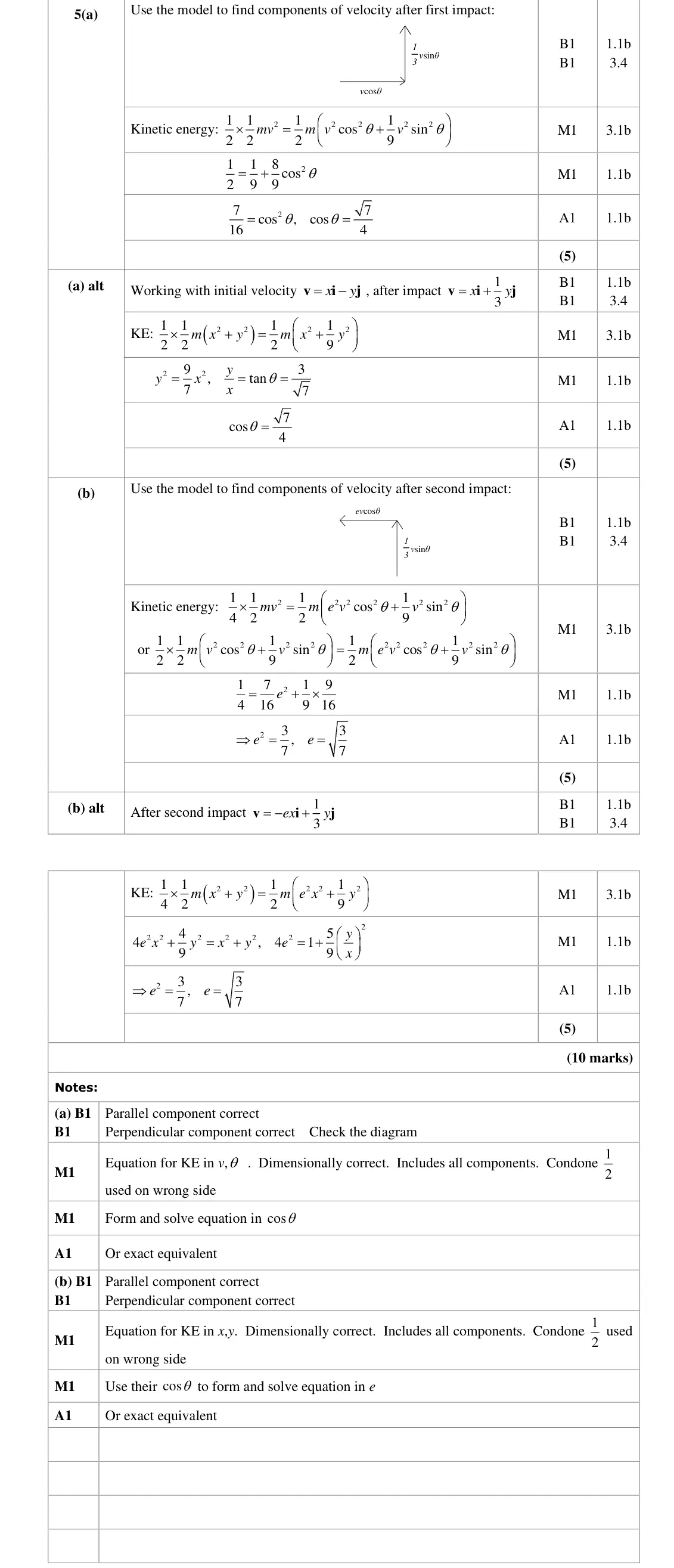
Nov 2021 · Paper 3C (Further Mechanics 1) · Q5(b)5 marks
Mark scheme (whole question; this part is marked with the orange bar)
Examiner's comment
(b) Here again, those candidates who introduced new variables added complications and often could not see how to solve their equations. There were only a small number of fully correct solutions.
Key points from the mark scheme and examiner's report
after BC: e v cos θ and (1/3)v sin θ
KE now a quarter of the original: e² = 3/7, e = √(3/7)
few fully correct solutions
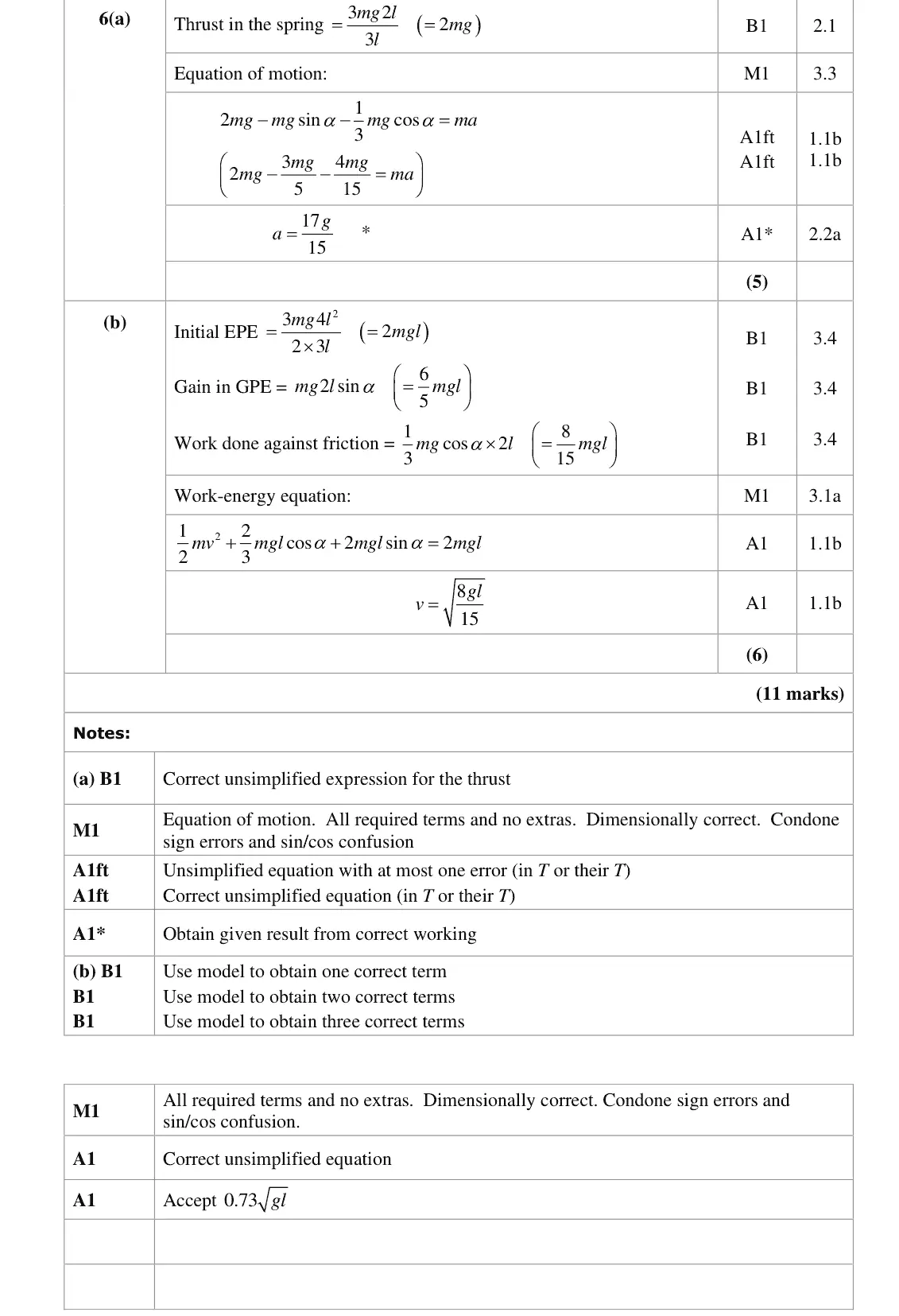
Nov 2021 · Paper 3C (Further Mechanics 1) · Q6(b)6 marks
Mark scheme (whole question; this part is marked with the orange bar)
Examiner's comment
(b) The better candidates recognised the need to form a work-energy equation. The mark scheme helped those candidates who found some, but not all, of the required terms. The most common error was to omit the work done against friction.
Key points from the mark scheme and examiner's report
EPE 2mgl = KE + GPE (6/5)mgl + WD against friction (8/15)mgl over 2l
v = √(8gl/15)
omitting friction was the commonest error
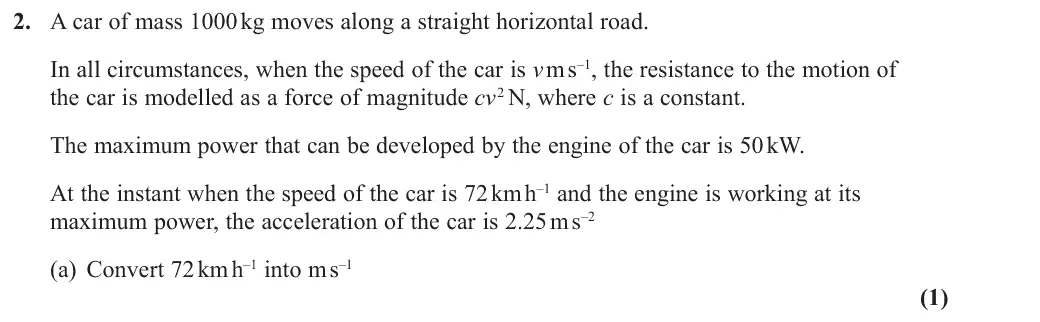
Oct 2020 · AS Paper 2 (Further Mechanics 1) · Q2(a)1 mark
Mark scheme (whole question; this part is marked with the orange bar)
Examiner's comment
(a) The majority of candidates completed this task correctly, but a significant minority showed little understanding of the relationship between the different units.
Key points from the mark scheme and examiner's report
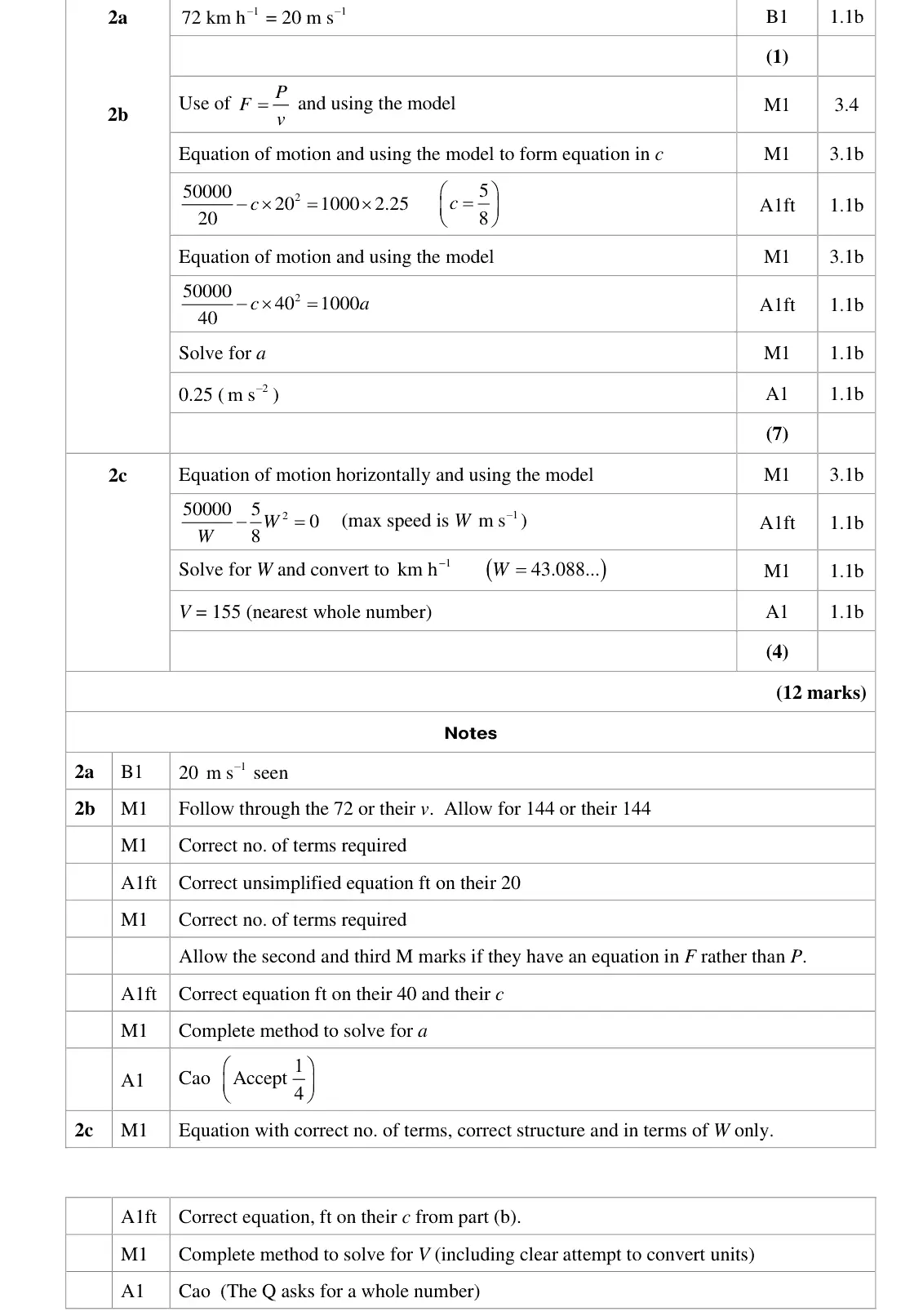
72 km h⁻¹ = 20 m s⁻¹
some unsure of unit conversion
Oct 2020 · AS Paper 2 (Further Mechanics 1) · Q2(b)7 marks
Mark scheme (whole question; this part is marked with the orange bar)
Examiner's comment
(b) There were several fully correct solutions, with the majority of candidates being familiar with the relationship between the power, the speed and the driving force. The majority of errors were due to incorrect signs or slips in the arithmetic.
Key points from the mark scheme and examiner's report
F = P/v
50000/20 − 400c = 1000 × 2.25 gives c = 5/8
then 50000/40 − c × 40² = 1000a, a = 0.25 m s⁻²
errors mainly signs and arithmetic
Oct 2020 · AS Paper 2 (Further Mechanics 1) · Q2(c)4 marks
Mark scheme (whole question; this part is marked with the orange bar)
Examiner's comment
43 1 V = 43 ms . (c) The most common answers were and Many candidates had not - V = 1 kmh . noticed that the maximum speed was given as - V
Key points from the mark scheme and examiner's report
at maximum speed a = 0: 50000/W − (5/8)W² = 0, W = 43.09 m s⁻¹
convert back: V = 155
common error giving 43 (m s⁻¹) instead of km h⁻¹
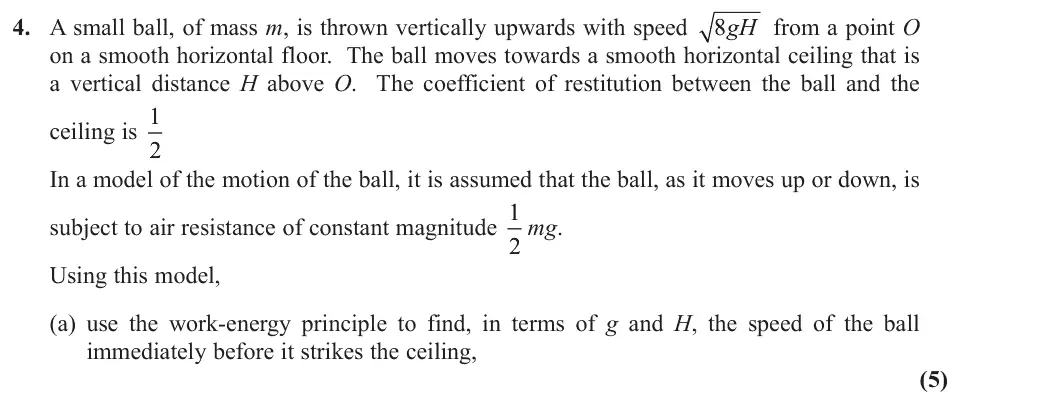
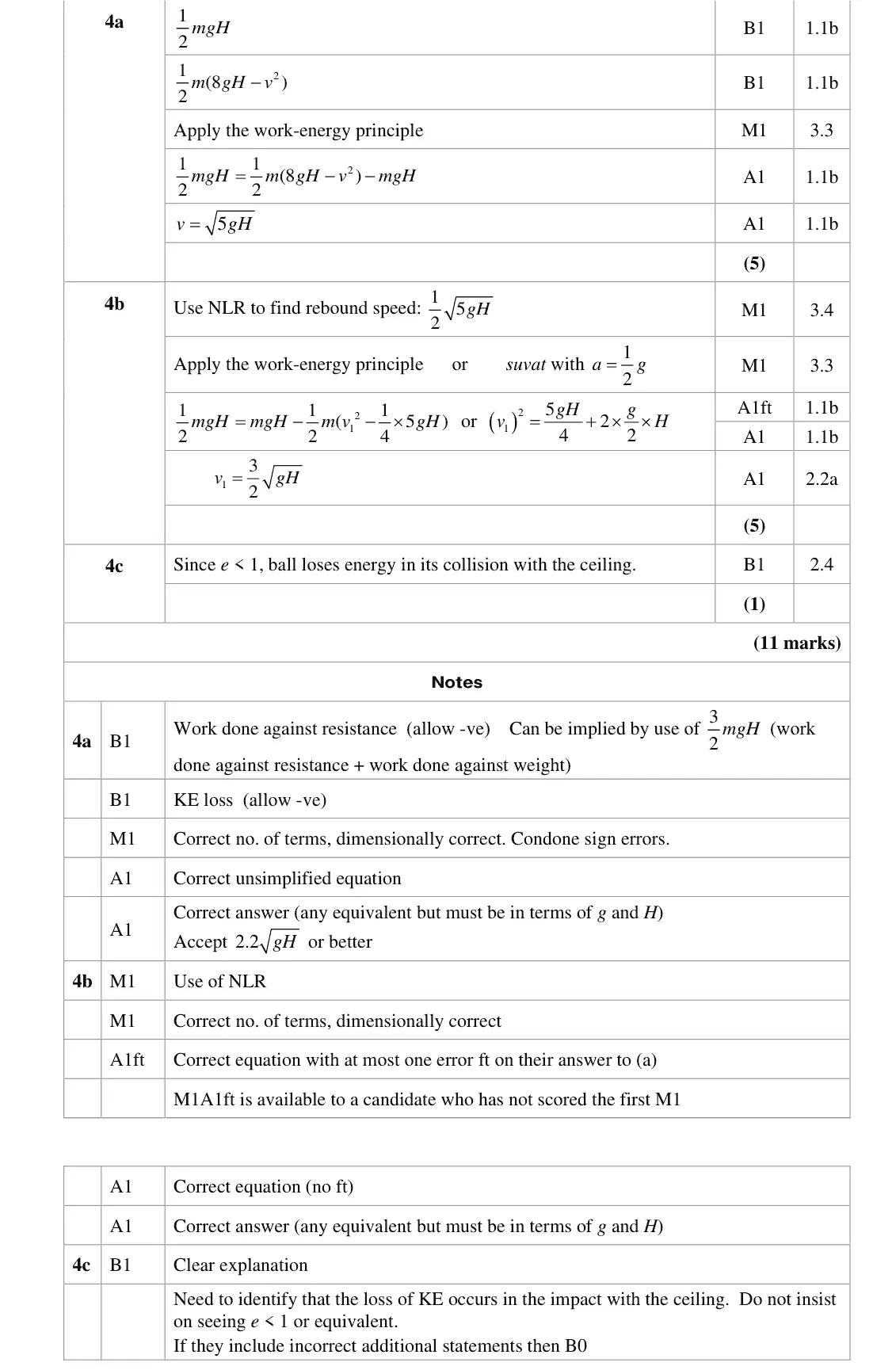
Oct 2020 · AS Paper 2 (Further Mechanics 1) · Q4(a)5 marks
Mark scheme (whole question; this part is marked with the orange bar)
Examiner's comment
(a) This part of the question asked candidates to use the work-energy principle, so solutions that did not take that approach did not score any marks. Several candidates did score the first two marks for correct statements of the work done against the resistance and for the change in kinetic energy. The most common errors in the energy equation were to omit the work done against the resistance, to include both the work done against the weight of the ball and the gain in gravitational potential energy, and sign errors. work-energy equation in part (a) they usually repeated the same error here. No particular method was required in this part of the question, so correct solutions using suvat equations gained full credit. Some correct solutions were seen, but many used incorrect values for the acceleration, usually g or 3 . g 2
Key points from the mark scheme and examiner's report
must use work-energy: work against resistance ½mgH = ½m(8gH − v²) − mgH, v = √(5gH)
omitting the resistance work or double-counting weight and PE are common errors
Oct 2020 · AS Paper 2 (Further Mechanics 1) · Q4(b)5 marks
Mark scheme (whole question; this part is marked with the orange bar)
Examiner's comment
(b) Most candidates made a correct start by using the coefficient of restitution correctly. Several candidates used the work-energy principle again. If they had made an error in the work-energy equation in part (a) they usually repeated the same error here.
Key points from the mark scheme and examiner's report
rebound speed ½√(5gH) by NLR, then work-energy or suvat with a = g/2 (not g or 3g/2): v = (3/2)√(gH)
Oct 2020 · Paper 3C (Further Mechanics 1) · Q2(a)4 marks
Mark scheme (whole question; this part is marked with the orange bar)
Examiner's comment
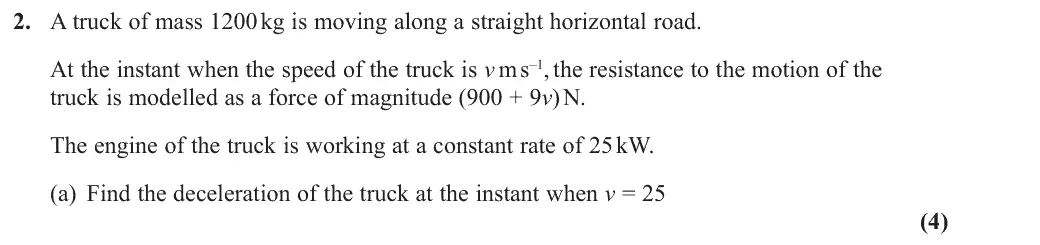
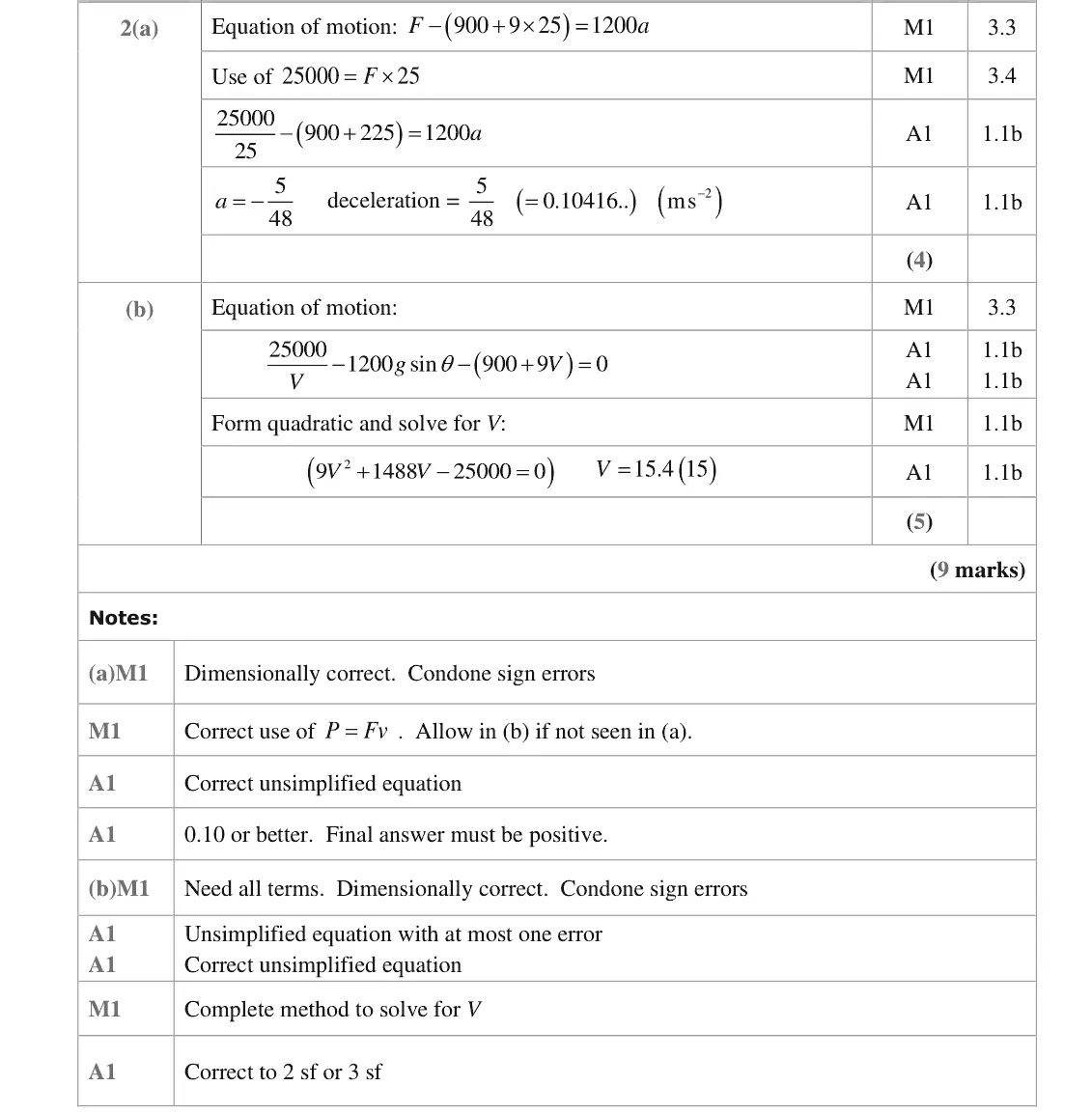
(a) The majority of candidates formed a correct equation for the motion of the truck. They found a negative value for the acceleration of the particle but often did not go on to conclude that the deceleration was positive.
Key points from the mark scheme and examiner's report
F = 25000/25 = 1000
1000 − (900 + 225) = 1200a, a = −5/48
deceleration must be given as positive 0.104 m s⁻²
many left a negative value
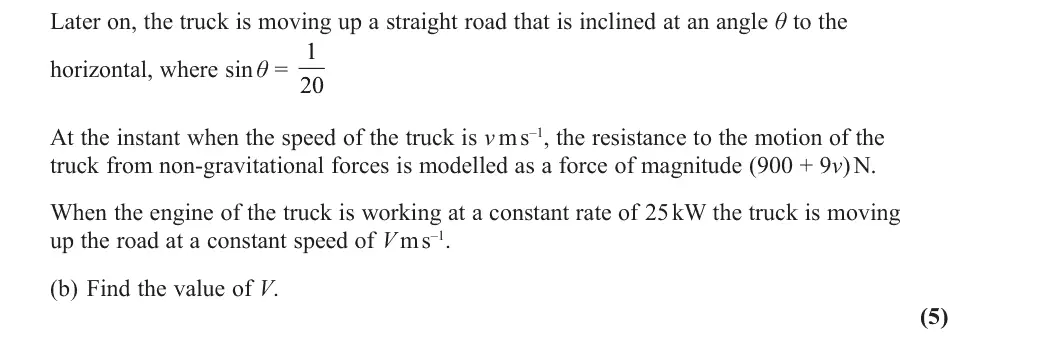
Oct 2020 · Paper 3C (Further Mechanics 1) · Q2(b)5 marks
Mark scheme (whole question; this part is marked with the orange bar)
Examiner's comment
(b) Most candidates formed an equation of motion containing all the required terms. There were some sign errors, and some candidates did not include a component of the weight. The majority of candidates who formed a correct equation went on to find the correct solution. A few candidates gave their final answer to more than three significant figures, which is not appropriate following the use of 9.8.
Key points from the mark scheme and examiner's report
25000/V − 1200g sin θ − (900 + 9V) = 0
9V² + 1488V − 25000 = 0, V = 15.4 (2 or 3 sf after g = 9.8)
missing the weight component or sign errors
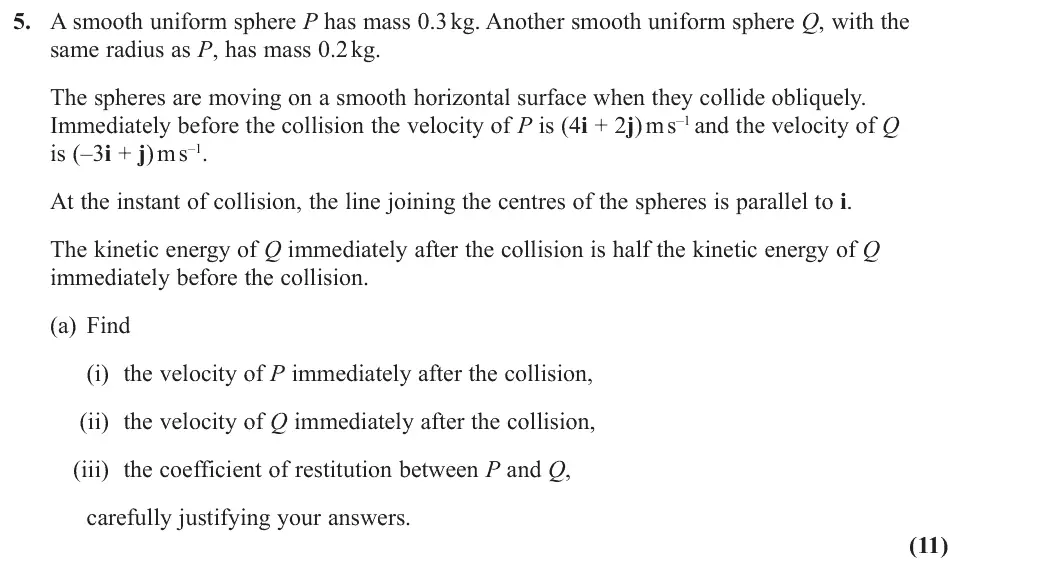
Oct 2020 · Paper 3C (Further Mechanics 1) · Q5(a)11 marks
Mark scheme (whole question; this part is marked with the orange bar)
Examiner's comment
(a) Those candidates who started with a diagram with the correct line of centres clearly marked were most likely to reach correct conclusions. Many candidates did form correct equations for conservation of momentum and for the impact law working parallel to the line of centres, but there were several candidates who wrote down equations in two dimensions. Some candidates wrote down an equation for the combined kinetic energy of P and Q, but the information given relates only to Q. The simplest way to solve the resulting simultaneous equations is to use the kinetic energy equation to find the velocity of Q and then use the other two equations. Candidates who started by finding the components of the speeds of P and Q in terms of e had more complicated algebra to deal with. The reason for the question asking the candidates to "carefully justify" their answers is that there are two possible solutions to the equations, one of which is not possible. In order to gain the final mark, the candidates needed to say why the second solution was not possible - very few candidates scored this mark.
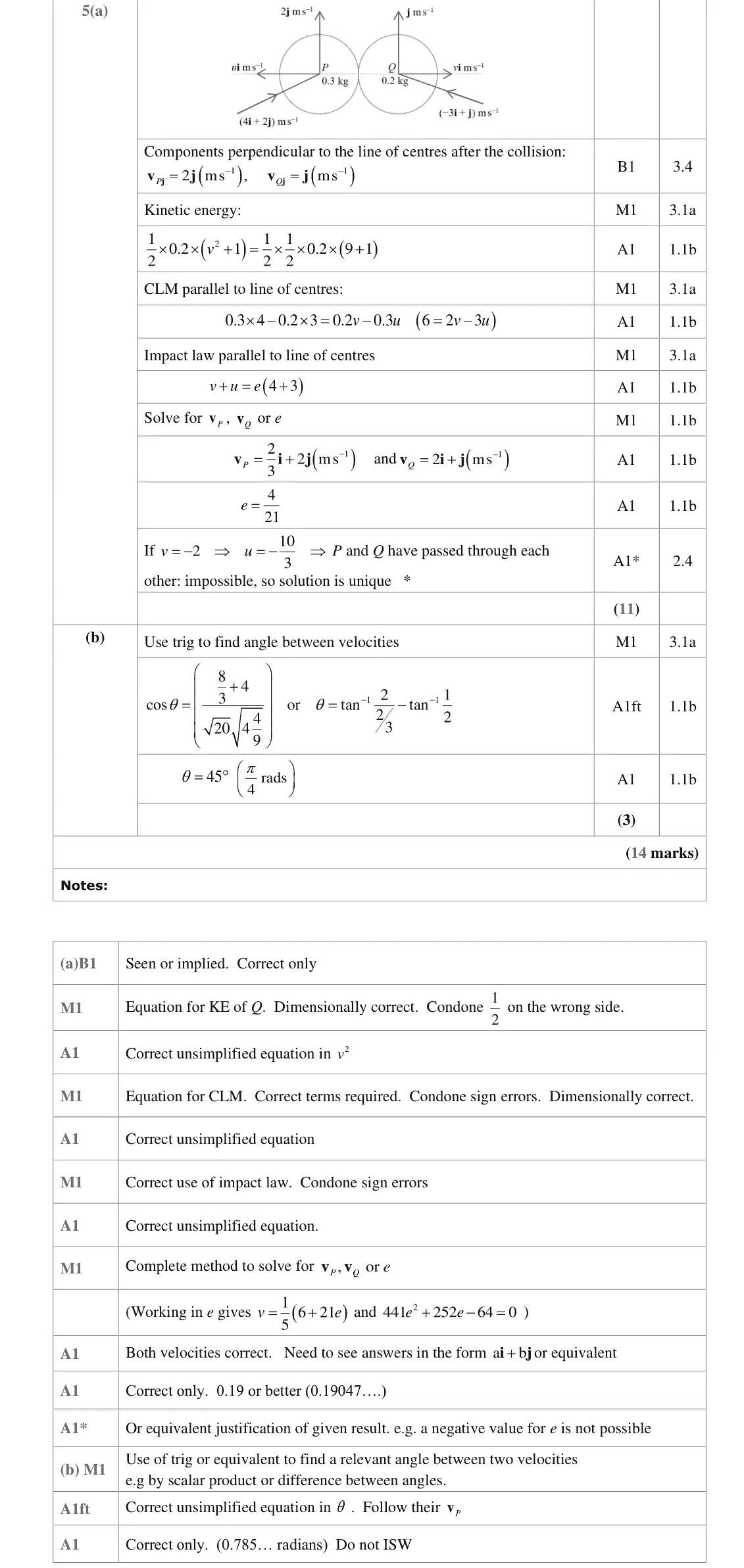
Key points from the mark scheme and examiner's report
j components unchanged
KE of Q gives v² = 4 (KE of Q only, not both)
CLM and NLR along i: v_P = (2/3)i + 2j, v_Q = 2i + j, e = 4/21
reject v = −2 (particles would pass through each other)
some wrote 2-D equations
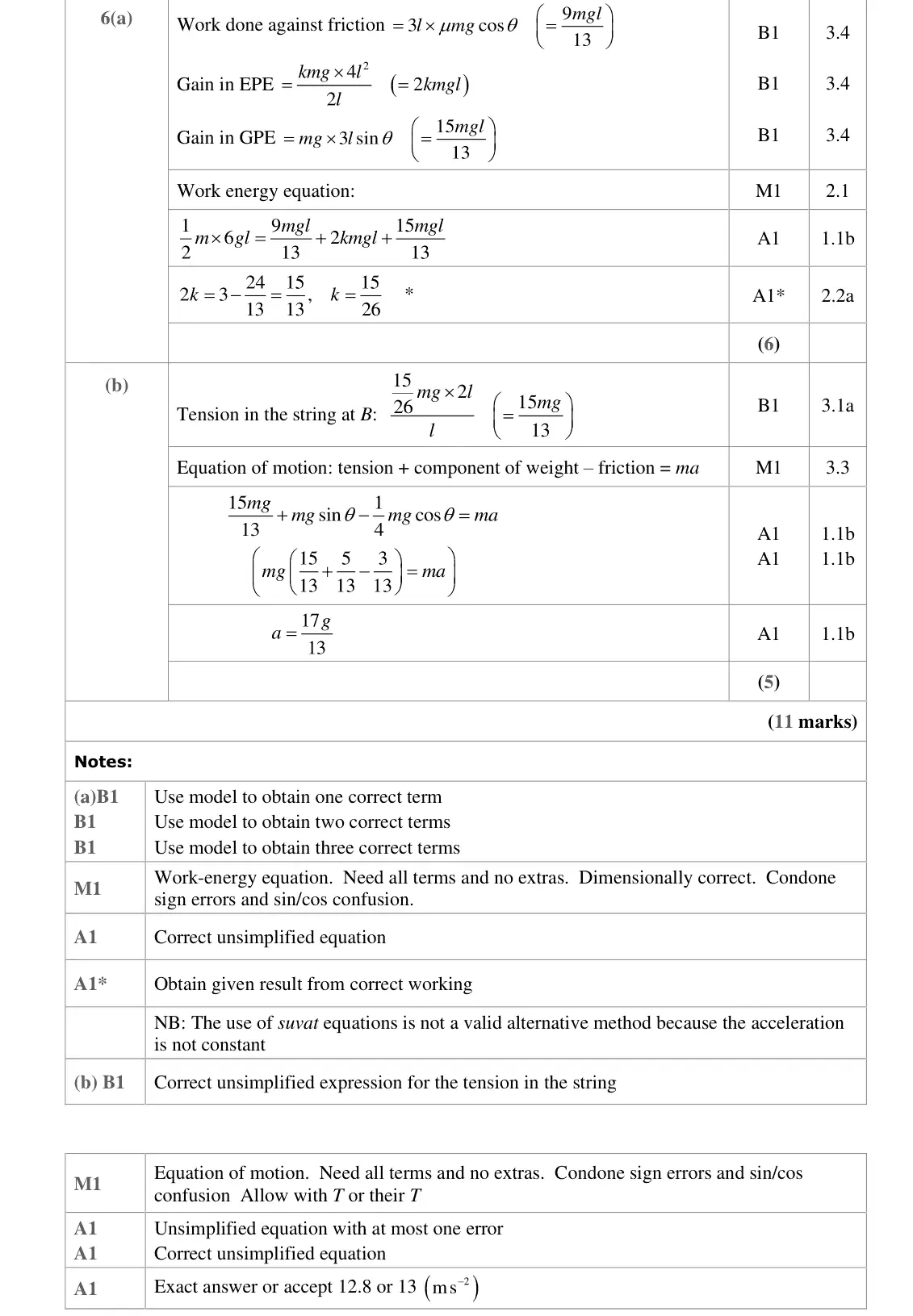
Oct 2020 · Paper 3C (Further Mechanics 1) · Q6(a)6 marks
Mark scheme (whole question; this part is marked with the orange bar)
Examiner's comment
(a) Most candidates recognised the need to use conservation of energy. The work done against friction and the gain in gravitational potential energy were usually found correctly. Some candidates used 3l for the extension of the string, rather than 2l, to calculate the elastic potential energy in the string when the package is at B. There were many fully correct work-energy equations. The most common errors were sign errors, incorrect elastic potential energy and double counting the work done against the weight and the gain in gravitational potential energy. There were some attempts to solve the problem using suvat formulae, which are not appropriate here because the acceleration is not constant.
Key points from the mark scheme and examiner's report
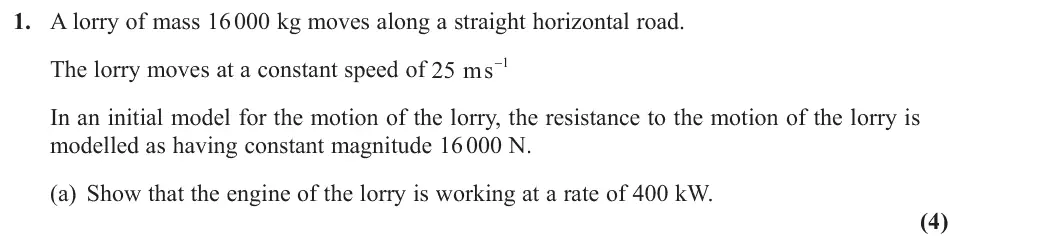
June 2019 · AS Paper 2 (Further Mechanics 1) · Q1(a)4 marks
Mark scheme (whole question; this part is marked with the orange bar)
Examiner's comment
(a) There were four marks available for this part of the question, which should have indicated to candidates that the response required more than simply calculating . The request “Show that …” means that there is some explanation required. In this case, candidates were expected to explain why they were using 16000 N as the driving force. A solution which gave no justification scored a maximum of one mark. In order to score all four marks it was necessary to reach the given answer correctly – some candidates stopped when they got to 400 000 W, and some made errors in the number of zeros in their working.
Key points from the mark scheme and examiner's report
constant speed so a = 0 and driving force = 16000 N must be stated
P = Fv = 16000 × 25 = 400 kW
must reach the given answer in kW, not stop at 400 000 W
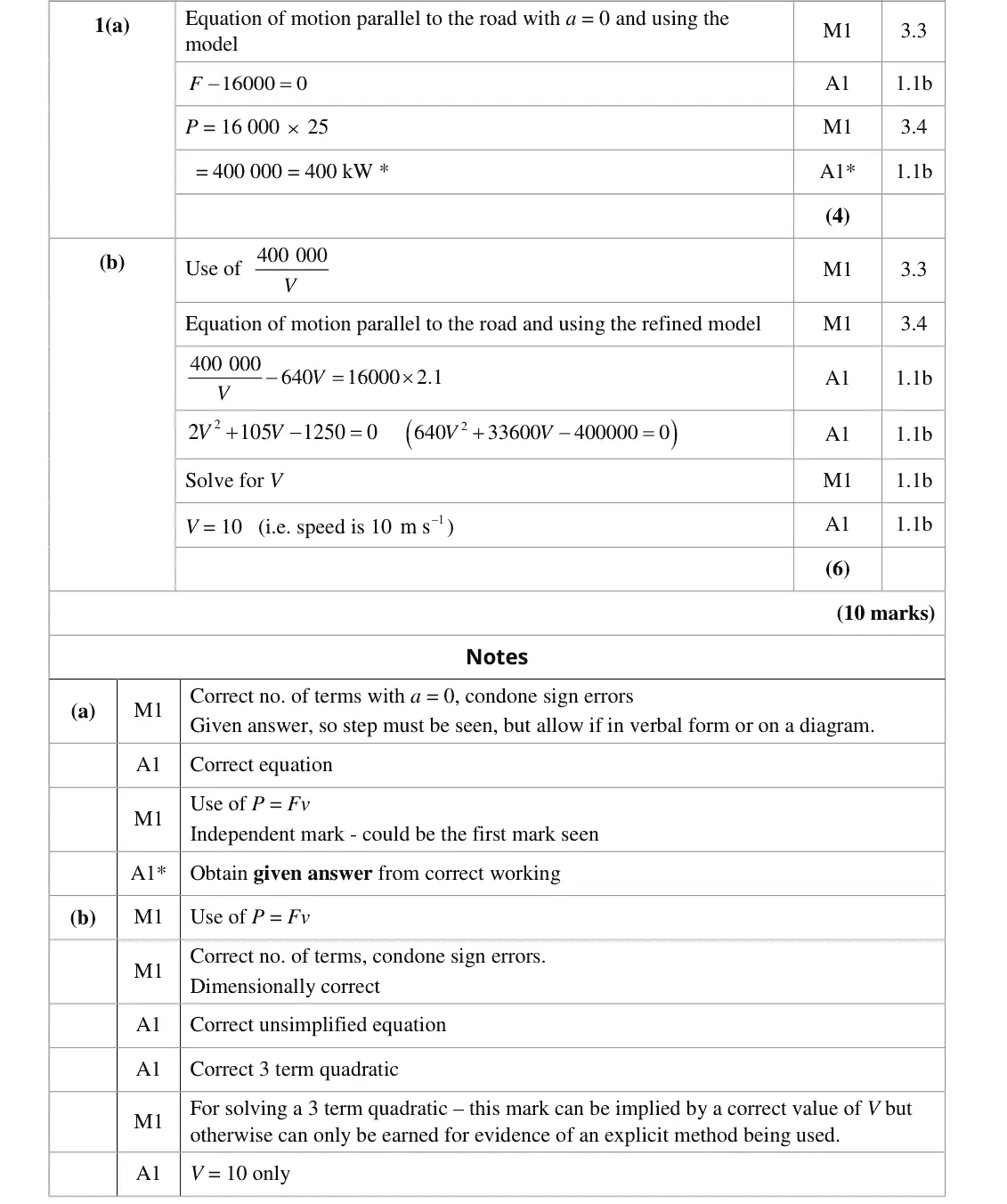
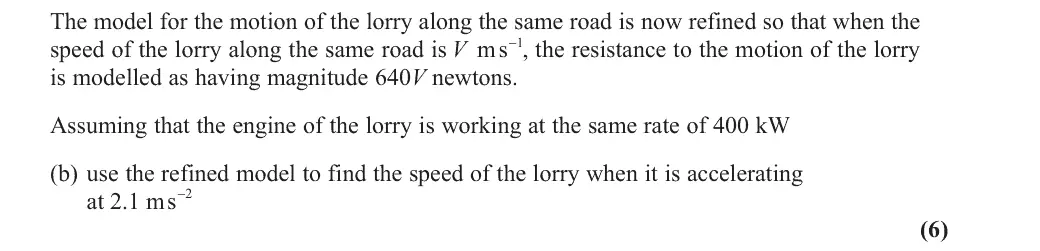
June 2019 · AS Paper 2 (Further Mechanics 1) · Q1(b)6 marks
Mark scheme (whole question; this part is marked with the orange bar)
Examiner's comment
(b) There were many fully correct solutions to this part of the question. For those candidates who scored the two initial method marks, the most common error was a sign error in the resistance. Candidates should bear in mind that if they use a calculator to solve an incorrect quadratic equation, showing no working, they will not score the method mark for solving the equation. There were several instances of candidates misreading either the question or their own writing. Many of these examples involved gaining or losing zeros in numbers, but there were also people who used a resistance of 640 newtons. This error in the resistance substantially changes the question, so only the first two marks were available to these candidates.
Key points from the mark scheme and examiner's report
400000/V − 640V = 16000 × 2.1 gives 2V² + 105V − 1250 = 0, V = 10 m s⁻¹ only
sign error in the resistance
solving a wrong quadratic with no working shown loses the method mark
misreading 640V as 640 N
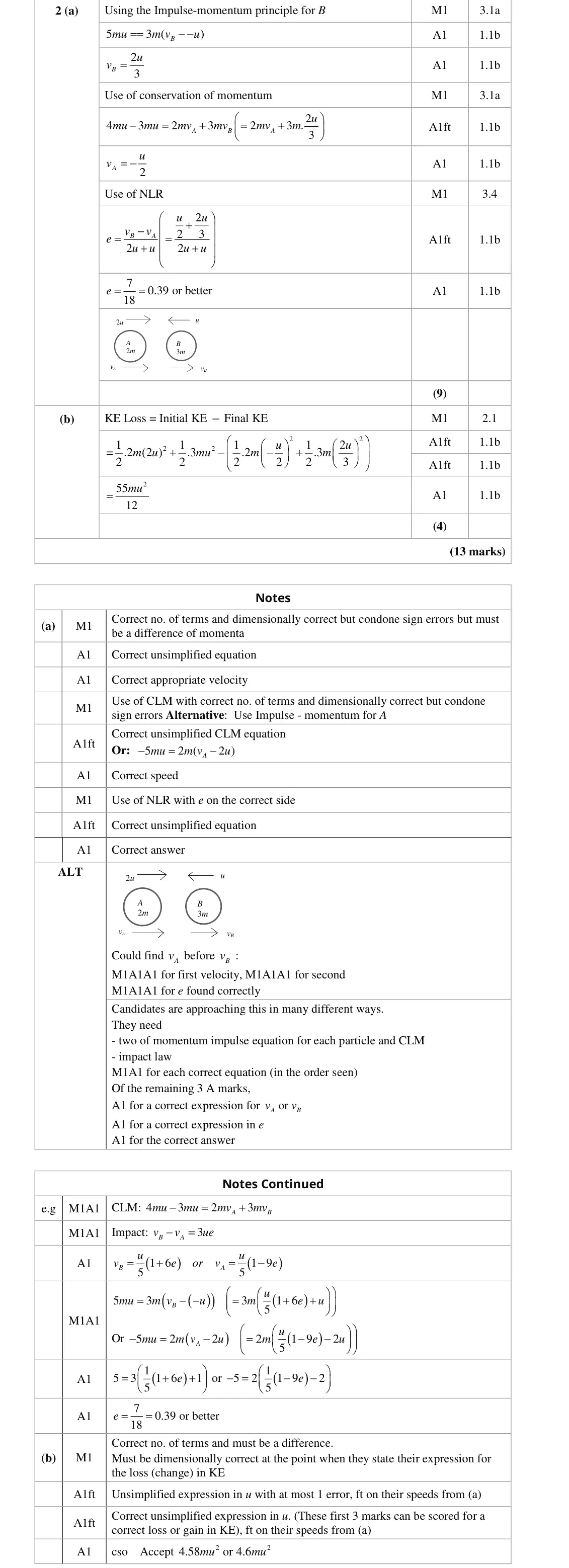
June 2019 · AS Paper 2 (Further Mechanics 1) · Q2(b)4 marks
Mark scheme (whole question; this part is marked with the orange bar)
Examiner's comment
(b) Most candidates who attempted this part of the question used a correct expression for kinetic energy. Many reached the correct answer, or were able to score at least three marks for the correct use of their values from part (a). A few candidates scored no marks
Key points from the mark scheme and examiner's report
initial KE − final KE using speeds from (a): 55mu²/12
follow-through allowed on (a) speeds
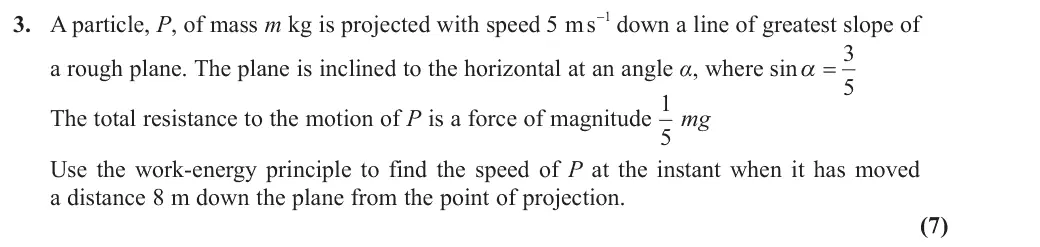
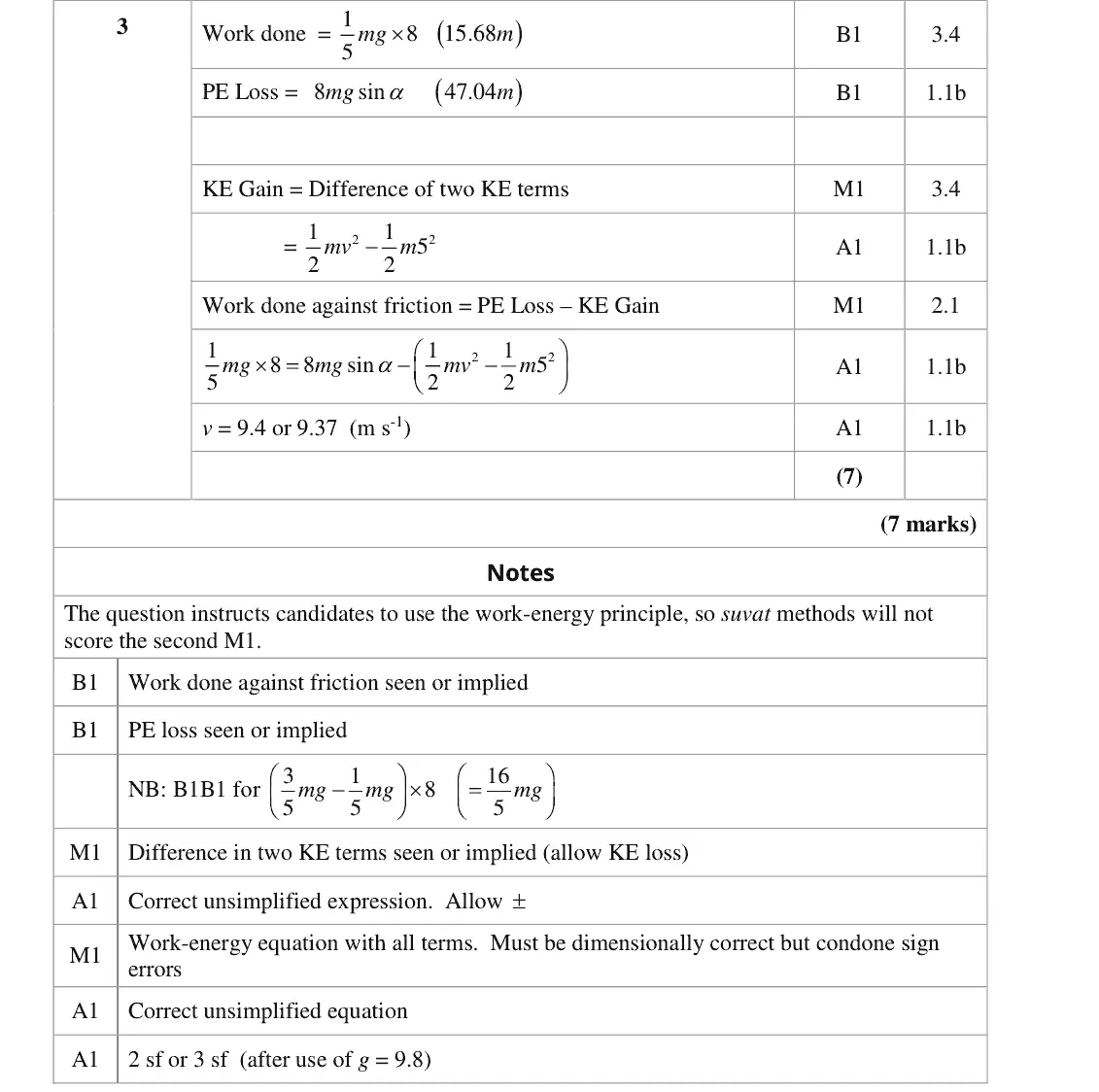
June 2019 · AS Paper 2 (Further Mechanics 1) · Q37 marks
Mark scheme (whole question; this part is marked with the orange bar)
Examiner's comment
Some candidates used suvat equations to obtain a “correct” answer to this question, but they scored no marks because they had not followed the instruction to use the work-energy principle. The majority of candidates did gain credit for finding at least some of the relevant terms. The most common errors were to assume that the initial kinetic energy was zero, or to overlook the work done against the resistance. Having been told that the plane was rough, some candidates engaged in unnecessary work to try to find the coefficient of friction between the particle and the plane. In forming the work-energy equation, there were some sign errors, some candidates omitted either the work done against the resistance or the change in gravitational potential energy, and some candidates included both the change in gravitational potential energy and the work done by the weight. The final answer follows the use of 9.8, so it should be given to 2 significant figures or to 3 significant figures.
Key points from the mark scheme and examiner's report
must use work-energy: work against resistance (1/5)mg × 8 = PE loss 8mg sin α − KE gain
v = 9.4 m s⁻¹ (2 or 3 sf)
suvat scores no marks
common errors: initial KE taken as 0, resistance work or PE change omitted, or both PE and work by weight counted
June 2019 · Paper 3C (Further Mechanics 1) · Q4(a)4 marks
Mark scheme (whole question; this part is marked with the orange bar)
Examiner's comment
The three parts of this question were independent of each other; candidates’ scores seemed to follow a pattern of all four marks or zero marks in each part. (a) The given answer resulted in many fully correct solutions. Some candidates formed separate equations of motion for the car and the trailer, and had to combine these in order to answer the question. A small number of candidates stated different components and correct expressions for the different terms of the equation of motion but never combined these in an equation, so gained only the first mark, despite declaring that 8 . The most common error was to overlook the constant speed and assume a non-zero value for the acceleration in the equation of motion.
Key points from the mark scheme and examiner's report
commonest error was assuming non-zero acceleration
June 2019 · Paper 3C (Further Mechanics 1) · Q4(b)4 marks
Mark scheme (whole question; this part is marked with the orange bar)
Examiner's comment
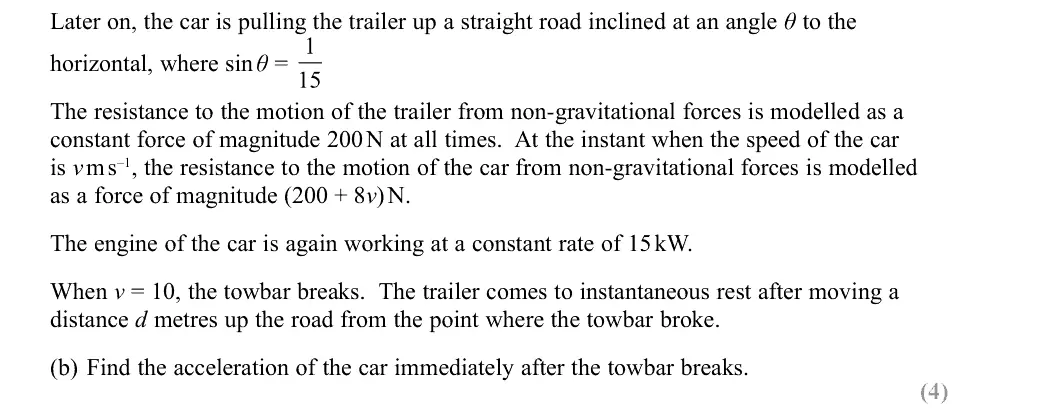
The three parts of this question were independent of each other; candidates’ scores seemed to follow a pattern of all four marks or zero marks in each part. (b) There was some confusion here over what needed to be considered; some candidates formed an equation for the car and the trailer moving up the road, and some considered only the trailer. Those candidates who considered only the car often reached the correct answer – their most common errors were a sign error in the equation of motion or using the resistance to the motion of the trailer in place of the resistance to motion of the car. The working involves the use of a substitution for g, so the final answer should be given to either 2 or 3 significant figures.
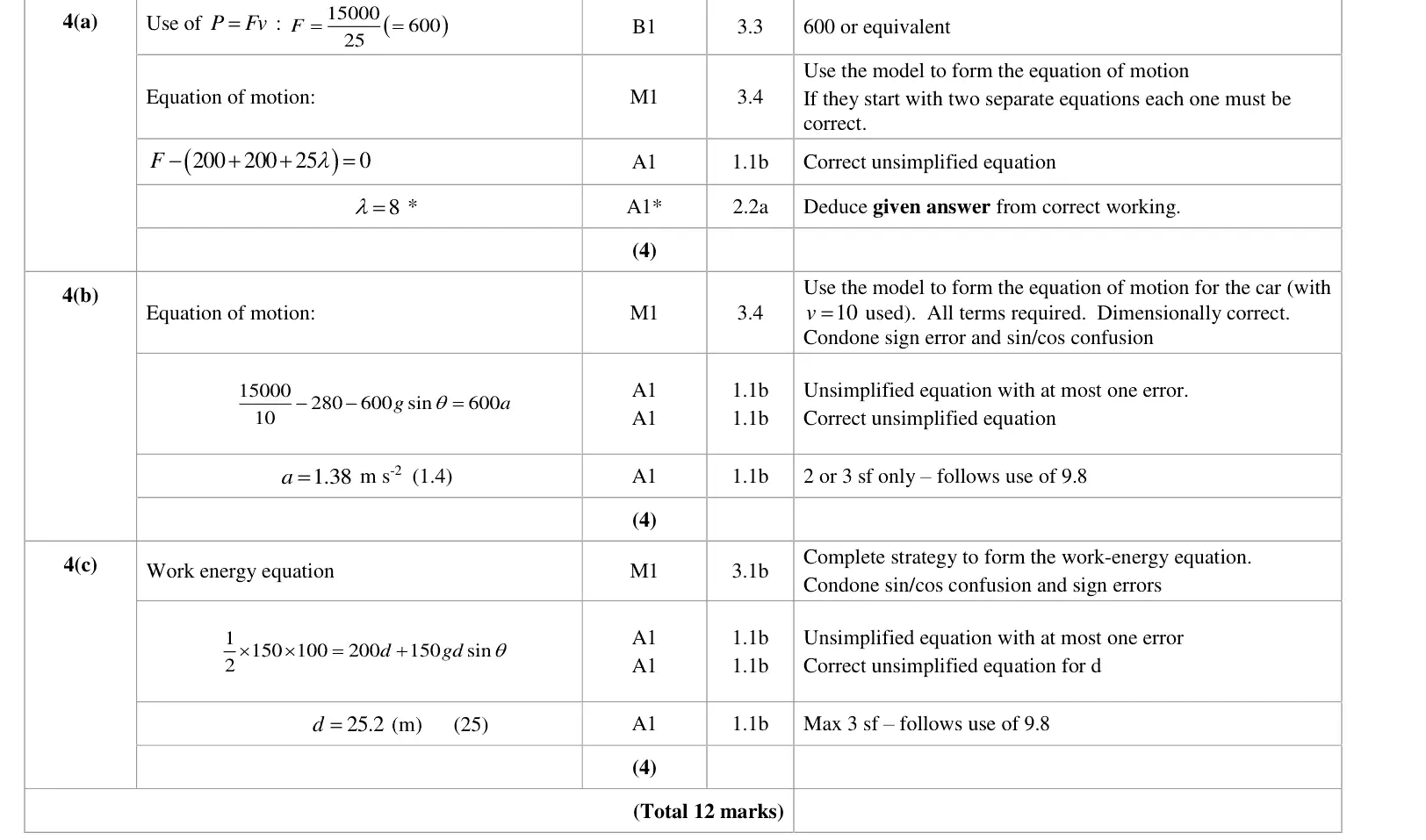
Key points from the mark scheme and examiner's report
car only after the towbar breaks: 15000/10 − 280 − 600g sin θ = 600a, a = 1.38 m s⁻² (2 or 3 sf)
errors included using the trailer's resistance or a sign error
June 2019 · Paper 3C (Further Mechanics 1) · Q4(c)4 marks
Mark scheme (whole question; this part is marked with the orange bar)
Examiner's comment
The three parts of this question were independent of each other; candidates’ scores seemed to follow a pattern of all four marks or zero marks in each part. (c) This question specifically asked candidates to use the work-energy principle, so solutions reliant on an equation of motion and suvat equations scored no marks. Many candidates considering only the motion of the car gave fully correct solutions. Some solutions included the trailer, and some solutions double counted the gain in gravitational potential energy. Some candidates used the distance along the road, rather than the change in vertical height, when finding the change in potential energy. Some solutions omitted the work done against the resistance. A few candidates lost the final mark through giving an answer to more than 3 significant figures.
Key points from the mark scheme and examiner's report
trailer alone: ½(150)(10²) = 200d + 150gd sin θ, d = 25.2 m
must use work-energy (suvat scores 0)
use vertical height for PE, do not double count PE or omit work against resistance
June 2019 · Paper 3C (Further Mechanics 1) · Q5(b)3 marks
Mark scheme (whole question; this part is marked with the orange bar)
Examiner's comment
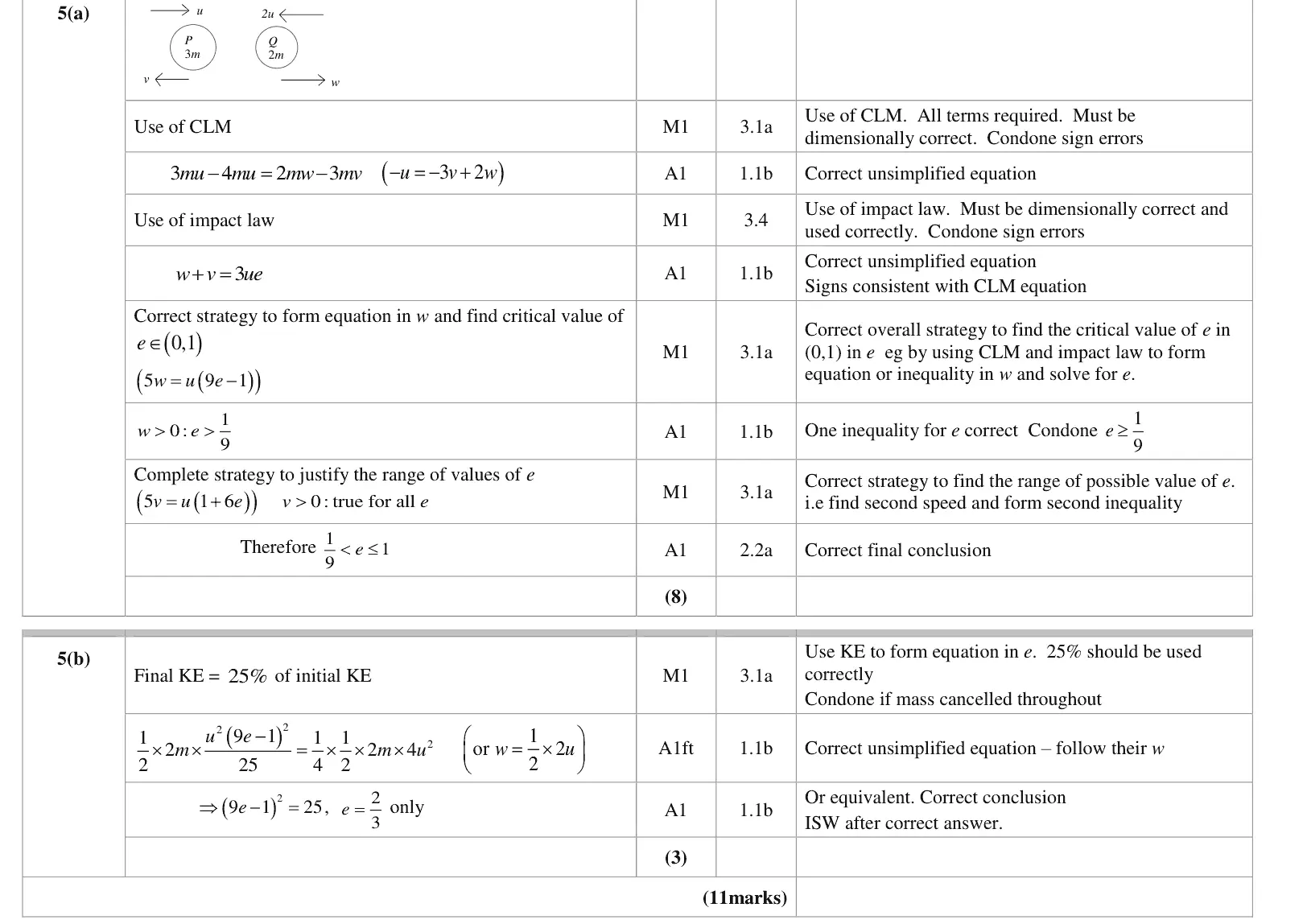
(b) Many candidates with a correct expression for the speed of Q formed a correct equation for the loss in kinetic energy and reached the correct answer. The most common errors were to form an equation about the total kinetic energy lost (for both particles), or to use the percentage loss incorrectly.
Key points from the mark scheme and examiner's report
final KE of Q is 25% of initial, so w = u (half the speed): (9e − 1)² = 25, e = 2/3 only
errors: total KE of both particles or misusing the percentage
June 2019 · Paper 3C (Further Mechanics 1) · Q7(a)3 marks
Mark scheme (whole question; this part is marked with the orange bar)
Examiner's comment
(a) The majority of candidates recognised that they needed to use energy. Many candidates initially treated the spring as a string and omitted the second term for elastic potential energy, but the given answer helped then to realise their error and correct their working. A significant minority of candidates showed completely correct working but in terms of λ and never used kmg, so they did not reach the given conclusion
Key points from the mark scheme and examiner's report
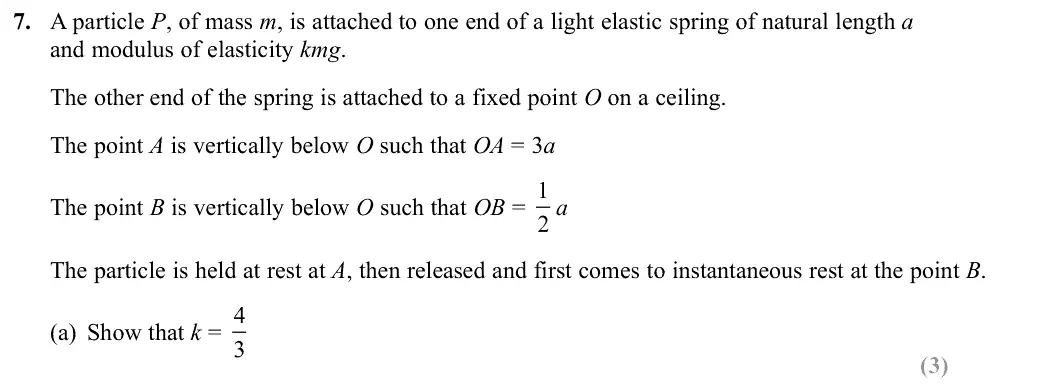
EPE lost = GPE gained with EPE = λx²/2a at both A (x = 2a) and B (compression a/2)
treating the spring as a string omits the second EPE term
leaving λ and never using kmg
June 2019 · Paper 3C (Further Mechanics 1) · Q7(c)6 marks
Mark scheme (whole question; this part is marked with the orange bar)
Examiner's comment
(c) This question proved to be quite challenging. A significant number of candidates did not realise that the greatest speed would be at the equilibrium position, with many assuming that it was when the spring was at its natural length, or with an extension of . 2 a For those candidates who were looking in the right place, it was common for one of the EPE terms to be missing in the energy equation. Some candidates had sign errors in their equations, and for some the algebra and fractions proved too much. A significant number of candidates did reach the correct final answer, many giving the answer in an exact form. A few candidates started by forming the energy equation at a general point and proceeded to rearrange this to give an equation for 2v in terms of x and then differentiate this and solve to find the value of x to minimise v; this was sometimes successful.
Key points from the mark scheme and examiner's report
max speed at equilibrium, extension 3a/4
energy equation from A to there: v = (5/2)√(ga/3)
many assumed max speed at natural length
missing an EPE term common
June 2018 · AS Paper 2 (Further Mechanics 1) · Q1(b)3 marks
Mark scheme (whole question; this part is marked with the orange bar)
Examiner's comment
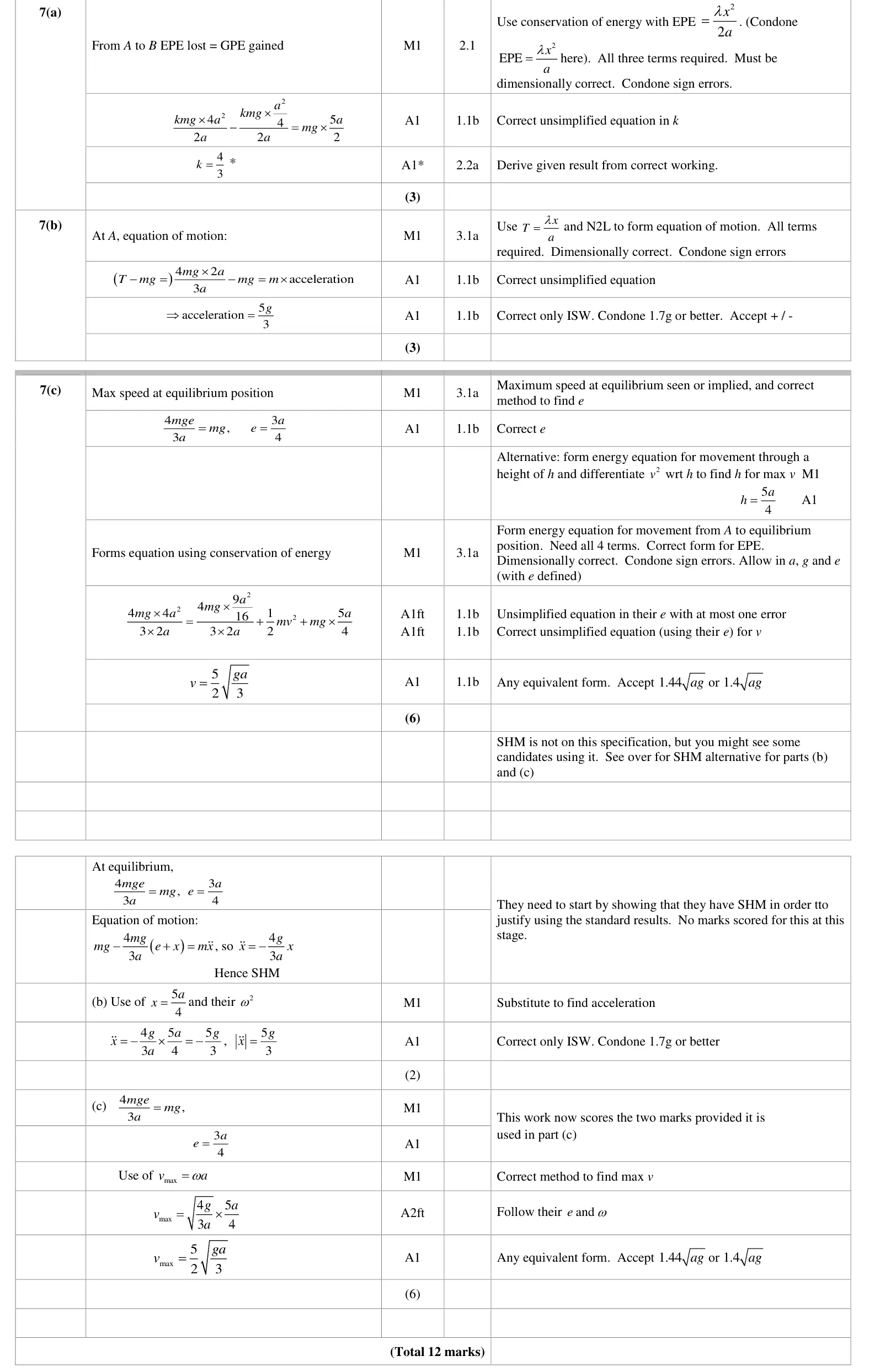
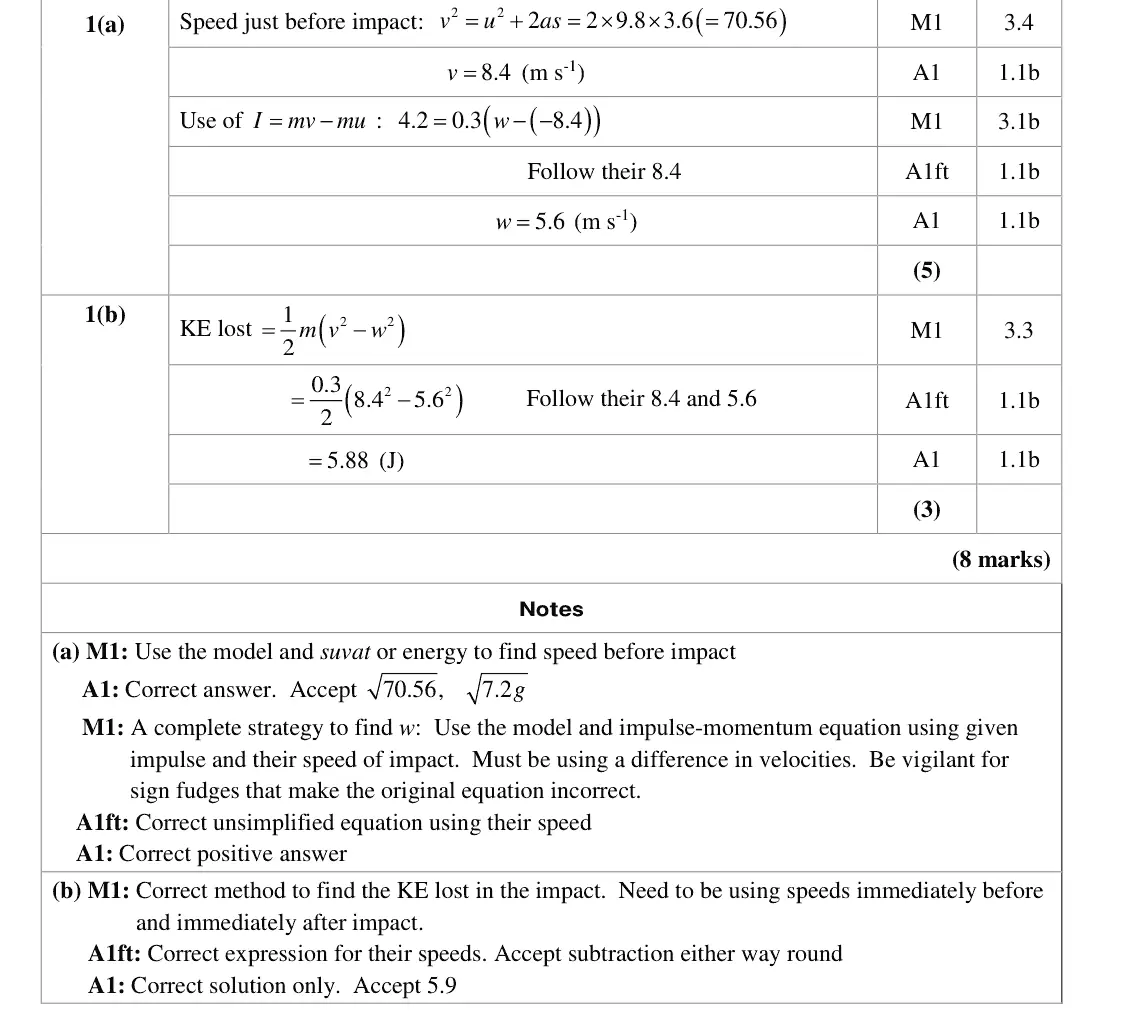
(b) The method for finding loss in kinetic energy was widely understood. Students were able to score at least two of the three marks because of the follow-through on their answer from part (a). A minority of students used an initial or final speed of zero - usually the same students who had been confused between the speed of release and the speed of impact in part (a).
Key points from the mark scheme and examiner's report
KE lost = ½(0.3)(8.4² − 5.6²) = 5.88 J
must use speeds immediately before and after impact, not the release speed 0
June 2018 · AS Paper 2 (Further Mechanics 1) · Q2(a)4 marks
Mark scheme (whole question; this part is marked with the orange bar)
Examiner's comment
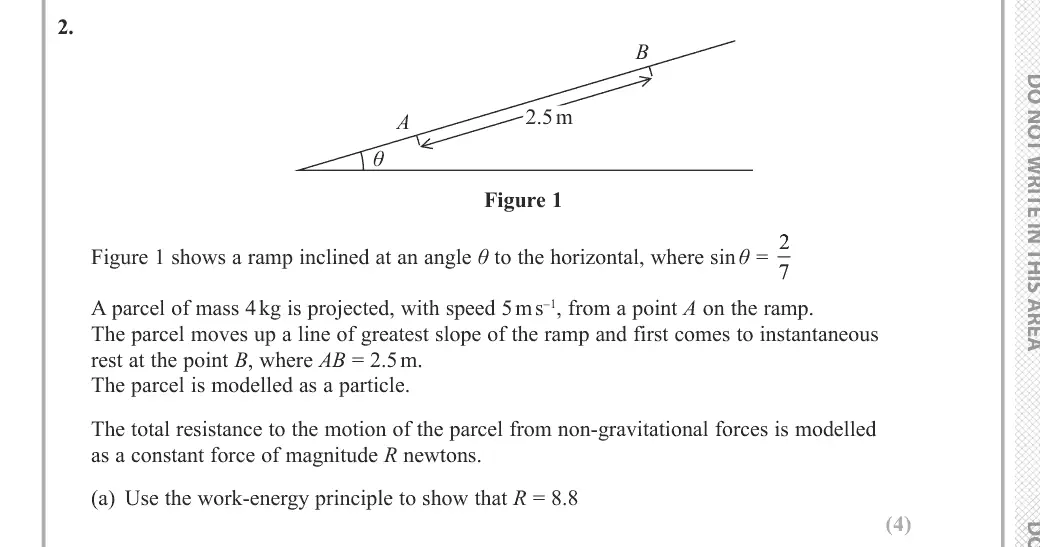
(a) This part of the question required students to use the work-energy principle. "Correct" solutions using alternative methods scored no marks. Many students achieved the correct answer, but this was often through a step-by-step approach of finding relevant values and closing in on the given answer. Relatively few students started their answer by writing down an equation for change in energy and work done.
Key points from the mark scheme and examiner's report
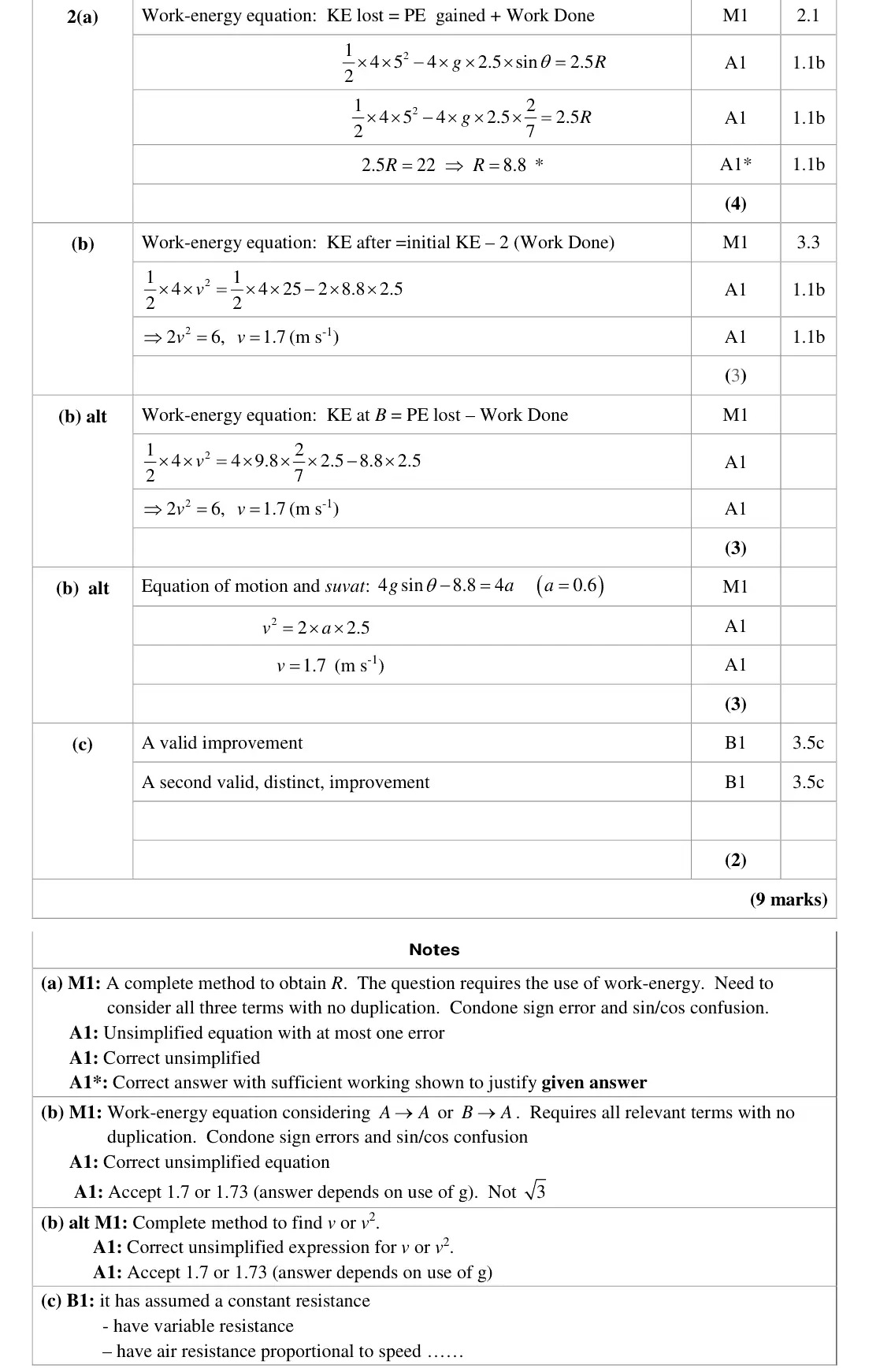
must use work-energy: ½ × 4 × 5² − 4g × 2.5 × (2/7) = 2.5R gives R = 8.8
F = ma/suvat routes score 0
many worked towards the given answer without stating the energy equation
June 2018 · AS Paper 2 (Further Mechanics 1) · Q2(b)3 marks
Mark scheme (whole question; this part is marked with the orange bar)
Examiner's comment
(b) Although this part of the question did not require students to use the work-energy principle, many did follow this approach. The change in direction of motion was not always taken into account, so there were several sign errors in the equations and the change in gravitational potential energy was sometimes overlooked. The alternative approach of using F ma and suvat was popular. Here too there were sign errors in the equation of motion, with resistance to motion and the weight often acting in the same direction. For both approaches, several students lost the final mark due to inappropriate accuracy in their final answer. Many left the final answer as 3 , which is inappropriate accuracy following a substitution for g.
Key points from the mark scheme and examiner's report
work-energy B to A (PE lost − work done) or A to A (initial KE − 2 × work done), or F = ma with a = 0.6
v = 1.7 m s⁻¹ (not √3)
resistance and weight taken in the same direction, PE change overlooked
June 2018 · AS Paper 2 (Further Mechanics 1) · Q2(c)2 marks
Mark scheme (whole question; this part is marked with the orange bar)
Examiner's comment
(c) Some students made no attempt to answer this part of the question. Several responses made it clear that some students did not recognise the modelling within the question, and others had little understanding of how the model might affect the outcome. In the question there are only two mentions of modelling; the parcel is modelled as a particle and the resistance is modelled as a constant force. In trying to improve the model, students should have focussed on these two points. A very popular suggestion was to consider friction, but this is already there in the total resistance. Very few students suggested that the parcel should not be modelled as a particle.
Key points from the mark scheme and examiner's report
e.g. variable resistance (depending on speed), do not model the parcel as a particle
"include friction" scores nothing as it is already in the resistance
June 2018 · AS Paper 2 (Further Mechanics 1) · Q3(a)4 marks
Mark scheme (whole question; this part is marked with the orange bar)
Examiner's comment
(a) Students demonstrated a good understanding of work and power. As with part (a) of question 2, many students did reach the given answer correctly, despite not forming the equation of motion at the start of their solutions.
Key points from the mark scheme and examiner's report
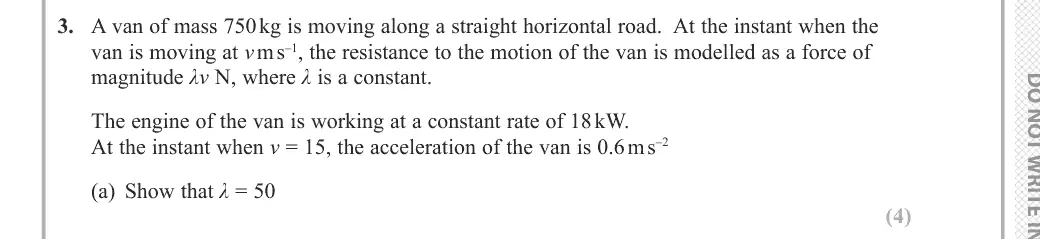
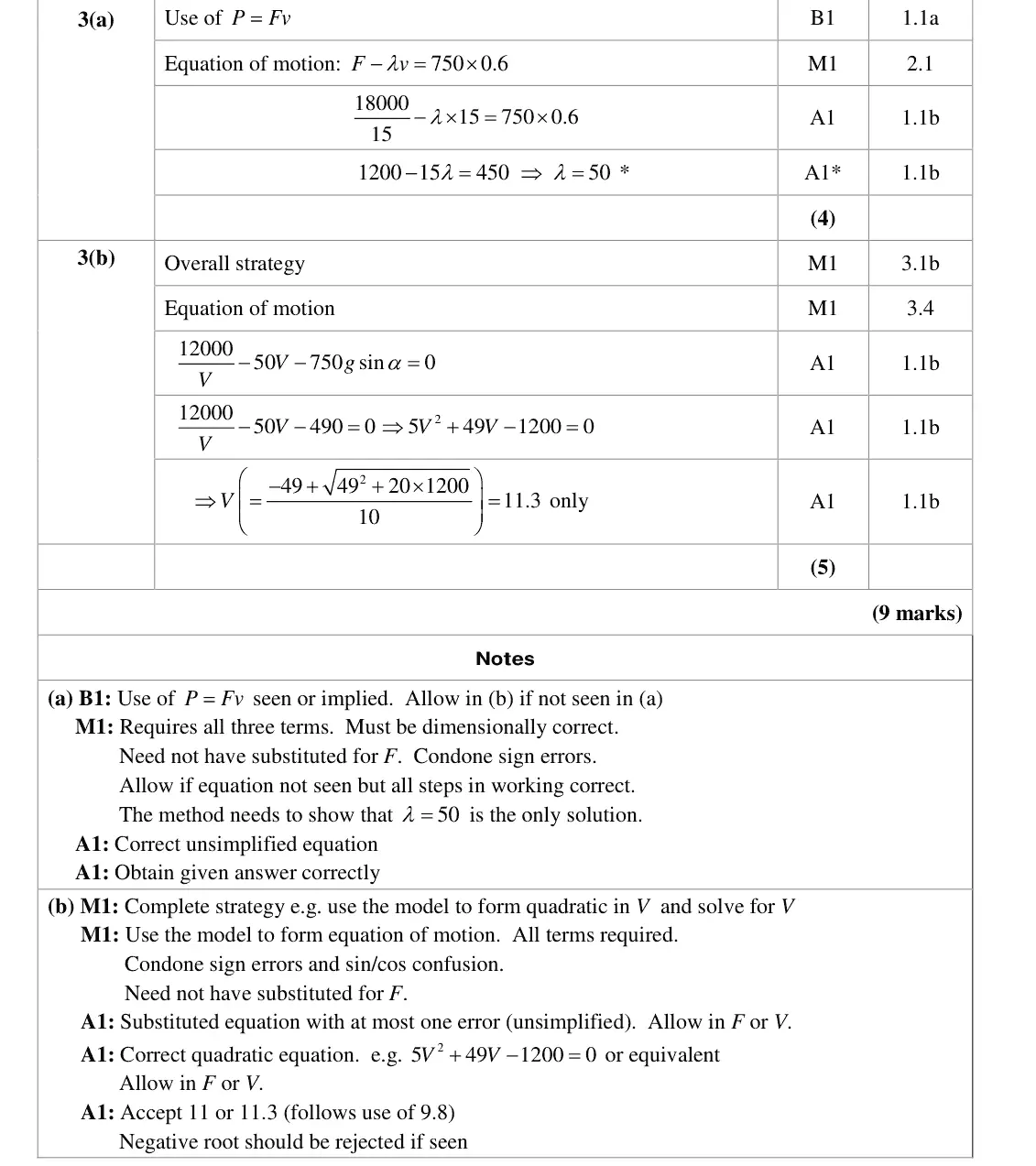
P = Fv: 18000/15 − 15λ = 750 × 0.6 gives λ = 50
state the equation of motion before working to the given answer
June 2018 · AS Paper 2 (Further Mechanics 1) · Q3(b)5 marks
Mark scheme (whole question; this part is marked with the orange bar)
Examiner's comment
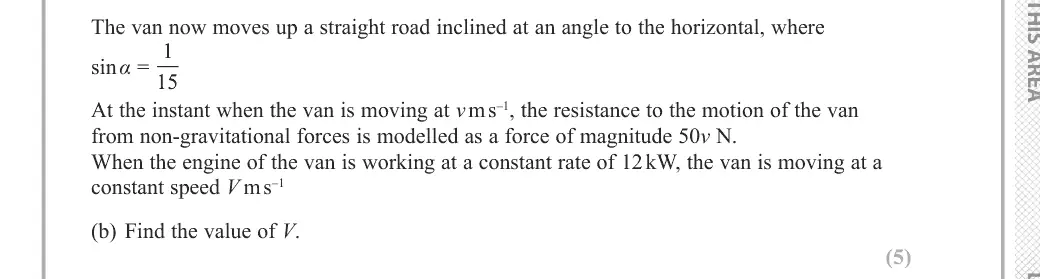
(b) The van is now moving up an inclined road, but many students did not realise that this meant that they needed to consider the weight of the van. In order to make any progress at all, students needed to start with an equation of motion that contained all relevant terms. There were several fully correct solutions, but a significant number of correct equations of motion did not result in the correct quadratic in V, usually due to arithmetic and algebraic slips. It was common for students to lose the final mark due to an over-specified answer following a substitution for g. If a candidate reached an incorrect quadratic in V and gave no indication of the method used to solve it, then they could not score the method mark for forming and solving a quadratic in V. A few students did not reject the negative value of V as being incorrect.
Key points from the mark scheme and examiner's report
12000/V − 50V − 750g sin α = 0 gives 5V² + 49V − 1200 = 0, V = 11.3 (11 or 11.3, not over-specified)
many omitted the weight component
reject the negative root
Find an Edexcel Further Maths tutor
Stuck on this? Book a trial lesson with our Further Maths tutor.