Examiner's comment
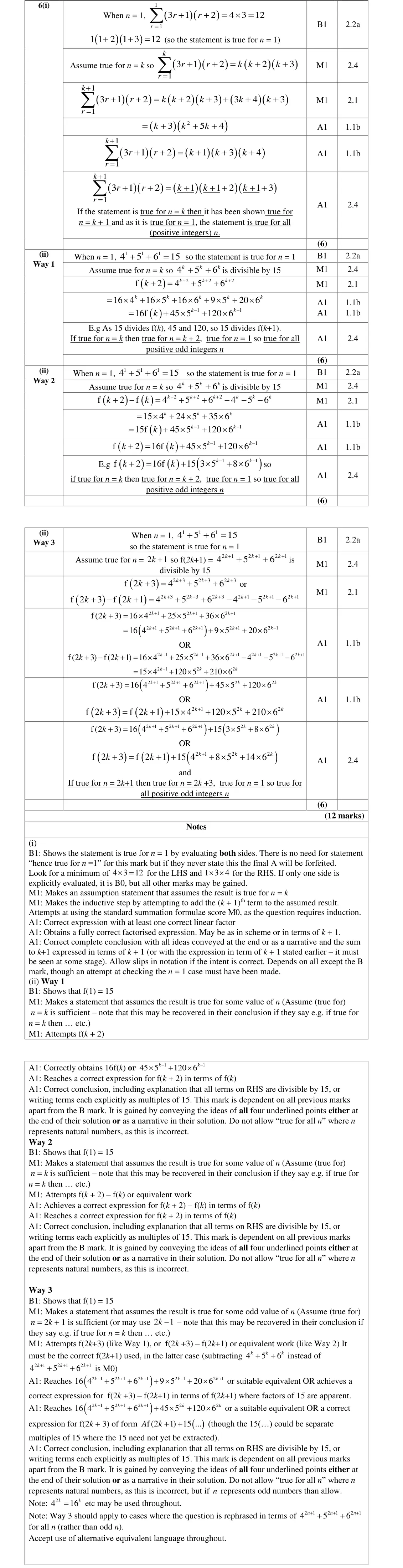
Generally, these two proofs using induction were well attempted. Candidates are much better than they used to be at making correct statements and nearly all of them seem to have memorised the final conclusion! The double step induction in (ii) did cause some problems, but the modal mark here was 8, and only 1% of candidates scored fewer than 2 marks. The first two marks of each part were scored in most cases. (i) Most evaluated both sides to gain the B mark, though a few evaluated to get 8, and some other only evaluated one side, so these did not gain the mark. They usually stated the assumption and then made an attempt at the inductive step. Some struggled with the (k+1)th term, thinking they should add 12 to k(k+2)(k+3). Others lost the last 3 marks by expanding their expression to obtain a cubic and then showing no working to reach the final answer. Most realised they needed to show the expression explicitly in terms of (k+1) which was pleasing. There was also a minority of candidates who attempted to use summation formulae to prove the inductive step, losing the final 4 marks. (ii) Almost all gained the first two marks by showing the expression was divisible by 15 for n=1, and for their assumption. The fact that the question wanted them to prove the result for positive odd integers caused problems for many of the candidates, with most attempting to find f(k+1) having assumed true for n=k. These candidates could gain no further marks. For those who did realise the two-step induction was required there were many different approaches made. The most successful one was to find f(k+2), or f(k+2) - f(k) and quite a few did this. They then needed to extract f(k) and balance the remaining terms for the first A mark, and not all were able to do this. A few different approaches were possible. Alternatively, some started assuming f(2k+1), then found f(2k+3), which was fine for the first three marks, but again there was difficulty for many students in reaching a suitable form to prove the result. Though not many, there were some completely correct solutions which was very pleasing.