June 2018: AS Paper 21: Further Pure Mathematics 1

40 marks · 9 question parts · Question paper, mark scheme and examiner's report on Pearson's site

Question by question

QTopicMarksDifficulty
1(a) The t-formulae 3 —
1(b) The t-formulae 4 —
2(a) Numerical methods: differential equations and Simpson's rule 6 —
2(b) Numerical methods: differential equations and Simpson's rule 1 —
3 Inequalities 7 —
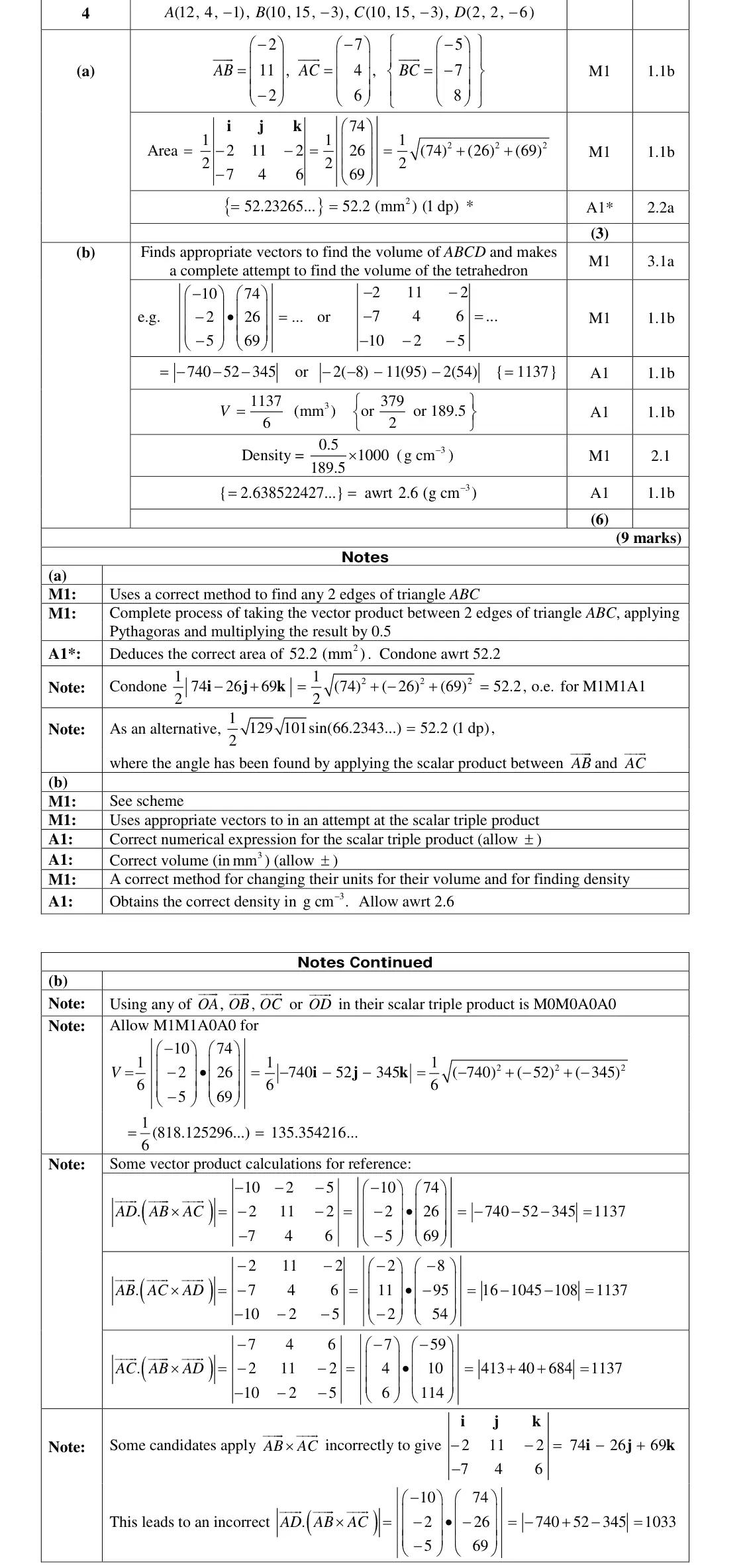
4(a) Vector product and scalar triple product 3 —
4(b) Vector product and scalar triple product 6 —
5(a) Conic sections: parabola, ellipse and hyperbola 4 —
5(b) Conic sections: parabola, ellipse and hyperbola 6 —

The questions

1(a)1(b)2(a)2(b)34(a)4(b)5(a)5(b)
June 2018 · AS Paper 2 (Further Pure 1) · Q1(a) 3 marks t formulae
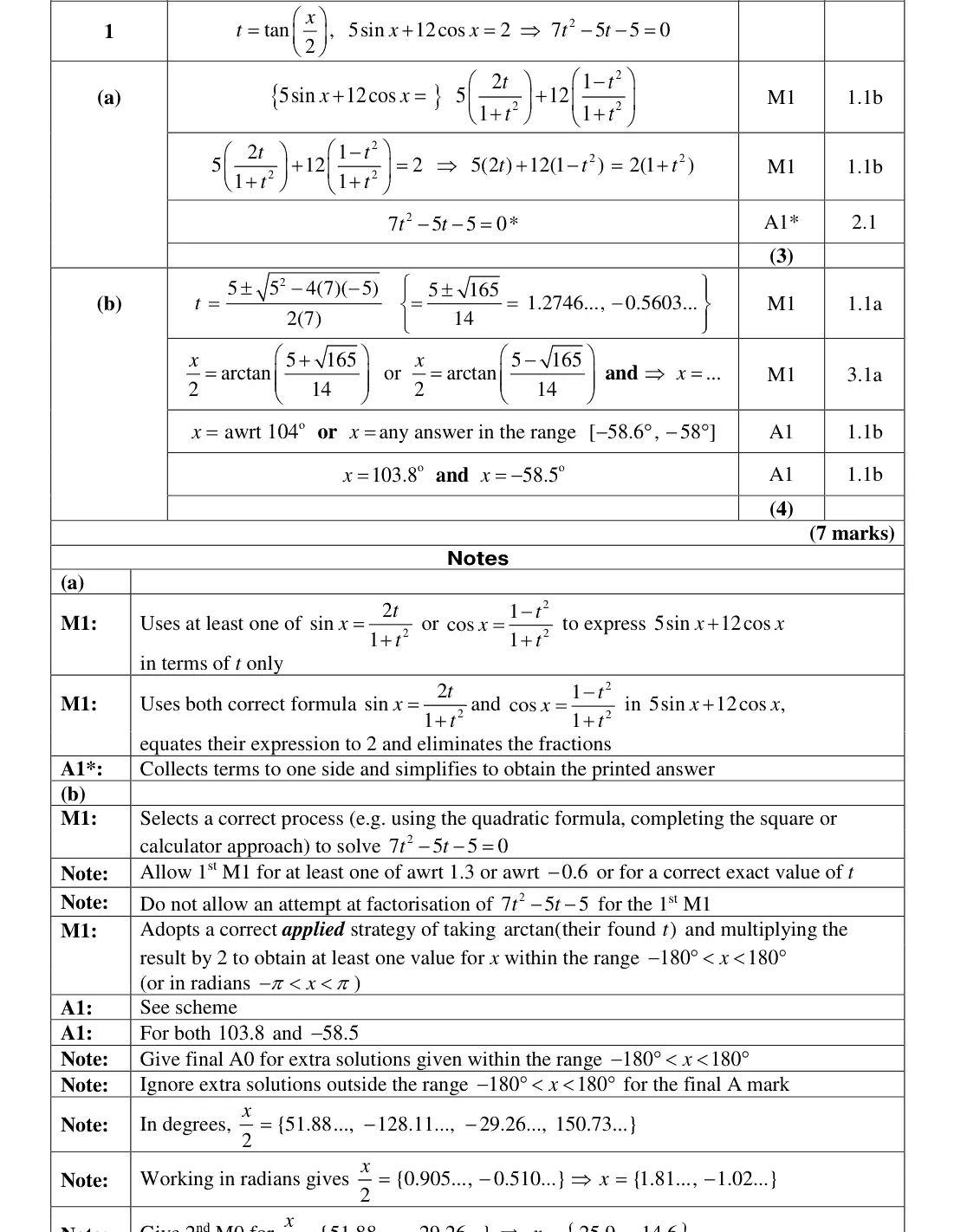
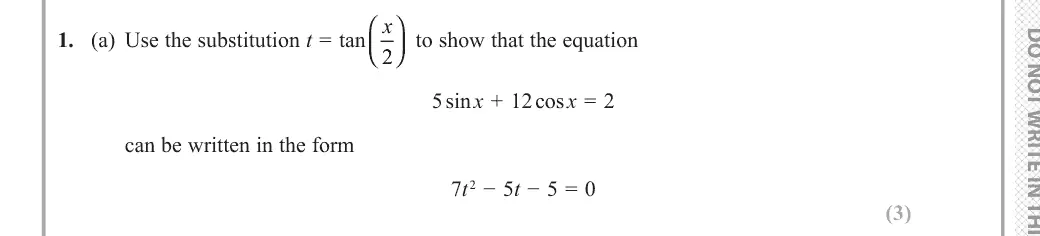
1. (a) Use the substitution t = tan x to show that the equation 5 sin x + 12 cos x = 2 can be written in the form 7t 2 - 5t - 5 = 0 (3)
June 2018 · AS Paper 2 (Further Pure 1) · Q1(b) 4 marks t formulae
(b) Hence solve, for -180° < x < 180°, the equation 5 sin x + 12 cos x = 2 giving your answers to one decimal place. (4)
June 2018 · AS Paper 2 (Further Pure 1) · Q2(a) 6 marks numerical methods fp1
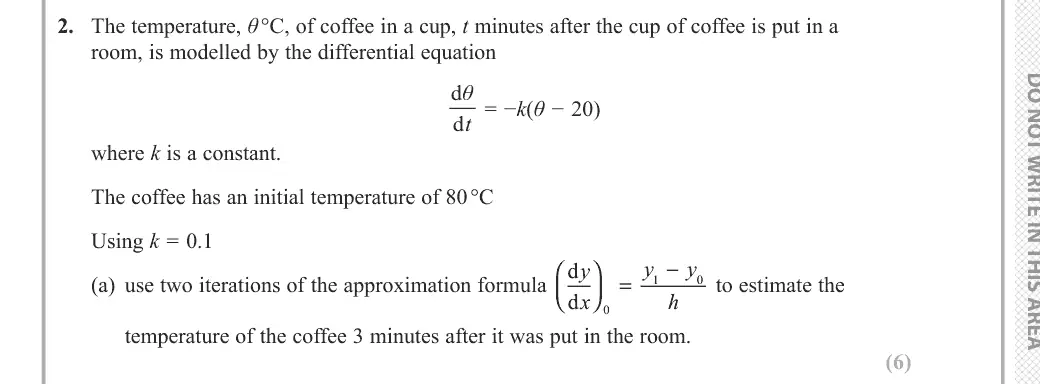
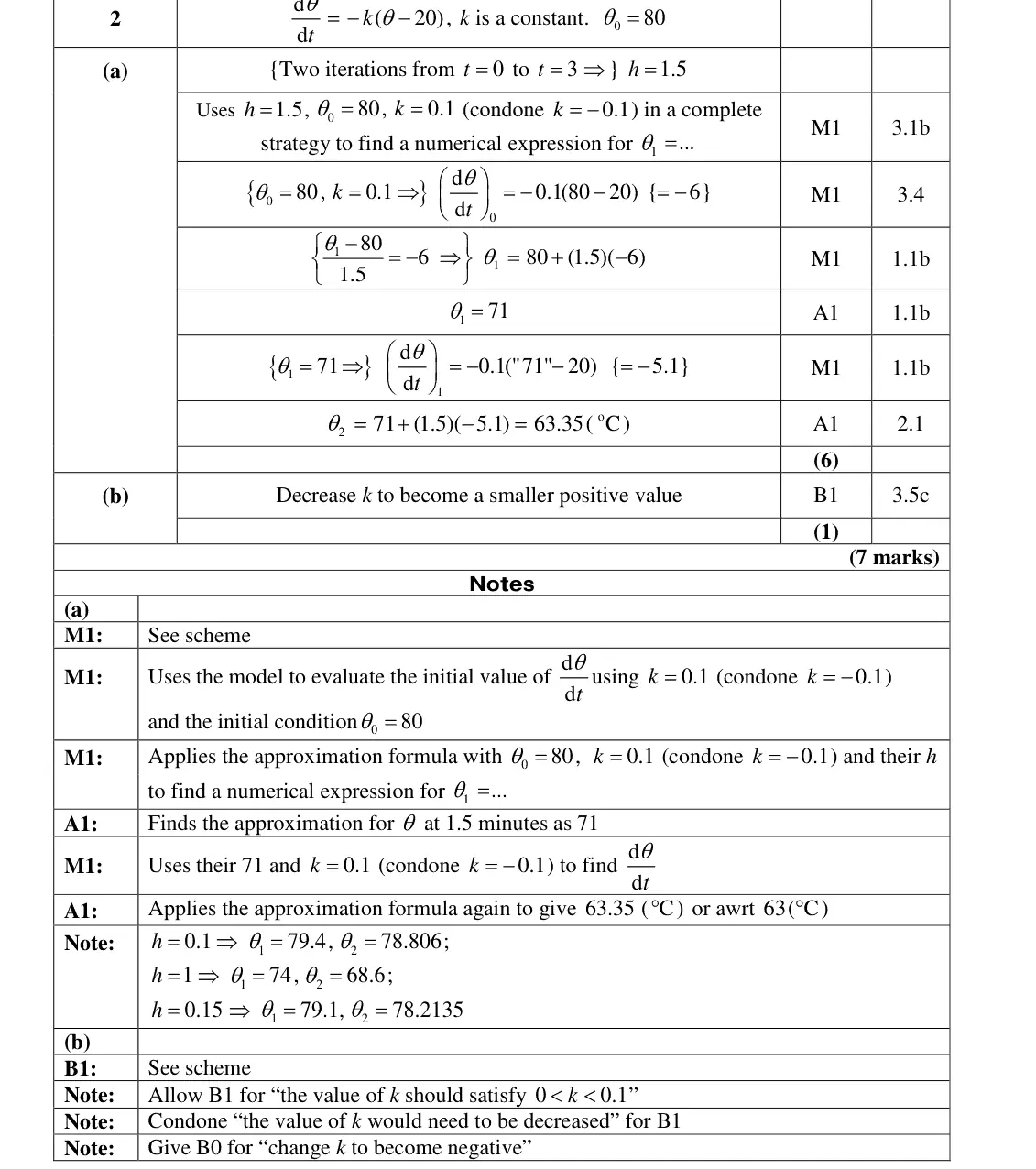
2. The temperature, theta °C, of coffee in a cup, t minutes after the cup of coffee is put in a room, is modelled by the differential equation d theta t = -k( theta - 20) d where k is a constant. The coffee has an initial temperature of 80 °C Using k = 0.1 y - y (a) use two iterations of the approximation formula d y = 0 to estimate the d x h temperature of the coffee 3 minutes after it was put in the room. (6)
June 2018 · AS Paper 2 (Further Pure 1) · Q2(b) 1 mark numerical methods fp1
The coffee in a different cup, which also had an initial temperature of 80 °C when it was put in the room, cools more slowly. (b) Use this information to suggest how the value of k would need to be changed in the model. (1)
June 2018 · AS Paper 2 (Further Pure 1) · Q3 7 marks further inequalities
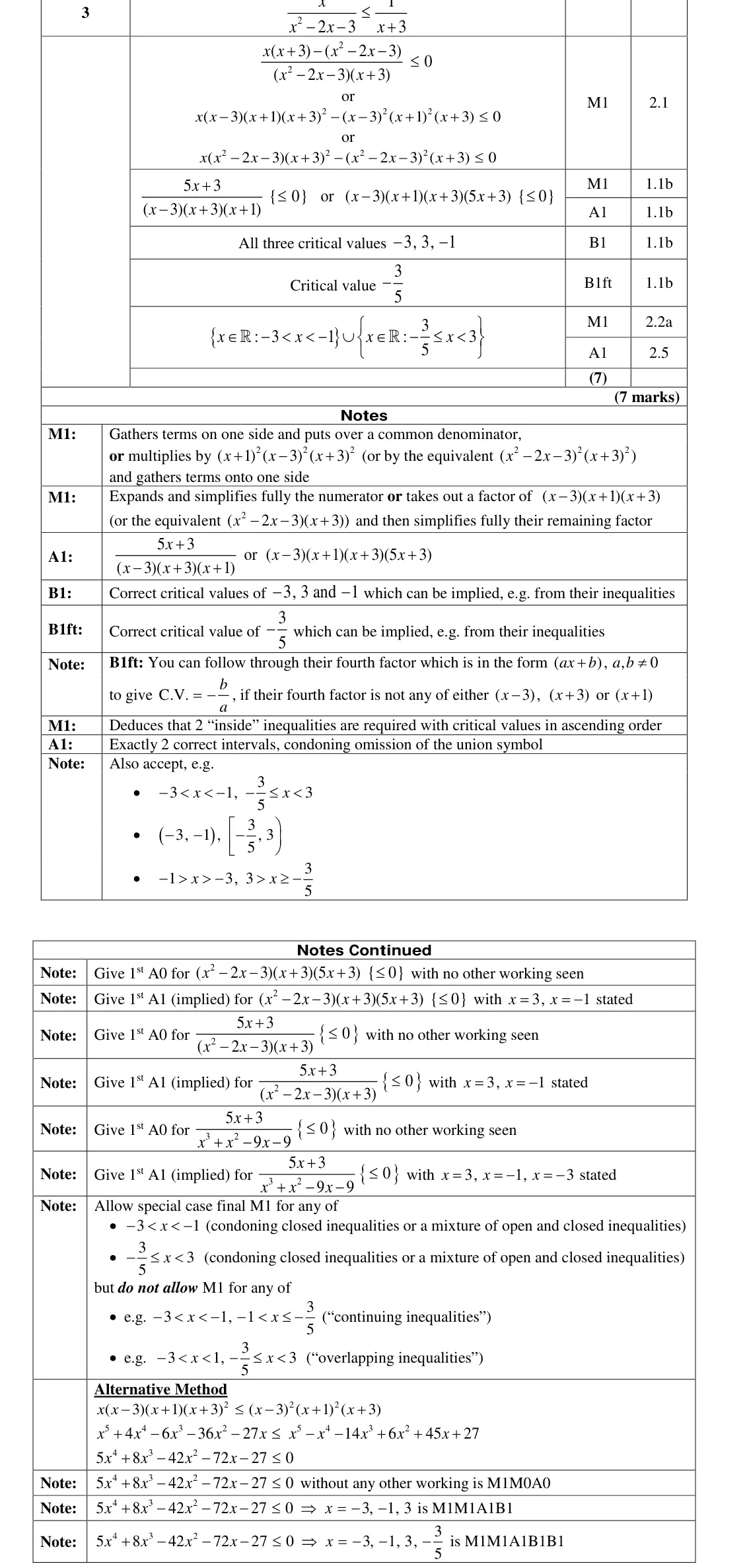
3. Use algebra to find the values of x for which x x - x - x + (7)
June 2018 · AS Paper 2 (Further Pure 1) · Q4(a) 3 marks vector product
4. A scientist is investigating the properties of a crystal. The crystal is modelled as a tetrahedron whose vertices are A (12, 4, -1), B (10, 15, -3), C (5, 8, 5) and D (2, 2, -6), where the length of unit is the millimetre. The mass of the crystal is 0.5 grams. (a) Show that, to one decimal place, the area of the triangular face ABC is 52.2 mm2 (3)
June 2018 · AS Paper 2 (Further Pure 1) · Q4(b) 6 marks vector product
(b) Find the density of the crystal, giving your answer in g cm–3 (6)
June 2018 · AS Paper 2 (Further Pure 1) · Q5(a) 4 marks conic sections
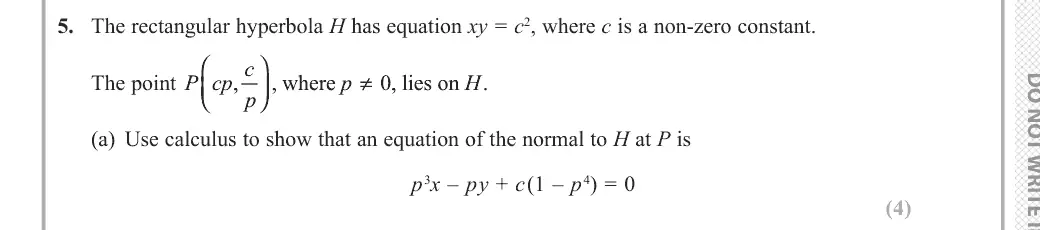
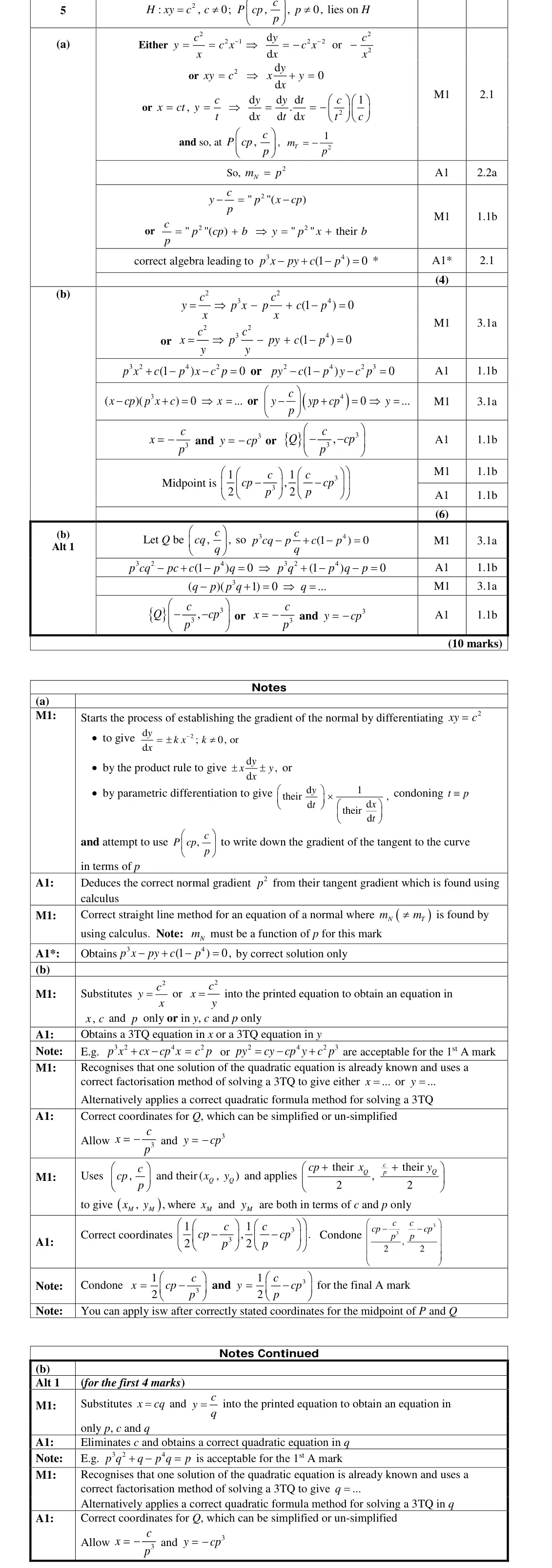
5. The rectangular hyperbola H has equation xy = c2, where c is a non-zero constant. The point P cp c , , where p ≠ , lies on H p (a) Use calculus to show that an equation of the normal to H at P is p 3x – p y + c (1 – p 4) = 0 (4)
June 2018 · AS Paper 2 (Further Pure 1) · Q5(b) 6 marks conic sections
The normal to H at the point P meets H again at the point Q. (b) Find the coordinates of the midpoint of PQ in terms of c and p, simplifying your answer where possible. (6)

Find an Edexcel Further Maths tutor

Want this paper marked and gone through with a Further Maths tutor? Message us.

Prefer email? Send an enquiry

If you are under 18, please include a parent's contact details. Enquiries go to enquiries@alevelfurthermathstutor.com and are deleted once handled.