Examiner's comment
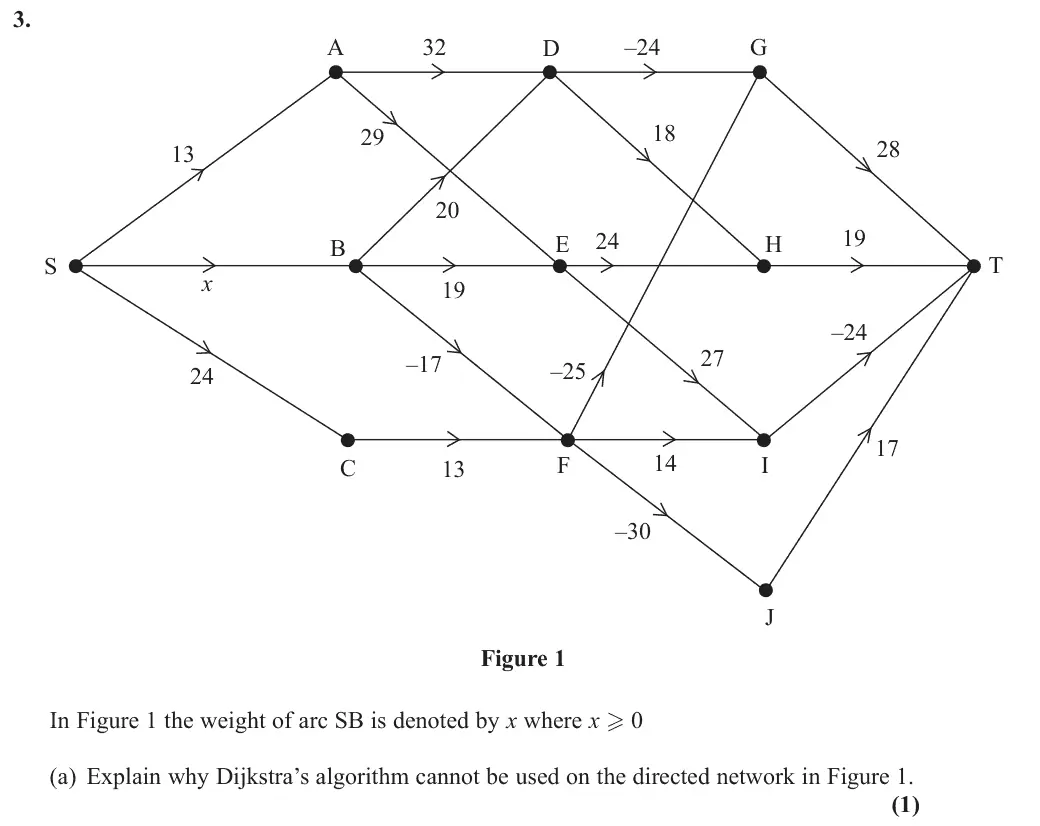
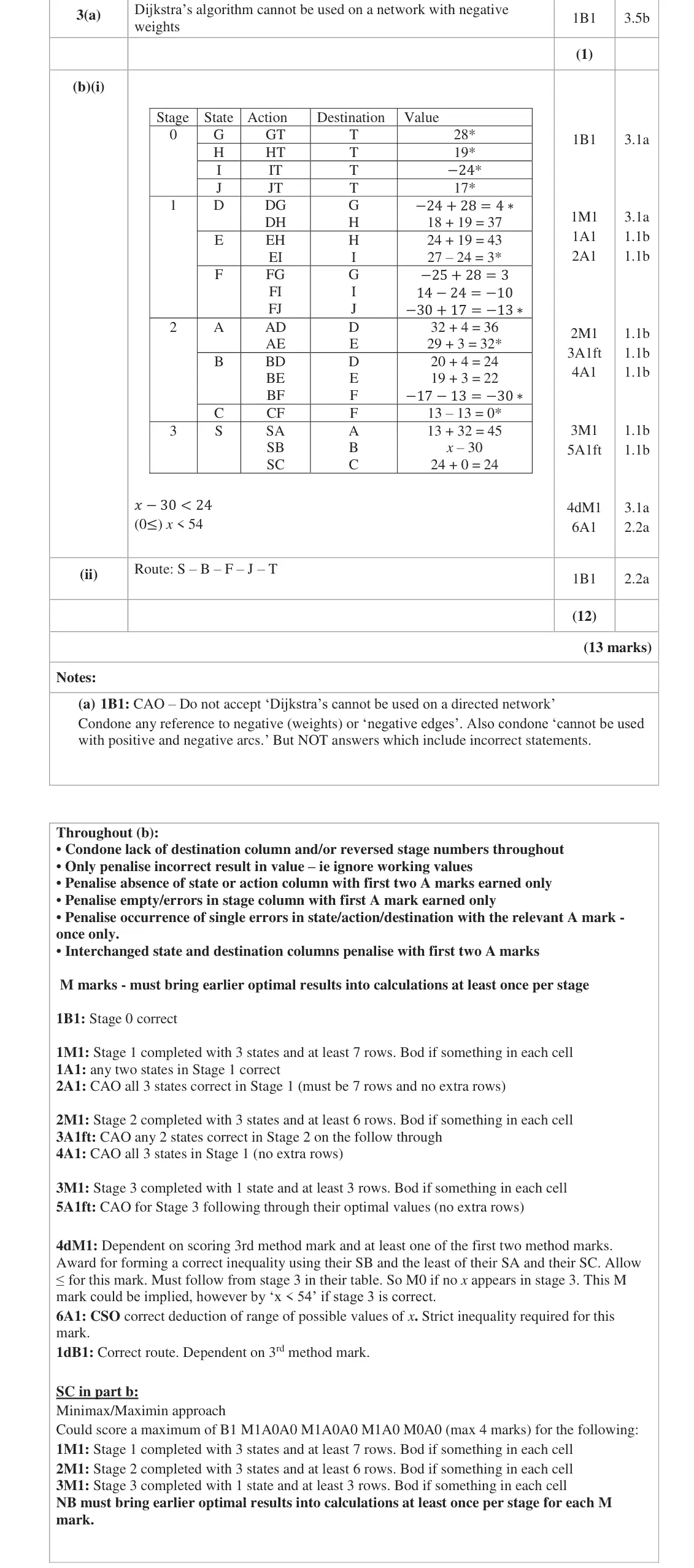
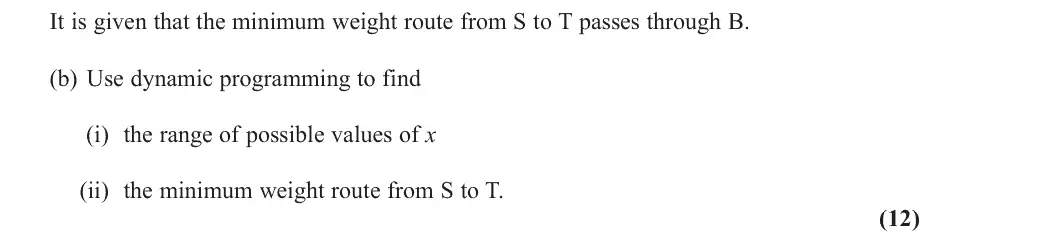
Once again, testing a familiar area of the specification which migrated from the legacy qualification, As already mentioned, most candidates proved to be well prepared for part (b). Those that didn’t do well either forgot to carry forward previous optimal values. or had misunderstood the question to be a minimax/maximin problem but these candidates were in the minority. One costly error, made by some candidates, was the inclusion of an insufficient number of rows in stage one of their table. It would be advisable for candidates to be reminded to perform a straightforward check that their table contains sufficient rows for the number of arcs on the digraph in cases such as these. In fact, most candidates appeared to find the application of a dynamic programming approach to a minimisation problem based on a digraph relatively straightforward and coped very well with the blank table and lack of scaffolding in the answer book. Occasionally, candidates mislabelled their states and destinations giving reversed actions and as with the legacy qualification, arithmetic errors were fairly common. A very small number of candidates did not evaluate their calculations at each stage: calculating only the optimal row. Candidates should be advised that in decision mathematics they must rigorously apply the algorithm in full. Most candidates’ presentation here, however, was clear and easy to follow although a minority crossed out working and then attempted to squeeze in alternative answers, making it difficult for examiners to follow their working. Once candidates had completed the programming, most were able to find a suitable range for 𝑥 based on the values in their final stage. Some candidates, however, appeared to be reluctant to carry the -30 into stage 3 and so obtained an incorrect value for SB at the end of the table which in turn led to an incorrect result for the range for 𝑥. A significant number of candidates misunderstood the final part of the question, quoting the minimum total weight along the route (setting 𝑥 = 0) rather than giving the route itself.