June 2022: A level Paper 4D: Decision Mathematics 2

75 marks · 24 question parts · Question paper, mark scheme and examiner's report on Pearson's site

Question by question

QTopicMarksDifficulty
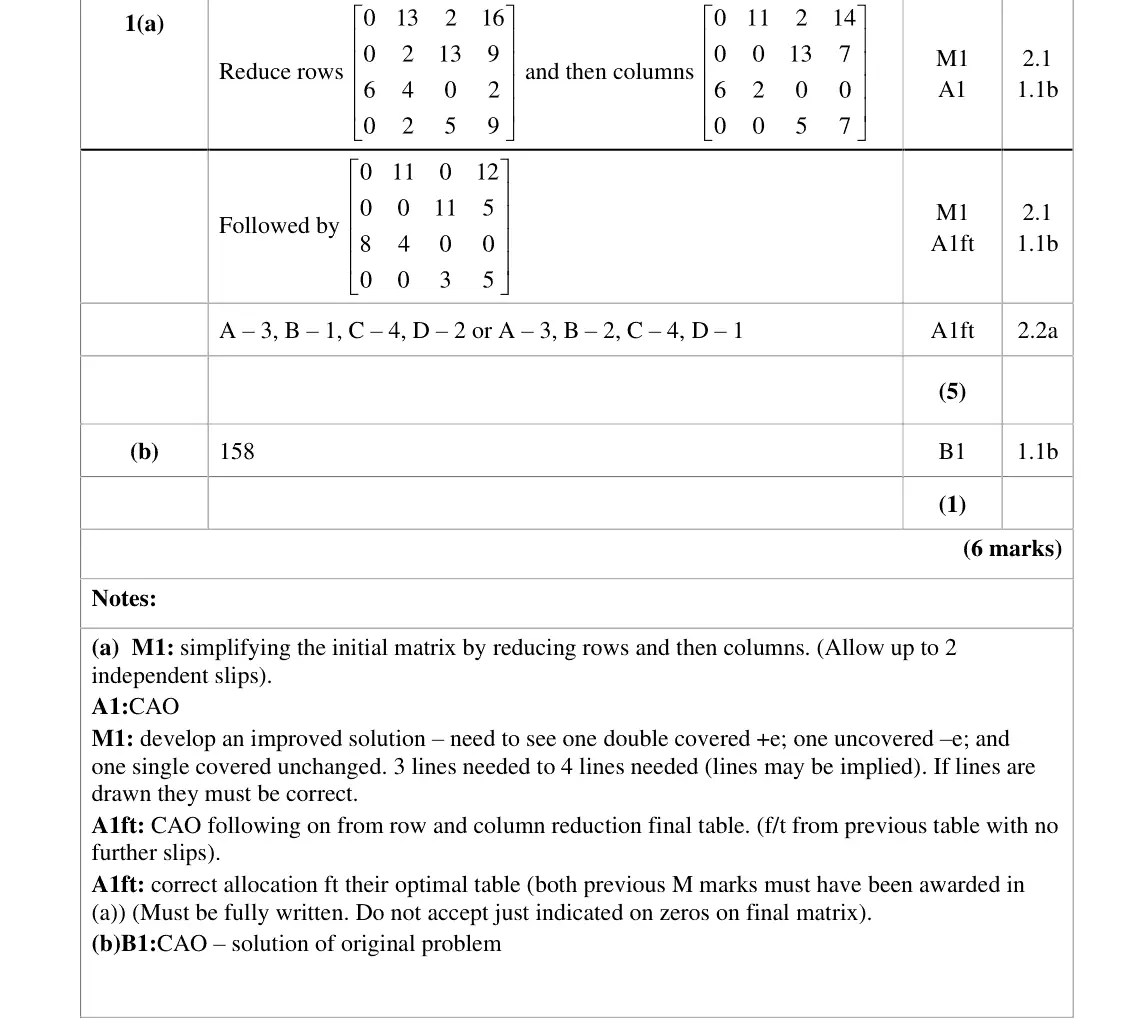
1(a) Allocation (assignment) problems and the Hungarian algorithm 5 —
1(b) Allocation (assignment) problems and the Hungarian algorithm 1 —
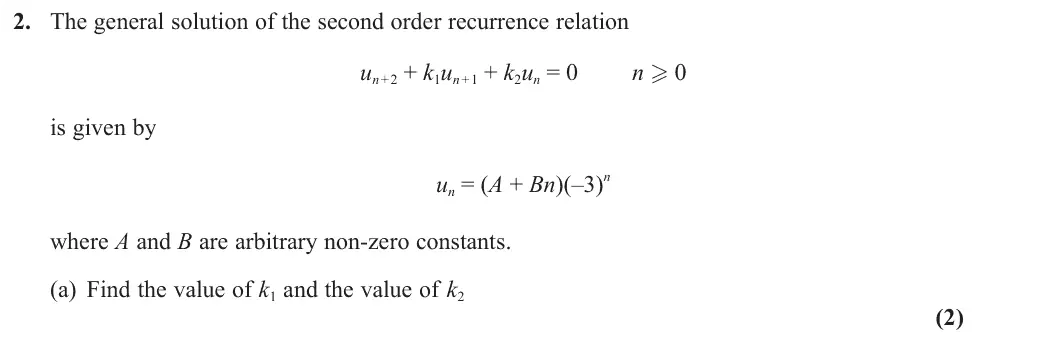
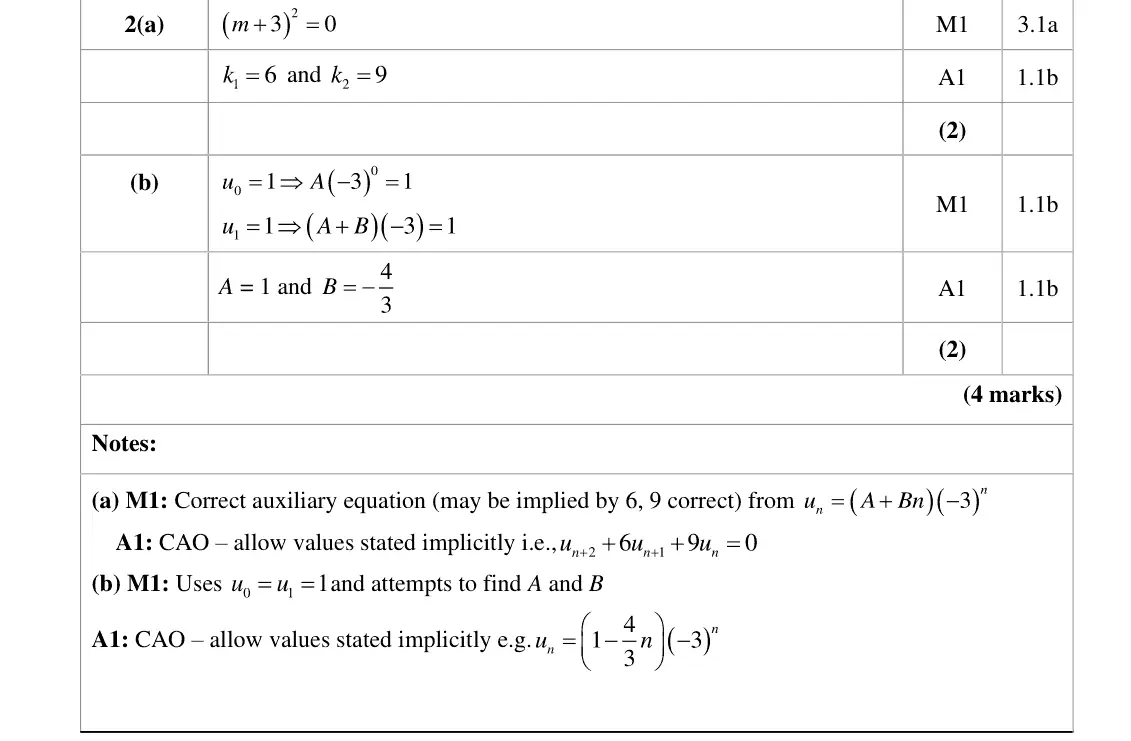
2(a) Recurrence relations (Decision 2) 2 —
2(b) Recurrence relations (Decision 2) 2 —
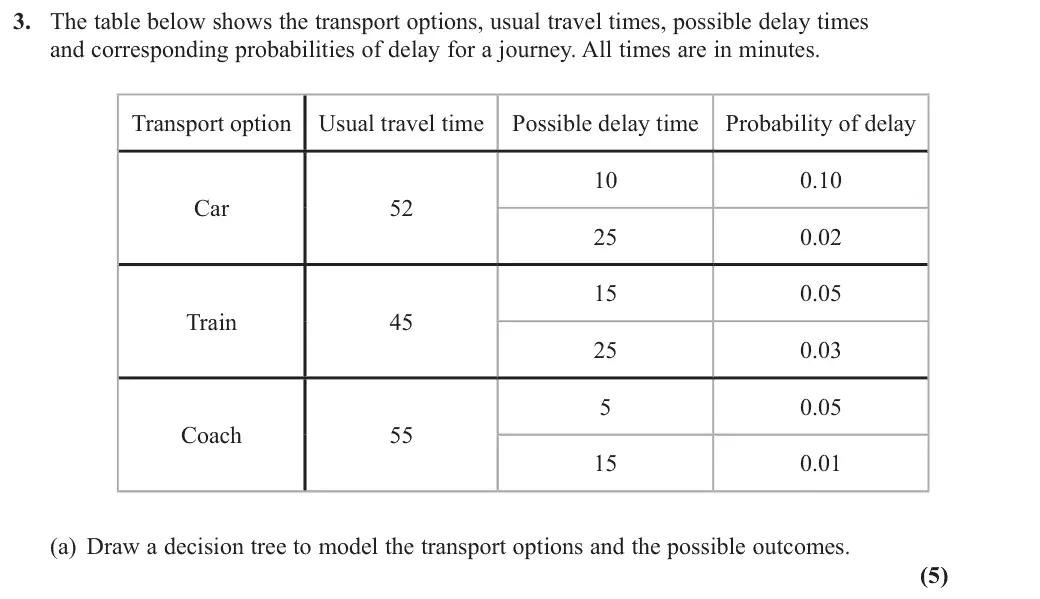
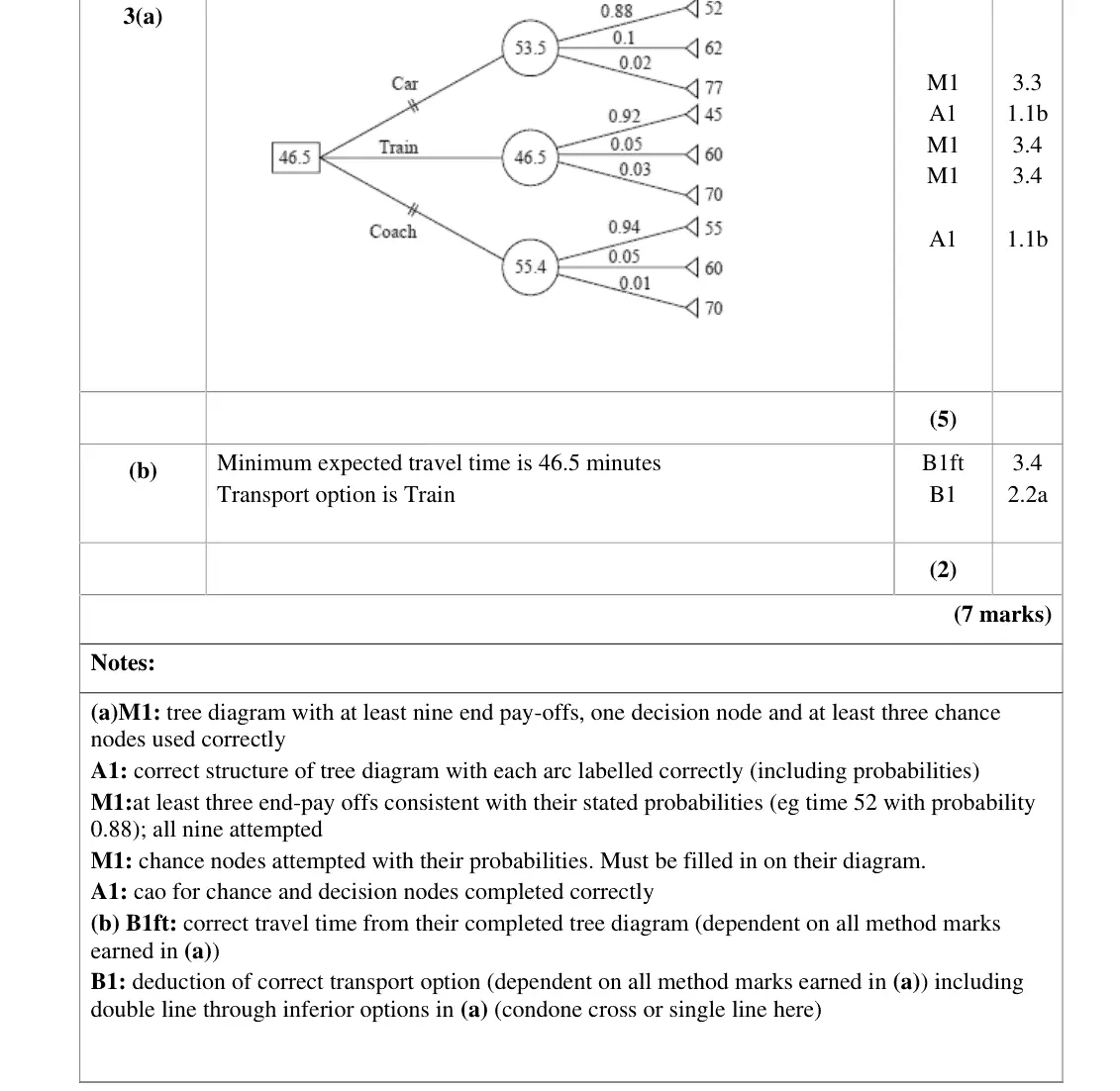
3(a) Decision analysis: decision trees and expected values 5 —
3(b) Decision analysis: decision trees and expected values 2 —
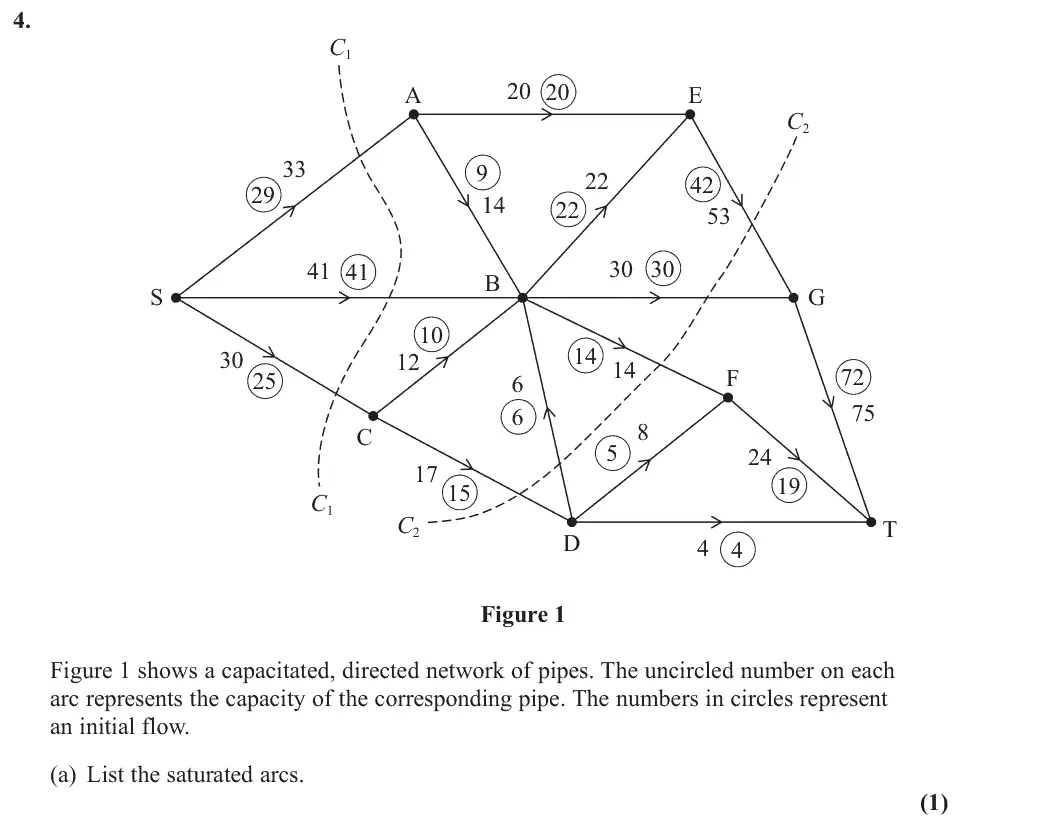
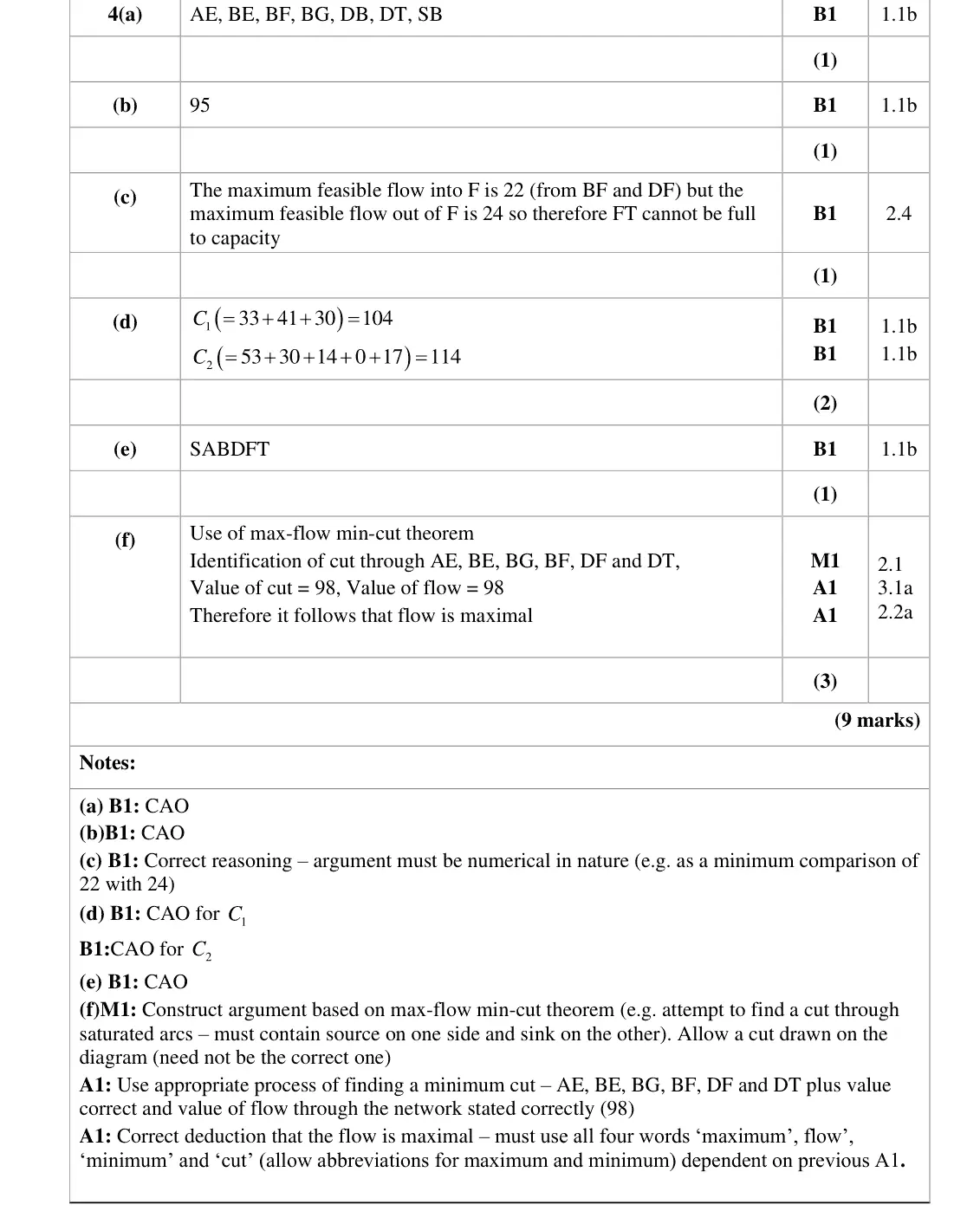
4(a) Flows in networks 1 —
4(b) Flows in networks 1 —
4(c) Flows in networks 1 —
4(d) Flows in networks 2 —
4(e) Flows in networks 1 —
4(f) Flows in networks 3 —
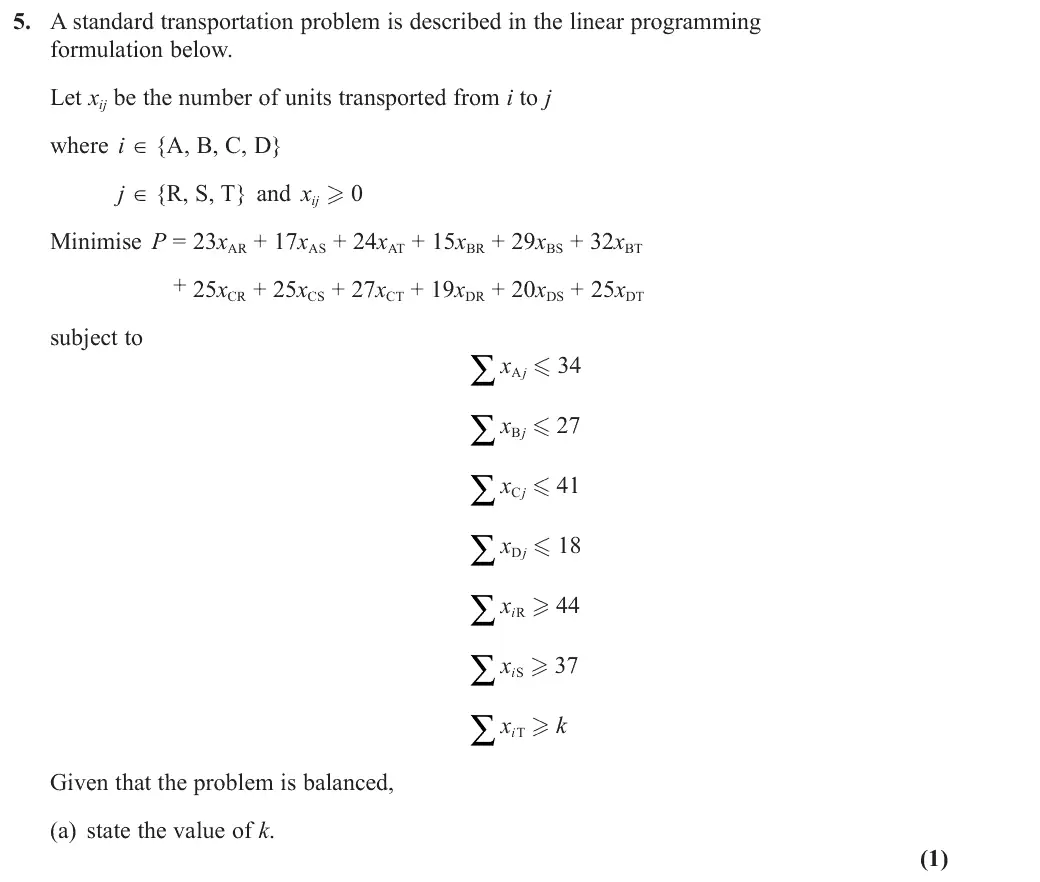
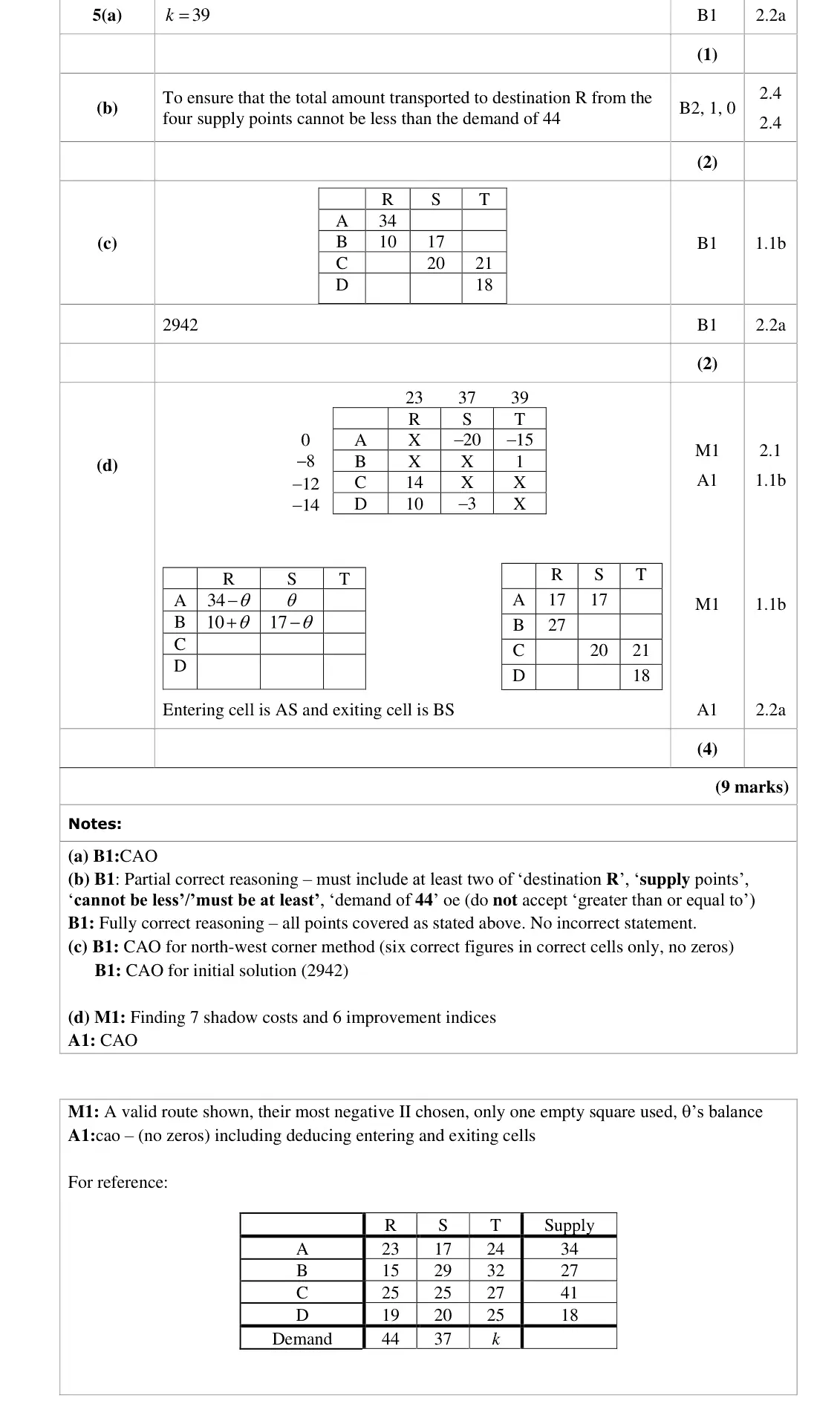
5(a) Transportation problems 1 —
5(b) Transportation problems 2 —
5(c) Transportation problems 2 —
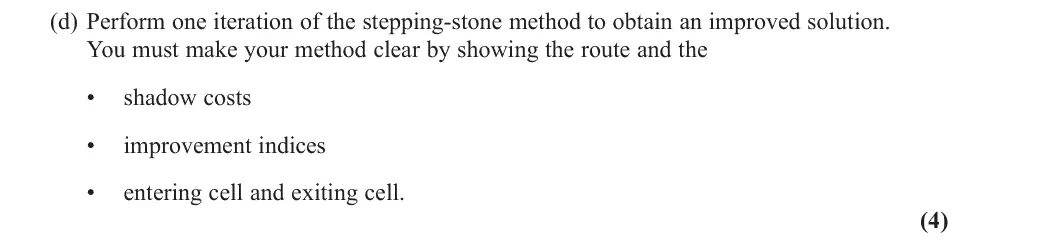
5(d) Transportation problems 4 —
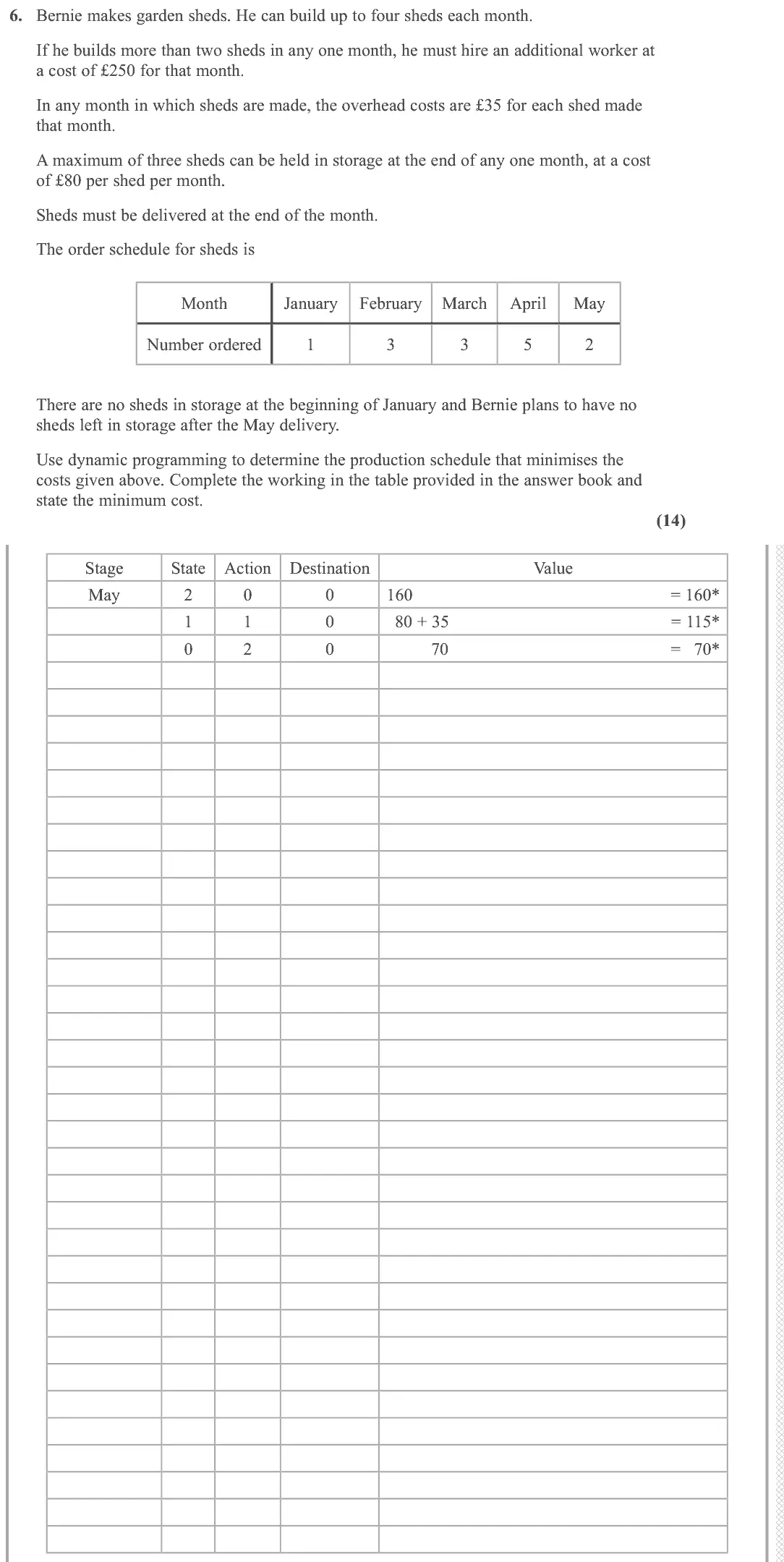
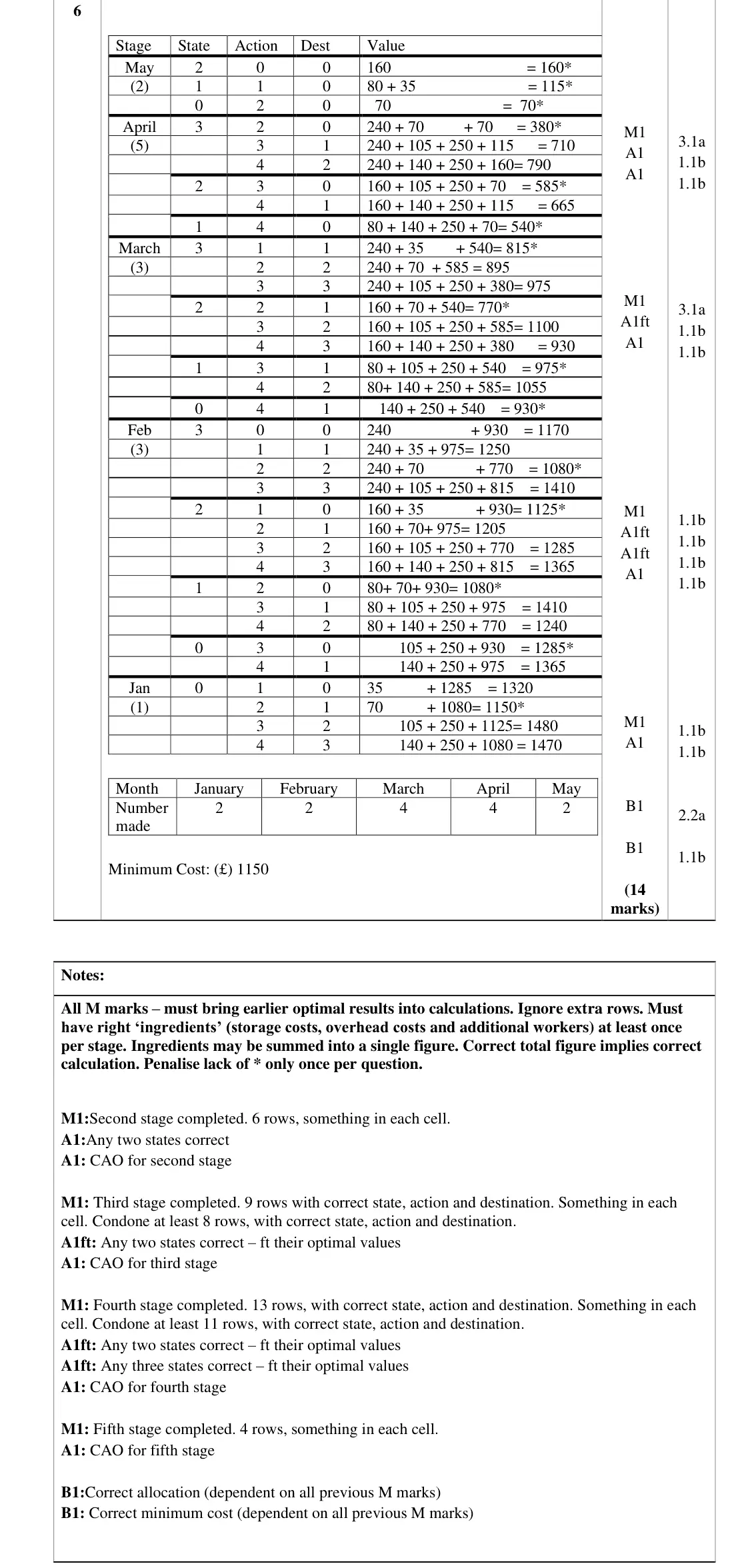
6 Dynamic programming 14 —
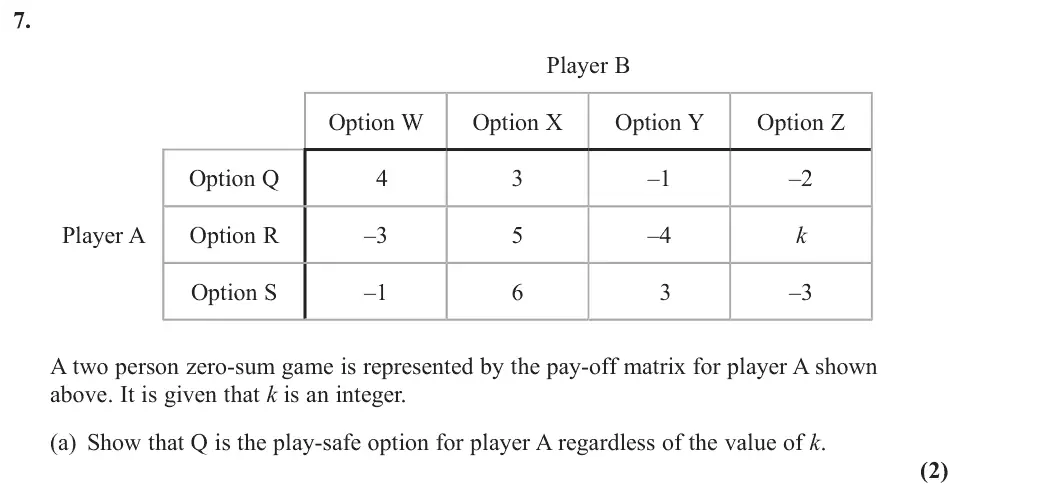
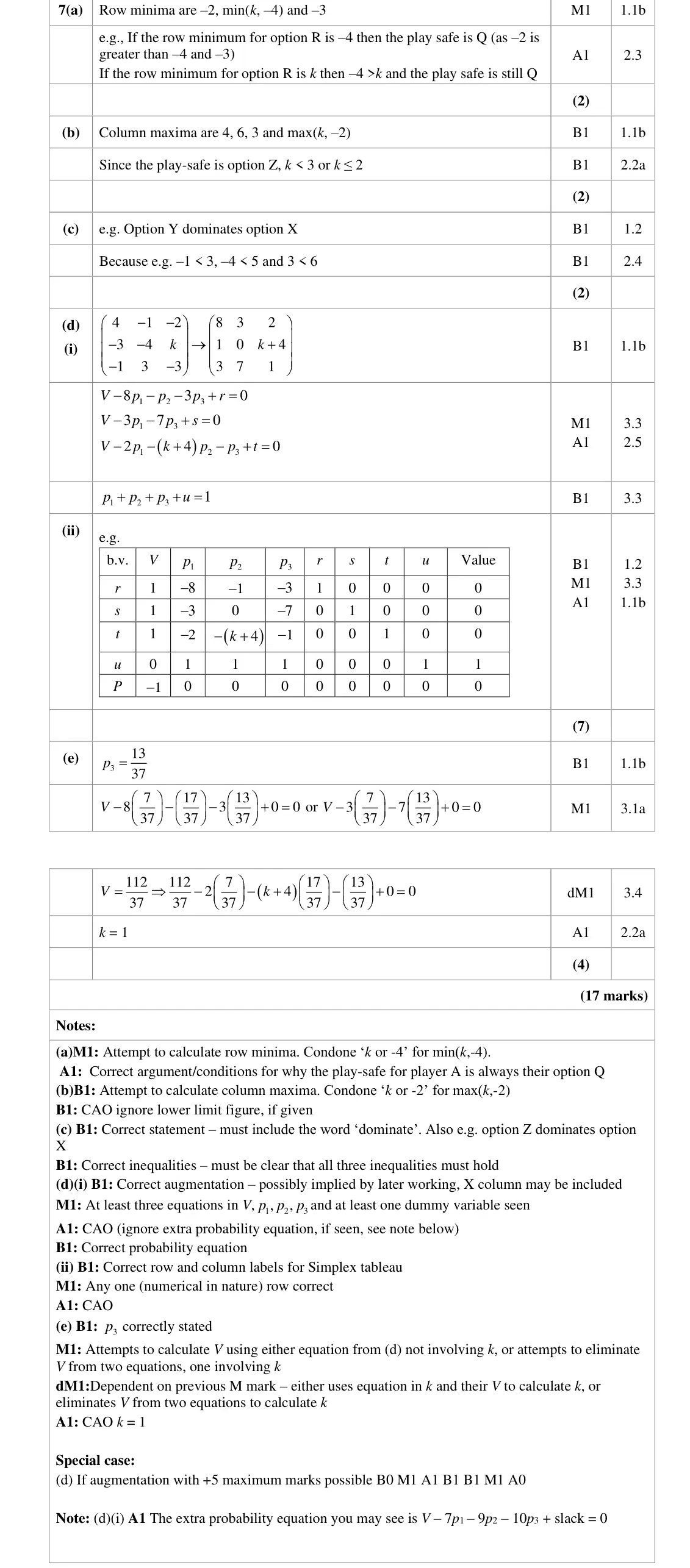
7(a) Game theory 2 —
7(b) Game theory 2 —
7(c) Game theory 2 —
7(d) Game theory 7 —
7(e) Game theory 4 —
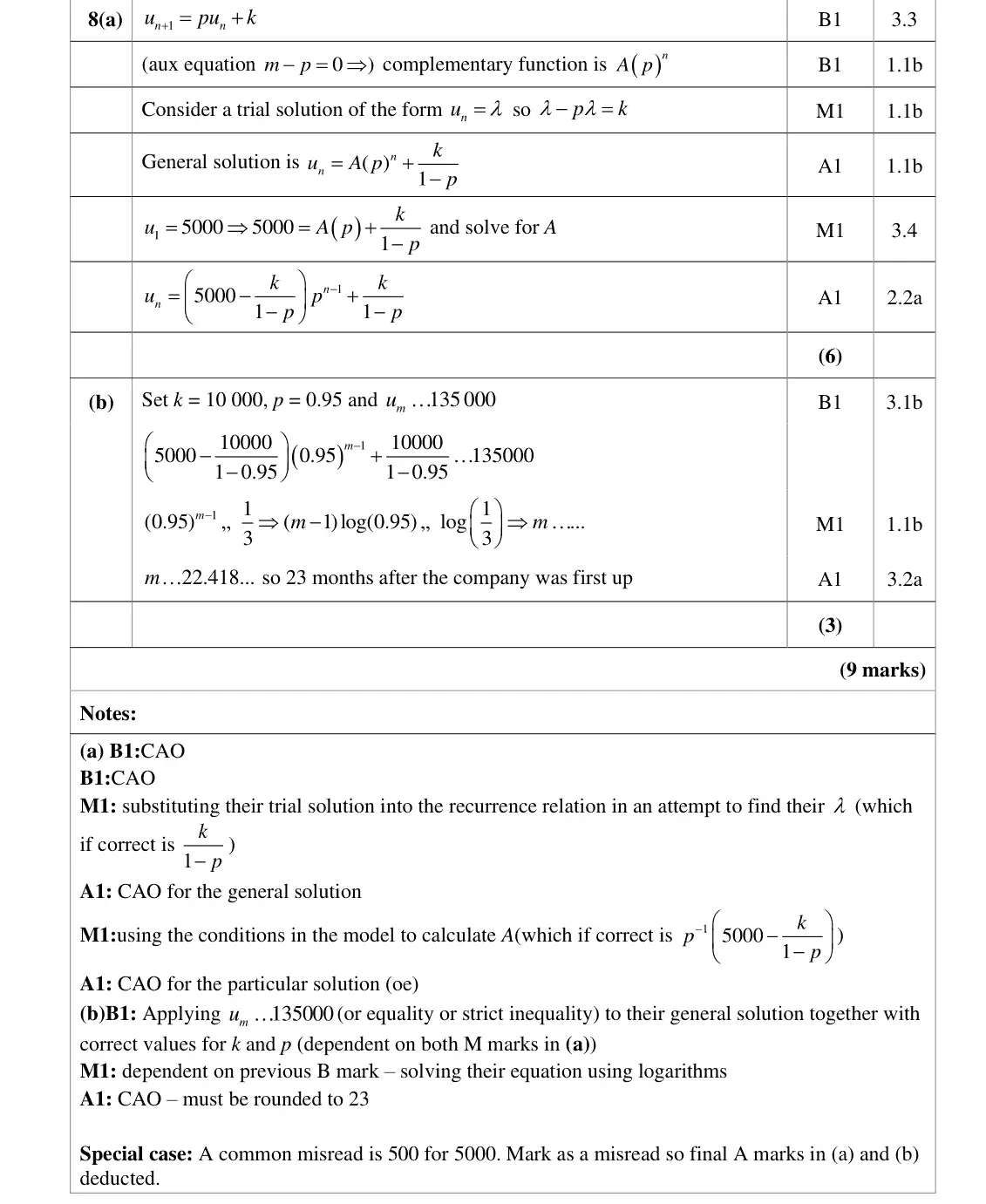
8(a) Recurrence relations (Decision 2) 6 —
8(b) Recurrence relations (Decision 2) 3 —

The questions

1(a)1(b)2(a)2(b)3(a)3(b)4(a)4(b)4(c)4(d)4(e)4(f)5(a)5(b)5(c)5(d)67(a)7(b)7(c)7(d)7(e)8(a)8(b)
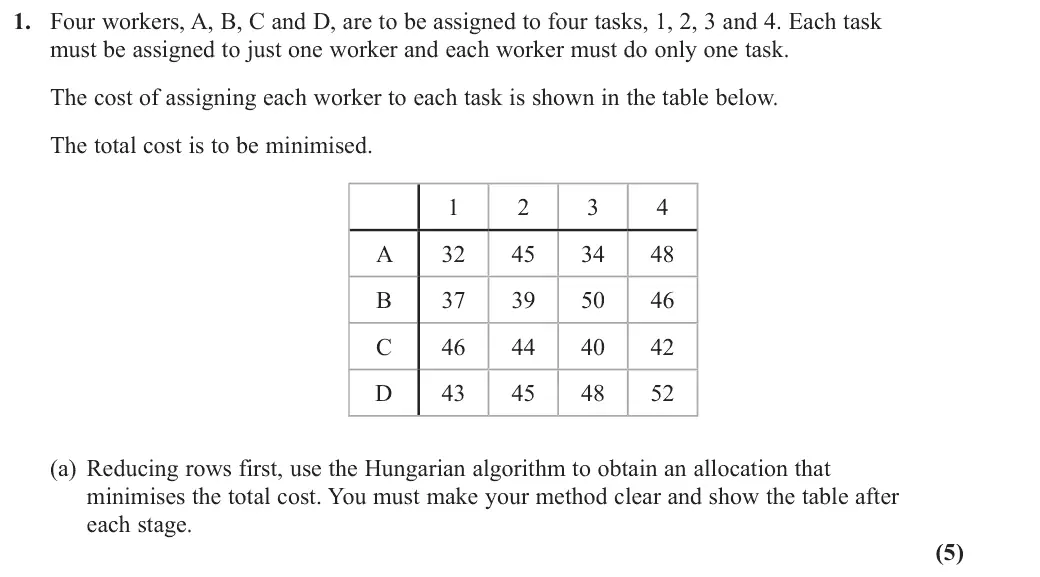
June 2022 · Paper 4D (Decision 2) · Q1(a) 5 marks allocation problems
1. Four workers, A, B, C and D, are to be assigned to four tasks, 1, 2, 3 and 4. Each task must be assigned to just one worker and each worker must do only one task. The cost of assigning each worker to each task is shown in the table below. The total cost is to be minimised. A B C (a) Reducing rows first, use the Hungarian algorithm to obtain an allocation that minimises the total cost. You must make your method clear and show the table after each stage. (5)
June 2022 · Paper 4D (Decision 2) · Q1(b) 1 mark allocation problems
(b) State the minimum total cost. (1)
June 2022 · Paper 4D (Decision 2) · Q2(a) 2 marks recurrence relations d2
2. The general solution of the second order recurrence relation n 0 un + 2 + k1un + 1 + k2un = 0 is given by un = (A + Bn)(–3)n where A and B are arbitrary non‑zero constants. (a) Find the value of k1 and the value of k2 (2)
June 2022 · Paper 4D (Decision 2) · Q2(b) 2 marks recurrence relations d2
Given that u0 = u1 = 1 (b) find the value of A and the value of B. (2)
June 2022 · Paper 4D (Decision 2) · Q3(a) 5 marks decision analysis
3. The table below shows the transport options, usual travel times, possible delay times and corresponding probabilities of delay for a journey. All times are in minutes. Transport option Usual travel time Possible delay time Probability of delay 0.10 Car 0.02 0.05 Train 0.03 0.05 Coach 0.01 (a) Draw a decision tree to model the transport options and the possible outcomes. (5)
June 2022 · Paper 4D (Decision 2) · Q3(b) 2 marks decision analysis
(b) State the minimum expected travel time and the corresponding transport option indicated by the decision tree. (2)
June 2022 · Paper 4D (Decision 2) · Q4(a) 1 mark flows in networks
4. C1 A E C2 B S G F C C1 C2 T Figure 1 Figure 1 shows a capacitated, directed network of pipes. The uncircled number on each arc represents the capacity of the corresponding pipe. The numbers in circles represent an initial flow. (a) List the saturated arcs. (1)
June 2022 · Paper 4D (Decision 2) · Q4(b) 1 mark flows in networks
(b) State the value of the initial flow. (1)
June 2022 · Paper 4D (Decision 2) · Q4(c) 1 mark flows in networks
(c) Explain why arc FT cannot be full to capacity. (1)
June 2022 · Paper 4D (Decision 2) · Q4(d) 2 marks flows in networks
(d) State the capacity of cut C1 and the capacity of cut C2 (2)
June 2022 · Paper 4D (Decision 2) · Q4(e) 1 mark flows in networks
(e) By inspection find one flow‑augmenting route to increase the flow by three units. You must state your route. (1)
June 2022 · Paper 4D (Decision 2) · Q4(f) 3 marks flows in networks
(f) Prove that, once the flow‑augmenting route found in part (e) has been applied, the flow is maximal. (3)
June 2022 · Paper 4D (Decision 2) · Q5(a) 1 mark transportation problems
5. A standard transportation problem is described in the linear programming formulation below. Let xij be the number of units transported from i to j where =$i ∈ {A, B, C, D} j ∈ {R, S, T} and xij 0 Minimise P=$Z=OPxAR + 17xAS + 24xAT + 15xBR + 29xBS + 32xBT + 25xCR + 25xCS + 27xCT + 19xDR + 20xDS + 25xDT subject to ∑xAj 34 ∑xBj 27 ∑xCj 41 ∑xDj 18 ∑xiR 44 ∑xiS 37 ∑xiT k Given that the problem is balanced, (a) state the value of k. (1)
June 2022 · Paper 4D (Decision 2) · Q5(b) 2 marks transportation problems
(b) Explain precisely what the constraint ∑xiR 44 means in the transportation problem. (2)
June 2022 · Paper 4D (Decision 2) · Q5(c) 2 marks transportation problems
(c) Use the north‑west corner method to obtain the cost of an initial solution to this transportation problem. (2)
June 2022 · Paper 4D (Decision 2) · Q5(d) 4 marks transportation problems
(d) Perform one iteration of the stepping‑stone method to obtain an improved solution. You must make your method clear by showing the route and the • shadow costs • improvement indices • entering cell and exiting cell. (4)
June 2022 · Paper 4D (Decision 2) · Q6 14 marks dynamic programming
6. Bernie makes garden sheds. He can build up to four sheds each month. If he builds more than two sheds in any one month, he must hire an additional worker at a cost of £250 for that month. In any month in which sheds are made, the overhead costs are £35 for each shed made that month. A maximum of three sheds can be held in storage at the end of any one month, at a cost of £80 per shed per month. Sheds must be delivered at the end of the month. The order schedule for sheds is Month January February March April May Number ordered There are no sheds in storage at the beginning of January and Bernie plans to have no sheds left in storage after the May delivery. Use dynamic programming to determine the production schedule that minimises the costs given above. Complete the working in the table provided in the answer book and state the minimum cost. (14)
June 2022 · Paper 4D (Decision 2) · Q7(a) 2 marks game theory
7. Player B Option W Option X Option Y Option Z Option Q –1 –2 Player A Option R –3 –4 k Option S –1 –3 A two person zero‑sum game is represented by the pay‑off matrix for player A shown above. It is given that k is an integer. (a) Show that Q is the play‑safe option for player A regardless of the value of k. (2)
June 2022 · Paper 4D (Decision 2) · Q7(b) 2 marks game theory
Given that Z is the play‑safe option for player B, (b) determine the range of possible values of k. You must make your working clear. (2)
June 2022 · Paper 4D (Decision 2) · Q7(c) 2 marks game theory
(c) Explain why player B should never play option X. You must make your reasoning clear. (2)
June 2022 · Paper 4D (Decision 2) · Q7(d) 7 marks game theory
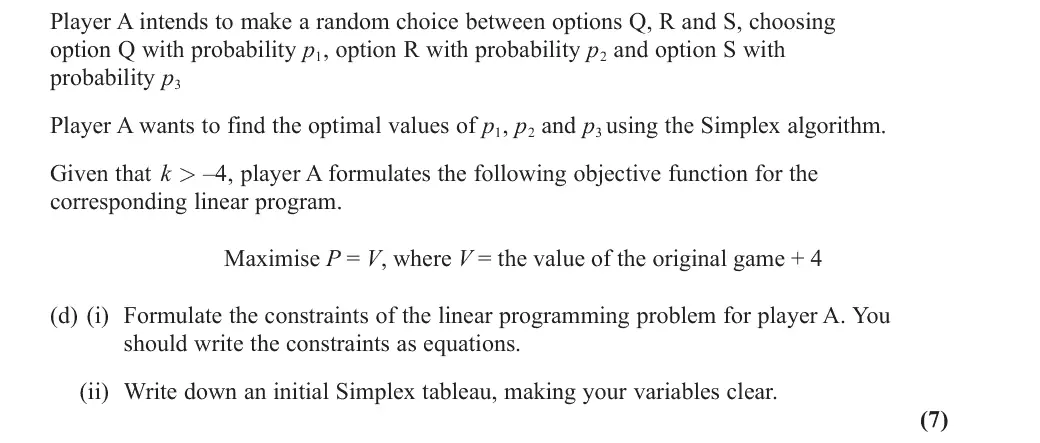
Player A intends to make a random choice between options Q, R and S, choosing option Q with probability p1, option R with probability p2 and option S with probability p3 Player A wants to find the optimal values of p1, p2 and p3 using the Simplex algorithm. Given that k > –4, player A formulates the following objective function for the corresponding linear program. Maximise P = V, where V = the value of the original game + 4 (d) (i) Formulate the constraints of the linear programming problem for player A. You should write the constraints as equations. (ii) Write down an initial Simplex tableau, making your variables clear. (7)
June 2022 · Paper 4D (Decision 2) · Q7(e) 4 marks game theory
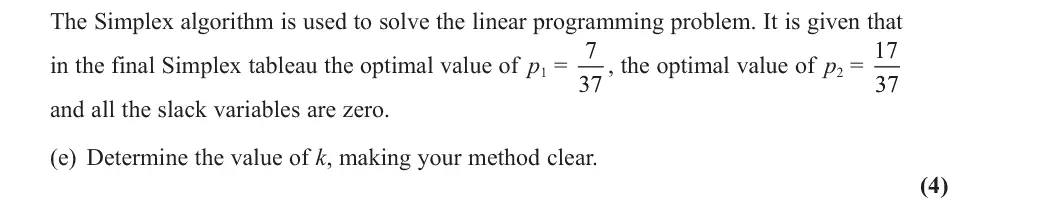
The Simplex algorithm is used to solve the linear programming problem. It is given that in the final Simplex tableau the optimal value of p1 = 7 37 , the optimal value of p2 = 17 and all the slack variables are zero. (e) Determine the value of k, making your method clear. (4)
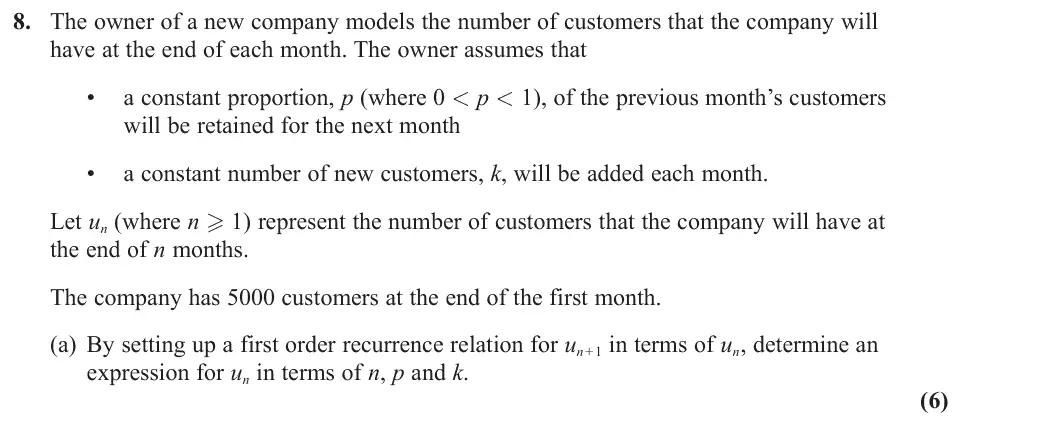
June 2022 · Paper 4D (Decision 2) · Q8(a) 6 marks recurrence relations d2
8. The owner of a new company models the number of customers that the company will have at the end of each month. The owner assumes that • a constant proportion, p (where 0 < p < 1), of the previous month’s customers will be retained for the next month • a constant number of new customers, k, will be added each month. Let un (where n 1) represent the number of customers that the company will have at the end of n months. The company has 5000 customers at the end of the first month. (a) By setting up a first order recurrence relation for un + 1 in terms of un, determine an expression for un in terms of n, p and k. (6)
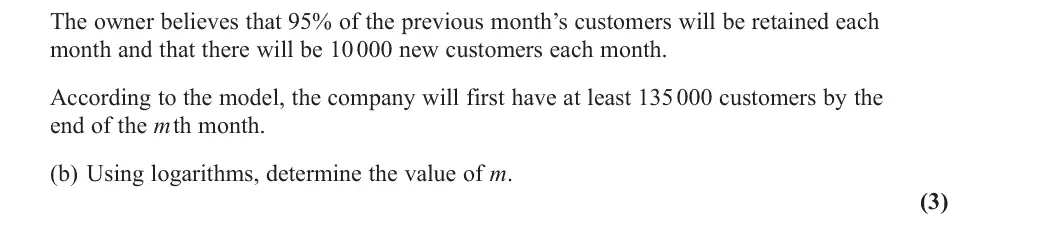
June 2022 · Paper 4D (Decision 2) · Q8(b) 3 marks recurrence relations d2
The owner believes that 95% of the previous month’s customers will be retained each month and that there will be 10 000 new customers each month. According to the model, the company will first have at least 135 000 customers by the end of the mth month. (b) Using logarithms, determine the value of m. (3)

Find an Edexcel Further Maths tutor

Want this paper marked and gone through with a Further Maths tutor? Message us.

Prefer email? Send an enquiry

If you are under 18, please include a parent's contact details. Enquiries go to enquiries@alevelfurthermathstutor.com and are deleted once handled.