Mark scheme (whole question; this part is marked with the orange bar)
Examiner's comment
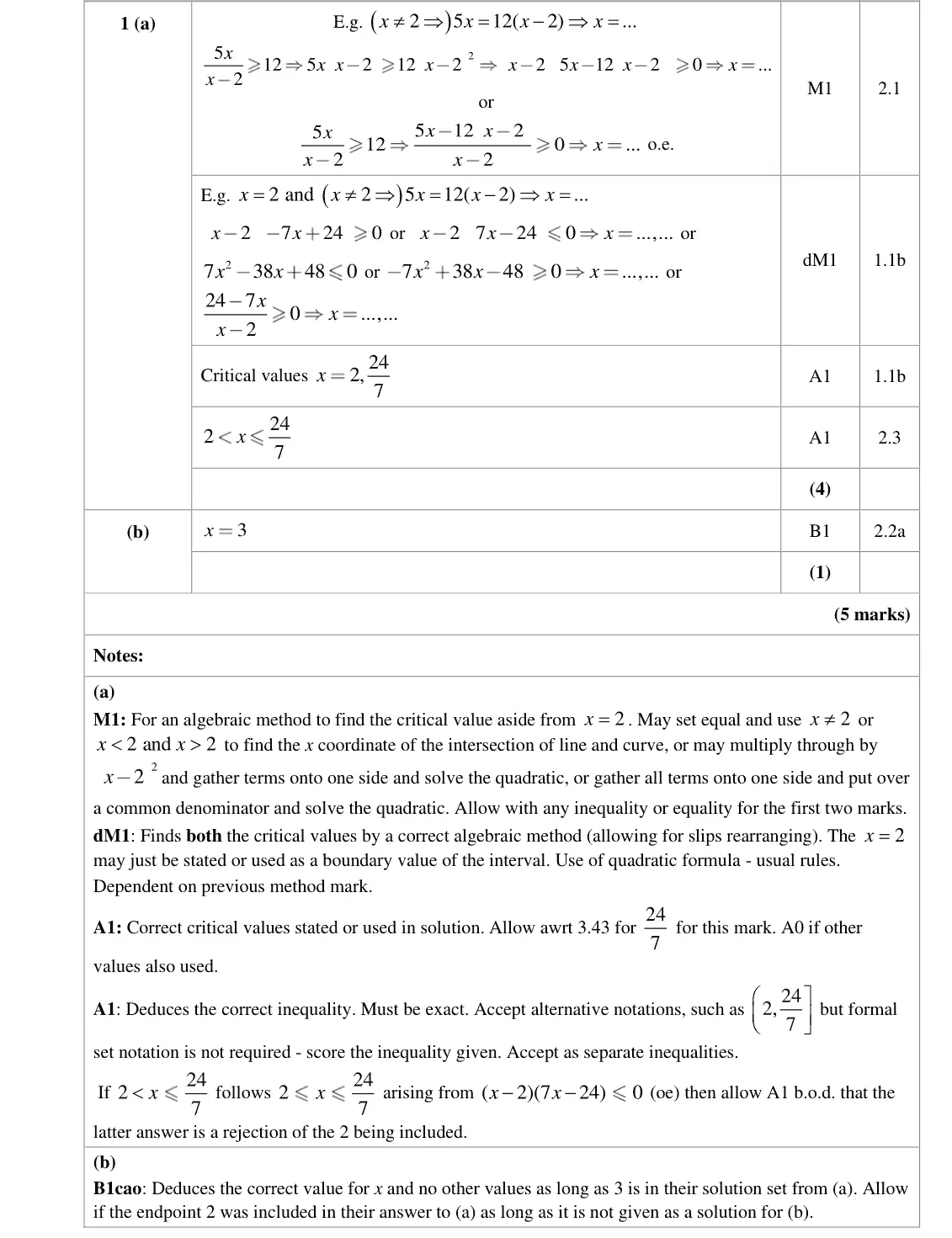
With full marks achieved by well over one third of students, this question provided a reassuring start to the paper for many. However, part (b) was not well understood, and so full marks was relatively uncommon. Part (a) was well answered by the vast majority, with mainly slips in the inclusion or not of boundary values in the solution preventing full marks from this part for many. Most were able to achieve the correct critical values, though there were occasional slips or miscopies, e.g. from omitting the x to obtain 5(x – 2) when multiplying by (x – 2)2, or incorrect multiplying out to give 5x2 – 10. Multiplication through by (x – 2)2 was the most common of the methods to find the critical values, though the other approaches were also seen frequently. Most students solved the quadratic (if one was found) correctly, but a few who factorised gave the value as 7 24 rather than 24 7 . There were also some sign errors at this stage. A few assumed that the critical values needed to be integers so tried rounding. As noted, the biggest problem in this part was the inequality at the end, with many students failing to give a strict inequality at the lower end of the range – even if they had said x ≠ 2 in their response. Only a small number of students made the error of selecting the outside ranges as their solution.
Key points from the mark scheme and examiner's report
- multiply by (x − 2)² (or common denominator): (x − 2)(7x − 24) ≤ 0
- critical values 2 and 24/7
- answer 2 < x ≤ 24/7
- the commonest loss was a non-strict inequality at x = 2
- slips such as 5(x − 2) for 5x(x − 2)