June 2023: A level Paper 4D: Decision Mathematics 2

75 marks · 20 question parts · Question paper, mark scheme and examiner's report on Pearson's site

Question by question

QTopicMarksDifficulty
1(a) Flows in networks 1 —
1(b) Flows in networks 2 —
1(c) Flows in networks 1 —
1(d) Flows in networks 3 —
2 Decision analysis: decision trees and expected values 5 —
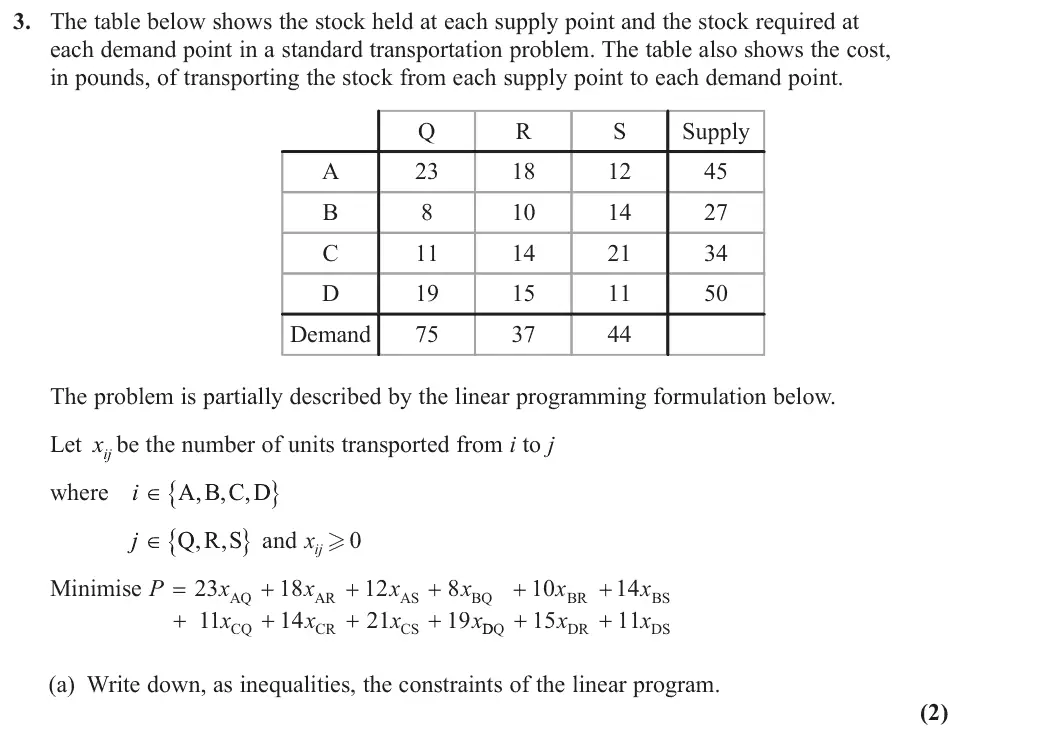
3(a) Transportation problems 2 —
3(b) Transportation problems 1 —
3(c) Transportation problems 2 —
3(d) Transportation problems 4 —
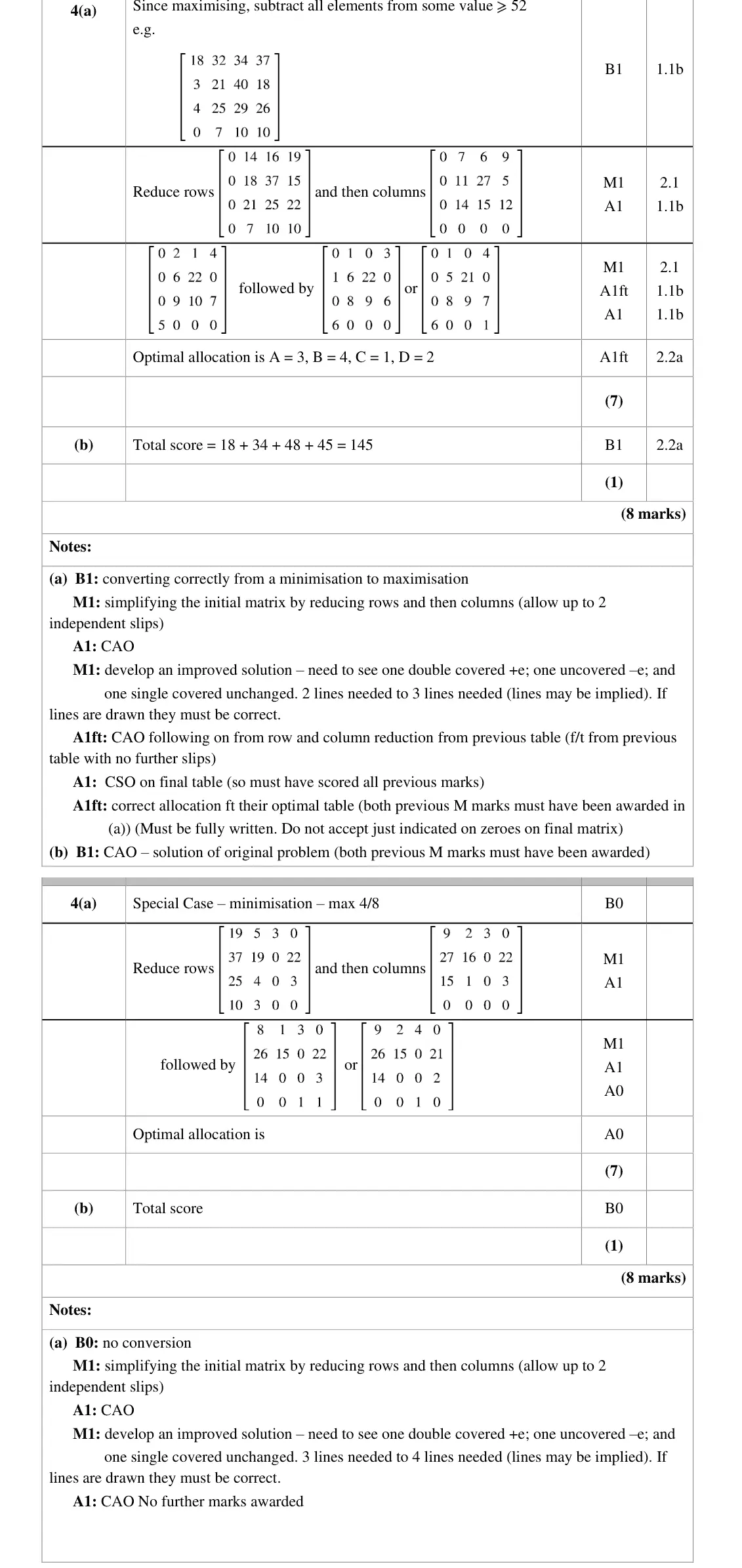
4(a) Allocation (assignment) problems and the Hungarian algorithm 7 —
4(b) Allocation (assignment) problems and the Hungarian algorithm 1 —
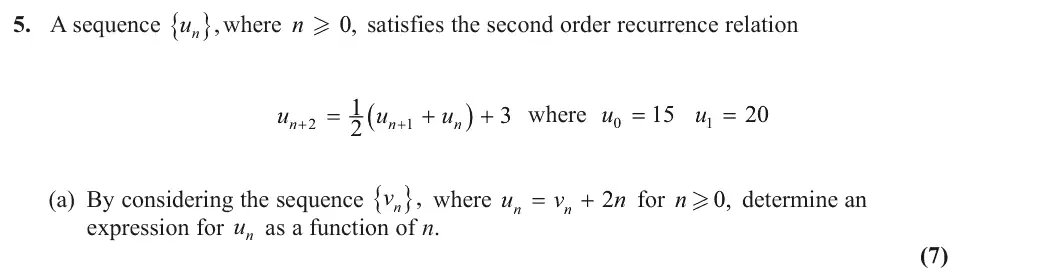
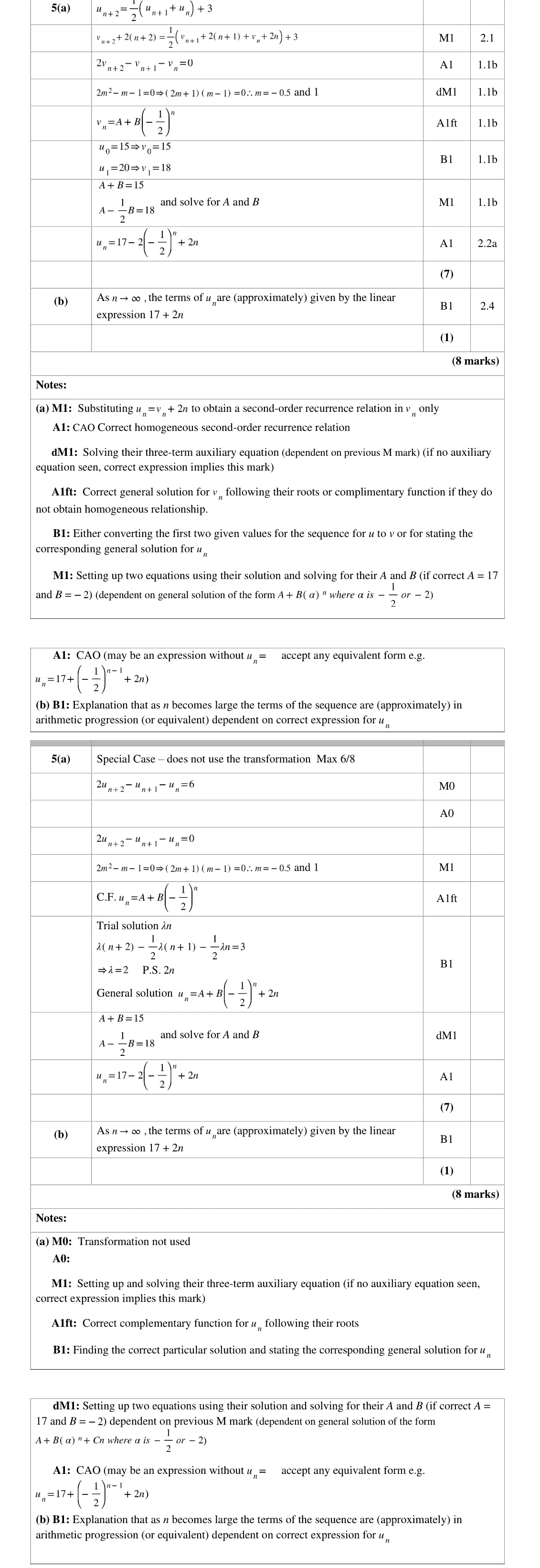
5(a) Recurrence relations (Decision 2) 7 —
5(b) Recurrence relations (Decision 2) 1 —
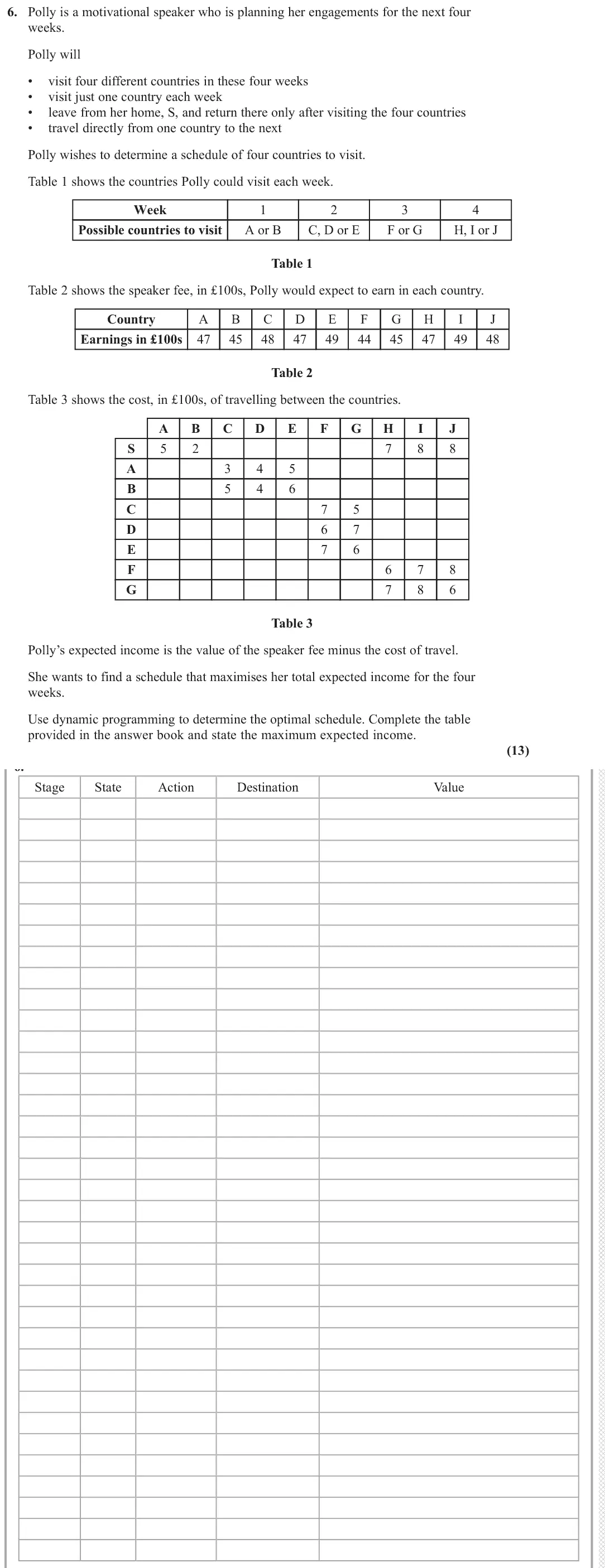
6 Dynamic programming 13 —
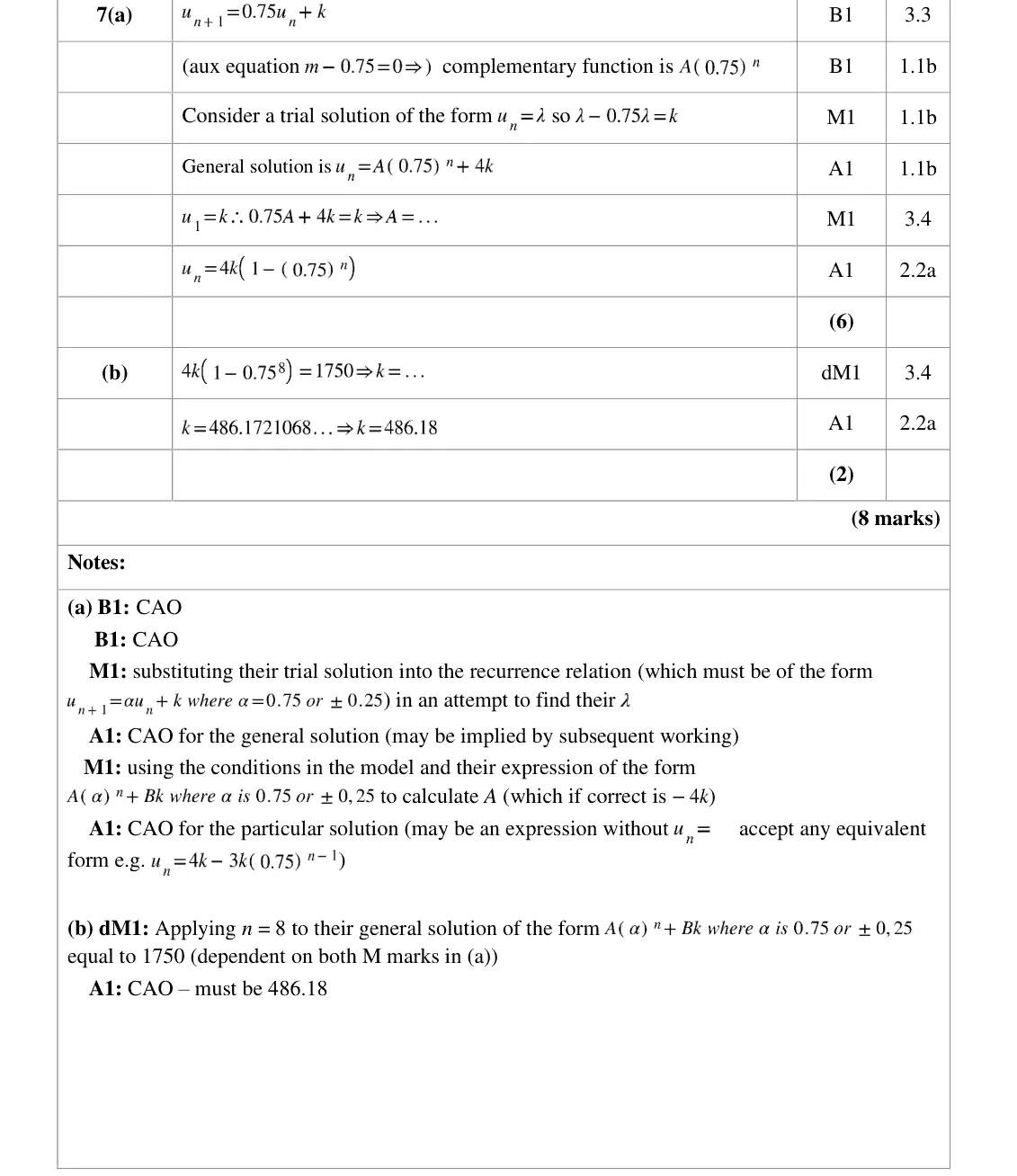
7(a) Recurrence relations (Decision 2) 6 —
7(b) Recurrence relations (Decision 2) 2 —
8(a) Game theory 2 —
8(b) Game theory 2 —
8(c) Game theory 7 —
8(d) Game theory 6 —

The questions

1(a)1(b)1(c)1(d)23(a)3(b)3(c)3(d)4(a)4(b)5(a)5(b)67(a)7(b)8(a)8(b)8(c)8(d)
June 2023 · Paper 4D (Decision 2) · Q1(a) 1 mark flows in networks
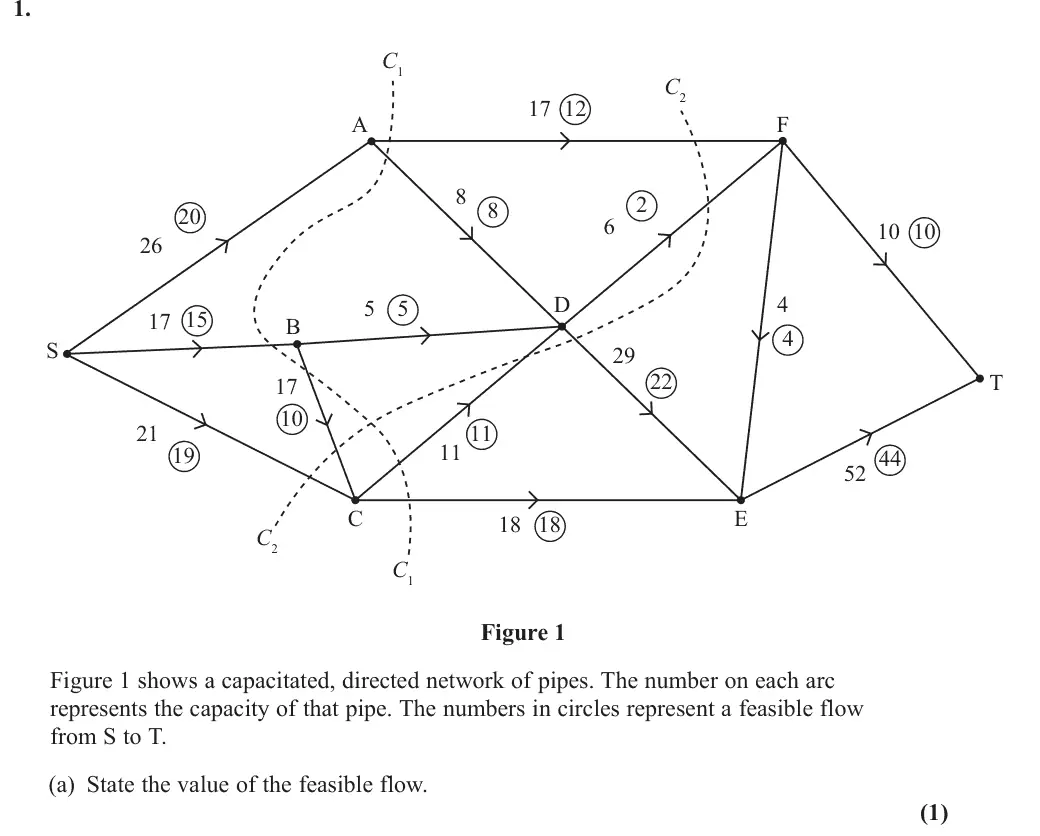
1. C1 C2 A F 17 15 B S T C E C2 C1 Figure 1 Figure 1 shows a capacitated, directed network of pipes. The number on each arc represents the capacity of that pipe. The numbers in circles represent a feasible flow from S to T. (a) State the value of the feasible flow. (1)
June 2023 · Paper 4D (Decision 2) · Q1(b) 2 marks flows in networks
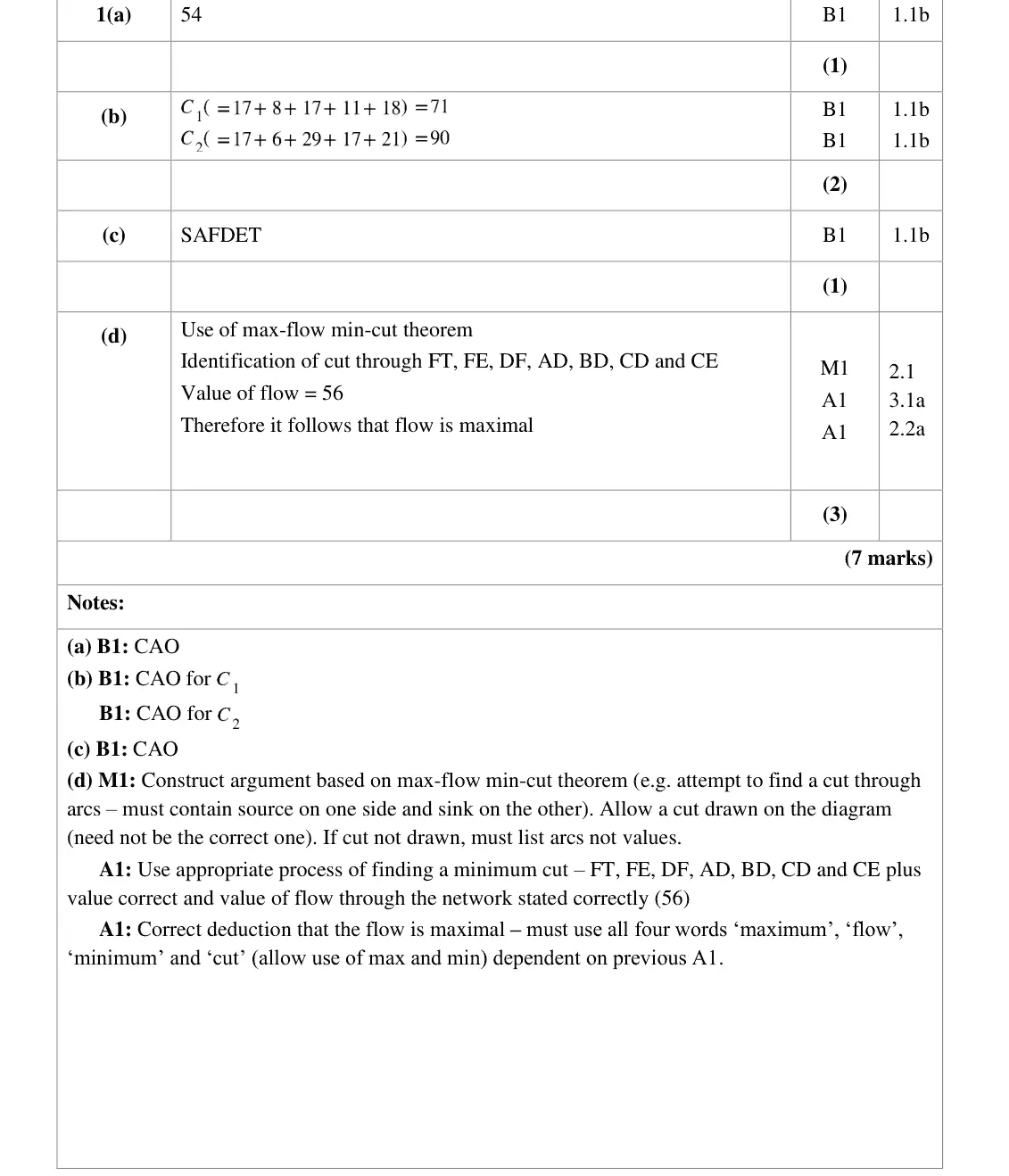
(b) Find the capacity of cut C1 and the capacity of cut C2 (2)
June 2023 · Paper 4D (Decision 2) · Q1(c) 1 mark flows in networks
(c) By inspection, find a flow-augmenting route to increase the flow by two units. You must state your route. (1)
June 2023 · Paper 4D (Decision 2) · Q1(d) 3 marks flows in networks
(d) Prove that, once the flow-augmenting route found in (c) has been applied, the flow is now maximal. (3)
June 2023 · Paper 4D (Decision 2) · Q2 5 marks decision analysis
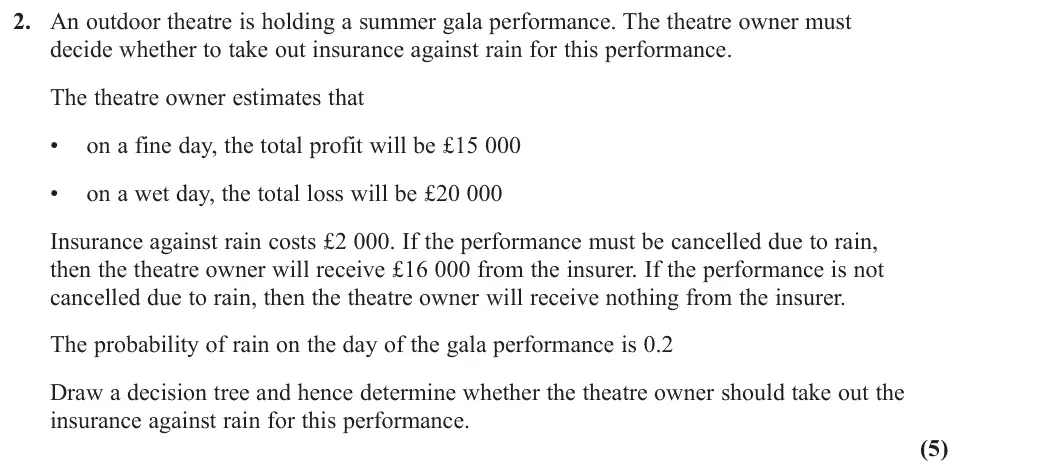
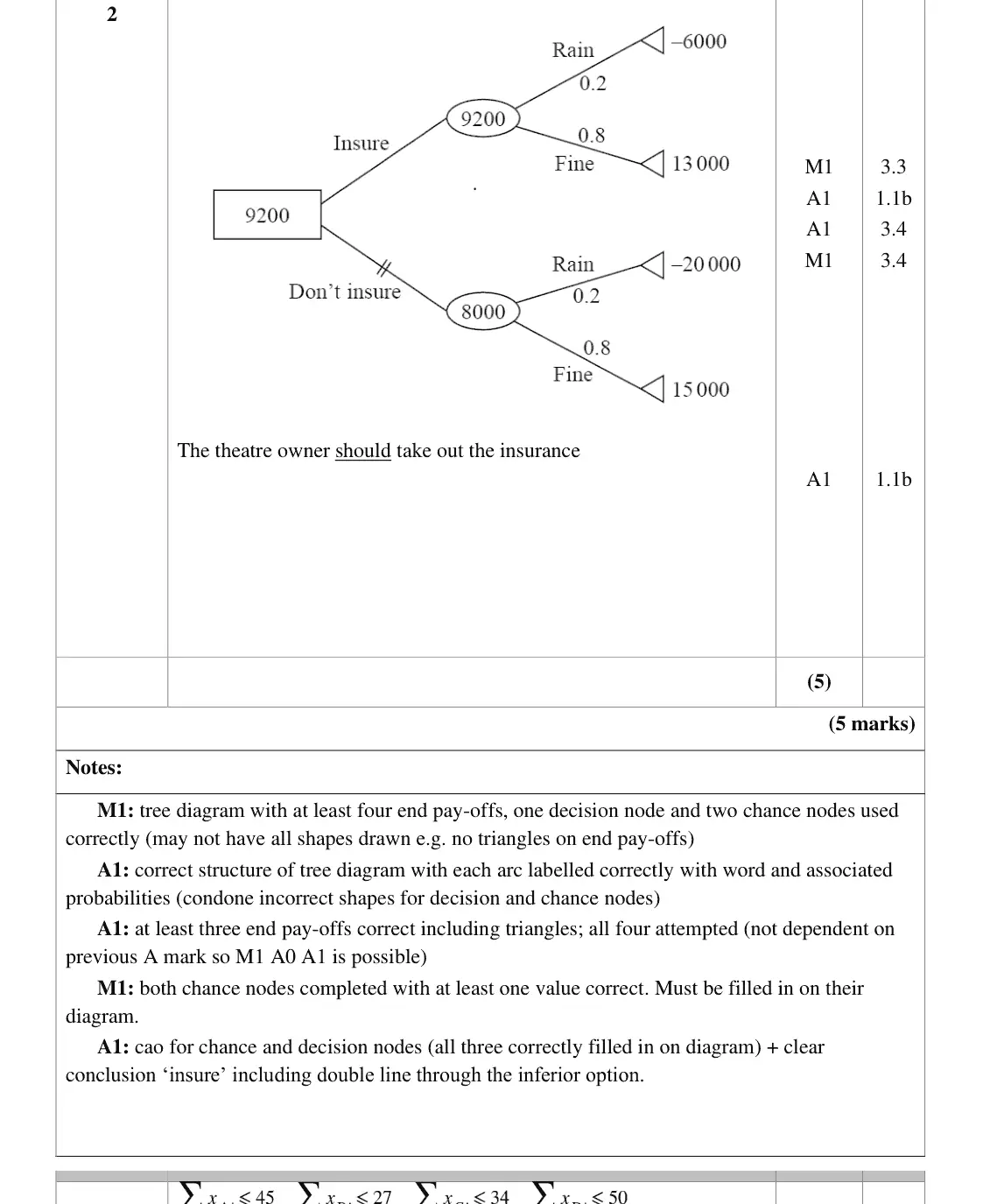
2. An outdoor theatre is holding a summer gala performance. The theatre owner must decide whether to take out insurance against rain for this performance. The theatre owner estimates that • on a fine day, the total profit will be £15 000 • on a wet day, the total loss will be £20 000 Insurance against rain costs £2 000. If the performance must be cancelled due to rain, then the theatre owner will receive £16 000 from the insurer. If the performance is not cancelled due to rain, then the theatre owner will receive nothing from the insurer. The probability of rain on the day of the gala performance is 0.2 Draw a decision tree and hence determine whether the theatre owner should take out the insurance against rain for this performance. (5)
June 2023 · Paper 4D (Decision 2) · Q3(a) 2 marks transportation problems
3. The table below shows the stock held at each supply point and the stock required at each demand point in a standard transportation problem. The table also shows the cost, in pounds, of transporting the stock from each supply point to each demand point. Q R S Supply A B C Demand The problem is partially described by the linear programming formulation below. Let xij be the number of units transported from i to j where i=< <= ¥ A B C D , , , j=< <= ¥ and xij=<0 Q R S , , Minimise P x x x x x x AQ AR AS BQ BR BS x x x x x x CQ CR CS DQ DR DS (a) Write down, as inequalities, the constraints of the linear program. (2)
June 2023 · Paper 4D (Decision 2) · Q3(b) 1 mark transportation problems
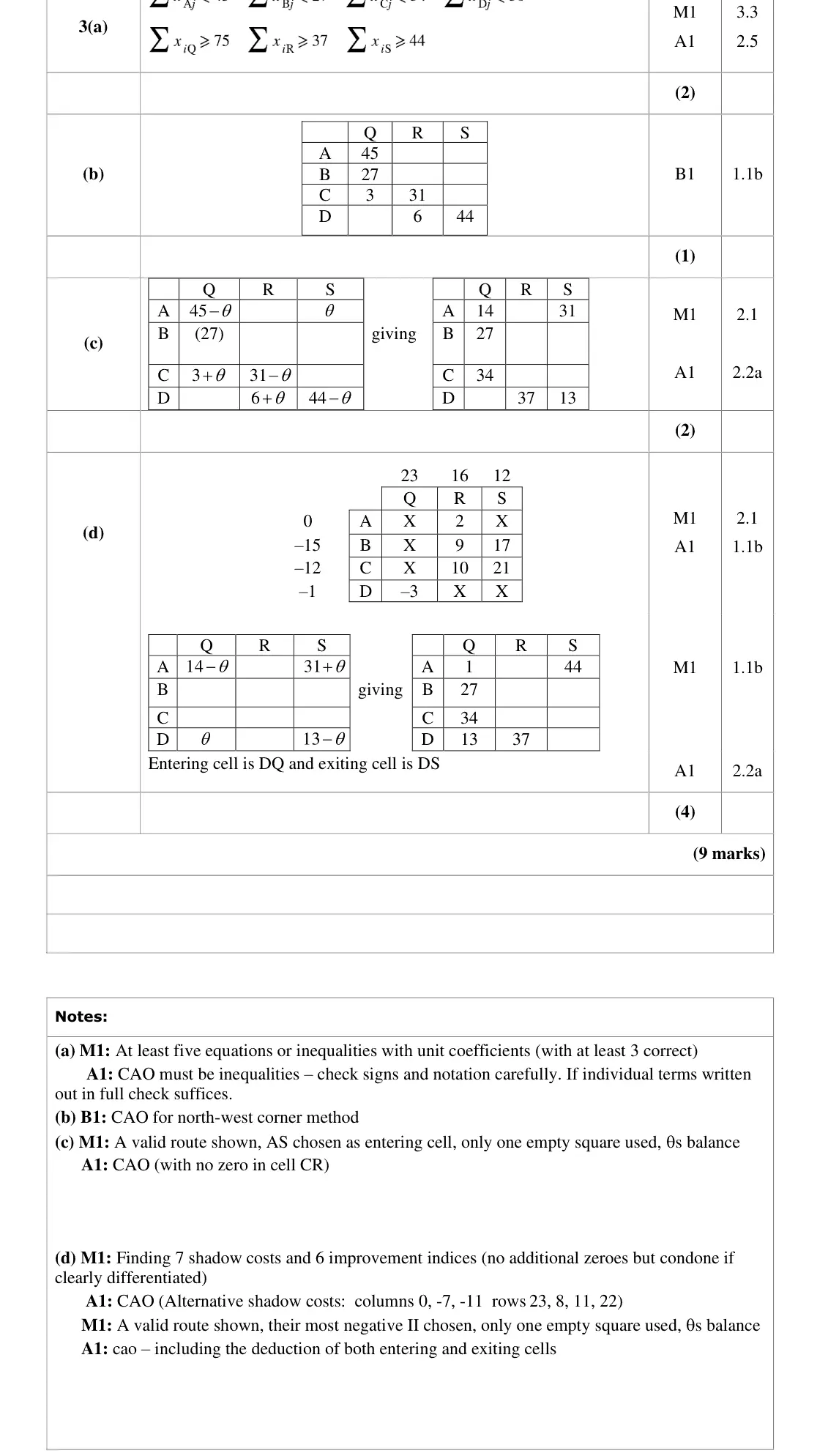
(b) Use the north-west corner method to obtain an initial solution to this transportation problem. (1)
June 2023 · Paper 4D (Decision 2) · Q3(c) 2 marks transportation problems
(c) Taking AS as the entering cell, use the stepping-stone method to find an improved solution. Make your route clear. (2)
June 2023 · Paper 4D (Decision 2) · Q3(d) 4 marks transportation problems
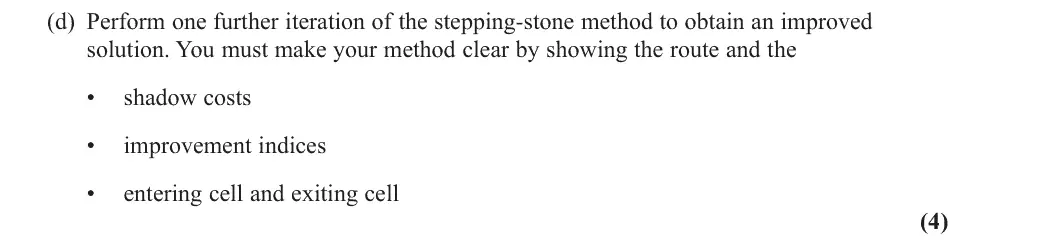
(d) Perform one further iteration of the stepping-stone method to obtain an improved solution. You must make your method clear by showing the route and the • shadow costs • improvement indices • entering cell and exiting cell (4)
June 2023 · Paper 4D (Decision 2) · Q4(a) 7 marks allocation problems
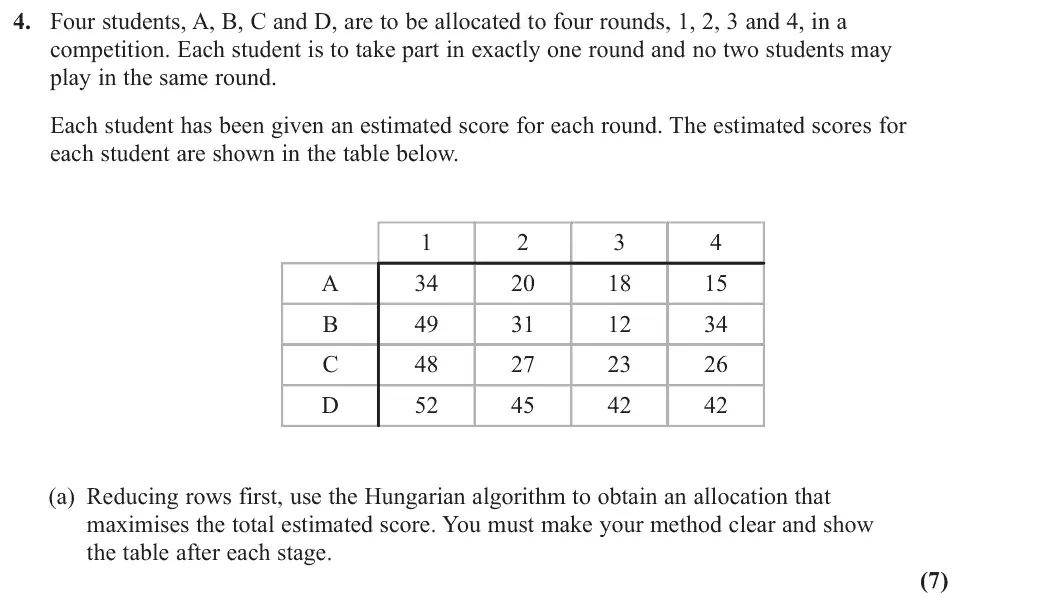
4. Four students, A, B, C and D, are to be allocated to four rounds, 1, 2, 3 and 4, in a competition. Each student is to take part in exactly one round and no two students may play in the same round. Each student has been given an estimated score for each round. The estimated scores for each student are shown in the table below. A B C (a) Reducing rows first, use the Hungarian algorithm to obtain an allocation that maximises the total estimated score. You must make your method clear and show the table after each stage. (7)
June 2023 · Paper 4D (Decision 2) · Q4(b) 1 mark allocation problems
(b) Find this total estimated score. (1)
June 2023 · Paper 4D (Decision 2) · Q5(a) 7 marks recurrence relations d2
<= ¥,where n 0, satisfies the second order recurrence relation 5. A sequence un / 1 u u u 3 where u = u = n n n <= ¥, where u (a) By considering the sequence vn 1 2 for n 0, determine an v n n n expression for un as a function of n. (7)
June 2023 · Paper 4D (Decision 2) · Q5(b) 1 mark recurrence relations d2
(b) Describe the long-term behaviour of un (1)
June 2023 · Paper 4D (Decision 2) · Q6 13 marks dynamic programming
6. Polly is a motivational speaker who is planning her engagements for the next four weeks. Polly will • visit four different countries in these four weeks • visit just one country each week • leave from her home, S, and return there only after visiting the four countries • travel directly from one country to the next Polly wishes to determine a schedule of four countries to visit. Table 1 shows the countries Polly could visit each week. Week Possible countries to visit A or B C, D or E F or G H, I or J Table 1 Table 2 shows the speaker fee, in £100s, Polly would expect to earn in each country. Country A B C E F G H I J Earnings in £100s Table 2 Table 3 shows the cost, in £100s, of travelling between the countries. A B C E F G H I J S A B C E F G Table 3 Polly’s expected income is the value of the speaker fee minus the cost of travel. She wants to find a schedule that maximises her total expected income for the four weeks. Use dynamic programming to determine the optimal schedule. Complete the table provided in the answer book and state the maximum expected income. (13)
June 2023 · Paper 4D (Decision 2) · Q7(a) 6 marks recurrence relations d2
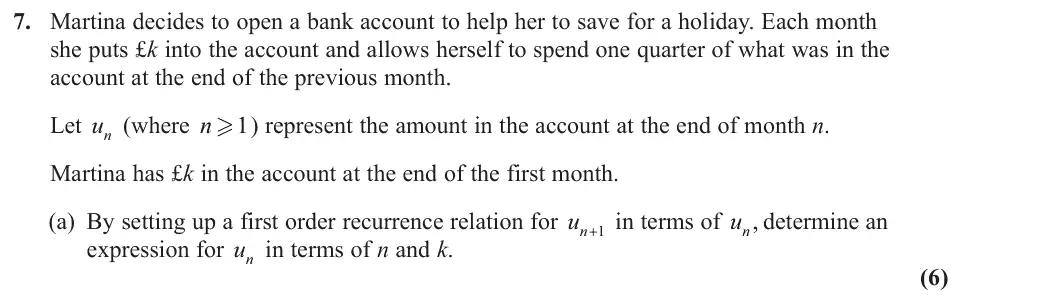
7. Martina decides to open a bank account to help her to save for a holiday. Each month she puts £k into the account and allows herself to spend one quarter of what was in the account at the end of the previous month. Let un (where n 1) represent the amount in the account at the end of month n. Martina has £k in the account at the end of the first month. (a) By setting up a first order recurrence relation for un+1 in terms of un, determine an expression for un in terms of n and k. (6)
June 2023 · Paper 4D (Decision 2) · Q7(b) 2 marks recurrence relations d2
At the end of the 8th month, Martina needs to have at least £1750 in the account to pay for her holiday. (b) Determine, to the nearest penny, the minimum amount of money that Martina should put into the account each month. (2)
June 2023 · Paper 4D (Decision 2) · Q8(a) 2 marks game theory
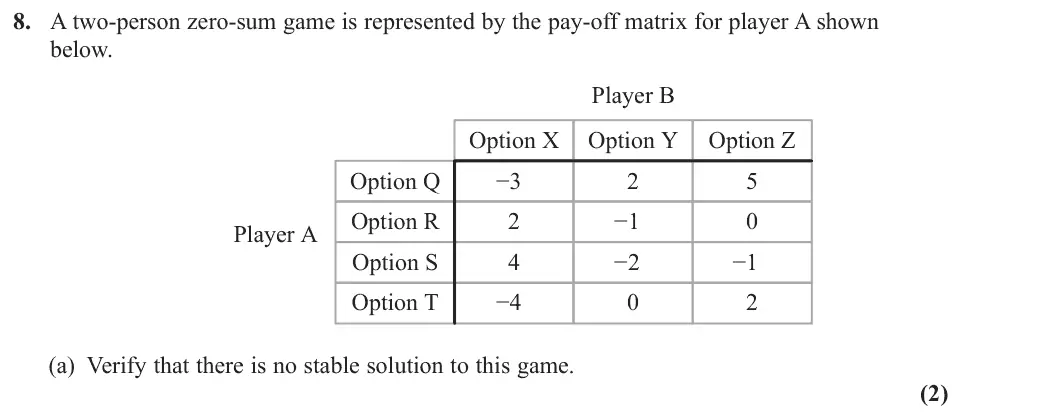
8. A two-person zero-sum game is represented by the pay-off matrix for player A shown below. Player B Option X Option Y Option Z Option Q -3 Option R -1 Player A Option S -2 -1 Option T -4 (a) Verify that there is no stable solution to this game. (2)
June 2023 · Paper 4D (Decision 2) · Q8(b) 2 marks game theory
(b) Explain why player A should never play option T. You must make your reasoning clear. (2)
June 2023 · Paper 4D (Decision 2) · Q8(c) 7 marks game theory
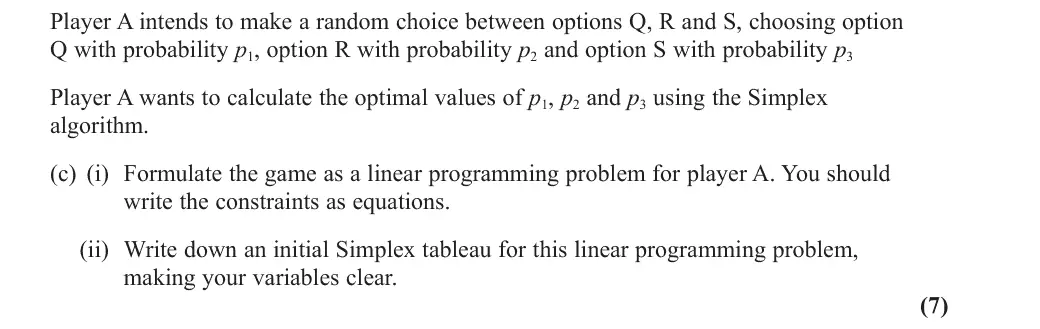
Player A intends to make a random choice between options Q, R and S, choosing option Q with probability p1, option R with probability p2 and option S with probability p3 Player A wants to calculate the optimal values of p1, p2 and p3 using the Simplex algorithm. (c) (i) Formulate the game as a linear programming problem for player A. You should write the constraints as equations. (ii) Write down an initial Simplex tableau for this linear programming problem, making your variables clear. (7)
June 2023 · Paper 4D (Decision 2) · Q8(d) 6 marks game theory
The linear programming problem is solved using the Simplex algorithm. The optimal value of p1 and the optimal value of p2 is is (d) Find the best strategy for player B, defining any variables you use. (6)

Find an Edexcel Further Maths tutor

Want this paper marked and gone through with a Further Maths tutor? Message us.

Prefer email? Send an enquiry

If you are under 18, please include a parent's contact details. Enquiries go to enquiries@alevelfurthermathstutor.com and are deleted once handled.