June 2024: A level Paper 01: Core Pure Mathematics 1

75 marks · 22 question parts · Question paper, mark scheme and examiner's report on Pearson's site

Question by question

QTopicMarksDifficulty
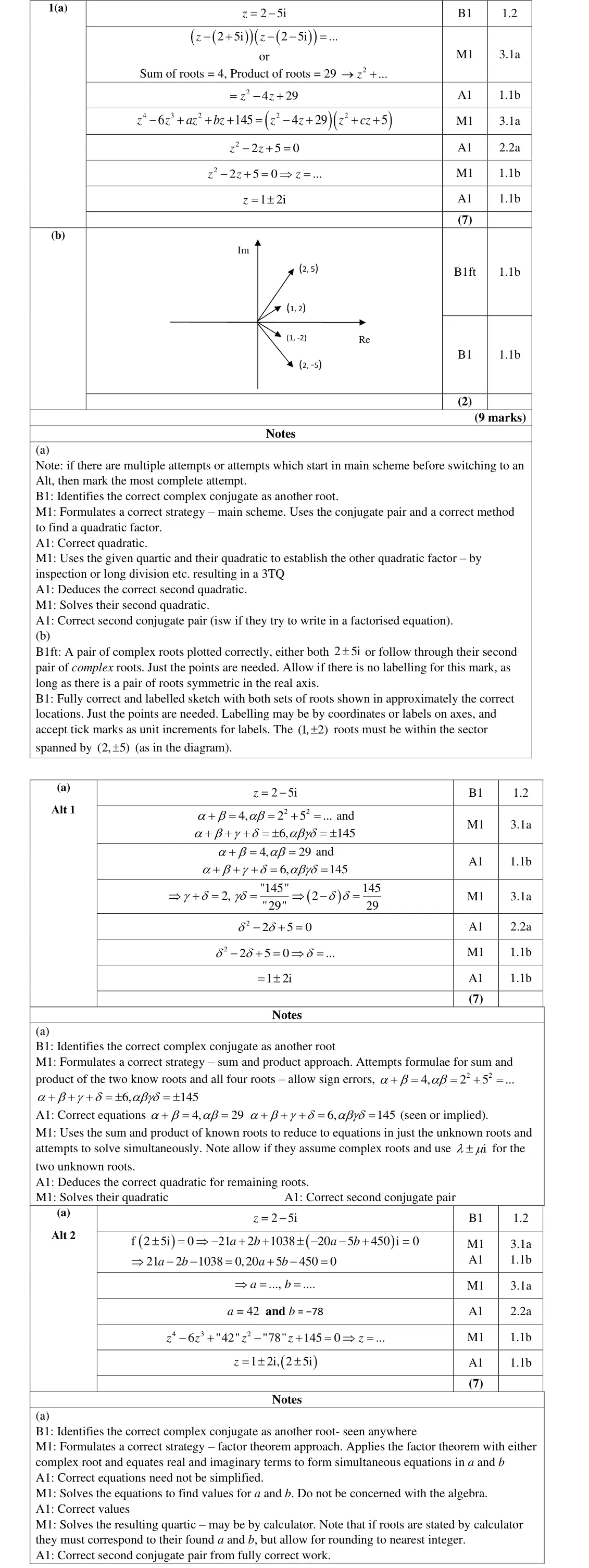
1(a) Complex numbers: arithmetic, conjugates, roots of polynomials and Argand diagrams 7 —
1(b) Complex numbers: arithmetic, conjugates, roots of polynomials and Argand diagrams 2 —
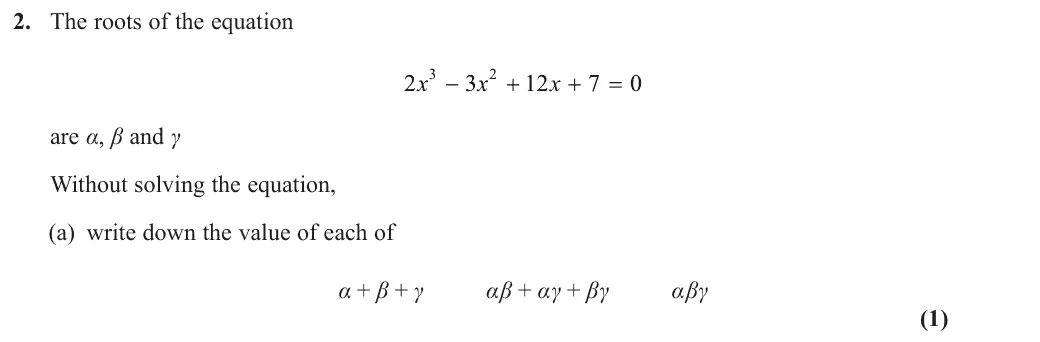
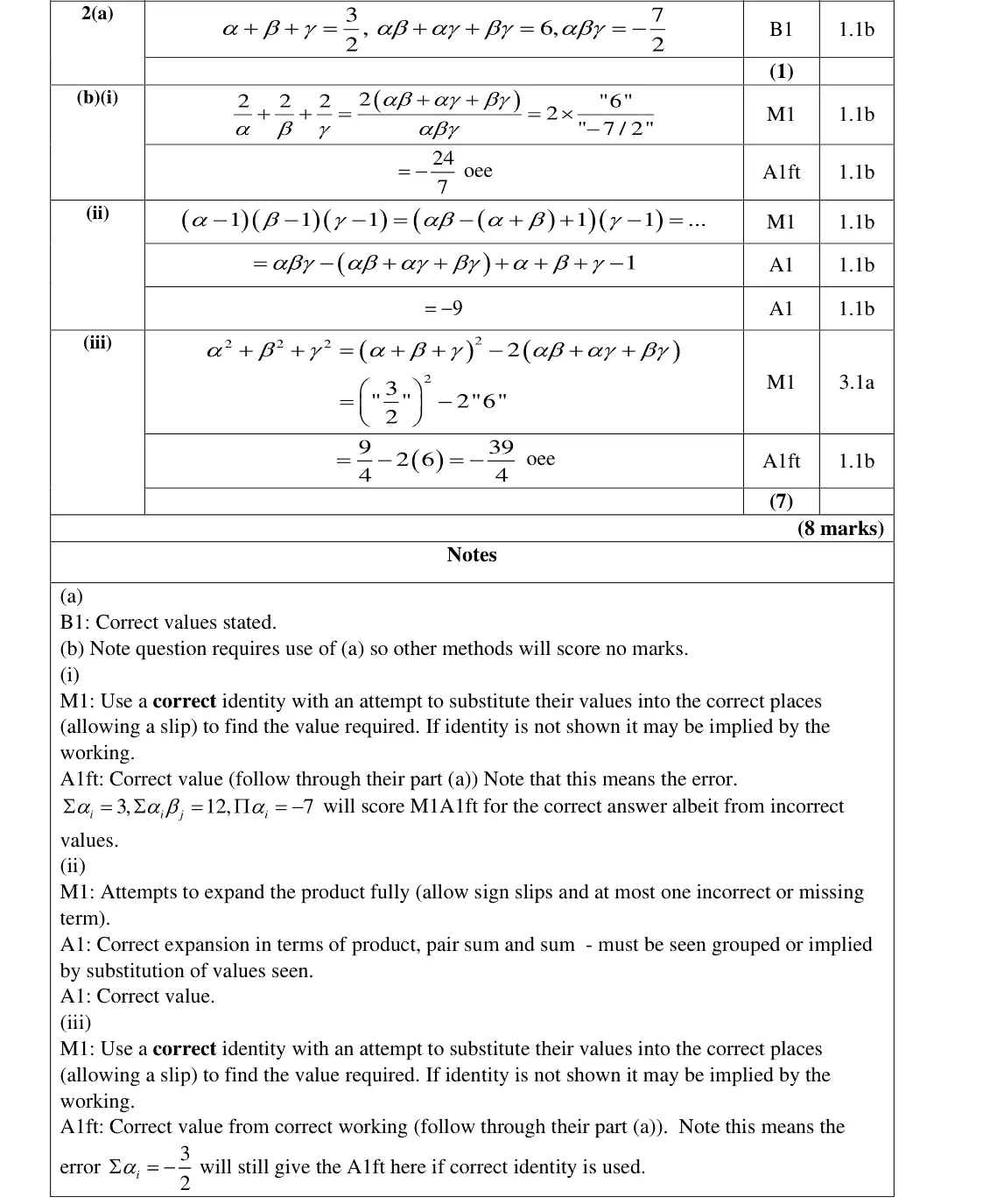
2(a) Roots of polynomials 1 —
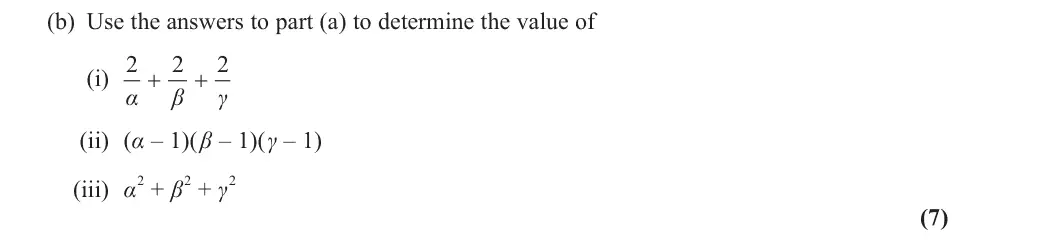
2(b) Roots of polynomials 7 —
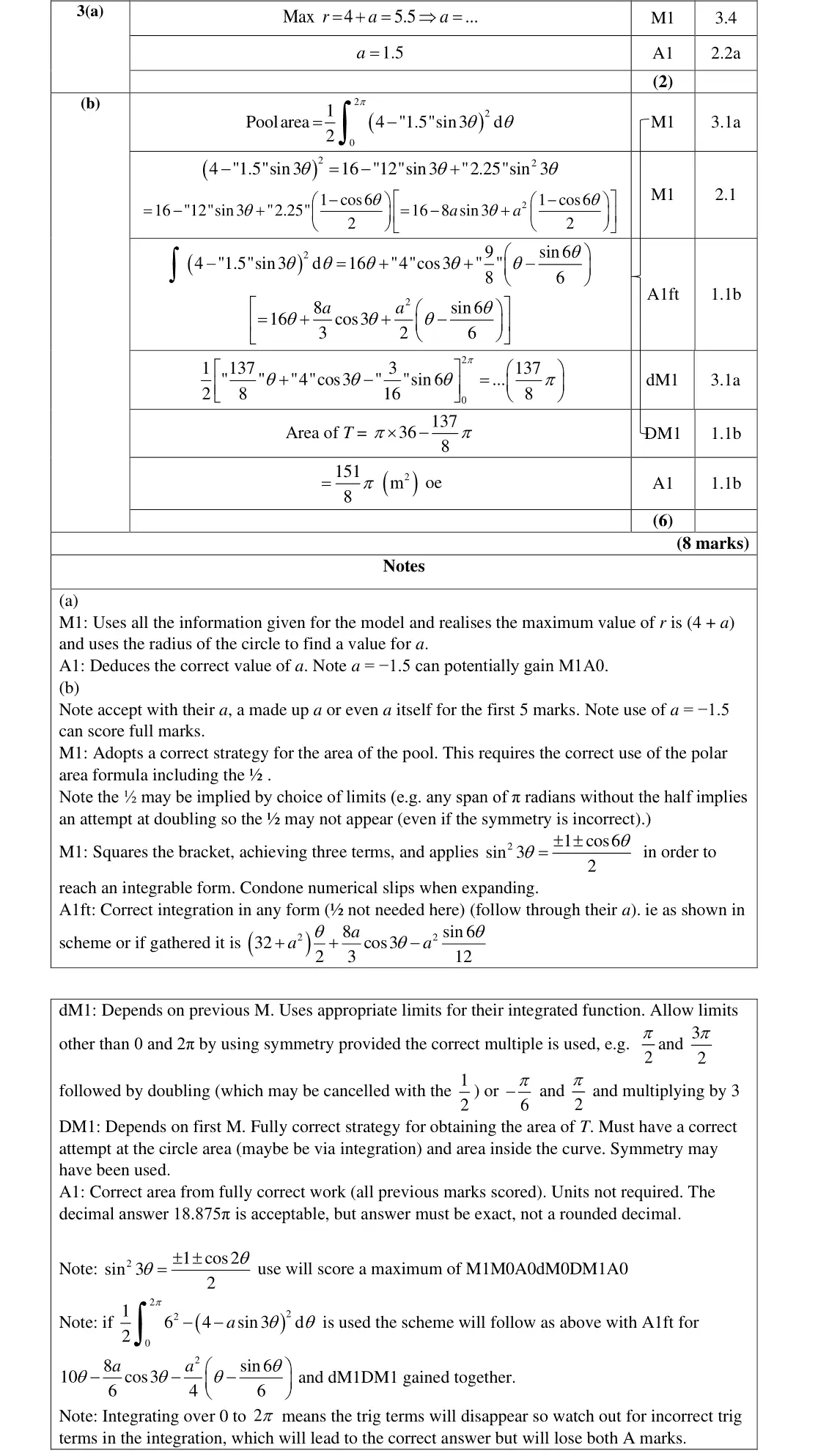
3(a) Polar coordinates: curves and areas 2 —
3(b) Polar coordinates: curves and areas 6 —
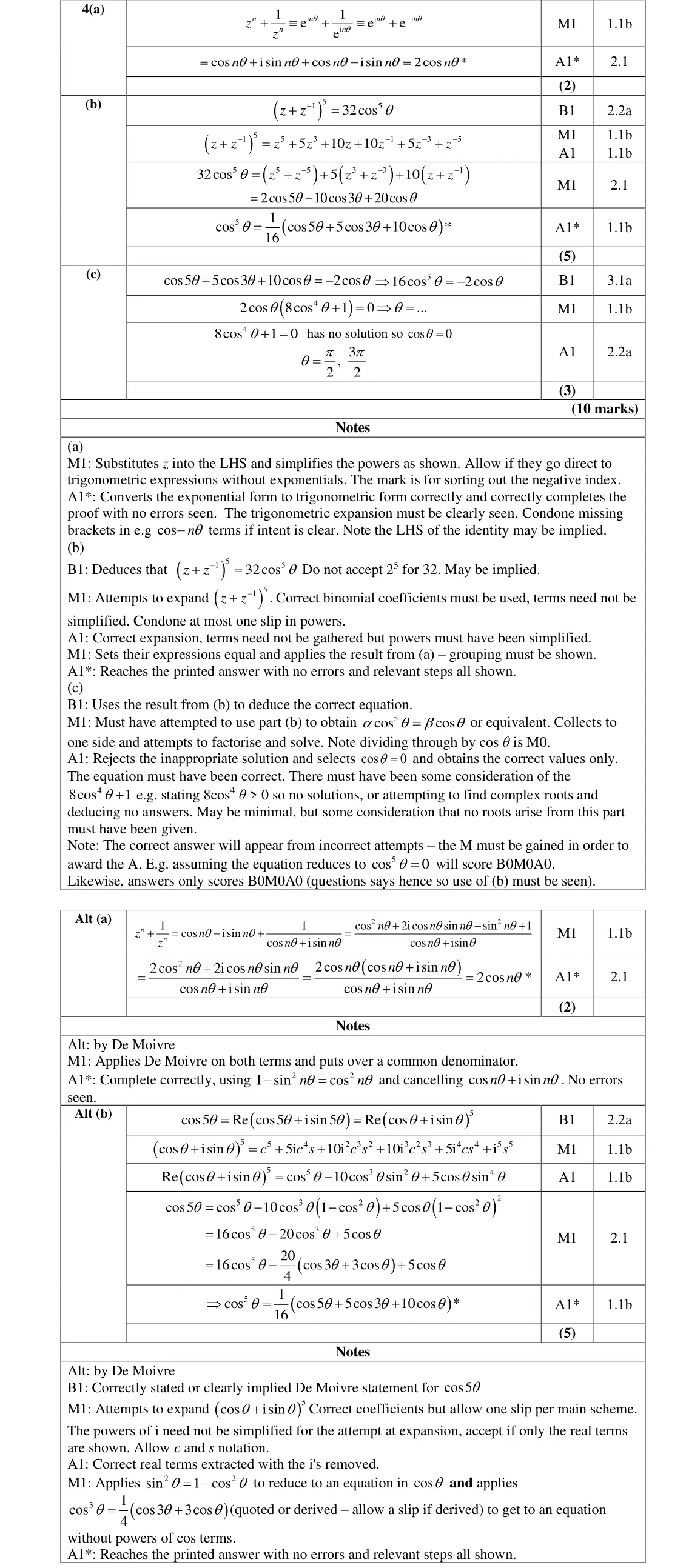
4(a) De Moivre's theorem and exponential form 2 —
4(b) De Moivre's theorem and exponential form 5 —
4(c) De Moivre's theorem and exponential form 3 —
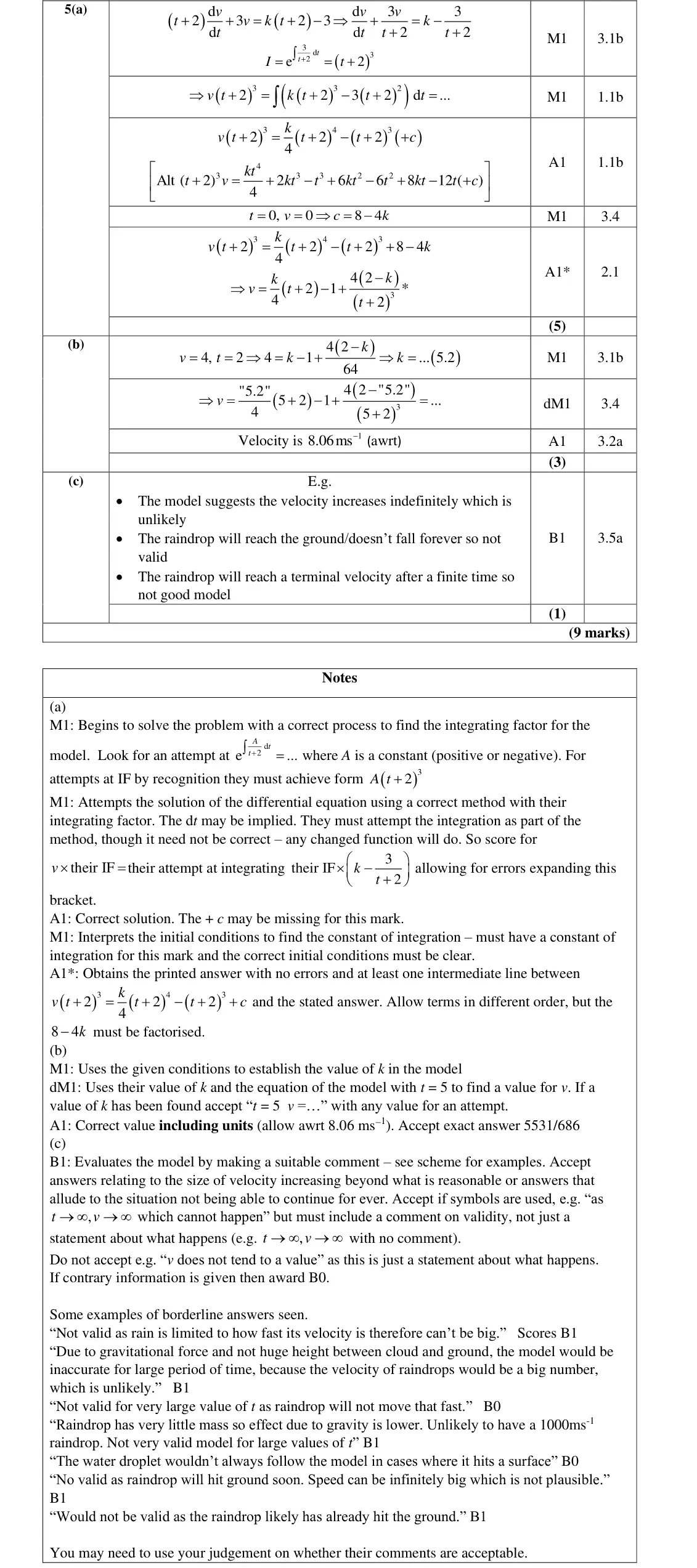
5(a) First-order differential equations: integrating factors and modelling 5 —
5(b) First-order differential equations: integrating factors and modelling 3 —
5(c) First-order differential equations: integrating factors and modelling 1 —
6 Proof by induction 6 —
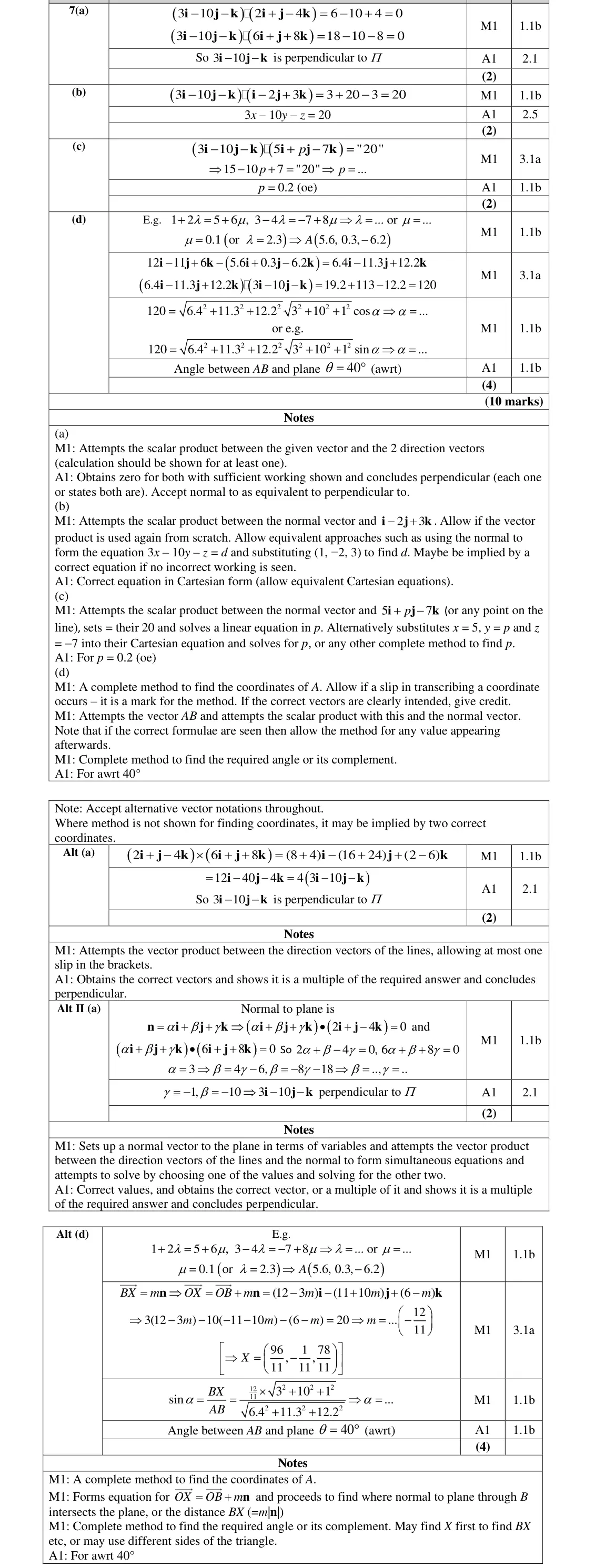
7(a) Vectors: equations of lines and planes, scalar product 2 —
7(b) Vectors: equations of lines and planes, scalar product 2 —
7(c) Vectors: equations of lines and planes, scalar product 2 —
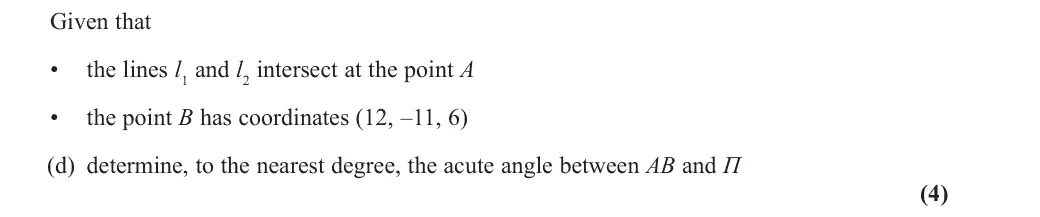
7(d) Vectors: equations of lines and planes, scalar product 4 —
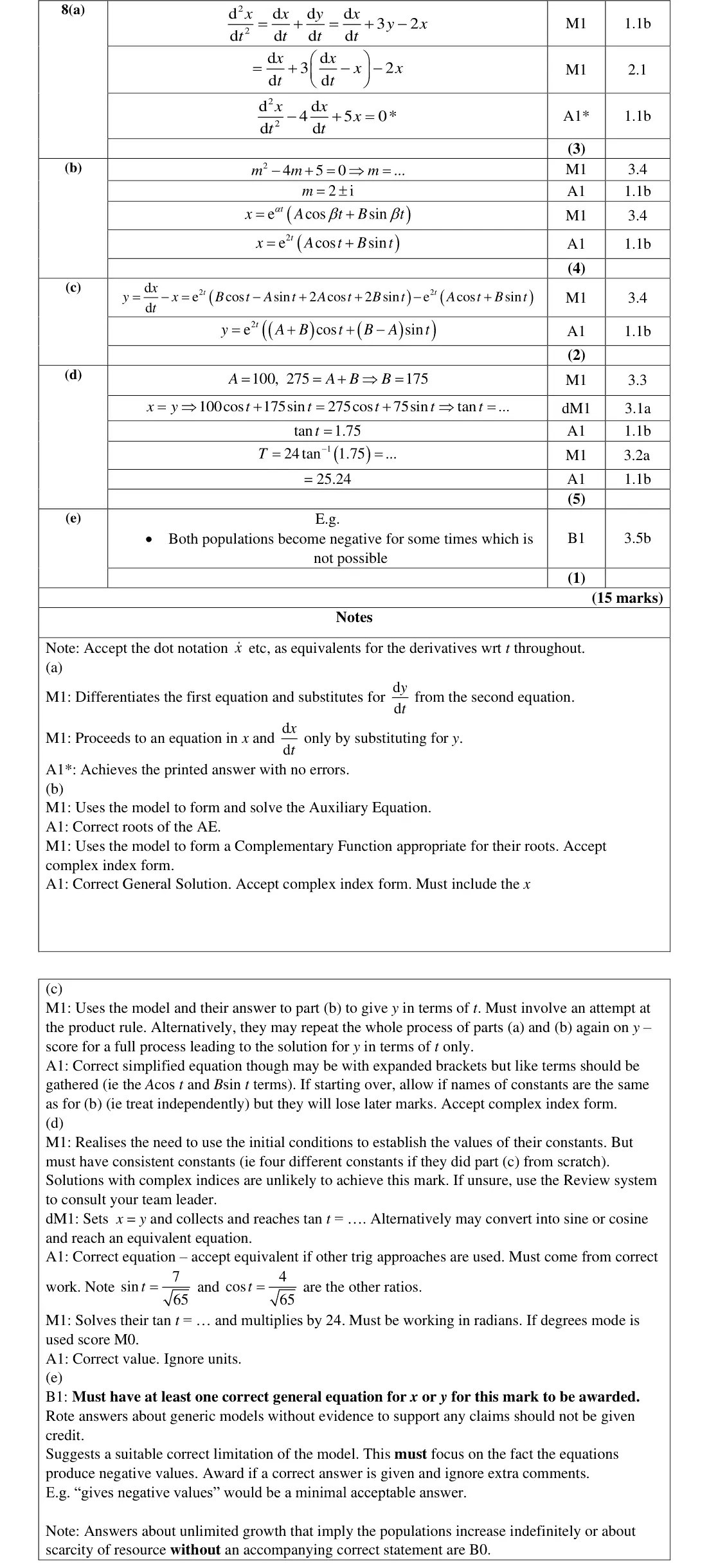
8(a) Coupled first-order differential equations 3 —
8(b) Second-order differential equations 4 —
8(c) Coupled first-order differential equations 2 —
8(d) First-order differential equations: integrating factors and modelling, Coupled first-order differential equations 5 —
8(e) First-order differential equations: integrating factors and modelling 1 —

The questions

1(a)1(b)2(a)2(b)3(a)3(b)4(a)4(b)4(c)5(a)5(b)5(c)67(a)7(b)7(c)7(d)8(a)8(b)8(c)8(d)8(e)
June 2024 · Paper 1 (Core Pure 1) · Q1(a) 7 marks complex numbers
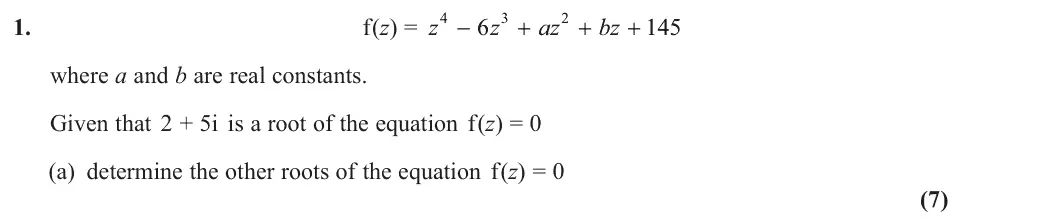
1. f(z) = z z az bz where a and b are real constants. Given that 2 + 5i is a root of the equation f(z) = 0 (a) determine the other roots of the equation f(z) = 0 (7)
June 2024 · Paper 1 (Core Pure 1) · Q1(b) 2 marks complex numbers
(b) Show all the roots of f(z) = 0 on a single Argand diagram. (2)
June 2024 · Paper 1 (Core Pure 1) · Q2(a) 1 mark roots of polynomials
2. The roots of the equation x x x are alpha , beta and γ Without solving the equation, (a) write down the value of each of alpha + beta + γ alpha beta + alpha γ + beta γ alpha beta γ (1)
June 2024 · Paper 1 (Core Pure 1) · Q2(b) 7 marks roots of polynomials
(b) Use the answers to part (a) to determine the value of (i) 2 alpha beta γ (ii) ( alpha – 1)( beta – 1)(γ – 1) 2 + beta 2 + γ (iii) alpha (7)
June 2024 · Paper 1 (Core Pure 1) · Q3(a) 2 marks polar coordinates
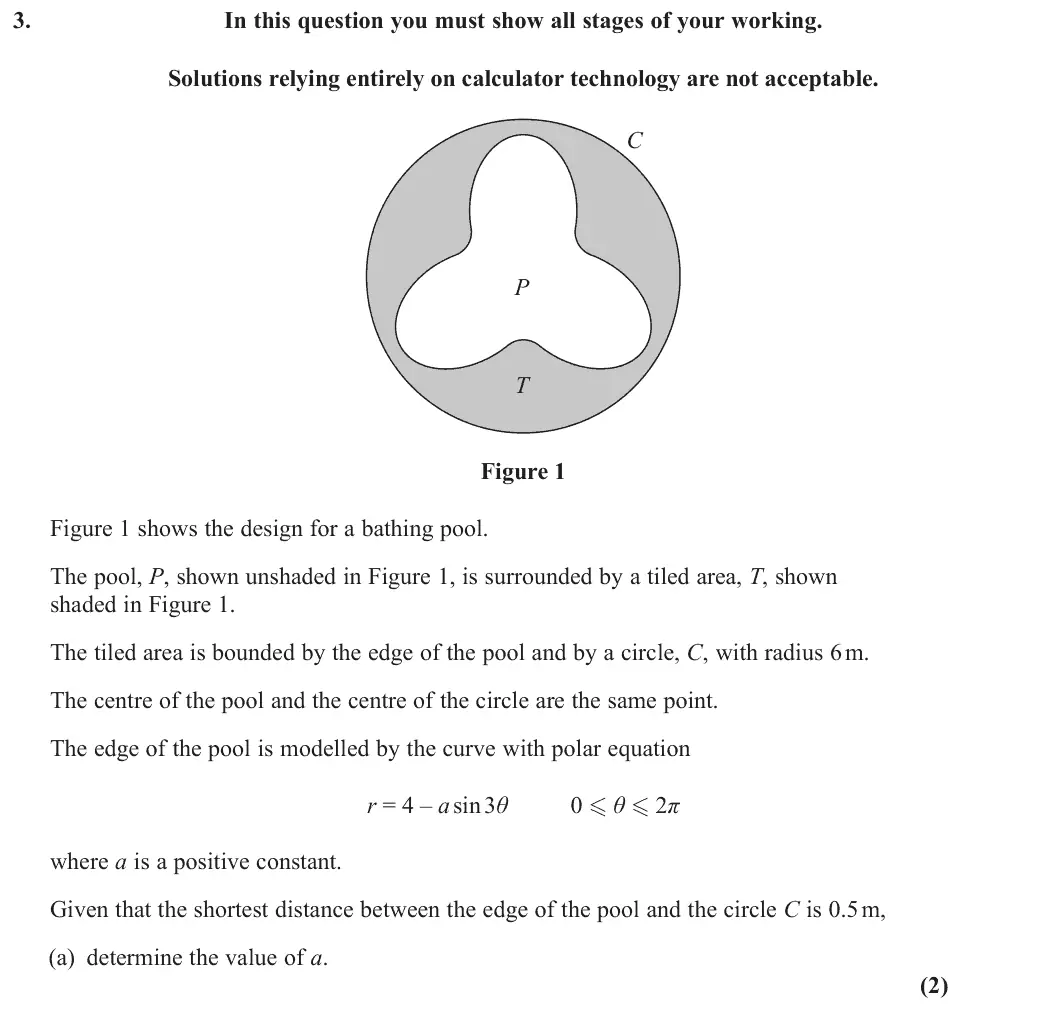
3. In this question you must show all stages of your working. Solutions relying entirely on calculator technology are not acceptable. C P T Figure 1 Figure 1 shows the design for a bathing pool. The pool, P, shown unshaded in Figure 1, is surrounded by a tiled area, T, shown shaded in Figure 1. The tiled area is bounded by the edge of the pool and by a circle, C, with radius 6 m. The centre of the pool and the centre of the circle are the same point. The edge of the pool is modelled by the curve with polar equation r = 4 – a sin 3 theta 0 theta 2 pi where a is a positive constant. Given that the shortest distance between the edge of the pool and the circle C is 0.5 m, (a) determine the value of a. (2)
June 2024 · Paper 1 (Core Pure 1) · Q3(b) 6 marks polar coordinates
(b) Hence, using algebraic integration, determine, according to the model, the exact area of T. (6)
June 2024 · Paper 1 (Core Pure 1) · Q4(a) 2 marks de moivres theorem
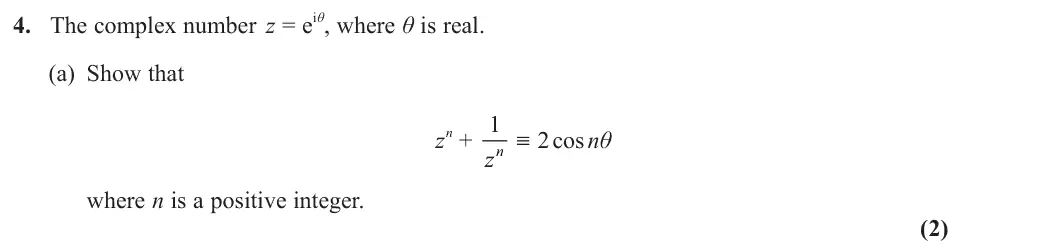
4. The complex number z = e i theta , where theta is real. (a) Show that n + 1 zn ≡2 cos n theta z where n is a positive integer. (2)
June 2024 · Paper 1 (Core Pure 1) · Q4(b) 5 marks de moivres theorem
(b) Show that 5 theta = 1 cos 16 (cos 5 theta + 5 cos 3 theta + 10 cos theta ) (5)
June 2024 · Paper 1 (Core Pure 1) · Q4(c) 3 marks de moivres theorem
(c) Hence, making your reasoning clear, determine all the solutions of cos 5 theta + 5 cos 3 theta + 12 cos theta = 0 in the interval 0 theta < 2 pi (3)
June 2024 · Paper 1 (Core Pure 1) · Q5(a) 5 marks first order differential equations
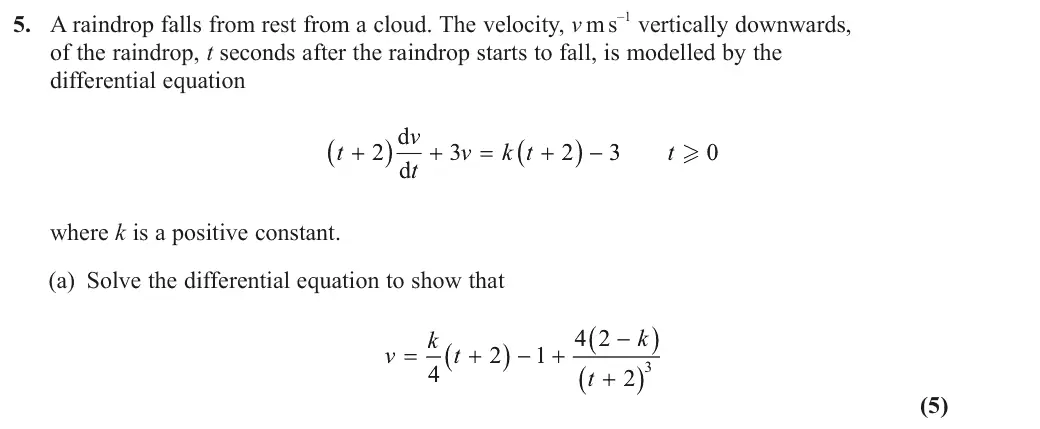
5. A raindrop falls from rest from a cloud. The velocity, v m s –1 vertically downwards, of the raindrop, t seconds after the raindrop starts to fall, is modelled by the differential equation v d / / 3 t v k t t t d where k is a positive constant. (a) Solve the differential equation to show that / k k t 4 2 / 3 v / t (5)
June 2024 · Paper 1 (Core Pure 1) · Q5(b) 3 marks first order differential equations
Given that v = 4 when t = 2 (b) determine, according to the model, the velocity of the raindrop 5 seconds after it starts to fall. (3)
June 2024 · Paper 1 (Core Pure 1) · Q5(c) 1 mark first order differential equations
(c) Comment on the validity of the model for very large values of t (1)
June 2024 · Paper 1 (Core Pure 1) · Q6 6 marks proof by induction
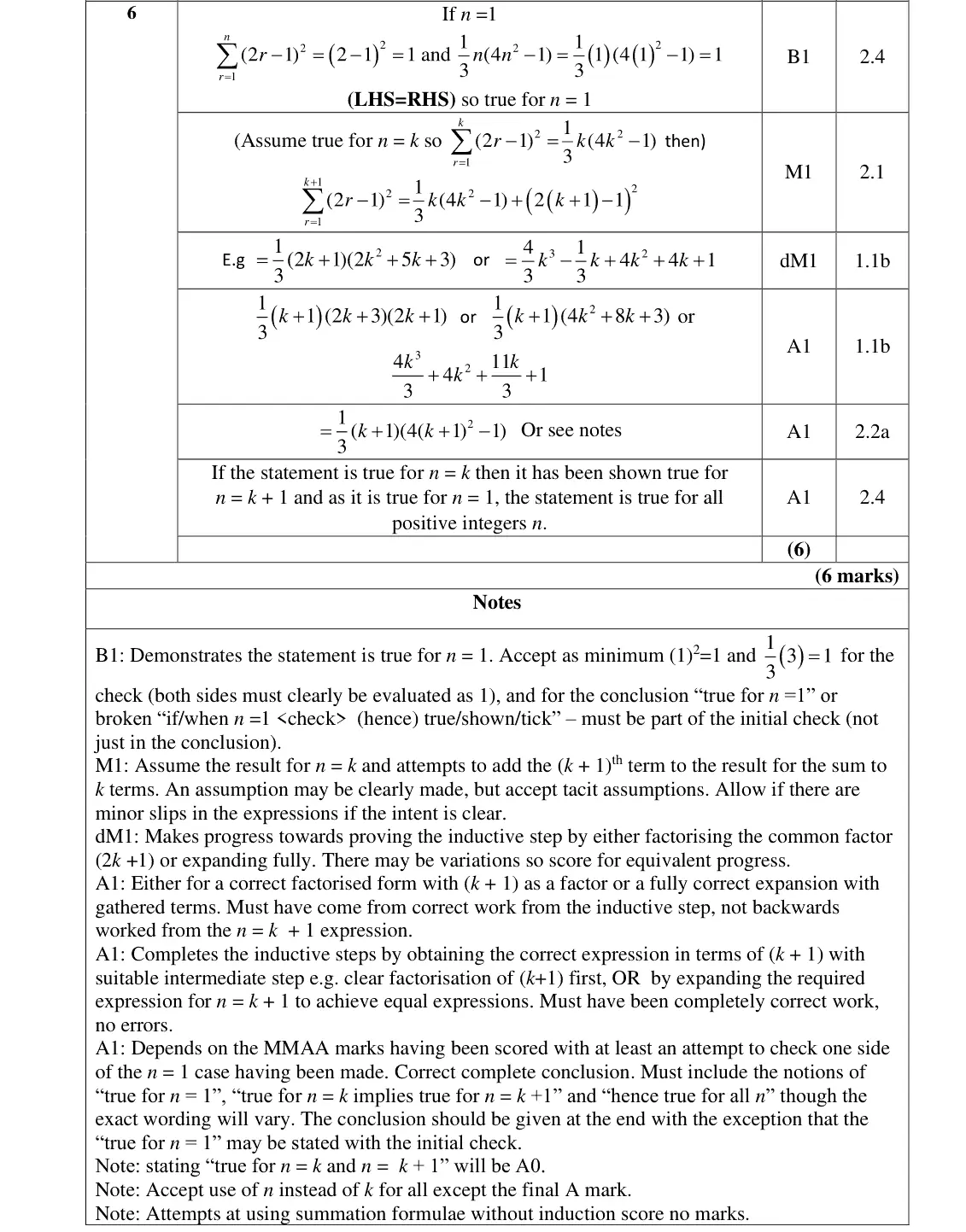
6. Prove by induction that, for all positive integers n, n / O8 / O r n n r (6)
June 2024 · Paper 1 (Core Pure 1) · Q7(a) 2 marks vectors lines and planes
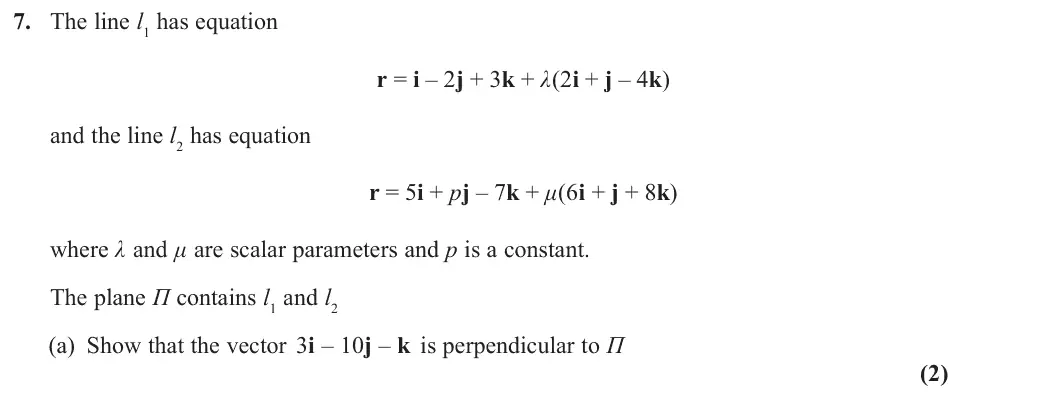
7. The line l1 has equation r = i – 2j + 3k + λ(2i + j – 4k) and the line l2 has equation r = 5i + pj – 7k + μ(6i + j + 8k) where λ and μ are scalar parameters and p is a constant. The plane Π contains l1 and l2 (a) Show that the vector 3i – 10j – k is perpendicular to Π (2)
June 2024 · Paper 1 (Core Pure 1) · Q7(b) 2 marks vectors lines and planes
(b) Hence determine a Cartesian equation of Π (2)
June 2024 · Paper 1 (Core Pure 1) · Q7(c) 2 marks vectors lines and planes
(c) Hence determine the value of p (2)
June 2024 · Paper 1 (Core Pure 1) · Q7(d) 4 marks vectors lines and planes
Given that • the lines l1 and l2 intersect at the point A • the point B has coordinates (12, –11, 6) (d) determine, to the nearest degree, the acute angle between AB and Π (4)
June 2024 · Paper 1 (Core Pure 1) · Q8(a) 3 marks coupled differential equations
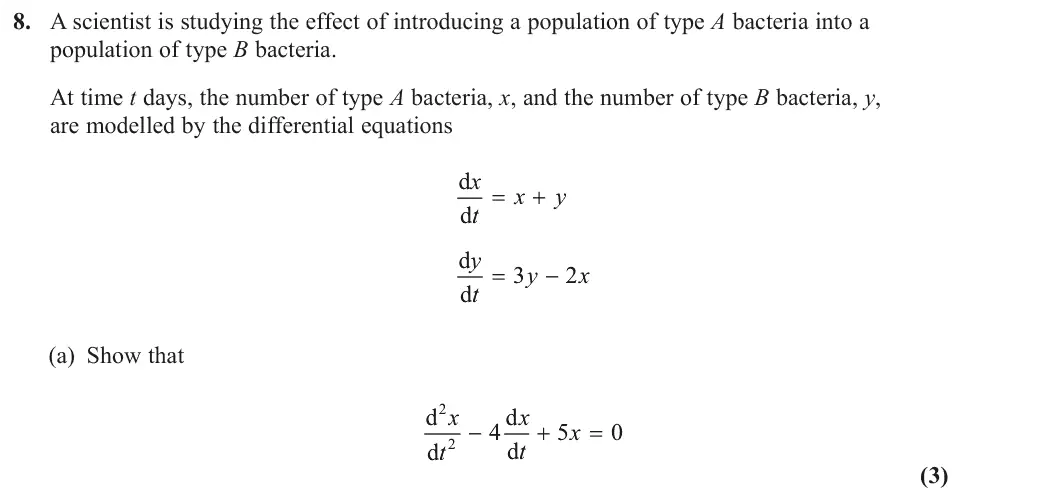
8. A scientist is studying the effect of introducing a population of type A bacteria into a population of type B bacteria. At time t days, the number of type A bacteria, x, and the number of type B bacteria, y, are modelled by the differential equations x d x y t d d y y x d t (a) Show that x x d d x t d t d (3)
June 2024 · Paper 1 (Core Pure 1) · Q8(b) 4 marks second order differential equations
(b) Determine a general solution for the number of type A bacteria at time t days. (4)
June 2024 · Paper 1 (Core Pure 1) · Q8(c) 2 marks coupled differential equations
(c) Determine a general solution for the number of type B bacteria at time t days. (2)
June 2024 · Paper 1 (Core Pure 1) · Q8(d) 5 marks first order differential equationscoupled differential equations
The model predicts that, at time T hours, the number of bacteria in the two populations will be equal. Given that x = 100 and y = 275 when t = 0 (d) determine the value of T, giving your answer to 2 decimal places. (5)
June 2024 · Paper 1 (Core Pure 1) · Q8(e) 1 mark first order differential equations
(e) Suggest a limitation of the model. (1)

Find an Edexcel Further Maths tutor

Want this paper marked and gone through with a Further Maths tutor? Message us.

Prefer email? Send an enquiry

If you are under 18, please include a parent's contact details. Enquiries go to enquiries@alevelfurthermathstutor.com and are deleted once handled.