June 2024: A level Paper 4D: Decision Mathematics 2

75 marks · 25 question parts · Question paper, mark scheme and examiner's report on Pearson's site

Question by question

QTopicMarksDifficulty
1(a) Flows in networks 2 —
1(b) Flows in networks 1 —
1(c) Flows in networks 1 —
1(d) Flows in networks 1 —
1(e) Flows in networks 3 —
1(f) Flows in networks 2 —
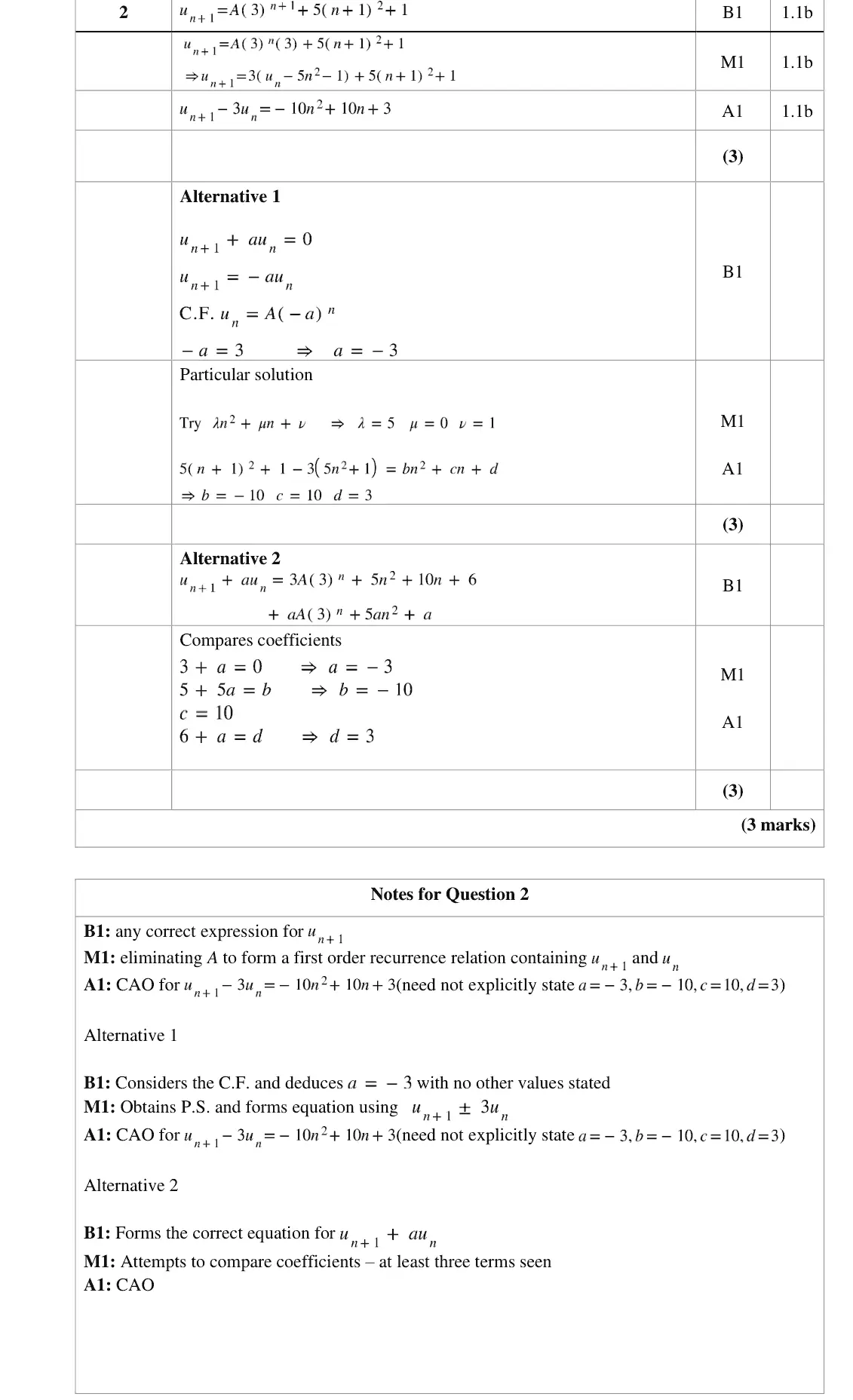
2 Recurrence relations (Decision 2) 3 —
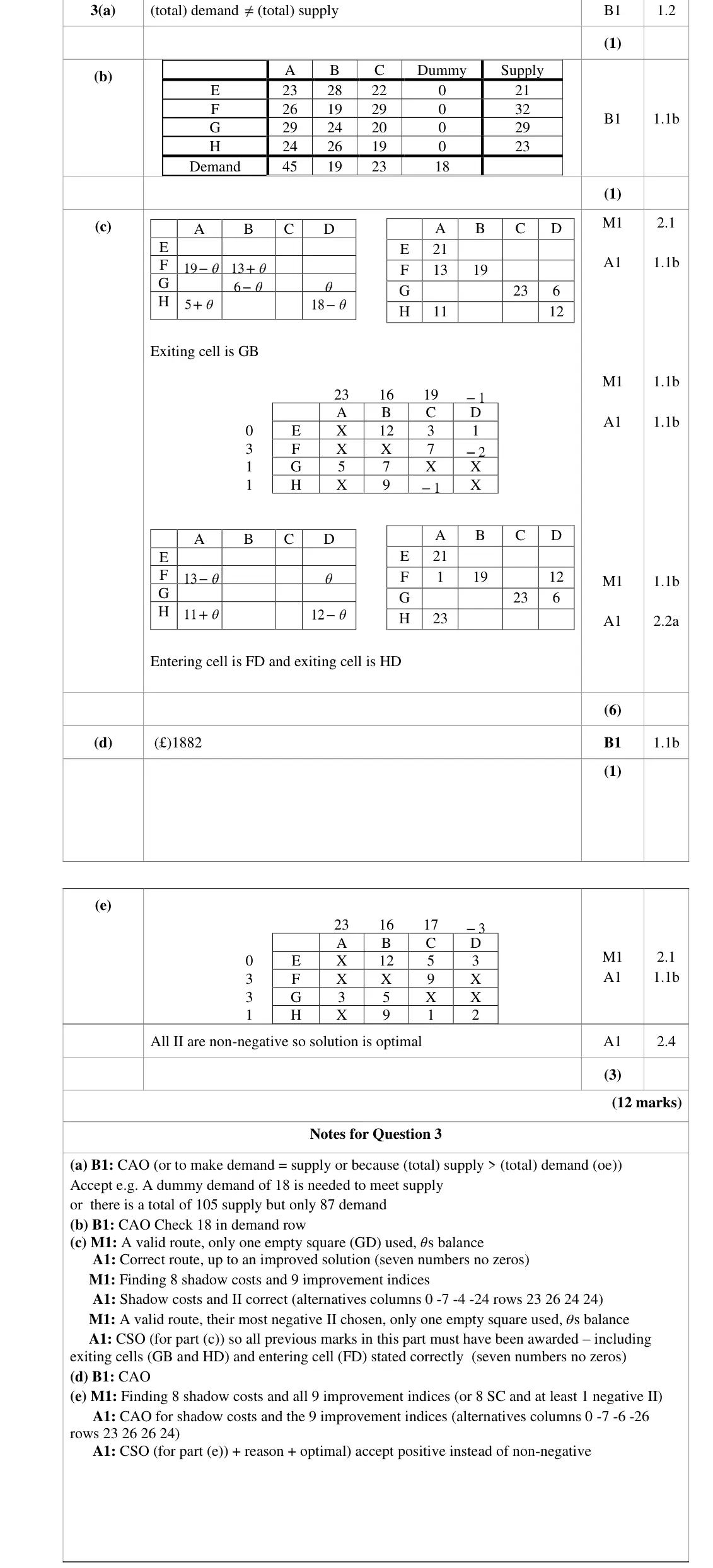
3(a) Transportation problems 1 —
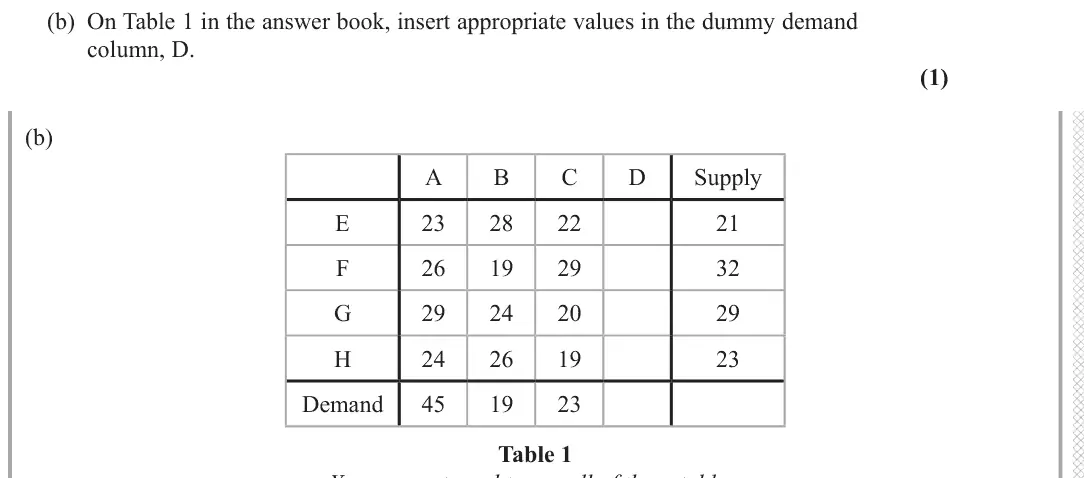
3(b) Transportation problems 1 —
3(c) Transportation problems 6 —
3(d) Transportation problems 1 —
3(e) Transportation problems 3 —
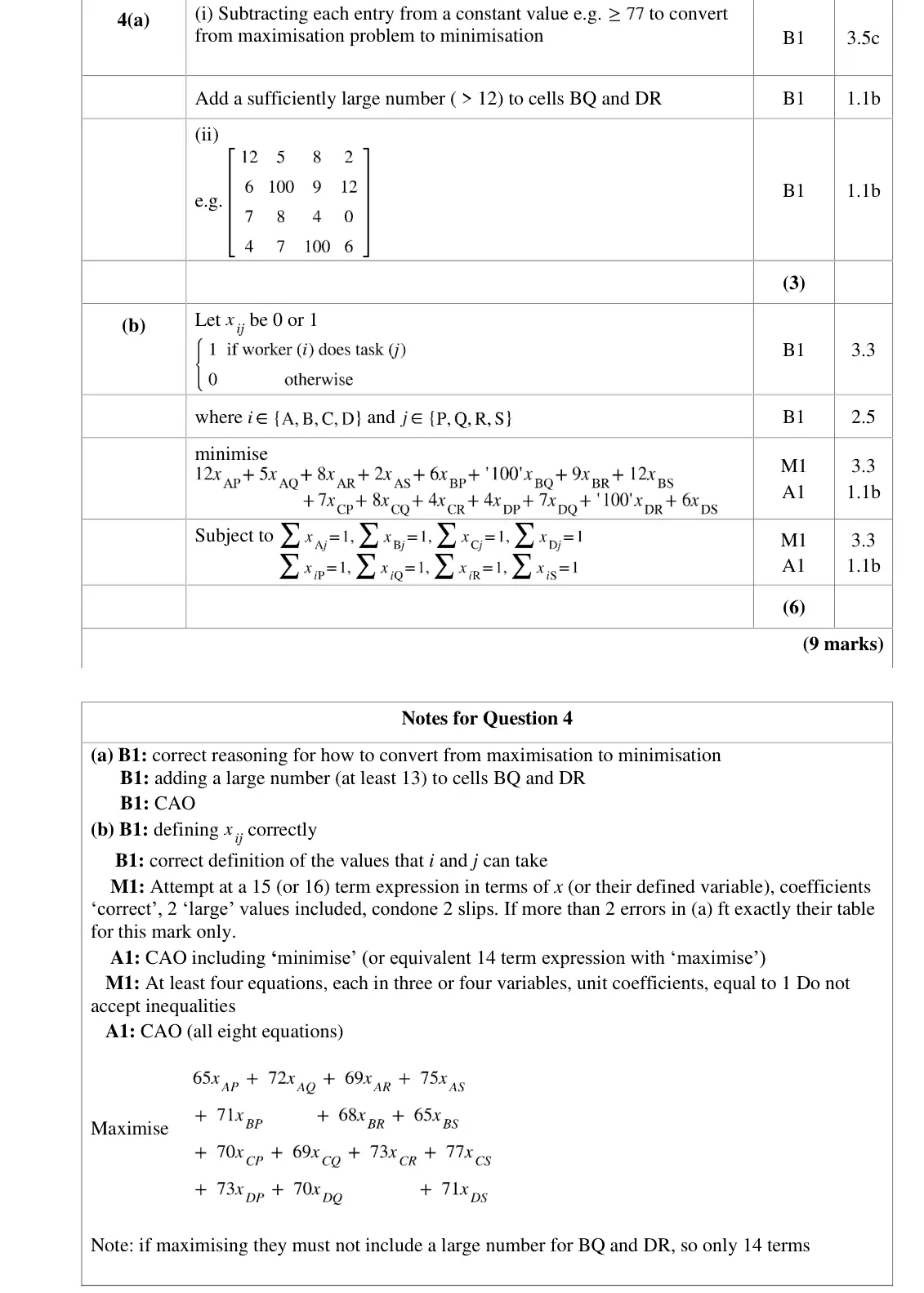
4(a) Allocation (assignment) problems and the Hungarian algorithm 3 —
4(b) Allocation (assignment) problems and the Hungarian algorithm 6 —
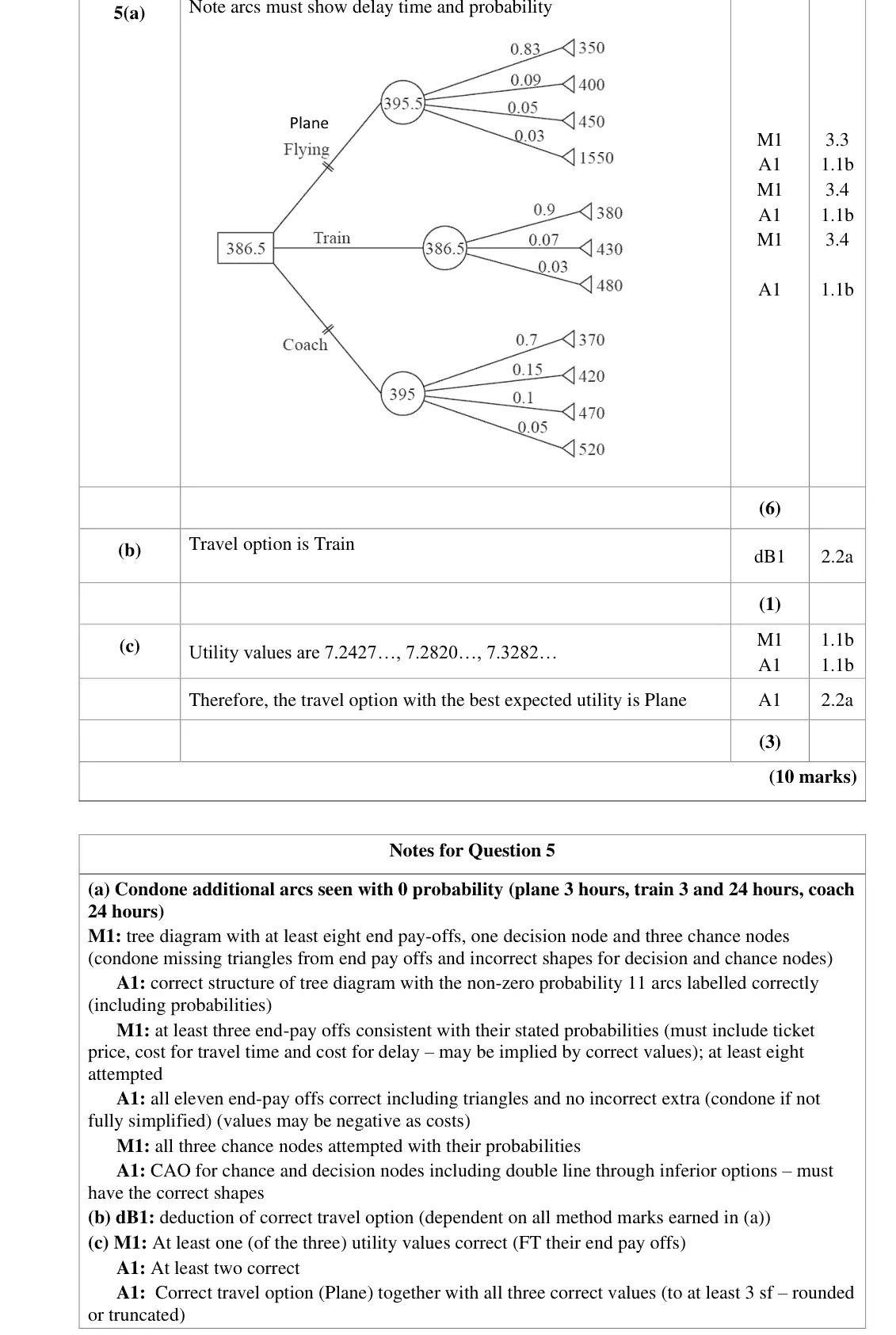
5(a) Decision analysis: decision trees and expected values 6 —
5(b) Decision analysis: decision trees and expected values 1 —
5(c) Decision analysis: decision trees and expected values 3 —
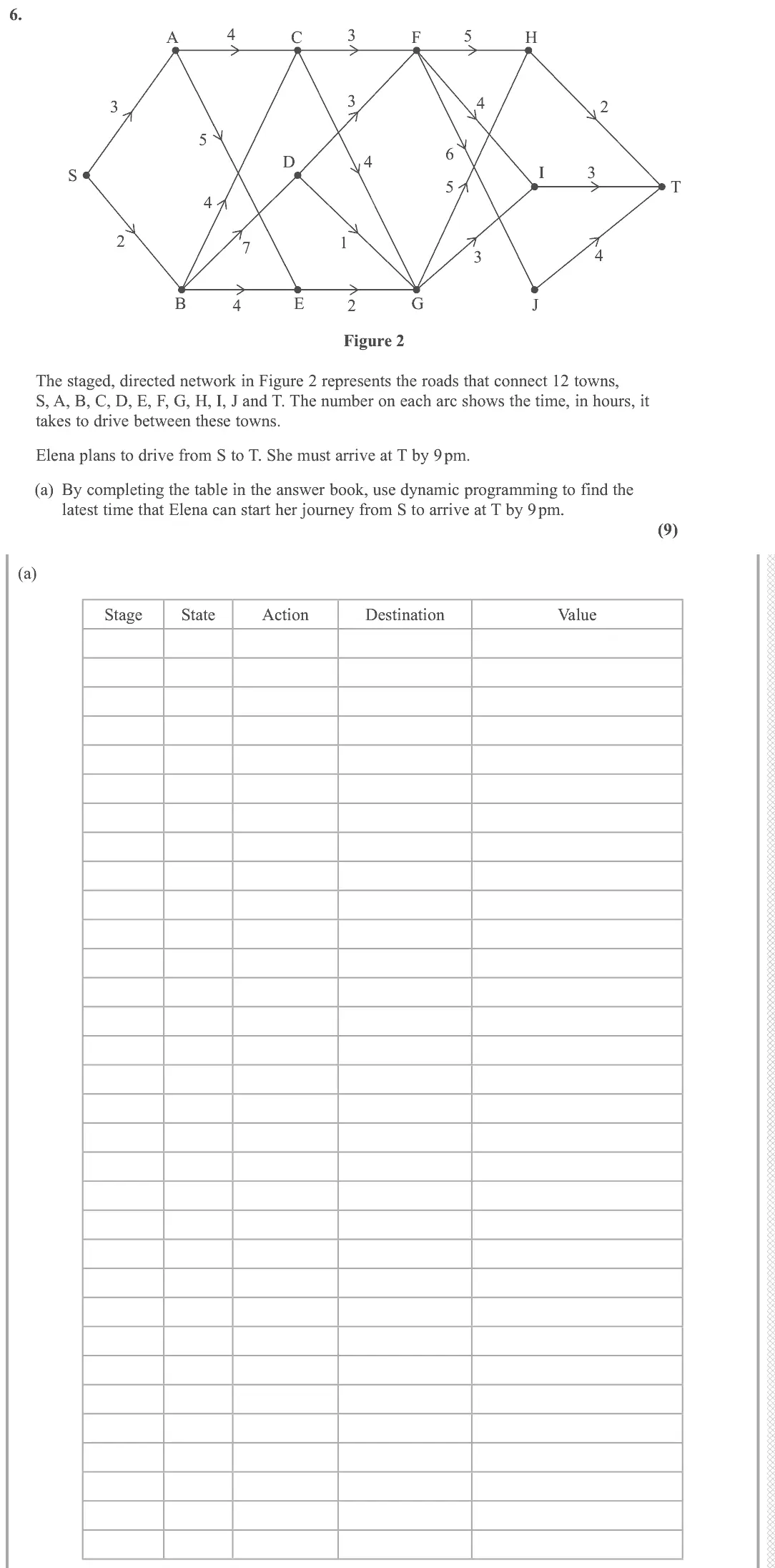
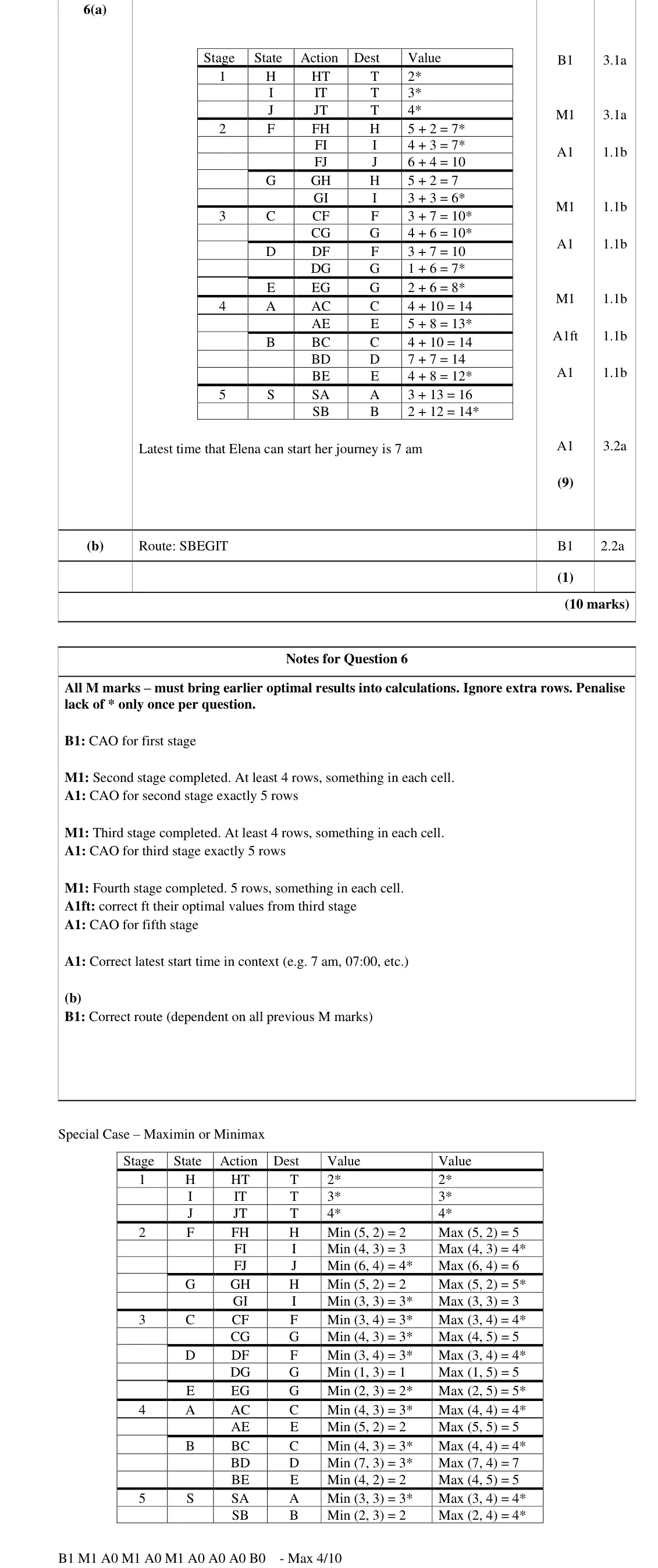
6(a) Dynamic programming 9 —
6(b) Dynamic programming 1 —
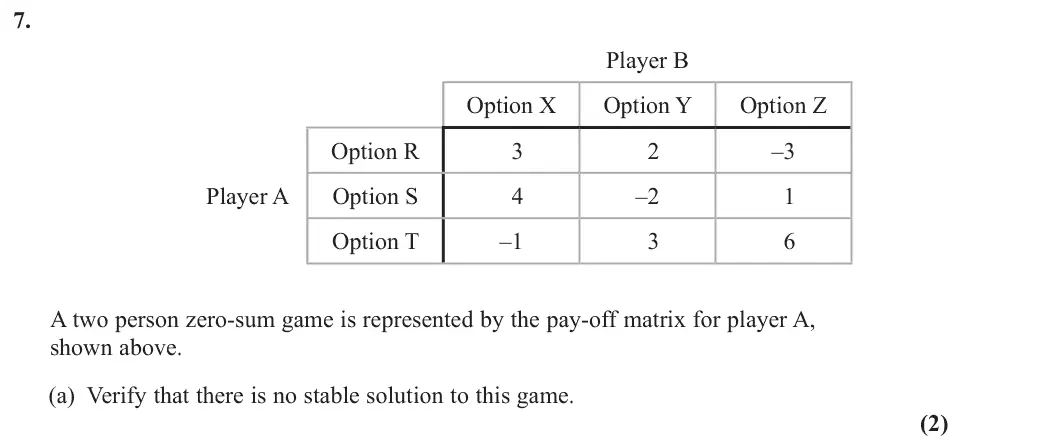
7(a) Game theory 2 —
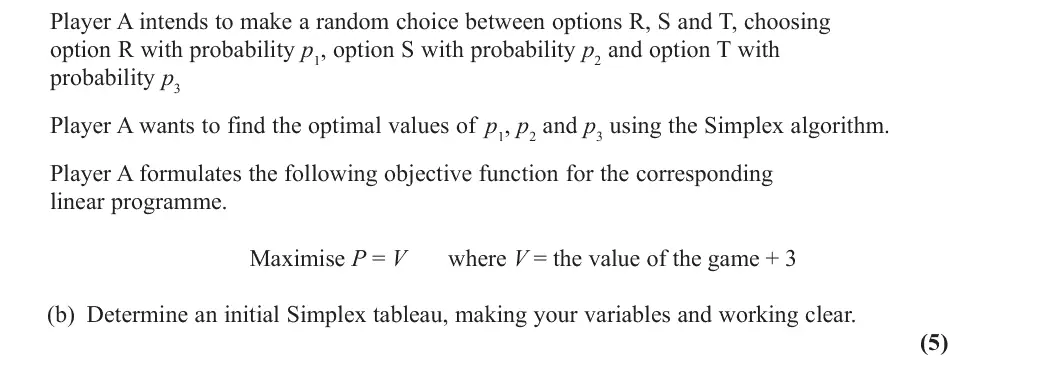
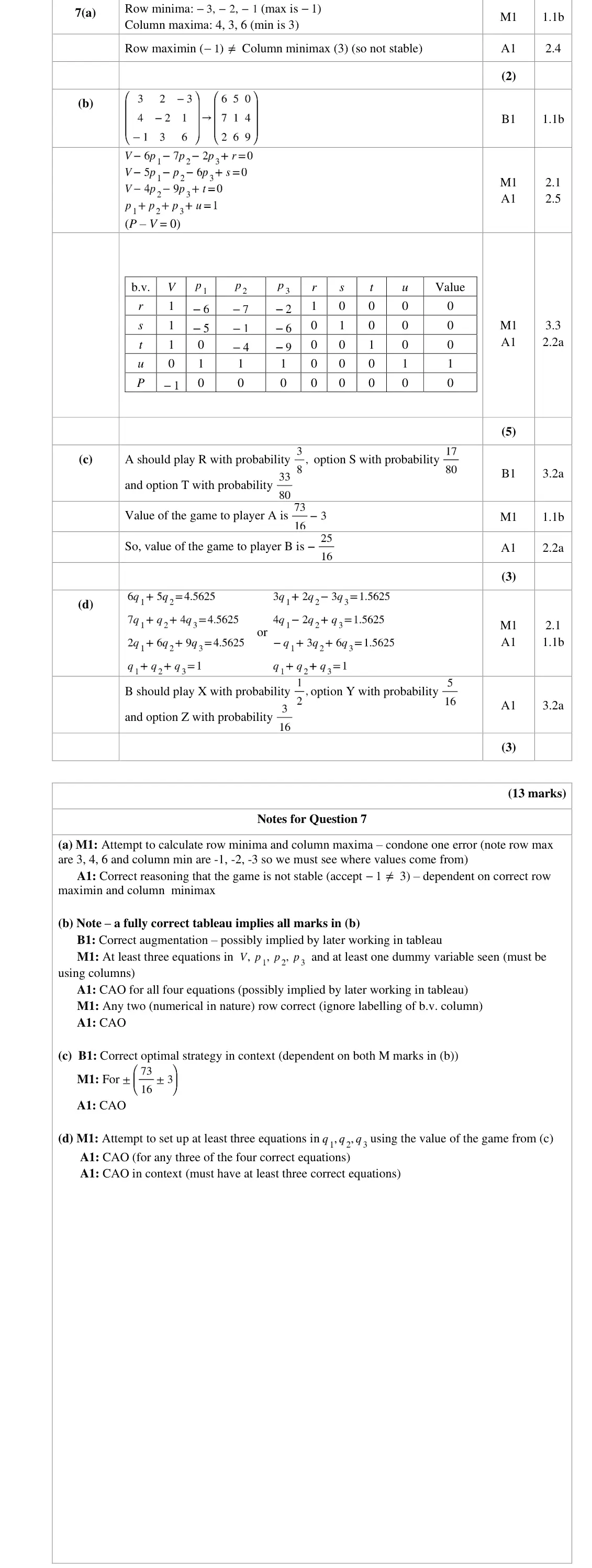
7(b) Game theory 5 —
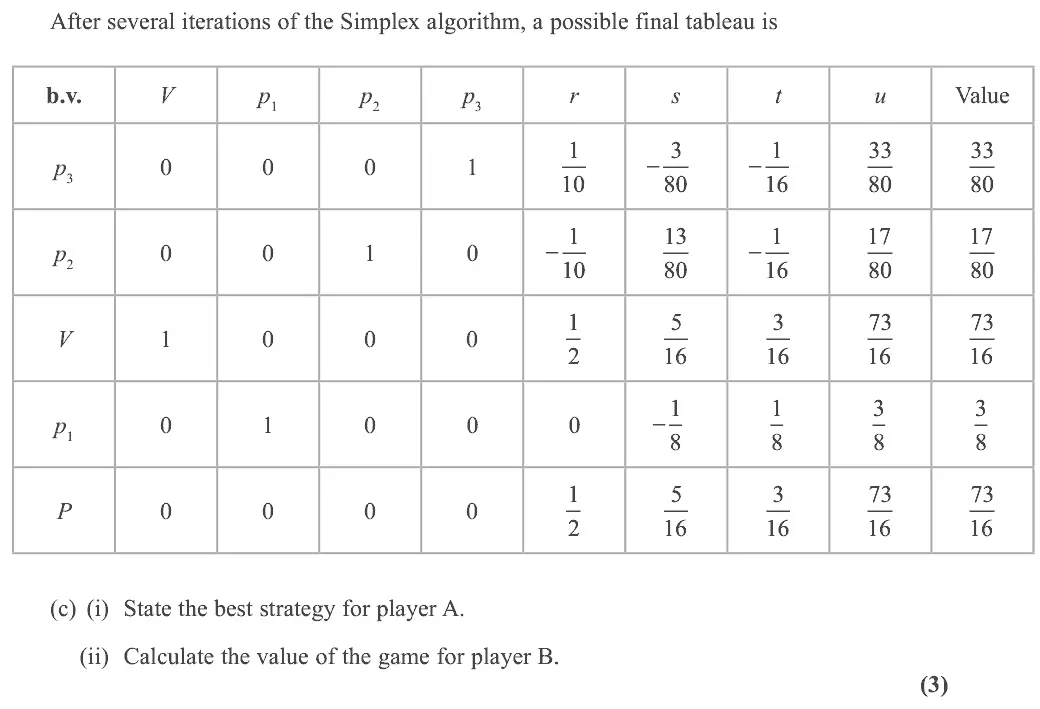
7(c) Game theory 3 —
7(d) Game theory 3 —
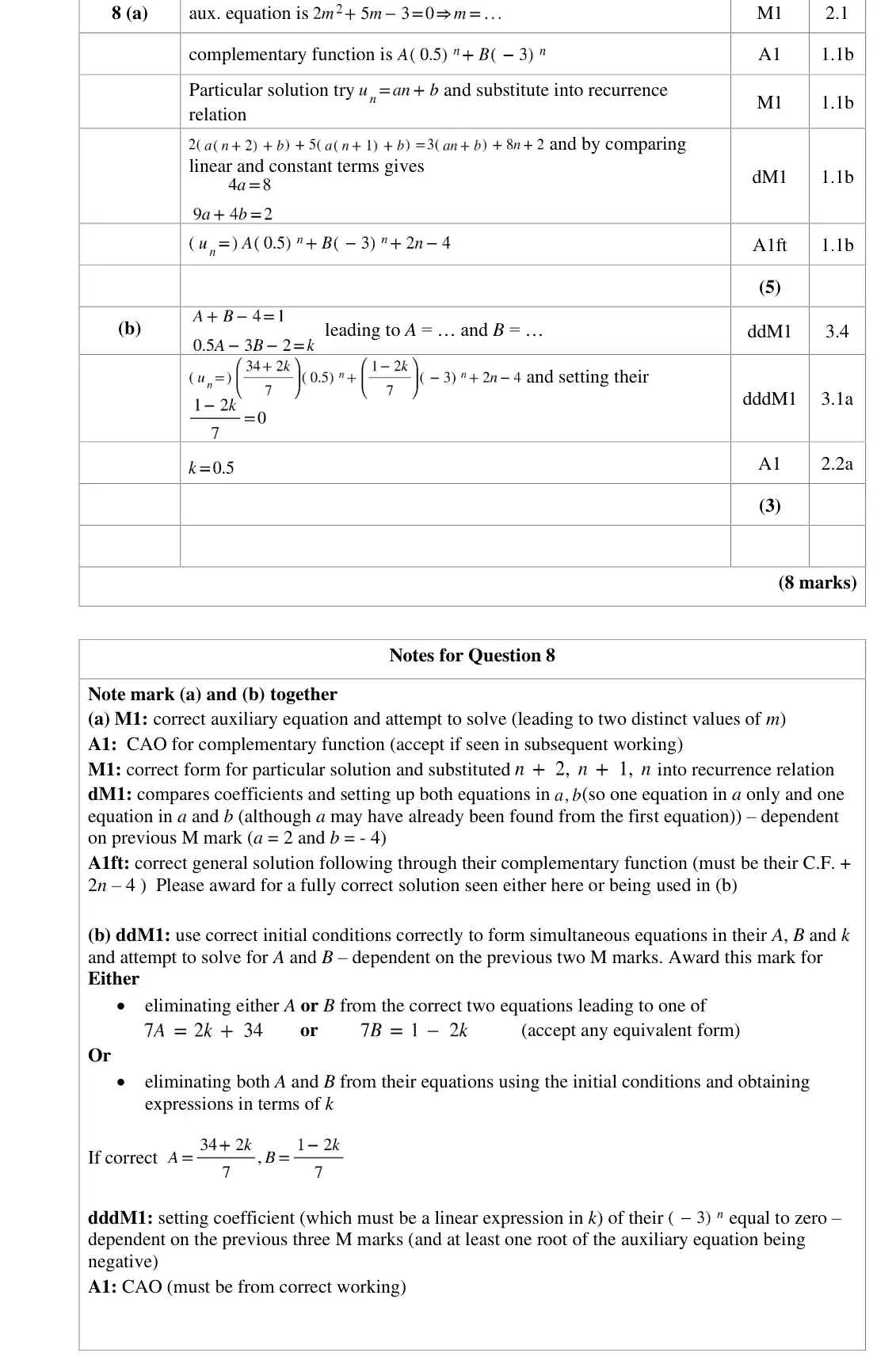
8(a) Recurrence relations (Decision 2) 5 —
8(b) Recurrence relations (Decision 2) 3 —

The questions

1(a)1(b)1(c)1(d)1(e)1(f)23(a)3(b)3(c)3(d)3(e)4(a)4(b)5(a)5(b)5(c)6(a)6(b)7(a)7(b)7(c)7(d)8(a)8(b)
June 2024 · Paper 4D (Decision 2) · Q1(a) 2 marks flows in networks
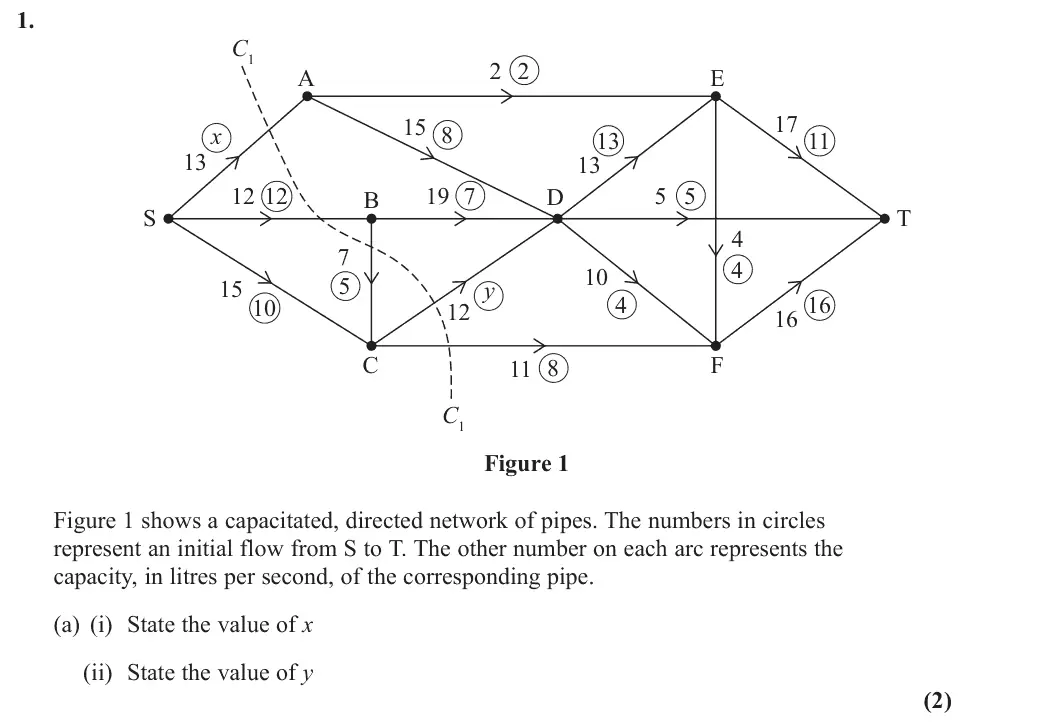
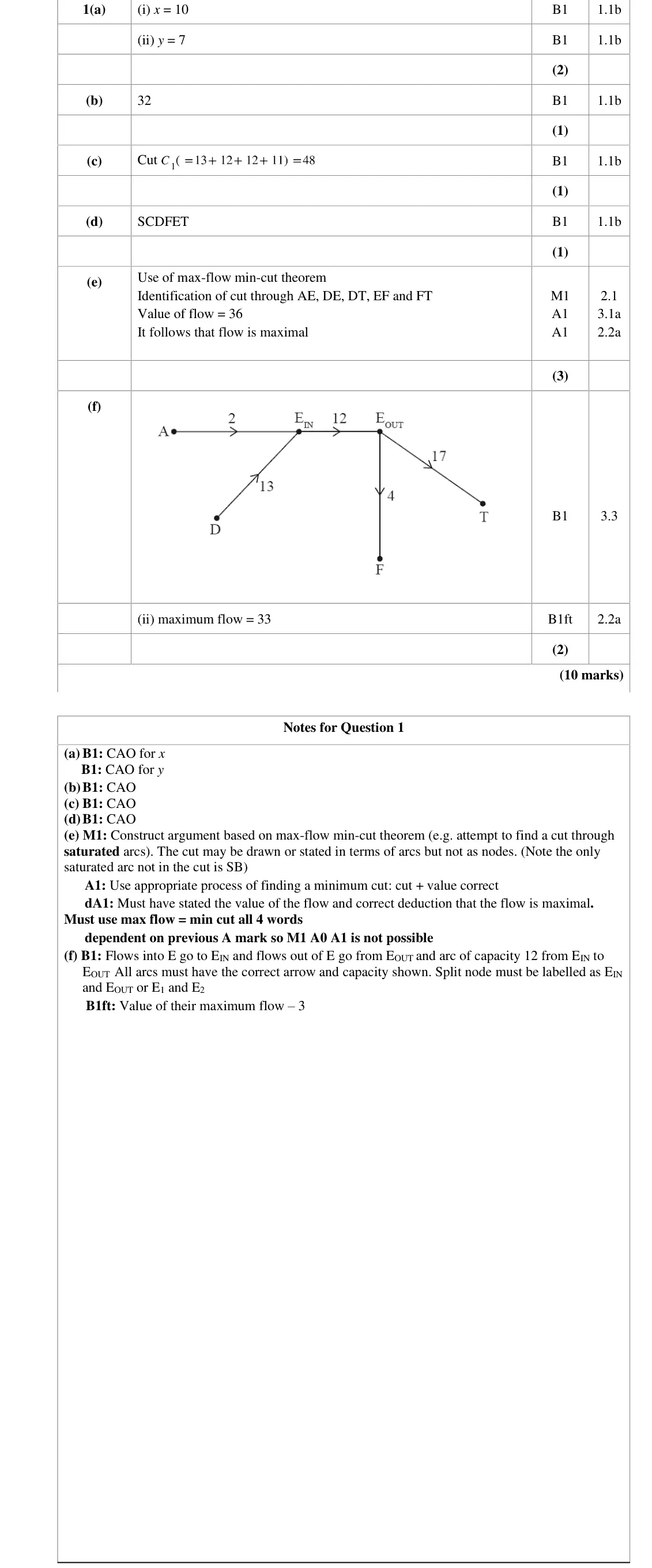
1. C1 2 2 A E 17 11 15 8 x 12 12 19 7 5 5 B S T 15 10 y 16 16 C F 11 8 C1 Figure 1 Figure 1 shows a capacitated, directed network of pipes. The numbers in circles represent an initial flow from S to T. The other number on each arc represents the capacity, in litres per second, of the corresponding pipe. (a) (i) State the value of x (ii) State the value of y (2)
June 2024 · Paper 4D (Decision 2) · Q1(b) 1 mark flows in networks
(b) State the value of the initial flow. (1)
June 2024 · Paper 4D (Decision 2) · Q1(c) 1 mark flows in networks
(c) State the capacity of cut C1 (1)
June 2024 · Paper 4D (Decision 2) · Q1(d) 1 mark flows in networks
(d) Find, by inspection, a flow‑augmenting route to increase the flow by four units. You must state your route. (1)
June 2024 · Paper 4D (Decision 2) · Q1(e) 3 marks flows in networks
The flow‑augmenting route from (d) is used to increase the flow from S to T. (e) Prove that the flow is now maximal. (3)
June 2024 · Paper 4D (Decision 2) · Q1(f) 2 marks flows in networks
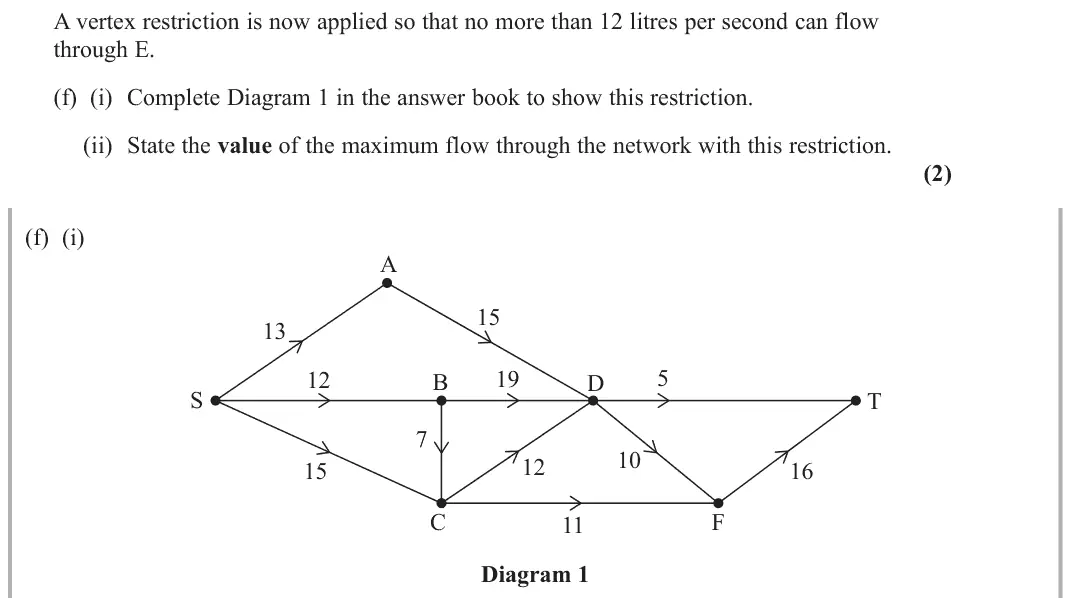
A vertex restriction is now applied so that no more than 12 litres per second can flow through E. (f) (i) Complete Diagram 1 in the answer book to show this restriction. (ii) State the value of the maximum flow through the network with this restriction. (2)
June 2024 · Paper 4D (Decision 2) · Q2 3 marks recurrence relations d2
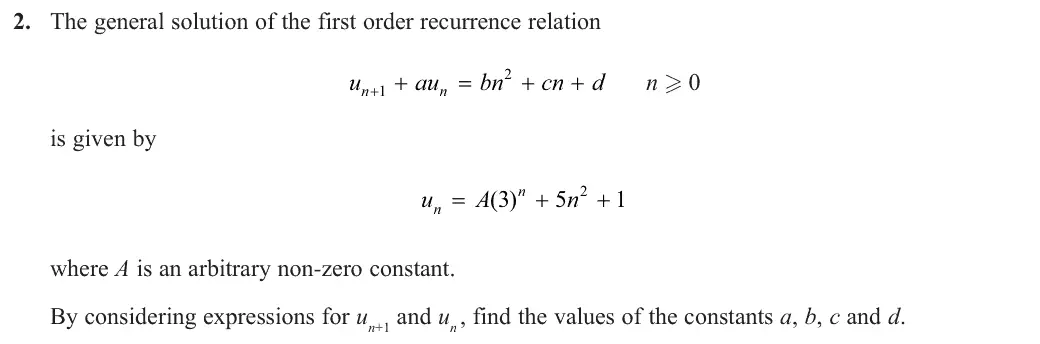
2. The general solution of the first order recurrence relation n 0 u 1 1 au bn cn d n n is given by n u A n ( ) n where A is an arbitrary non‑zero constant. By considering expressions for un+1 and un , find the values of the constants a, b, c and d.
June 2024 · Paper 4D (Decision 2) · Q3(a) 1 mark transportation problems
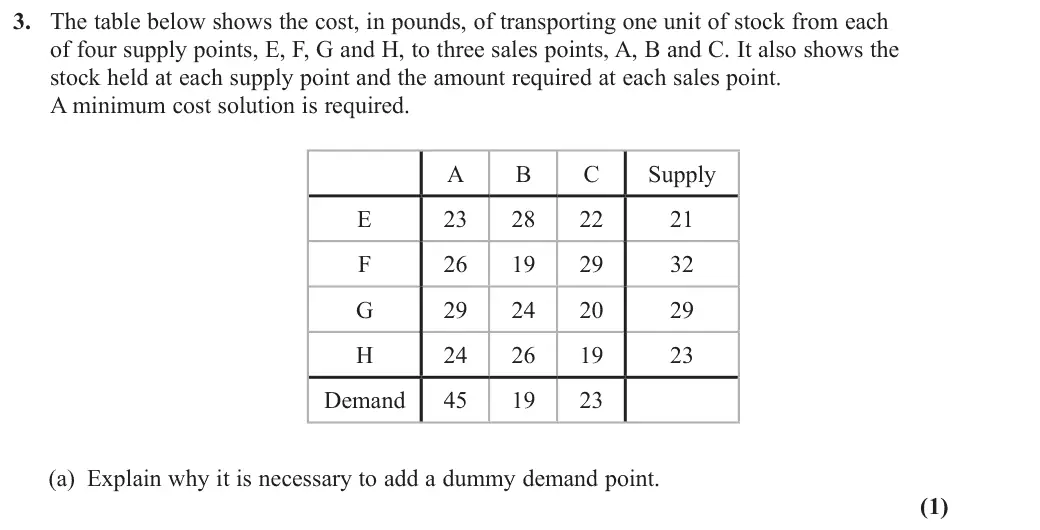
3. The table below shows the cost, in pounds, of transporting one unit of stock from each of four supply points, E, F, G and H, to three sales points, A, B and C. It also shows the stock held at each supply point and the amount required at each sales point. A minimum cost solution is required. A B C Supply E F G H Demand (a) Explain why it is necessary to add a dummy demand point. (1)
June 2024 · Paper 4D (Decision 2) · Q3(b) 1 mark transportation problems
(b) On Table 1 in the answer book, insert appropriate values in the dummy demand column, D. (1)
June 2024 · Paper 4D (Decision 2) · Q3(c) 6 marks transportation problems
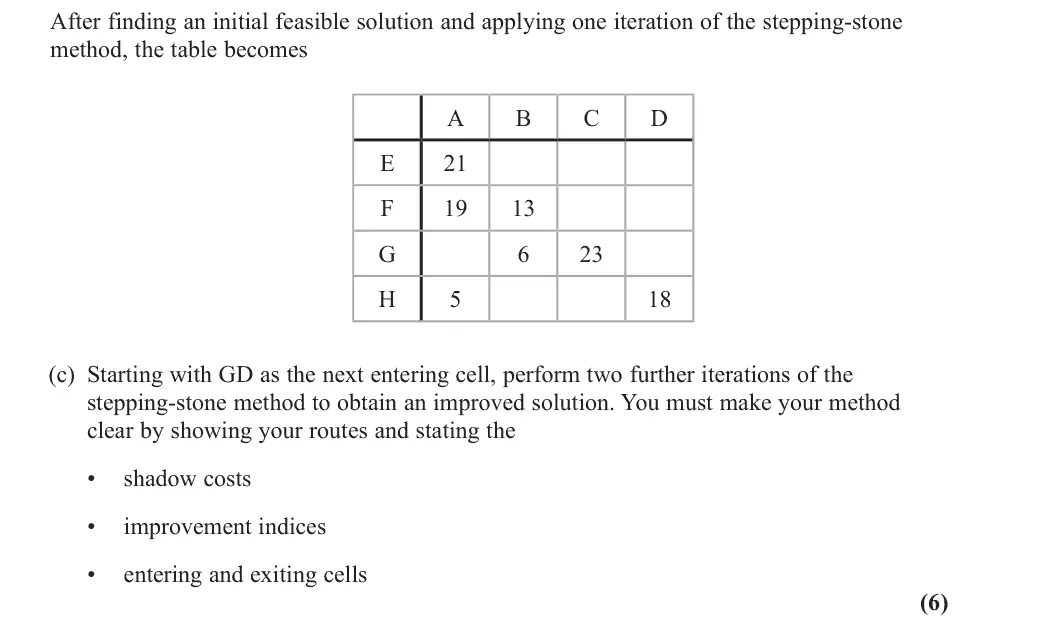
After finding an initial feasible solution and applying one iteration of the stepping‑stone method, the table becomes A B C E F G H (c) Starting with GD as the next entering cell, perform two further iterations of the stepping‑stone method to obtain an improved solution. You must make your method clear by showing your routes and stating the • shadow costs • improvement indices • entering and exiting cells (6)
June 2024 · Paper 4D (Decision 2) · Q3(d) 1 mark transportation problems
(d) State the cost of the solution found in (c). (1)
June 2024 · Paper 4D (Decision 2) · Q3(e) 3 marks transportation problems
(e) Determine whether the solution obtained in (c) is optimal, giving a reason for your answer. (3)
June 2024 · Paper 4D (Decision 2) · Q4(a) 3 marks allocation problems
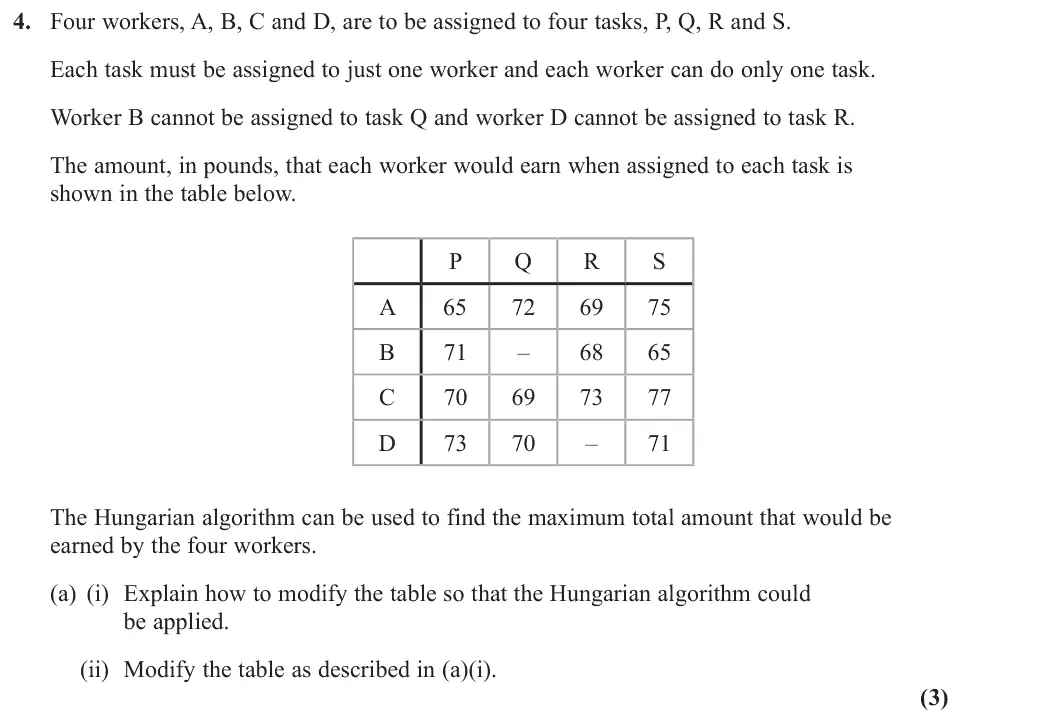
4. Four workers, A, B, C and D, are to be assigned to four tasks, P, Q, R and S. Each task must be assigned to just one worker and each worker can do only one task. Worker B cannot be assigned to task Q and worker D cannot be assigned to task R. The amount, in pounds, that each worker would earn when assigned to each task is shown in the table below. P Q R S A B – C – The Hungarian algorithm can be used to find the maximum total amount that would be earned by the four workers. (a) (i) Explain how to modify the table so that the Hungarian algorithm could be applied. (ii) Modify the table as described in (a)(i). (3)
June 2024 · Paper 4D (Decision 2) · Q4(b) 6 marks allocation problems
(b) Formulate the above situation as a linear programming problem. You must define the decision variables and make the objective function and constraints clear. (6)
June 2024 · Paper 4D (Decision 2) · Q5(a) 6 marks decision analysis

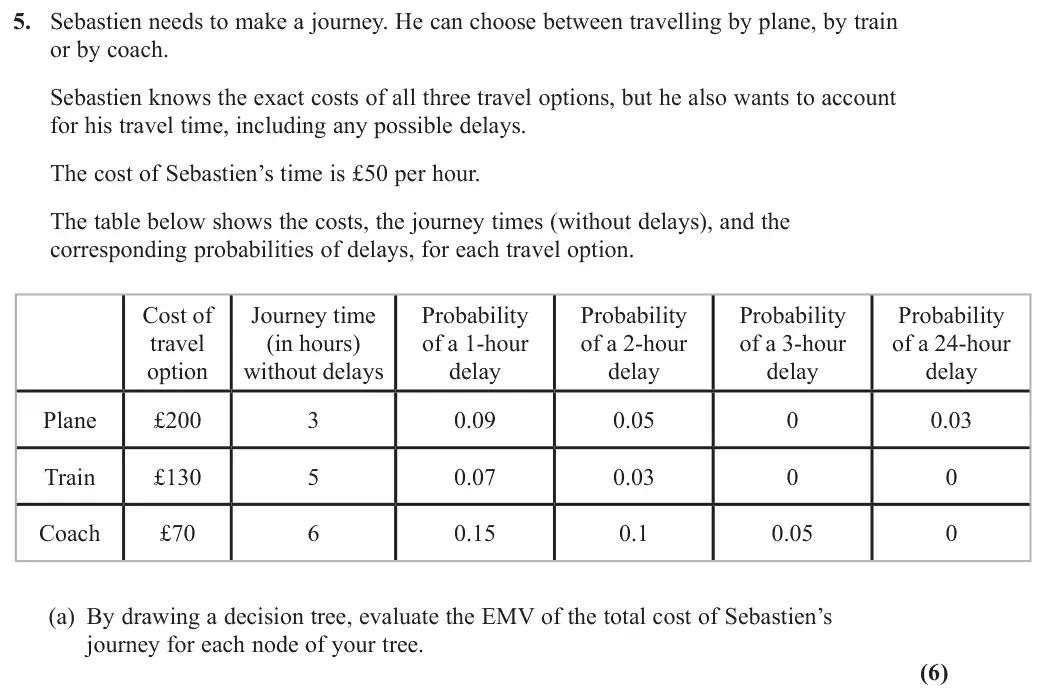
5. Sebastien needs to make a journey. He can choose between travelling by plane, by train or by coach. Sebastien knows the exact costs of all three travel options, but he also wants to account for his travel time, including any possible delays. The cost of Sebastien’s time is £50 per hour. The table below shows the costs, the journey times (without delays), and the corresponding probabilities of delays, for each travel option. Cost of Journey time Probability Probability Probability Probability travel (in hours) of a 1‑hour of a 2‑hour of a 3‑hour of a 24‑hour option without delays delay delay delay delay Plane £200 0.09 0.05 0.03 Train £130 0.07 0.03 Coach £70 0.15 0.1 0.05 (a) By drawing a decision tree, evaluate the EMV of the total cost of Sebastien’s journey for each node of your tree. (6)
June 2024 · Paper 4D (Decision 2) · Q5(b) 1 mark decision analysis

(b) Hence state the travel option that minimises the EMV of the total cost of Sebastien’s journey. (1)
June 2024 · Paper 4D (Decision 2) · Q5(c) 3 marks decision analysis
(c) A cube root utility function is applied to the total costs of each option. Determine the travel option with the best expected utility and state the corresponding value. (3)
June 2024 · Paper 4D (Decision 2) · Q6(a) 9 marks dynamic programming
6. A C F H I S T B E G J Figure 2 The staged, directed network in Figure 2 represents the roads that connect 12 towns, S, A, B, C, D, E, F, G, H, I, J and T. The number on each arc shows the time, in hours, it takes to drive between these towns. Elena plans to drive from S to T. She must arrive at T by 9 pm. (a) By completing the table in the answer book, use dynamic programming to find the latest time that Elena can start her journey from S to arrive at T by 9 pm. (9)
June 2024 · Paper 4D (Decision 2) · Q6(b) 1 mark dynamic programming
(b) Hence write down the route that Elena should take. (1)
June 2024 · Paper 4D (Decision 2) · Q7(a) 2 marks game theory
7. Player B Option X Option Y Option Z Option R –3 Player A Option S –2 Option T –1 A two person zero‑sum game is represented by the pay‑off matrix for player A, shown above. (a) Verify that there is no stable solution to this game. (2)
June 2024 · Paper 4D (Decision 2) · Q7(b) 5 marks game theory
Player A intends to make a random choice between options R, S and T, choosing option R with probability p1, option S with probability p2 and option T with probability p3 Player A wants to find the optimal values of p1, p2 and p3 using the Simplex algorithm. Player A formulates the following objective function for the corresponding linear programme. Maximise P = V where V = the value of the game + 3 (b) Determine an initial Simplex tableau, making your variables and working clear. (5)
June 2024 · Paper 4D (Decision 2) · Q7(c) 3 marks game theory
After several iterations of the Simplex algorithm, a possible final tableau is b.v. V p1 p2 p3 r s t u Value -3 -1 p3 -1 -1 p2 V -1 p1 P (c) (i) State the best strategy for player A. (ii) Calculate the value of the game for player B. (3)
June 2024 · Paper 4D (Decision 2) · Q7(d) 3 marks game theory
Player B intends to make a random choice between options X, Y and Z. (d) Determine the best strategy for player B, making your method and working clear. (3)
June 2024 · Paper 4D (Decision 2) · Q8(a) 5 marks recurrence relations d2
8. A sequence {un}, where n 0, satisfies the recurrence relation u u u n n n n (a) Find the general solution of this recurrence relation. (5)
June 2024 · Paper 4D (Decision 2) · Q8(b) 3 marks recurrence relations d2
A particular solution of this recurrence relation has u0 = 1 and u1 = k , where k is a positive constant. All terms of the sequence are positive. (b) Determine the value of k. (3)

Find an Edexcel Further Maths tutor

Want this paper marked and gone through with a Further Maths tutor? Message us.

Prefer email? Send an enquiry

If you are under 18, please include a parent's contact details. Enquiries go to enquiries@alevelfurthermathstutor.com and are deleted once handled.