June 2025: A level Paper 4D: Decision Mathematics 2

75 marks · 23 question parts · Question paper, mark scheme and examiner's report on Pearson's site

Question by question

QTopicMarksDifficulty
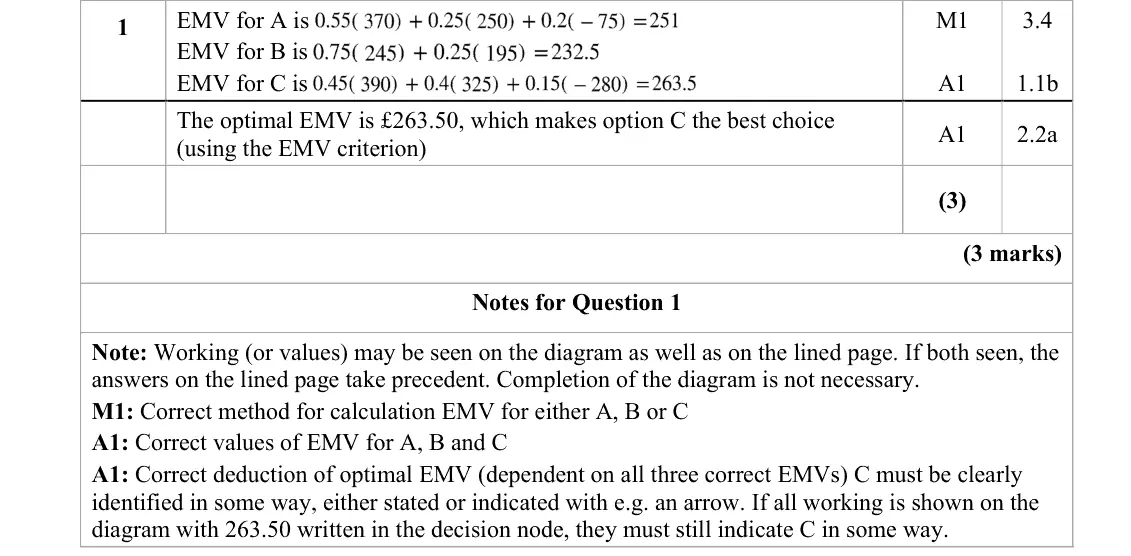
1 Decision analysis: decision trees and expected values 3 —
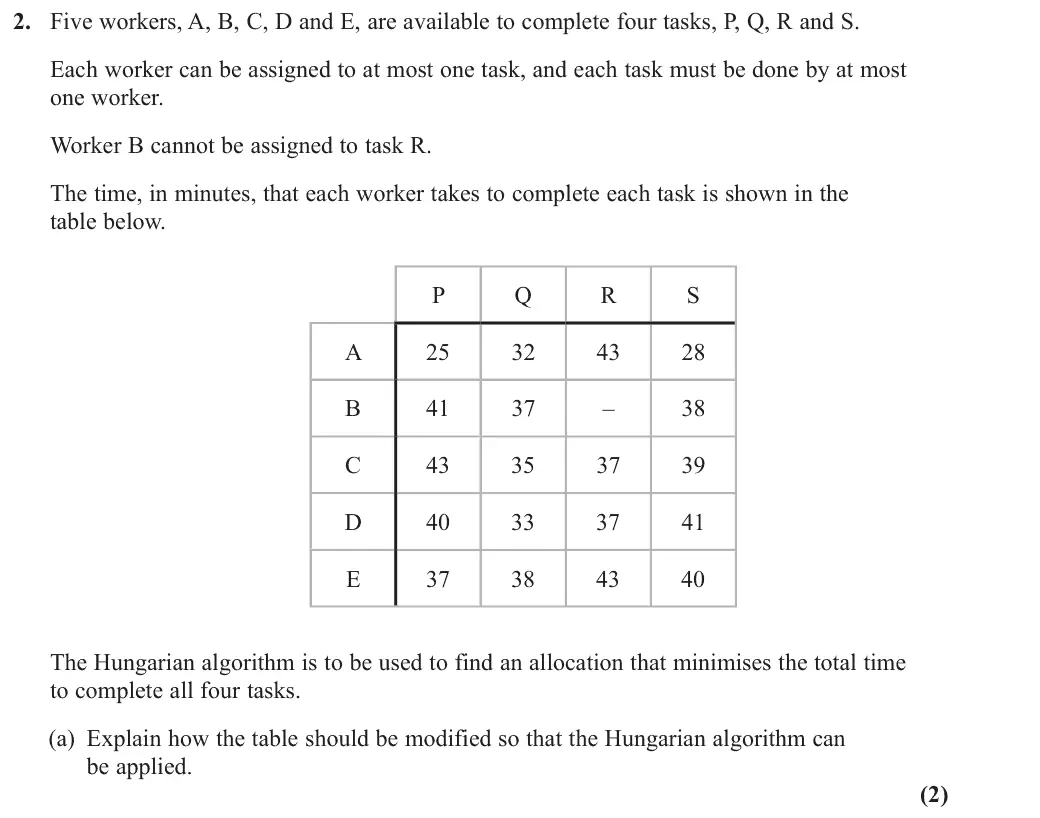
2(a) Allocation (assignment) problems and the Hungarian algorithm 2 —
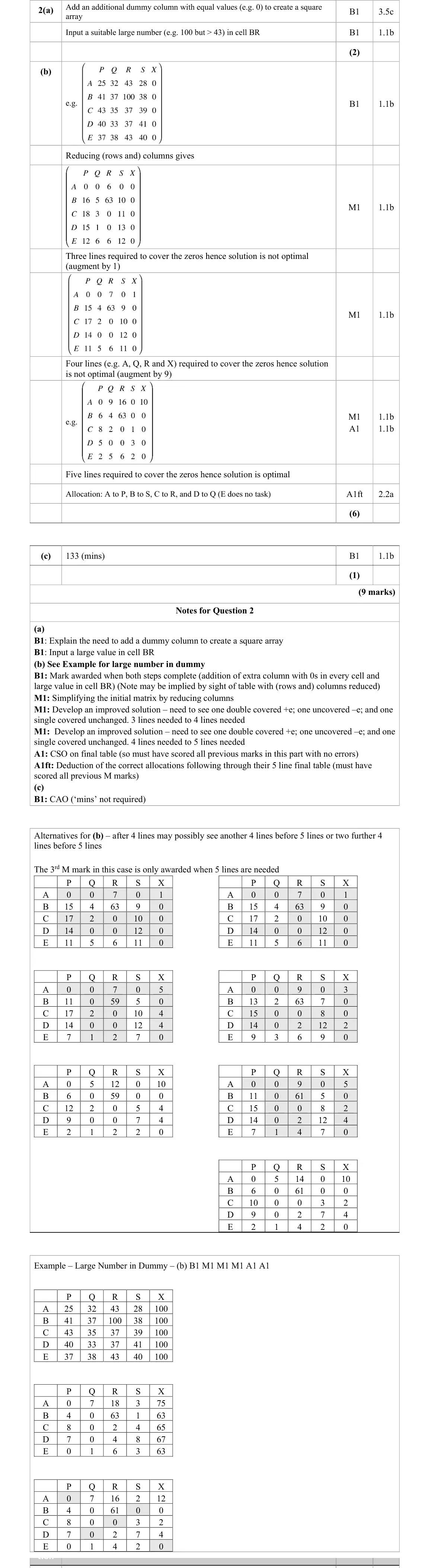
2(b) Allocation (assignment) problems and the Hungarian algorithm 6 —
2(c) Allocation (assignment) problems and the Hungarian algorithm 1 —
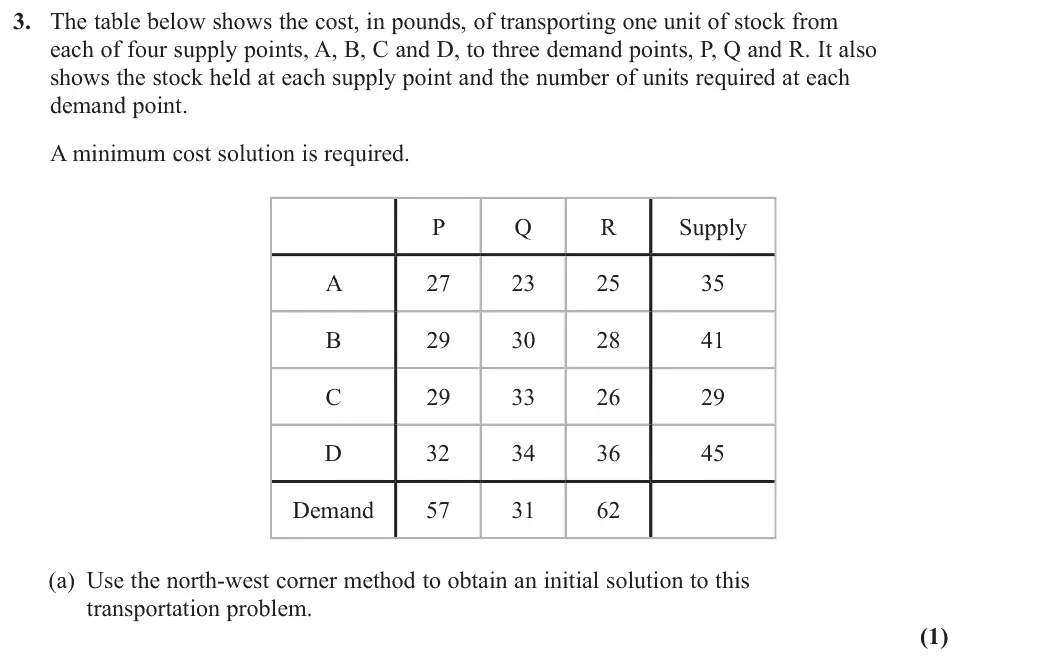
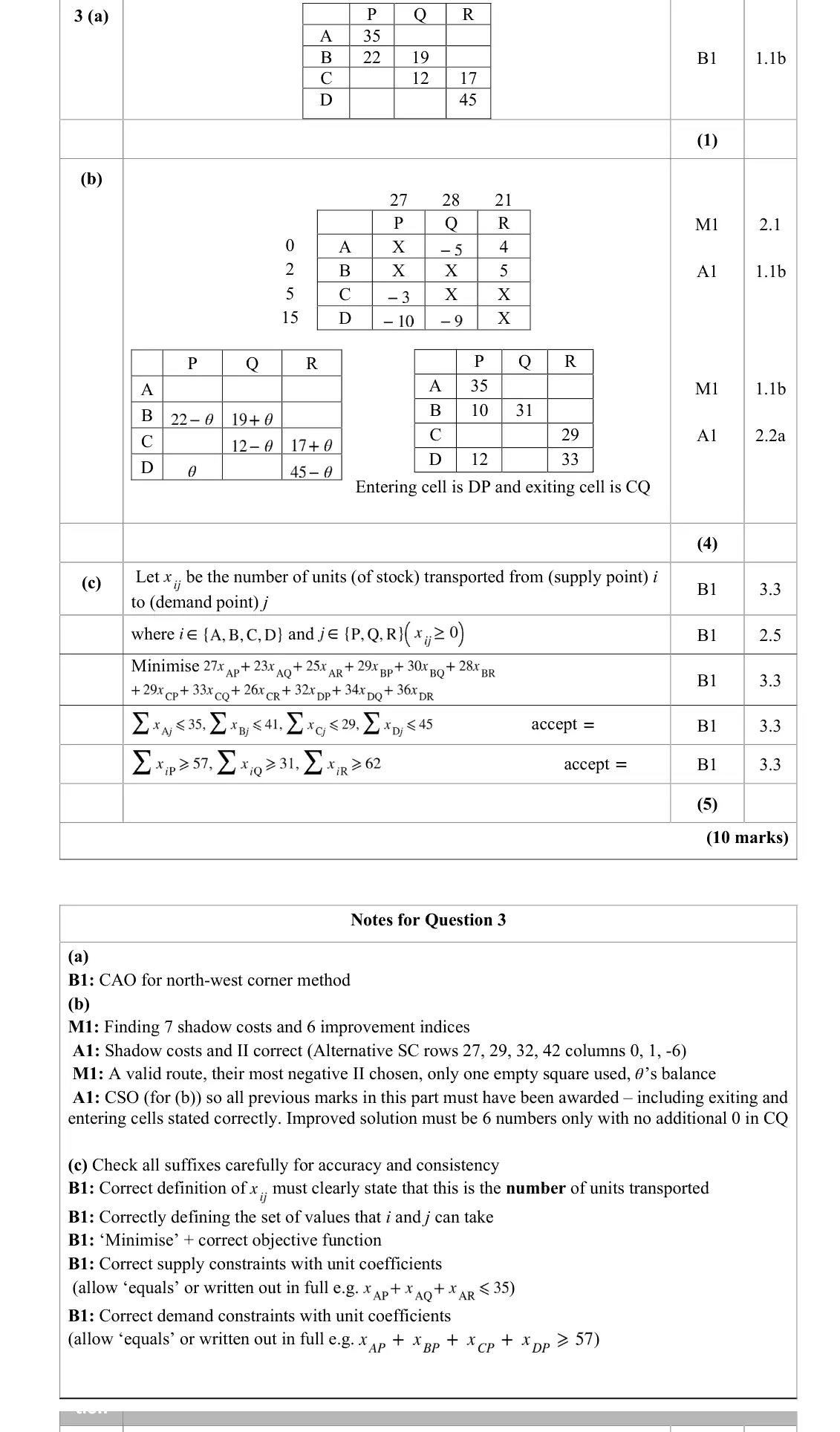
3(a) Transportation problems 1 —
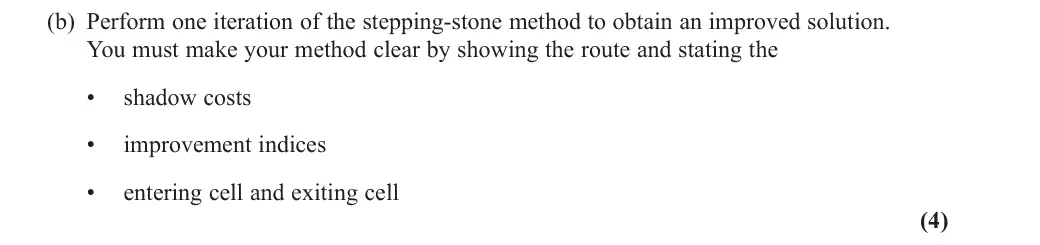
3(b) Transportation problems 4 —
3(c) Transportation problems 5 —
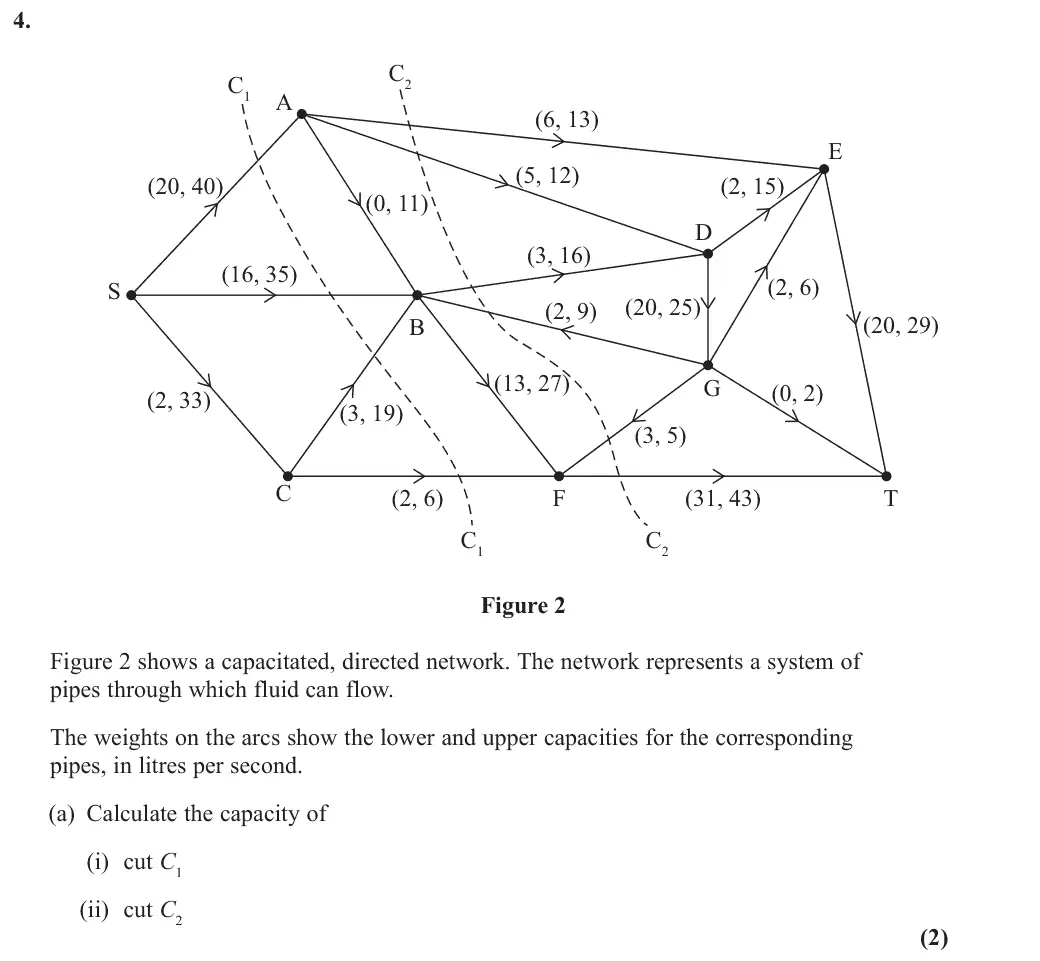
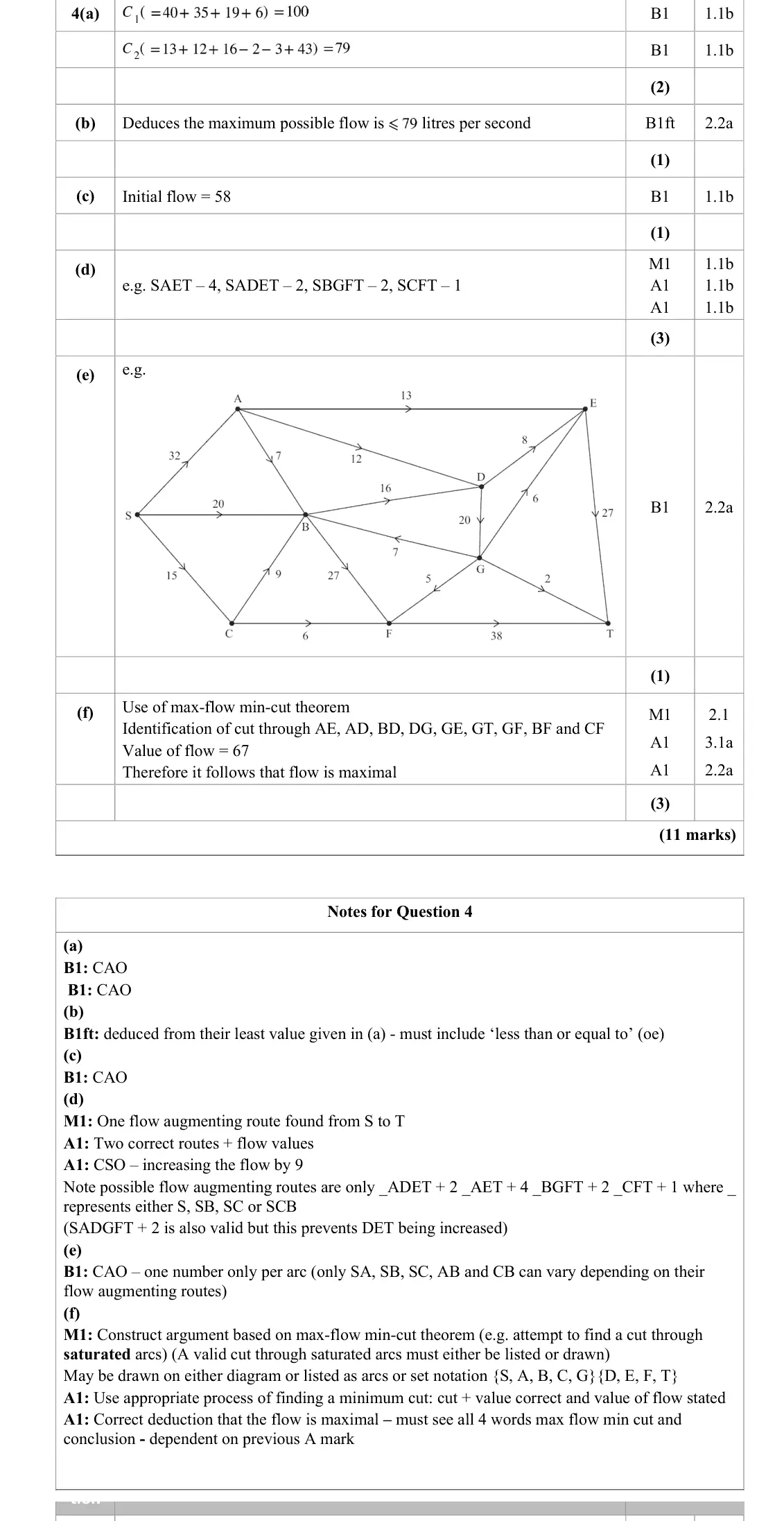
4(a) Flows in networks 2 —
4(b) Flows in networks 1 —
4(c) Flows in networks 1 —
4(d) Flows in networks 3 —
4(e) Flows in networks 1 —
4(f) Flows in networks 3 —
5(a) Dynamic programming 12 —
5(b) Dynamic programming 1 —
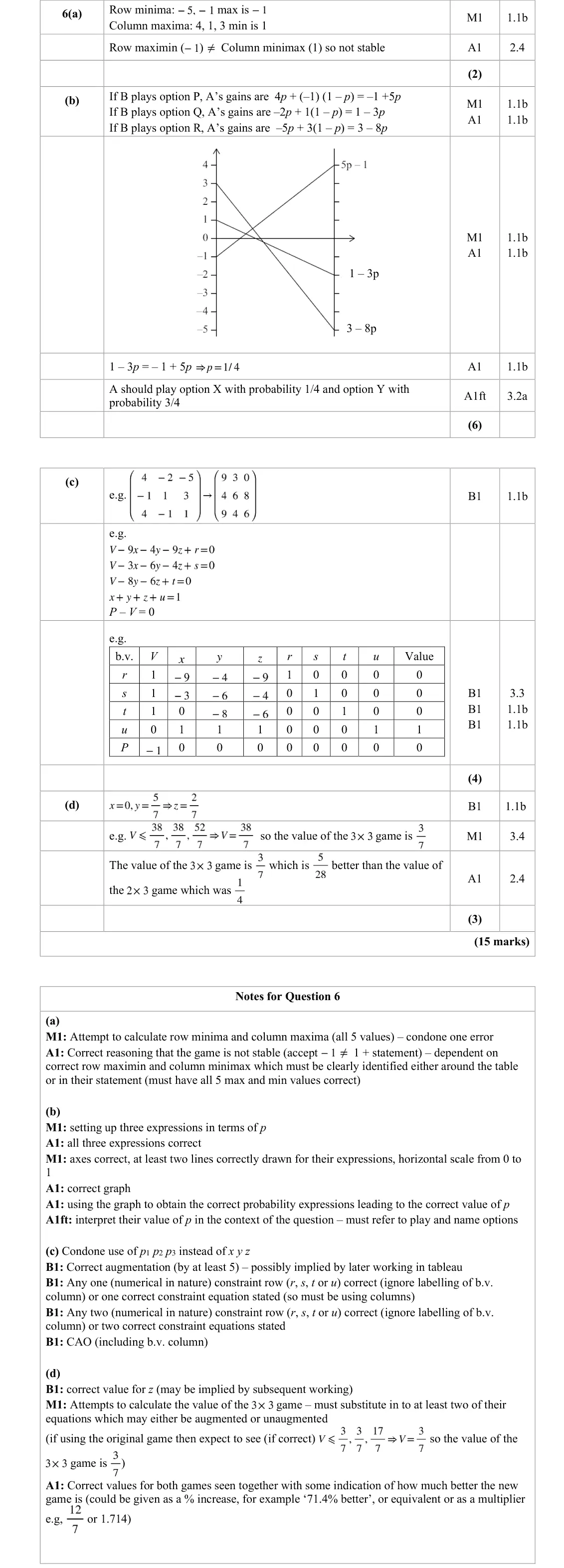
6(a) Game theory 2 —
6(b) Game theory 6 —
6(c) Game theory 4 —
6(d) Game theory 3 —
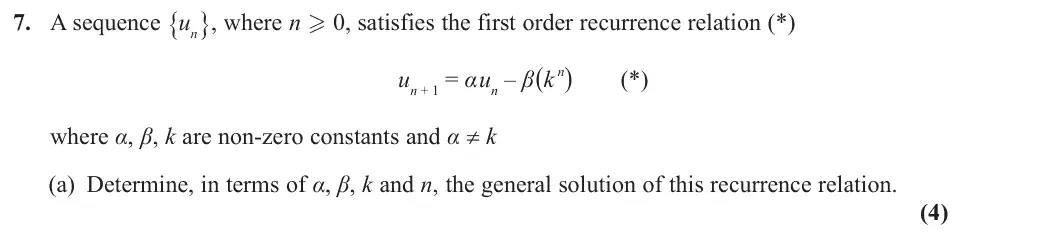
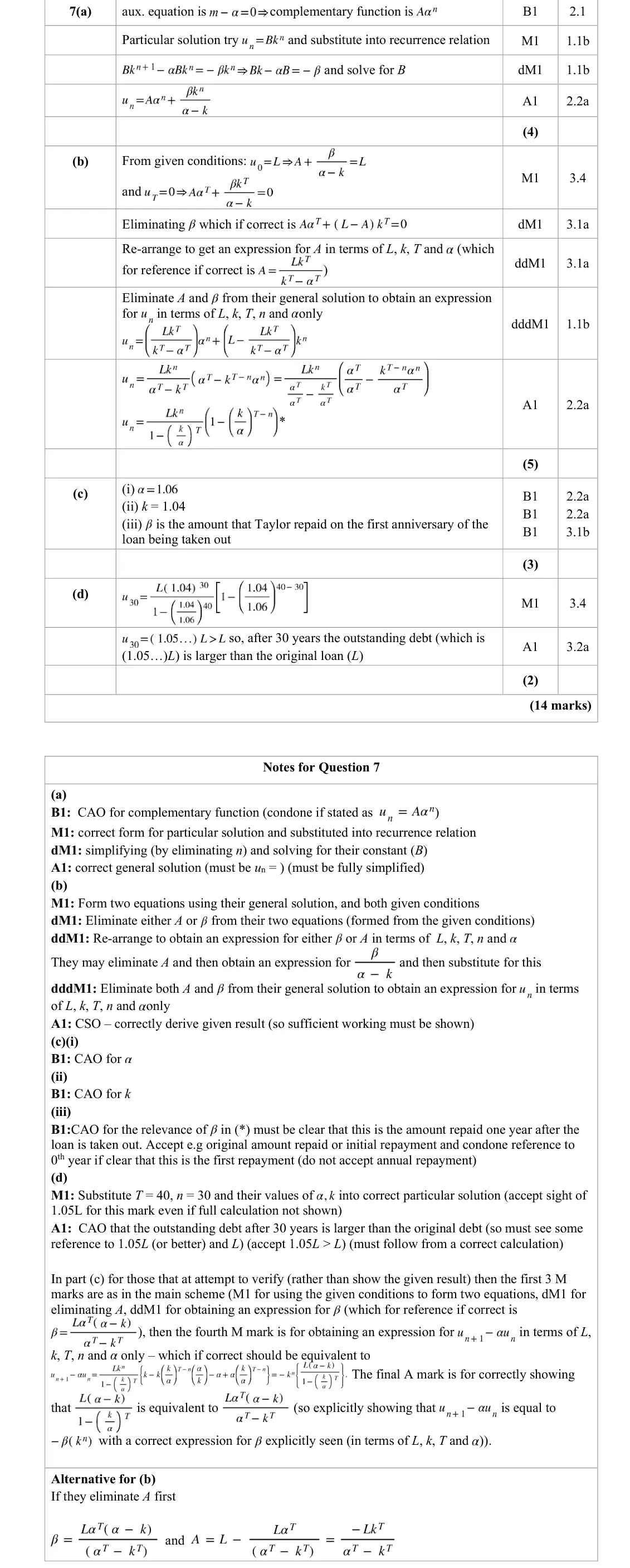
7(a) Recurrence relations (Decision 2) 4 —
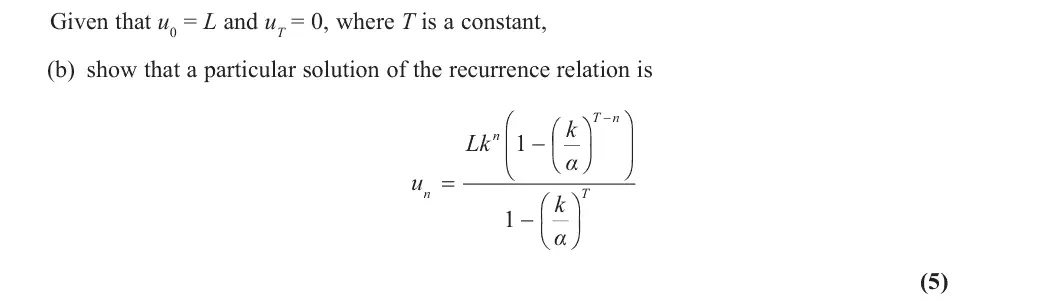
7(b) Recurrence relations (Decision 2) 5 —
7(c) Recurrence relations (Decision 2) 3 —
7(d) Recurrence relations (Decision 2) 2 —

The questions

12(a)2(b)2(c)3(a)3(b)3(c)4(a)4(b)4(c)4(d)4(e)4(f)5(a)5(b)6(a)6(b)6(c)6(d)7(a)7(b)7(c)7(d)
June 2025 · Paper 4D (Decision 2) · Q1 3 marks decision analysis
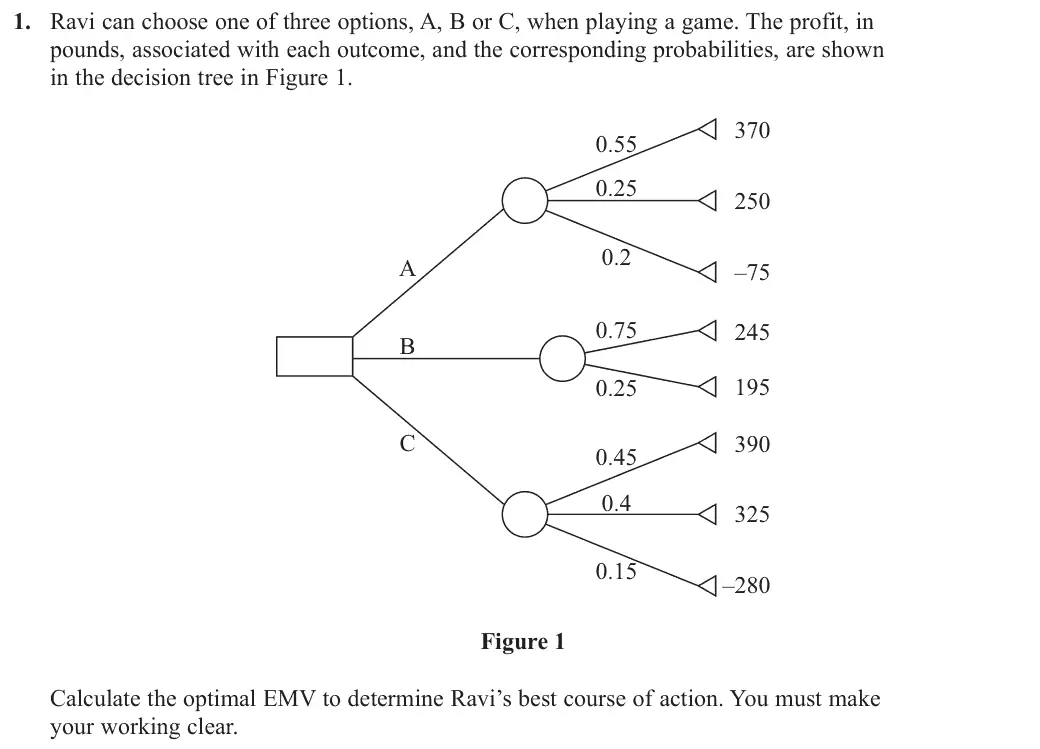
1. Ravi can choose one of three options, A, B or C, when playing a game. The profit, in pounds, associated with each outcome, and the corresponding probabilities, are shown in the decision tree in Figure 1. 0.55 0.25 0.2 A –75 0.75 B 0.25 C 0.45 0.4 0.15 –280 Figure 1 Calculate the optimal EMV to determine Ravi’s best course of action. You must make your working clear.
June 2025 · Paper 4D (Decision 2) · Q2(a) 2 marks allocation problems
2. Five workers, A, B, C, D and E, are available to complete four tasks, P, Q, R and S. Each worker can be assigned to at most one task, and each task must be done by at most one worker. Worker B cannot be assigned to task R. The time, in minutes, that each worker takes to complete each task is shown in the table below. P Q R S A B – C E The Hungarian algorithm is to be used to find an allocation that minimises the total time to complete all four tasks. (a) Explain how the table should be modified so that the Hungarian algorithm can be applied. (2)
June 2025 · Paper 4D (Decision 2) · Q2(b) 6 marks allocation problems
(b) Use the Hungarian algorithm to obtain an allocation that minimises the total time. (6)
June 2025 · Paper 4D (Decision 2) · Q2(c) 1 mark allocation problems
(c) Calculate the least total time to complete all four tasks. (1)
June 2025 · Paper 4D (Decision 2) · Q3(a) 1 mark transportation problems
3. The table below shows the cost, in pounds, of transporting one unit of stock from each of four supply points, A, B, C and D, to three demand points, P, Q and R. It also shows the stock held at each supply point and the number of units required at each demand point. A minimum cost solution is required. P Q R Supply A B C Demand (a) Use the north-west corner method to obtain an initial solution to this transportation problem. (1)
June 2025 · Paper 4D (Decision 2) · Q3(b) 4 marks transportation problems
(b) Perform one iteration of the stepping-stone method to obtain an improved solution. You must make your method clear by showing the route and stating the • shadow costs • improvement indices • entering cell and exiting cell (4)
June 2025 · Paper 4D (Decision 2) · Q3(c) 5 marks transportation problems
(c) Formulate the transportation problem as a linear programming problem. You must define your decision variables and make the objective function and constraints clear. (5)
June 2025 · Paper 4D (Decision 2) · Q4(a) 2 marks flows in networks
4. C2 C1 A (6, 13) E (5, 12) (20, 40) (2, 15) (0, 11) (3, 16) (16, 35) (2, 6) S (20, 25) (2, 9) (20, 29) B (13, 27) G (0, 2) (2, 33) (3, 19) (3, 5) C (2, 6) F (31, 43) T C1 C2 Figure 2 Figure 2 shows a capacitated, directed network. The network represents a system of pipes through which fluid can flow. The weights on the arcs show the lower and upper capacities for the corresponding pipes, in litres per second. (a) Calculate the capacity of (i) cut C1 (ii) cut C2 (2)
June 2025 · Paper 4D (Decision 2) · Q4(b) 1 mark flows in networks
(b) Using only the capacities of cuts C1 and C2 , state what can be deduced about the maximum flow through the system. (1)
June 2025 · Paper 4D (Decision 2) · Q4(c) 1 mark flows in networks
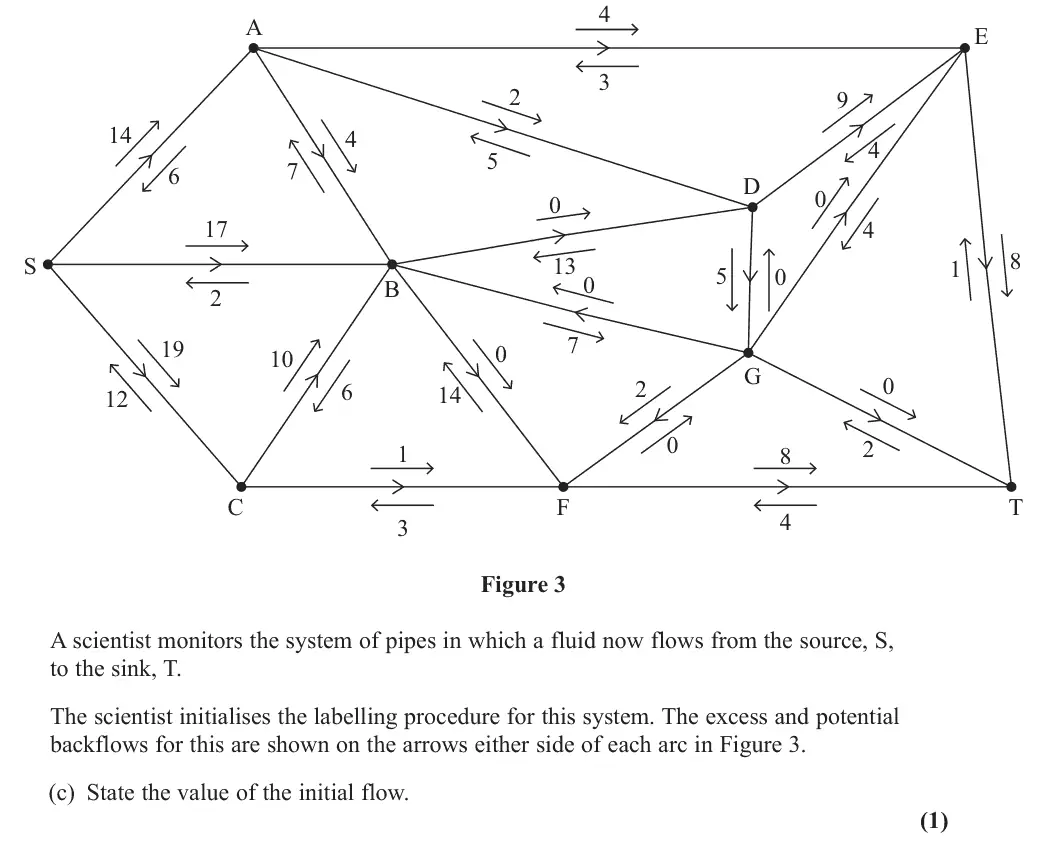
A E S B G C F T Figure 3 A scientist monitors the system of pipes in which a fluid now flows from the source, S, to the sink, T. The scientist initialises the labelling procedure for this system. The excess and potential backflows for this are shown on the arrows either side of each arc in Figure 3. (c) State the value of the initial flow. (1)
June 2025 · Paper 4D (Decision 2) · Q4(d) 3 marks flows in networks
(d) Use the labelling procedure to find a maximum flow through the network. You must list each flow-augmenting route you use, together with its flow. (3)
June 2025 · Paper 4D (Decision 2) · Q4(e) 1 mark flows in networks
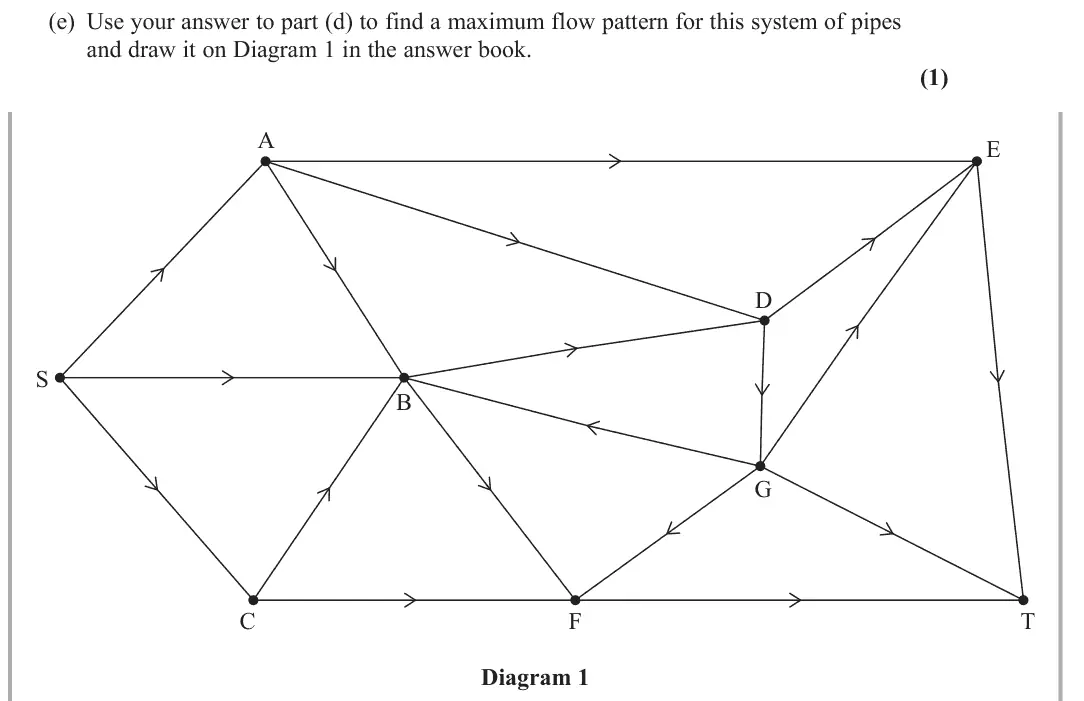
(e) Use your answer to part (d) to find a maximum flow pattern for this system of pipes and draw it on Diagram 1 in the answer book. (1)
June 2025 · Paper 4D (Decision 2) · Q4(f) 3 marks flows in networks
(f) Prove that the answer to part (e) is optimal. (3)
June 2025 · Paper 4D (Decision 2) · Q5(a) 12 marks dynamic programming
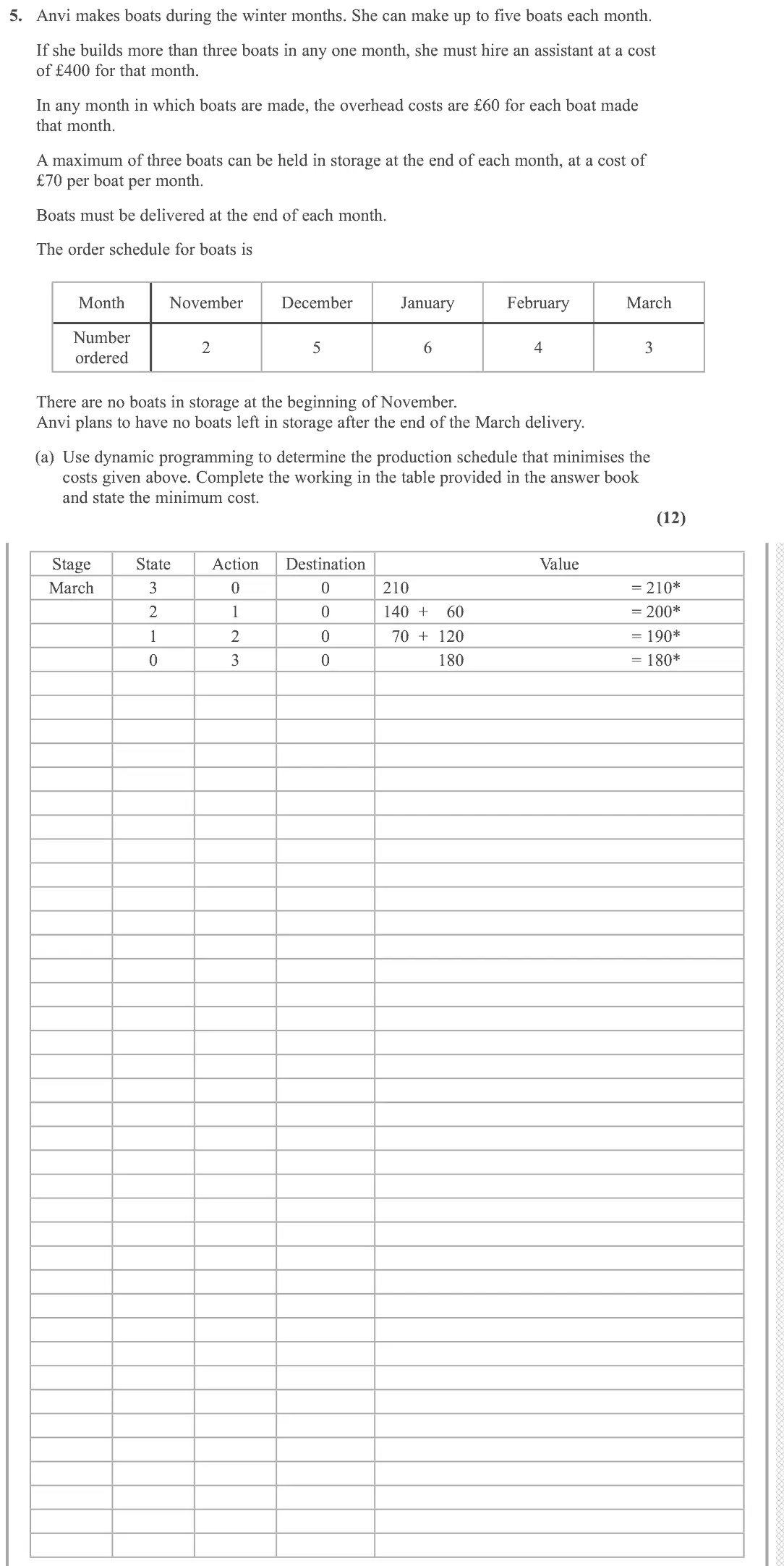
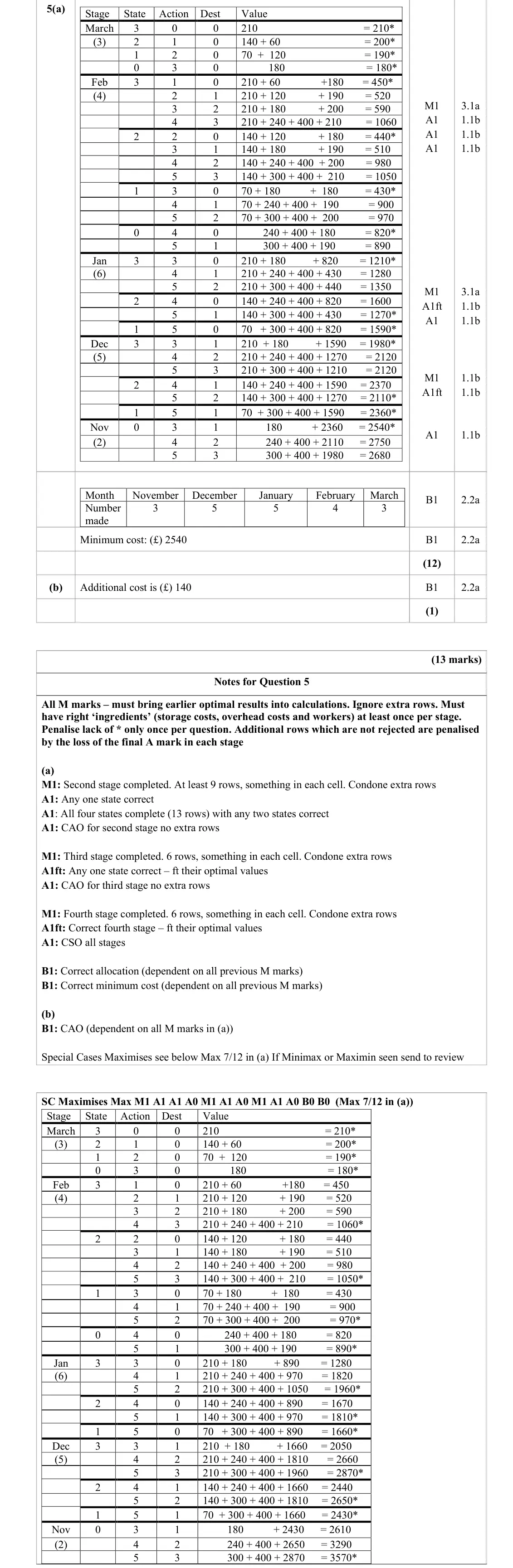
5. Anvi makes boats during the winter months. She can make up to five boats each month. If she builds more than three boats in any one month, she must hire an assistant at a cost of £400 for that month. In any month in which boats are made, the overhead costs are £60 for each boat made that month. A maximum of three boats can be held in storage at the end of each month, at a cost of £70 per boat per month. Boats must be delivered at the end of each month. The order schedule for boats is Month November December January February March Number ordered There are no boats in storage at the beginning of November. Anvi plans to have no boats left in storage after the end of the March delivery. (a) Use dynamic programming to determine the production schedule that minimises the costs given above. Complete the working in the table provided in the answer book and state the minimum cost. (12)
June 2025 · Paper 4D (Decision 2) · Q5(b) 1 mark dynamic programming
The assistant asks to work in November, and Anvi agrees. (b) Given that more than three boats are now made in November, state the minimum additional cost of producing all the required boats to the schedule shown above. (1)
June 2025 · Paper 4D (Decision 2) · Q6(a) 2 marks game theory
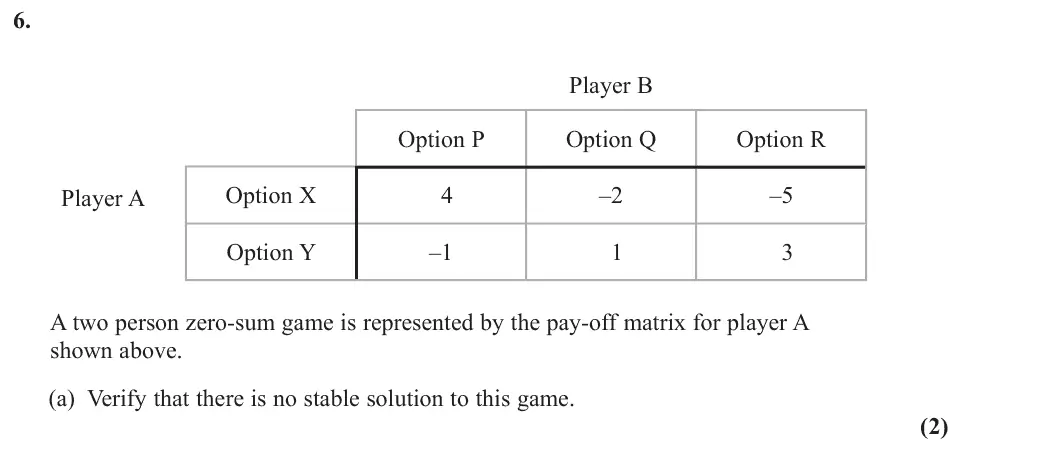
6. Player B Option P Option Q Option R Option X –2 –5 Player A Option Y –1 A two person zero-sum game is represented by the pay-off matrix for player A shown above. (a) Verify that there is no stable solution to this game. (2)
June 2025 · Paper 4D (Decision 2) · Q6(b) 6 marks game theory
Let player A play option X with probability p (b) Use a graphical method to find the optimal value of p and hence find the best strategy for player A in this game. (6)
June 2025 · Paper 4D (Decision 2) · Q6(c) 4 marks game theory
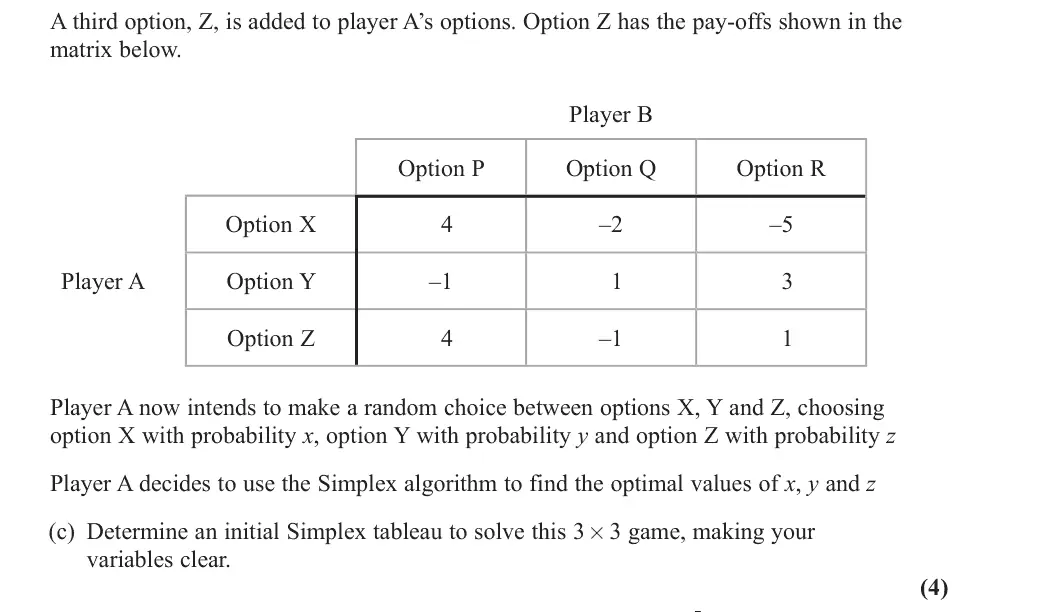
A third option, Z, is added to player A’s options. Option Z has the pay-offs shown in the matrix below. Player B Option P Option Q Option R Option X –2 –5 Player A Option Y –1 Option Z –1 Player A now intends to make a random choice between options X, Y and Z, choosing option X with probability x, option Y with probability y and option Z with probability z Player A decides to use the Simplex algorithm to find the optimal values of x, y and z (c) Determine an initial Simplex tableau to solve this 3 x 3 game, making your variables clear. (4)
June 2025 · Paper 4D (Decision 2) · Q6(d) 3 marks game theory
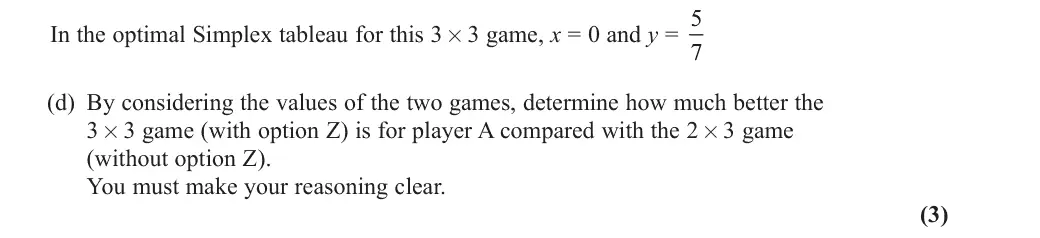
In the optimal Simplex tableau for this 3 x 3 game, x = 0 and y = 5 (d) By considering the values of the two games, determine how much better the 3 x 3 game (with option Z) is for player A compared with the 2 x 3 game (without option Z). You must make your reasoning clear. (3)
June 2025 · Paper 4D (Decision 2) · Q7(a) 4 marks recurrence relations d2
7. A sequence {un }, where n 0, satisfies the first order recurrence relation (*) un + 1 = alpha un – beta (k n) (*) where alpha , beta , k are non-zero constants and alpha ≠ k (a) Determine, in terms of alpha , beta , k and n, the general solution of this recurrence relation. (4)
June 2025 · Paper 4D (Decision 2) · Q7(b) 5 marks recurrence relations d2
Given that u0 = L and uT = 0, where T is a constant, (b) show that a particular solution of the recurrence relation is T n k n Lk alpha u T n k alpha (5)
June 2025 · Paper 4D (Decision 2) · Q7(c) 3 marks recurrence relations d2
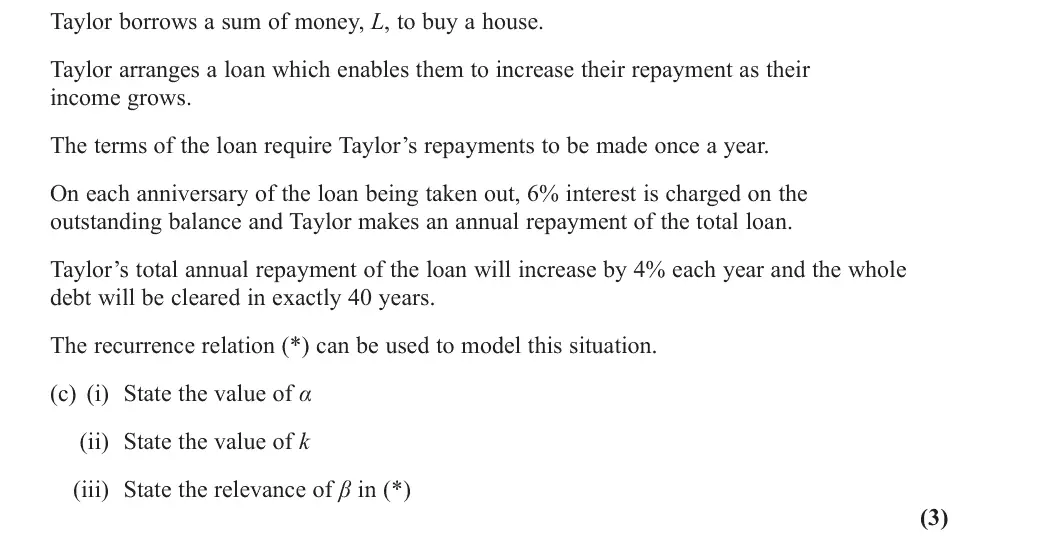
Taylor borrows a sum of money, L, to buy a house. Taylor arranges a loan which enables them to increase their repayment as their income grows. The terms of the loan require Taylor’s repayments to be made once a year. On each anniversary of the loan being taken out, 6% interest is charged on the outstanding balance and Taylor makes an annual repayment of the total loan. Taylor’s total annual repayment of the loan will increase by 4% each year and the whole debt will be cleared in exactly 40 years. The recurrence relation (*) can be used to model this situation. (c) (i) State the value of alpha (ii) State the value of k (iii) State the relevance of beta in (*) (3)
June 2025 · Paper 4D (Decision 2) · Q7(d) 2 marks recurrence relations d2
(d) Show that after 30 years, according to the model, the outstanding debt is larger than the original loan. (2)

Find an Edexcel Further Maths tutor

Want this paper marked and gone through with a Further Maths tutor? Message us.

Prefer email? Send an enquiry

If you are under 18, please include a parent's contact details. Enquiries go to enquiries@alevelfurthermathstutor.com and are deleted once handled.