Nov 2021: A level Paper 4D: Decision Mathematics 2
75 marks · 25 question parts · Question paper, mark scheme and examiner's report on Pearson's site
Question by question
The questions
Mark scheme (whole question; this part is marked with the orange bar)
Key points from the mark scheme and examiner's report
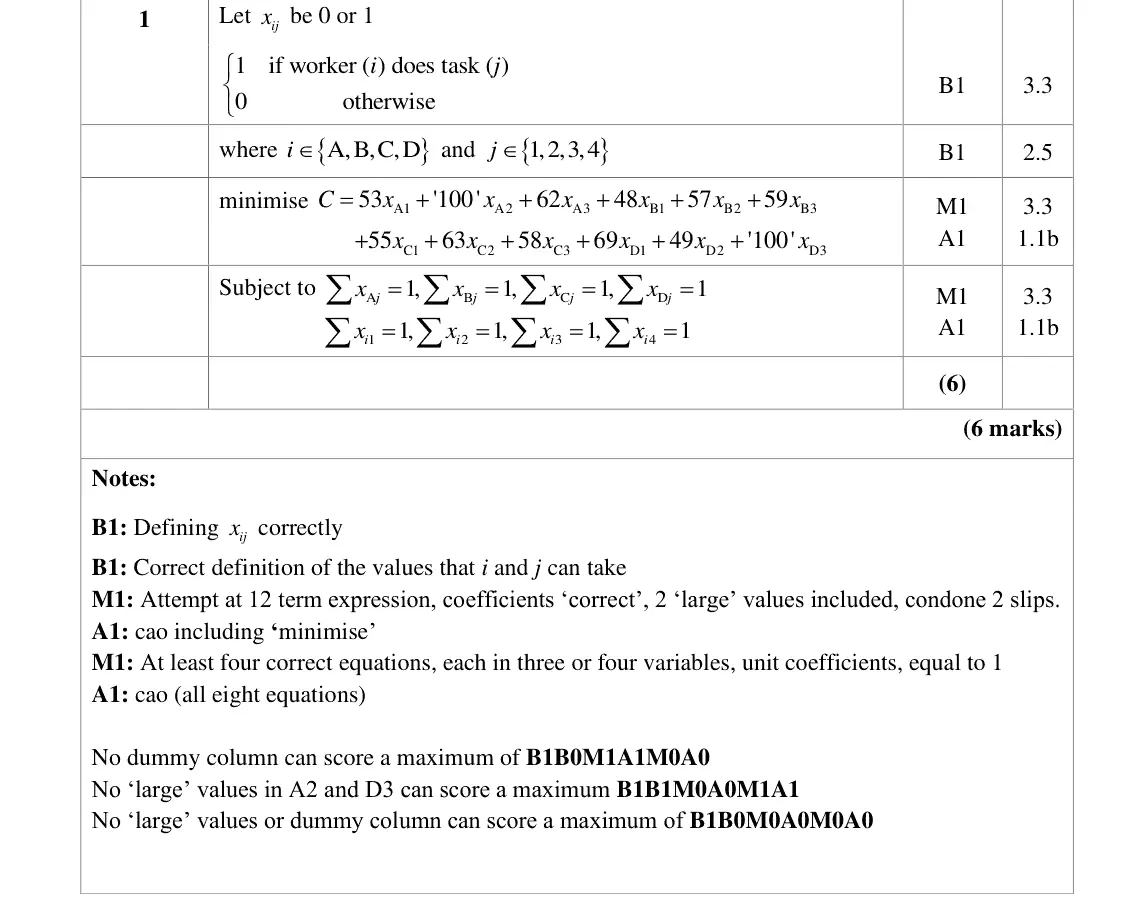
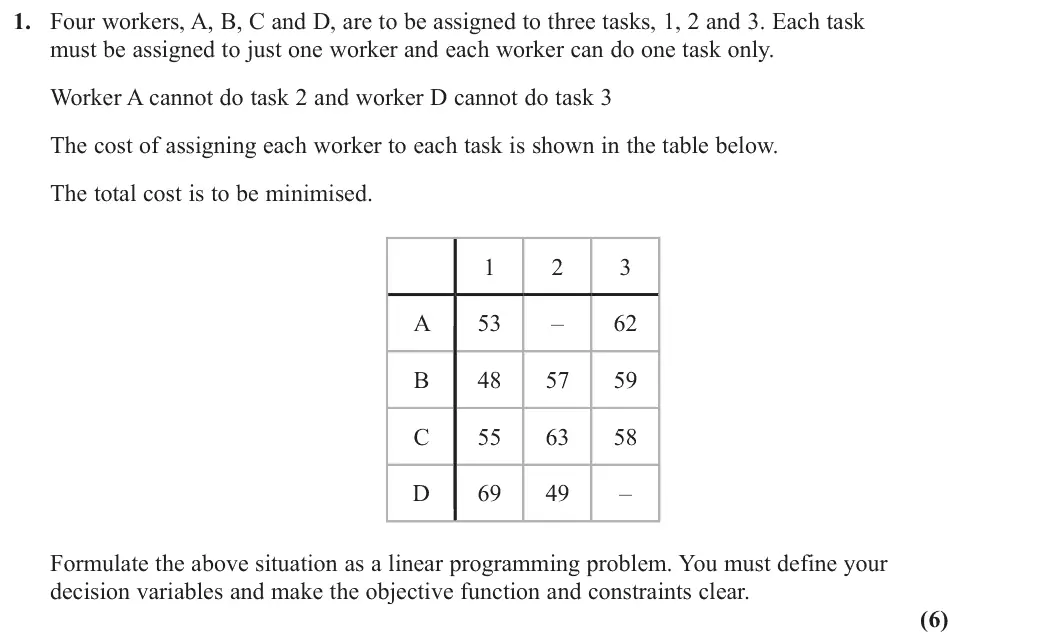
- add a dummy task 4 (four workers, three tasks) and a large cost (e.g. 100) in A2 and D3
- x_ij = 1 if worker i does task j, 0 otherwise, i in {A, B, C, D}, j in {1, 2, 3, 4}
- minimise the 12-term cost (dummy column costs 0)
- eight constraints, each sum = 1
- no dummy column or no large values loses several marks
Mark scheme (whole question; this part is marked with the orange bar)
Key points from the mark scheme and examiner's report
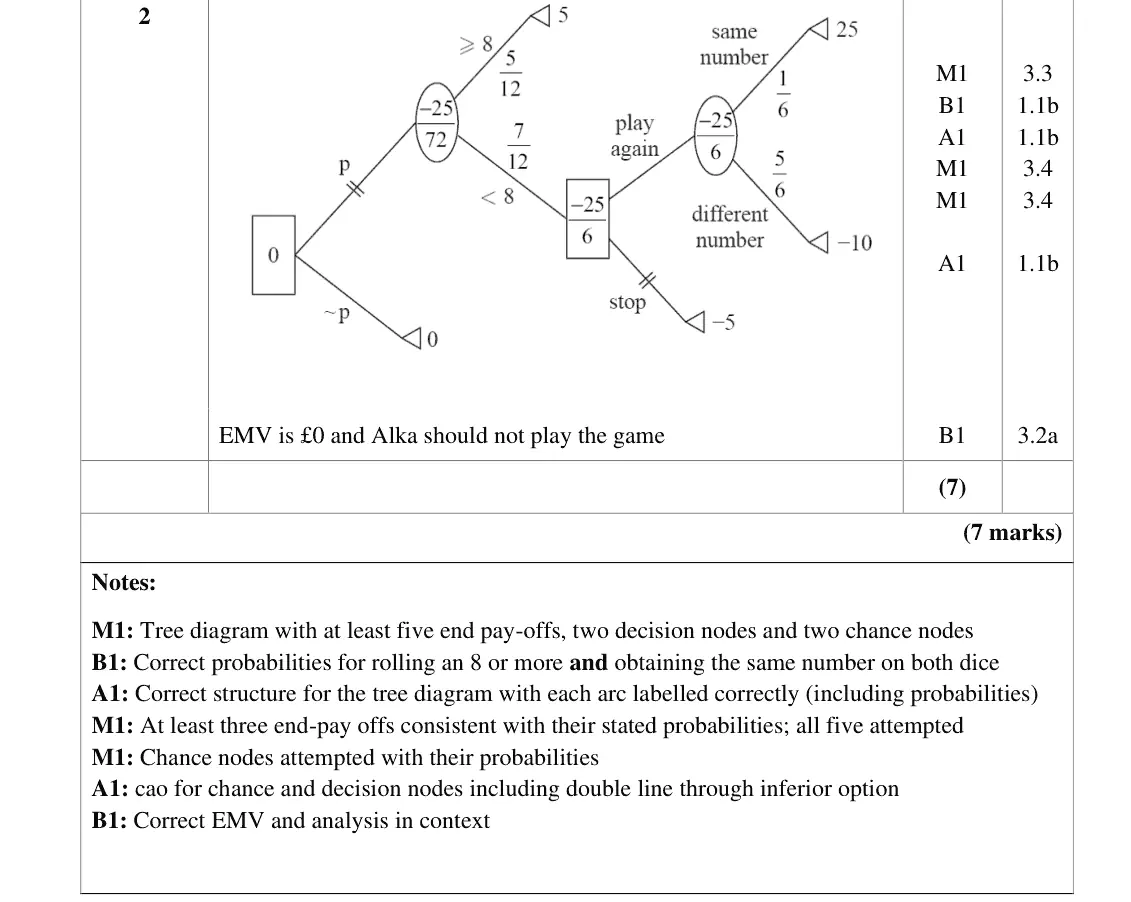
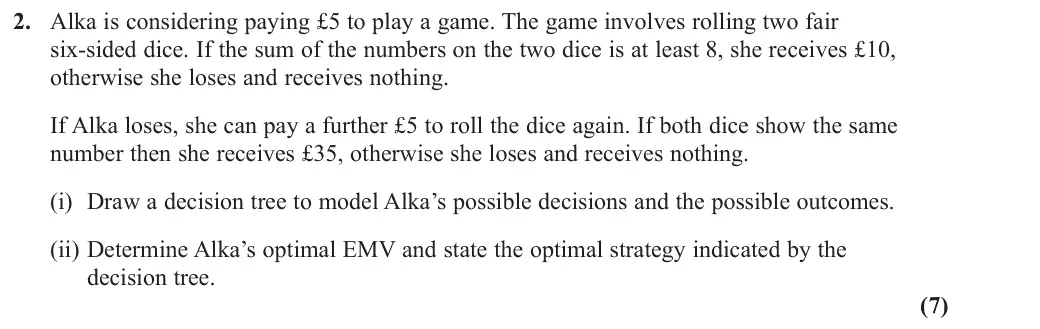
- two decision nodes, two chance nodes, five pay-offs net of the £5 stakes (5, 25, −10, −5, 0)
- P(sum at least 8) = 5/12, P(double) = 1/6
- play again EMV −25/6 beats stop −5, play EMV −25/72
- optimal EMV £0 so do not play
- double line through inferior options
Mark scheme (whole question; this part is marked with the orange bar)
Key points from the mark scheme and examiner's report
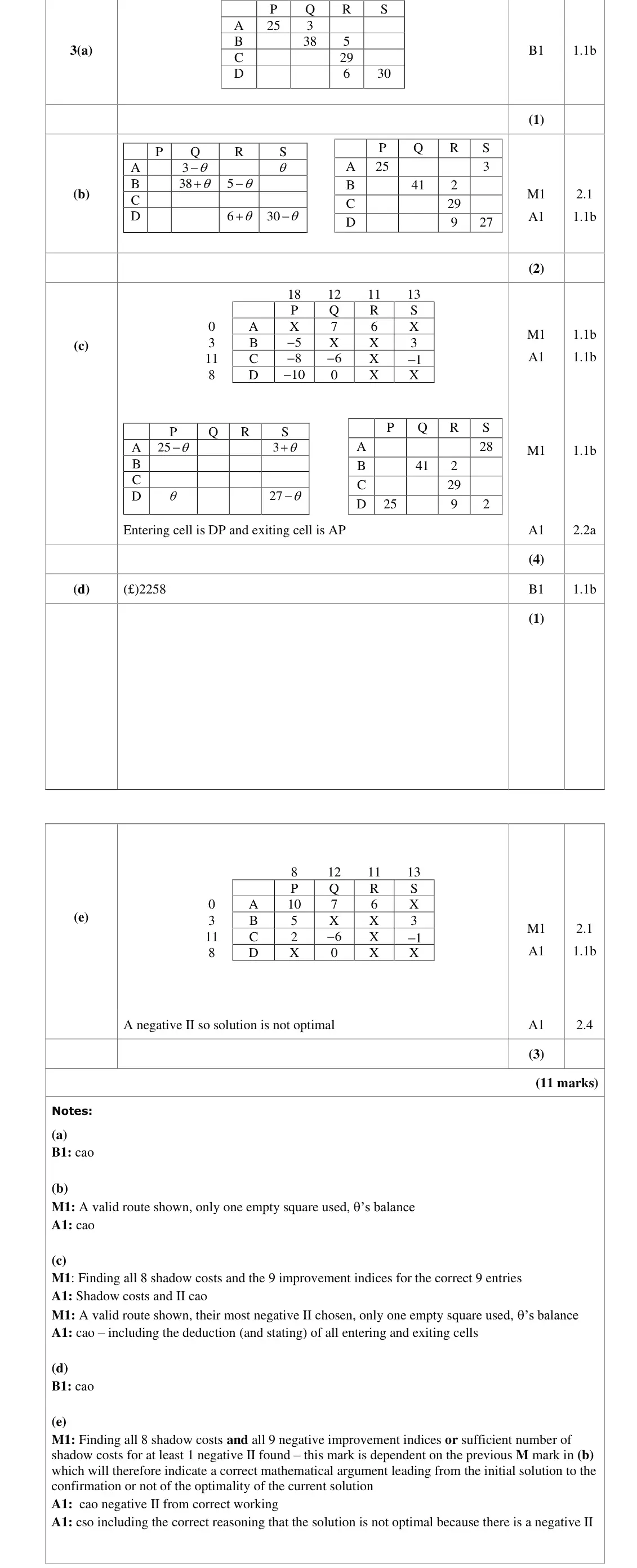
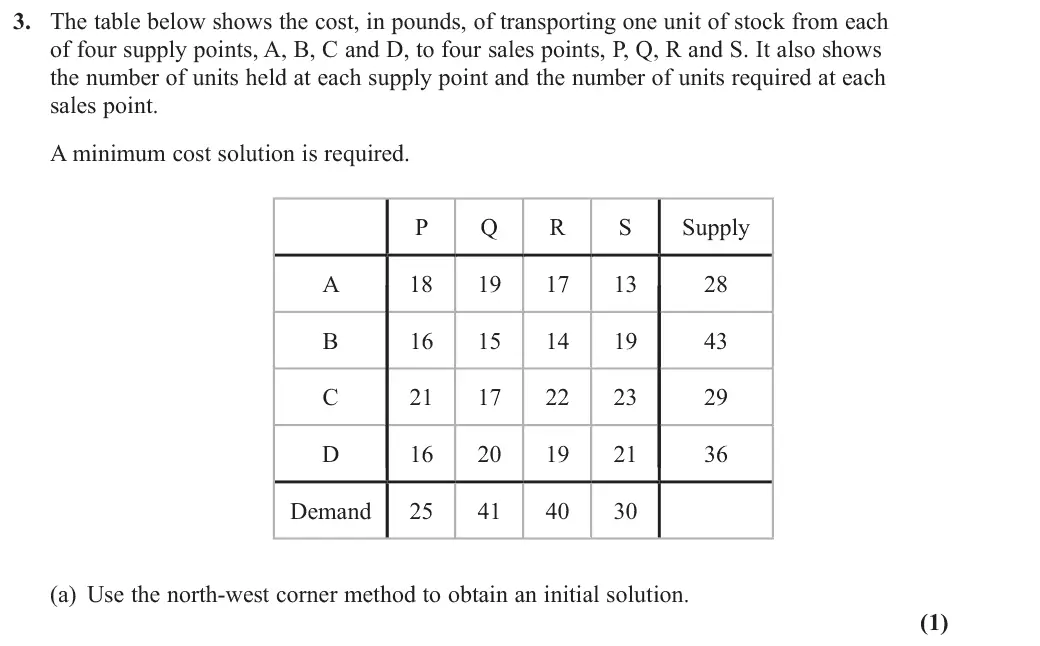
- AP 25, AQ 3, BQ 38, BR 5, CR 29, DR 6, DS 30

Mark scheme (whole question; this part is marked with the orange bar)
Key points from the mark scheme and examiner's report
- route AS, AQ, BQ, BR, DR, DS with theta = 3
- AP 25, AS 3, BQ 41, BR 2, CR 29, DR 9, DS 27
Mark scheme (whole question; this part is marked with the orange bar)
Key points from the mark scheme and examiner's report
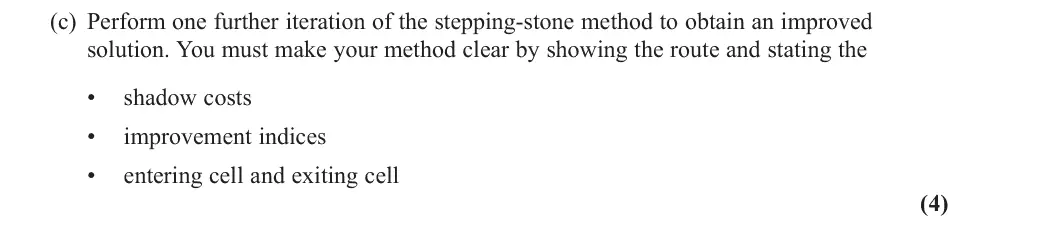
- 8 shadow costs and 9 improvement indices
- most negative II is DP (−10)
- entering DP, exiting AP
- AS 28, BQ 41, BR 2, CR 29, DP 25, DR 9, DS 2

Mark scheme (whole question; this part is marked with the orange bar)
Key points from the mark scheme and examiner's report

Mark scheme (whole question; this part is marked with the orange bar)
Key points from the mark scheme and examiner's report
- recalculate shadow costs and IIs
- CQ has II −6 (CS −1) so not optimal
Mark scheme (whole question; this part is marked with the orange bar)
Key points from the mark scheme and examiner's report
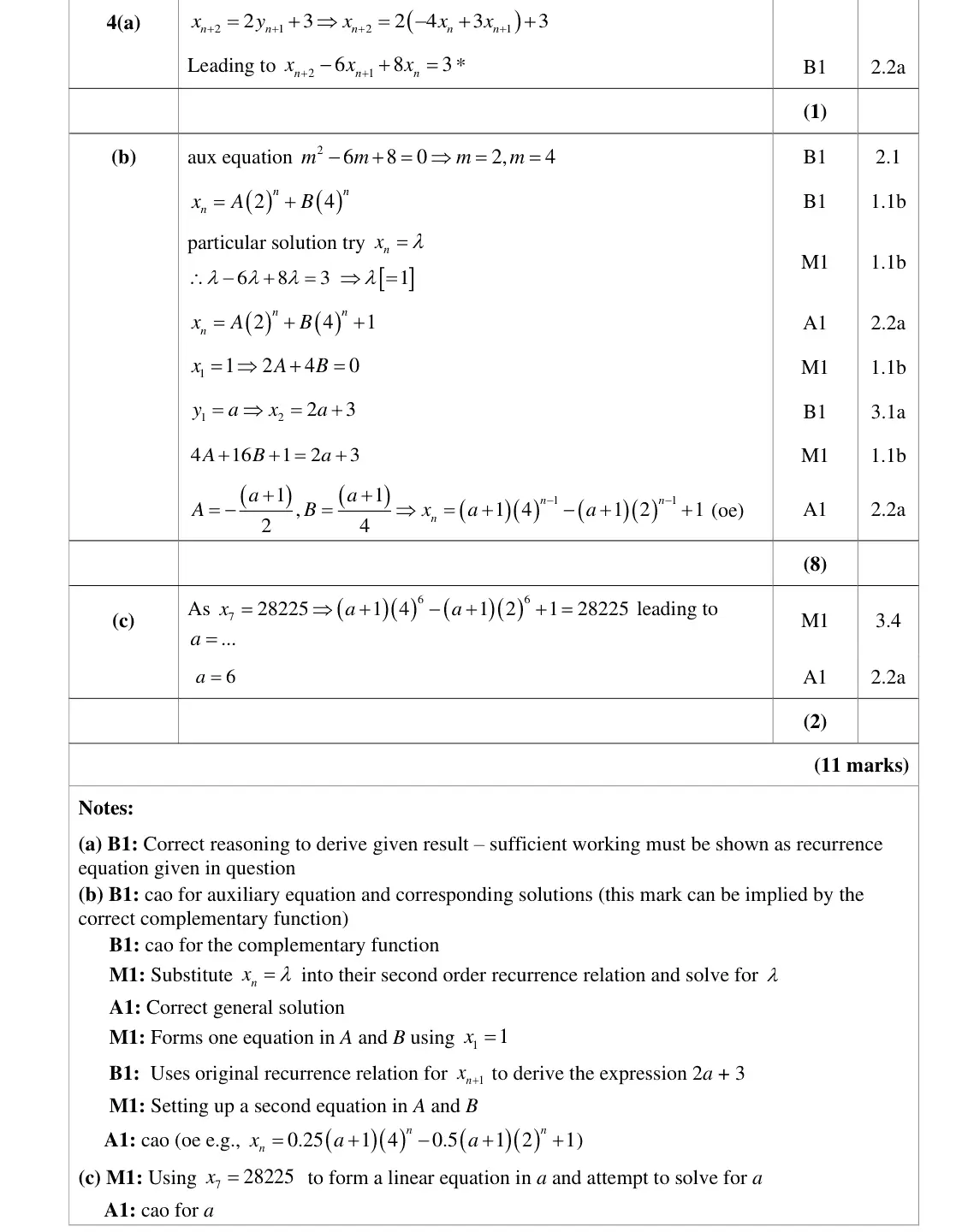
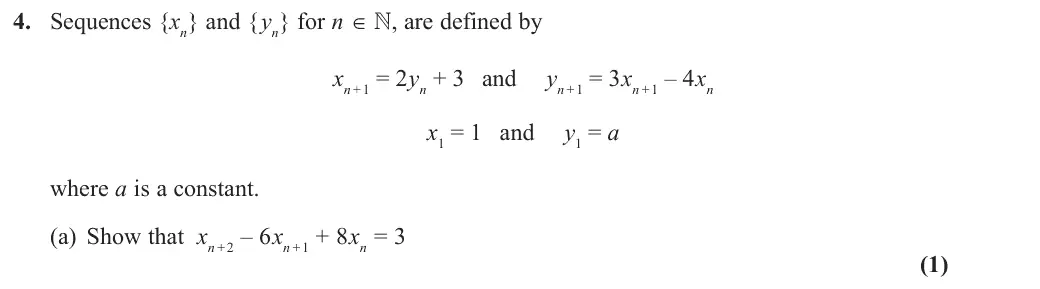
- substitute y_{n+1} = 3x_{n+1} − 4x_n into x_{n+2} = 2y_{n+1} + 3
- printed answer so working must be shown

Mark scheme (whole question; this part is marked with the orange bar)
Key points from the mark scheme and examiner's report
- m² − 6m + 8 = 0, m = 2, 4
- PS constant λ = 1
- x1 = 1 gives 2A + 4B = 0
- use the original relation to get x2 = 2a + 3 for the second equation
- x_n = (a + 1)4ⁿ⁻¹ − (a + 1)2ⁿ⁻¹ + 1

Mark scheme (whole question; this part is marked with the orange bar)
Key points from the mark scheme and examiner's report
- (a + 1)(4⁶ − 2⁶) + 1 = 28225 gives a = 6
Mark scheme (whole question; this part is marked with the orange bar)
Key points from the mark scheme and examiner's report
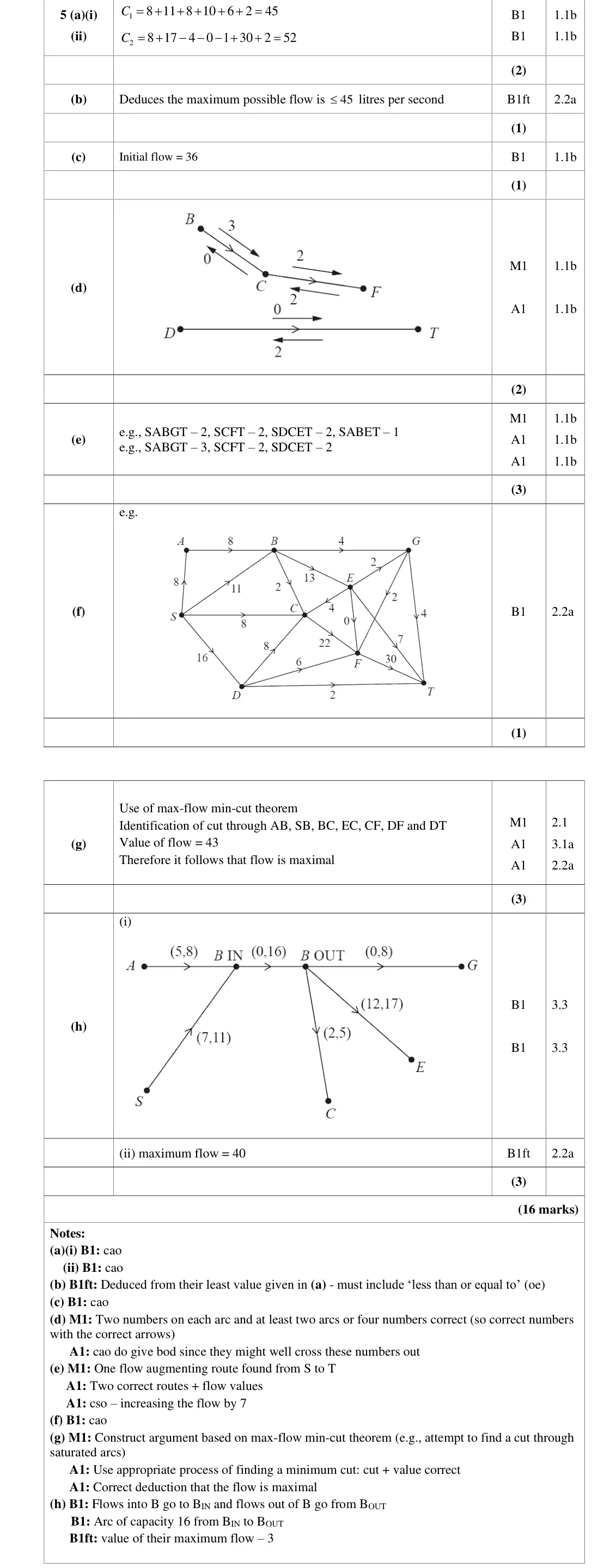
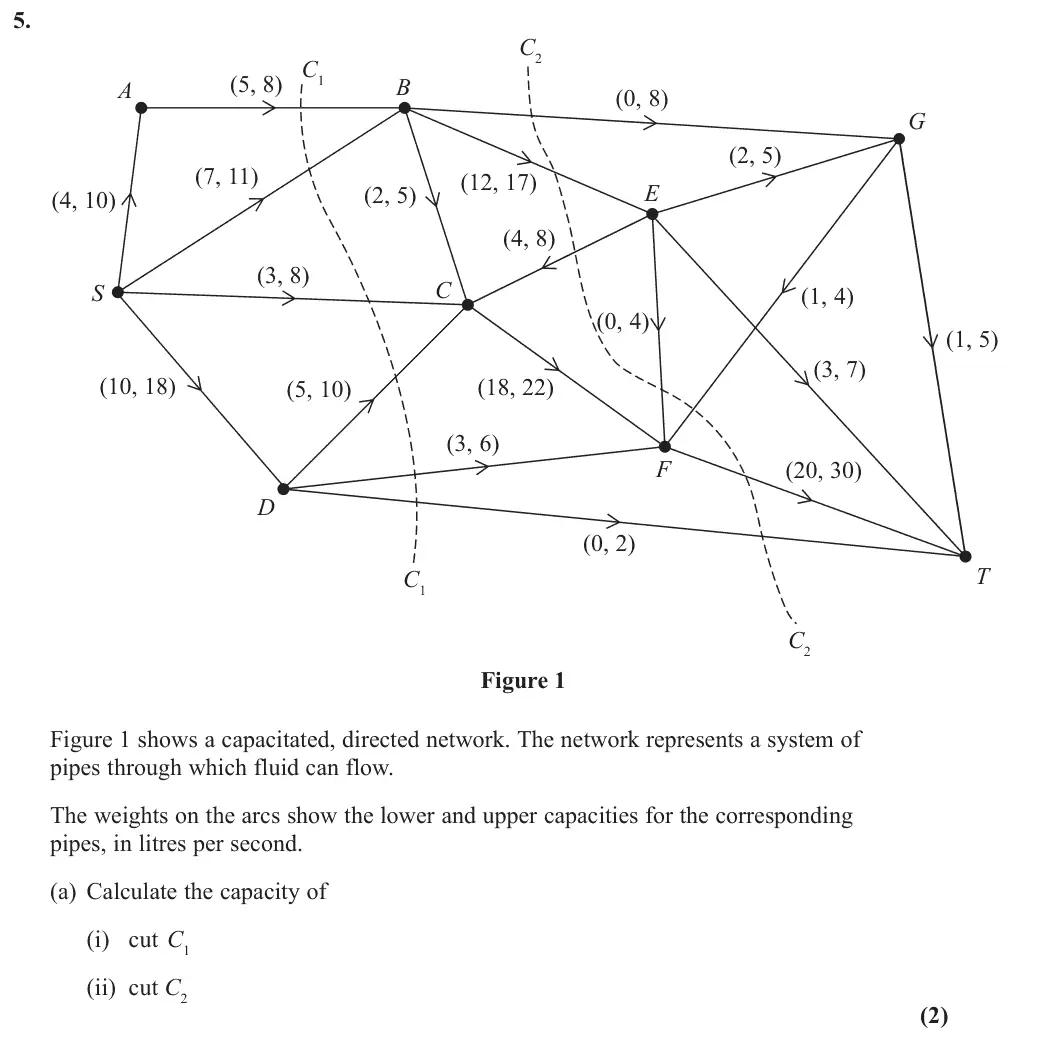
- add upper capacities forward, subtract lower capacities of backward arcs: C1 = 45, C2 = 52

Mark scheme (whole question; this part is marked with the orange bar)
Key points from the mark scheme and examiner's report
- maximum flow ≤ 45 (the smaller cut)
- must say 'less than or equal to'
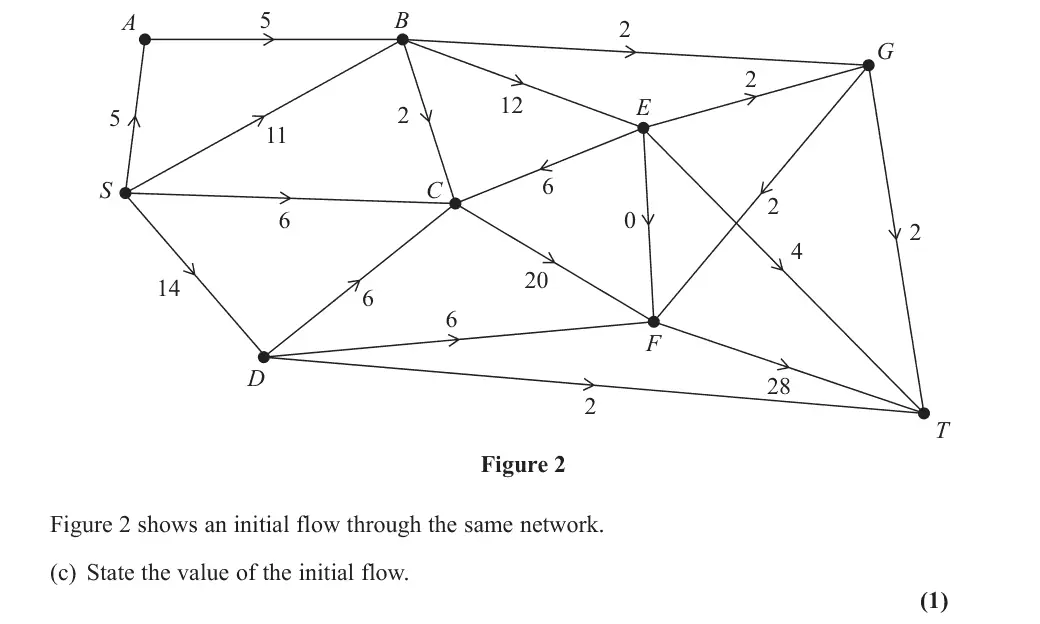
Mark scheme (whole question; this part is marked with the orange bar)
Key points from the mark scheme and examiner's report
Mark scheme (whole question; this part is marked with the orange bar)
Key points from the mark scheme and examiner's report
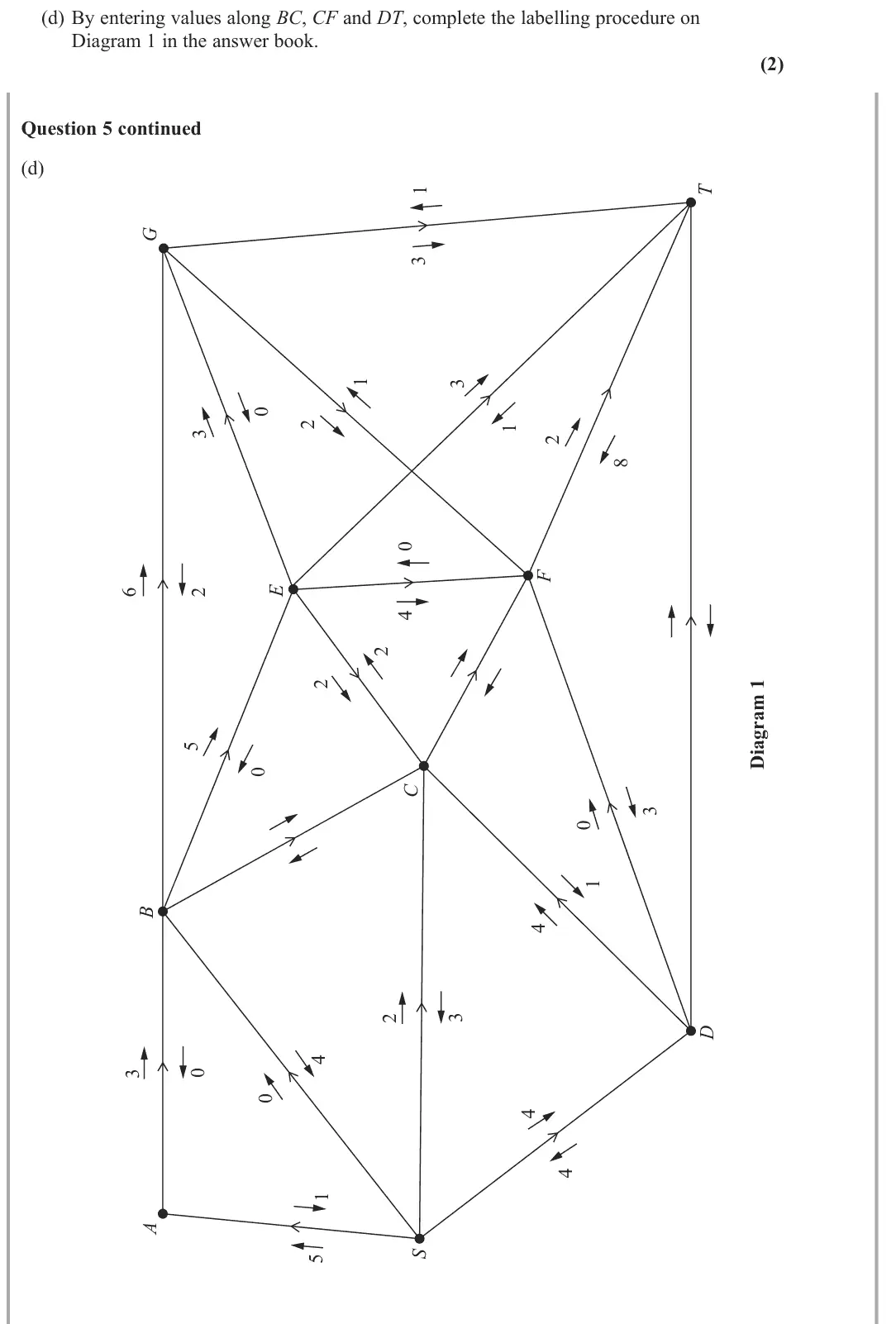
- forward arrow shows spare capacity, backward arrow the current flow above the lower capacity: BC 3 and 0, CF 2 and 2, DT 0 and 2

Mark scheme (whole question; this part is marked with the orange bar)
Key points from the mark scheme and examiner's report
- e.g. SABGT 3, SCFT 2, SDCET 2
- total increase 7
Mark scheme (whole question; this part is marked with the orange bar)
Key points from the mark scheme and examiner's report
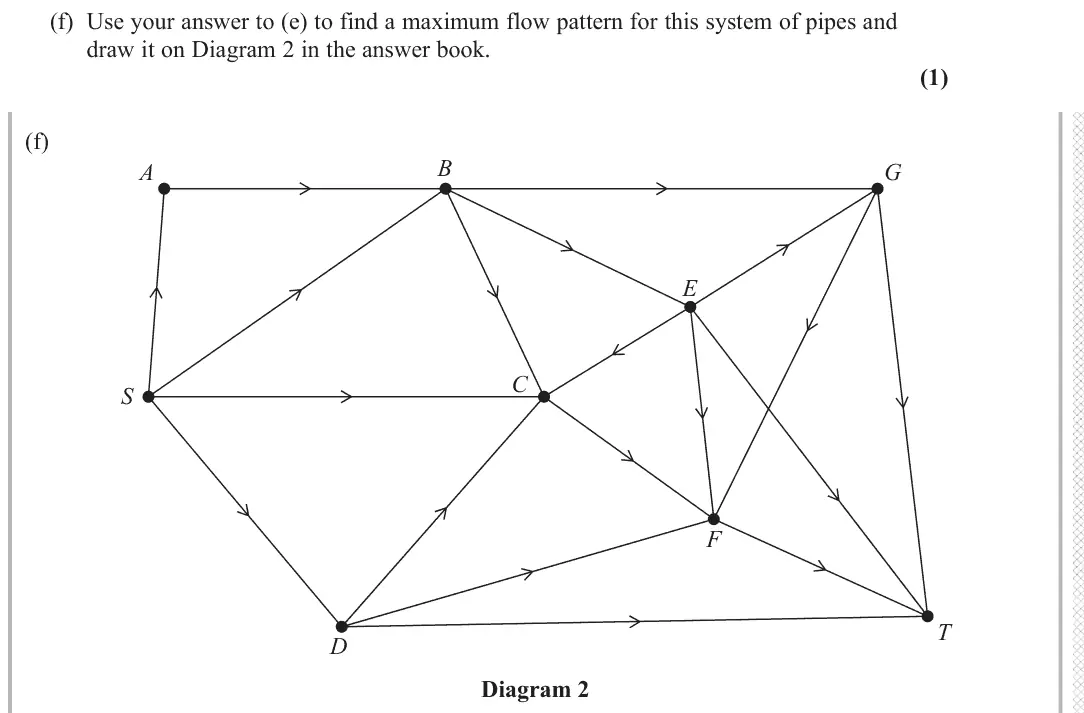
- flow of 43 with one number per arc, consistent at every vertex and within bounds

Mark scheme (whole question; this part is marked with the orange bar)
Key points from the mark scheme and examiner's report
- max-flow min-cut theorem: cut through AB, SB, BC, EC, CF, DF, DT with capacity 43 = flow, so maximal
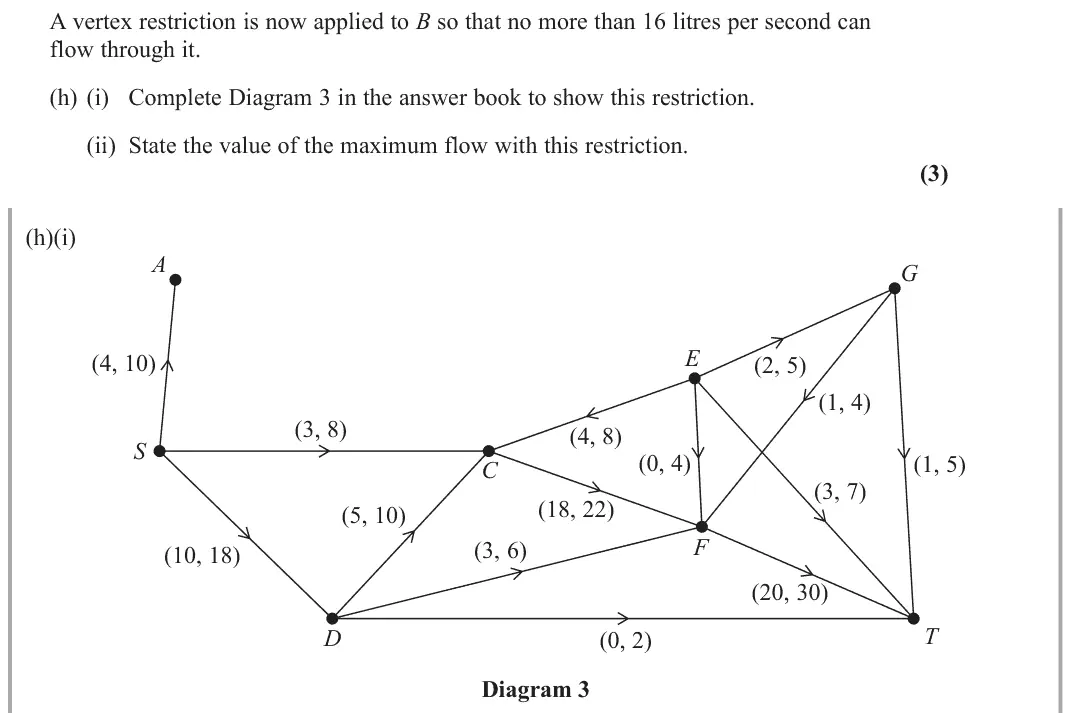
Mark scheme (whole question; this part is marked with the orange bar)
Key points from the mark scheme and examiner's report
- replace B by B_in and B_out joined by an arc of capacity (0, 16)
- arcs into B go to B_in, arcs out leave B_out
- maximum flow becomes 40
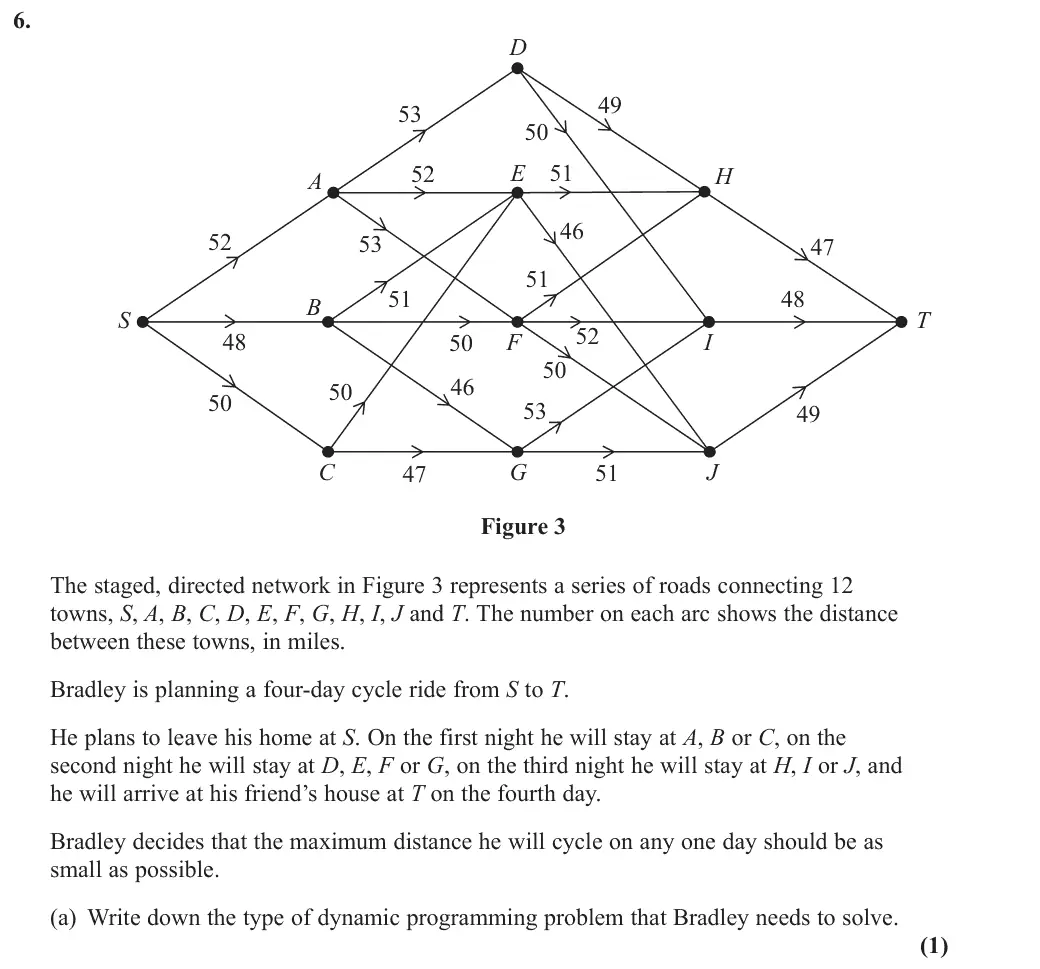
Mark scheme (whole question; this part is marked with the orange bar)
Key points from the mark scheme and examiner's report
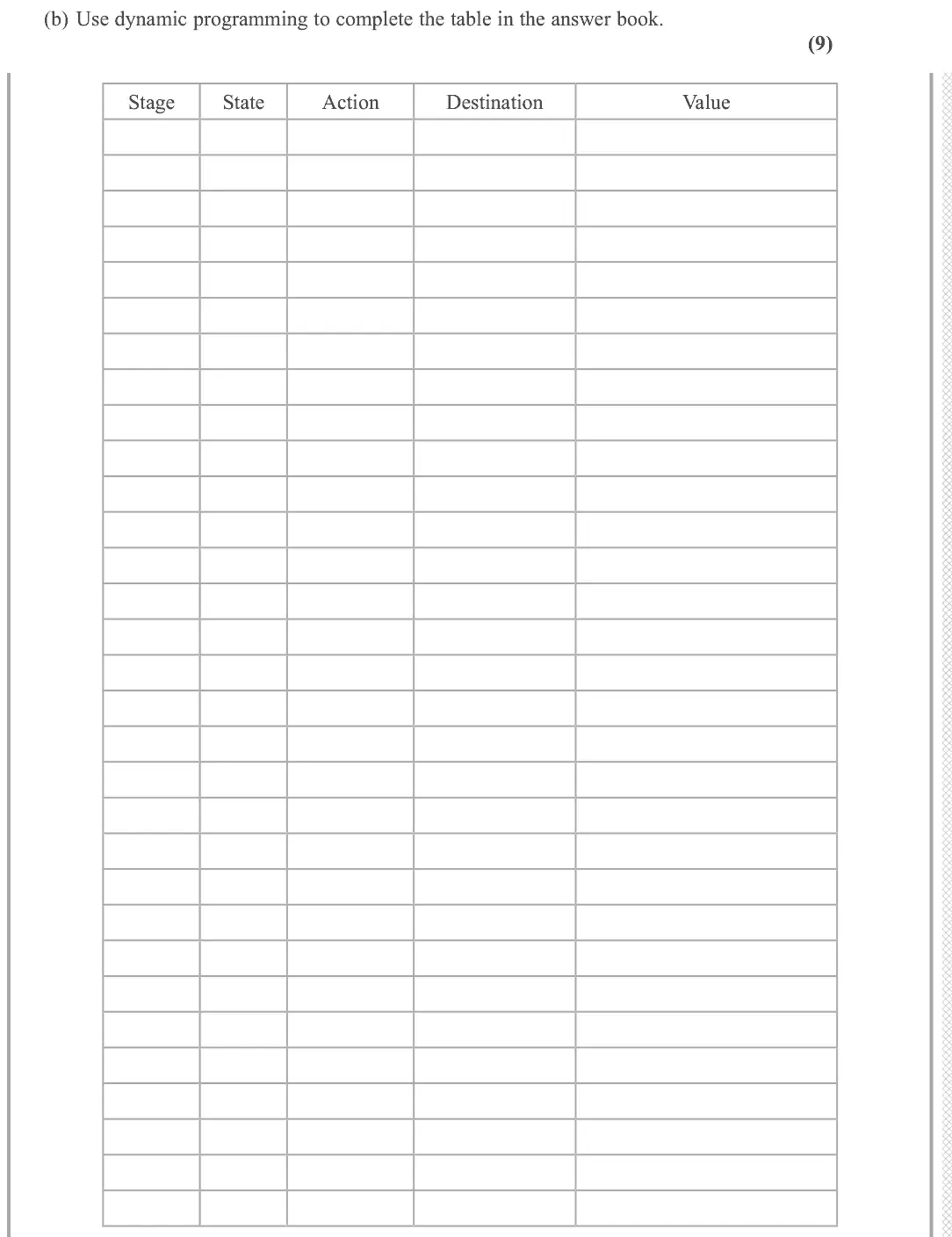
Mark scheme (whole question; this part is marked with the orange bar)
Key points from the mark scheme and examiner's report
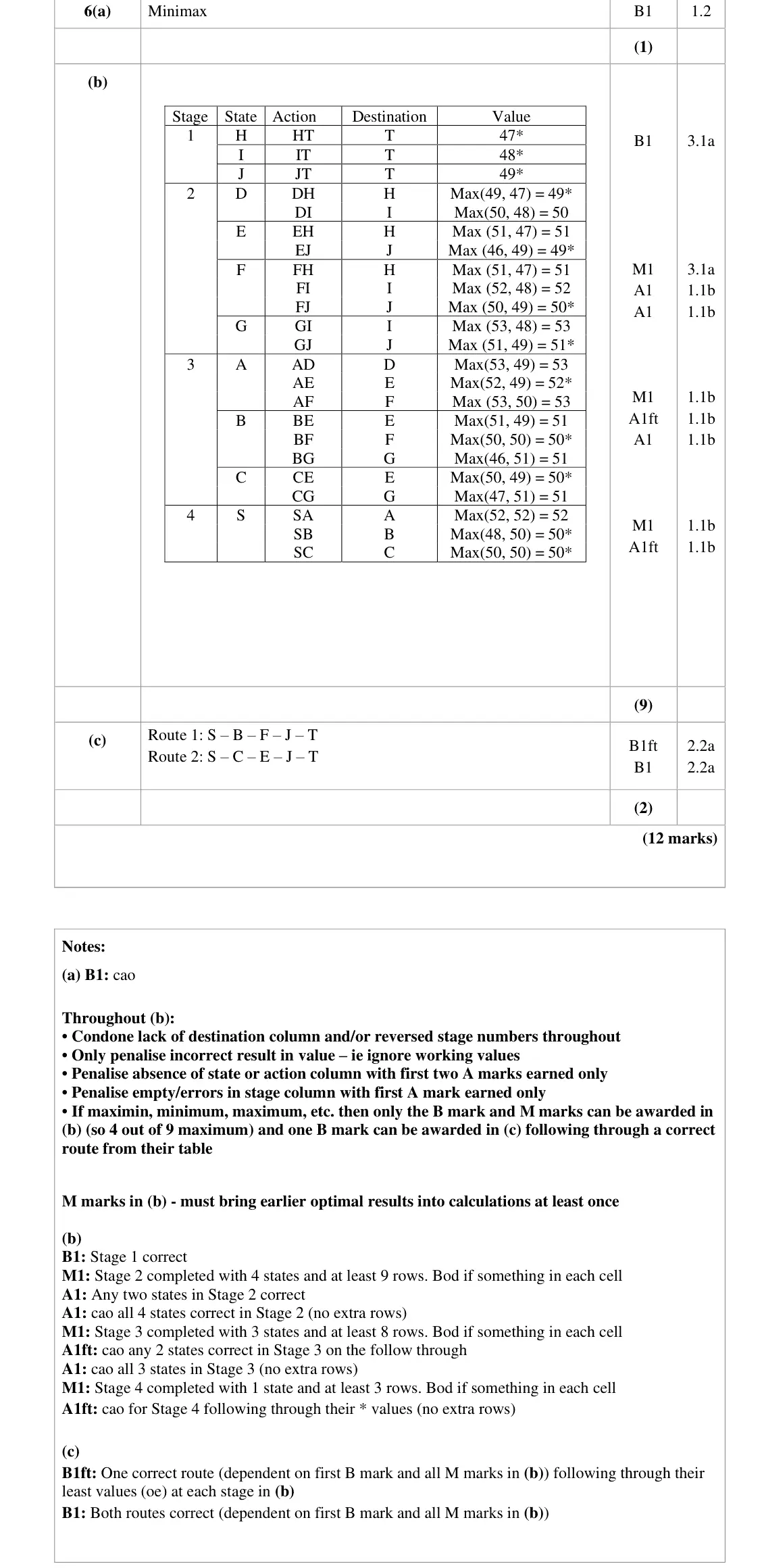
- value = max(arc, best from destination), keep the minimum at each state
- stage 1 H 47, I 48, J 49
- stage 2 has 9 rows
- S value 50
- using maximin, minimum or maximum scores at most 4

Mark scheme (whole question; this part is marked with the orange bar)
Key points from the mark scheme and examiner's report
- trace back: S–B–F–J–T and S–C–E–J–T
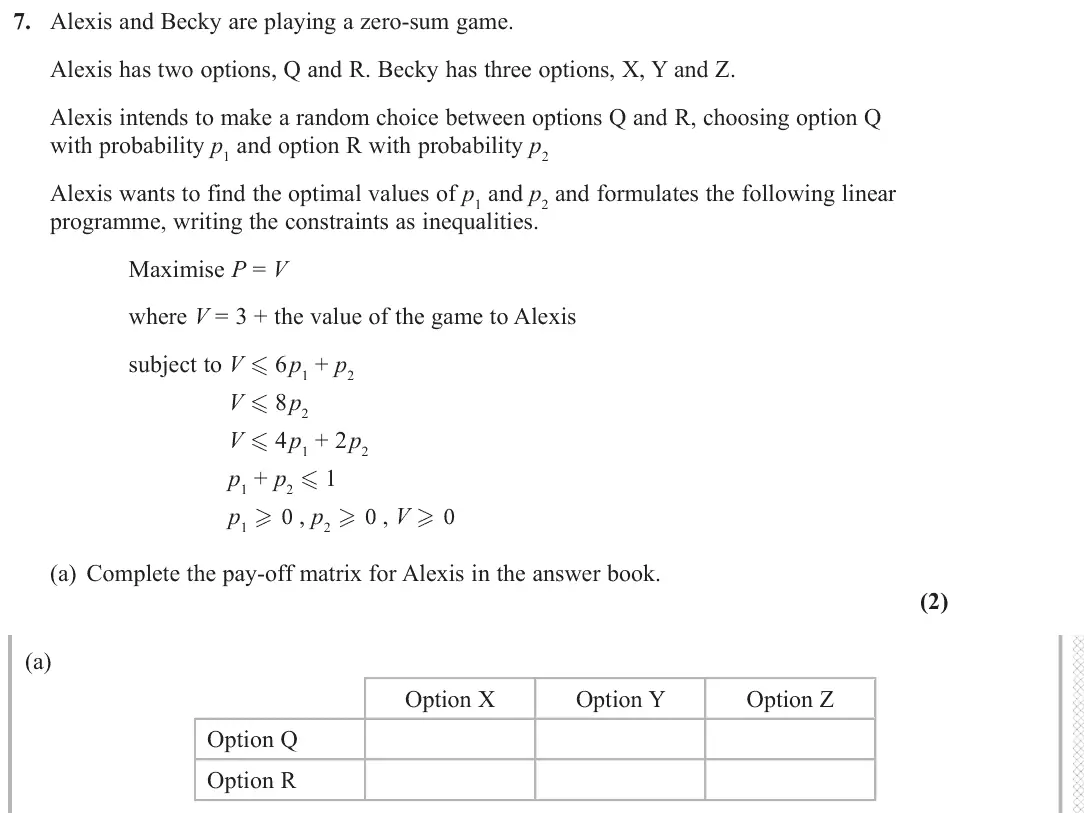
Mark scheme (whole question; this part is marked with the orange bar)
Key points from the mark scheme and examiner's report
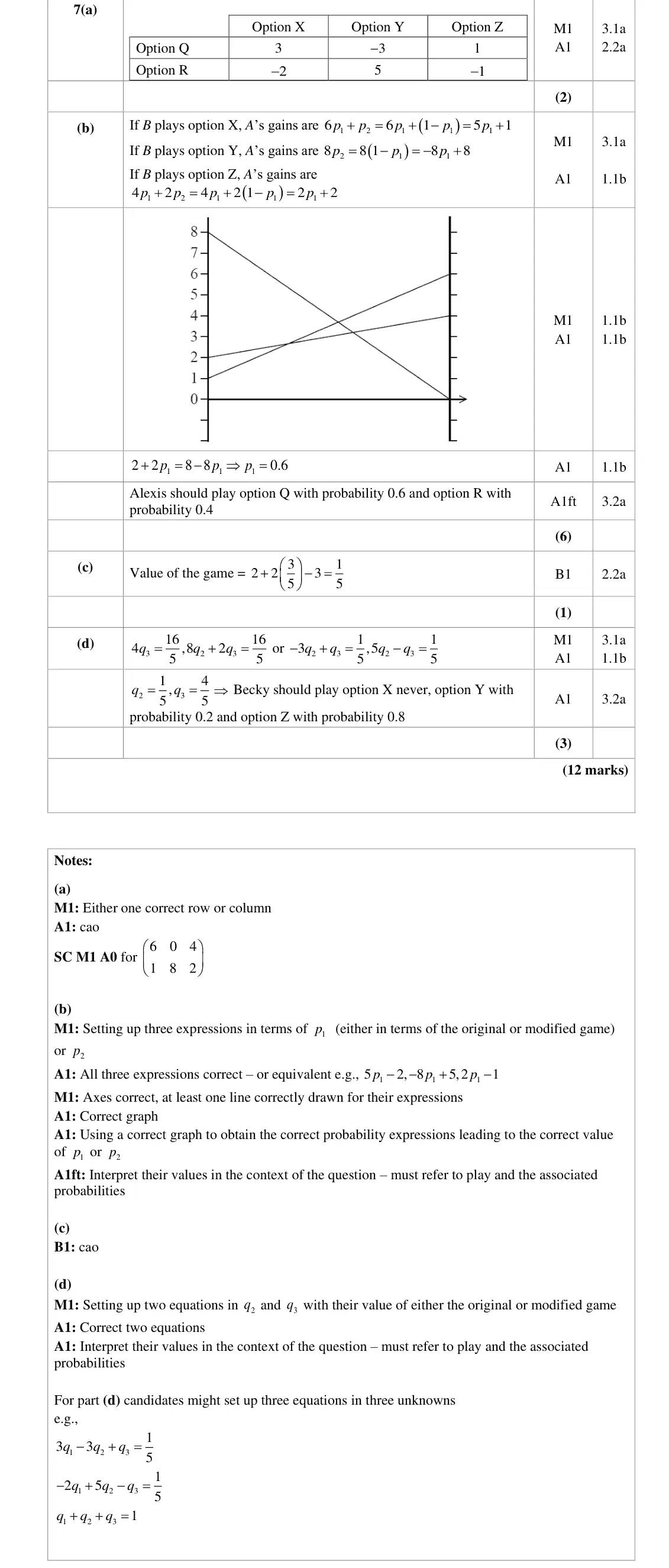
- subtract 3 from the LP coefficients: Q row 3, −3, 1
- R row −2, 5, −1
- forgetting to subtract 3 scores M1 A0

Mark scheme (whole question; this part is marked with the orange bar)
Key points from the mark scheme and examiner's report
- expected gains in terms of p1: X 5p1 − 2, Y 5 − 8p1, Z 2p1 − 1 (or +3 versions)
- lowest boundary, highest point where Y and Z meet: 2 + 2p1 = 8 − 8p1 so p1 = 0.6
- play Q with probability 0.6, R with 0.4

Mark scheme (whole question; this part is marked with the orange bar)
Key points from the mark scheme and examiner's report
- value 2 + 2(0.6) − 3 = 1/5

Mark scheme (whole question; this part is marked with the orange bar)
Key points from the mark scheme and examiner's report
- X is not used at the optimal point so q1 = 0
- equate Alexis's expected gains to 1/5 with q2 + q3 = 1: q2 = 1/5, q3 = 4/5
- never X, Y with probability 0.2, Z with 0.8
Find an Edexcel Further Maths tutor
Want this paper marked and gone through with a Further Maths tutor? Message us.
Prefer email? Send an enquiry