Oct 2020: A level Paper 4D: Decision Mathematics 2
75 marks · 25 question parts · Question paper, mark scheme and examiner's report on Pearson's site
Question by question
The questions
Mark scheme (whole question; this part is marked with the orange bar)
Key points from the mark scheme and examiner's report
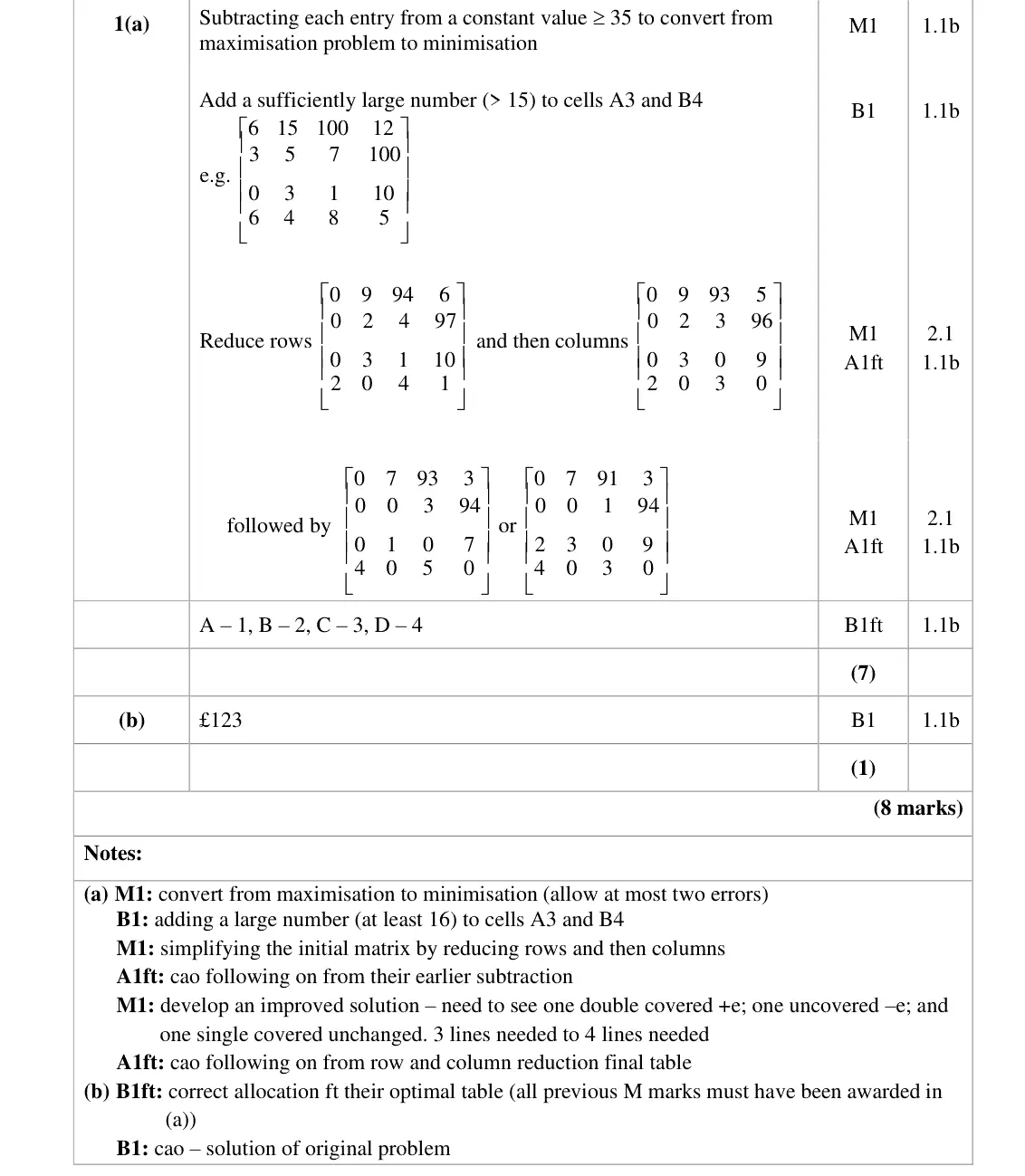
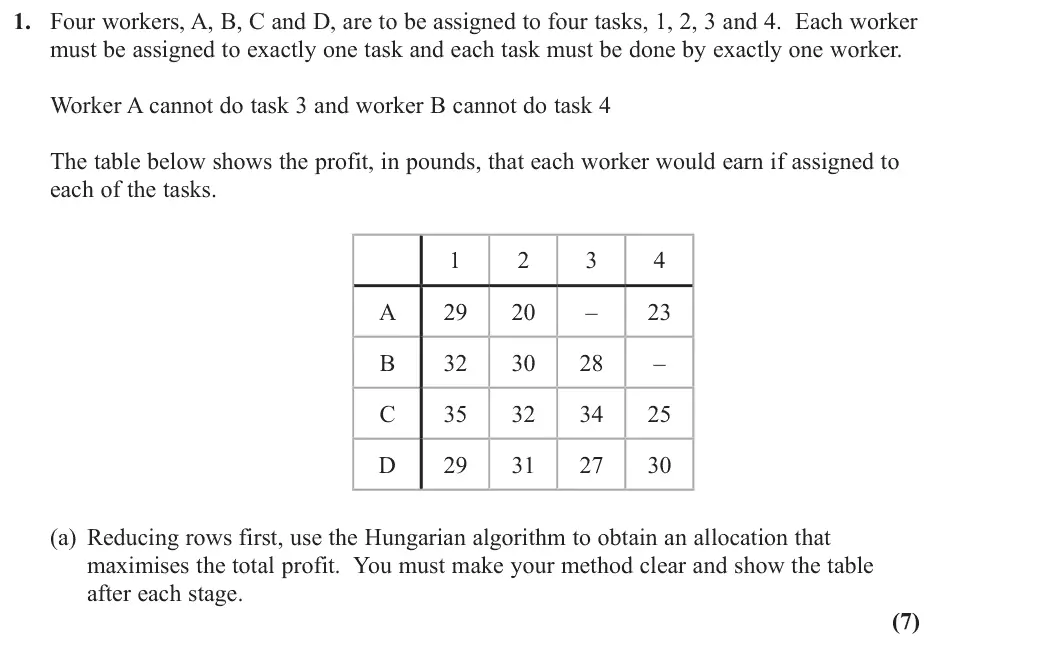
- subtract every entry from 35 (largest value) to convert to minimisation
- give the forbidden cells A3 and B4 a large cost (more than 15)
- reduce rows then columns, then augment from 3 lines to 4
- A1, B2, C3, D4

Mark scheme (whole question; this part is marked with the orange bar)
Key points from the mark scheme and examiner's report
- total profit from the original table: £123
Mark scheme (whole question; this part is marked with the orange bar)
Key points from the mark scheme and examiner's report
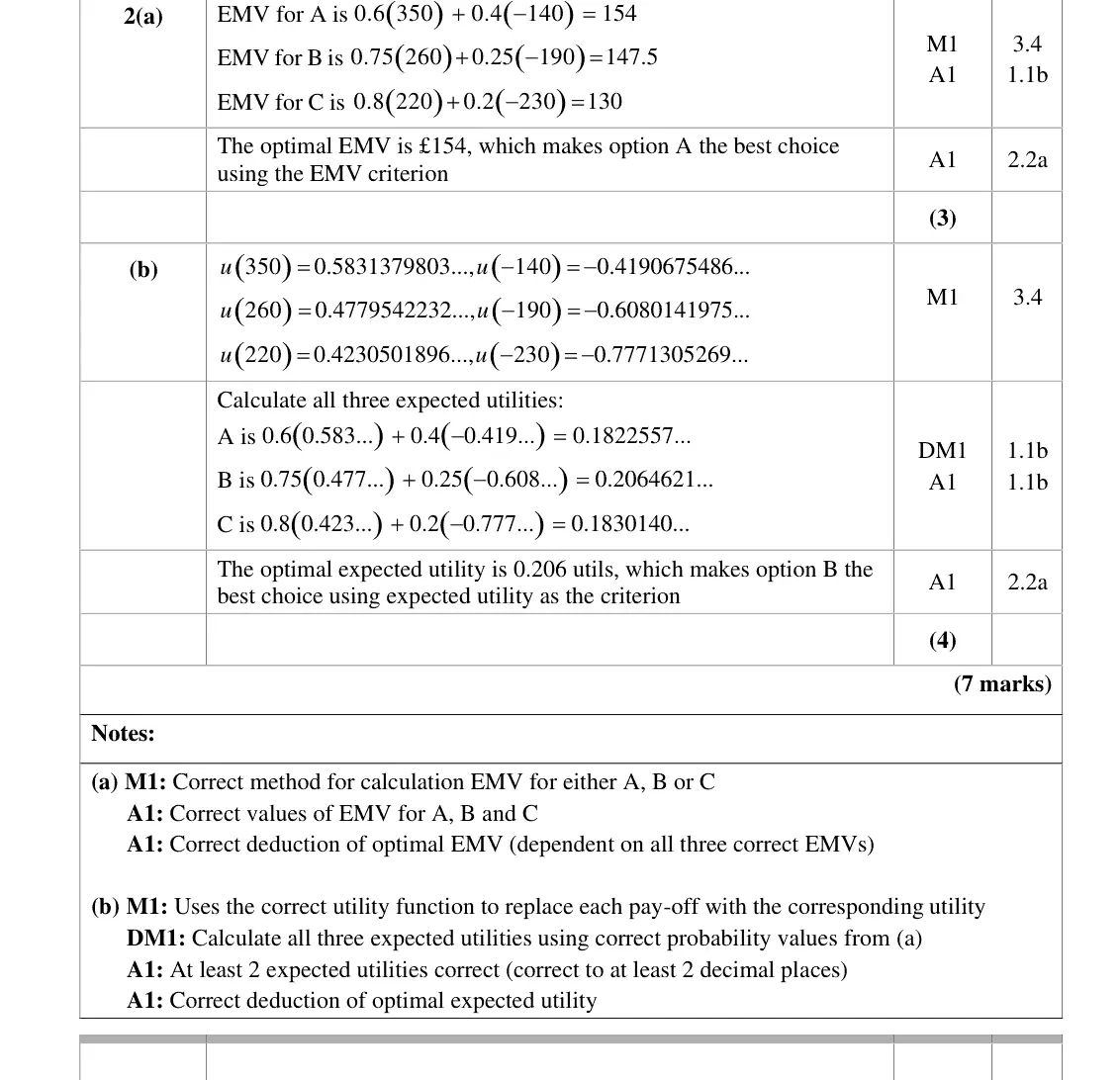
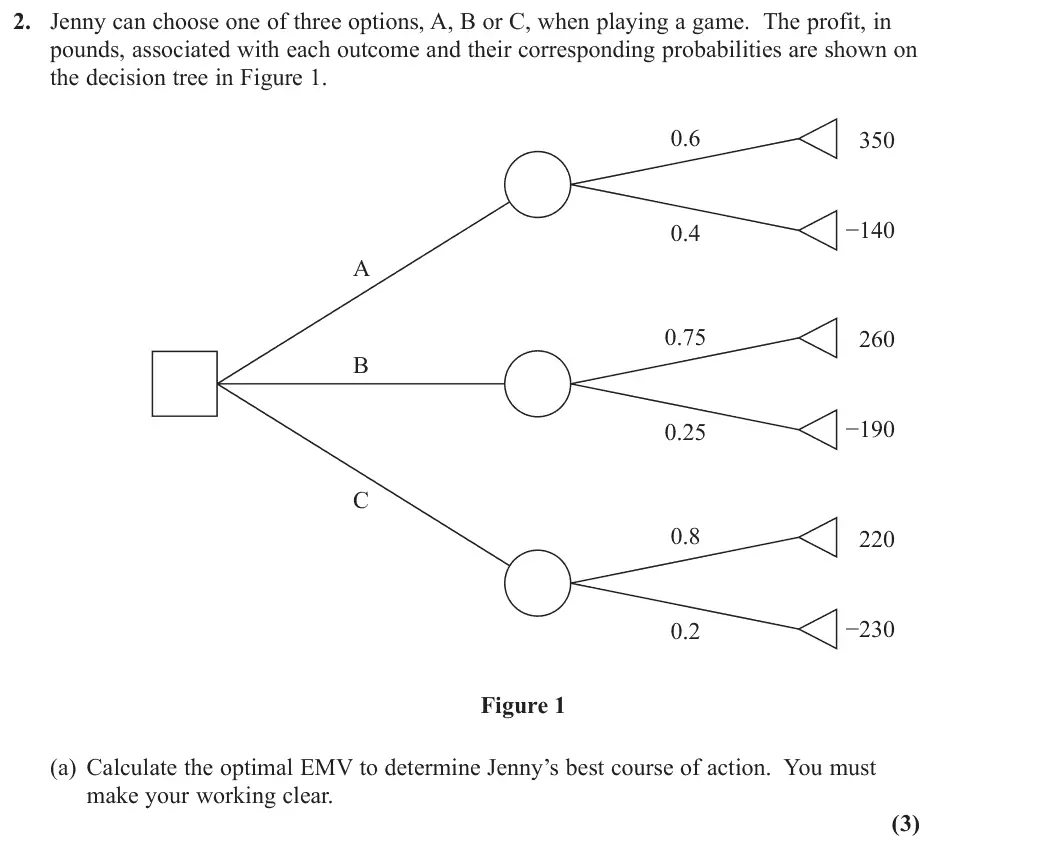
- EMVs A 154, B 147.5, C 130
- optimal EMV £154 so choose A

Mark scheme (whole question; this part is marked with the orange bar)
Key points from the mark scheme and examiner's report
- replace each pay-off by its utility 1 − e^(−x/400) (negative for losses), then expected utilities A 0.182, B 0.206, C 0.183
- choose B
- at least 2 expected utilities correct to 2 dp
Mark scheme (whole question; this part is marked with the orange bar)
Key points from the mark scheme and examiner's report
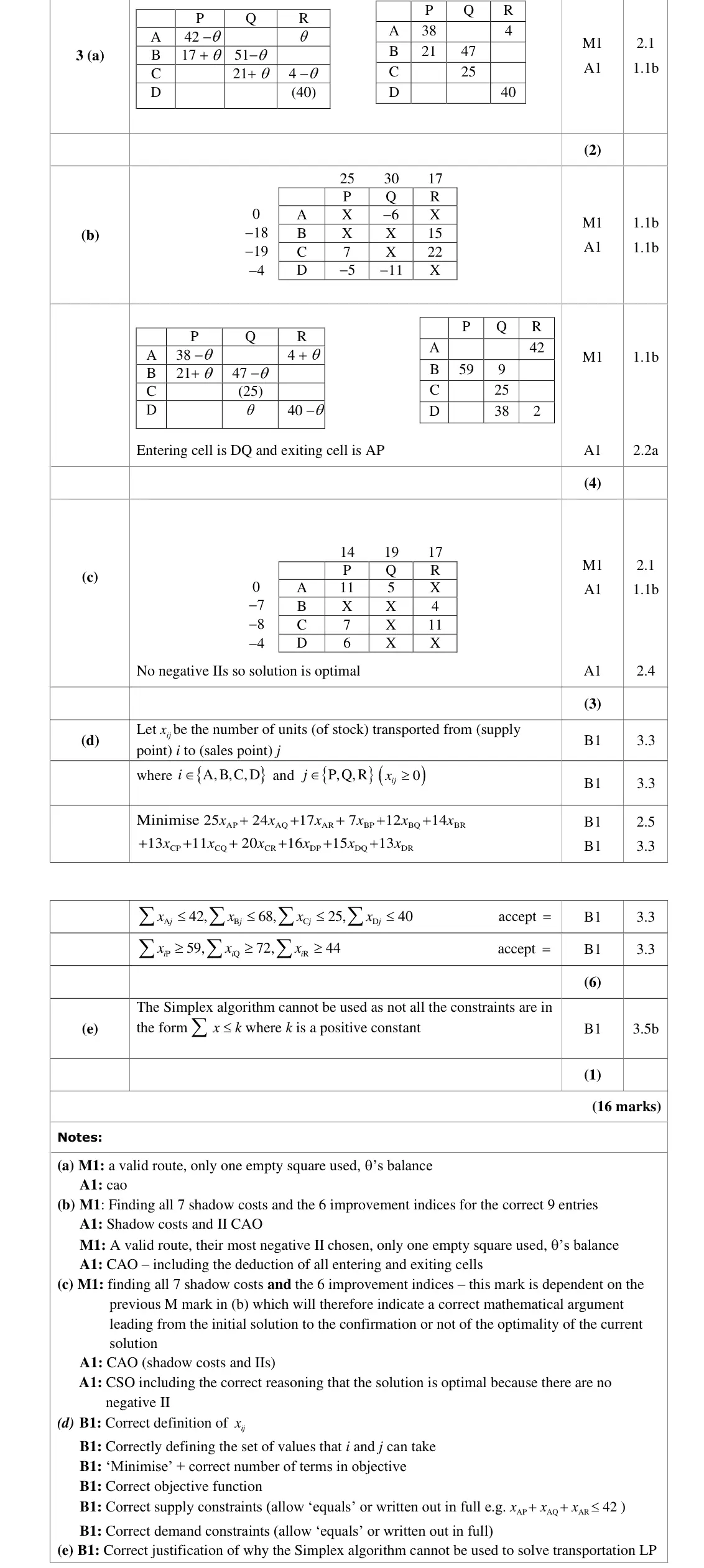
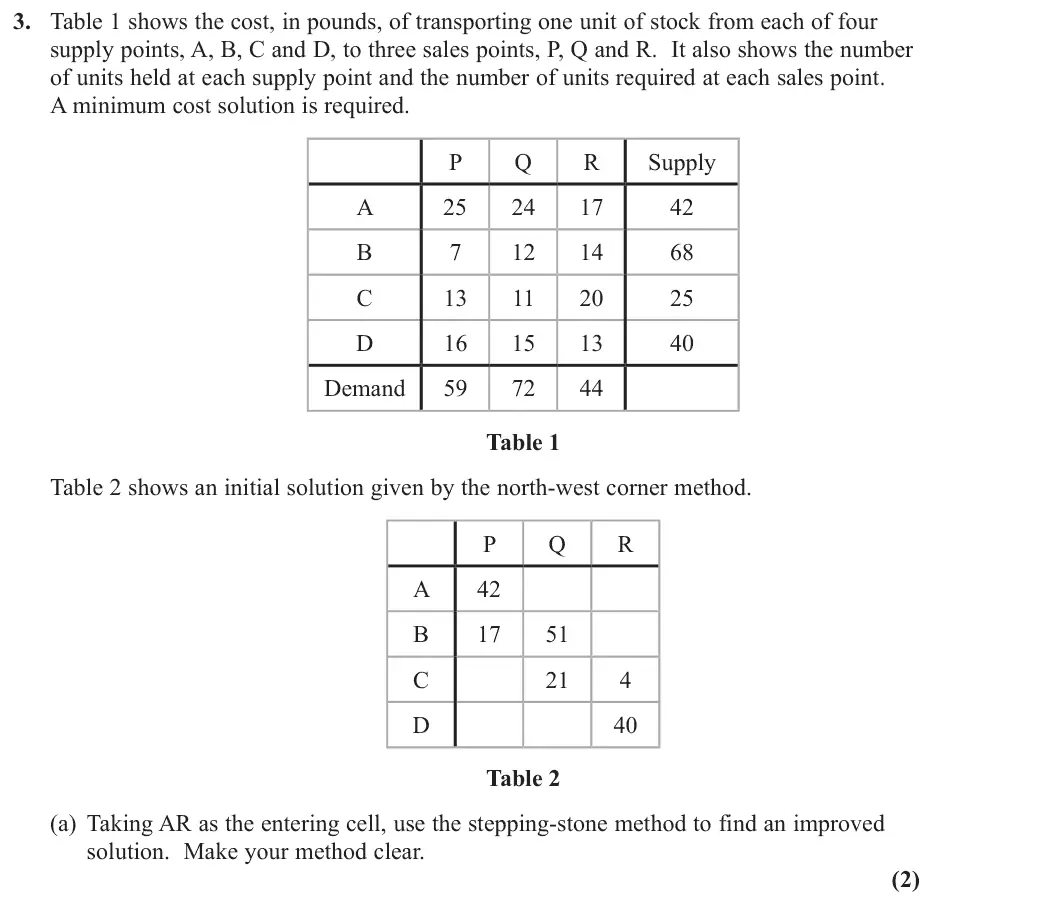
- route AR, CR, CQ, BQ, BP, AP with theta = 4
- AP 38, AR 4, BP 21, BQ 47, CQ 25, DR 40
Mark scheme (whole question; this part is marked with the orange bar)
Key points from the mark scheme and examiner's report
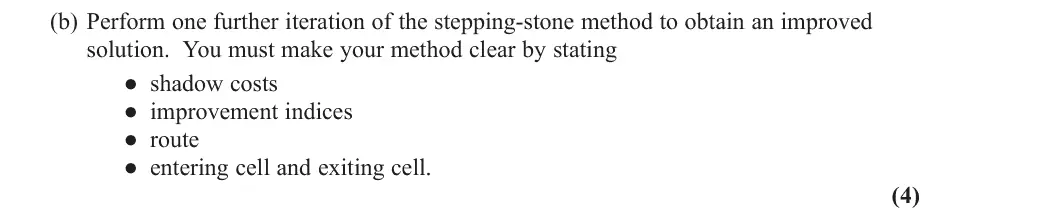
- 7 shadow costs and 6 improvement indices
- most negative II is DQ (−11)
- entering DQ, exiting AP
- AR 42, BP 59, BQ 9, CQ 25, DQ 38, DR 2

Mark scheme (whole question; this part is marked with the orange bar)
Key points from the mark scheme and examiner's report
- recalculate all shadow costs and IIs for the new solution
- no negative IIs so optimal

Mark scheme (whole question; this part is marked with the orange bar)
Key points from the mark scheme and examiner's report
- define x_ij as units from supply point i to sales point j with i in {A, B, C, D}, j in {P, Q, R}, x_ij ≥ 0
- minimise the cost-weighted sum of all 12 variables
- supply constraints ≤ 42, 68, 25, 40 and demand constraints ≥ 59, 72, 44

Mark scheme (whole question; this part is marked with the orange bar)
Key points from the mark scheme and examiner's report
- Simplex needs every constraint in the form sum ≤ positive constant
- the demand constraints are ≥
Mark scheme (whole question; this part is marked with the orange bar)
Key points from the mark scheme and examiner's report
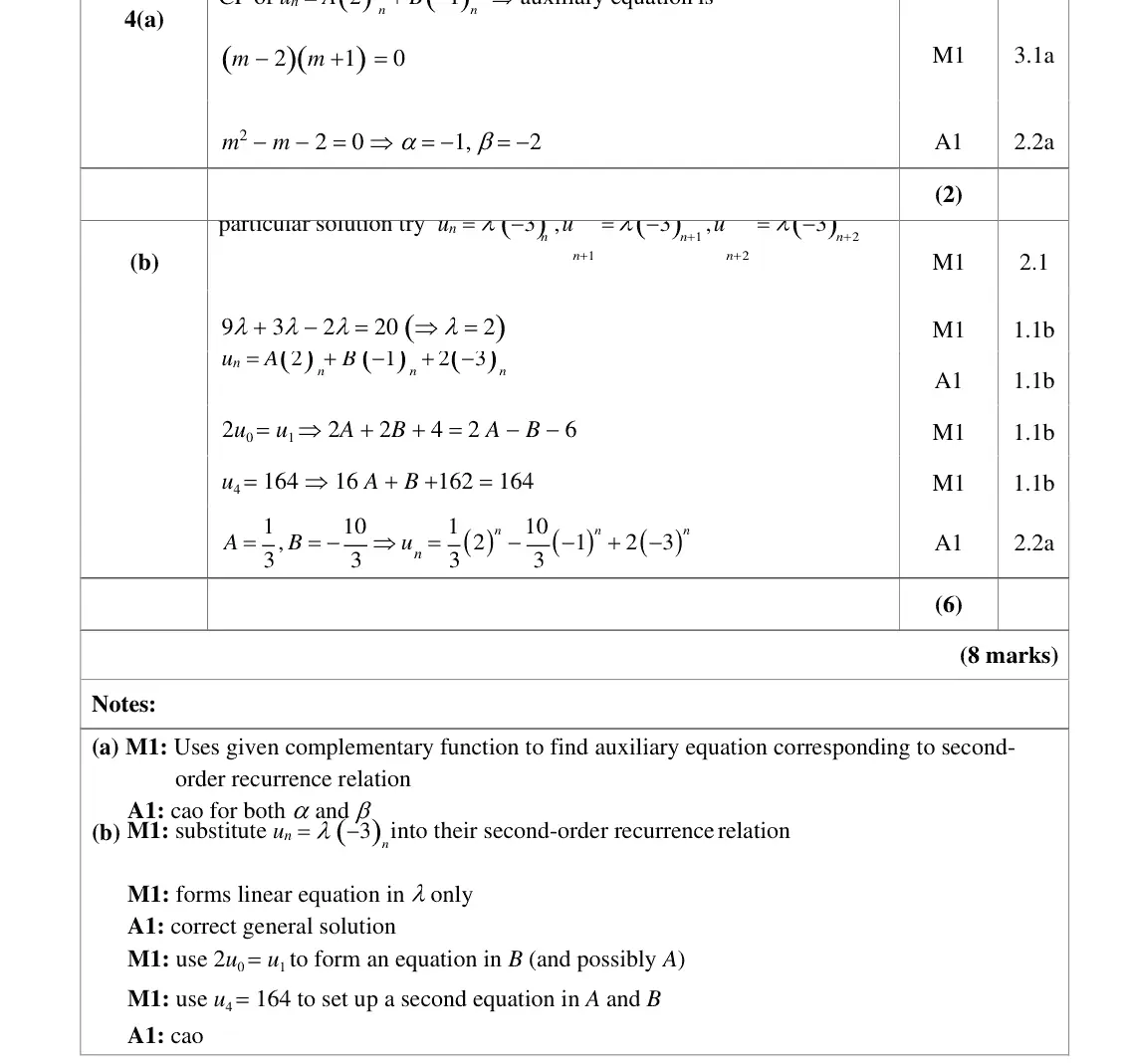
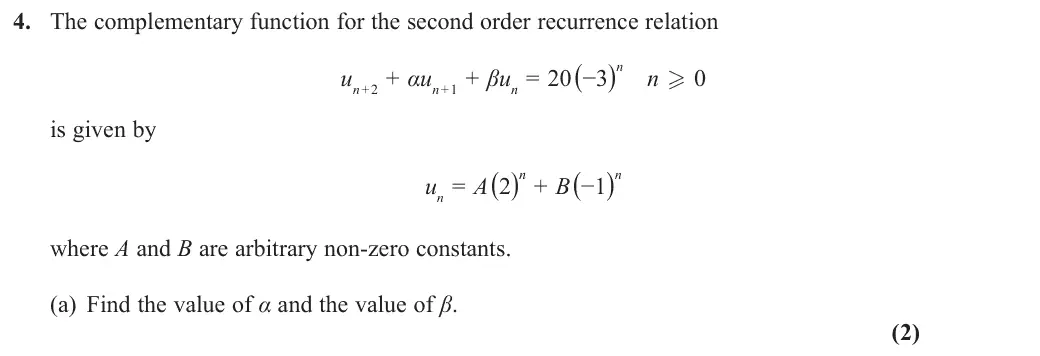
- roots 2 and −1 give auxiliary equation (m − 2)(m + 1) = m² − m − 2 = 0, so α = −1, β = −2

Mark scheme (whole question; this part is marked with the orange bar)
Key points from the mark scheme and examiner's report
- PS λ(−3)ⁿ: 9λ + 3λ − 2λ = 20, λ = 2
- use 2u0 = u1 and u4 = 164 to form two equations
- A = 1/3, B = −10/3: u_n = (1/3)2ⁿ − (10/3)(−1)ⁿ + 2(−3)ⁿ
Mark scheme (whole question; this part is marked with the orange bar)
Key points from the mark scheme and examiner's report
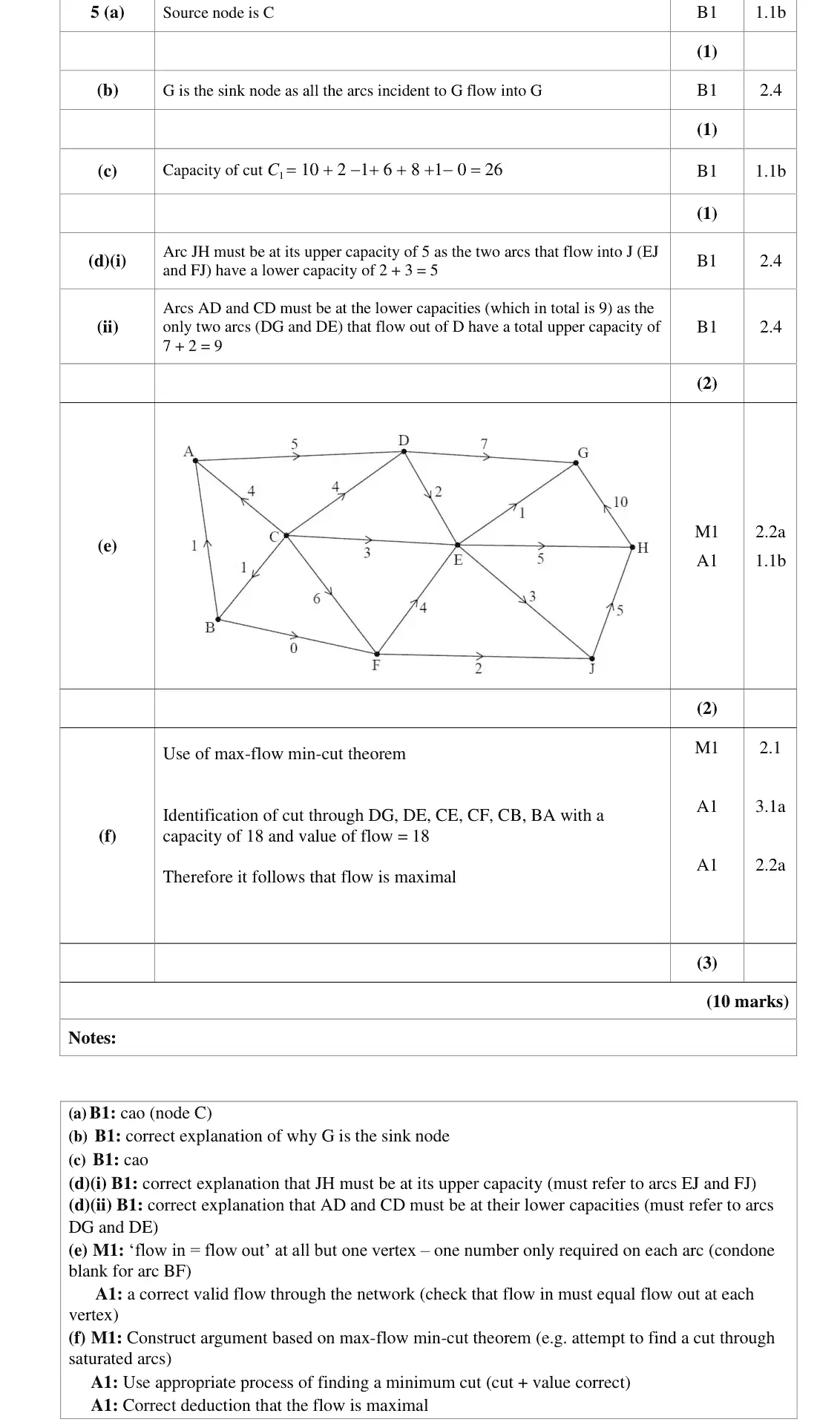
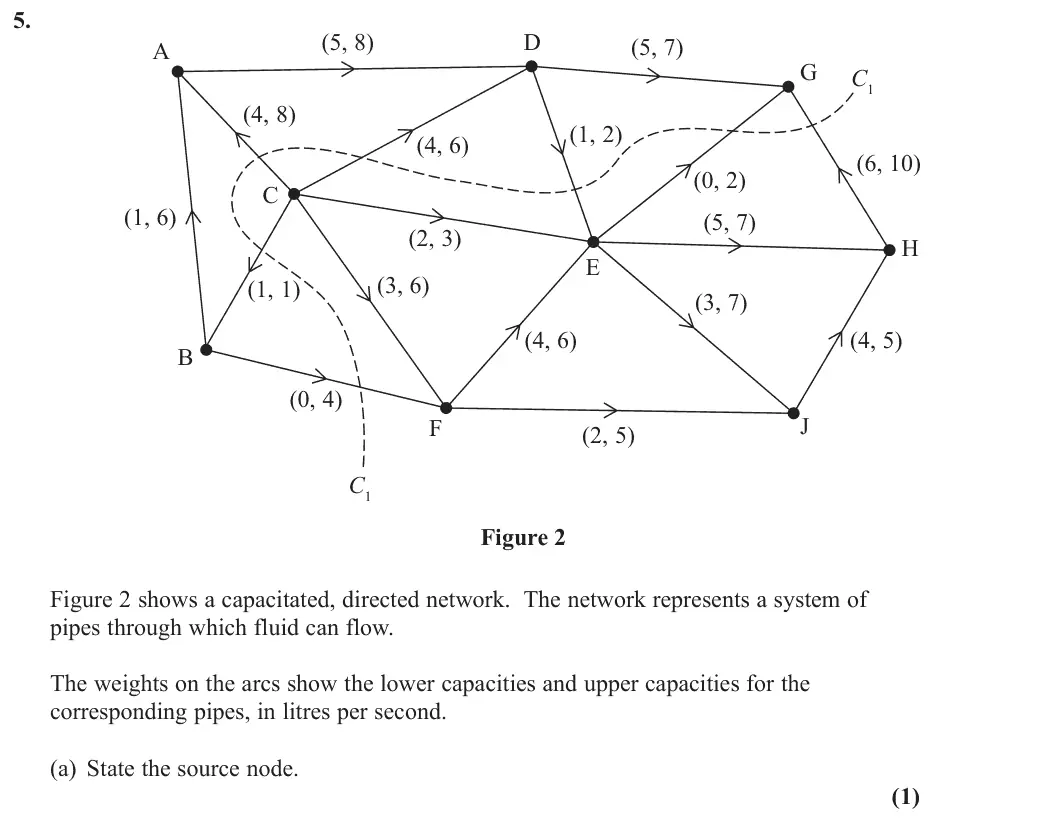
- source is C (all arcs at C point away)

Mark scheme (whole question; this part is marked with the orange bar)
Key points from the mark scheme and examiner's report
- every arc incident to G flows into G

Mark scheme (whole question; this part is marked with the orange bar)
Key points from the mark scheme and examiner's report
- add upper capacities of arcs crossing from source side to sink side, subtract lower capacities of arcs crossing back: 10 + 2 − 1 + 6 + 8 + 1 − 0 = 26

Mark scheme (whole question; this part is marked with the orange bar)
Key points from the mark scheme and examiner's report
- (i) lower capacities into J (EJ, FJ) total 2 + 3 = 5 = upper capacity of JH
- (ii) upper capacities out of D (DG, DE) total 7 + 2 = 9 = lower capacities of AD + CD
- must name these arcs
Mark scheme (whole question; this part is marked with the orange bar)
Key points from the mark scheme and examiner's report
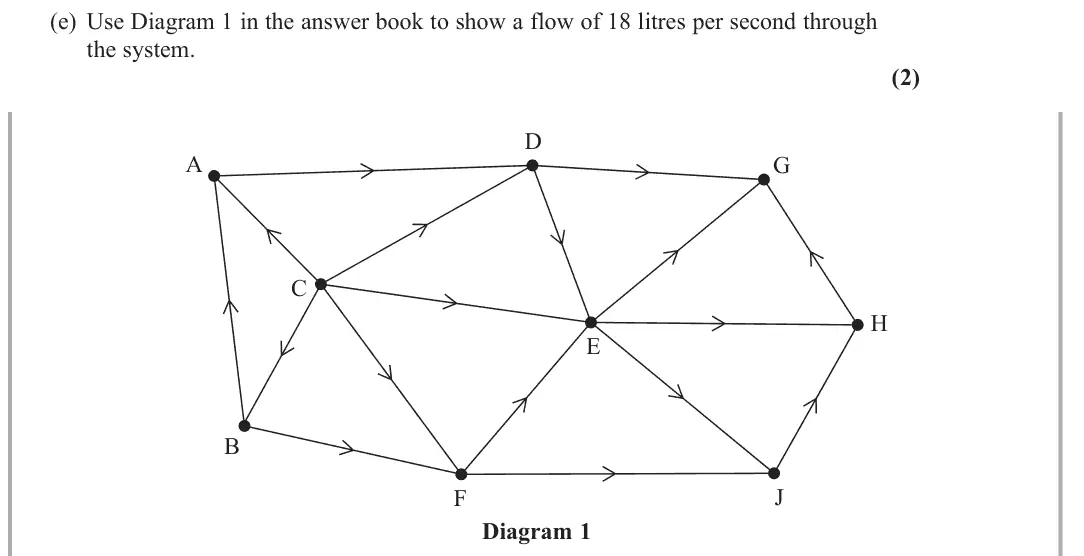
- one number per arc, flow in = flow out at every vertex, all flows within the (lower, upper) bounds

Mark scheme (whole question; this part is marked with the orange bar)
Key points from the mark scheme and examiner's report
- max-flow min-cut theorem: cut through DG, DE, CE, CF, CB, BA has capacity 18 = flow, so maximal
Mark scheme (whole question; this part is marked with the orange bar)
Key points from the mark scheme and examiner's report
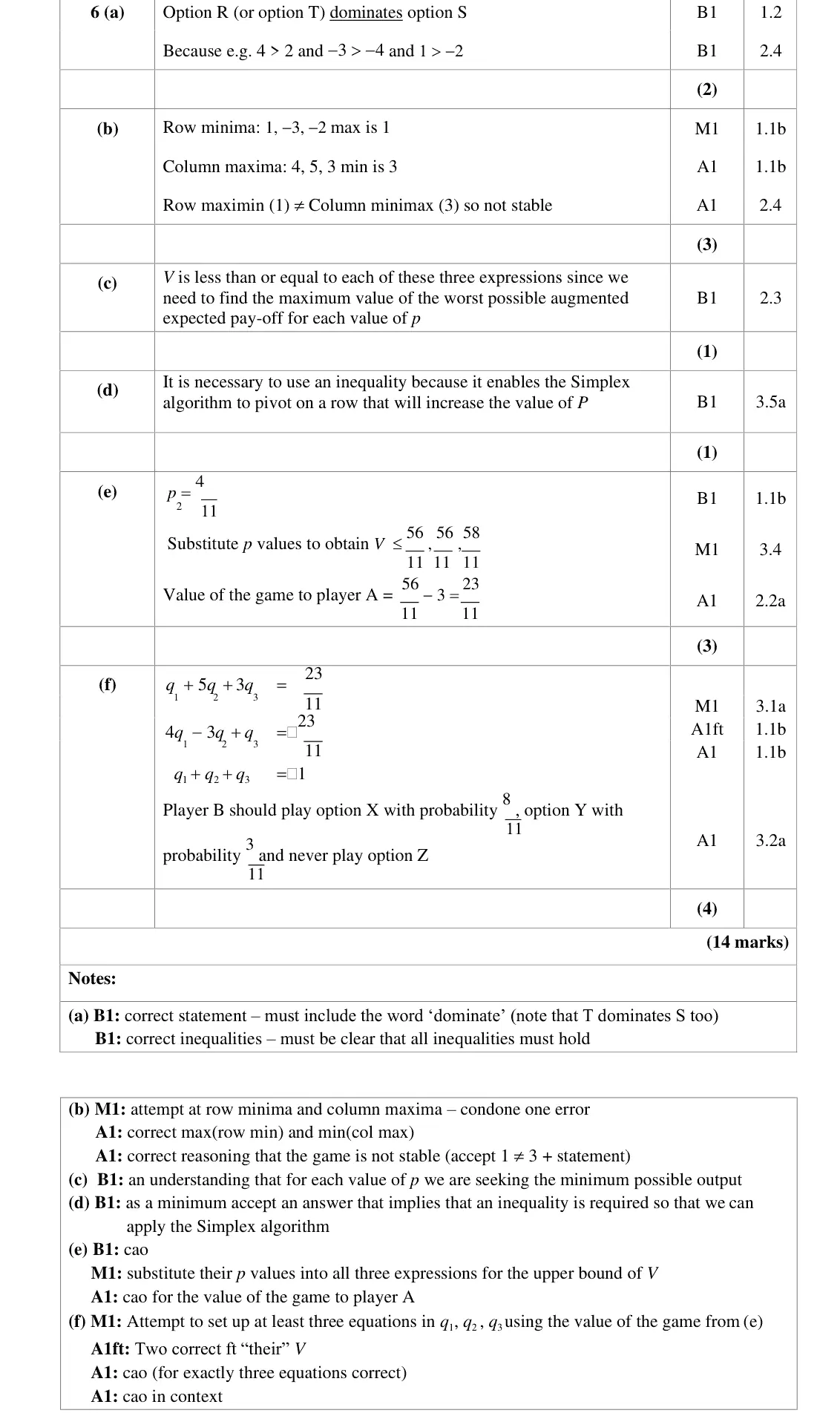
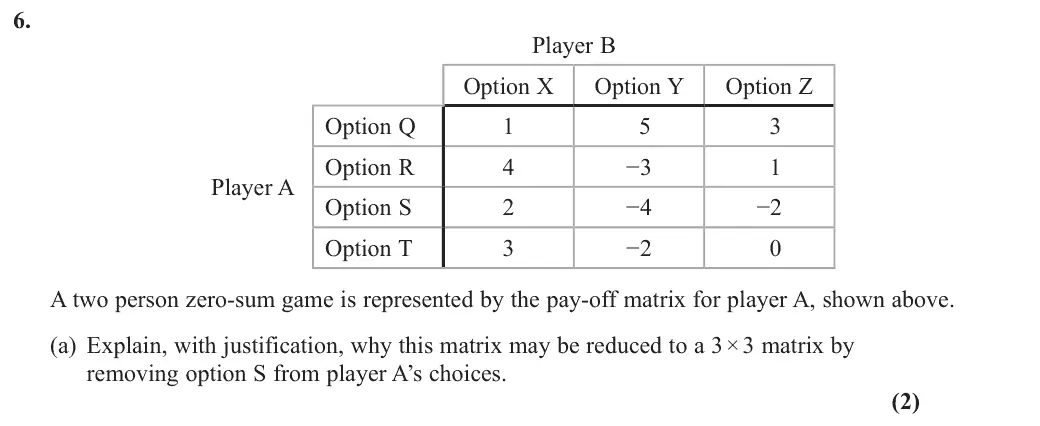
- R (or T) dominates S since 4 > 2, −3 > −4, 1 > −2
- must use the word 'dominate' and show all inequalities

Mark scheme (whole question; this part is marked with the orange bar)
Key points from the mark scheme and examiner's report
- row minima 1, −3, −2 so maximin 1
- column maxima 4, 5, 3 so minimax 3
- 1 ≠ 3 so not stable
Mark scheme (whole question; this part is marked with the orange bar)
Key points from the mark scheme and examiner's report
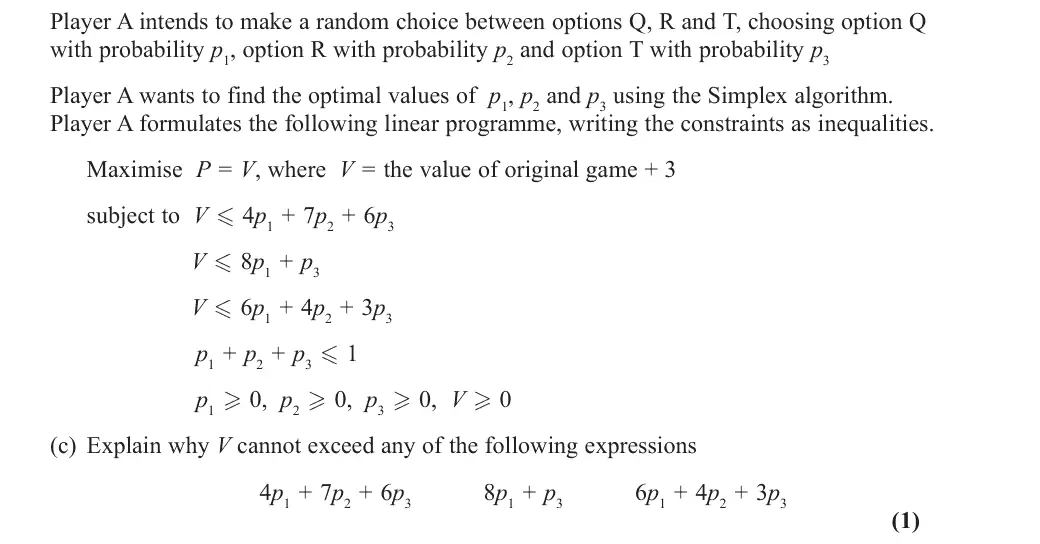
- V is the minimum expected (augmented) pay-off over B's options, so V ≤ each expression and we maximise that worst case

Mark scheme (whole question; this part is marked with the orange bar)
Key points from the mark scheme and examiner's report
- an inequality (not = 1) is needed so the Simplex algorithm can be applied and pivot to increase P

Mark scheme (whole question; this part is marked with the orange bar)
Key points from the mark scheme and examiner's report
- p2 = 4/11
- substitute into all three expressions: V ≤ 56/11, 56/11, 58/11 so V = 56/11
- subtract the 3 added: value 23/11

Mark scheme (whole question; this part is marked with the orange bar)
Key points from the mark scheme and examiner's report
- set expected pay-offs to A for rows Q and R equal to 23/11 with q1 + q2 + q3 = 1: q1 + 5q2 + 3q3 = 23/11, 4q1 − 3q2 + q3 = 23/11
- X with probability 8/11, Y 3/11, never Z
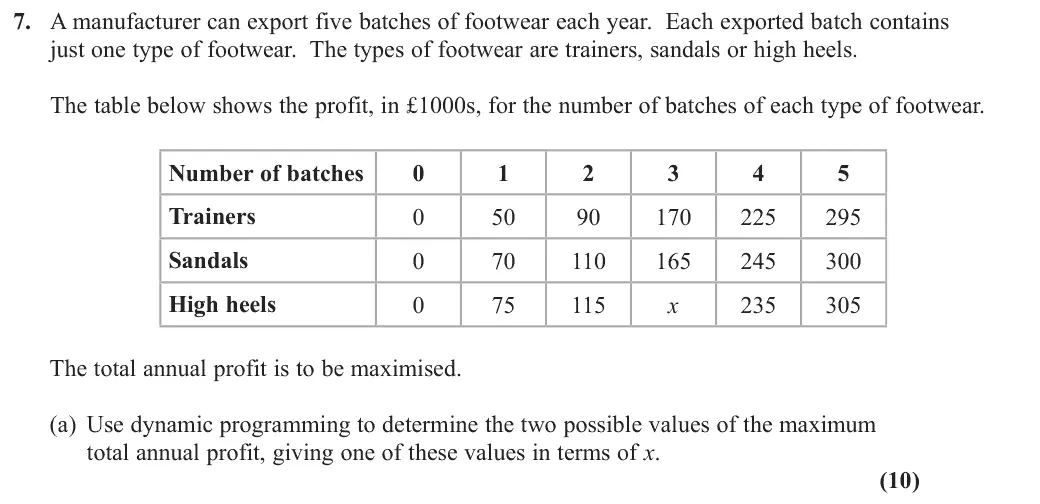
Mark scheme (whole question; this part is marked with the orange bar)
Key points from the mark scheme and examiner's report
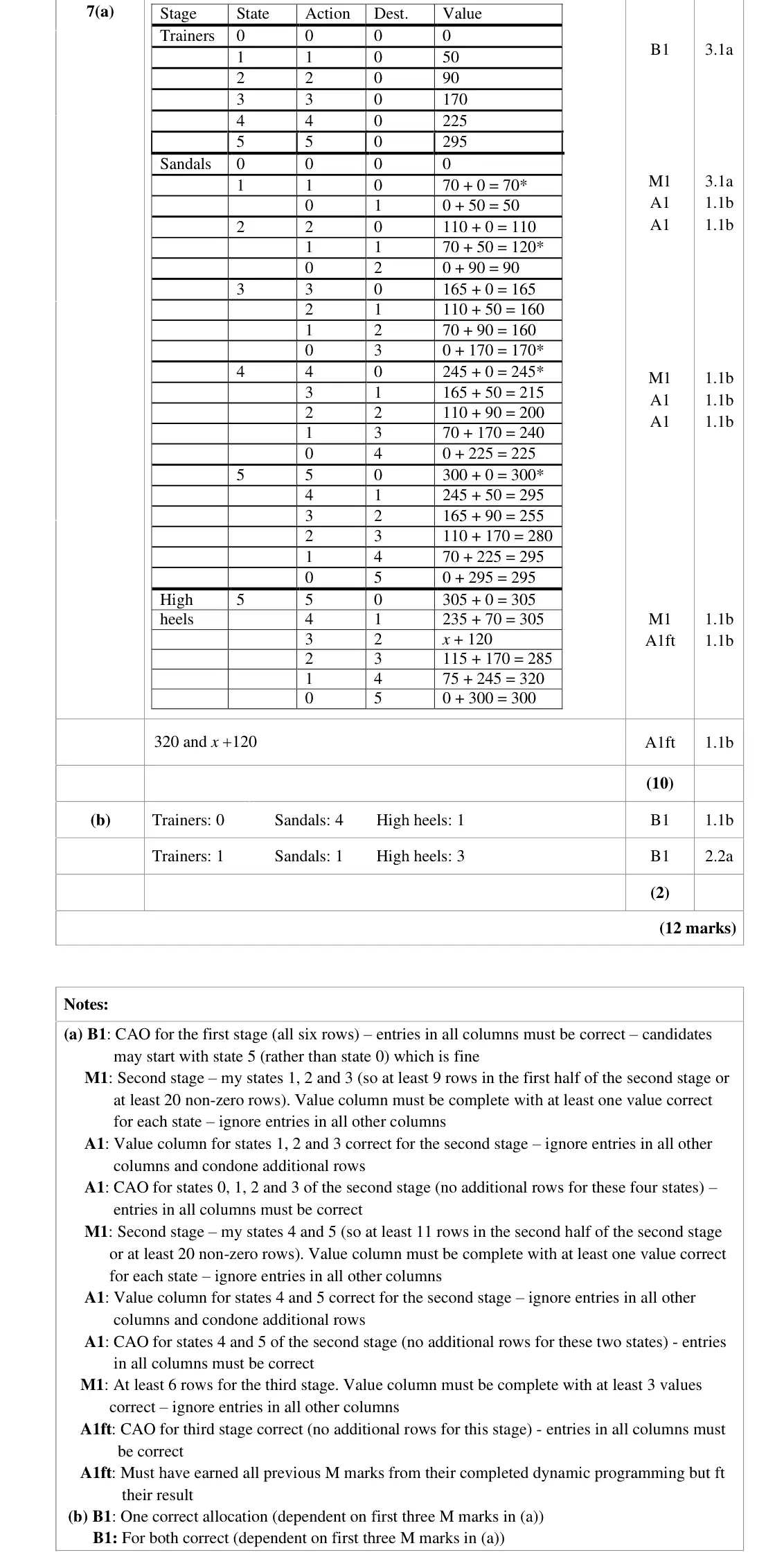
- stages trainers, sandals, high heels
- states = batches available
- full stage 2 has 21 rows (states 0 to 5)
- final stage values 305, 305, x + 120, 285, 320, 300
- maximum 320 or x + 120

Mark scheme (whole question; this part is marked with the orange bar)
Key points from the mark scheme and examiner's report
- trace back: trainers 0, sandals 4, high heels 1, or trainers 1, sandals 1, high heels 3 (when x = 200)
Find an Edexcel Further Maths tutor
Want this paper marked and gone through with a Further Maths tutor? Message us.
Prefer email? Send an enquiry