Examiner's comment
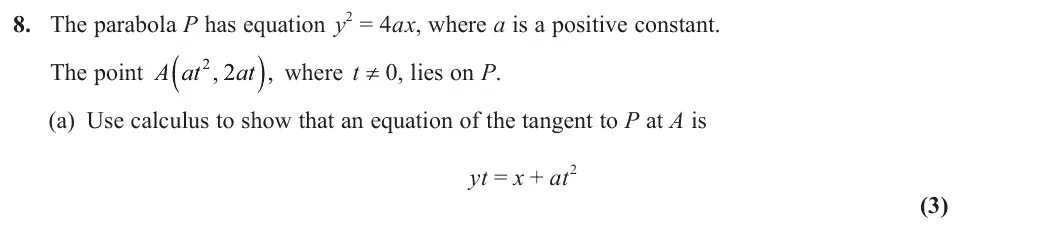
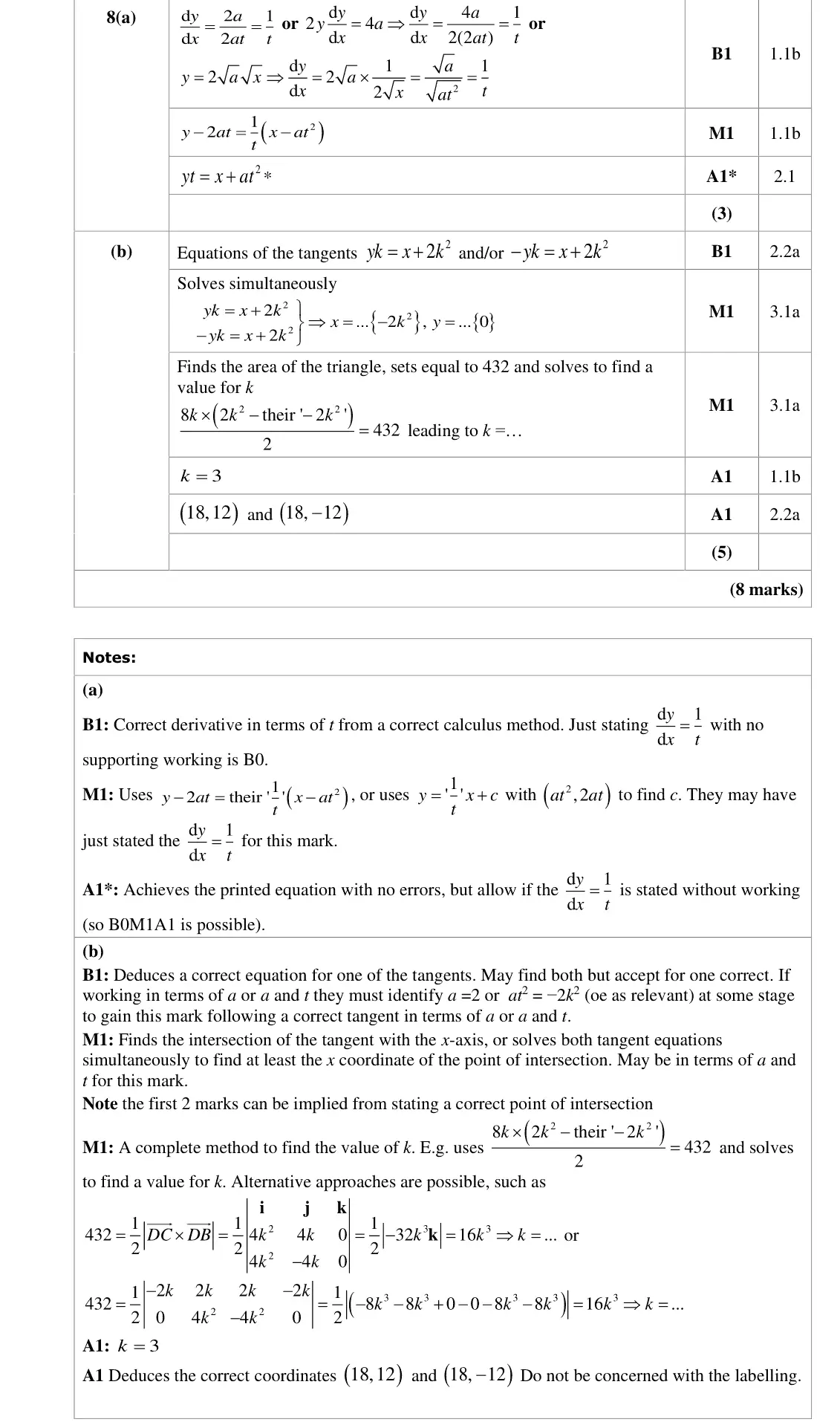
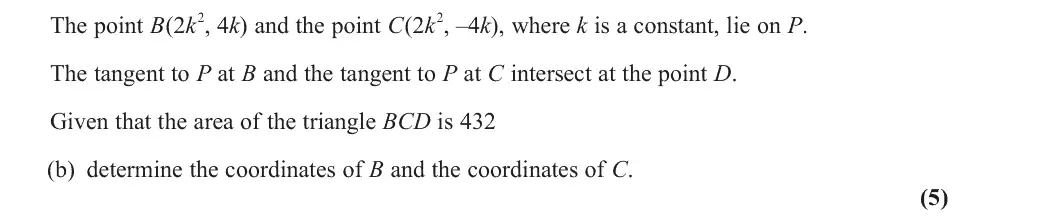
This second coordinate geometry question on the paper again provided some degree of discrimination in part (b), where many candidates failed to identify the values of a and t at the given points. This led to more complicated equations that needed, and often ground to a halt. In Part (b), most candidates realised the need to find the point of intersection of the two tangents at B and C, and tried to do so, but most did not immediately or at all realise that a = 2 and t = k^2 at the points B and C, and attempting to solve for equations of tangents in terms of a and t. This often led to them making little progress in the question with a score profile B0M1M0A0A0 being very common. It was also remarkable how many candidates failed to use the answer to (a) to deduce the tangents but instead resorted to recalculating the gradients for each point and setting up the tangents again from scratch. Usually this was done correctly but overlooks the point of having asked part (a). Having found the point of intersection, whether in terms of just k or in terms of k, a and t, there was usually an attempt to consider the area of the triangle, but due to the complicated or incorrect coordinates of the point of intersection, many candidates failed to find a value for k meaning the second method was inaccessible. Sometimes candidates did manage to work out a = 2 at this late stage (with copious amounts of work preceding it) to recover the situation, but mostly it was those who realise a = 2 from the outset who managed to access beyond the second mark. The method for the area of the triangle did vary, and although most used the direct approach, attempts at the cross-product formula, or shoelace method, were seen, while some attempted an incorrect dot product formula. Again, these were applied with a mix of k, a and t in the equations, though some erroneous methods managed to eliminate the a and t conveniently, but no further marks were available in any case. For the candidates who realised at some point in the solution the values of a and t, most were successful in eventually finding the value of k and correct coordinates, though slips with the triangle area formulae were sometimes made. The correct value of k, or correct coordinates, did occasionally arise from incorrect, or suspect working, such as erroneously arriving at k = ±3 from cube rooting and using the two values to attempt the two coordinates instead of symmetry. Candidates who drew a clear diagram had a higher successful rate of solving this part of the question, the diagram helped them to visualize the equations, and the most efficient solutions were those who identified the values from the outset and were easily able to identify the equations of the tangents, and quickly deduce the coordinates of D.