Oct 2020: A level Paper 01: Core Pure Mathematics 1

75 marks · 18 question parts · Question paper, mark scheme and examiner's report on Pearson's site

Question by question

QTopicMarksDifficulty
1(a) Complex numbers: arithmetic, conjugates, roots of polynomials and Argand diagrams, Roots of polynomials 7 —
1(b) Roots of polynomials 3 —
2(a) Improper integrals and the mean value of a function 1 —
2(b) Improper integrals and the mean value of a function 6 —
3 Polar coordinates: curves and areas 9 —
4(a) Vectors: equations of lines and planes, scalar product 4 —
4(b) Vectors: intersections, angles and shortest distances 3 —
4(c) Vectors: equations of lines and planes, scalar product 2 —
5(a) Coupled first-order differential equations 3 —
5(b) Second-order differential equations 6 —
5(c) Coupled first-order differential equations 3 —
5(d) First-order differential equations: integrating factors and modelling, Coupled first-order differential equations 4 —
5(e) First-order differential equations: integrating factors and modelling 1 —
6(i) Proof by induction 6 Hard
6(ii) Proof by induction 6 Hard
7(a) First-order differential equations: integrating factors and modelling 6 —
7(b) First-order differential equations: integrating factors and modelling 4 —
7(c) First-order differential equations: integrating factors and modelling 1 —

The questions

1(a)1(b)2(a)2(b)34(a)4(b)4(c)5(a)5(b)5(c)5(d)5(e)6(i)6(ii)7(a)7(b)7(c)
Oct 2020 · Paper 1 (Core Pure 1) · Q1(a) 7 marks complex numbersroots of polynomials
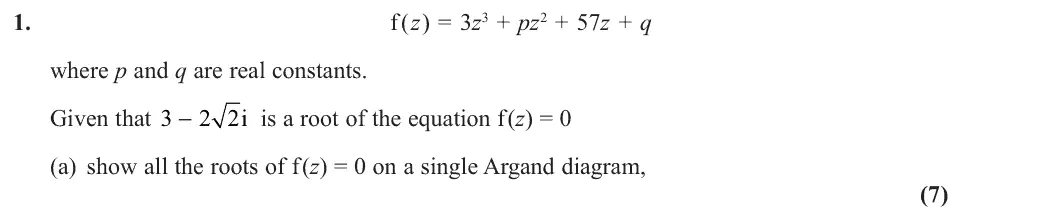
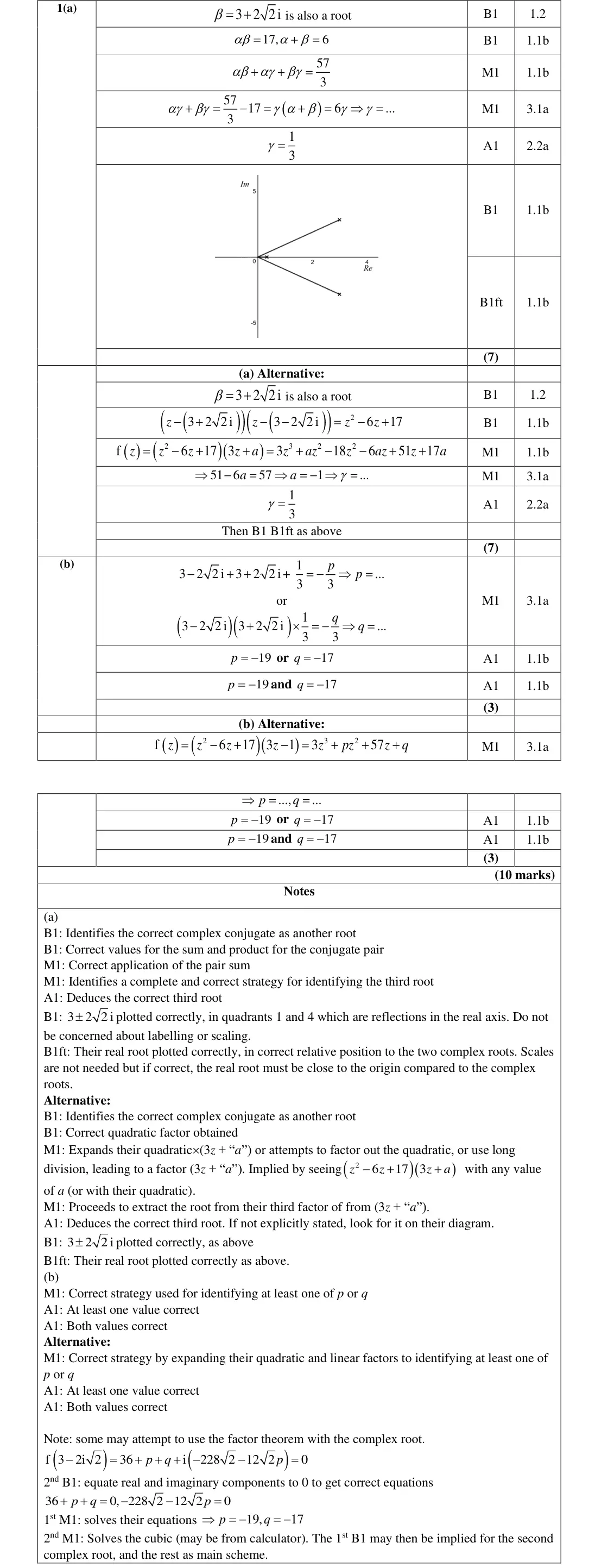
1. f ( z ) = 3z3 + pz2 + 57z + q where p and q are real constants. Given that 3 i is a root of the equation f(z) = 0 - 2 2 (a) show all the roots of f(z) = 0 on a single Argand diagram, (7)
Oct 2020 · Paper 1 (Core Pure 1) · Q1(b) 3 marks roots of polynomials
(b) find the value of p and the value of q. (3)
Oct 2020 · Paper 1 (Core Pure 1) · Q2(a) 1 mark improper integrals and mean value
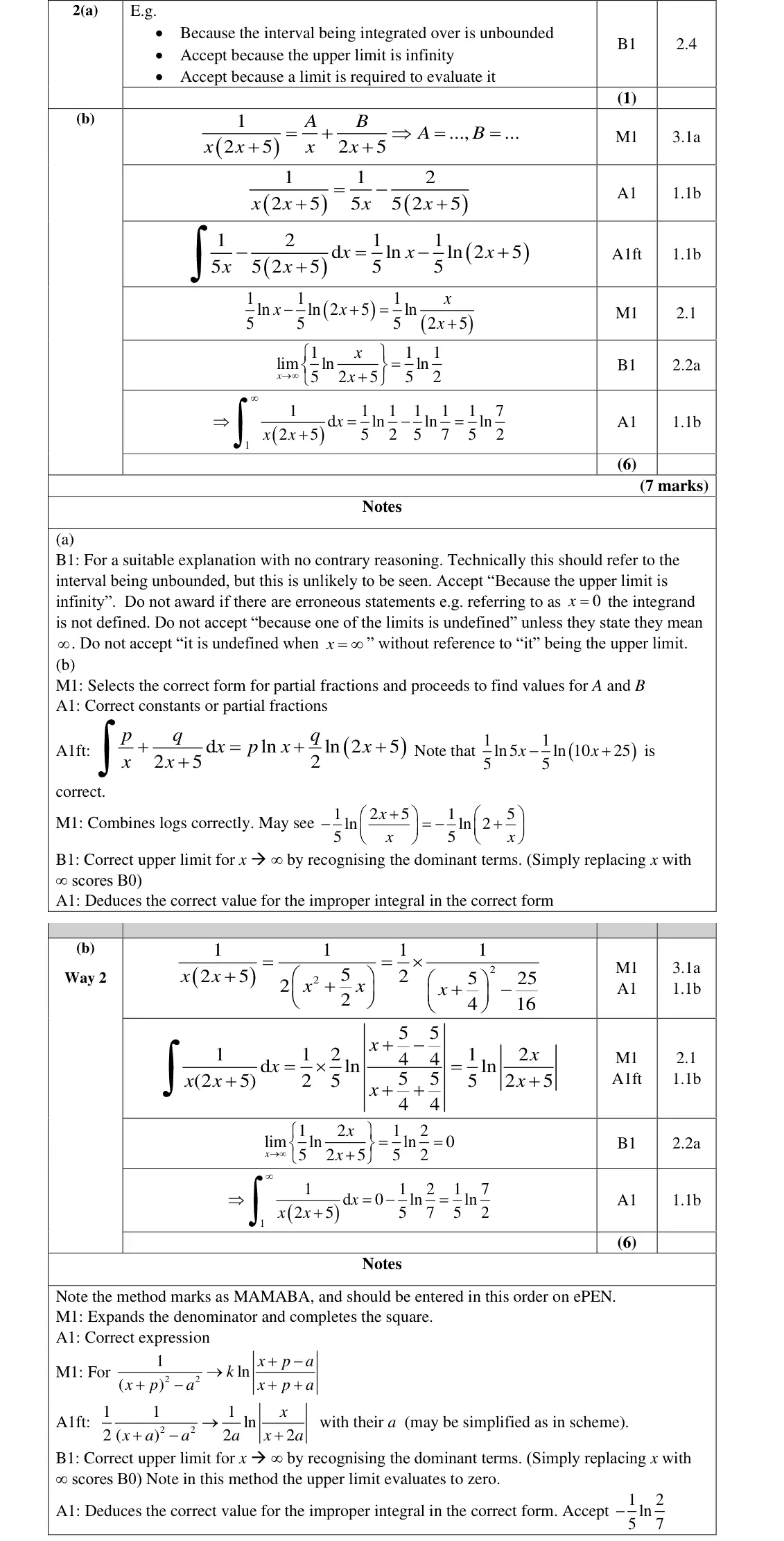
∫ 2. (a) Explain why is an improper integral. d x ( ) x x + (1)
Oct 2020 · Paper 1 (Core Pure 1) · Q2(b) 6 marks improper integrals and mean value
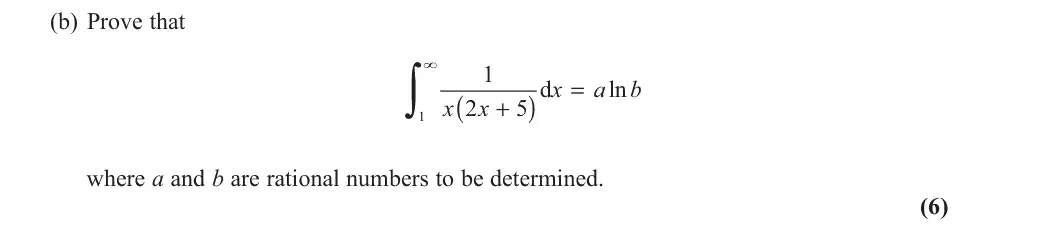
(b) Prove that ∫ d x = a ln b ( ) x x + where a and b are rational numbers to be determined. (6)
Oct 2020 · Paper 1 (Core Pure 1) · Q3 9 marks polar coordinates
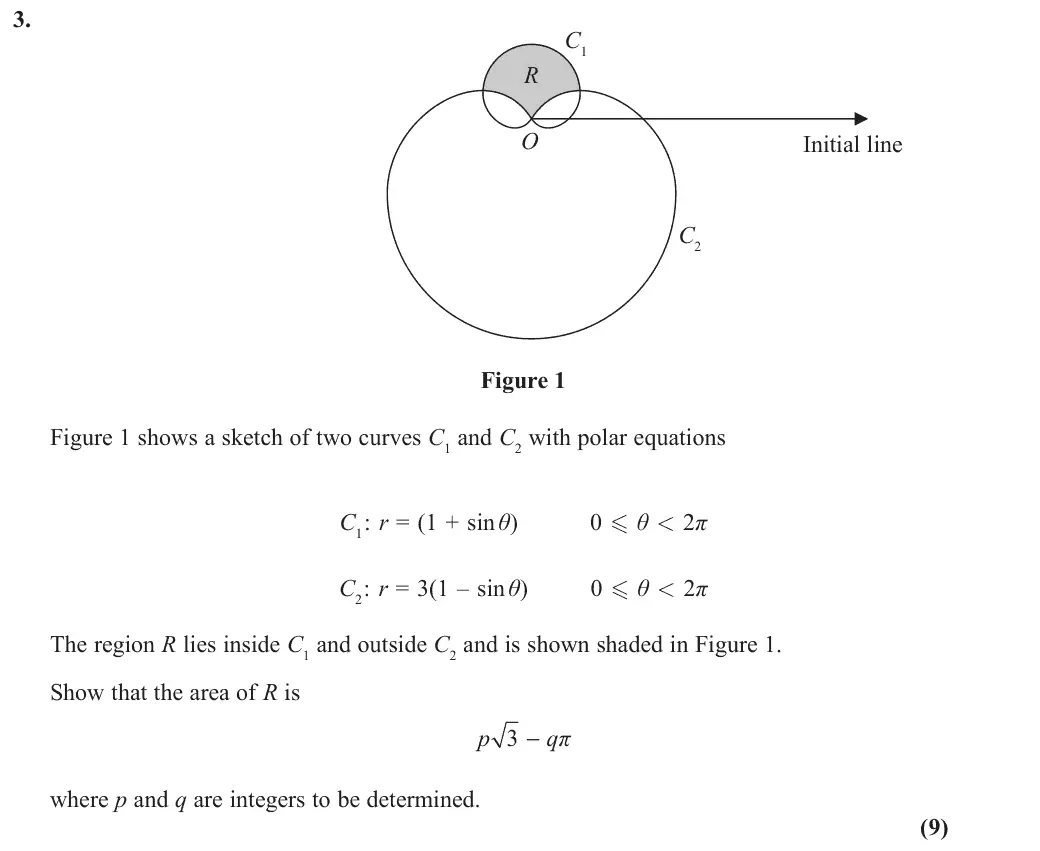
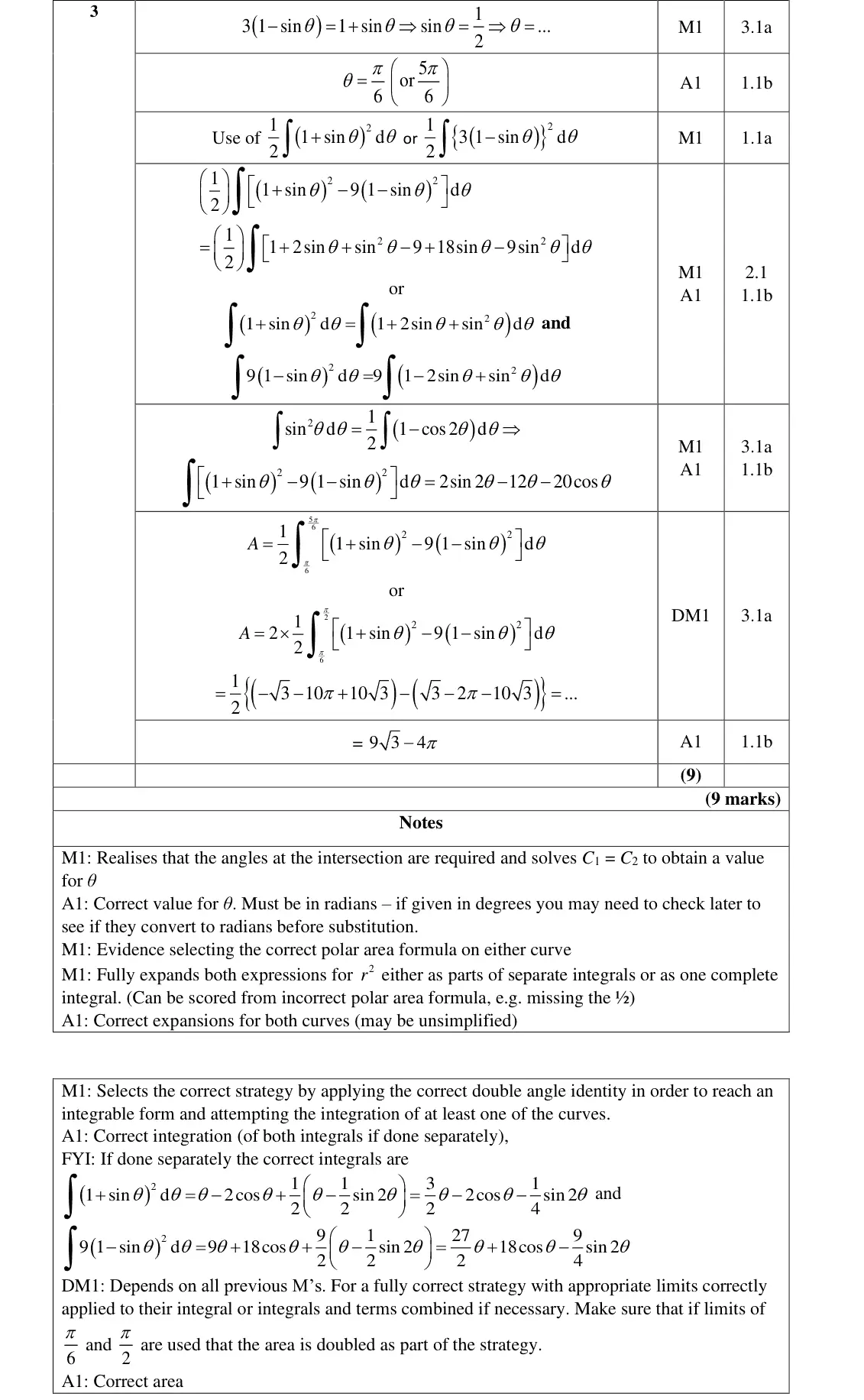
3. C1 R Initial line C2 Figure 1 Figure 1 shows a sketch of two curves C1 and C2 with polar equations C1 : r = (1 + sin theta ) 0 theta < 2 pi C2 : r = 3(1 – sin theta ) 0 theta < 2 pi The region R lies inside C1 and outside C2 and is shown shaded in Figure 1. Show that the area of R is p q pi - where p and q are integers to be determined. (9)
Oct 2020 · Paper 1 (Core Pure 1) · Q4(a) 4 marks vectors lines and planes
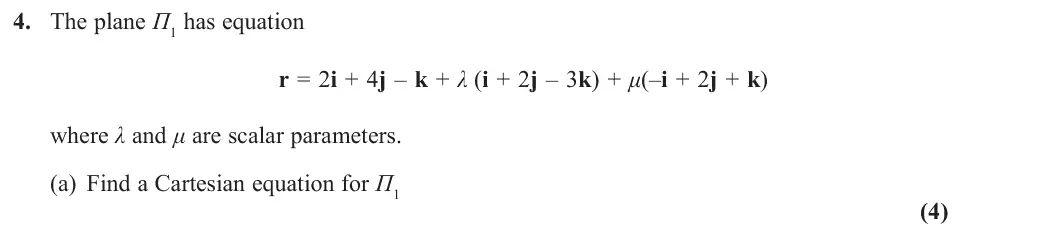
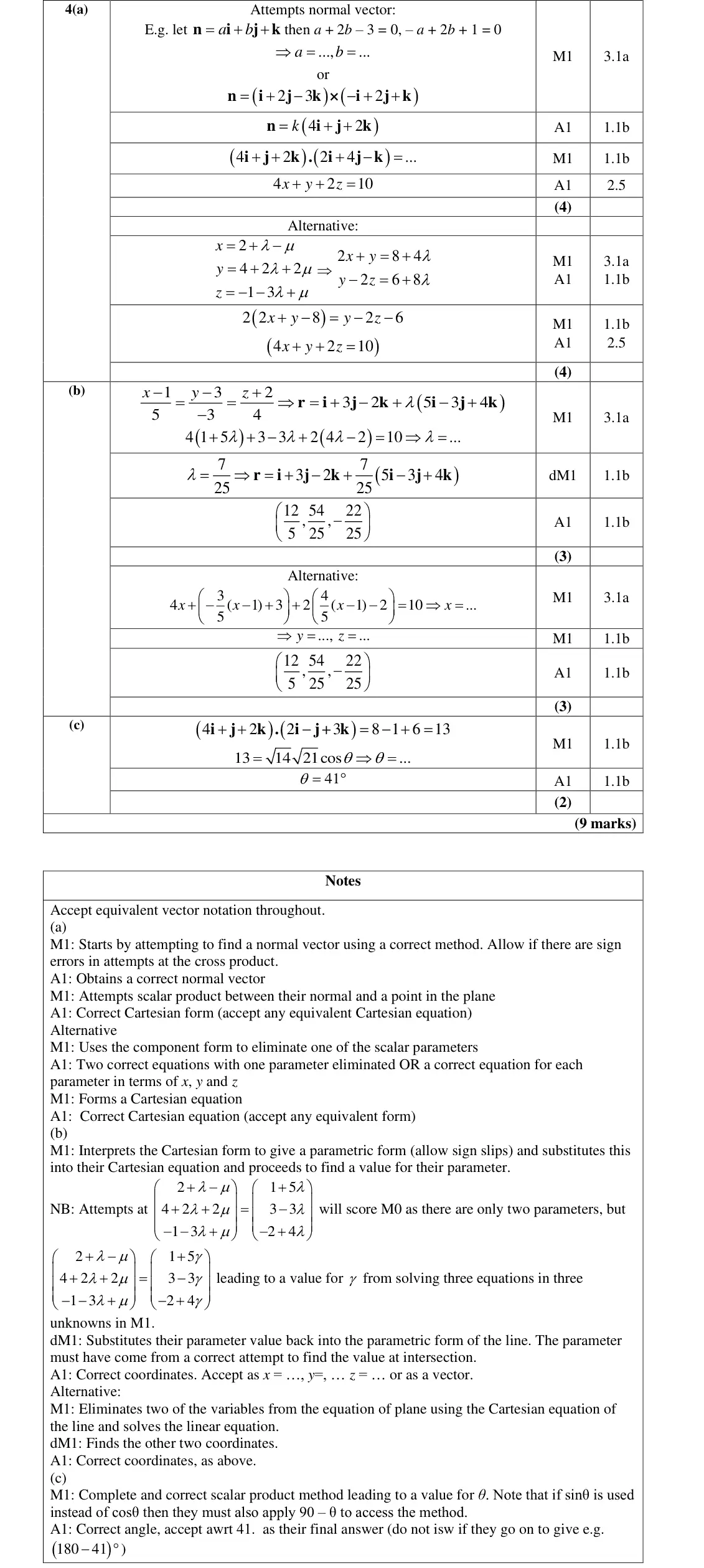
4. The plane Π1 has equation r = 2i + 4j – k + λ (i + 2j – 3k) + μ(–i + 2j + k) where λ and μ are scalar parameters. (a) Find a Cartesian equation for Π1 (4)
Oct 2020 · Paper 1 (Core Pure 1) · Q4(b) 3 marks vectors intersections and distances
The line l has equation x y z - - + = = - (b) Find the coordinates of the point of intersection of l with Π1 (3)
Oct 2020 · Paper 1 (Core Pure 1) · Q4(c) 2 marks vectors lines and planes
The plane Π2 has equation r . (2i – j + 3k) = 5 (c) Find, to the nearest degree, the acute angle between Π1 and Π2 (2)
Oct 2020 · Paper 1 (Core Pure 1) · Q5(a) 3 marks coupled differential equations
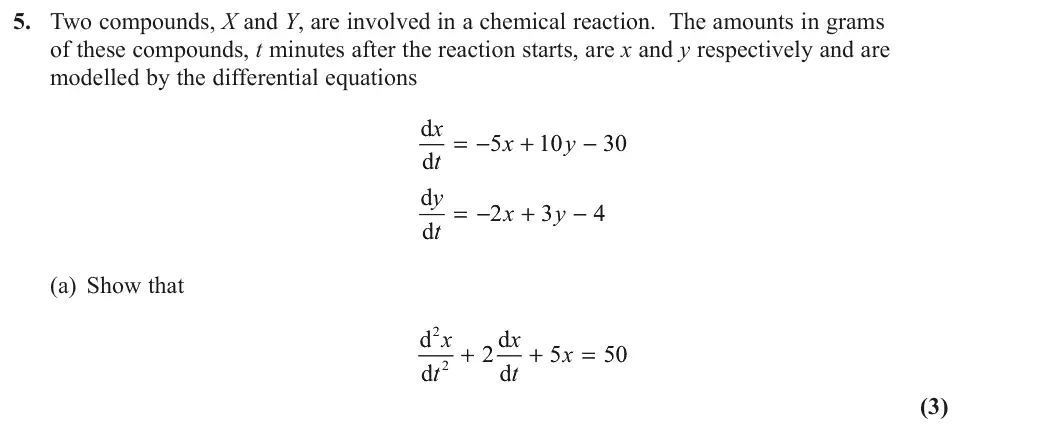
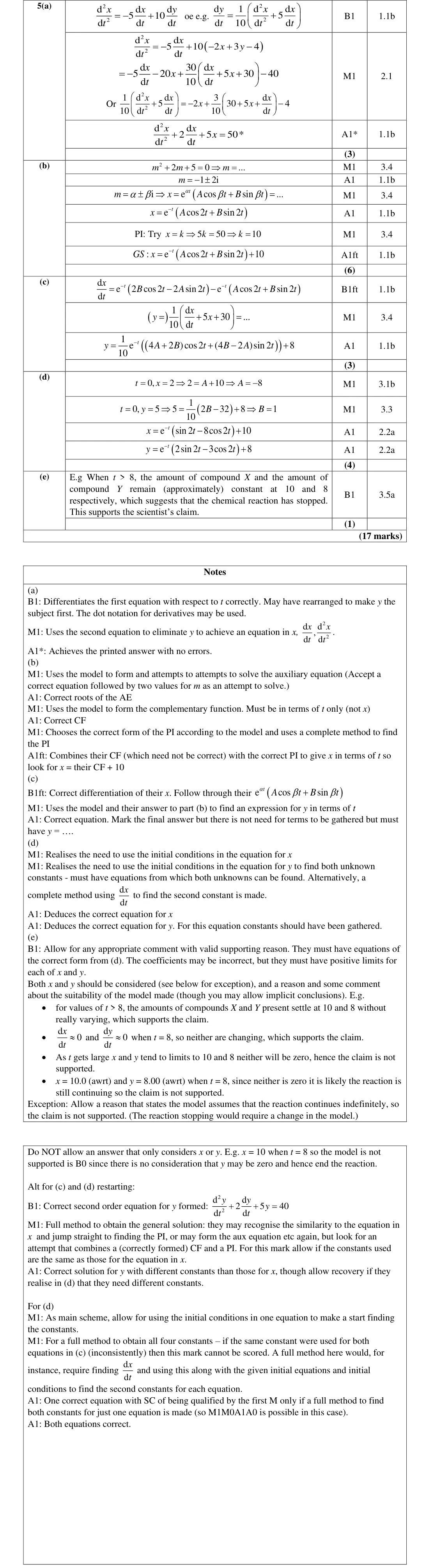
5. Two compounds, X and Y, are involved in a chemical reaction. The amounts in grams of these compounds, t minutes after the reaction starts, are x and y respectively and are modelled by the differential equations d x = - x + y - t d y d = - x + y - t d (a) Show that 2x x d d + + x = t t d d (3)
Oct 2020 · Paper 1 (Core Pure 1) · Q5(b) 6 marks second order differential equations
(b) Find, according to the model, a general solution for the amount in grams of compound X present at time t minutes. (6)
Oct 2020 · Paper 1 (Core Pure 1) · Q5(c) 3 marks coupled differential equations
(c) Find, according to the model, a general solution for the amount in grams of compound Y present at time t minutes. (3)
Oct 2020 · Paper 1 (Core Pure 1) · Q5(d) 4 marks first order differential equationscoupled differential equations
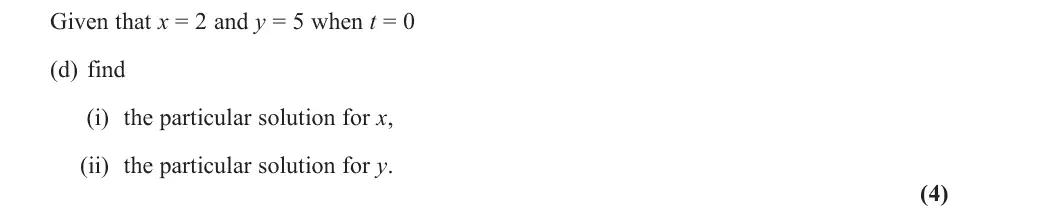
Given that x = 2 and y = 5 when t = 0 (d) find (i) the particular solution for x, (ii) the particular solution for y. (4)
Oct 2020 · Paper 1 (Core Pure 1) · Q5(e) 1 mark first order differential equations
A scientist thinks that the chemical reaction will have stopped after 8 minutes. (e) Explain whether this is supported by the model. (1)
Oct 2020 · Paper 1 (Core Pure 1) · Q6(i) 6 marks Hard proof by induction
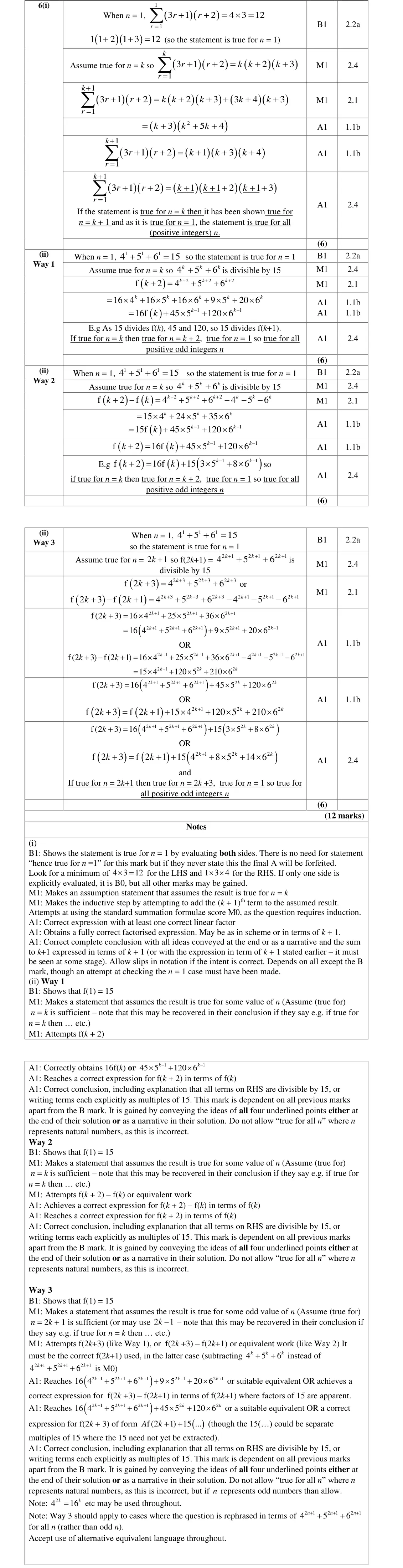
6. (i) Prove by induction that for n ∈ + n =∑ ( r + )( r + ) = n n ( + )( n + ) r (6)
Oct 2020 · Paper 1 (Core Pure 1) · Q6(ii) 6 marks Hard proof by induction
(ii) Prove by induction that for all positive odd integers n n + 5 n + 6 n f(n) = 4 is divisible by 15 (6)
Oct 2020 · Paper 1 (Core Pure 1) · Q7(a) 6 marks first order differential equations
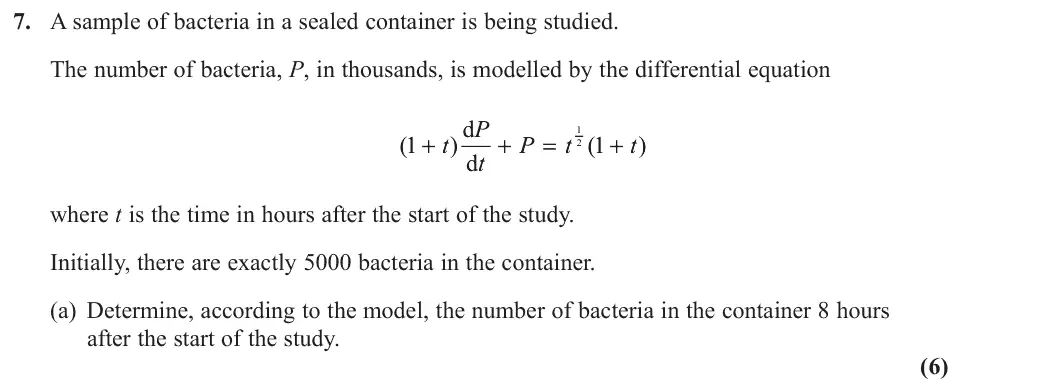
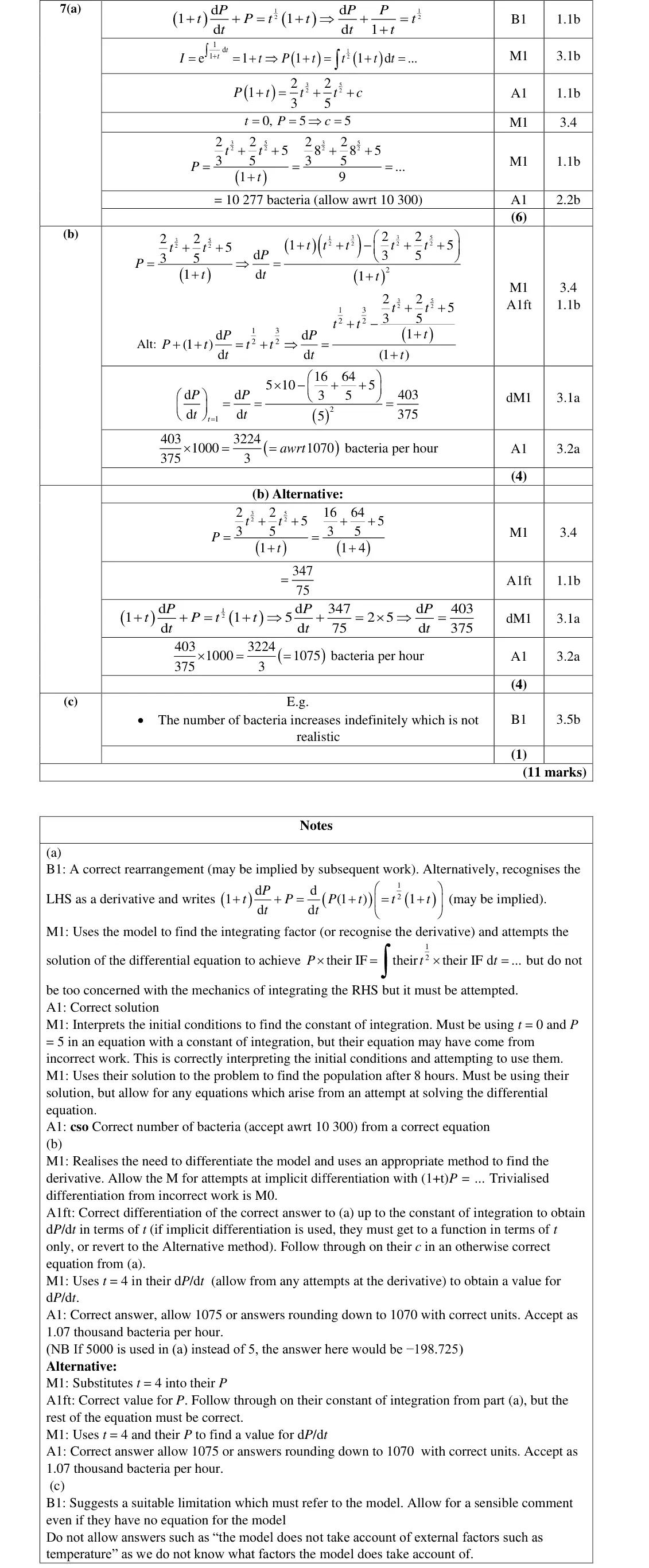
7. A sample of bacteria in a sealed container is being studied. The number of bacteria, P, in thousands, is modelled by the differential equation P d + t + P = t + t ( ) ( ) t d where t is the time in hours after the start of the study. Initially, there are exactly 5000 bacteria in the container. (a) Determine, according to the model, the number of bacteria in the container 8 hours after the start of the study. (6)
Oct 2020 · Paper 1 (Core Pure 1) · Q7(b) 4 marks first order differential equations
(b) Find, according to the model, the rate of change of the number of bacteria in the container 4 hours after the start of the study. (4)
Oct 2020 · Paper 1 (Core Pure 1) · Q7(c) 1 mark first order differential equations
(c) State a limitation of the model. (1)

Find an Edexcel Further Maths tutor

Want this paper marked and gone through with a Further Maths tutor? Message us.

Prefer email? Send an enquiry

If you are under 18, please include a parent's contact details. Enquiries go to enquiries@alevelfurthermathstutor.com and are deleted once handled.