Oct 2020: A level Paper 3A: Further Pure Mathematics 1

75 marks · 16 question parts · Question paper, mark scheme and examiner's report on Pearson's site

Question by question

QTopicMarksDifficulty
1 Taylor series, limits, Leibnitz's theorem, L'Hospital's rule and the Weierstrass substitution 5 —
2 Numerical methods: differential equations and Simpson's rule 6 —
3(a) Vector product and scalar triple product 3 —
3(b) Vector product and scalar triple product 2 —
3(c) Vector product and scalar triple product 4 —
4 Taylor series, limits, Leibnitz's theorem, L'Hospital's rule and the Weierstrass substitution 8 —
5(a) Conic sections: parabola, ellipse and hyperbola 3 —
5(b) Conic sections: parabola, ellipse and hyperbola 4 —
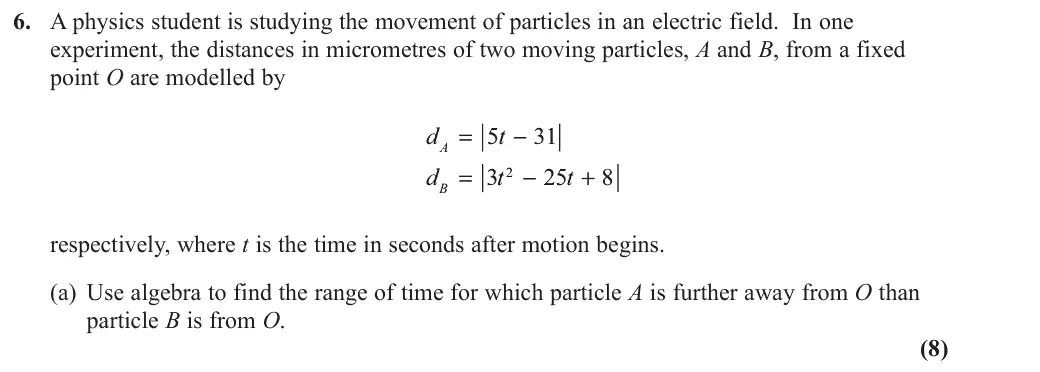
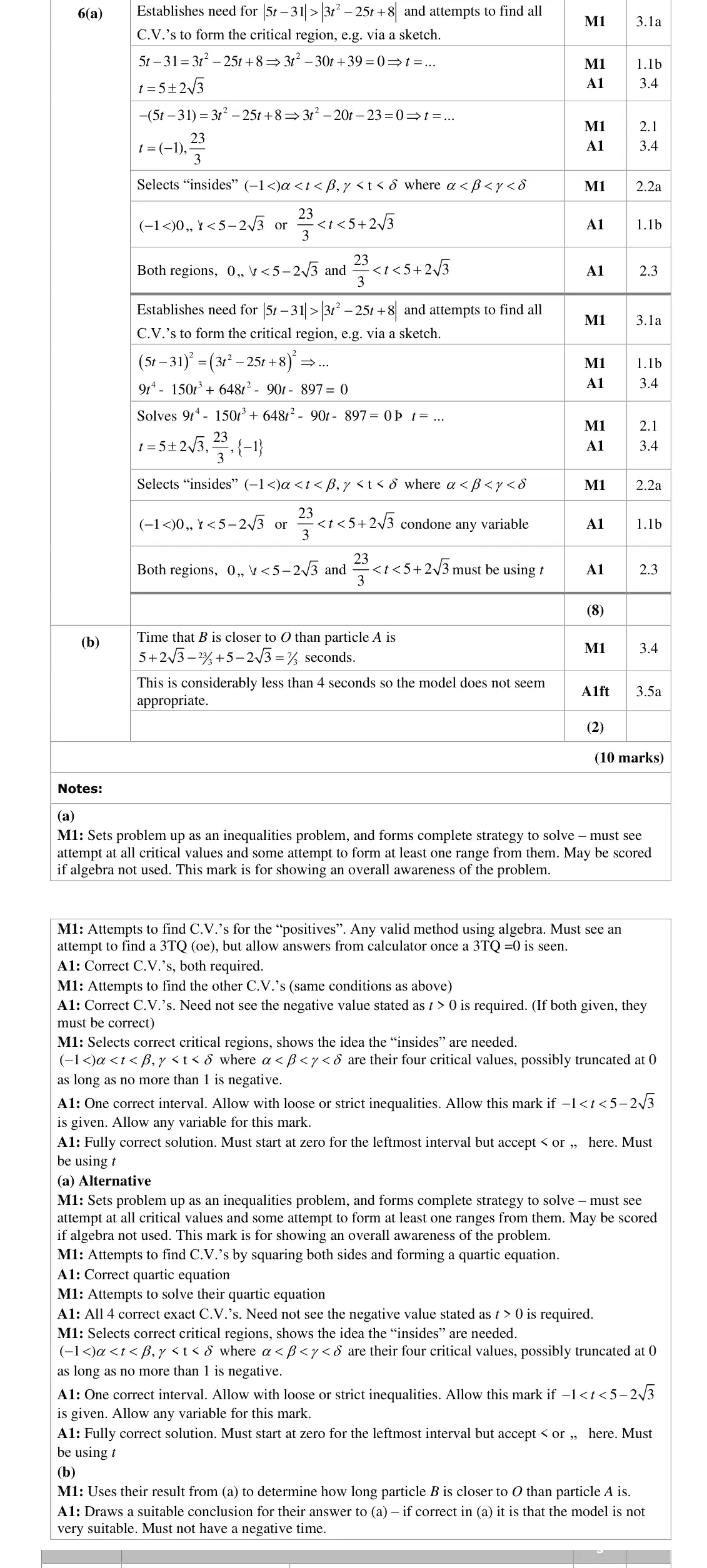
6(a) Inequalities 8 —
6(b) Inequalities 2 —
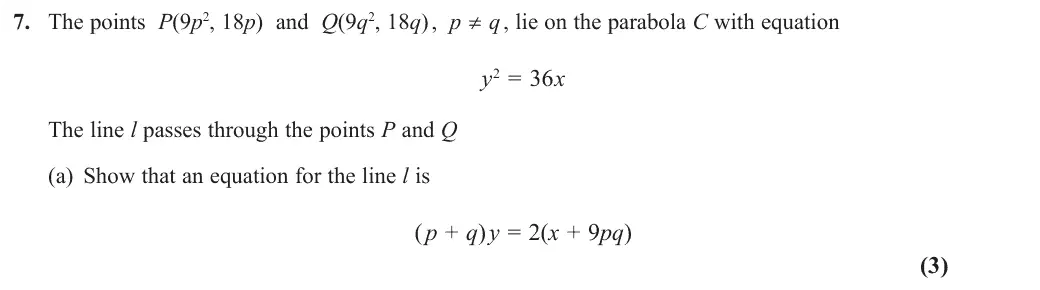
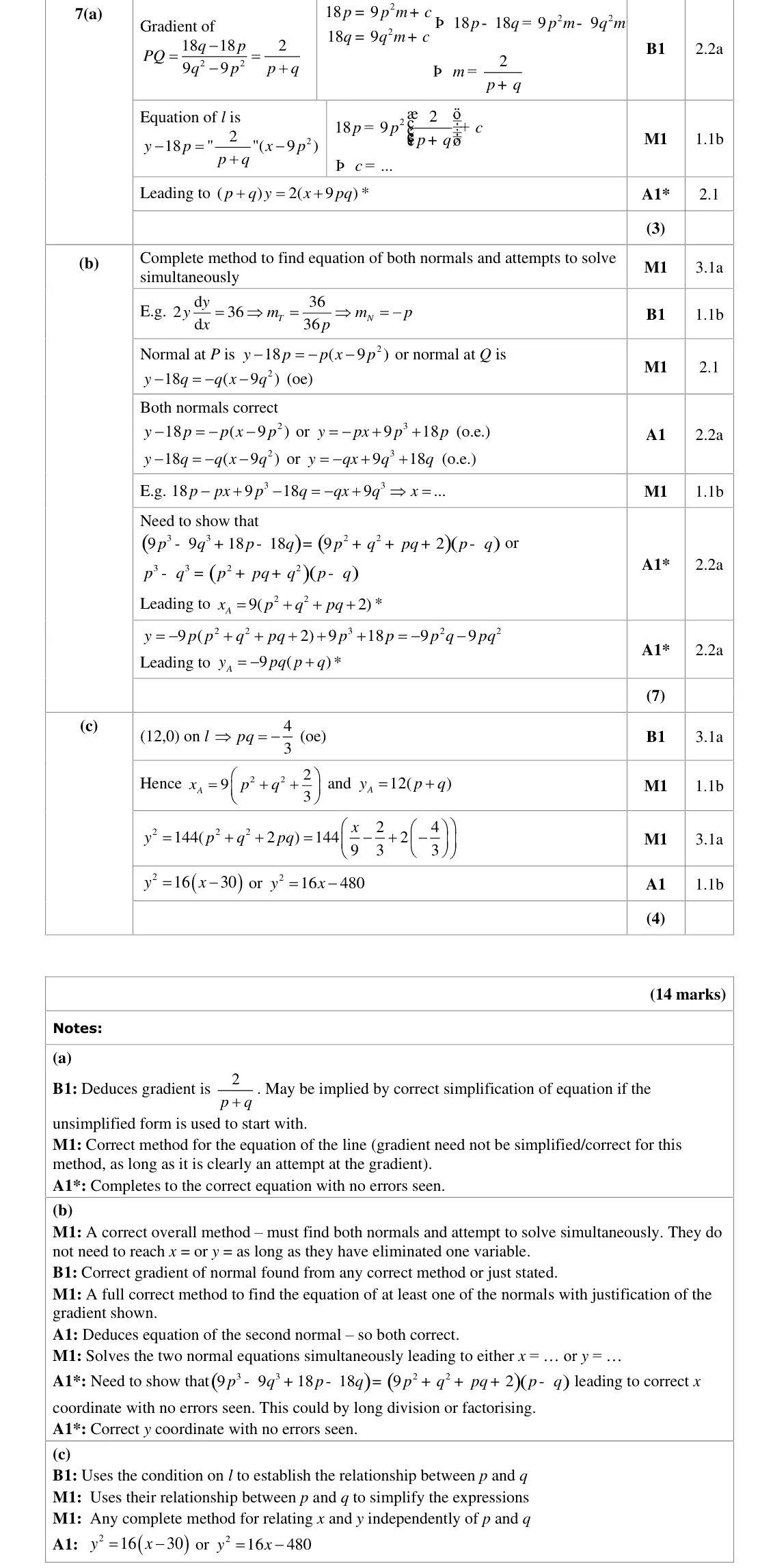
7(a) Conic sections: parabola, ellipse and hyperbola 3 —
7(b) Conic sections: parabola, ellipse and hyperbola 7 —
7(c) Conic sections: parabola, ellipse and hyperbola 4 —
8(a) The t-formulae 3 —
8(b) The t-formulae 5 —
8(c) Taylor series, limits, Leibnitz's theorem, L'Hospital's rule and the Weierstrass substitution 8 —

The questions

123(a)3(b)3(c)45(a)5(b)6(a)6(b)7(a)7(b)7(c)8(a)8(b)8(c)
Oct 2020 · Paper 3A (Further Pure 1) · Q1 5 marks taylor series leibnitz lhospital
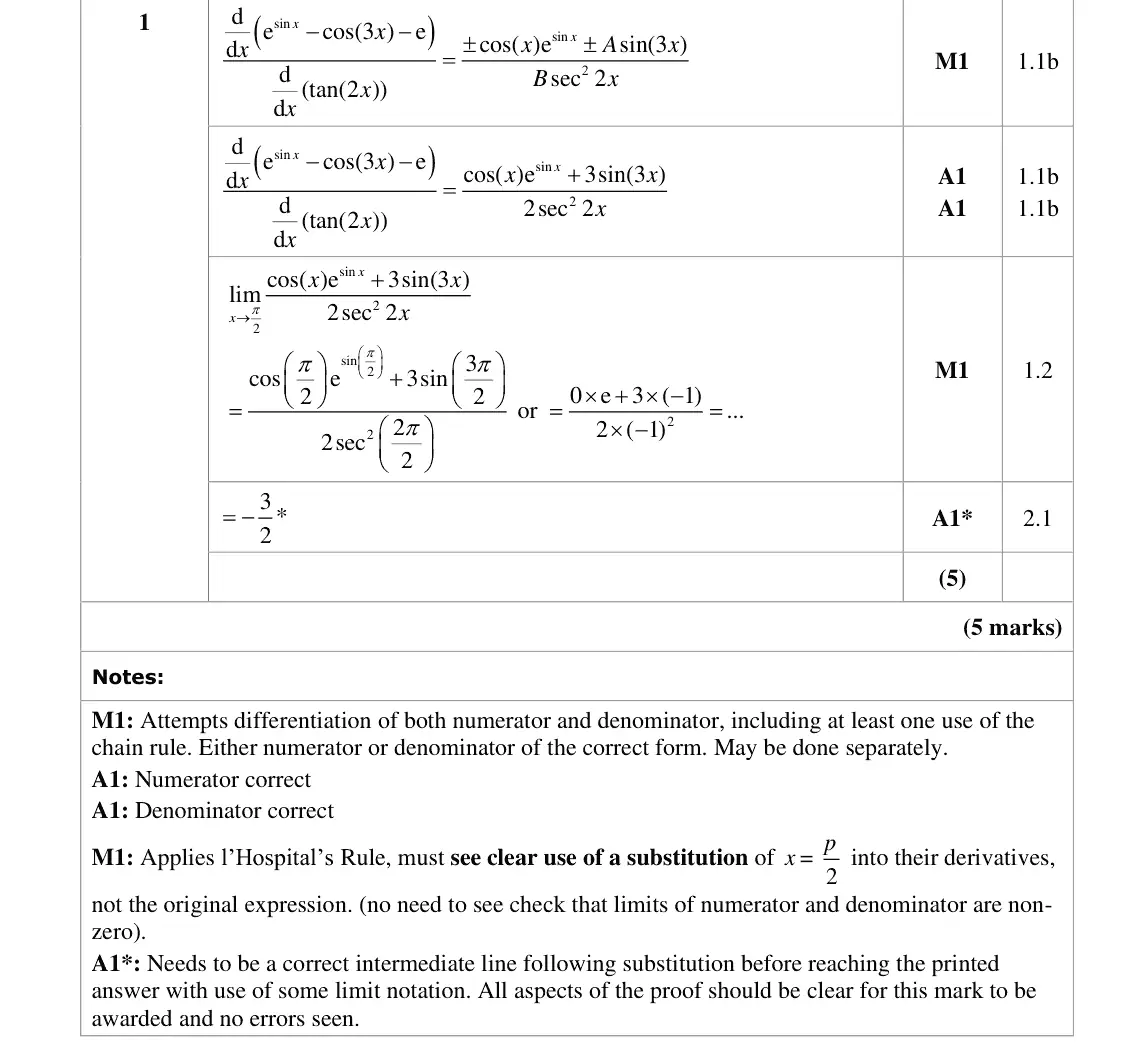
1. Use l’Hospital’s Rule to show that - x - x sin (e cos(3 ) e) = - lim x pi tan(2 ) x → (5)
Oct 2020 · Paper 3A (Further Pure 1) · Q2 6 marks numerical methods fp1
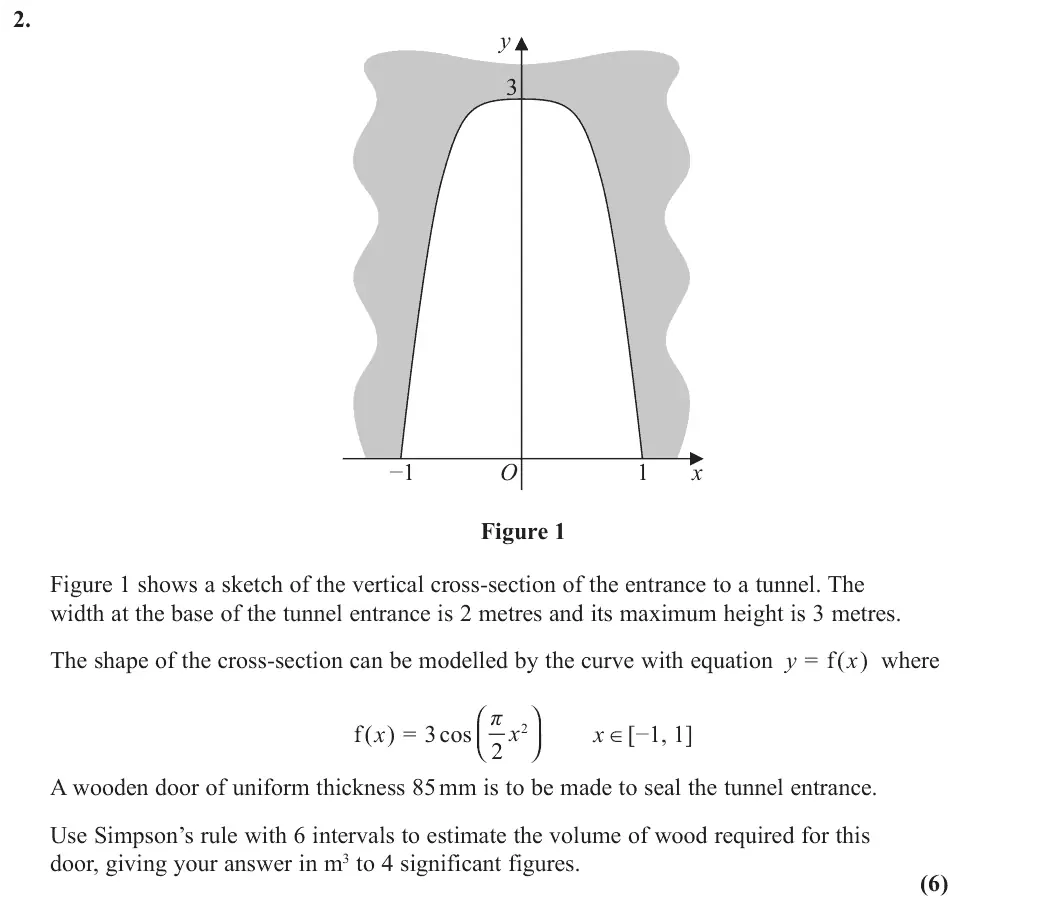
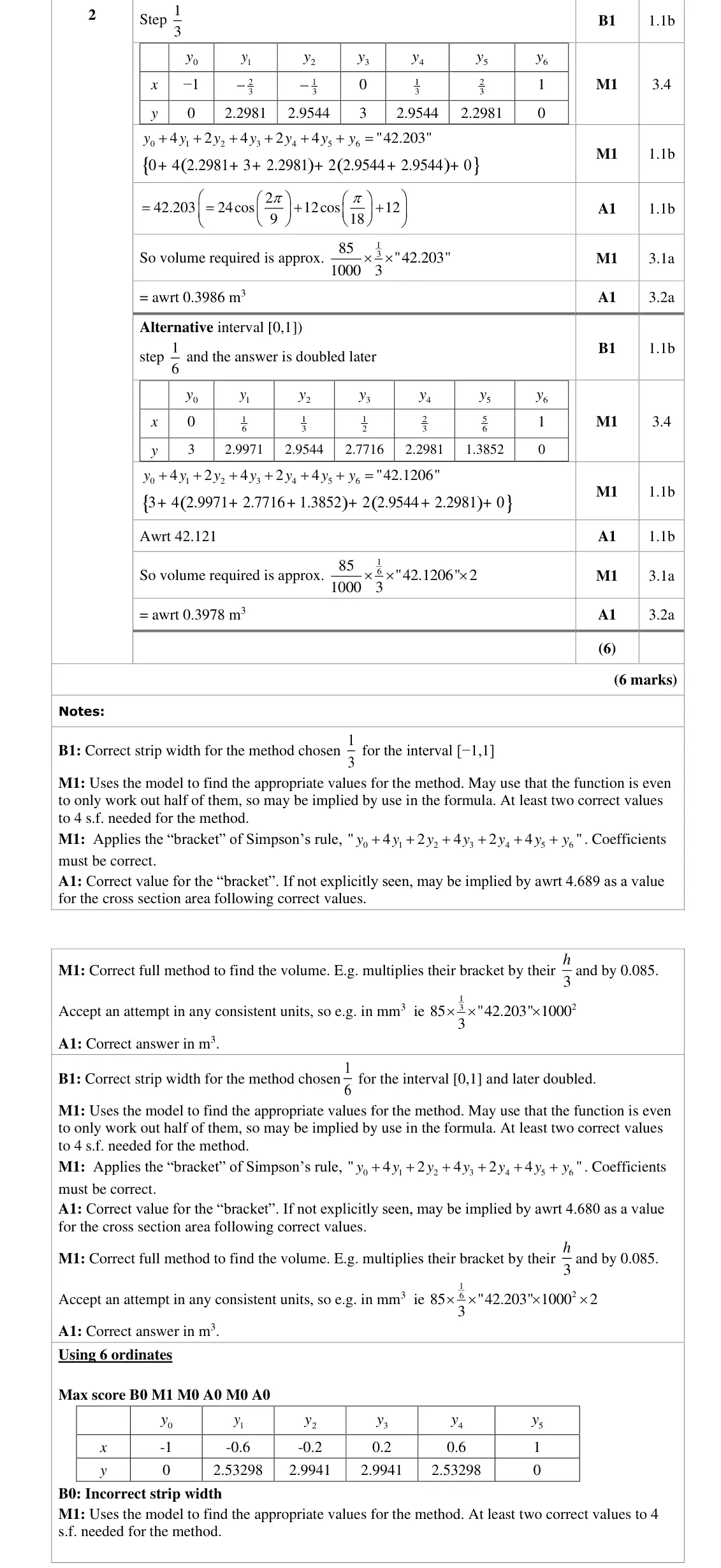
2. y -1 x Figure 1 Figure 1 shows a sketch of the vertical cross-section of the entrance to a tunnel. The width at the base of the tunnel entrance is 2 metres and its maximum height is 3 metres. The shape of the cross-section can be modelled by the curve with equation y = f ( x ) where pi x f ( x ) = 3 cos x ∈ [-1, 1] A wooden door of uniform thickness 85 mm is to be made to seal the tunnel entrance. Use Simpson’s rule with 6 intervals to estimate the volume of wood required for this door, giving your answer in m3 to 4 significant figures. (6)
Oct 2020 · Paper 3A (Further Pure 1) · Q3(a) 3 marks vector product
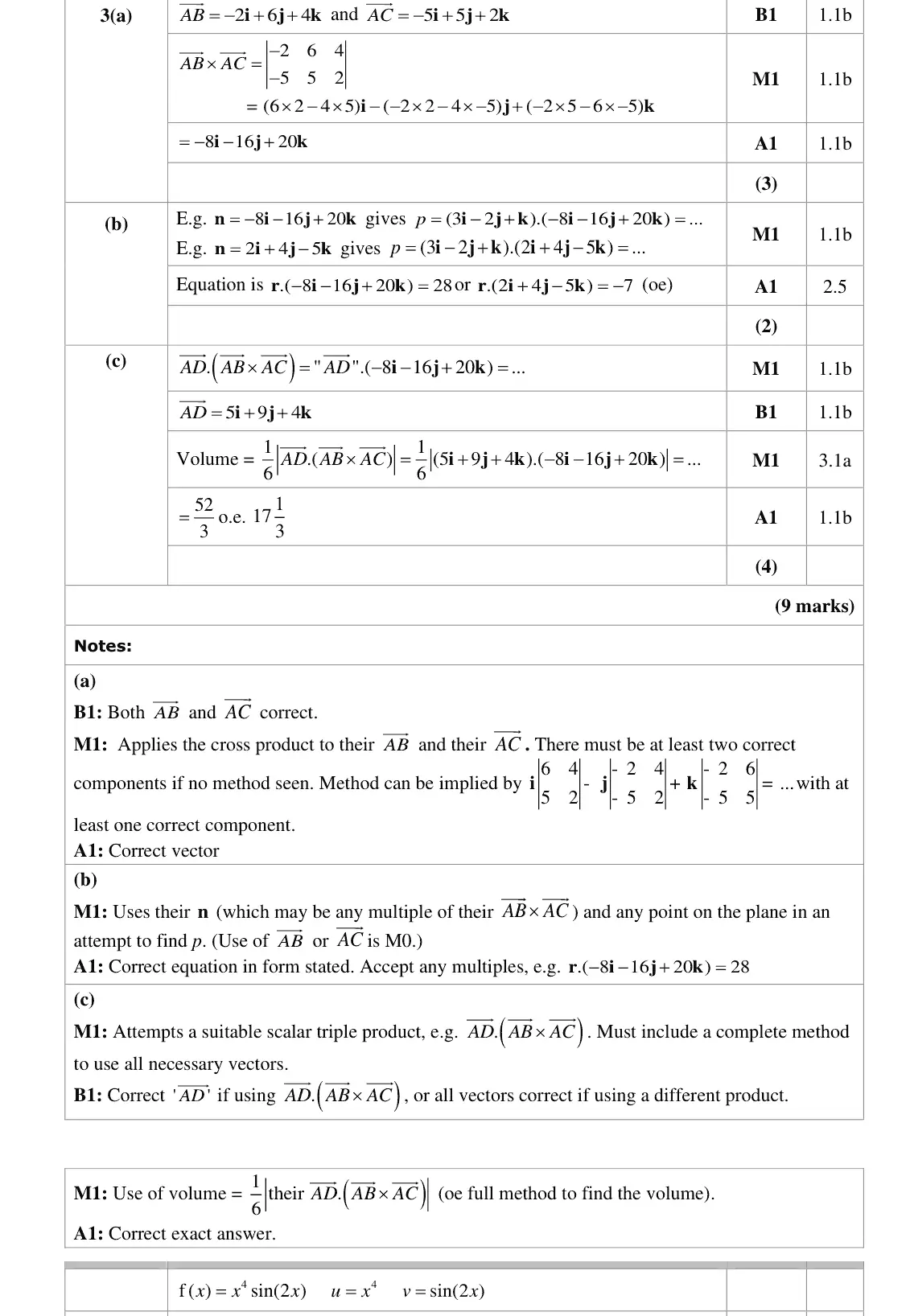
3. The points A, B and C, with position vectors a = 3i - 2j + k , b = i + 4j + 5k and c = -2i + 3j + 3k respectively, lie on the plane Π → → (a) Find AB x AC (3)
Oct 2020 · Paper 3A (Further Pure 1) · Q3(b) 2 marks vector product
(b) Find an equation for Π in the form r.n = p (2)
Oct 2020 · Paper 3A (Further Pure 1) · Q3(c) 4 marks vector product
The point D has position vector 8i + 7j + 5k (c) Determine the volume of the tetrahedron ABCD (4)
Oct 2020 · Paper 3A (Further Pure 1) · Q4 8 marks taylor series leibnitz lhospital
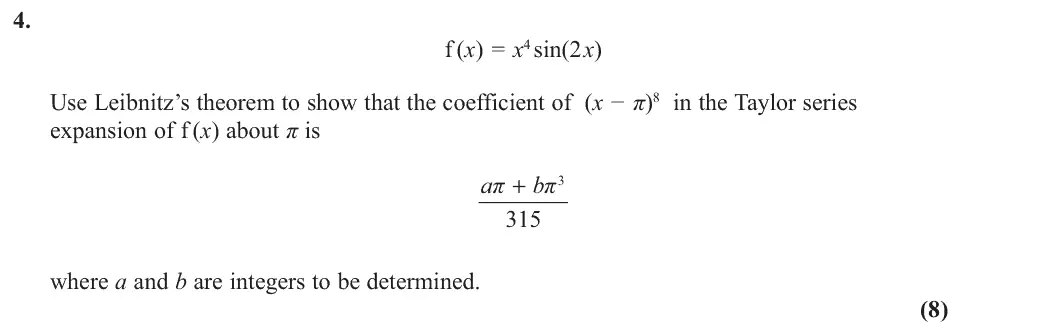
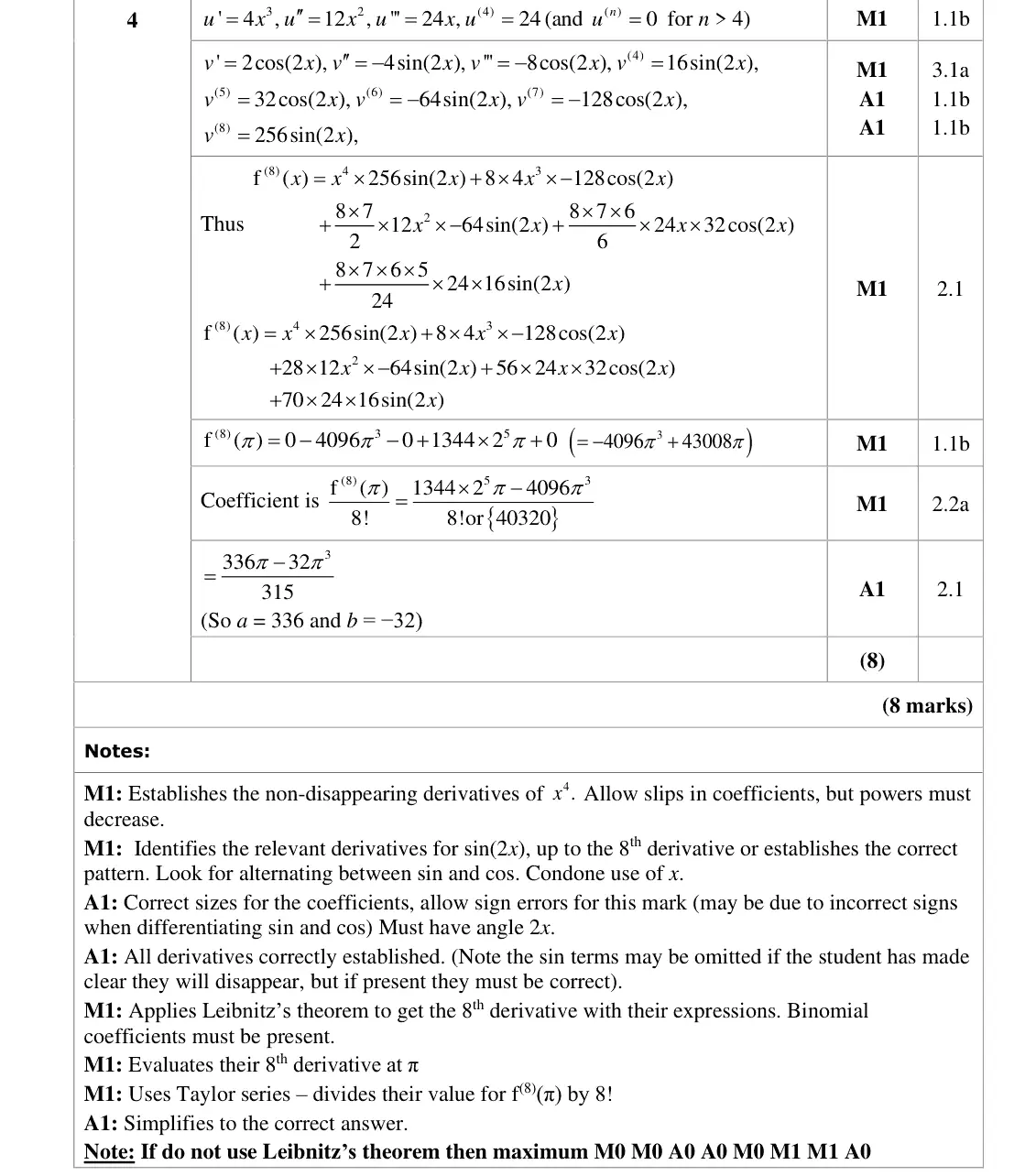
4. f (x) = x4 sin(2 x) Use Leibnitz’s theorem to show that the coefficient of (x - pi )8 in the Taylor series expansion of f (x) about pi is a pi + b pi where a and b are integers to be determined. (8)
Oct 2020 · Paper 3A (Further Pure 1) · Q5(a) 3 marks conic sections
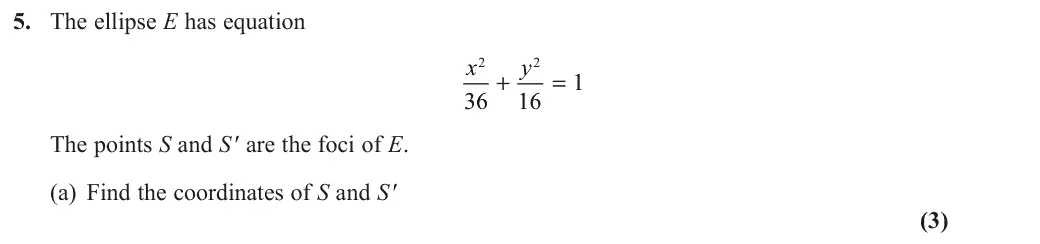
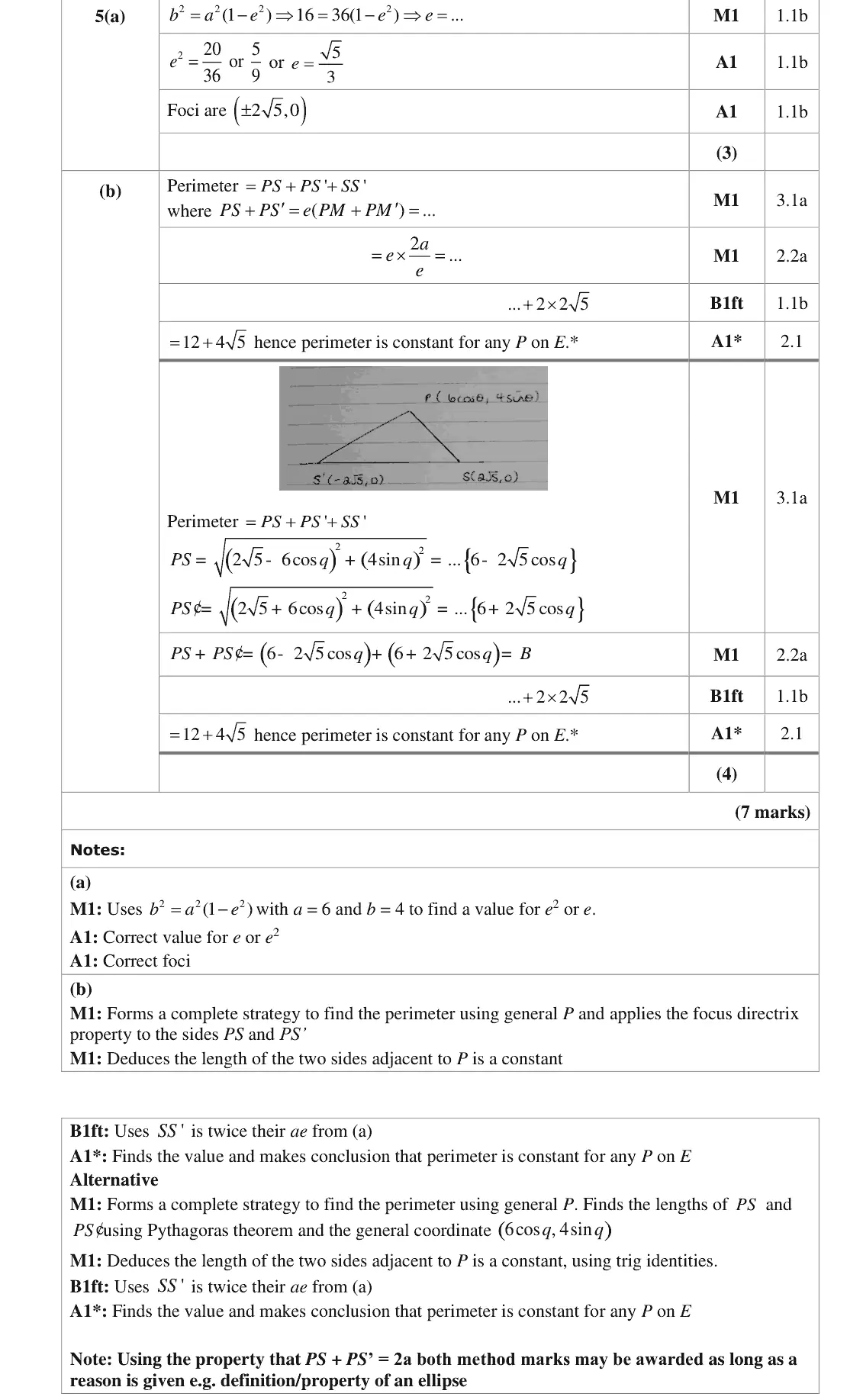
5. The ellipse E has equation x y + = The points S and S ′ are the foci of E. (a) Find the coordinates of S and S ′ (3)
Oct 2020 · Paper 3A (Further Pure 1) · Q5(b) 4 marks conic sections
(b) Show that for any point P on E, the triangle PSS ′ has constant perimeter and determine its value. (4)
Oct 2020 · Paper 3A (Further Pure 1) · Q6(a) 8 marks further inequalities
6. A physics student is studying the movement of particles in an electric field. In one experiment, the distances in micrometres of two moving particles, A and B, from a fixed point O are modelled by d = t - A d = t - t + B respectively, where t is the time in seconds after motion begins. (a) Use algebra to find the range of time for which particle A is further away from O than particle B is from O. (8)
Oct 2020 · Paper 3A (Further Pure 1) · Q6(b) 2 marks further inequalities
It was recorded that the distance of particle B from O was less than the distance of particle A from O for approximately 4 seconds. (b) Use this information to assess the validity of the model. (2)
Oct 2020 · Paper 3A (Further Pure 1) · Q7(a) 3 marks conic sections
7. The points P(9p2, 18p) and Q(9q2, 18q) , p ≠ q , lie on the parabola C with equation y2 = 36x The line l passes through the points P and Q (a) Show that an equation for the line l is ( p + q) y = 2(x + 9pq) (3)
Oct 2020 · Paper 3A (Further Pure 1) · Q7(b) 7 marks conic sections
The normal to C at P and the normal to C at Q meet at the point A. (b) Show that the coordinates of A are (9( p2 + q2 + pq + 2) , -9pq( p + q)) (7)
Oct 2020 · Paper 3A (Further Pure 1) · Q7(c) 4 marks conic sections
Given that the points P and Q vary such that l always passes through the point (12, 0) (c) find, in the form y2 = f ( x ) , an equation for the locus of A, giving f ( x ) in simplest form. (4)
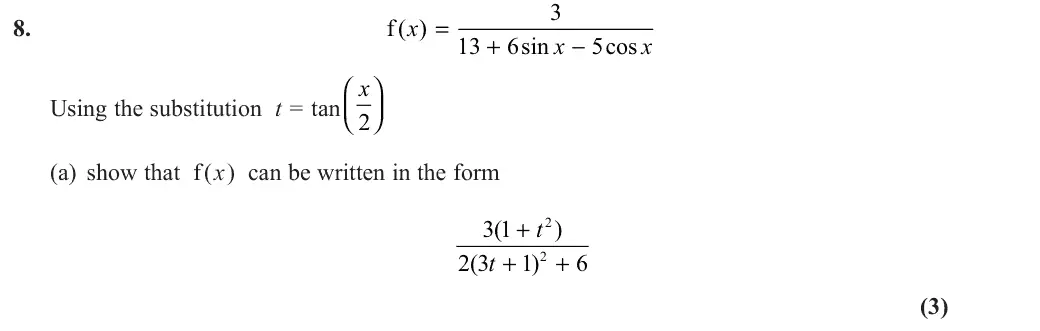
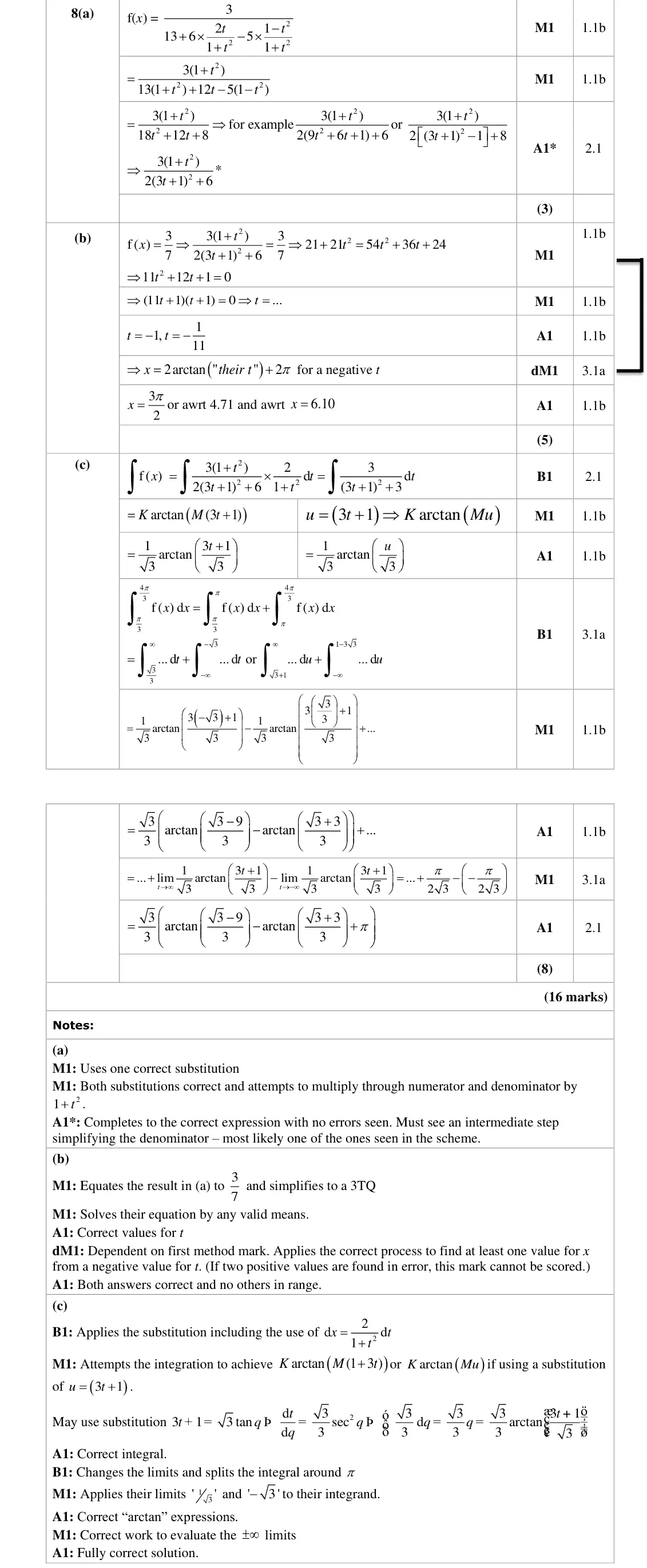
Oct 2020 · Paper 3A (Further Pure 1) · Q8(a) 3 marks t formulae
8. x = f ( ) + x - x sin cos x Using the substitution t = tan (a) show that f ( x ) can be written in the form 3 1 ( + t ) 2 3 ( t + ) + (3)
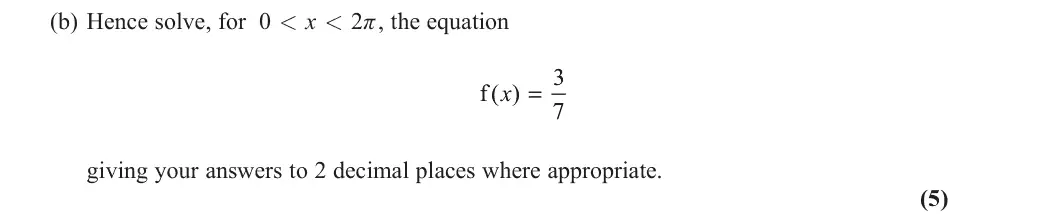
Oct 2020 · Paper 3A (Further Pure 1) · Q8(b) 5 marks t formulae
(b) Hence solve, for 0 < x < 2 pi , the equation x = 3 f ( ) giving your answers to 2 decimal places where appropriate. (5)
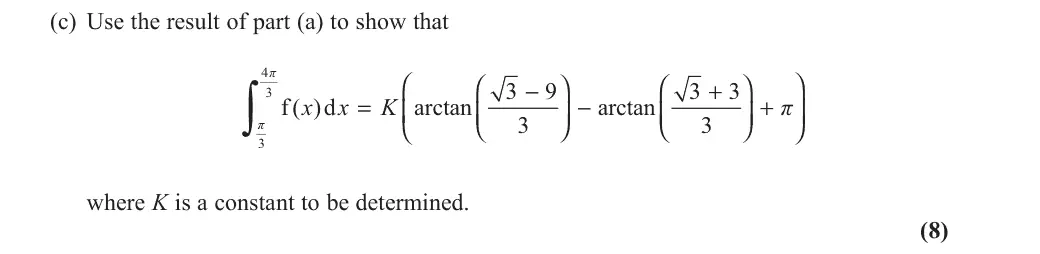
Oct 2020 · Paper 3A (Further Pure 1) · Q8(c) 8 marks taylor series leibnitz lhospital
(c) Use the result of part (a) to show that pi ∫ - + f ( )d x x = K arctan - arctan + pi pi where K is a constant to be determined. (8)

Find an Edexcel Further Maths tutor

Want this paper marked and gone through with a Further Maths tutor? Message us.

Prefer email? Send an enquiry

If you are under 18, please include a parent's contact details. Enquiries go to enquiries@alevelfurthermathstutor.com and are deleted once handled.