June 2019: A level Paper 01: Core Pure Mathematics 1

75 marks · 19 question parts · Question paper, mark scheme and examiner's report on Pearson's site

Question by question

QTopicMarksDifficulty
1(a) Complex numbers: arithmetic, conjugates, roots of polynomials and Argand diagrams 4 —
1(b) Complex numbers: arithmetic, conjugates, roots of polynomials and Argand diagrams, Roots of polynomials 5 —
2 Improper integrals and the mean value of a function, Integration with partial fractions 7 —
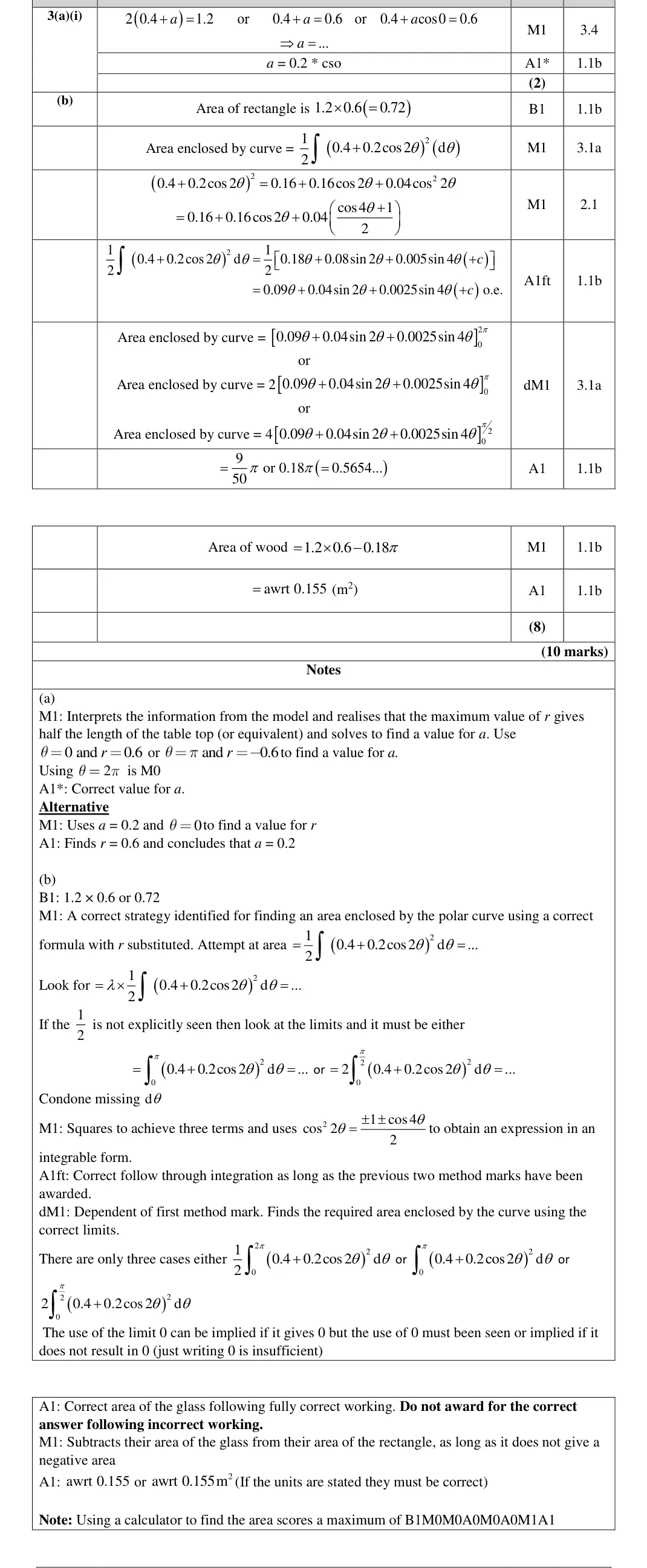
3(a) Polar coordinates: curves and areas 2 —
3(b) Polar coordinates: curves and areas 8 —
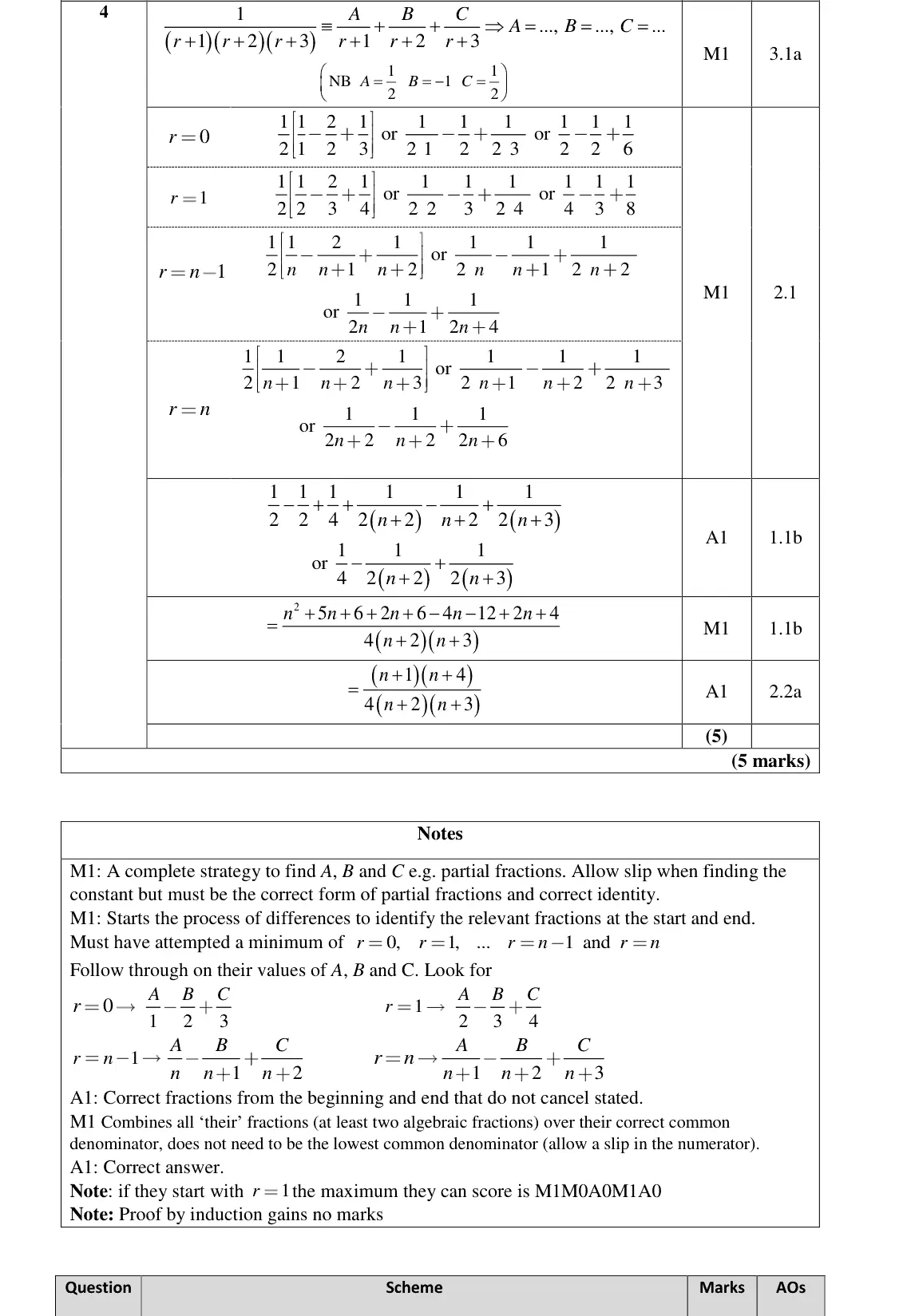
4 Series: standard sums and the method of differences 5 —
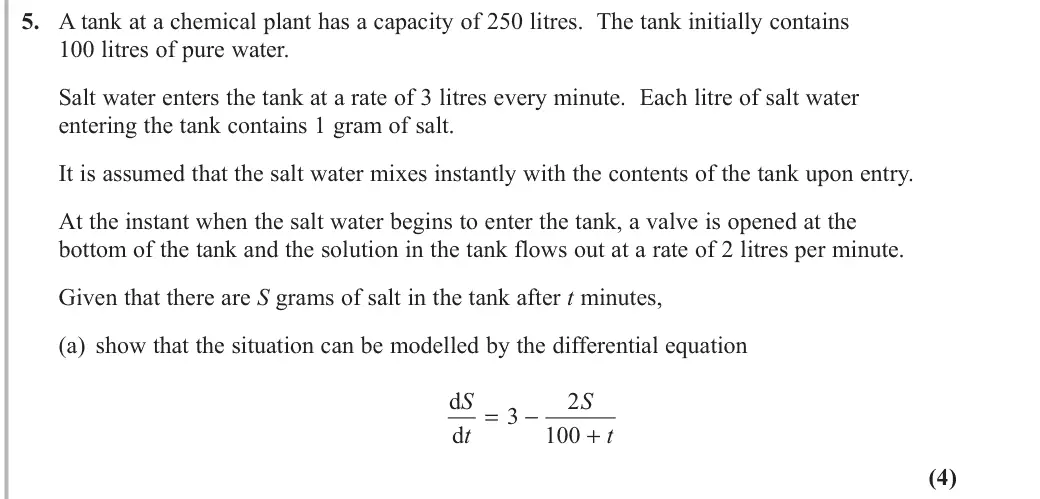
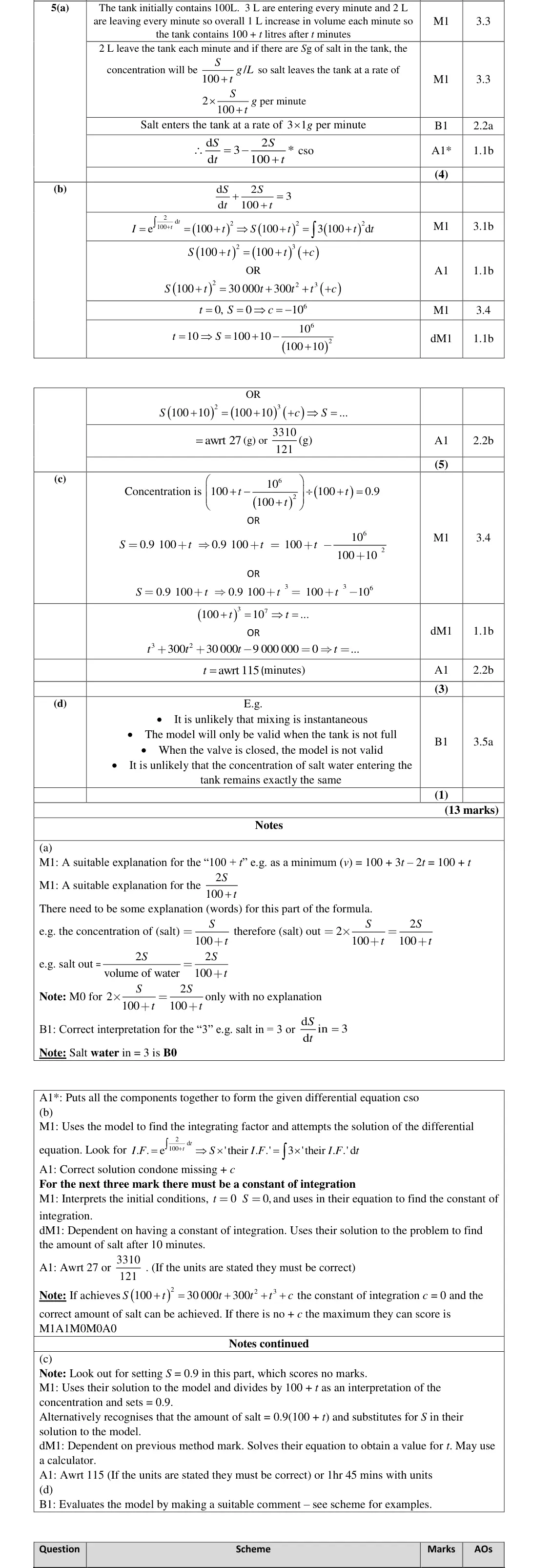
5(a) First-order differential equations: integrating factors and modelling 4 —
5(b) First-order differential equations: integrating factors and modelling 5 —
5(c) First-order differential equations: integrating factors and modelling 3 —
5(d) First-order differential equations: integrating factors and modelling 1 —
6 Proof by induction 6 —
7(a) Vectors: equations of lines and planes, scalar product 3 —
7(b) Vectors: equations of lines and planes, scalar product 1 —
7(c) Vectors: equations of lines and planes, scalar product 3 —
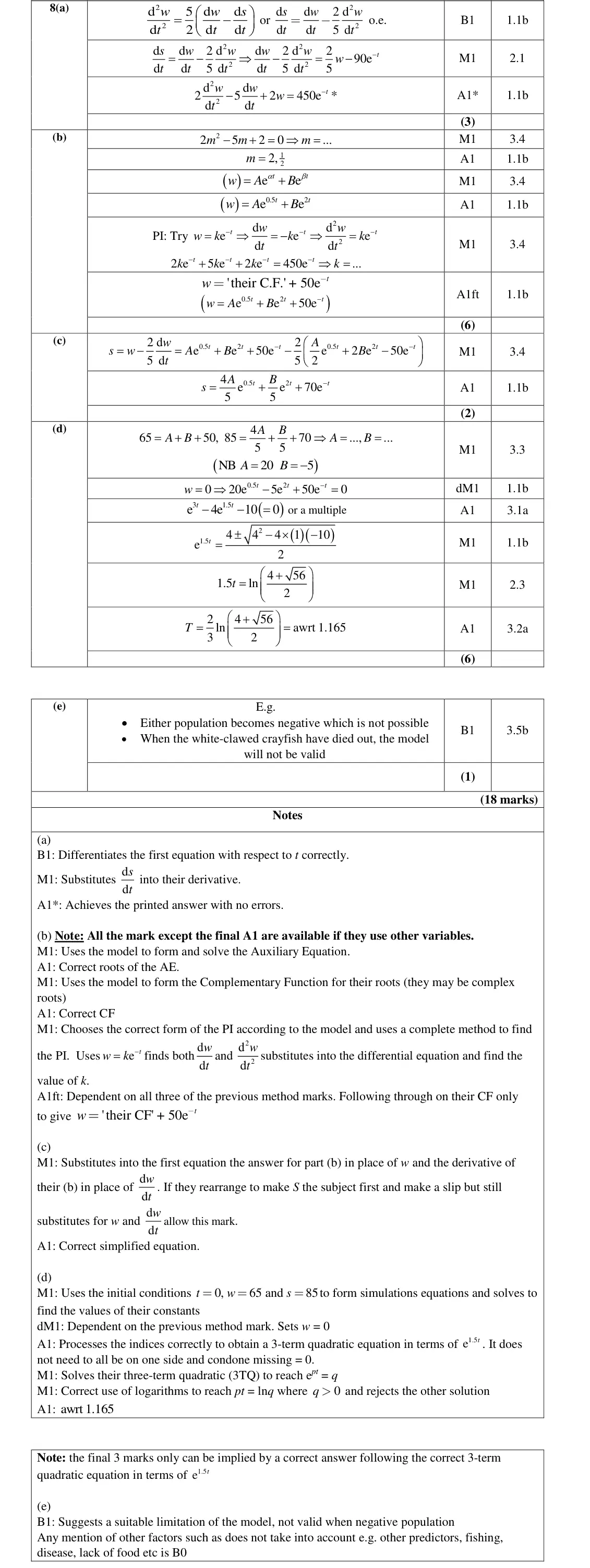
8(a) Coupled first-order differential equations 3 —
8(b) Second-order differential equations 6 —
8(c) Coupled first-order differential equations 2 —
8(d) First-order differential equations: integrating factors and modelling, Coupled first-order differential equations 6 —
8(e) First-order differential equations: integrating factors and modelling 1 —

The questions

1(a)1(b)23(a)3(b)45(a)5(b)5(c)5(d)67(a)7(b)7(c)8(a)8(b)8(c)8(d)8(e)
June 2019 · Paper 1 (Core Pure 1) · Q1(a) 4 marks complex numbers
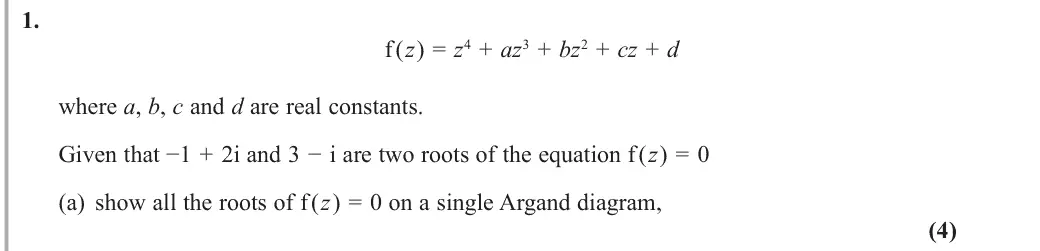
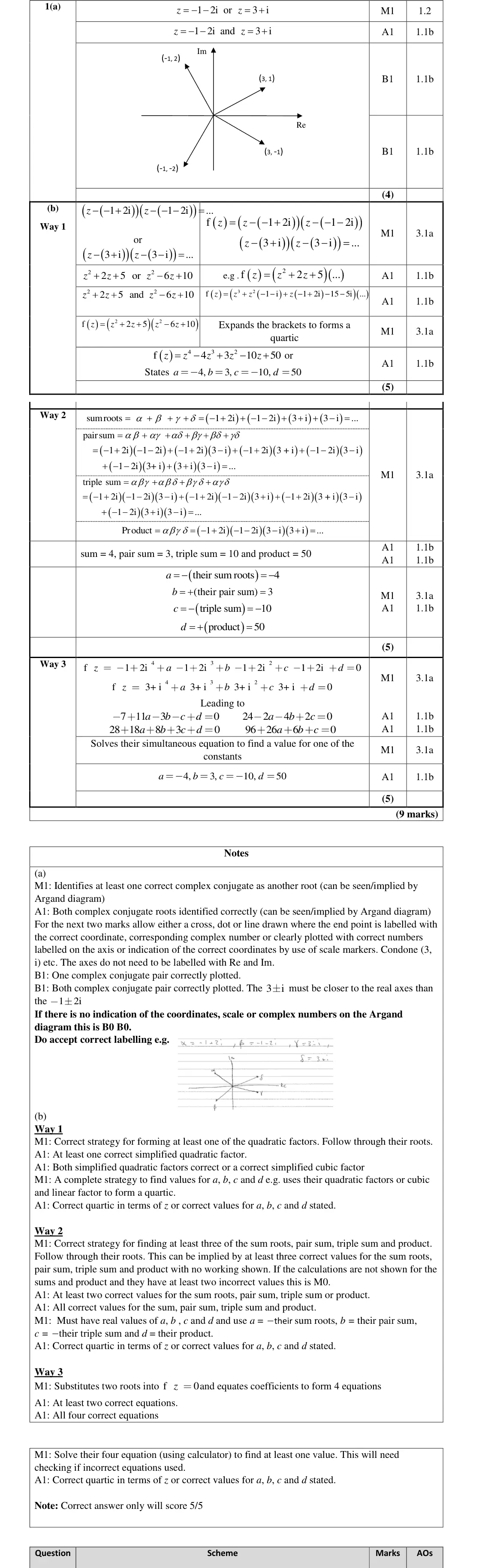
1. f (௘z௘) = z4 + az3 + bz2 + cz + d where a, b, c and d are real constants. Given that í1 + 2i and 3 í i are two roots of the equation f (௘z௘) = 0 (a) =show all the roots of f (௘z௘) = 0 on a single Argand diagram, (4)
June 2019 · Paper 1 (Core Pure 1) · Q1(b) 5 marks complex numbersroots of polynomials
(b) find the values of a, b, c and d. (5)
June 2019 · Paper 1 (Core Pure 1) · Q2 7 marks improper integrals and mean valuepartial fractions integration
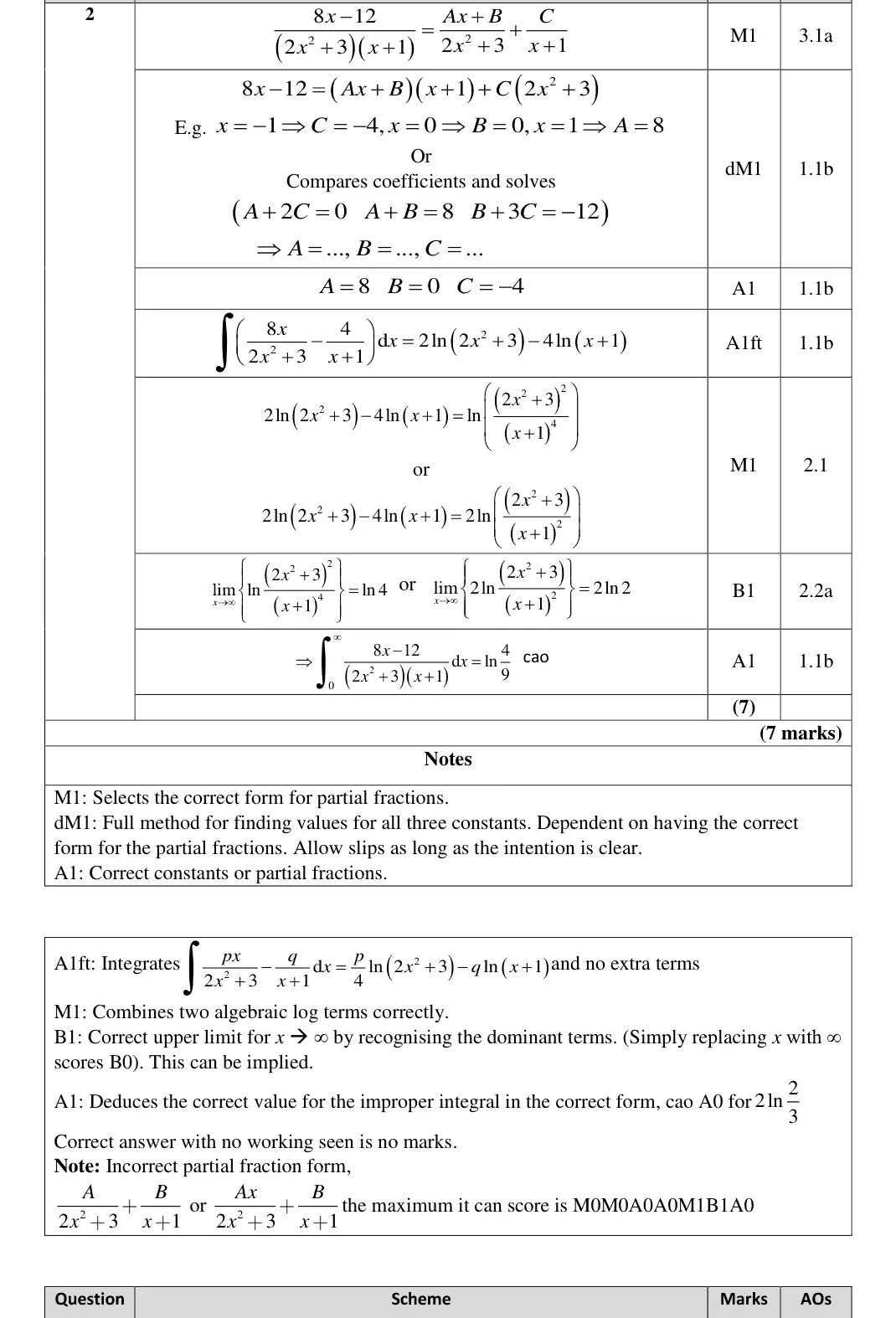
2. Show that x - ∫ d ln x = k ( )( ) x + x + where k is a rational number to be found. (7)
June 2019 · Paper 1 (Core Pure 1) · Q3(a) 2 marks polar coordinates
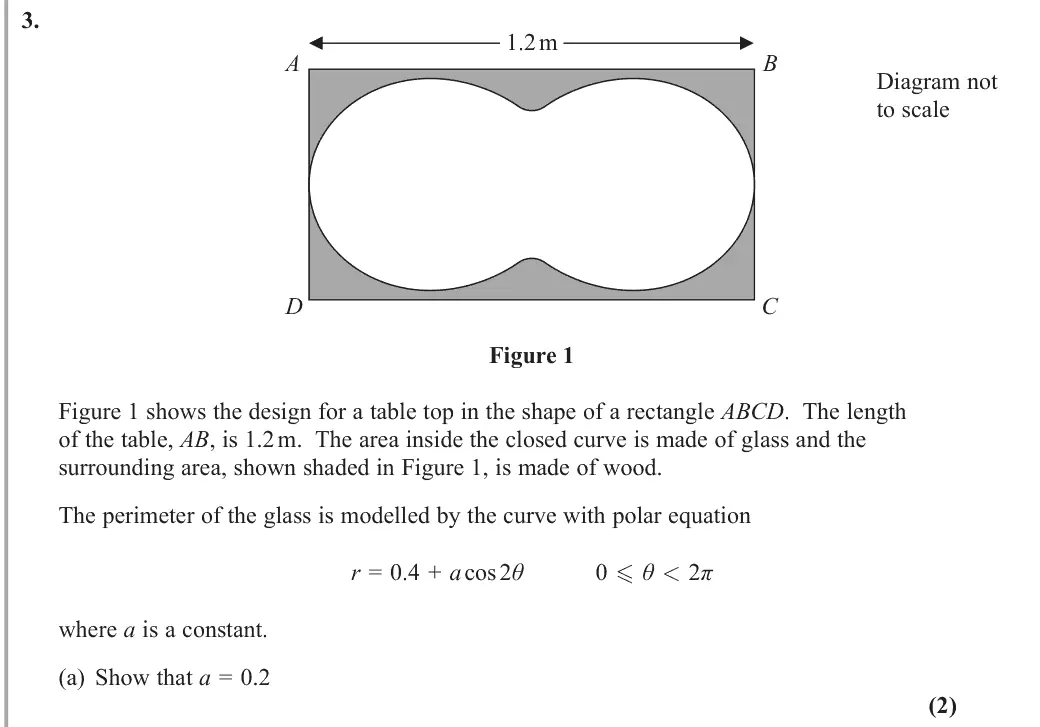
3. 1.2 m A B Diagram not to scale C Figure 1 Figure 1 shows the design for a table top in the shape of a rectangle ABCD. The length of the table, AB, is 1.2 m. The area inside the closed curve is made of glass and the surrounding area, shown shaded in Figure 1, is made of wood. The perimeter of the glass is modelled by the curve with polar equation r = 0.4 + a cos 2ș = = = = = =0 - ș : 2ʌ where a is a constant. (a) =Show that a = 0.2 (2)
June 2019 · Paper 1 (Core Pure 1) · Q3(b) 8 marks polar coordinates
Hence, given that AD = 60 cm, (b) find the area of the wooden part of the table top, giving your answer in m2 to 3 significant figures. (8)
June 2019 · Paper 1 (Core Pure 1) · Q4 5 marks series and method of differences
4. Prove that, for n  ], n . 0 n ( ) ( ) n + a n + b =∑ = ( ) ( ) ( ) ( ) ( ) r + r + r + c n + n + r where a, b and c are integers to be found. (5)
June 2019 · Paper 1 (Core Pure 1) · Q5(a) 4 marks first order differential equations
5. A tank at a chemical plant has a capacity of 250 litres. The tank initially contains 100 litres of pure water. Salt water enters the tank at a rate of 3 litres every minute. Each litre of salt water entering the tank contains 1 gram of salt. It is assumed that the salt water mixes instantly with the contents of the tank upon entry. At the instant when the salt water begins to enter the tank, a valve is opened at the bottom of the tank and the solution in the tank flows out at a rate of 2 litres per minute. Given that there are S grams of salt in the tank after t minutes, (a) =show that the situation can be modelled by the differential equation d S S = - d t + t (4)
June 2019 · Paper 1 (Core Pure 1) · Q5(b) 5 marks first order differential equations
(b) Hence find the number of grams of salt in the tank after 10 minutes. (5)
June 2019 · Paper 1 (Core Pure 1) · Q5(c) 3 marks first order differential equations
When the concentration of salt in the tank reaches 0.9 grams per litre, the valve at the bottom of the tank must be closed. (c) =Find, to the nearest minute, when the valve would need to be closed. (3)
June 2019 · Paper 1 (Core Pure 1) · Q5(d) 1 mark first order differential equations
(d) Evaluate the model. (1)
June 2019 · Paper 1 (Core Pure 1) · Q6 6 marks proof by induction
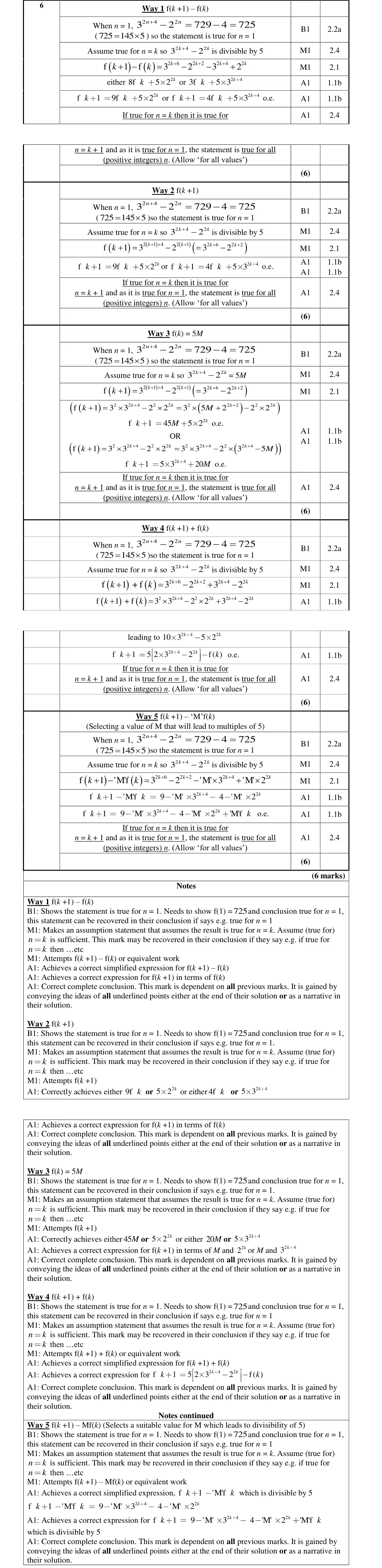
6. Prove by induction that for all positive integers n f (௘n௘) = 32n + 4 í 22n is divisible by 5 (6)
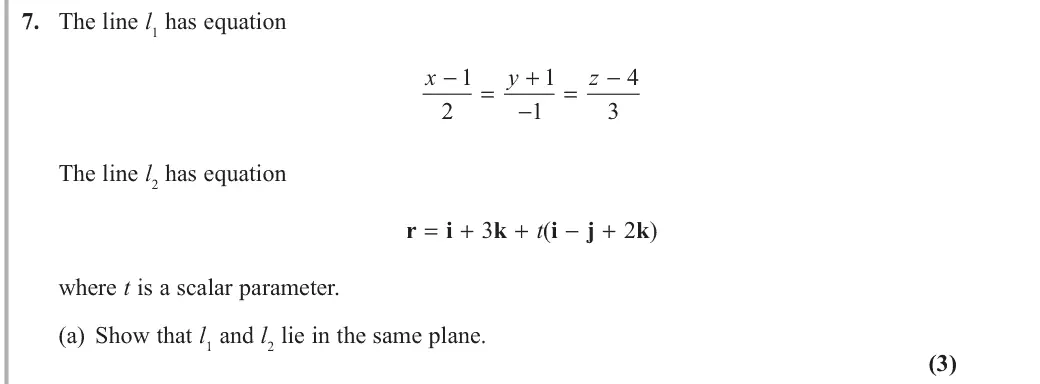
June 2019 · Paper 1 (Core Pure 1) · Q7(a) 3 marks vectors lines and planes
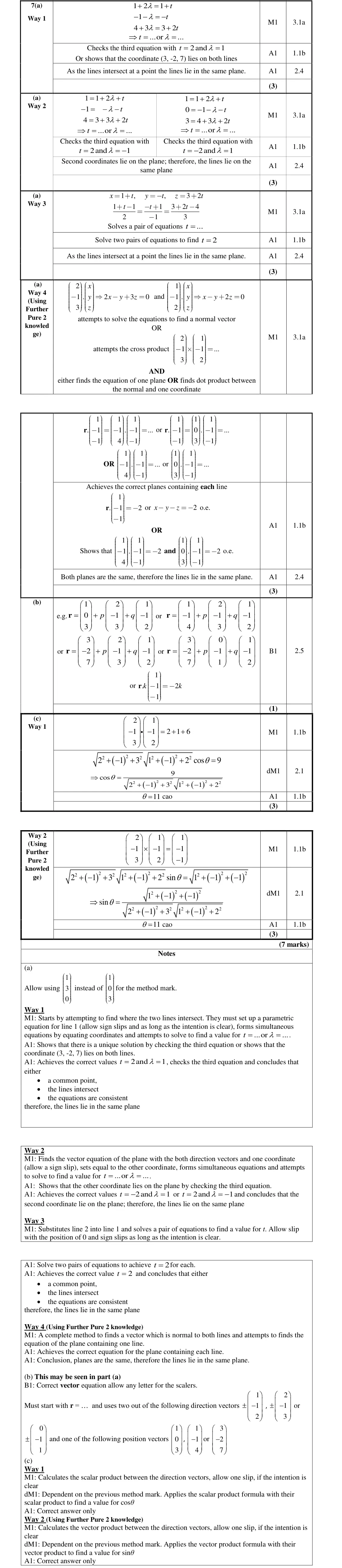
7. The line l1 has equation x - y + z - = = - The line l2 has equation r = i + 3k + t(i - j + 2k) where t is a scalar parameter. (a) =Show that l1 and l2 lie in the same plane. (3)
June 2019 · Paper 1 (Core Pure 1) · Q7(b) 1 mark vectors lines and planes
(b) Write down a vector equation for the plane containing l1 and l2 (1)
June 2019 · Paper 1 (Core Pure 1) · Q7(c) 3 marks vectors lines and planes
(c) =Find, to the nearest degree, the acute angle between l1 and l2 (3)
June 2019 · Paper 1 (Core Pure 1) · Q8(a) 3 marks coupled differential equations
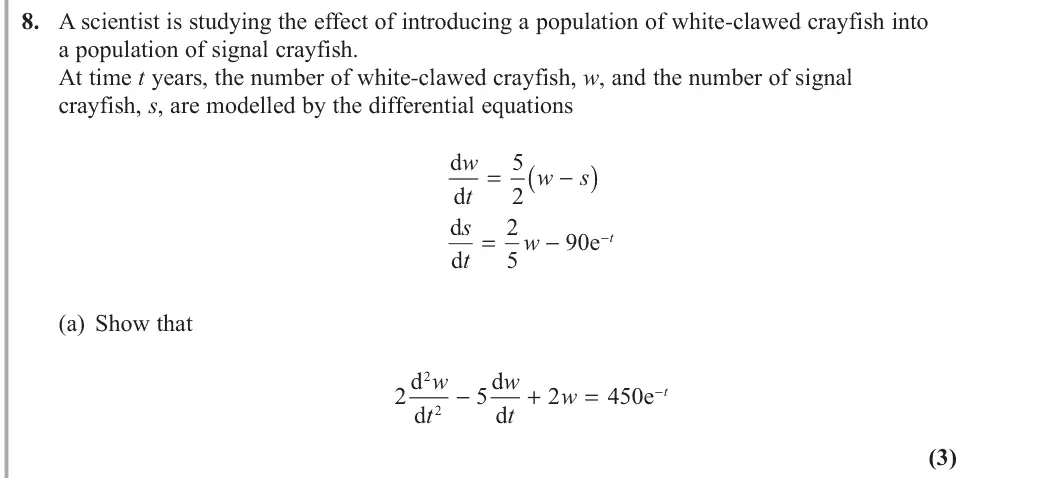
8. A scientist is studying the effect of introducing a population of white-clawed crayfish into a population of signal crayfish. At time t years, the number of white-clawed crayfish, w, and the number of signal crayfish, s, are modelled by the differential equations d w ( ) = w - s d t d s e = w - - t d t (a) =Show that d d w w e - + w = - t d d t t (3)
June 2019 · Paper 1 (Core Pure 1) · Q8(b) 6 marks second order differential equations
(b) Find a general solution for the number of white-clawed crayfish at time t years. (6)
June 2019 · Paper 1 (Core Pure 1) · Q8(c) 2 marks coupled differential equations
(c) =Find a general solution for the number of signal crayfish at time t years. (2)
June 2019 · Paper 1 (Core Pure 1) · Q8(d) 6 marks first order differential equationscoupled differential equations
The model predicts that, at time T years, the population of white-clawed crayfish will have died out. Given that w = 65 and s = 85 when t = 0 (d) find the value of T, giving your answer to 3 decimal places. (6)
June 2019 · Paper 1 (Core Pure 1) · Q8(e) 1 mark first order differential equations
(e) =Suggest a limitation of the model. (1)

Find an Edexcel Further Maths tutor

Want this paper marked and gone through with a Further Maths tutor? Message us.

Prefer email? Send an enquiry

If you are under 18, please include a parent's contact details. Enquiries go to enquiries@alevelfurthermathstutor.com and are deleted once handled.