June 2023: A level Paper 3B: Further Statistics 1

75 marks · 23 question parts · Question paper, mark scheme and examiner's report on Pearson's site

Question by question

QTopicMarksDifficulty
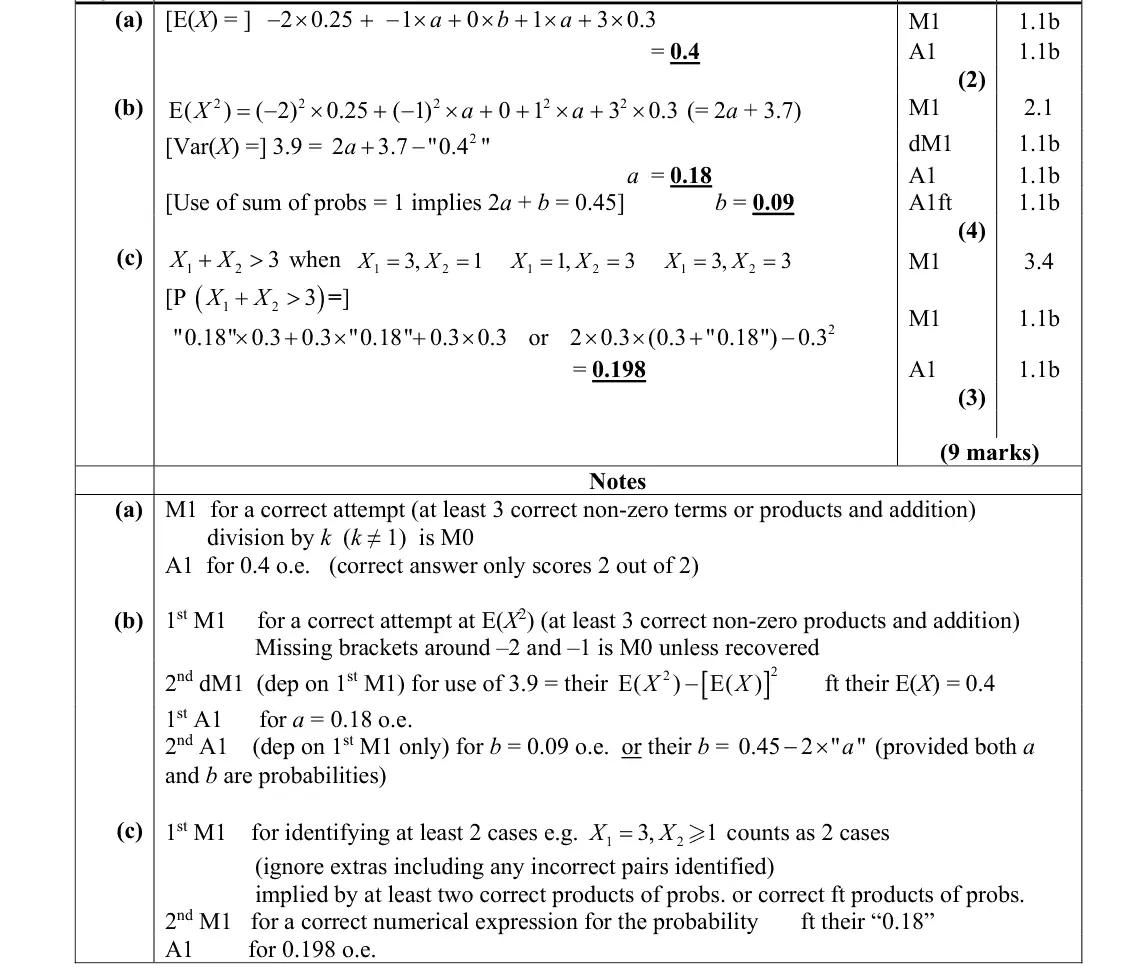
1(a) Discrete random variables: mean and variance 2 —
1(b) Discrete random variables: mean and variance 4 —
1(c) Discrete random variables: mean and variance 3 —
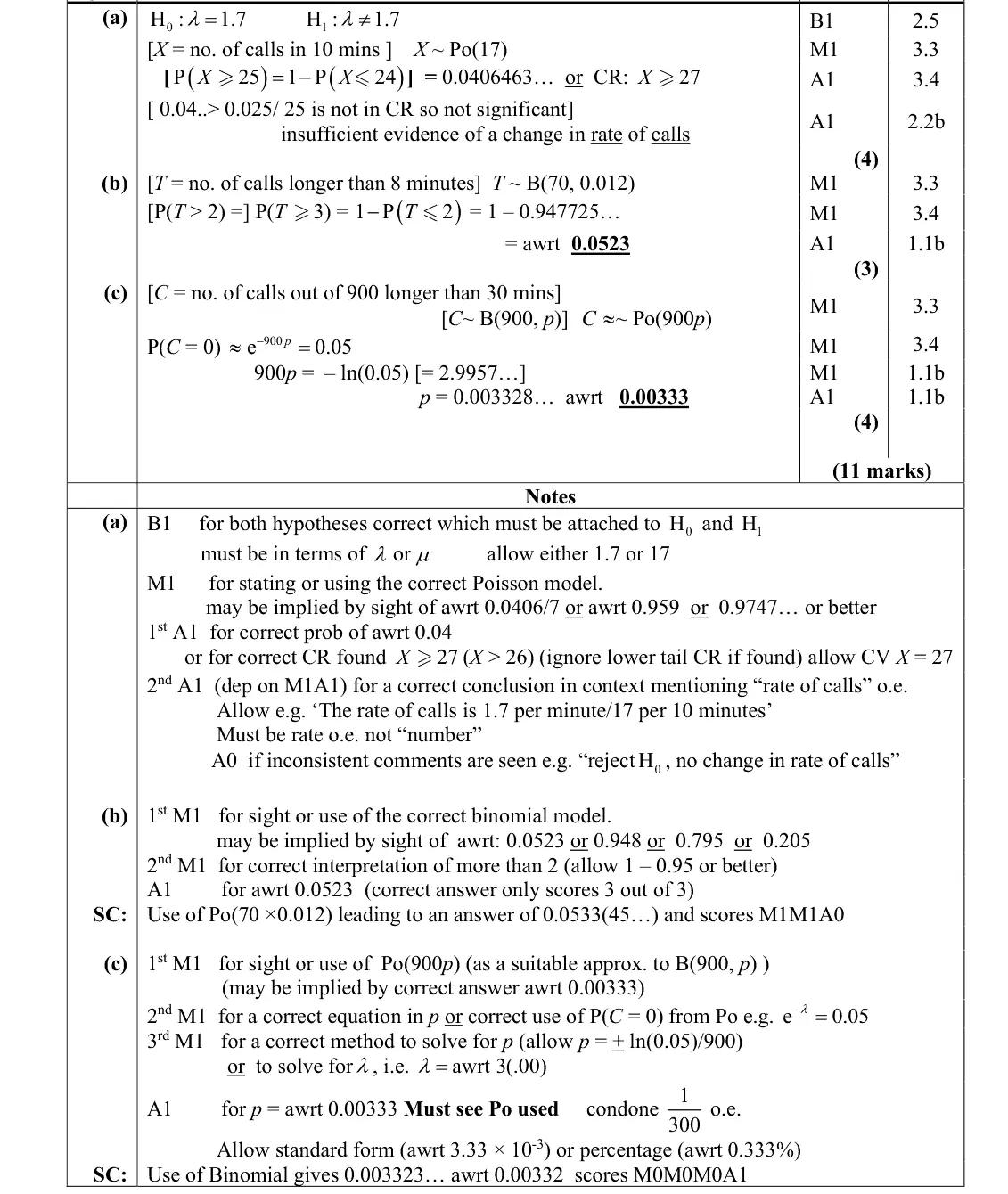
2(a) Hypothesis tests: Poisson, binomial and geometric 4 —
2(b) Poisson and binomial distributions 3 —
2(c) Poisson and binomial distributions 4 —
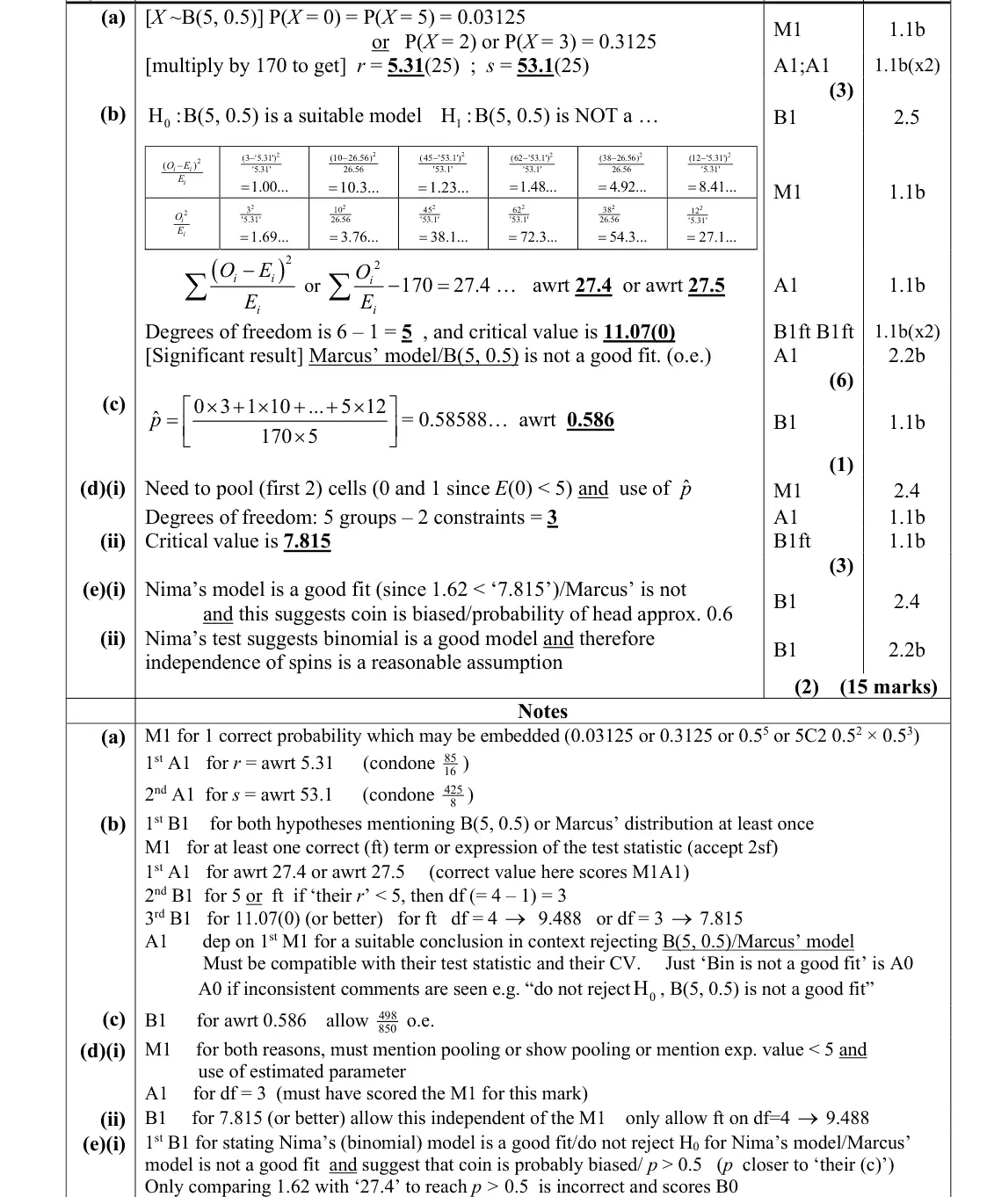
3(a) Chi-squared tests: goodness of fit and contingency tables 3 —
3(b) Chi-squared tests: goodness of fit and contingency tables 6 —
3(c) Chi-squared tests: goodness of fit and contingency tables 1 —
3(d) Chi-squared tests: goodness of fit and contingency tables 3 —
3(e) Chi-squared tests: goodness of fit and contingency tables 2 —
4 Central limit theorem, Geometric and negative binomial distributions 6 —
5(a) Quality of tests: Type I and Type II errors, size and power 4 —
5(b) Quality of tests: Type I and Type II errors, size and power 2 —
5(c) Quality of tests: Type I and Type II errors, size and power 2 —
6(a) Probability generating functions, Geometric and negative binomial distributions 2 —
6(b) Geometric and negative binomial distributions 1 —
6(c) Probability generating functions 7 —
6(d) Probability generating functions 3 —
7(a)(i) Geometric and negative binomial distributions 2 —
7(a)(ii) Geometric and negative binomial distributions 2 —
7(a)(iii) Poisson and binomial distributions 2 —
7(b) Geometric and negative binomial distributions 7 —

The questions

1(a)1(b)1(c)2(a)2(b)2(c)3(a)3(b)3(c)3(d)3(e)45(a)5(b)5(c)6(a)6(b)6(c)6(d)7(a)(i)7(a)(ii)7(a)(iii)7(b)
June 2023 · Paper 3B (Further Statistics 1) · Q1(a) 2 marks discrete random variables
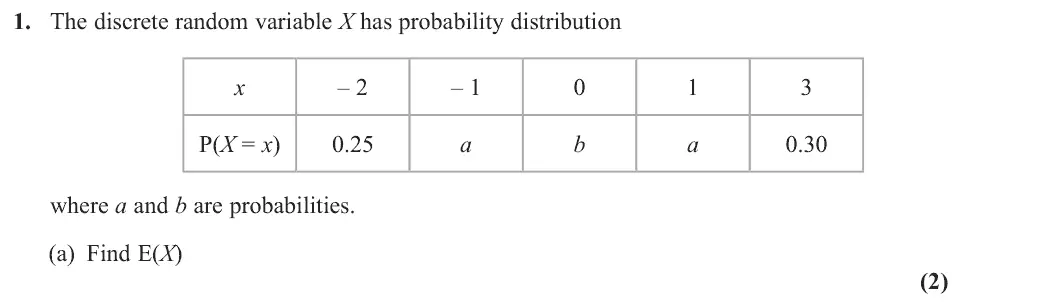
1. The discrete random variable X has probability distribution x – 2 – 1 P(X = x) 0.25 0.30 a b a where a and b are probabilities. (a) Find E(X) (2)
June 2023 · Paper 3B (Further Statistics 1) · Q1(b) 4 marks discrete random variables
Given that Var(X) = 3.9 (b) find the value of a and the value of b (4)
June 2023 · Paper 3B (Further Statistics 1) · Q1(c) 3 marks discrete random variables
The independent random variables X1 and X2 each have the same distribution as X / (c) Find P X X > (3)
June 2023 · Paper 3B (Further Statistics 1) · Q2(a) 4 marks hypothesis tests fs1
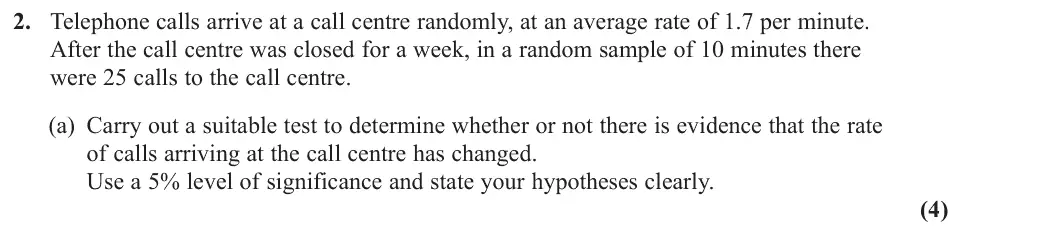
2. Telephone calls arrive at a call centre randomly, at an average rate of 1.7 per minute. After the call centre was closed for a week, in a random sample of 10 minutes there were 25 calls to the call centre. (a) Carry out a suitable test to determine whether or not there is evidence that the rate of calls arriving at the call centre has changed. Use a 5% level of significance and state your hypotheses clearly. (4)
June 2023 · Paper 3B (Further Statistics 1) · Q2(b) 3 marks poisson distribution
Only 1.2% of the calls to the call centre last longer than 8 minutes. One day Tiang has 70 calls. (b) Find the probability that out of these 70 calls Tiang has more than 2 calls lasting longer than 8 minutes. (3)
June 2023 · Paper 3B (Further Statistics 1) · Q2(c) 4 marks poisson distribution
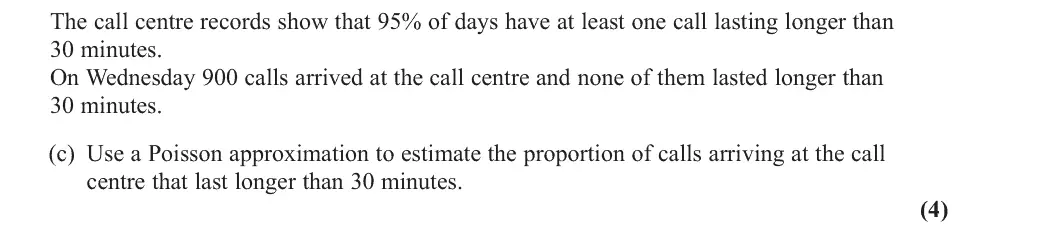
The call centre records show that 95% of days have at least one call lasting longer than 30 minutes. On Wednesday 900 calls arrived at the call centre and none of them lasted longer than 30 minutes. (c) Use a Poisson approximation to estimate the proportion of calls arriving at the call centre that last longer than 30 minutes. (4)
June 2023 · Paper 3B (Further Statistics 1) · Q3(a) 3 marks chi squared tests
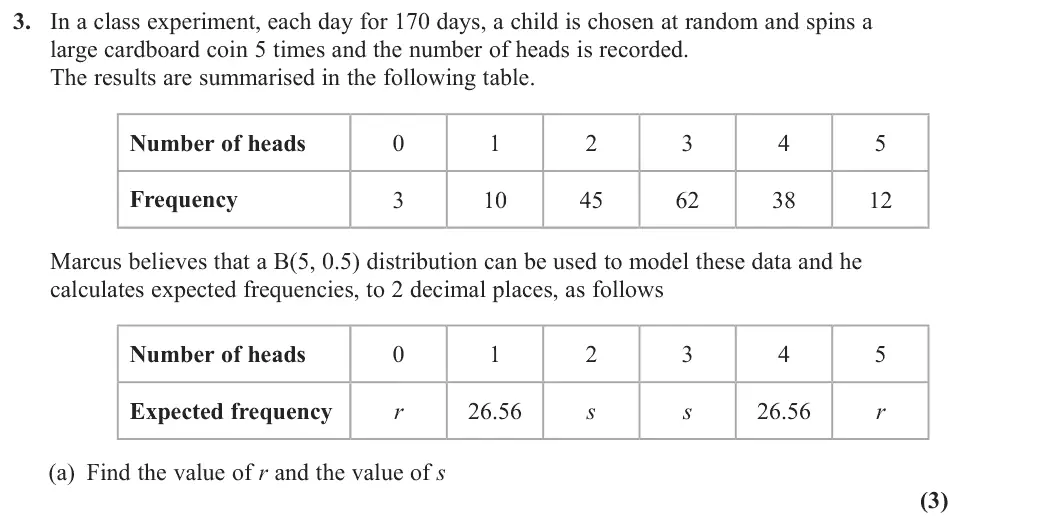
3. In a class experiment, each day for 170 days, a child is chosen at random and spins a large cardboard coin 5 times and the number of heads is recorded. The results are summarised in the following table. Number of heads Frequency Marcus believes that a B(5, 0.5) distribution can be used to model these data and he calculates expected frequencies, to 2 decimal places, as follows Number of heads Expected frequency r 26.56 s s 26.56 r (a) Find the value of r and the value of s (3)
June 2023 · Paper 3B (Further Statistics 1) · Q3(b) 6 marks chi squared tests
(b) Carry out a suitable test, at the 5% level of significance, to determine whether or not the B(5, 0.5) distribution is a good model for these data. You should state clearly your hypotheses, the test statistic and the critical value used. (6)
June 2023 · Paper 3B (Further Statistics 1) · Q3(c) 1 mark chi squared tests
Nima believes that a better model for these data would be B(5, p) (c) Find a suitable estimate for p (1)
June 2023 · Paper 3B (Further Statistics 1) · Q3(d) 3 marks chi squared tests
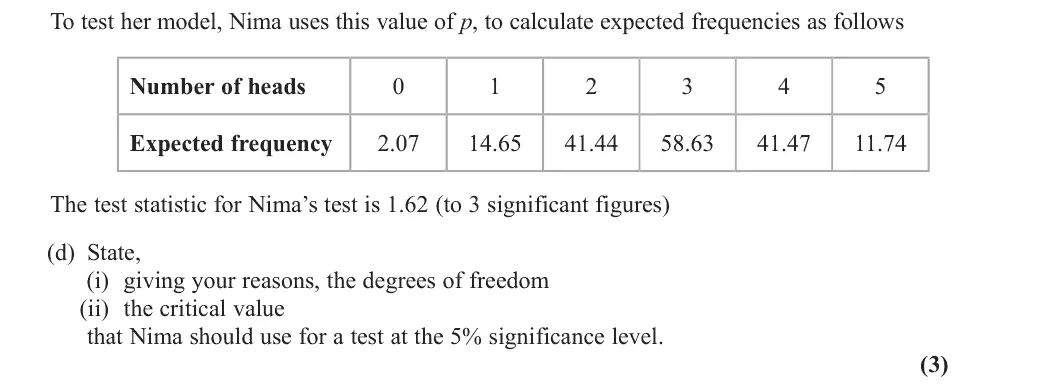
To test her model, Nima uses this value of p, to calculate expected frequencies as follows Number of heads Expected frequency 2.07 14.65 41.44 58.63 41.47 11.74 The test statistic for Nima’s test is 1.62 (to 3 significant figures) (d) State, (i) giving your reasons, the degrees of freedom (ii) the critical value that Nima should use for a test at the 5% significance level. (3)
June 2023 · Paper 3B (Further Statistics 1) · Q3(e) 2 marks chi squared tests
(e) With reference to Marcus’ and Nima’s test results, comment on (i) the probability of the coin landing on heads, (ii) the independence of the spins of the coin. Give reasons for your answers. (2)
June 2023 · Paper 3B (Further Statistics 1) · Q4 6 marks central limit theoremgeometric and negative binomial
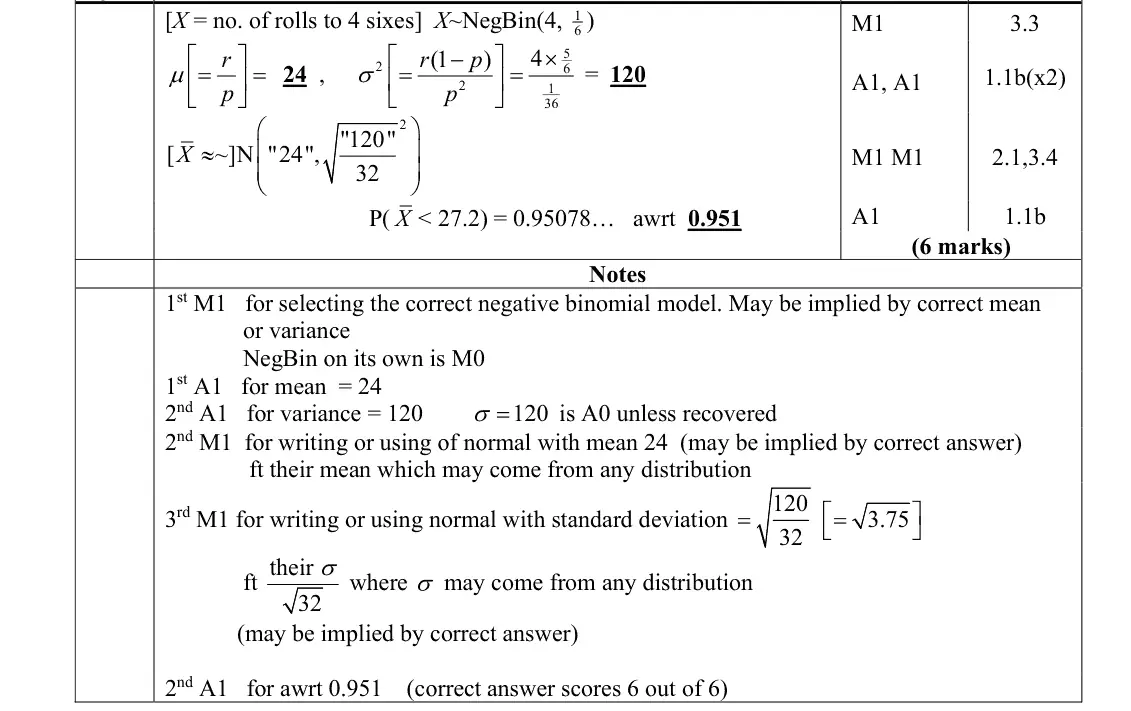
4. There are 32 students in a class. Each student rolls a fair die repeatedly, stopping when their total number of sixes is 4 Each student records the total number of times they rolled the die. Estimate the probability that the mean number of rolls for the class is less than 27.2 (6)
June 2023 · Paper 3B (Further Statistics 1) · Q5(a) 4 marks type i and type ii errors
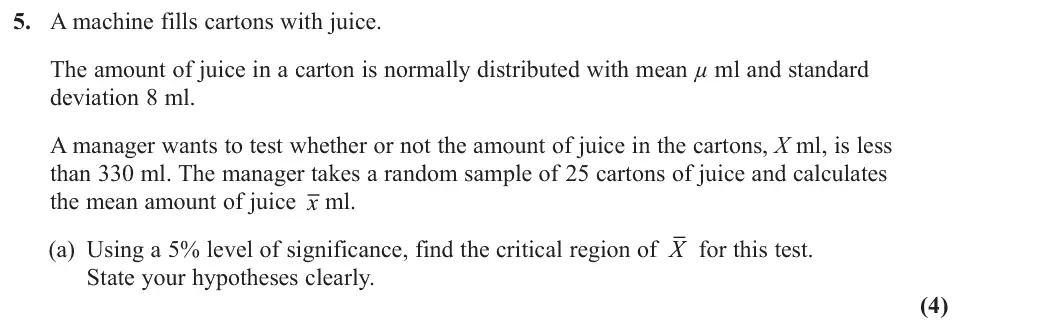
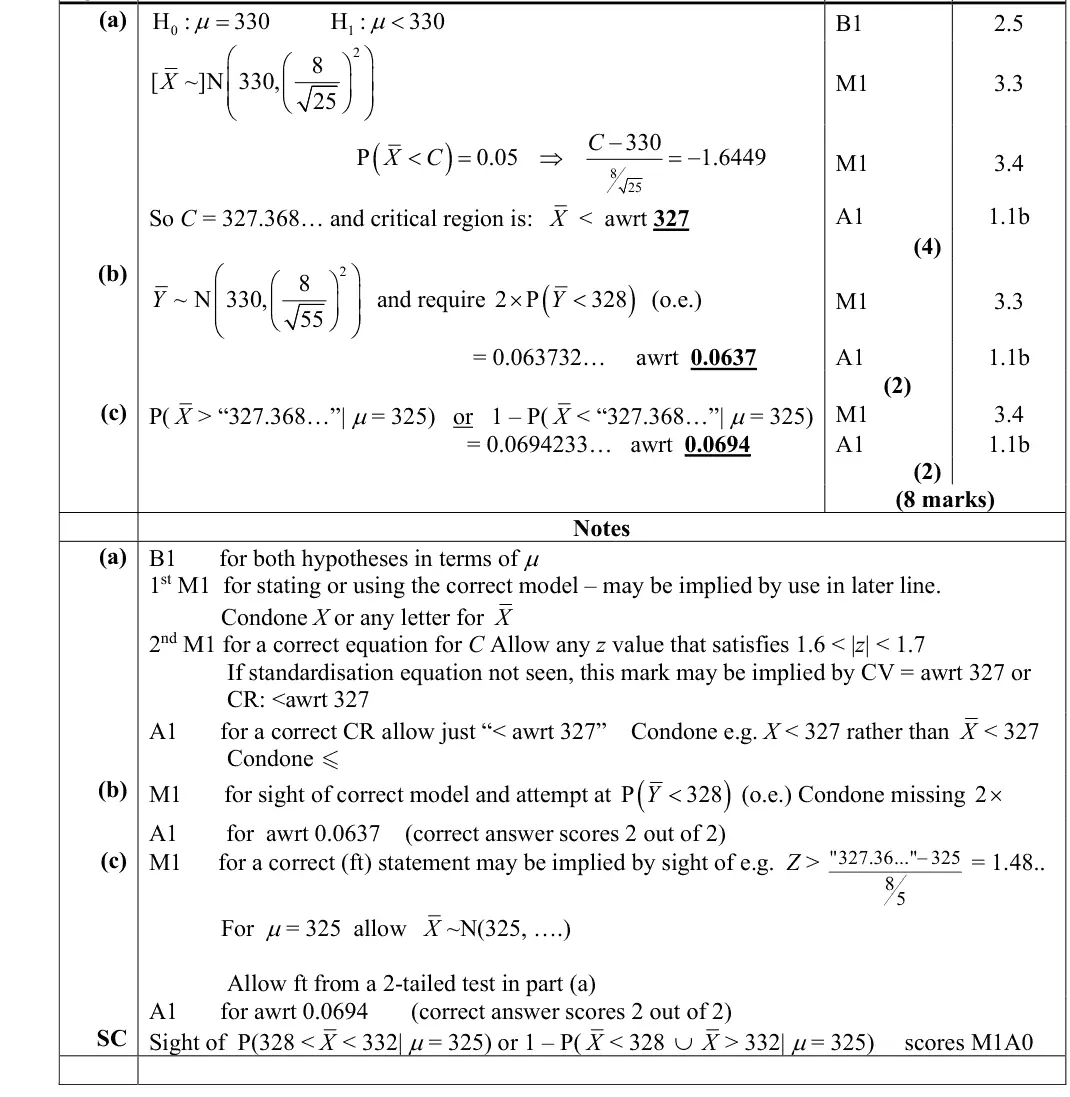
5. A machine fills cartons with juice. The amount of juice in a carton is normally distributed with mean mu ml and standard deviation 8 ml. A manager wants to test whether or not the amount of juice in the cartons, X ml, is less than 330 ml. The manager takes a random sample of 25 cartons of juice and calculates the mean amount of juice x ml. (a) Using a 5% level of significance, find the critical region of X for this test. State your hypotheses clearly. (4)
June 2023 · Paper 3B (Further Statistics 1) · Q5(b) 2 marks type i and type ii errors
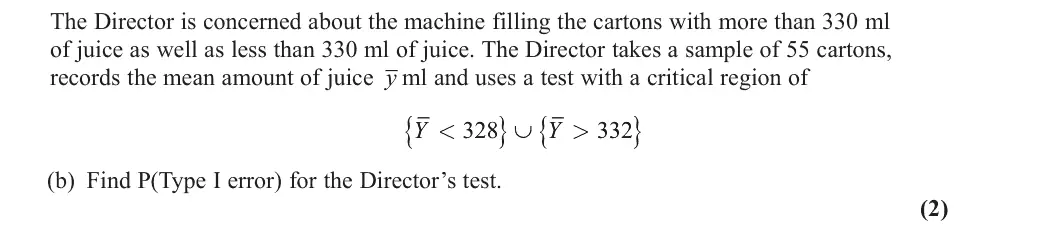
The Director is concerned about the machine filling the cartons with more than 330 ml of juice as well as less than 330 ml of juice. The Director takes a sample of 55 cartons, records the mean amount of juice y ml and uses a test with a critical region of ¥ : <= <= ¥ Y Y < > (b) Find P(Type I error) for the Director’s test. (2)
June 2023 · Paper 3B (Further Statistics 1) · Q5(c) 2 marks type i and type ii errors
When μ = 325 ml (c) find P(Type II error) for the test in part (a) (2)
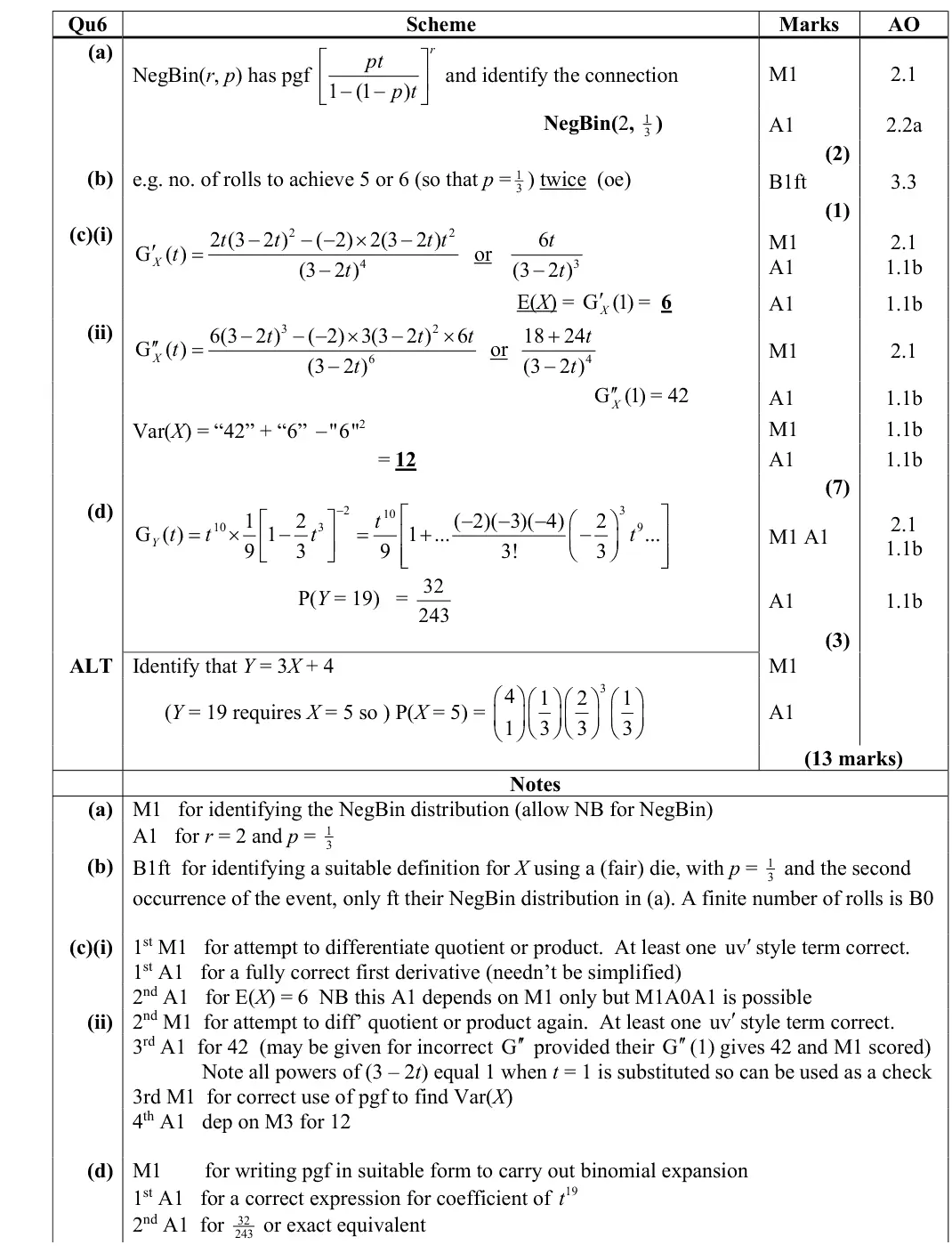
June 2023 · Paper 3B (Further Statistics 1) · Q6(a) 2 marks probability generating functionsgeometric and negative binomial
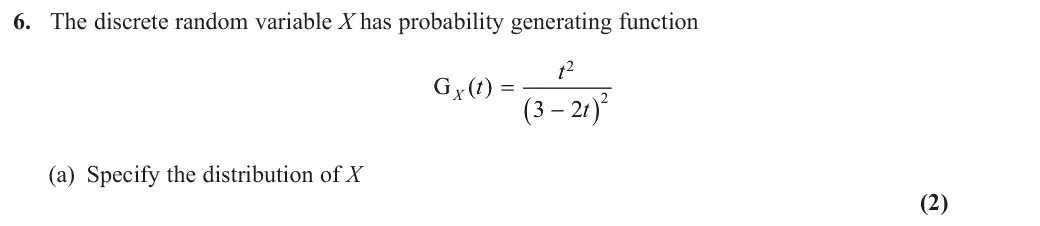
6. The discrete random variable X has probability generating function t G X t ( ) O / t (a) Specify the distribution of X (2)
June 2023 · Paper 3B (Further Statistics 1) · Q6(b) 1 mark geometric and negative binomial
A fair die is rolled repeatedly. (b) Describe an outcome that could be modelled by the random variable X (1)
June 2023 · Paper 3B (Further Statistics 1) · Q6(c) 7 marks probability generating functions
(c) Use calculus and G X t( ) to find (i) E(X) (ii) Var(X) (7)
June 2023 · Paper 3B (Further Statistics 1) · Q6(d) 3 marks probability generating functions
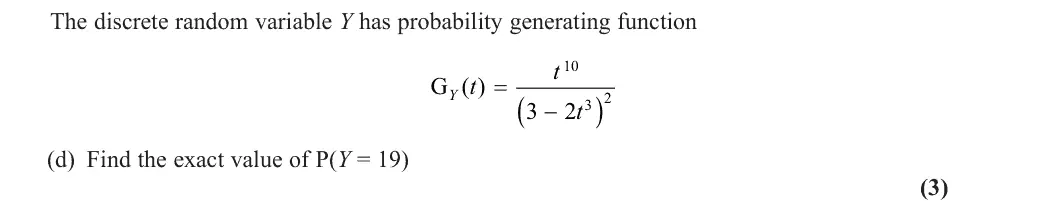
The discrete random variable Y has probability generating function t GY t ( ) O / 3 2 t (d) Find the exact value of P(Y = 19) (3)
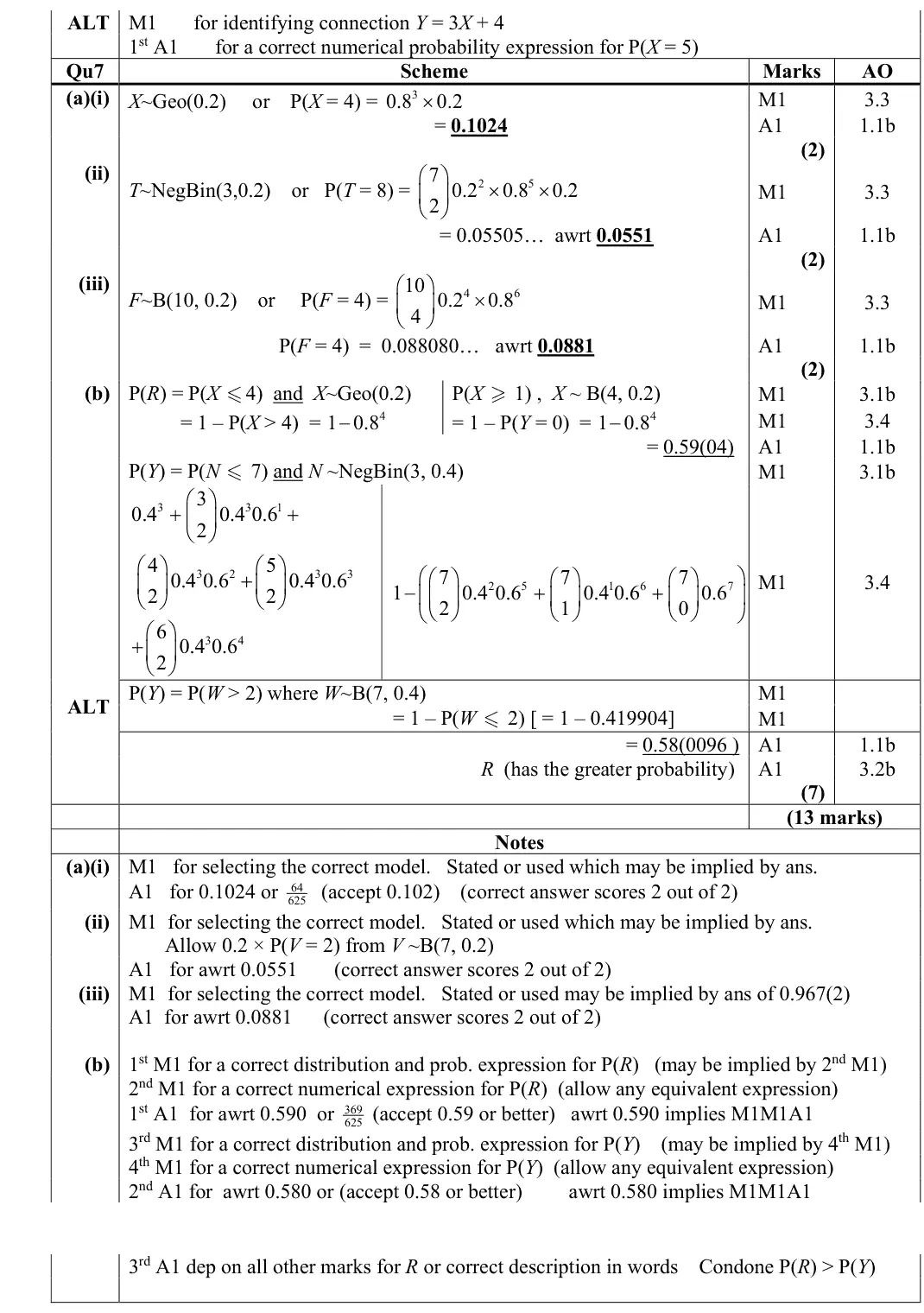
June 2023 · Paper 3B (Further Statistics 1) · Q7(a)(i) 2 marks geometric and negative binomial
7. Each time a spinner is spun, the probability that it lands on red is 0.2 (a) Find the probability that the spinner lands on red (i) for the 1st time on the 4th spin (2)
June 2023 · Paper 3B (Further Statistics 1) · Q7(a)(ii) 2 marks geometric and negative binomial
(ii) for the 3rd time on the 8th spin (2)
June 2023 · Paper 3B (Further Statistics 1) · Q7(a)(iii) 2 marks poisson distribution
(iii) exactly 4 times during 10 spins (2)
June 2023 · Paper 3B (Further Statistics 1) · Q7(b) 7 marks geometric and negative binomial
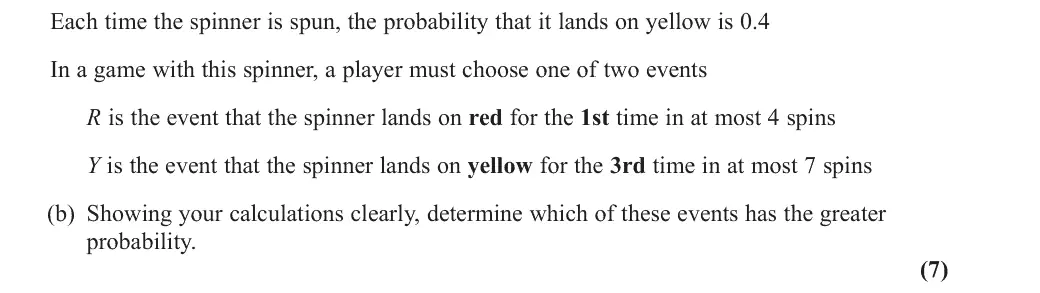
Each time the spinner is spun, the probability that it lands on yellow is 0.4 In a game with this spinner, a player must choose one of two events R is the event that the spinner lands on red for the 1st time in at most 4 spins Y is the event that the spinner lands on yellow for the 3rd time in at most 7 spins (b) Showing your calculations clearly, determine which of these events has the greater probability. (7)

Find an Edexcel Further Maths tutor

Want this paper marked and gone through with a Further Maths tutor? Message us.

Prefer email? Send an enquiry

If you are under 18, please include a parent's contact details. Enquiries go to enquiries@alevelfurthermathstutor.com and are deleted once handled.