June 2024: A level Paper 3B: Further Statistics 1

75 marks · 26 question parts · Question paper, mark scheme and examiner's report on Pearson's site

Question by question

QTopicMarksDifficulty
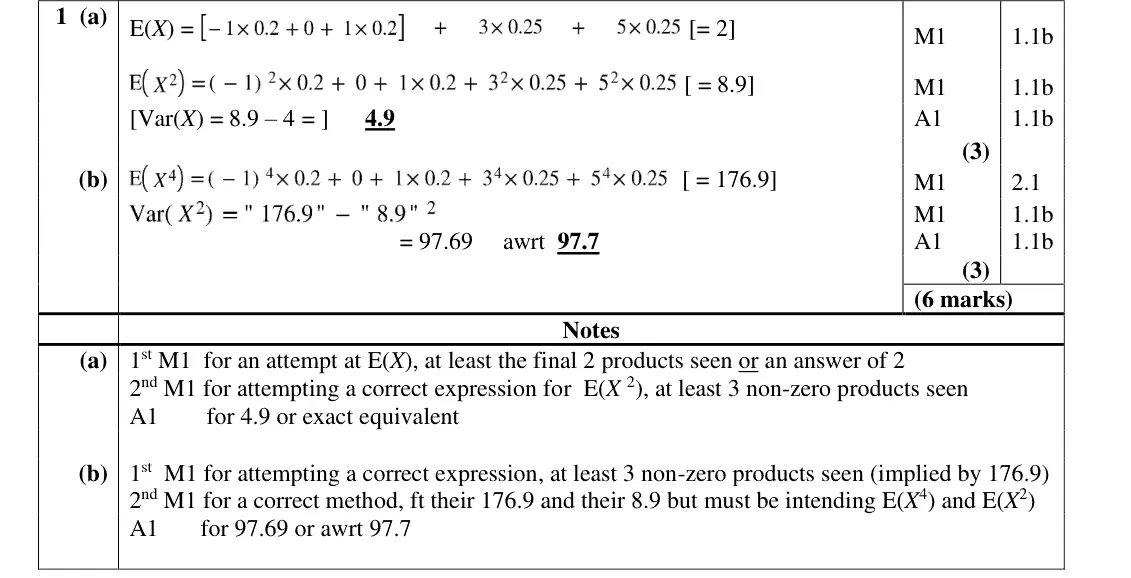
1(a) Discrete random variables: mean and variance 3 —
1(b) Discrete random variables: mean and variance 3 —
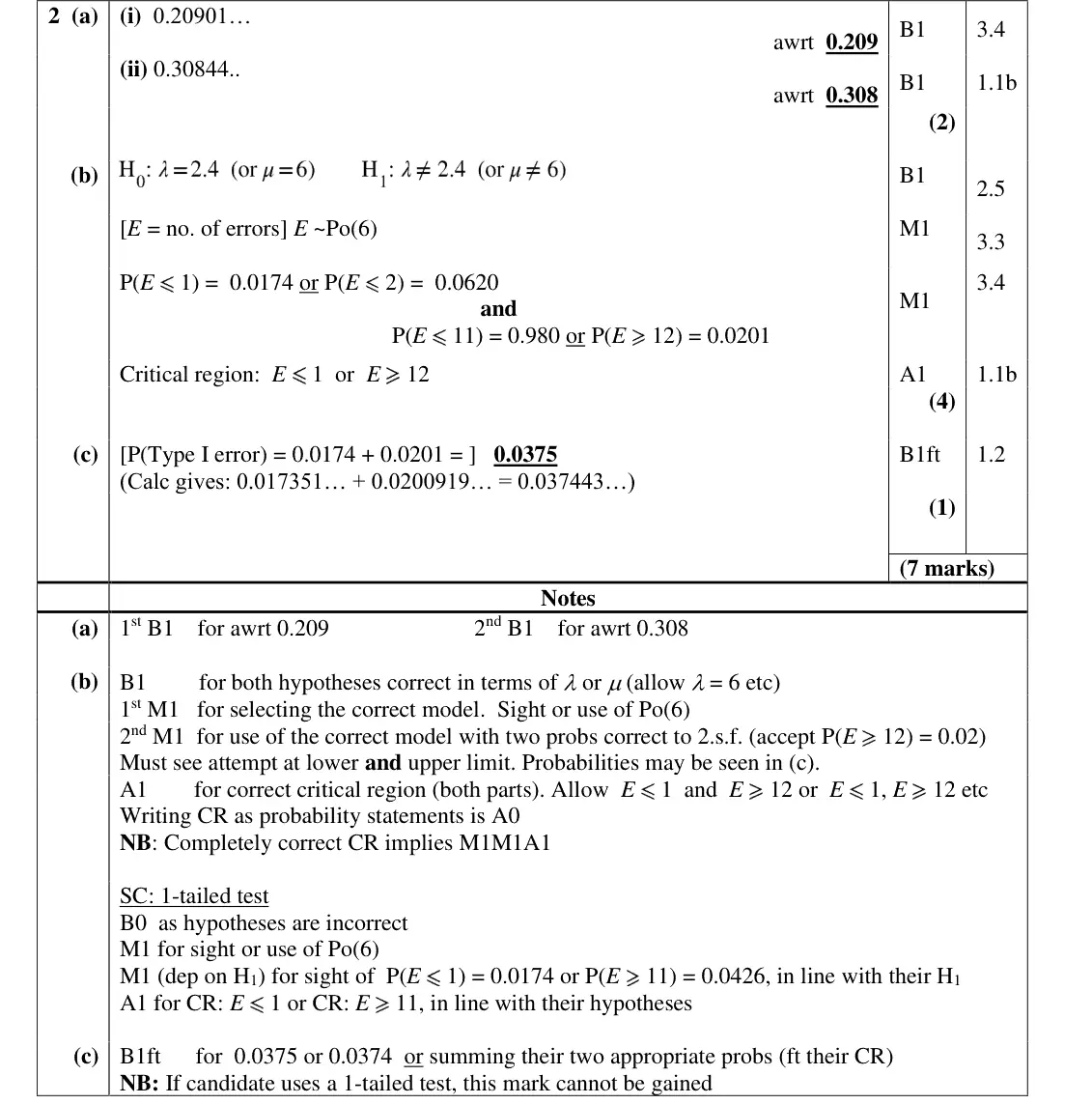
2(a) Poisson and binomial distributions 2 —
2(b) Hypothesis tests: Poisson, binomial and geometric 4 —
2(c) Quality of tests: Type I and Type II errors, size and power 1 —
3(a) Chi-squared tests: goodness of fit and contingency tables 1 —
3(b) Chi-squared tests: goodness of fit and contingency tables 2 —
3(c) Chi-squared tests: goodness of fit and contingency tables 3 —
4(a) Geometric and negative binomial distributions 1 —
4(b) Geometric and negative binomial distributions 2 —
4(c) Central limit theorem, Geometric and negative binomial distributions 5 —
4(d) Hypothesis tests: Poisson, binomial and geometric 4 —
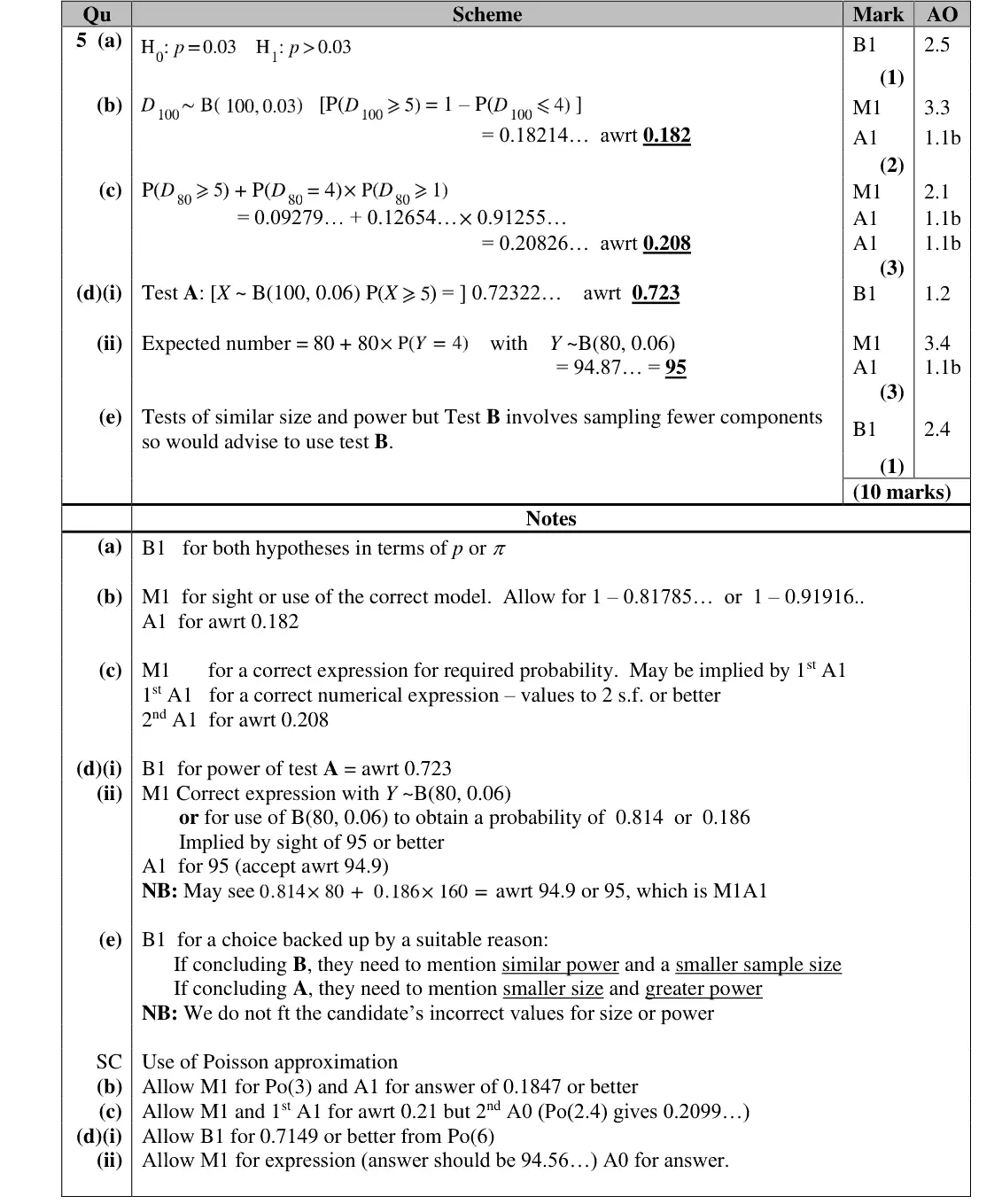
5(a) Quality of tests: Type I and Type II errors, size and power 1 —
5(b) Quality of tests: Type I and Type II errors, size and power 2 —
5(c) Quality of tests: Type I and Type II errors, size and power 3 —
5(d) Quality of tests: Type I and Type II errors, size and power, Discrete random variables: mean and variance 3 —
5(e) Quality of tests: Type I and Type II errors, size and power 1 —
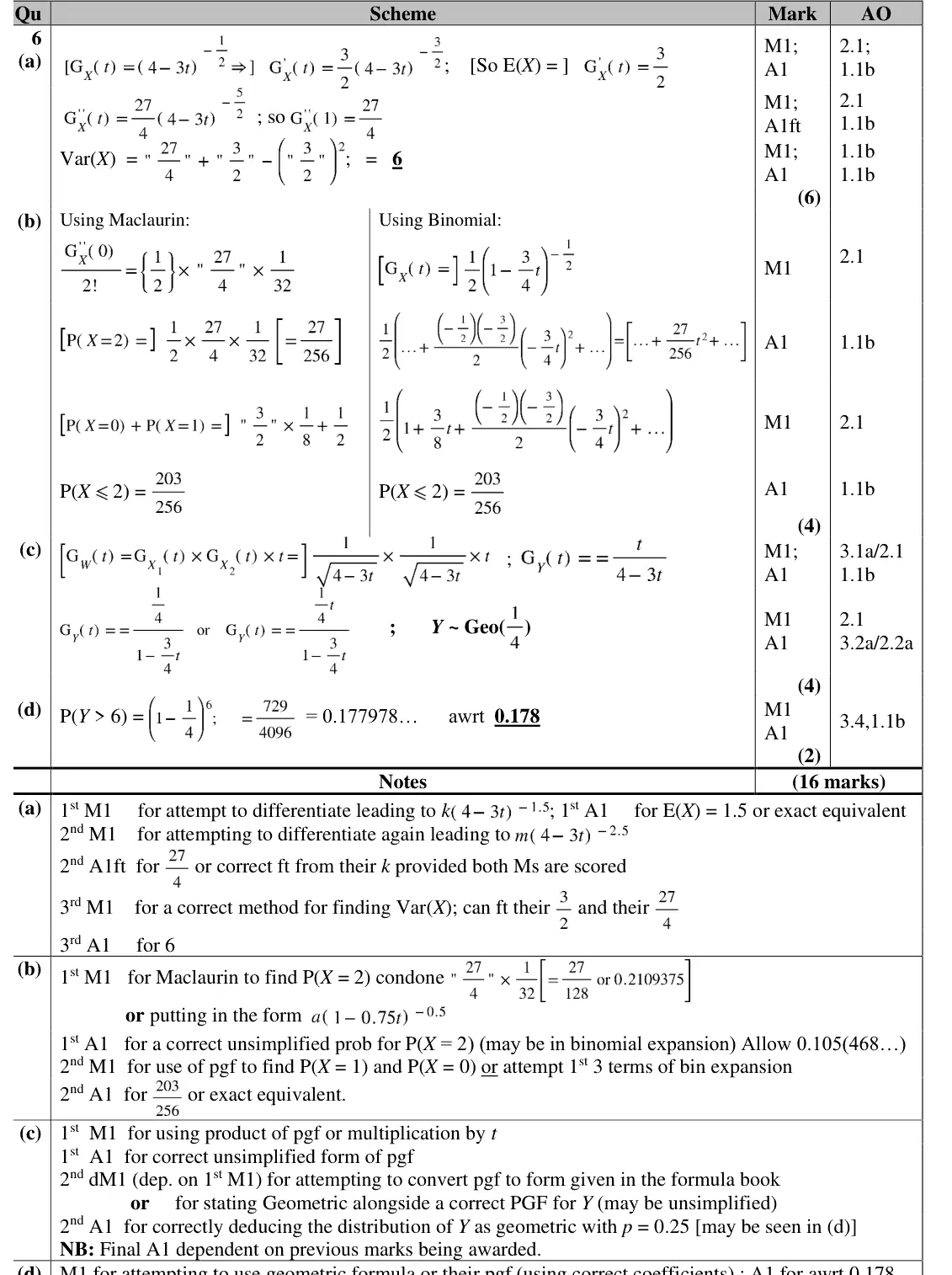
6(a) Probability generating functions 6 —
6(b) Probability generating functions 4 —
6(c) Probability generating functions 4 —
6(d) Geometric and negative binomial distributions 2 —
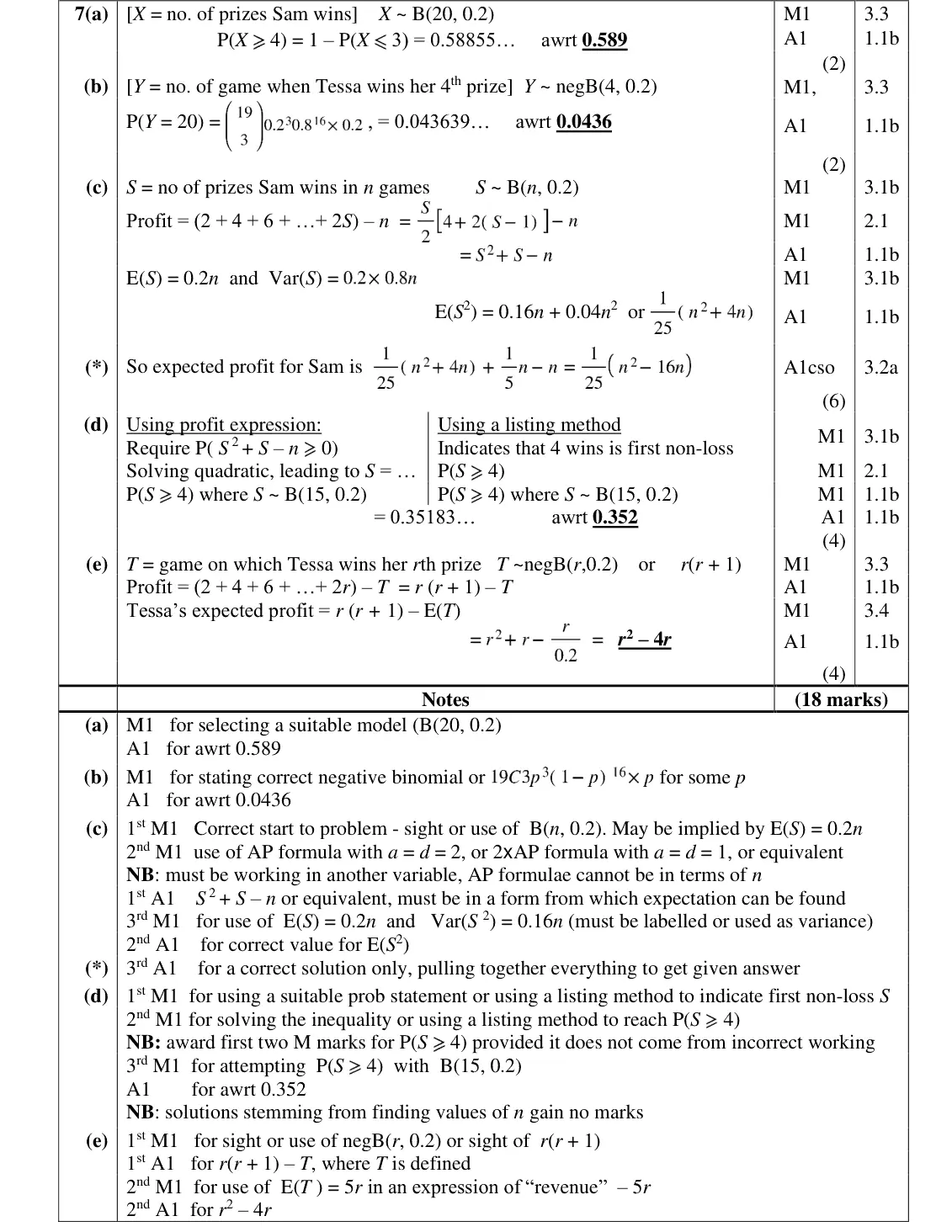
7(a) Poisson and binomial distributions 2 —
7(b) Geometric and negative binomial distributions 2 —
7(c) Discrete random variables: mean and variance, Poisson and binomial distributions 6 —
7(d) Poisson and binomial distributions 4 —
7(e) Geometric and negative binomial distributions, Discrete random variables: mean and variance 4 —

The questions

1(a)1(b)2(a)2(b)2(c)3(a)3(b)3(c)4(a)4(b)4(c)4(d)5(a)5(b)5(c)5(d)5(e)6(a)6(b)6(c)6(d)7(a)7(b)7(c)7(d)7(e)
June 2024 · Paper 3B (Further Statistics 1) · Q1(a) 3 marks discrete random variables
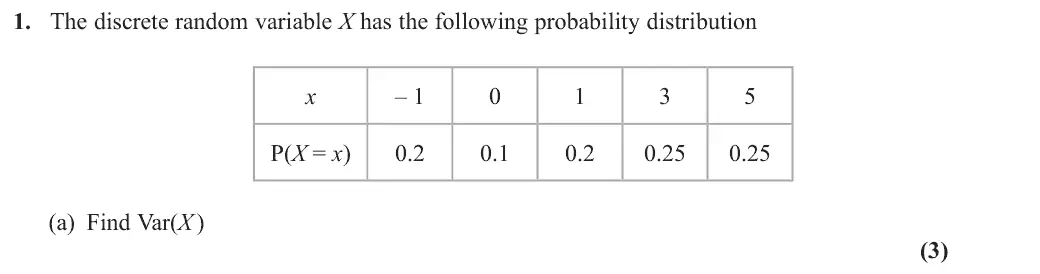
1. The discrete random variable X has the following probability distribution – 1 x P(X = x) 0.2 0.1 0.2 0.25 0.25 (a) Find Var(X ) (3)
June 2024 · Paper 3B (Further Statistics 1) · Q1(b) 3 marks discrete random variables
(b) Find Var(X 2) (3)
June 2024 · Paper 3B (Further Statistics 1) · Q2(a) 2 marks poisson distribution
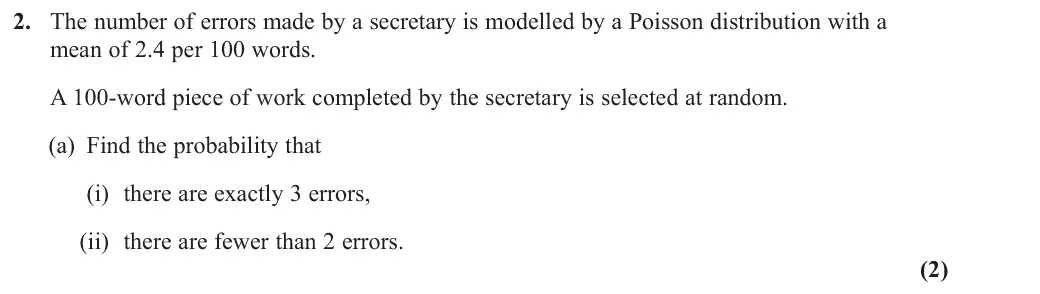
2. The number of errors made by a secretary is modelled by a Poisson distribution with a mean of 2.4 per 100 words. A 100‑word piece of work completed by the secretary is selected at random. (a) Find the probability that (i) there are exactly 3 errors, (ii) there are fewer than 2 errors. (2)
June 2024 · Paper 3B (Further Statistics 1) · Q2(b) 4 marks hypothesis tests fs1
After a long holiday, a randomly selected piece of work containing 250 words completed by the secretary is examined to see if the rate of errors has changed. (b) Stating your hypotheses clearly, and using a 5% level of significance, find the critical region for a suitable test. (4)
June 2024 · Paper 3B (Further Statistics 1) · Q2(c) 1 mark type i and type ii errors
(c) Find P(Type I error) for the test in part (b) (1)
June 2024 · Paper 3B (Further Statistics 1) · Q3(a) 1 mark chi squared tests
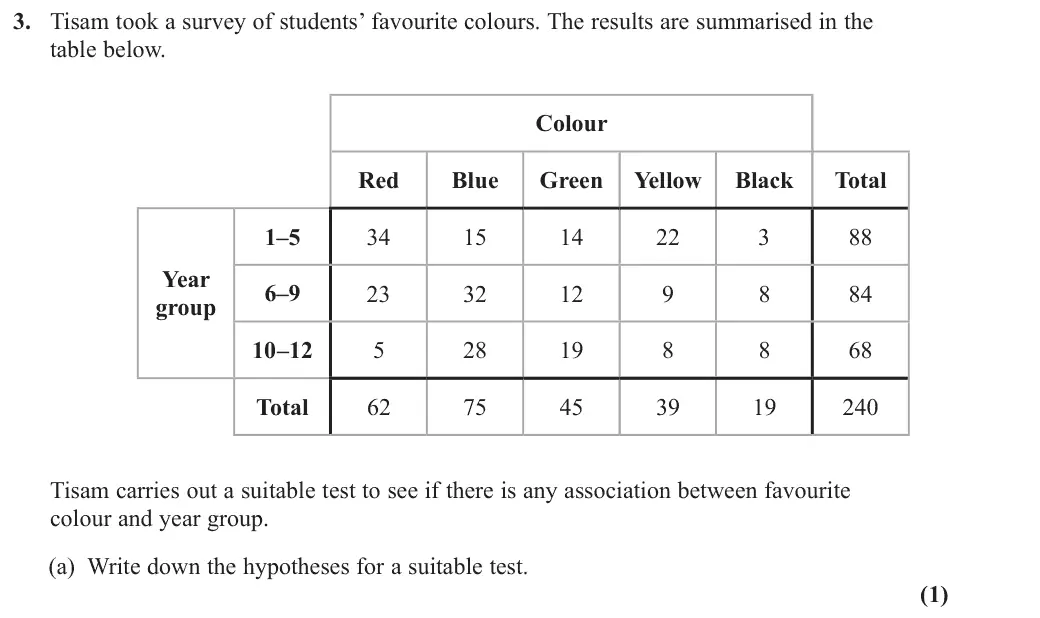
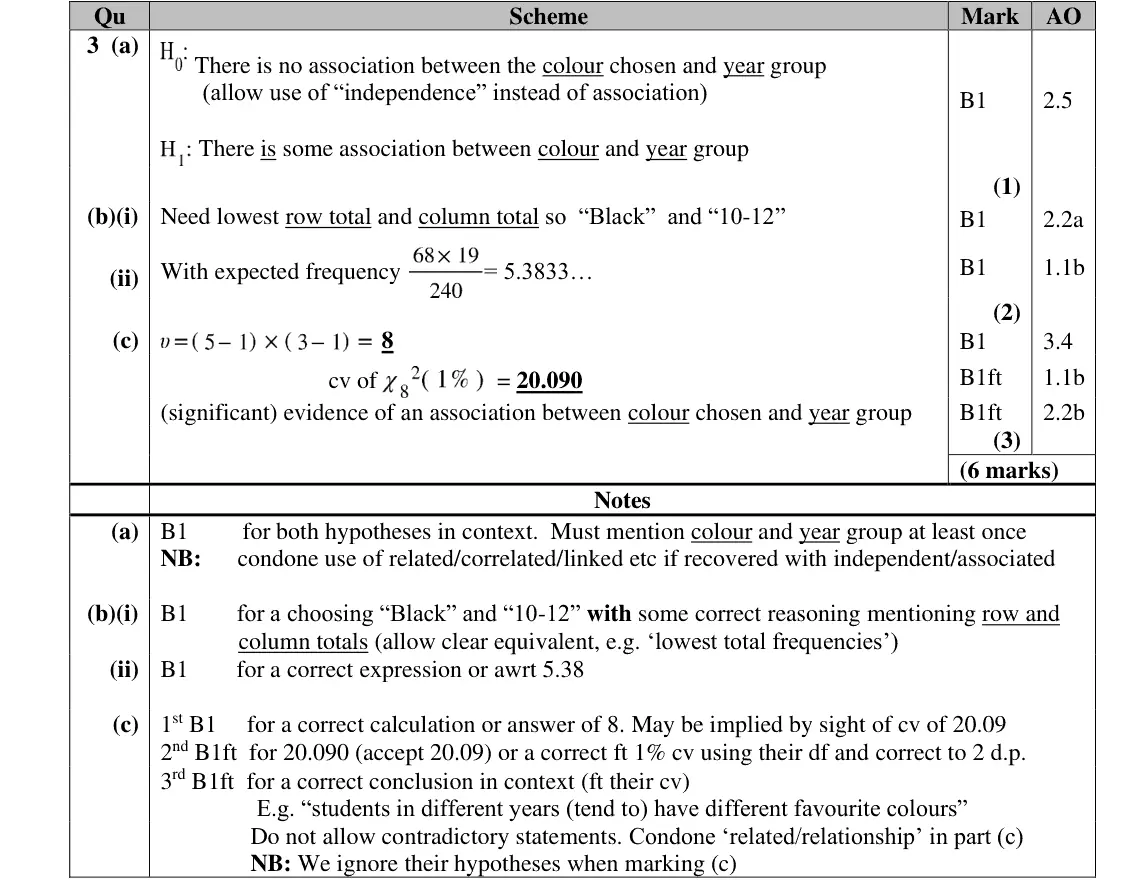
3. Tisam took a survey of students’ favourite colours. The results are summarised in the table below. Colour Red Blue Green Yellow Black Total 1–5 Year 6–9 group 10–12 Total Tisam carries out a suitable test to see if there is any association between favourite colour and year group. (a) Write down the hypotheses for a suitable test. (1)
June 2024 · Paper 3B (Further Statistics 1) · Q3(b) 2 marks chi squared tests
For her table, Tisam only needs to check one cell to show that none of the expected frequencies are less than 5 (b) (i) Identify this cell, giving your reason. (ii) Calculate the expected frequency for this cell. (2)
June 2024 · Paper 3B (Further Statistics 1) · Q3(c) 3 marks chi squared tests
The test statistic for Tisam’s test is 38.449 (c) Using a 1% level of significance, complete the test. You should state your critical value and conclusion clearly. (3)
June 2024 · Paper 3B (Further Statistics 1) · Q4(a) 1 mark geometric and negative binomial
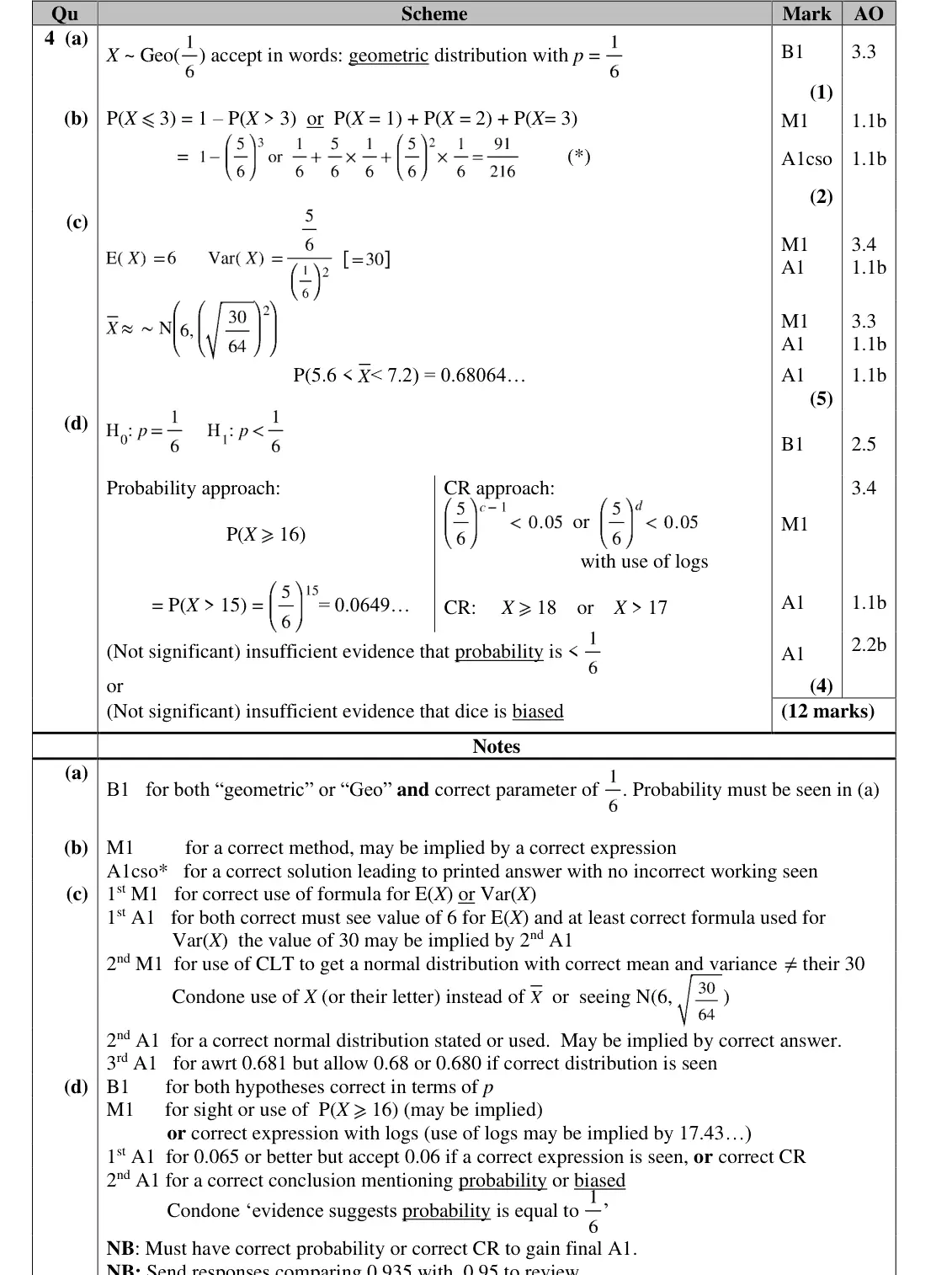
4. Every morning Geethaka repeatedly rolls a fair, six‑sided die until he rolls a 3 and then he stops. The random variable X represents the number of times he rolls the die each morning. (a) Suggest a suitable model for the random variable X (1)
June 2024 · Paper 3B (Further Statistics 1) · Q4(b) 2 marks geometric and negative binomial
(b) Show that P(X 3) = 91 (2)
June 2024 · Paper 3B (Further Statistics 1) · Q4(c) 5 marks central limit theoremgeometric and negative binomial
After 64 mornings Geethaka will calculate the mean number of times he rolled the die. (c) Estimate the probability that the mean number of rolls is between 5.6 and 7.2 (5)
June 2024 · Paper 3B (Further Statistics 1) · Q4(d) 4 marks hypothesis tests fs1
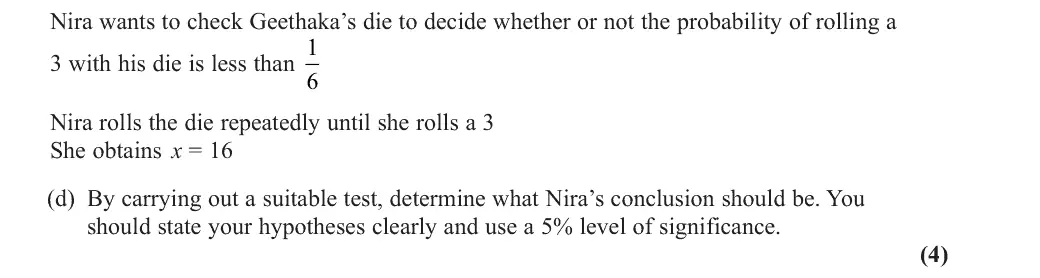
Nira wants to check Geethaka’s die to decide whether or not the probability of rolling a 3 with his die is less than 1 Nira rolls the die repeatedly until she rolls a 3 She obtains x = 16 (d) By carrying out a suitable test, determine what Nira’s conclusion should be. You should state your hypotheses clearly and use a 5% level of significance. (4)
June 2024 · Paper 3B (Further Statistics 1) · Q5(a) 1 mark type i and type ii errors
5. Some of the components produced by a factory are defective. The management requires that no more than 3% of the components produced are defective. Niluki monitors the production process and takes a random sample of n components. (a) Write down the hypotheses Niluki should use in a test to assess whether or not the proportion of defective components is greater than 0.03 (1)
June 2024 · Paper 3B (Further Statistics 1) · Q5(b) 2 marks type i and type ii errors
Niluki defines the random variable Dn to represent the number of defective components in a sample of size n. She considers two tests A and B In test A, Niluki uses n = 100 and if D100 5 she rejects H0 (b) Find the size of test A (2)
June 2024 · Paper 3B (Further Statistics 1) · Q5(c) 3 marks type i and type ii errors
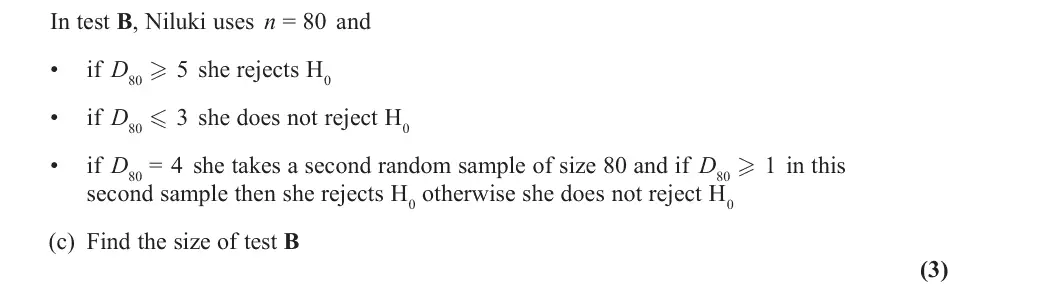
In test B, Niluki uses n = 80 and if D80 5 she rejects H0 • if D80 3 she does not reject H0 • if D80 = 4 she takes a second random sample of size 80 and if D80 1 in this • second sample then she rejects H0 otherwise she does not reject H0 (c) Find the size of test B (3)
June 2024 · Paper 3B (Further Statistics 1) · Q5(d) 3 marks type i and type ii errorsdiscrete random variables
Given that the actual proportion of defective components is 0.06 (d) (i) find the power of test A (ii) find the expected number of components sampled using test B (3)
June 2024 · Paper 3B (Further Statistics 1) · Q5(e) 1 mark type i and type ii errors
Given also that, when the actual proportion of defective components is 0.06, the power of test B is 0.713 (e) suggest, giving your reasons, which test Niluki should use. (1)
June 2024 · Paper 3B (Further Statistics 1) · Q6(a) 6 marks probability generating functions
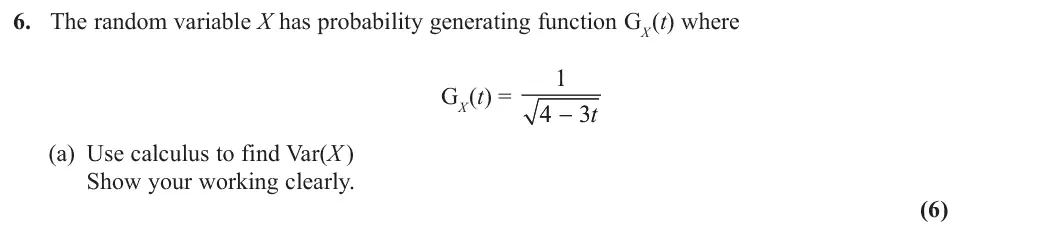
6. The random variable X has probability generating function GX(t) where GX(t) = -t (a) Use calculus to find Var(X ) Show your working clearly. (6)
June 2024 · Paper 3B (Further Statistics 1) · Q6(b) 4 marks probability generating functions
(b) Find the exact value of P(X 2) (4)
June 2024 · Paper 3B (Further Statistics 1) · Q6(c) 4 marks probability generating functions
The independent random variables X1 and X2 each have the same distribution as X The random variable Y = X1 + X2 + 1 (c) By finding the probability generating function of Y, state the name of the distribution of Y (4)
June 2024 · Paper 3B (Further Statistics 1) · Q6(d) 2 marks geometric and negative binomial
(d) Hence, or otherwise, find P(X1 + X2 > 5) (2)
June 2024 · Paper 3B (Further Statistics 1) · Q7(a) 2 marks poisson distribution
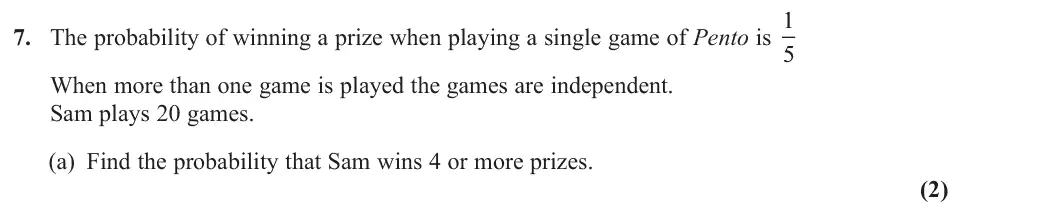
7. The probability of winning a prize when playing a single game of Pento is 1 When more than one game is played the games are independent. Sam plays 20 games. (a) Find the probability that Sam wins 4 or more prizes. (2)
June 2024 · Paper 3B (Further Statistics 1) · Q7(b) 2 marks geometric and negative binomial
Tessa plays a series of games. (b) Find the probability that Tessa wins her 4th prize on her 20th game. (2)
June 2024 · Paper 3B (Further Statistics 1) · Q7(c) 6 marks discrete random variablespoisson distribution
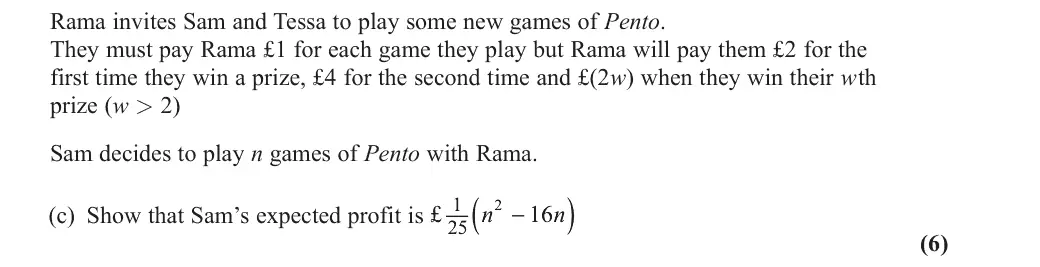
Rama invites Sam and Tessa to play some new games of Pento. They must pay Rama £1 for each game they play but Rama will pay them £2 for the first time they win a prize, £4 for the second time and £(2w) when they win their wth prize (w > 2) Sam decides to play n games of Pento with Rama. / (c) Show that Sam’s expected profit is £ 1 n n (6)
June 2024 · Paper 3B (Further Statistics 1) · Q7(d) 4 marks poisson distribution
Given that Sam chose n = 15 (d) find the probability that Sam does not make a loss. (4)
June 2024 · Paper 3B (Further Statistics 1) · Q7(e) 4 marks geometric and negative binomialdiscrete random variables
Tessa agrees to play Pento with Rama. She will play games until she wins r prizes and then she will stop. (e) Find, in terms of r, Tessa’s expected profit. (4)

Find an Edexcel Further Maths tutor

Want this paper marked and gone through with a Further Maths tutor? Message us.

Prefer email? Send an enquiry

If you are under 18, please include a parent's contact details. Enquiries go to enquiries@alevelfurthermathstutor.com and are deleted once handled.