Nov 2021: A level Paper 3B: Further Statistics 1

75 marks · 27 question parts · Question paper, mark scheme and examiner's report on Pearson's site

Question by question

QTopicMarksDifficulty
1(a) Chi-squared tests: goodness of fit and contingency tables 1 —
1(b) Chi-squared tests: goodness of fit and contingency tables 1 —
1(c) Chi-squared tests: goodness of fit and contingency tables 5 —
2(a) Poisson and binomial distributions 2 —
2(b) Poisson and binomial distributions 2 —
2(c) Poisson and binomial distributions 4 —
2(d) Poisson and binomial distributions 1 —
2(e) Hypothesis tests: Poisson, binomial and geometric 1 —
2(f) Hypothesis tests: Poisson, binomial and geometric 4 —
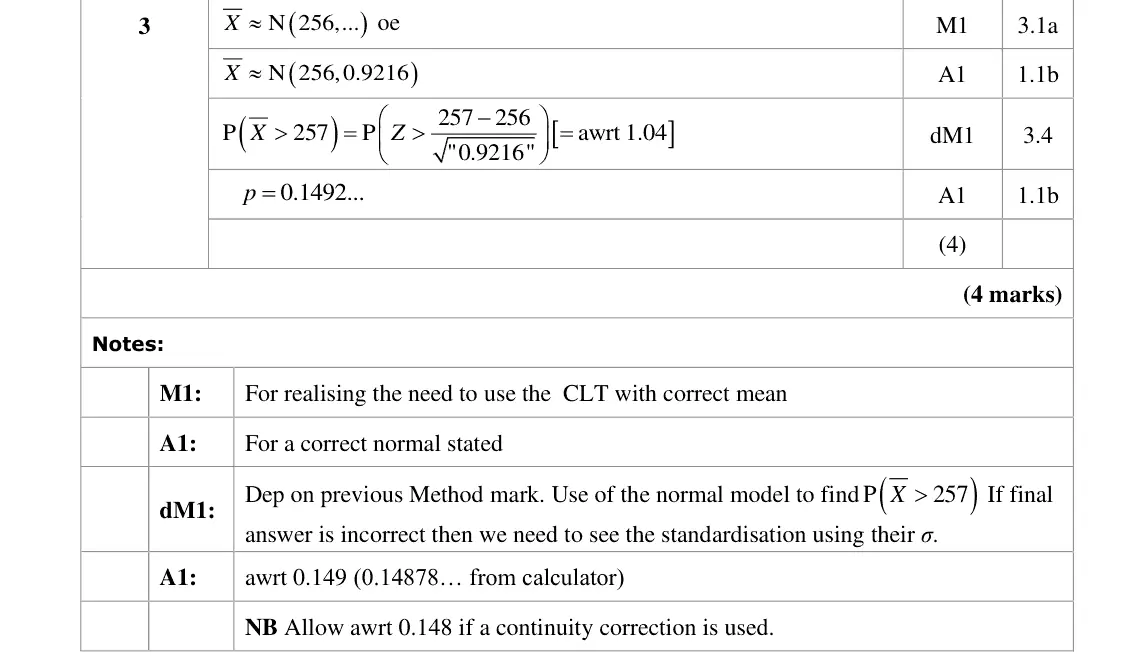
3 Central limit theorem 4 —
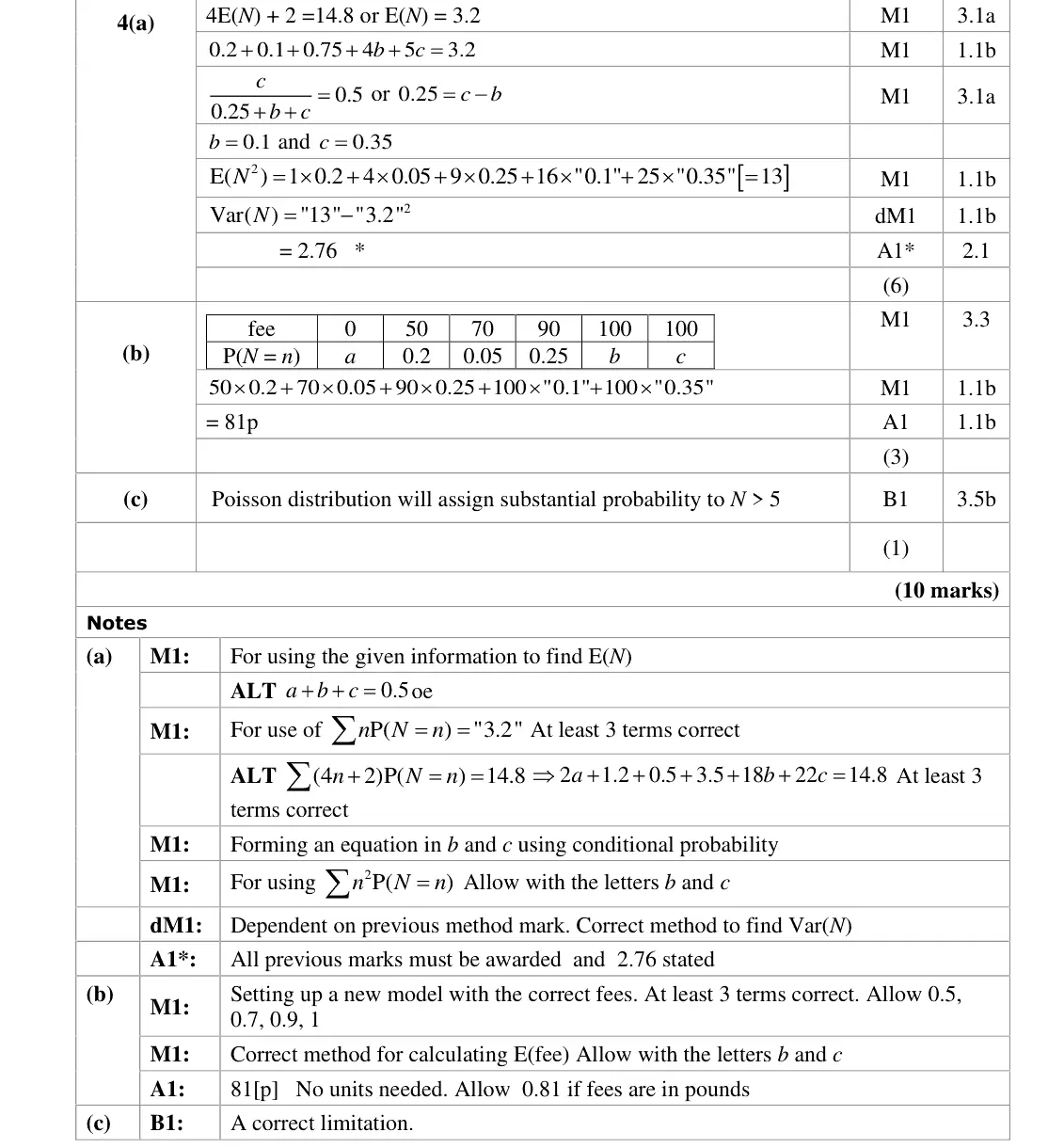
4(a) Discrete random variables: mean and variance 6 —
4(b) Discrete random variables: mean and variance 3 —
4(c) Poisson and binomial distributions 1 —
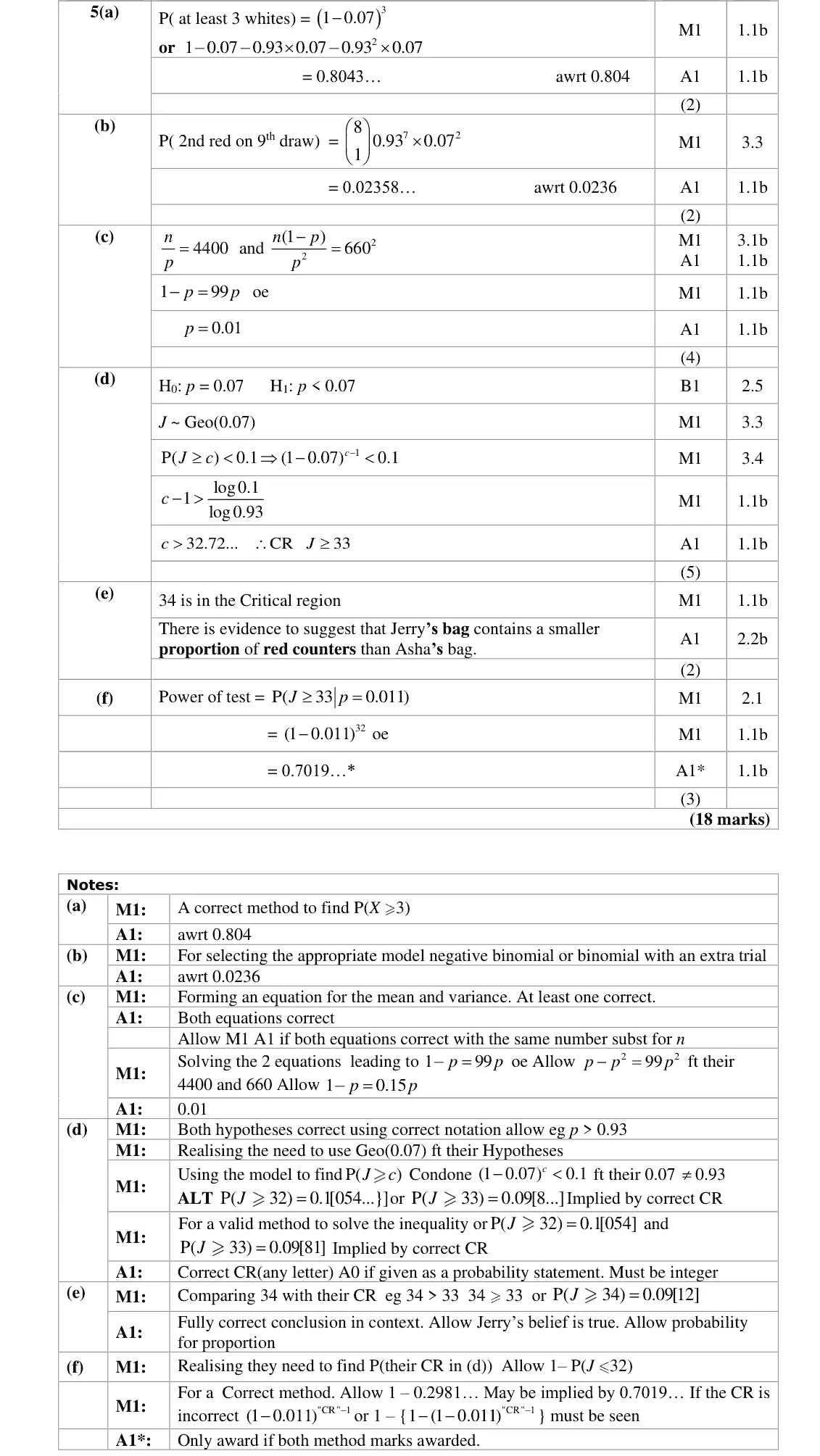
5(a) Geometric and negative binomial distributions 2 —
5(b) Geometric and negative binomial distributions 2 —
5(c) Geometric and negative binomial distributions 4 —
5(d) Hypothesis tests: Poisson, binomial and geometric 5 —
5(e) Hypothesis tests: Poisson, binomial and geometric 2 —
5(f) Quality of tests: Type I and Type II errors, size and power 3 —
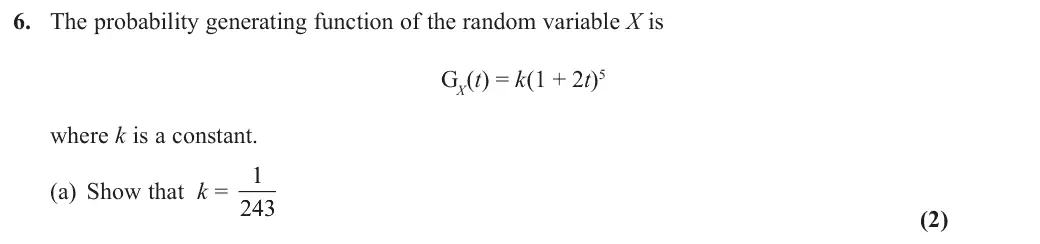
6(a) Probability generating functions 2 —
6(b) Probability generating functions 2 —
6(c) Probability generating functions 2 —
6(d) Probability generating functions 2 —
6(e) Probability generating functions 6 —
7(a) Quality of tests: Type I and Type II errors, size and power 1 —
7(b)(i) Quality of tests: Type I and Type II errors, size and power 6 —
7(b)(ii) Quality of tests: Type I and Type II errors, size and power 1 —

The questions

1(a)1(b)1(c)2(a)2(b)2(c)2(d)2(e)2(f)34(a)4(b)4(c)5(a)5(b)5(c)5(d)5(e)5(f)6(a)6(b)6(c)6(d)6(e)7(a)7(b)(i)7(b)(ii)
Nov 2021 · Paper 3B (Further Statistics 1) · Q1(a) 1 mark chi squared tests
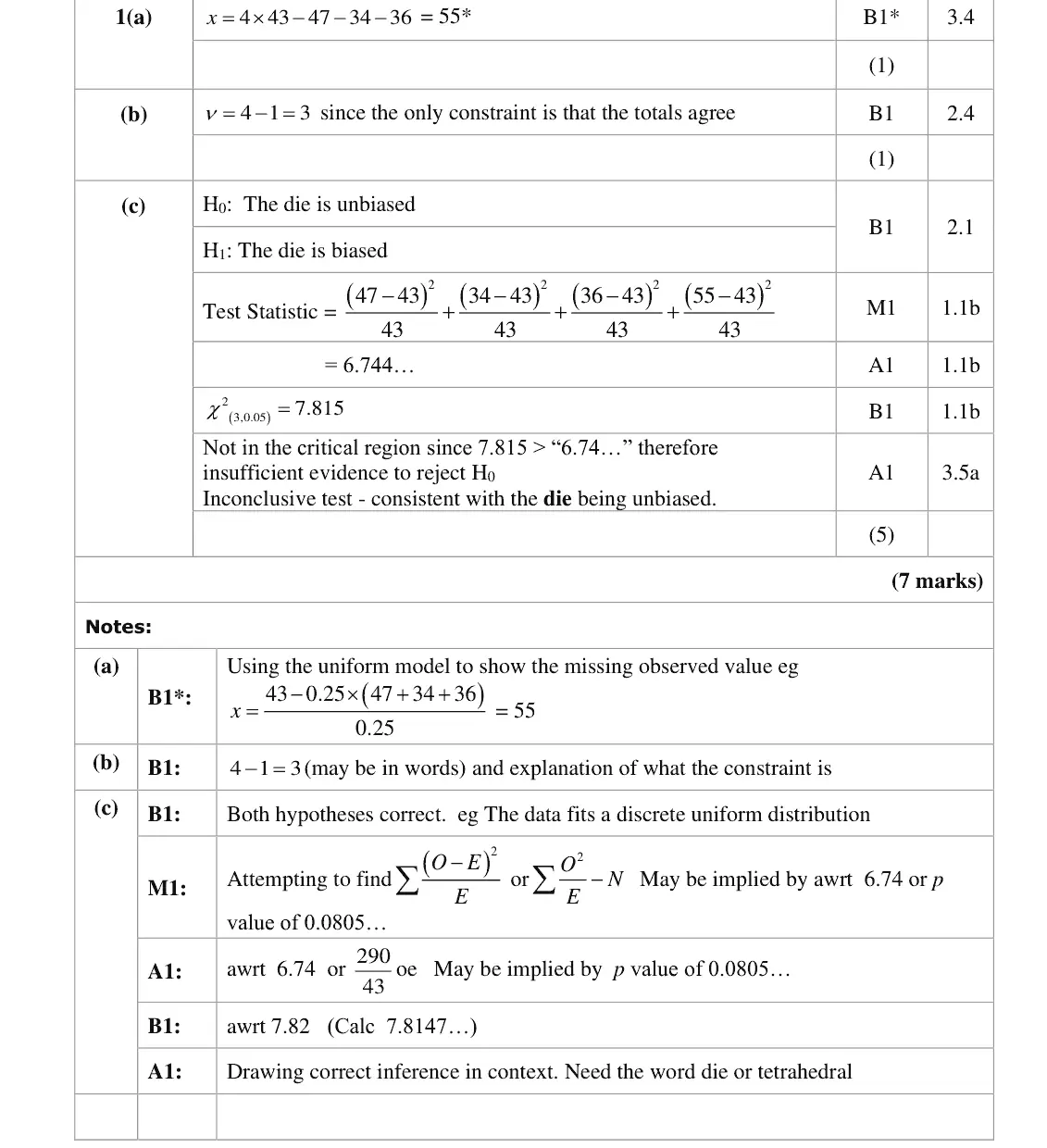
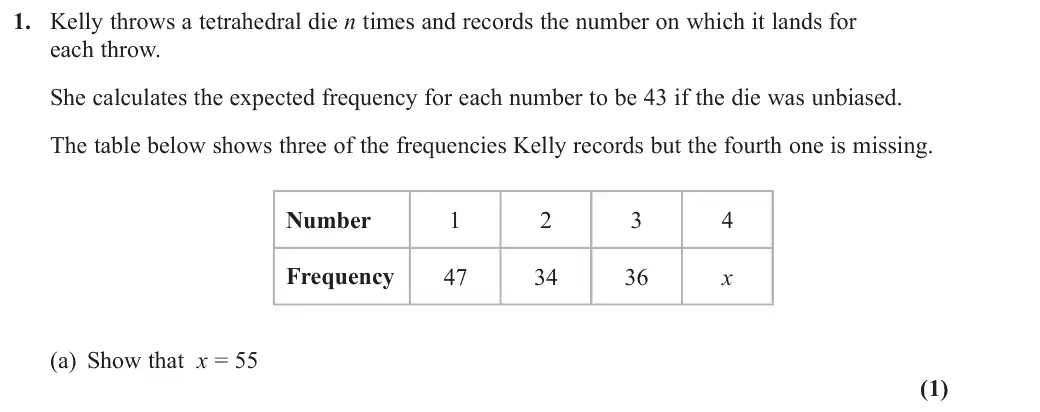
1. Kelly throws a tetrahedral die n times and records the number on which it lands for each throw. She calculates the expected frequency for each number to be 43 if the die was unbiased. The table below shows three of the frequencies Kelly records but the fourth one is missing. Number Frequency x (a) Show that x = 55 (1)
Nov 2021 · Paper 3B (Further Statistics 1) · Q1(b) 1 mark chi squared tests
Kelly wishes to test, at the 5% level of significance, whether or not there is evidence that the tetrahedral die is unbiased. (b) Explain why there are 3 degrees of freedom for this test. (1)
Nov 2021 · Paper 3B (Further Statistics 1) · Q1(c) 5 marks chi squared tests
(c) Stating your hypotheses clearly and the critical value used, carry out the test. (5)
Nov 2021 · Paper 3B (Further Statistics 1) · Q2(a) 2 marks poisson distribution
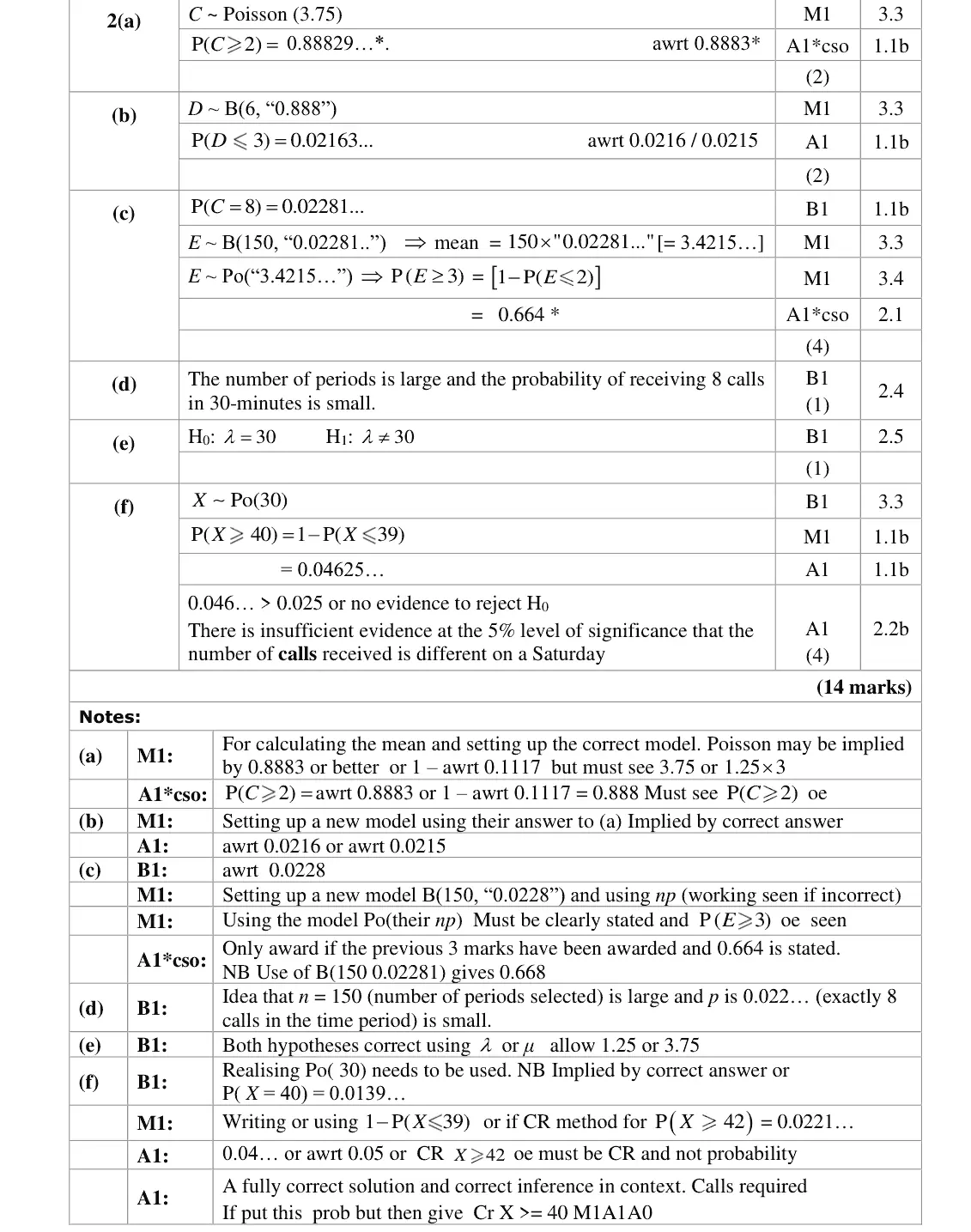
2. On a weekday, a garage receives telephone calls randomly, at a mean rate of 1.25 per 10 minutes. (a) Show that the probability that on a weekday at least 2 calls are received by the garage in a 30‑minute period is 0.888 to 3 decimal places. (2)
Nov 2021 · Paper 3B (Further Statistics 1) · Q2(b) 2 marks poisson distribution
(b) Calculate the probability that at least 2 calls are received by the garage in fewer than 4 out of 6 randomly selected, non‑overlapping 30‑minute periods on a weekday. (2)
Nov 2021 · Paper 3B (Further Statistics 1) · Q2(c) 4 marks poisson distribution
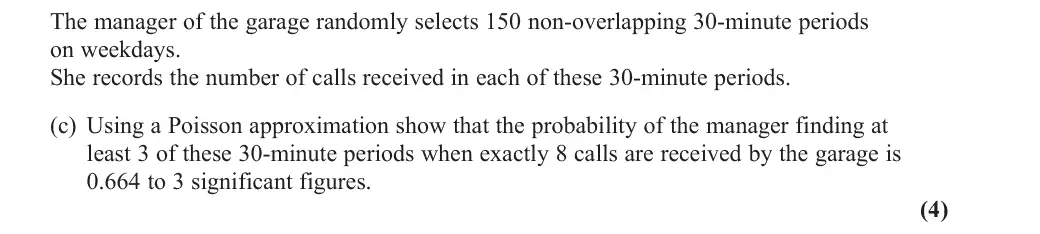
The manager of the garage randomly selects 150 non‑overlapping 30‑minute periods on weekdays. She records the number of calls received in each of these 30‑minute periods. (c) Using a Poisson approximation show that the probability of the manager finding at least 3 of these 30‑minute periods when exactly 8 calls are received by the garage is 0.664 to 3 significant figures. (4)
Nov 2021 · Paper 3B (Further Statistics 1) · Q2(d) 1 mark poisson distribution
(d) Explain why the Poisson approximation may be reasonable in this case. (1)
Nov 2021 · Paper 3B (Further Statistics 1) · Q2(e) 1 mark hypothesis tests fs1
The manager of the garage decides to test whether the number of calls received on a Saturday is different from the number of calls received on a weekday. She selects a Saturday at random and records the number of telephone calls received by the garage in the first 4 hours. (e) Write down the hypotheses for this test. (1)
Nov 2021 · Paper 3B (Further Statistics 1) · Q2(f) 4 marks hypothesis tests fs1
The manager found that there had been 40 telephone calls received by the garage in the first 4 hours. (f) Carry out the test using a 5% level of significance. (4)
Nov 2021 · Paper 3B (Further Statistics 1) · Q3 4 marks central limit theorem
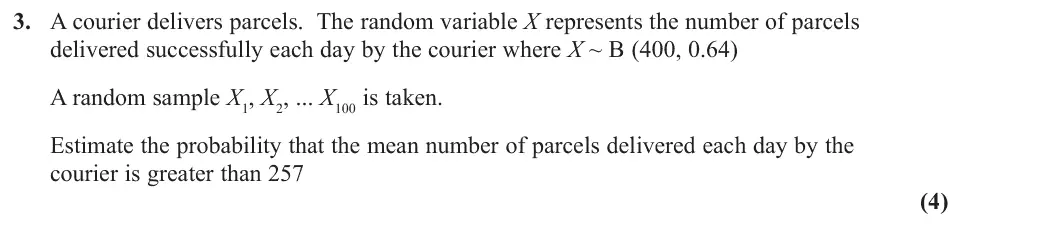
3. A courier delivers parcels. The random variable X represents the number of parcels delivered successfully each day by the courier where X ~ B (400, 0.64) A random sample X1, X2, ... X100 is taken. Estimate the probability that the mean number of parcels delivered each day by the courier is greater than 257 (4)
Nov 2021 · Paper 3B (Further Statistics 1) · Q4(a) 6 marks discrete random variables
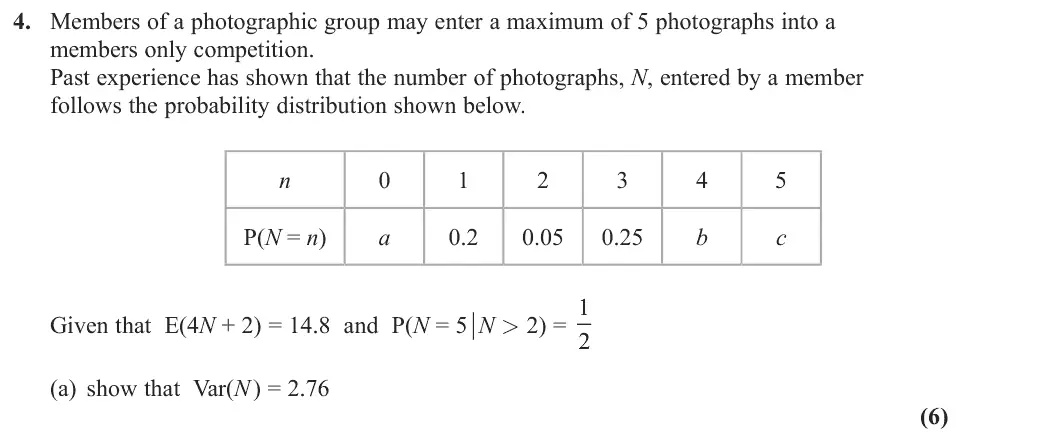
4. Members of a photographic group may enter a maximum of 5 photographs into a members only competition. Past experience has shown that the number of photographs, N, entered by a member follows the probability distribution shown below. n P(N = n) a 0.2 0.05 0.25 b c Given that E(4N + 2) = 14.8 and P(N = 5½N > 2) = 1 (a) show that Var(N) = 2.76 (6)
Nov 2021 · Paper 3B (Further Statistics 1) · Q4(b) 3 marks discrete random variables
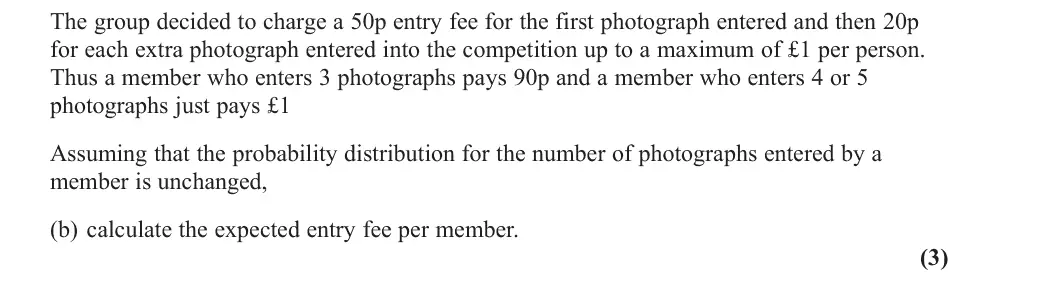
The group decided to charge a 50p entry fee for the first photograph entered and then 20p for each extra photograph entered into the competition up to a maximum of £1 per person. Thus a member who enters 3 photographs pays 90p and a member who enters 4 or 5 photographs just pays £1 Assuming that the probability distribution for the number of photographs entered by a member is unchanged, (b) calculate the expected entry fee per member. (3)
Nov 2021 · Paper 3B (Further Statistics 1) · Q4(c) 1 mark poisson distribution
Bai suggests that, as the mean and variance are close, a Poisson distribution could be used to model the number of photographs entered by a member next year. (c) State a limitation of the Poisson distribution in this case. (1)
Nov 2021 · Paper 3B (Further Statistics 1) · Q5(a) 2 marks geometric and negative binomial
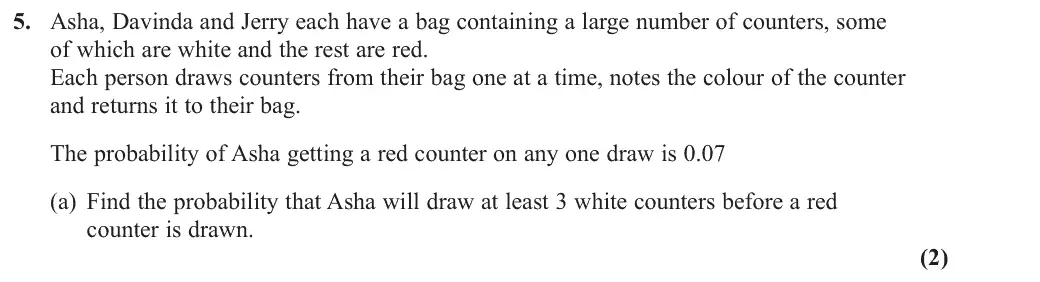
5. Asha, Davinda and Jerry each have a bag containing a large number of counters, some of which are white and the rest are red. Each person draws counters from their bag one at a time, notes the colour of the counter and returns it to their bag. The probability of Asha getting a red counter on any one draw is 0.07 (a) Find the probability that Asha will draw at least 3 white counters before a red counter is drawn. (2)
Nov 2021 · Paper 3B (Further Statistics 1) · Q5(b) 2 marks geometric and negative binomial
(b) Find the probability that Asha gets a red counter for the second time on her 9th draw. (2)
Nov 2021 · Paper 3B (Further Statistics 1) · Q5(c) 4 marks geometric and negative binomial
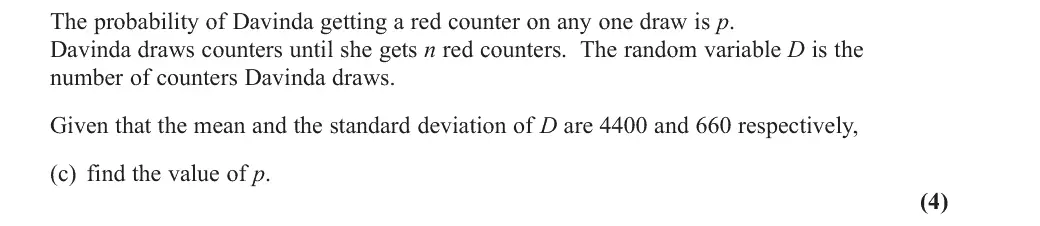
The probability of Davinda getting a red counter on any one draw is p. Davinda draws counters until she gets n red counters. The random variable D is the number of counters Davinda draws. Given that the mean and the standard deviation of D are 4400 and 660 respectively, (c) find the value of p. (4)
Nov 2021 · Paper 3B (Further Statistics 1) · Q5(d) 5 marks hypothesis tests fs1
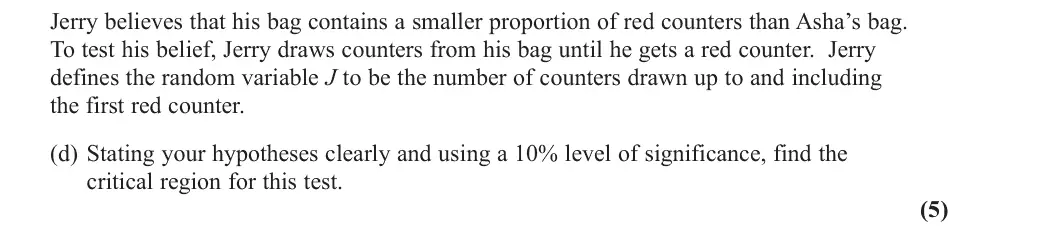
Jerry believes that his bag contains a smaller proportion of red counters than Asha’s bag. To test his belief, Jerry draws counters from his bag until he gets a red counter. Jerry defines the random variable J to be the number of counters drawn up to and including the first red counter. (d) Stating your hypotheses clearly and using a 10% level of significance, find the critical region for this test. (5)
Nov 2021 · Paper 3B (Further Statistics 1) · Q5(e) 2 marks hypothesis tests fs1
Jerry gets a red counter for the first time on his 34th draw. (e) Giving a reason for your answer, state whether or not there is evidence that Jerry’s bag contains a smaller proportion of red counters than Asha’s bag. (2)
Nov 2021 · Paper 3B (Further Statistics 1) · Q5(f) 3 marks type i and type ii errors
Given that the probability of Jerry getting a red counter on any one draw is 0.011 (f) show that the power of the test is 0.702 to 3 significant figures. (3)
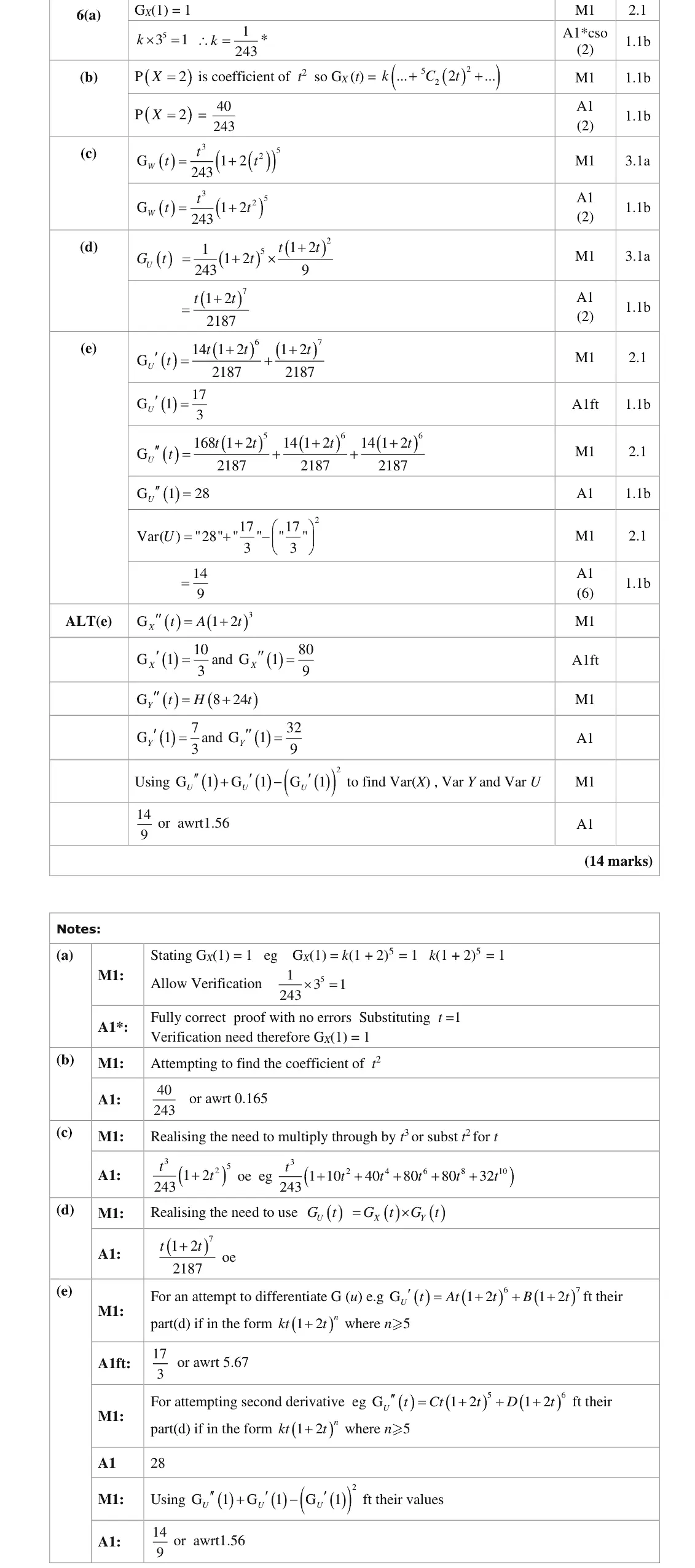
Nov 2021 · Paper 3B (Further Statistics 1) · Q6(a) 2 marks probability generating functions
6. The probability generating function of the random variable X is GX(t) = k(1 + 2t)5 where k is a constant. (a) Show that k = 1 (2)
Nov 2021 · Paper 3B (Further Statistics 1) · Q6(b) 2 marks probability generating functions
(b) Find P(X = 2) (2)
Nov 2021 · Paper 3B (Further Statistics 1) · Q6(c) 2 marks probability generating functions
(c) Find the probability generating function of W = 2X + 3 (2)
Nov 2021 · Paper 3B (Further Statistics 1) · Q6(d) 2 marks probability generating functions
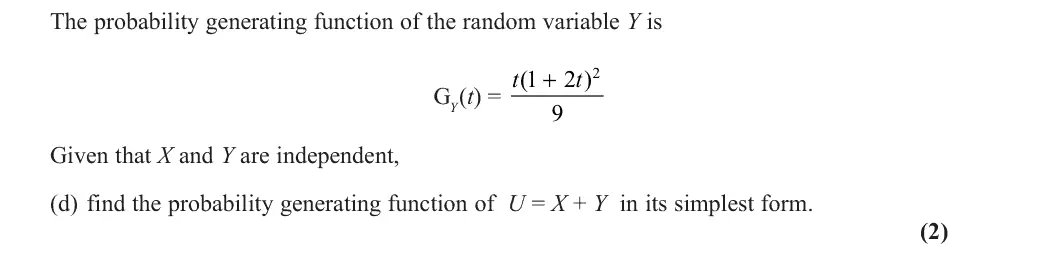
The probability generating function of the random variable Y is GY(t) = t ( + t ) Given that X and Y are independent, (d) find the probability generating function of U = X + Y in its simplest form. (2)
Nov 2021 · Paper 3B (Further Statistics 1) · Q6(e) 6 marks probability generating functions
(e) Use calculus to find the value of Var(U) (6)
Nov 2021 · Paper 3B (Further Statistics 1) · Q7(a) 1 mark type i and type ii errors
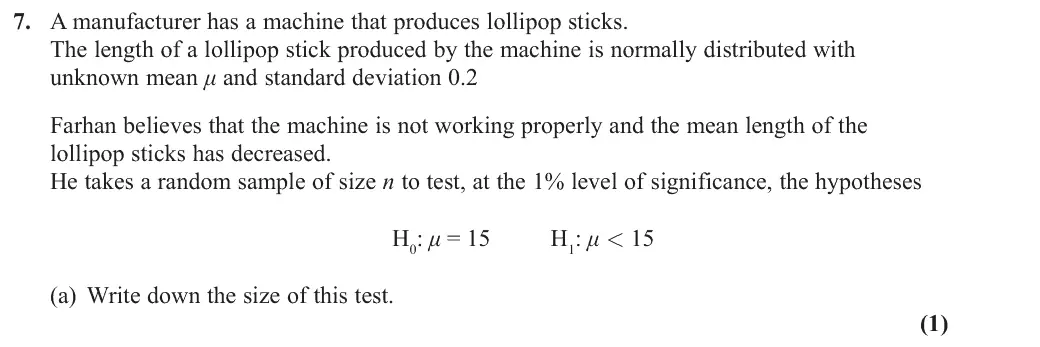
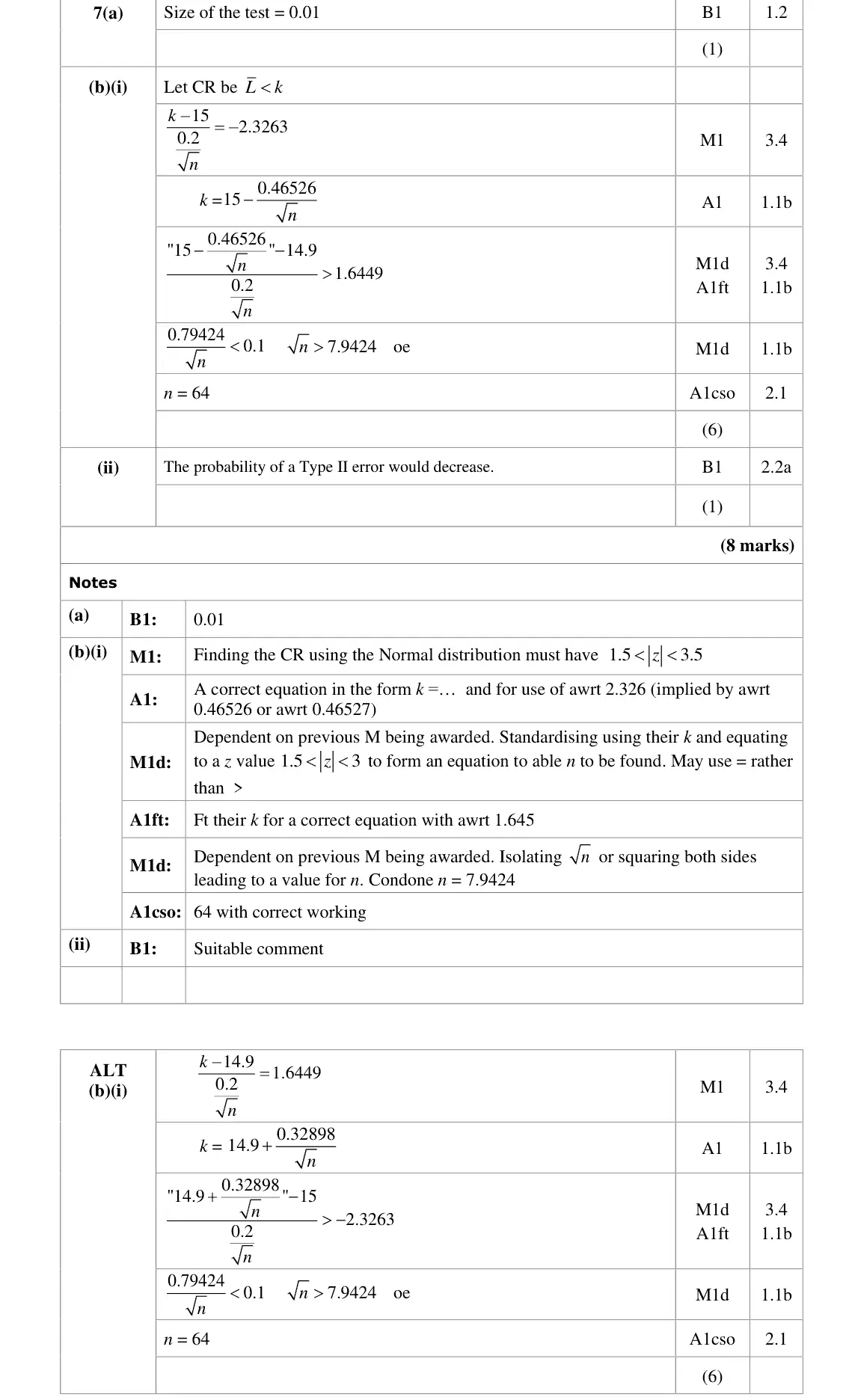
7. A manufacturer has a machine that produces lollipop sticks. The length of a lollipop stick produced by the machine is normally distributed with unknown mean μ and standard deviation 0.2 Farhan believes that the machine is not working properly and the mean length of the lollipop sticks has decreased. He takes a random sample of size n to test, at the 1% level of significance, the hypotheses H0: μ = 15 H1: μ < 15 (a) Write down the size of this test. (1)
Nov 2021 · Paper 3B (Further Statistics 1) · Q7(b)(i) 6 marks type i and type ii errors
Given that the actual value of μ is 14.9 (b) (i) calculate the minimum value of n such that the probability of a Type II error is less than 0.05 Show your working clearly. (6)
Nov 2021 · Paper 3B (Further Statistics 1) · Q7(b)(ii) 1 mark type i and type ii errors
(ii) Farhan uses the same sample size, n, but now carries out the test at a 5% level of significance. Without doing any further calculations, state how this would affect the probability of a Type II error. (1)

Find an Edexcel Further Maths tutor

Want this paper marked and gone through with a Further Maths tutor? Message us.

Prefer email? Send an enquiry

If you are under 18, please include a parent's contact details. Enquiries go to enquiries@alevelfurthermathstutor.com and are deleted once handled.