June 2022: AS Paper 01: Core Pure Mathematics

80 marks · 28 question parts · Question paper, mark scheme and examiner's report on Pearson's site

Question by question

QTopicMarksDifficulty
1(a) Matrices: multiplication, determinants and inverses 4 —
1(b) Three linear equations: solutions and planes 3 —
2(a) Modulus-argument form 4 —
2(b) Loci in the Argand diagram, Complex numbers: arithmetic, conjugates, roots of polynomials and Argand diagrams 3 —
2(c) Loci in the Argand diagram 3 —
3(a) Linear transformations and invariant points and lines 1 —
3(b) Linear transformations and invariant points and lines, Matrices: multiplication, determinants and inverses 2 —
3(c) Linear transformations and invariant points and lines 2 —
3(d) Vectors: equations of lines and planes, scalar product 1 —
3(e) Vectors: equations of lines and planes, scalar product 2 —
4(i) Roots of polynomials 3 —
4(ii) Roots of polynomials 3 —
4(iii) Roots of polynomials 3 —
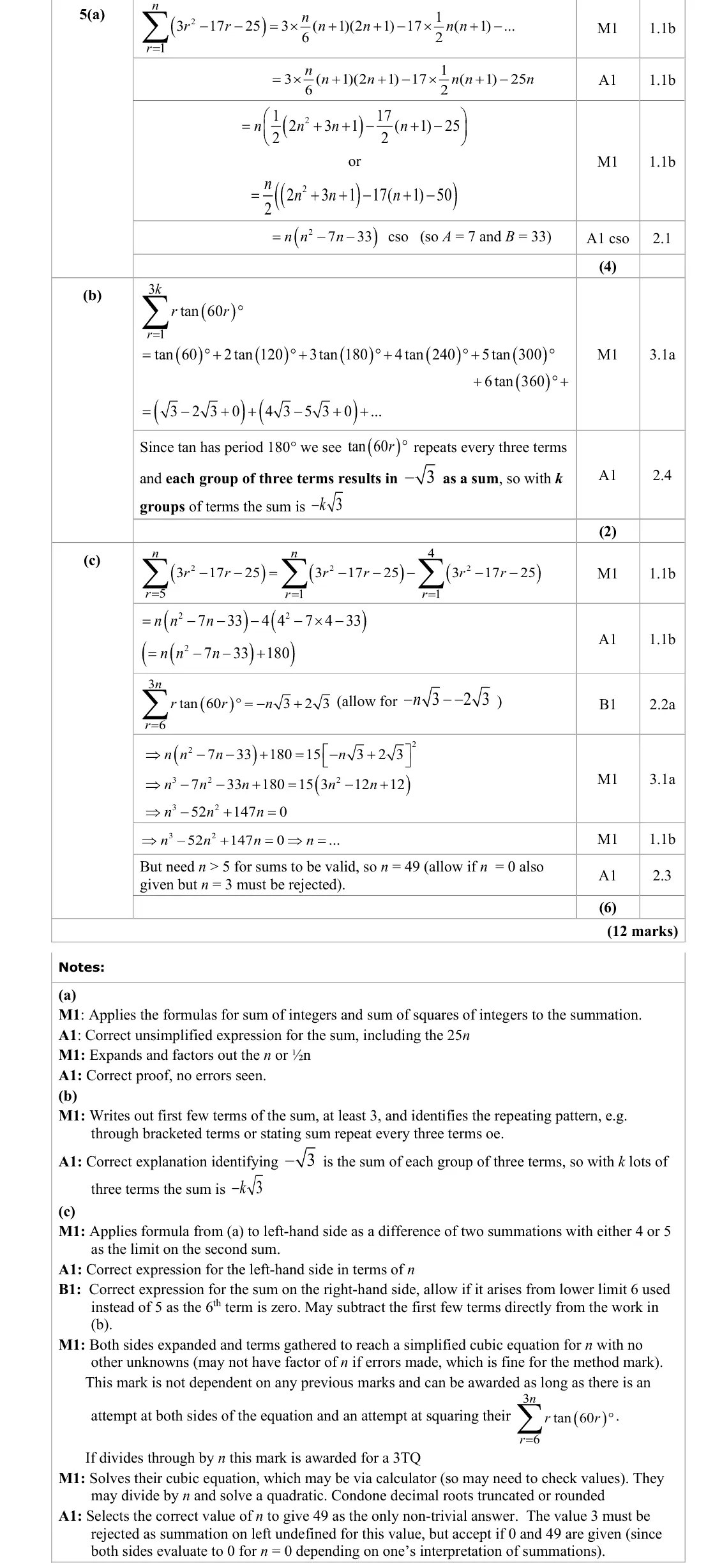
5(a) Series: standard sums and the method of differences 4 —
5(b) Series: standard sums and the method of differences 2 —
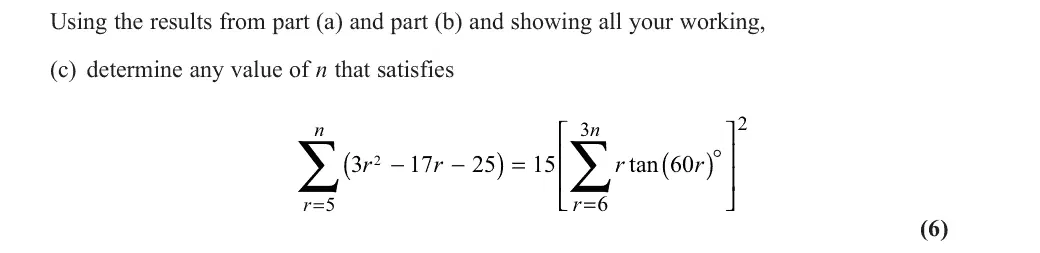
5(c) Series: standard sums and the method of differences 6 —
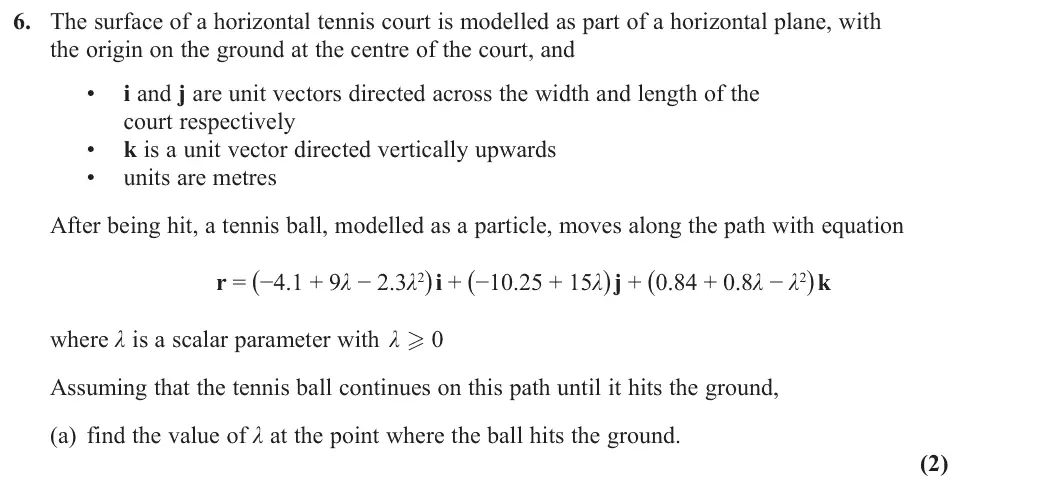
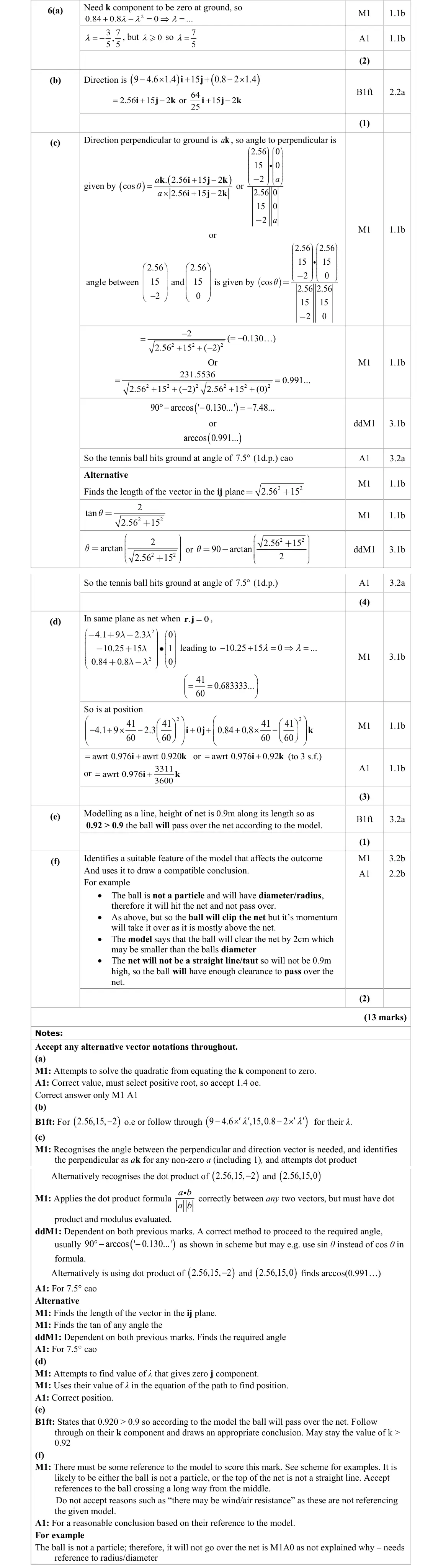
6(a) Vectors: equations of lines and planes, scalar product 2 —
6(b) Vectors: equations of lines and planes, scalar product 1 —
6(c) Vectors: equations of lines and planes, scalar product 4 —
6(d) Vectors: intersections, angles and shortest distances 3 —
6(e) Vectors: equations of lines and planes, scalar product 1 —
6(f) Vectors: equations of lines and planes, scalar product 2 —
7 Proof by induction 6 —
8(a) Volumes of revolution 1 —
8(b) Volumes of revolution 7 —
8(c) Volumes of revolution 1 —
8(d) Volumes of revolution 5 —
8(e) Volumes of revolution 1 —

The questions

1(a)1(b)2(a)2(b)2(c)3(a)3(b)3(c)3(d)3(e)4(i)4(ii)4(iii)5(a)5(b)5(c)6(a)6(b)6(c)6(d)6(e)6(f)78(a)8(b)8(c)8(d)8(e)
June 2022 · AS Paper 1 (Core Pure) · Q1(a) 4 marks matrices
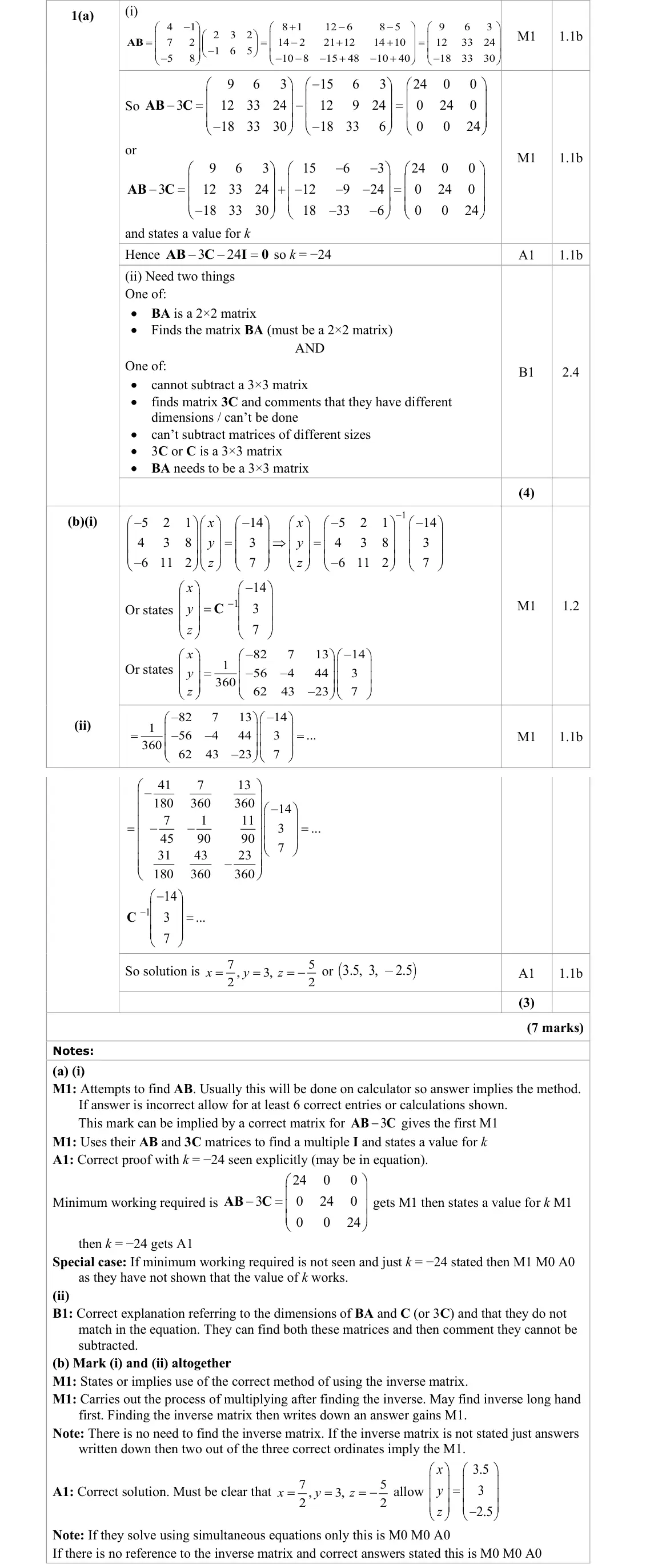
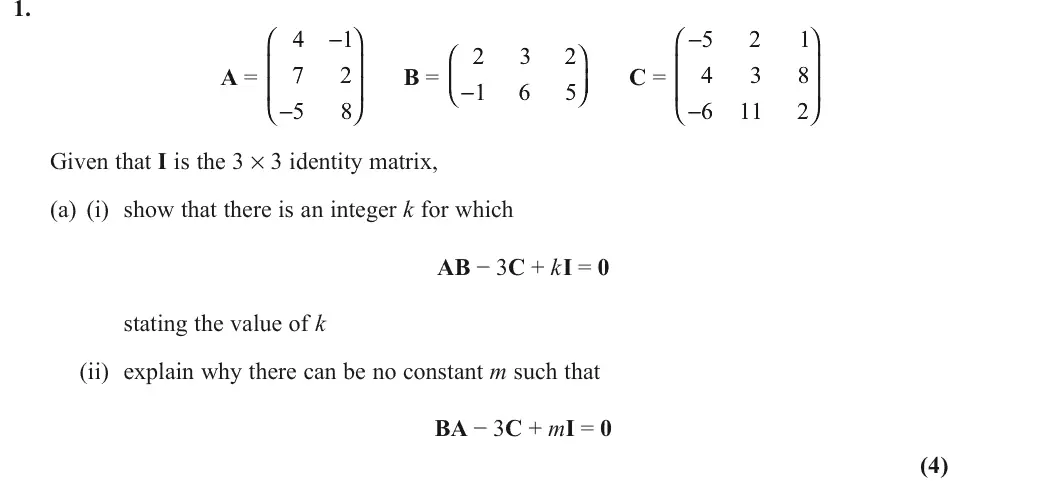
1. - - A = B = C = - - - Given that I is the 3 x 3 identity matrix, (a) (i) show that there is an integer k for which AB - 3C + kI = 0 stating the value of k (ii) explain why there can be no constant m such that BA - 3C + mI = 0 (4)
June 2022 · AS Paper 1 (Core Pure) · Q1(b) 3 marks three equations three unknowns
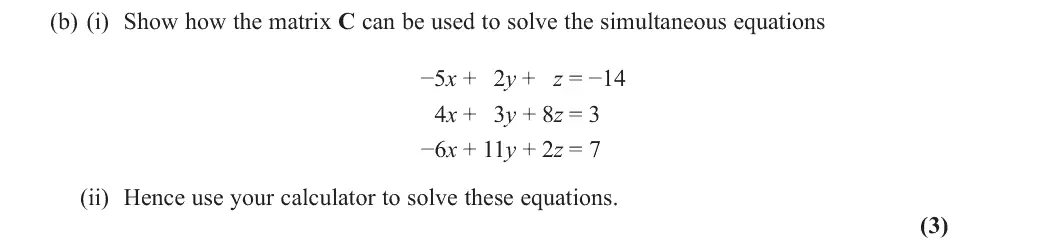
(b) (i) Show how the matrix C can be used to solve the simultaneous equations -5x + 2y + z = -14 4x + 3y + 8z = 3 -6x + 11y + 2z = 7 (ii) Hence use your calculator to solve these equations. (3)
June 2022 · AS Paper 1 (Core Pure) · Q2(a) 4 marks modulus argument form
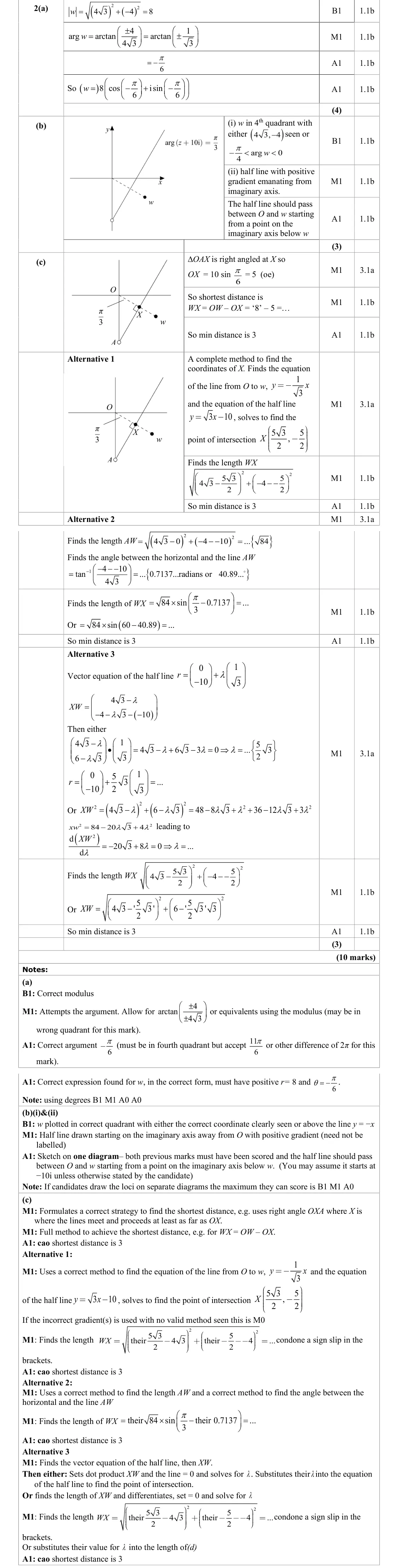
2. (a) Express the complex number w = 4 3 - 4i in the form r (cos theta + i sin theta ) where r > 0 and - pi < theta pi (4)
June 2022 · AS Paper 1 (Core Pure) · Q2(b) 3 marks loci in the argand diagramcomplex numbers
(b) Show, on a single Argand diagram, (i) the point representing w pi (ii) the locus of points defined by arg (z + 10i) = 3 (3)
June 2022 · AS Paper 1 (Core Pure) · Q2(c) 3 marks loci in the argand diagram
pi (c) Hence determine the minimum distance of w from the locus arg (z + 10i) = 3 (3)
June 2022 · AS Paper 1 (Core Pure) · Q3(a) 1 mark linear transformations
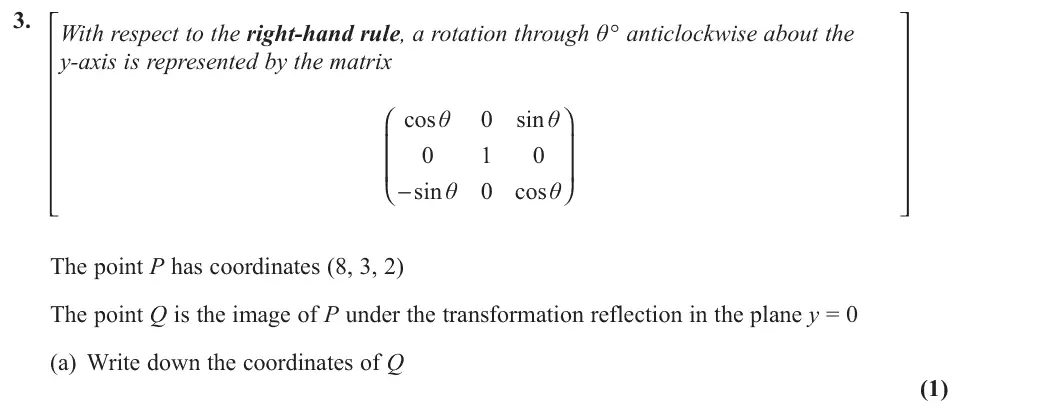
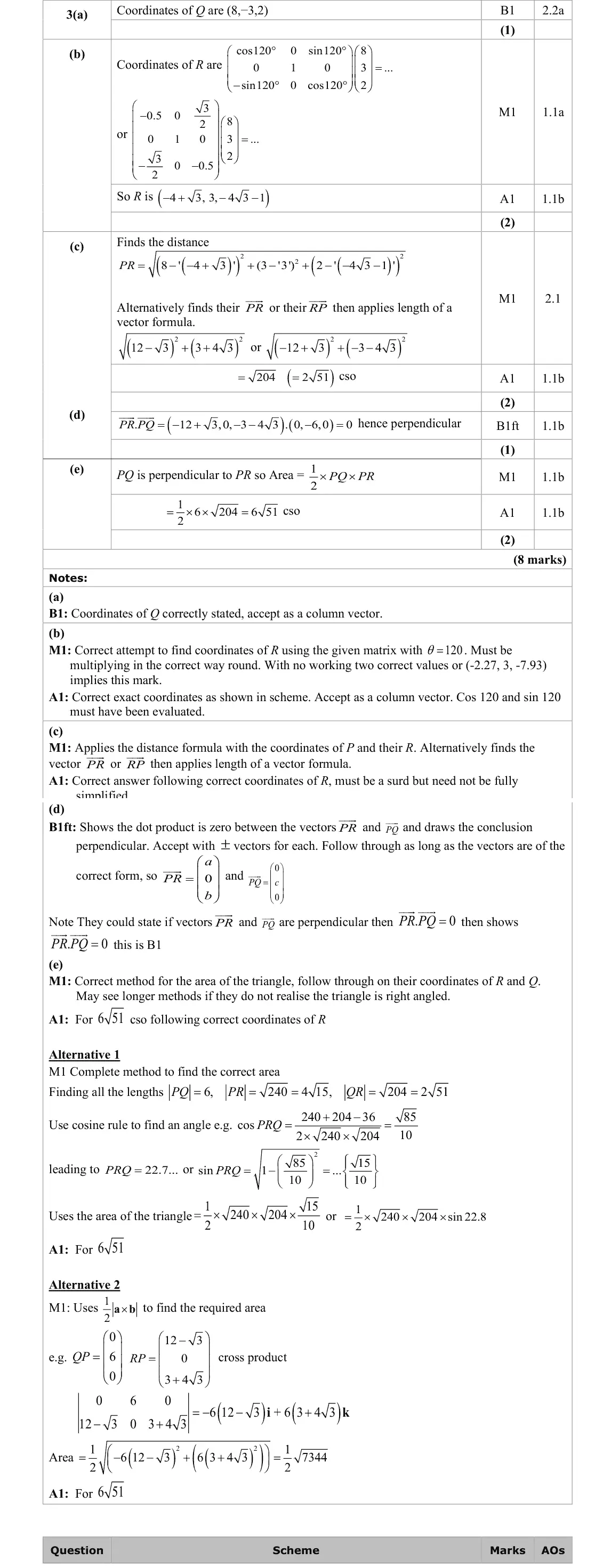
3. With respect to the right-hand rule, a rotation through theta ° anticlockwise about the y-axis is represented by the matrix cos theta sin theta - sin theta cos theta The point P has coordinates (8, 3, 2) The point Q is the image of P under the transformation reflection in the plane y = 0 (a) Write down the coordinates of Q (1)
June 2022 · AS Paper 1 (Core Pure) · Q3(b) 2 marks linear transformationsmatrices
The point R is the image of P under the transformation rotation through 120° anticlockwise about the y-axis, with respect to the right-hand rule. (b) Determine the exact coordinates of R (2)
June 2022 · AS Paper 1 (Core Pure) · Q3(c) 2 marks linear transformations
→½ giving your answer as a simplified surd. (c) Hence find ½PR (2)
June 2022 · AS Paper 1 (Core Pure) · Q3(d) 1 mark vectors lines and planes
→ and PQ → are perpendicular. (d) Show that PR (1)
June 2022 · AS Paper 1 (Core Pure) · Q3(e) 2 marks vectors lines and planes
(e) Hence determine the exact area of triangle PQR, giving your answer as a surd in simplest form. (2)
June 2022 · AS Paper 1 (Core Pure) · Q4(i) 3 marks roots of polynomials
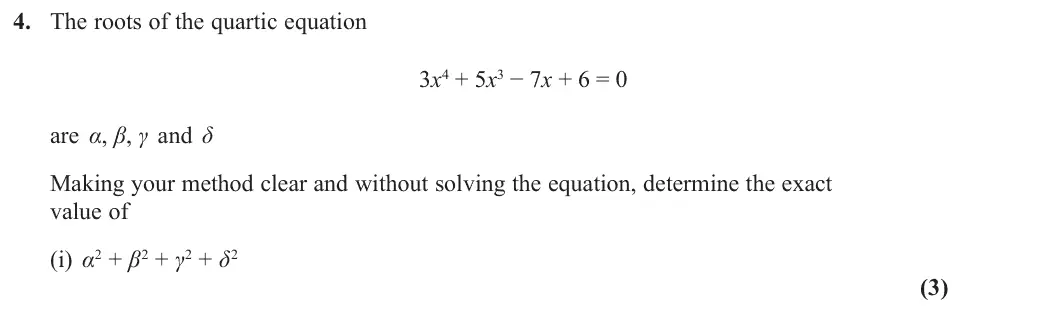
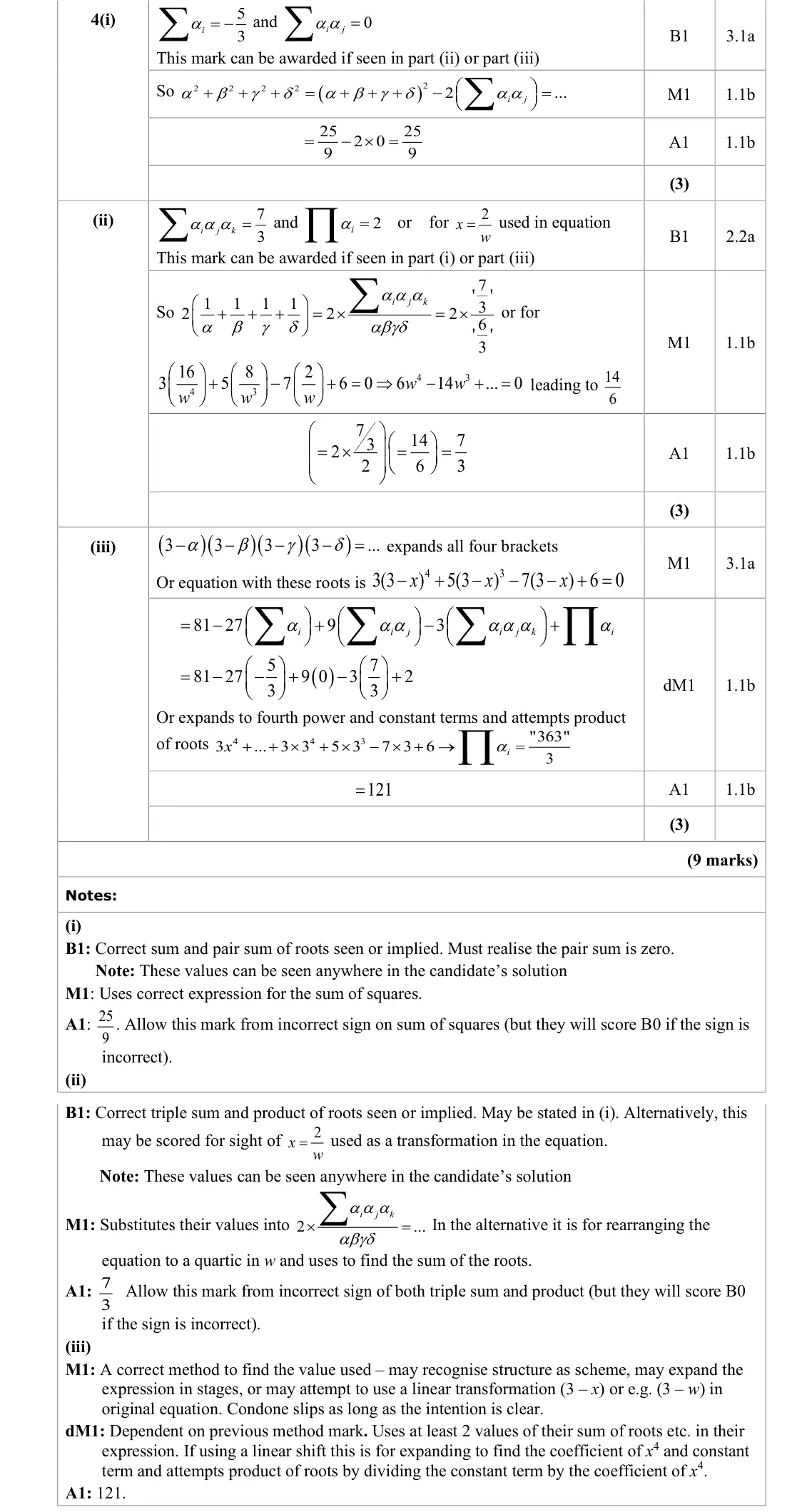
4. The roots of the quartic equation 3x4 + 5x3 - 7x + 6 = 0 are alpha , beta , γ and δ Making your method clear and without solving the equation, determine the exact value of (i) alpha 2 + beta 2 + γ2 + δ2 (3)
June 2022 · AS Paper 1 (Core Pure) · Q4(ii) 3 marks roots of polynomials
(ii) 2 alpha + 2 beta + 2 γ + 2 δ (3)
June 2022 · AS Paper 1 (Core Pure) · Q4(iii) 3 marks roots of polynomials
(iii) (3 - alpha )(3 - beta )(3 - γ)(3 - δ) (3)
June 2022 · AS Paper 1 (Core Pure) · Q5(a) 4 marks series and method of differences
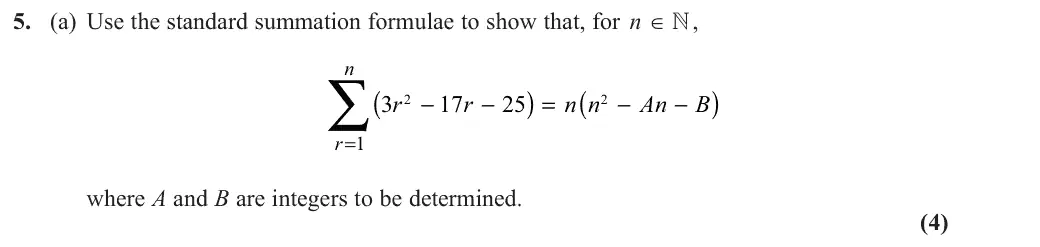
5. (a) Use the standard summation formulae to show that, for n ∈ , n =∑ ( ) = ( ) r - r - n n - An - B r where A and B are integers to be determined. (4)
June 2022 · AS Paper 1 (Core Pure) · Q5(b) 2 marks series and method of differences
(b) Explain why, for k ∈ , k =∑ ( ) = - ° r tan 60 r k r (2)
June 2022 · AS Paper 1 (Core Pure) · Q5(c) 6 marks series and method of differences
Using the results from part (a) and part (b) and showing all your working, (c) determine any value of n that satisfies n n ∑ =∑ ( ) = ( ) ° r r r r - - tan r r = (6)
June 2022 · AS Paper 1 (Core Pure) · Q6(a) 2 marks vectors lines and planes
6. The surface of a horizontal tennis court is modelled as part of a horizontal plane, with the origin on the ground at the centre of the court, and • i and j are unit vectors directed across the width and length of the court respectively • k is a unit vector directed vertically upwards • units are metres After being hit, a tennis ball, modelled as a particle, moves along the path with equation r = (-4.1 + 9λ - 2.3λ2) i + (-10.25 + 15λ) j + (0.84 + 0.8λ - λ2) k where λ is a scalar parameter with λ 0 Assuming that the tennis ball continues on this path until it hits the ground, (a) find the value of λ at the point where the ball hits the ground. (2)
June 2022 · AS Paper 1 (Core Pure) · Q6(b) 1 mark vectors lines and planes
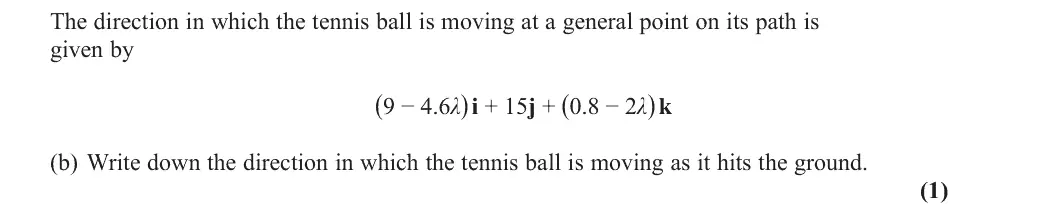
The direction in which the tennis ball is moving at a general point on its path is given by (9 - 4.6λ) i + 15j + (0.8 - 2λ) k (b) Write down the direction in which the tennis ball is moving as it hits the ground. (1)
June 2022 · AS Paper 1 (Core Pure) · Q6(c) 4 marks vectors lines and planes
(c) Hence find the acute angle at which the tennis ball hits the ground, giving your answer in degrees to one decimal place. (4)
June 2022 · AS Paper 1 (Core Pure) · Q6(d) 3 marks vectors intersections and distances
The net of the tennis court lies in the plane r. j = 0 (d) Find the position of the tennis ball at the point where it is in the same plane as the net. (3)
June 2022 · AS Paper 1 (Core Pure) · Q6(e) 1 mark vectors lines and planes
The maximum height above the court of the top of the net is 0.9 m. Modelling the top of the net as a horizontal straight line, (e) state whether the tennis ball will pass over the net according to the model, giving a reason for your answer. (1)
June 2022 · AS Paper 1 (Core Pure) · Q6(f) 2 marks vectors lines and planes
With reference to the model, (f) decide whether the tennis ball will actually pass over the net, giving a reason for your answer. (2)
June 2022 · AS Paper 1 (Core Pure) · Q7 6 marks proof by induction
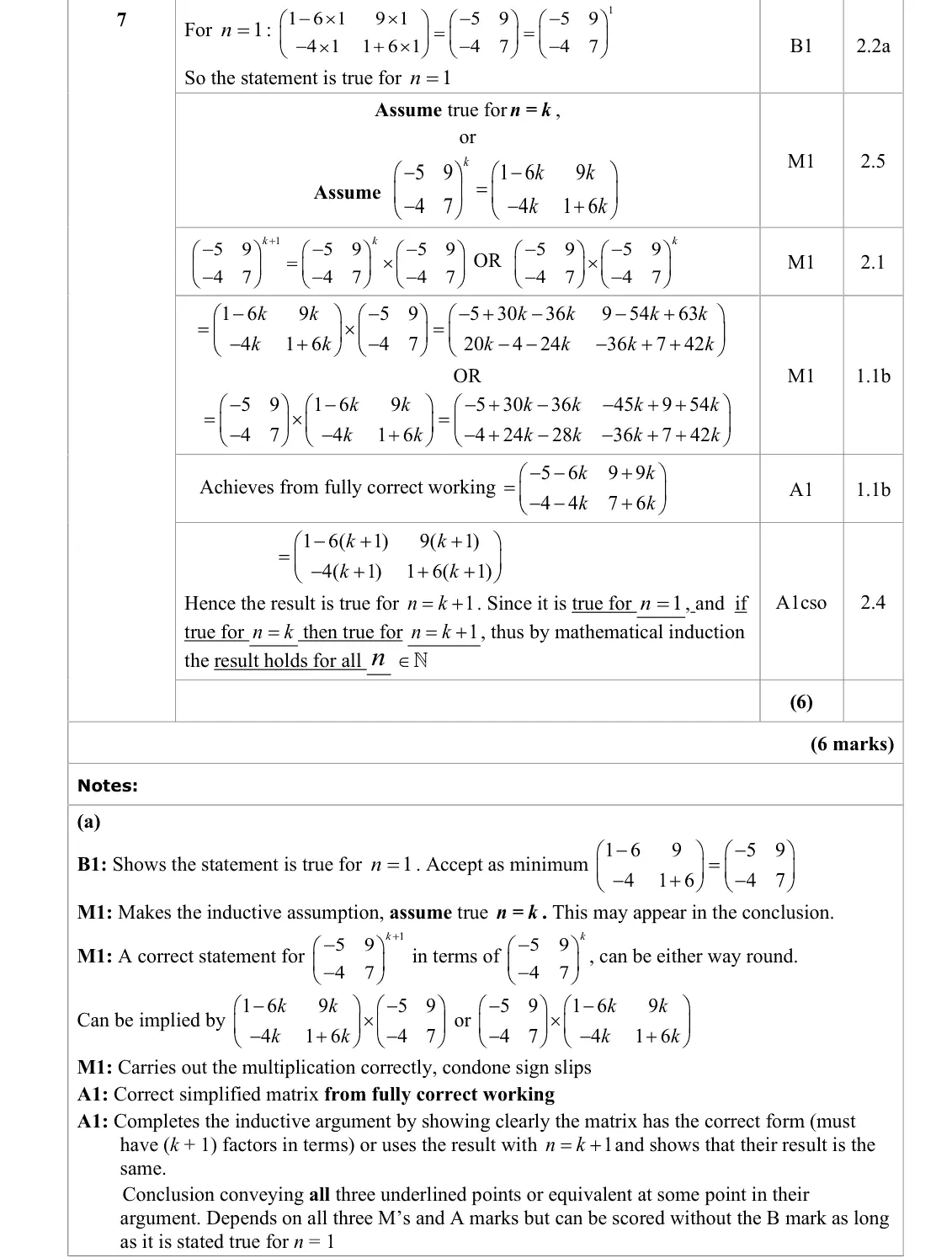
7. Prove by mathematical induction that, for n ∈ n n n - - = n n - - + (6)
June 2022 · AS Paper 1 (Core Pure) · Q8(a) 1 mark volumes of revolution
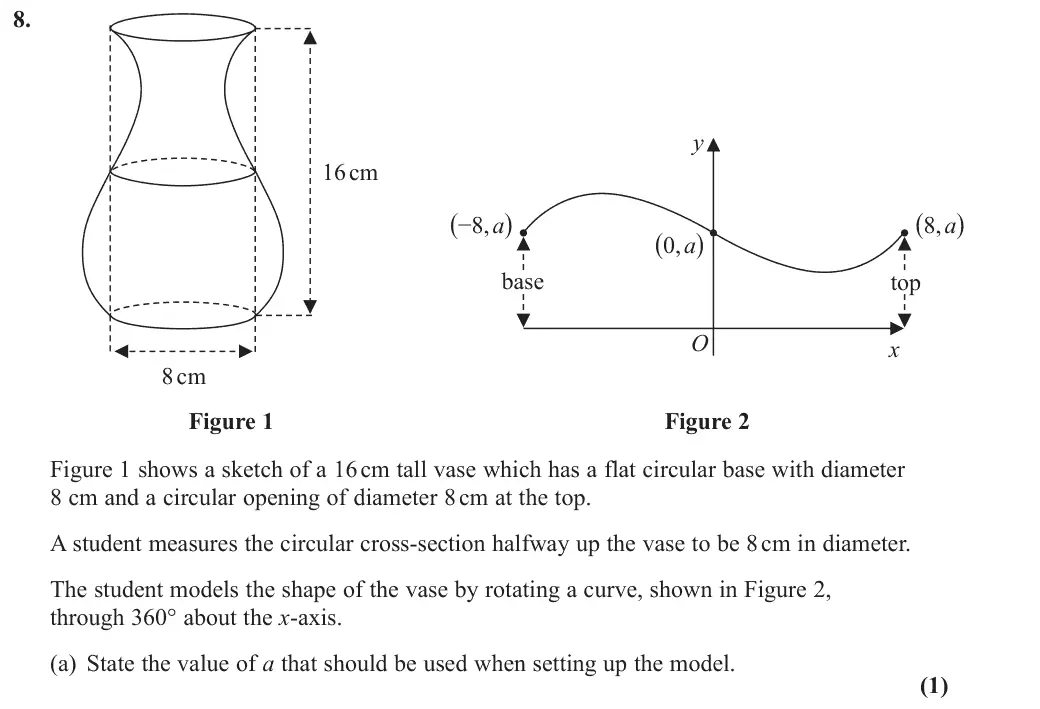
8. y 16 cm (-8, a) (8, a) (0, a) base top x 8 cm Figure 1 Figure 2 Figure 1 shows a sketch of a 16 cm tall vase which has a flat circular base with diameter 8 cm and a circular opening of diameter 8 cm at the top. A student measures the circular cross-section halfway up the vase to be 8 cm in diameter. The student models the shape of the vase by rotating a curve, shown in Figure 2, through 360° about the x-axis. (a) State the value of a that should be used when setting up the model. (1)
June 2022 · AS Paper 1 (Core Pure) · Q8(b) 7 marks volumes of revolution
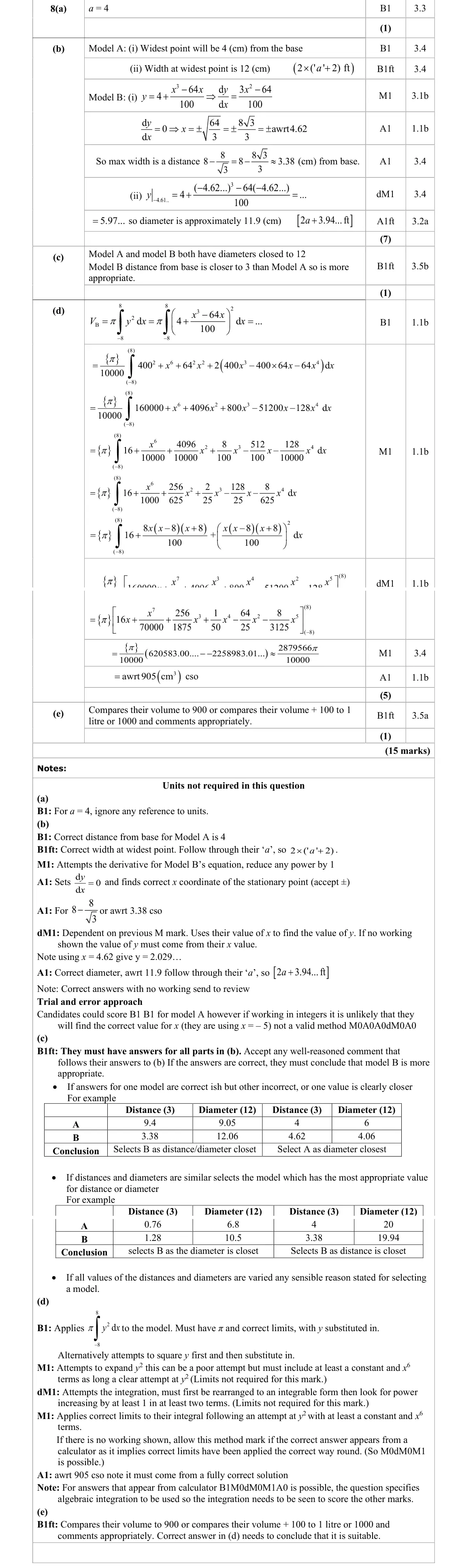
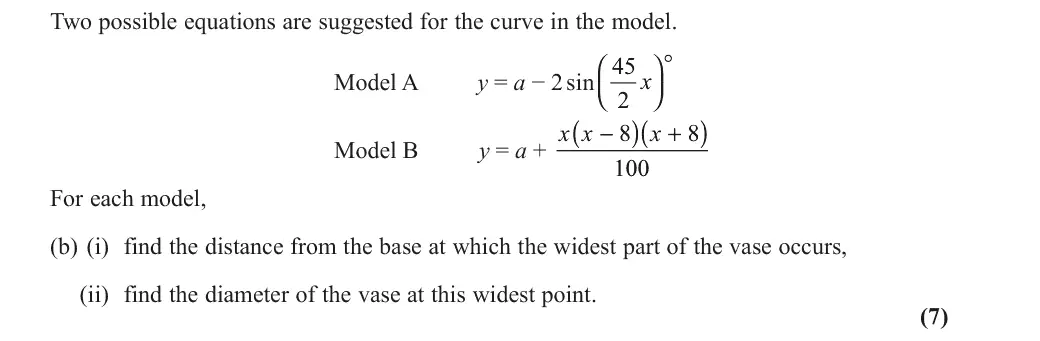
Two possible equations are suggested for the curve in the model. ° Model A y = a - 2 sin 45 2 x ( ) ( ) Model B y = a + x x - x + For each model, (b) (i) find the distance from the base at which the widest part of the vase occurs, (ii) find the diameter of the vase at this widest point. (7)
June 2022 · AS Paper 1 (Core Pure) · Q8(c) 1 mark volumes of revolution
The widest part of the vase has diameter 12 cm and is just over 3 cm from the base. (c) Using this information and making your reasoning clear, suggest which model is more appropriate. (1)
June 2022 · AS Paper 1 (Core Pure) · Q8(d) 5 marks volumes of revolution
(d) Using algebraic integration, find the volume for the vase predicted by Model B. You must make your method clear. (5)
June 2022 · AS Paper 1 (Core Pure) · Q8(e) 1 mark volumes of revolution
The student pours water from a full one litre jug into the vase and finds that there is 100 ml left in the jug when the vase is full. (e) Comment on the suitability of Model B in light of this information. (1)

Find an Edexcel Further Maths tutor

Want this paper marked and gone through with a Further Maths tutor? Message us.

Prefer email? Send an enquiry

If you are under 18, please include a parent's contact details. Enquiries go to enquiries@alevelfurthermathstutor.com and are deleted once handled.