June 2024: AS Paper 01: Core Pure Mathematics

80 marks · 30 question parts · Question paper, mark scheme and examiner's report on Pearson's site

Question by question

QTopicMarksDifficulty
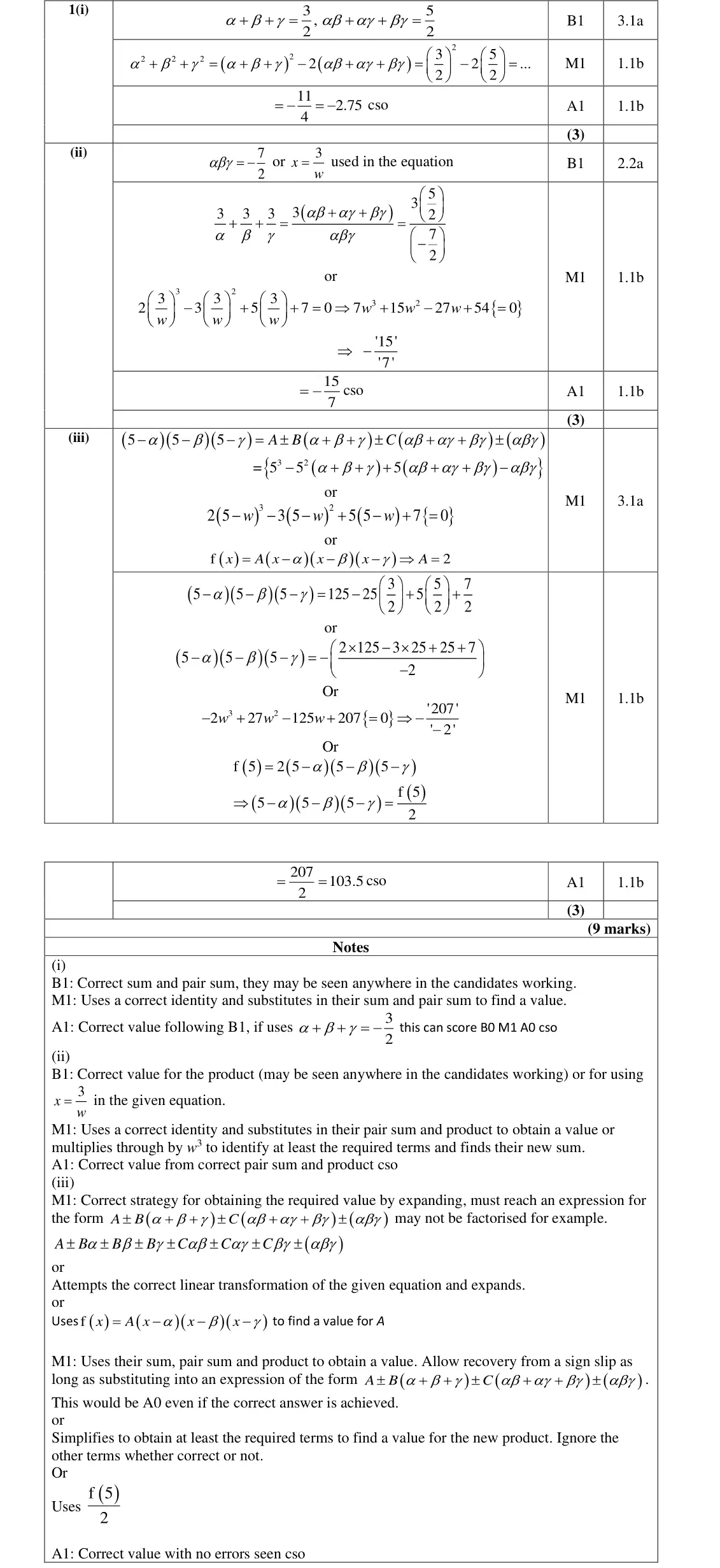
1(i) Roots of polynomials 3 —
1(ii) Roots of polynomials 3 —
1(iii) Roots of polynomials 3 —
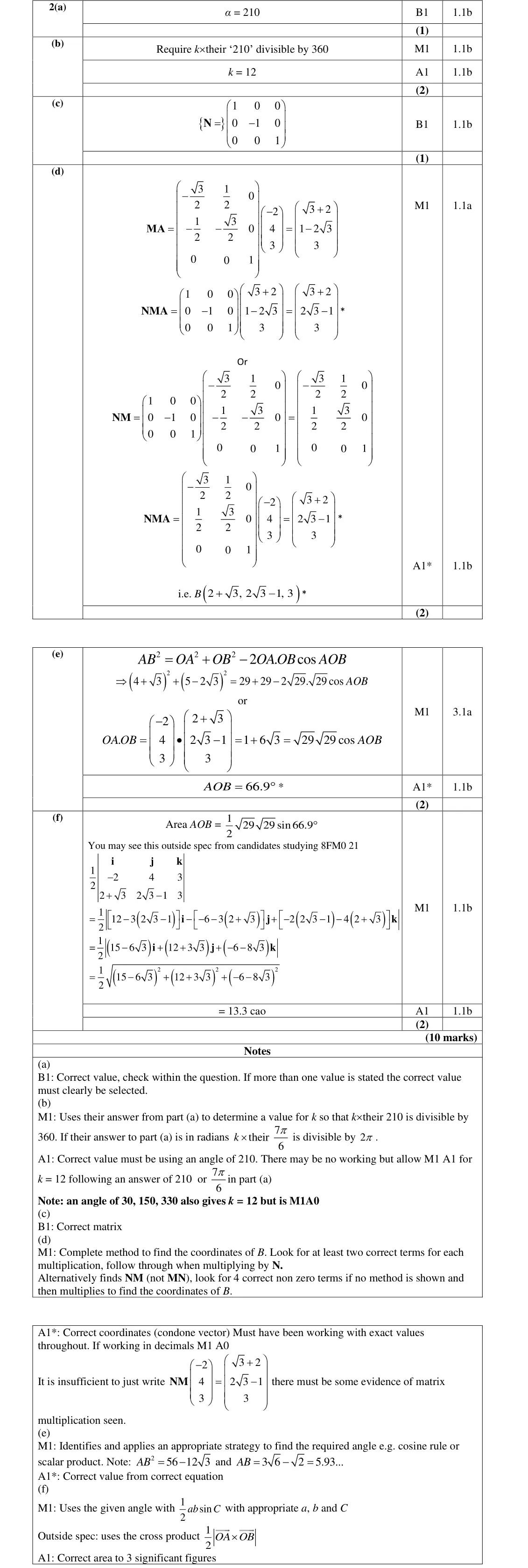
2(a) Linear transformations and invariant points and lines 1 —
2(b) Linear transformations and invariant points and lines 2 —
2(c) Linear transformations and invariant points and lines 1 —
2(d) Linear transformations and invariant points and lines, Matrices: multiplication, determinants and inverses 2 —
2(e) Vectors: equations of lines and planes, scalar product 2 —
2(f) Vectors: equations of lines and planes, scalar product 2 —
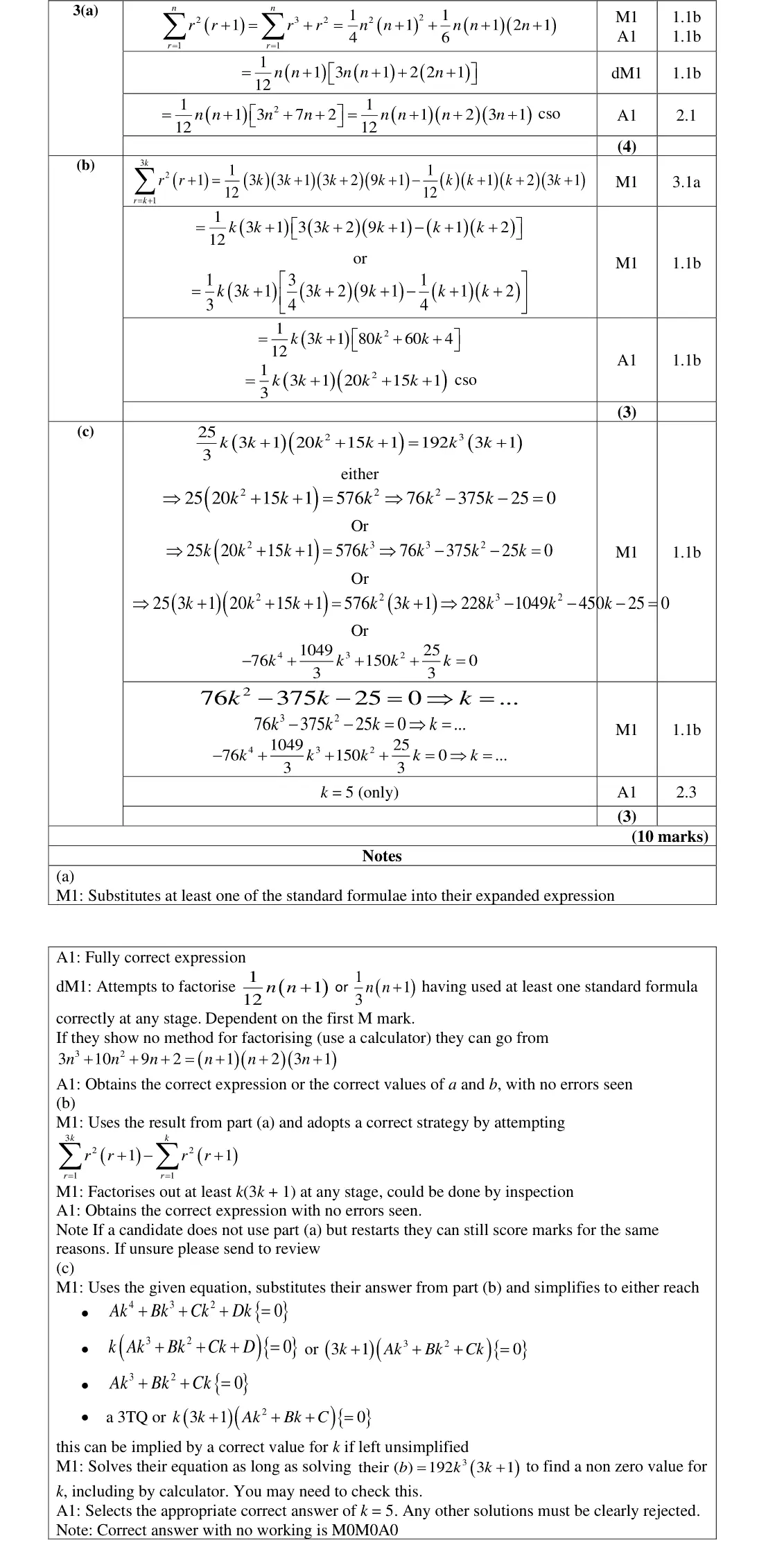
3(a) Series: standard sums and the method of differences 4 —
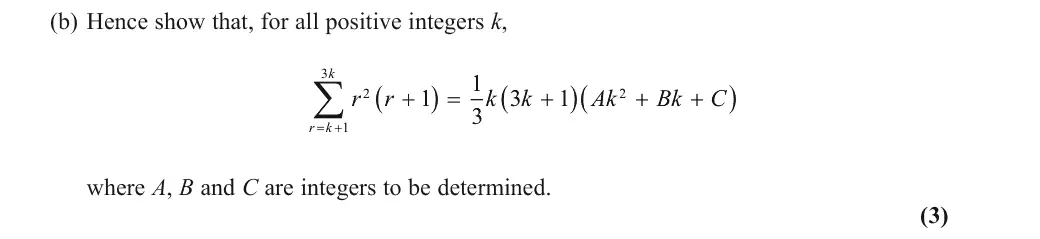
3(b) Series: standard sums and the method of differences 3 —
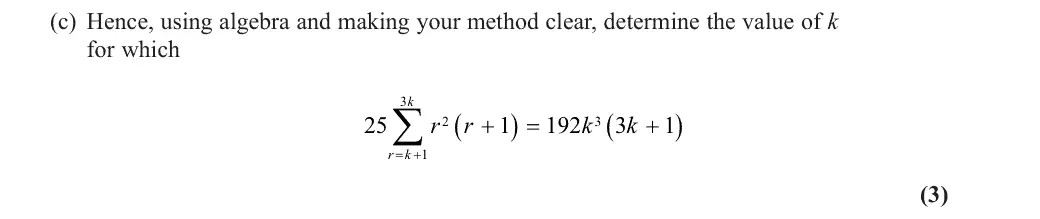
3(c) Series: standard sums and the method of differences 3 —
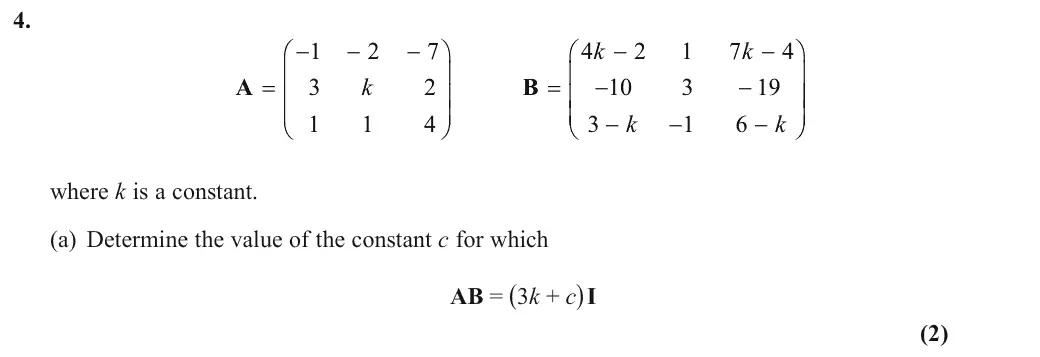
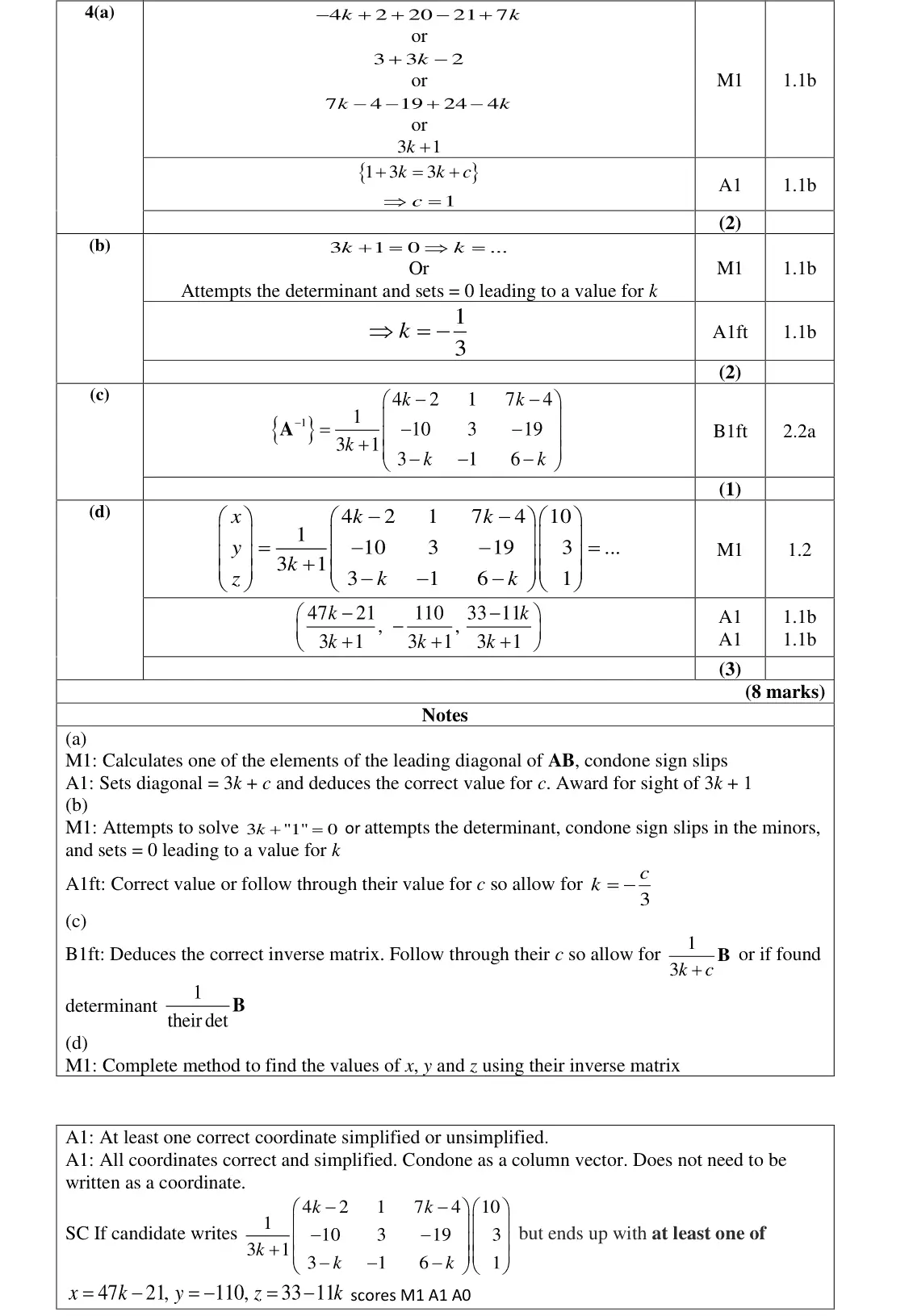
4(a) Matrices: multiplication, determinants and inverses 2 —
4(b) Matrices: multiplication, determinants and inverses 2 —
4(c) Matrices: multiplication, determinants and inverses 1 —
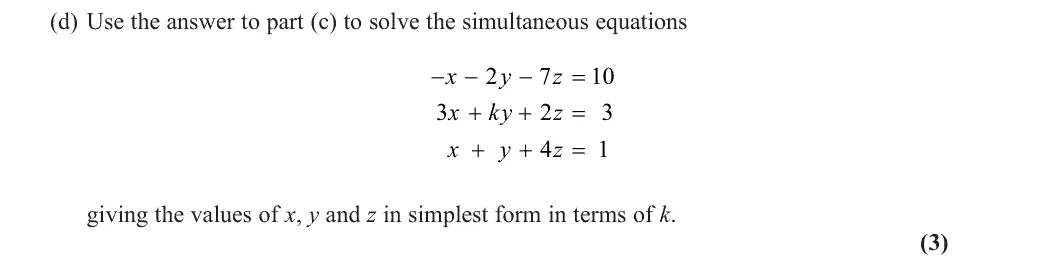
4(d) Three linear equations: solutions and planes 3 —
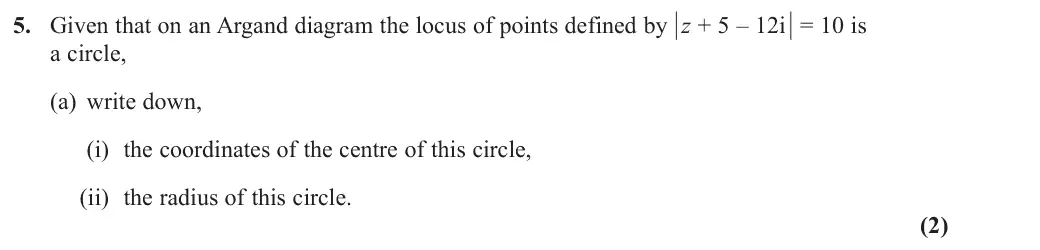
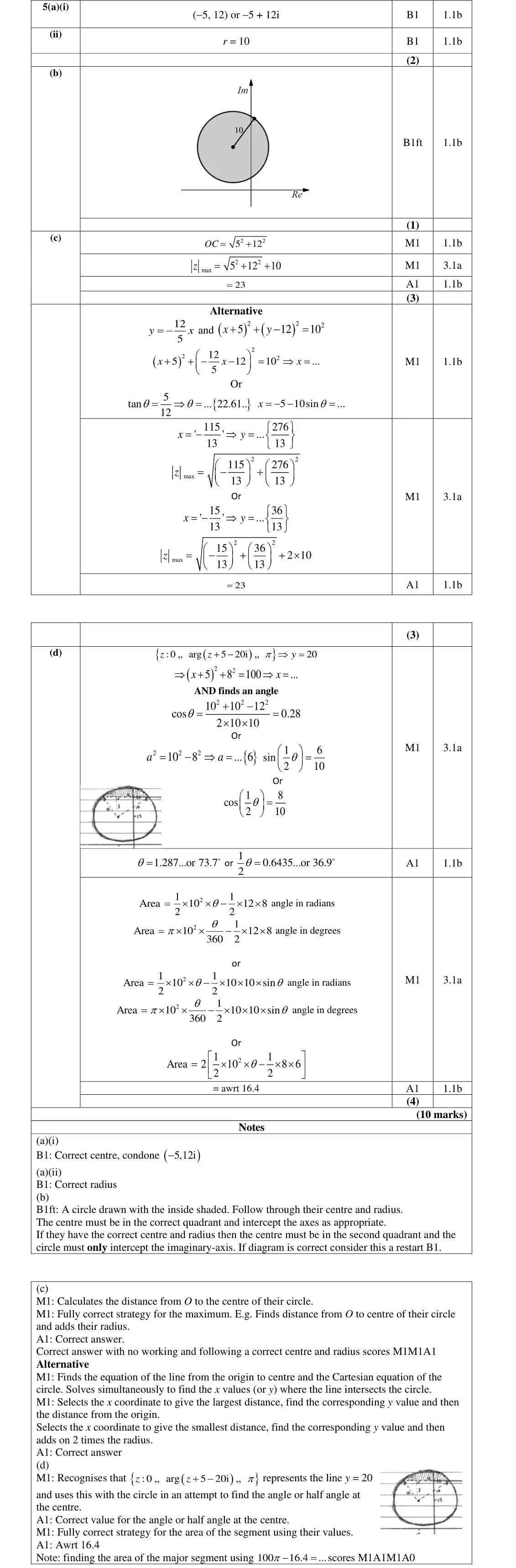
5(a) Loci in the Argand diagram 2 —
5(b) Loci in the Argand diagram, Complex numbers: arithmetic, conjugates, roots of polynomials and Argand diagrams 1 —
5(c) Loci in the Argand diagram 3 —
5(d) Loci in the Argand diagram 4 —
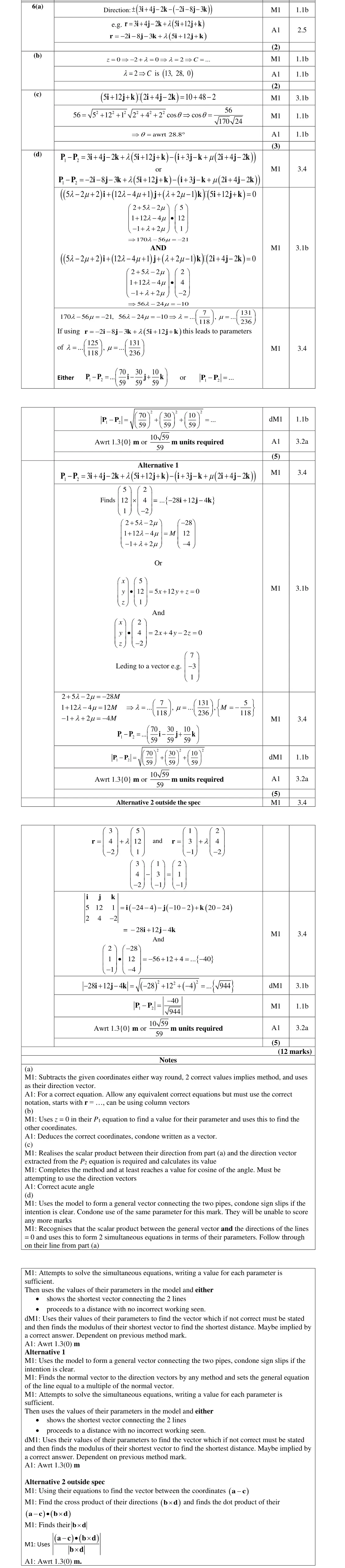
6(a) Vectors: equations of lines and planes, scalar product 2 —
6(b) Vectors: equations of lines and planes, scalar product 2 —
6(c) Vectors: equations of lines and planes, scalar product 3 —
6(d) Vectors: intersections, angles and shortest distances 5 —
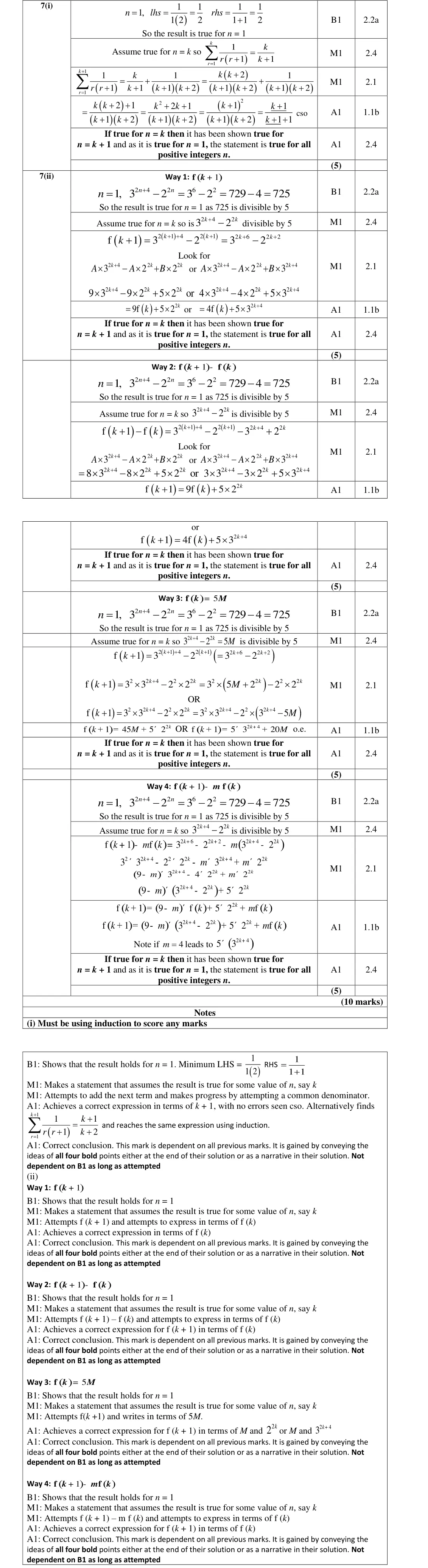
7(i) Proof by induction 5 —
7(ii) Proof by induction 5 —
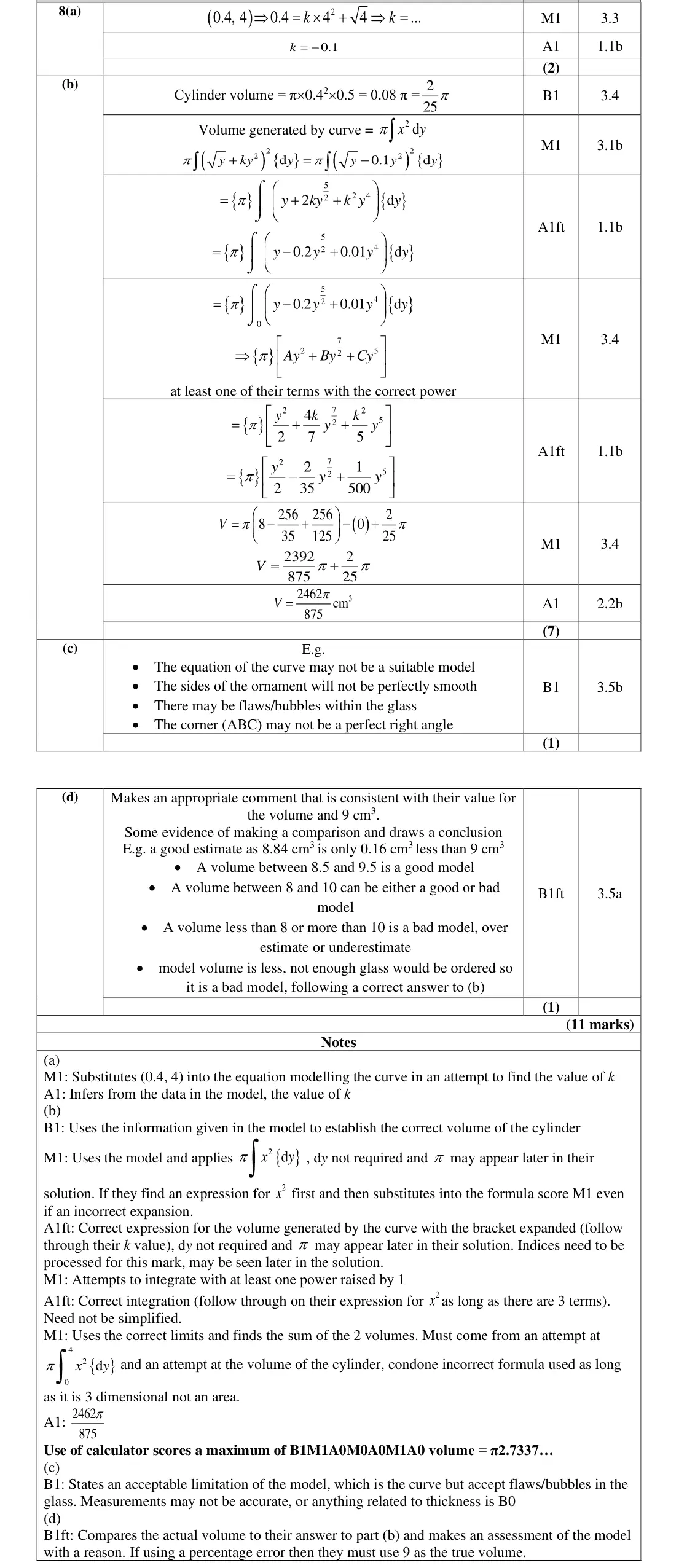
8(a) Volumes of revolution 2 —
8(b) Volumes of revolution 7 —
8(c) Volumes of revolution 1 —
8(d) Volumes of revolution 1 —

The questions

1(i)1(ii)1(iii)2(a)2(b)2(c)2(d)2(e)2(f)3(a)3(b)3(c)4(a)4(b)4(c)4(d)5(a)5(b)5(c)5(d)6(a)6(b)6(c)6(d)7(i)7(ii)8(a)8(b)8(c)8(d)
June 2024 · AS Paper 1 (Core Pure) · Q1(i) 3 marks roots of polynomials

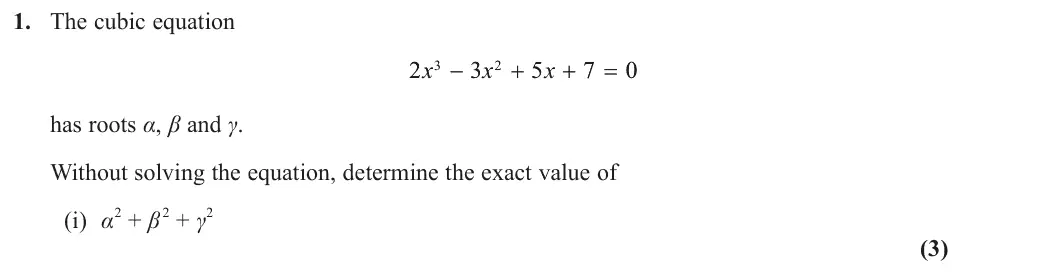
1. The cubic equation x x x has roots alpha , beta and γ. Without solving the equation, determine the exact value of 2 + beta 2 + γ (i) alpha (3)
June 2024 · AS Paper 1 (Core Pure) · Q1(ii) 3 marks roots of polynomials

(ii) 3 alpha beta γ (3)
June 2024 · AS Paper 1 (Core Pure) · Q1(iii) 3 marks roots of polynomials
(iii) (5 – alpha )(5 – beta )(5 – γ) (3)
June 2024 · AS Paper 1 (Core Pure) · Q2(a) 1 mark linear transformations
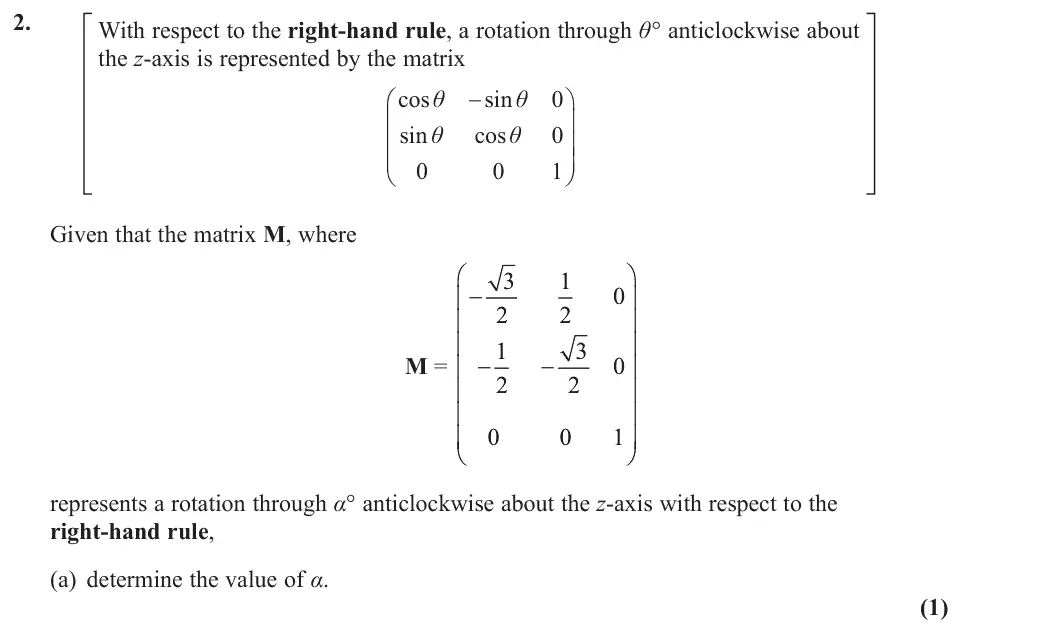
2. With respect to the right-hand rule, a rotation through theta ° anticlockwise about the z-axis is represented by the matrix cos theta sin theta ; : sin theta cos theta Given that the matrix M, where ; M = : represents a rotation through alpha ° anticlockwise about the z-axis with respect to the right‑hand rule, (a) determine the value of alpha . (1)
June 2024 · AS Paper 1 (Core Pure) · Q2(b) 2 marks linear transformations
k = I (b) Hence determine the smallest possible positive integer value of k for which M (2)
June 2024 · AS Paper 1 (Core Pure) · Q2(c) 1 mark linear transformations
The 3 x 3 matrix N represents a reflection in the plane with equation y = 0 (c) Write down the matrix N. (1)
June 2024 · AS Paper 1 (Core Pure) · Q2(d) 2 marks linear transformationsmatrices
The point A has coordinates (-2, 4, 3) The point B is the image of the point A under the transformation represented by matrix M followed by the transformation represented by matrix N. / (d) Show that the coordinates of B are 2 3 2 3 , 1 3 , (2)
June 2024 · AS Paper 1 (Core Pure) · Q2(e) 2 marks vectors lines and planes
Given that O is the origin, (e) show that, to 3 significant figures, the size of angle AOB is 66.9° (2)
June 2024 · AS Paper 1 (Core Pure) · Q2(f) 2 marks vectors lines and planes
(f) Hence determine the area of triangle AOB, giving your answer to 3 significant figures. (2)
June 2024 · AS Paper 1 (Core Pure) · Q3(a) 4 marks series and method of differences
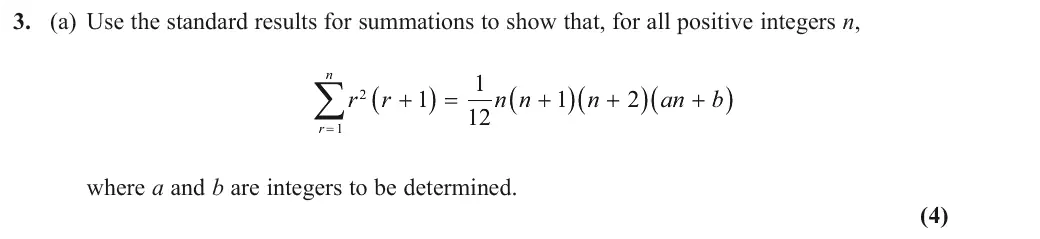
3. (a) Use the standard results for summations to show that, for all positive integers n, n O8 / O / / / r r n n n an b r where a and b are integers to be determined. (4)
June 2024 · AS Paper 1 (Core Pure) · Q3(b) 3 marks series and method of differences
(b) Hence show that, for all positive integers k, k O 18 / O / / r r k k Ak Bk C r k where A, B and C are integers to be determined. (3)
June 2024 · AS Paper 1 (Core Pure) · Q3(c) 3 marks series and method of differences
(c) Hence, using algebra and making your method clear, determine the value of k for which k O 18 / O / r r k k r k (3)
June 2024 · AS Paper 1 (Core Pure) · Q4(a) 2 marks matrices
4. k k : : A B k k k where k is a constant. (a) Determine the value of the constant c for which AB = (3k + c) I (2)
June 2024 · AS Paper 1 (Core Pure) · Q4(b) 2 marks matrices
(b) Hence determine the value of k for which A –1 does not exist. (2)
June 2024 · AS Paper 1 (Core Pure) · Q4(c) 1 mark matrices
Given that A –1 does exist, (c) write down A –1 in terms of k. (1)
June 2024 · AS Paper 1 (Core Pure) · Q4(d) 3 marks three equations three unknowns
(d) Use the answer to part (c) to solve the simultaneous equations x y z x ky z x y z giving the values of x, y and z in simplest form in terms of k. (3)
June 2024 · AS Paper 1 (Core Pure) · Q5(a) 2 marks loci in the argand diagram
5. Given that on an Argand diagram the locus of points defined by | z + 5 – 12i | = 10 is a circle, (a) write down, (i) the coordinates of the centre of this circle, (ii) the radius of this circle. (2)
June 2024 · AS Paper 1 (Core Pure) · Q5(b) 1 mark loci in the argand diagramcomplex numbers
(b) Show, by shading on an Argand diagram, the set of points defined by | z + 5 – 12i | 10 (1)
June 2024 · AS Paper 1 (Core Pure) · Q5(c) 3 marks loci in the argand diagram
(c) For the set of points defined in part (b), determine the maximum value of | z | (3)
June 2024 · AS Paper 1 (Core Pure) · Q5(d) 4 marks loci in the argand diagram
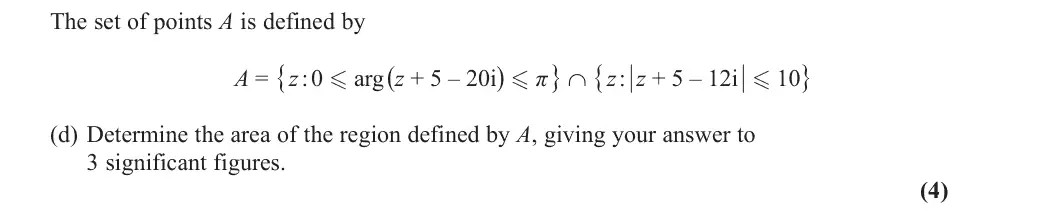
The set of points A is defined by A = { z : 0 arg (z + 5 – 20i) pi } ∩ { z : | z + 5 – 12i | 10} (d) Determine the area of the region defined by A, giving your answer to 3 significant figures. (4)
June 2024 · AS Paper 1 (Core Pure) · Q6(a) 2 marks vectors lines and planes
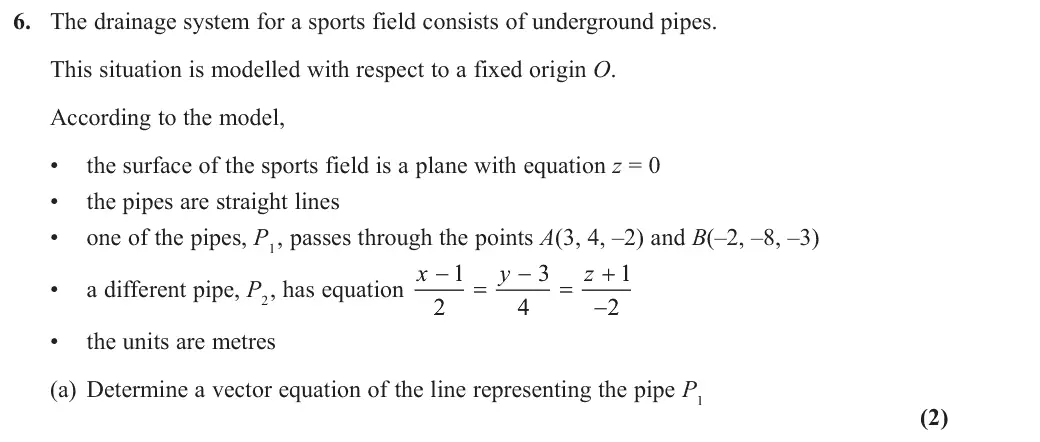
6. The drainage system for a sports field consists of underground pipes. This situation is modelled with respect to a fixed origin O. According to the model, • the surface of the sports field is a plane with equation z = 0 • the pipes are straight lines • one of the pipes, P1 , passes through the points A(3, 4, –2) and B(–2, –8, –3) a different pipe, P2 , has equation x y z • • the units are metres (a) Determine a vector equation of the line representing the pipe P1 (2)
June 2024 · AS Paper 1 (Core Pure) · Q6(b) 2 marks vectors lines and planes
(b) Determine the coordinates of the point at which the pipe P1 meets the surface of the playing field, according to the model. (2)
June 2024 · AS Paper 1 (Core Pure) · Q6(c) 3 marks vectors lines and planes
Determine, according to the model, (c) the acute angle between pipes P1 and P2 , giving your answer in degrees to 3 significant figures, (3)
June 2024 · AS Paper 1 (Core Pure) · Q6(d) 5 marks vectors intersections and distances
(d) the shortest distance between pipes P1 and P2 (5)
June 2024 · AS Paper 1 (Core Pure) · Q7(i) 5 marks proof by induction
7. (i) Prove by induction that, for all positive integers n, n O8 n / 1 r r n r (5)
June 2024 · AS Paper 1 (Core Pure) · Q7(ii) 5 marks proof by induction
(ii) Prove by induction that, for all positive integers n, f ( n ) = 3 2n + 4 – 2 2 n is divisible by 5 (5)
June 2024 · AS Paper 1 (Core Pure) · Q8(a) 2 marks volumes of revolution
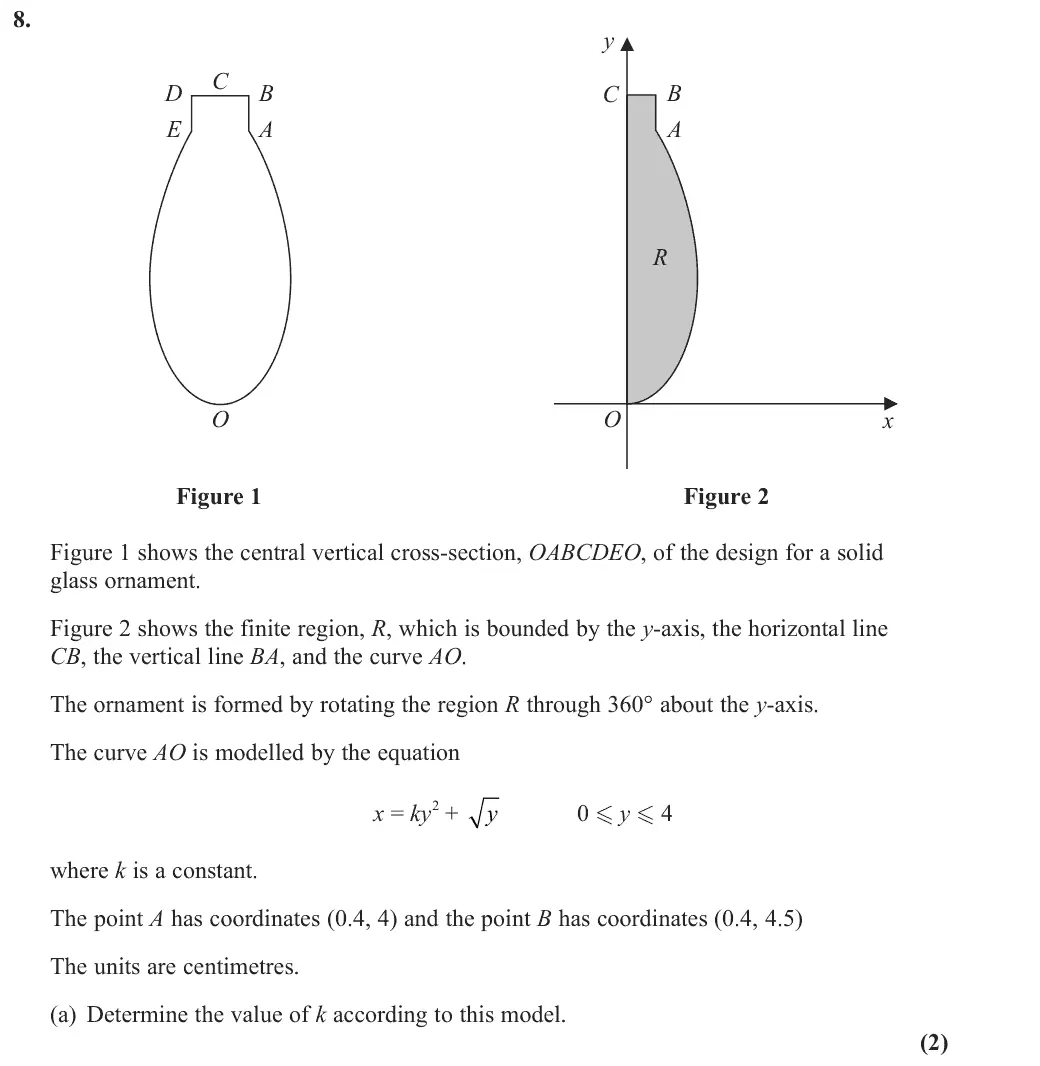
8. y C B B C E A A R x Figure 1 Figure 2 Figure 1 shows the central vertical cross-section, OABCDEO, of the design for a solid glass ornament. Figure 2 shows the finite region, R, which is bounded by the y-axis, the horizontal line CB, the vertical line BA, and the curve AO. The ornament is formed by rotating the region R through 360° about the y-axis. The curve AO is modelled by the equation 2 + y 0 y 4 x = ky where k is a constant. The point A has coordinates (0.4, 4) and the point B has coordinates (0.4, 4.5) The units are centimetres. (a) Determine the value of k according to this model. (2)
June 2024 · AS Paper 1 (Core Pure) · Q8(b) 7 marks volumes of revolution
(b) Use algebraic integration to determine the exact volume of glass that would be required to make the ornament, according to the model. (7)
June 2024 · AS Paper 1 (Core Pure) · Q8(c) 1 mark volumes of revolution
(c) State a limitation of the model. (1)
June 2024 · AS Paper 1 (Core Pure) · Q8(d) 1 mark volumes of revolution
3 of glass was required. When the ornament was manufactured, 9 cm (d) Use this information and your answer to part (b) to evaluate the model, explaining your reasoning. (1)

Find an Edexcel Further Maths tutor

Want this paper marked and gone through with a Further Maths tutor? Message us.

Prefer email? Send an enquiry

If you are under 18, please include a parent's contact details. Enquiries go to enquiries@alevelfurthermathstutor.com and are deleted once handled.