Oct 2020: AS Paper 01: Core Pure Mathematics

80 marks · 24 question parts · Question paper, mark scheme and examiner's report on Pearson's site

Question by question

QTopicMarksDifficulty
1(a) Matrices: multiplication, determinants and inverses, Three linear equations: solutions and planes 2 —
1(b) Three linear equations: solutions and planes 3 —
1(c) Three linear equations: solutions and planes 1 —
2(a) Modulus-argument form 2 —
2(b) Modulus-argument form 6 —
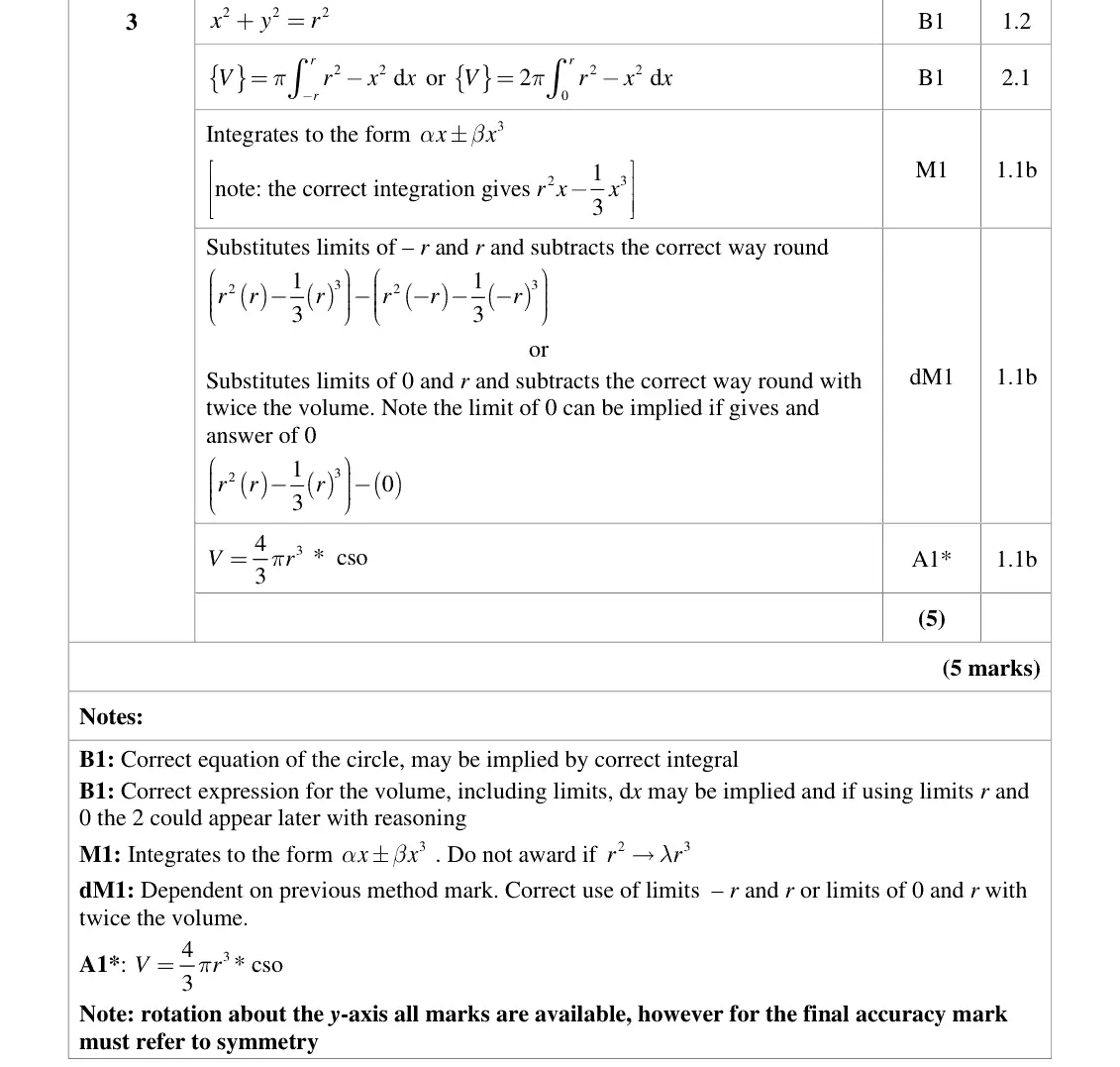
3 Volumes of revolution 5 —
4(a) Vectors: equations of lines and planes, scalar product 3 —
4(b) Vectors: equations of lines and planes, scalar product 4 —
4(c) Vectors: equations of lines and planes, scalar product 2 —
4(d) Vectors: equations of lines and planes, scalar product 1 —
4(e) Vectors: intersections, angles and shortest distances 2 —
4(f) Vectors: intersections, angles and shortest distances 1 —
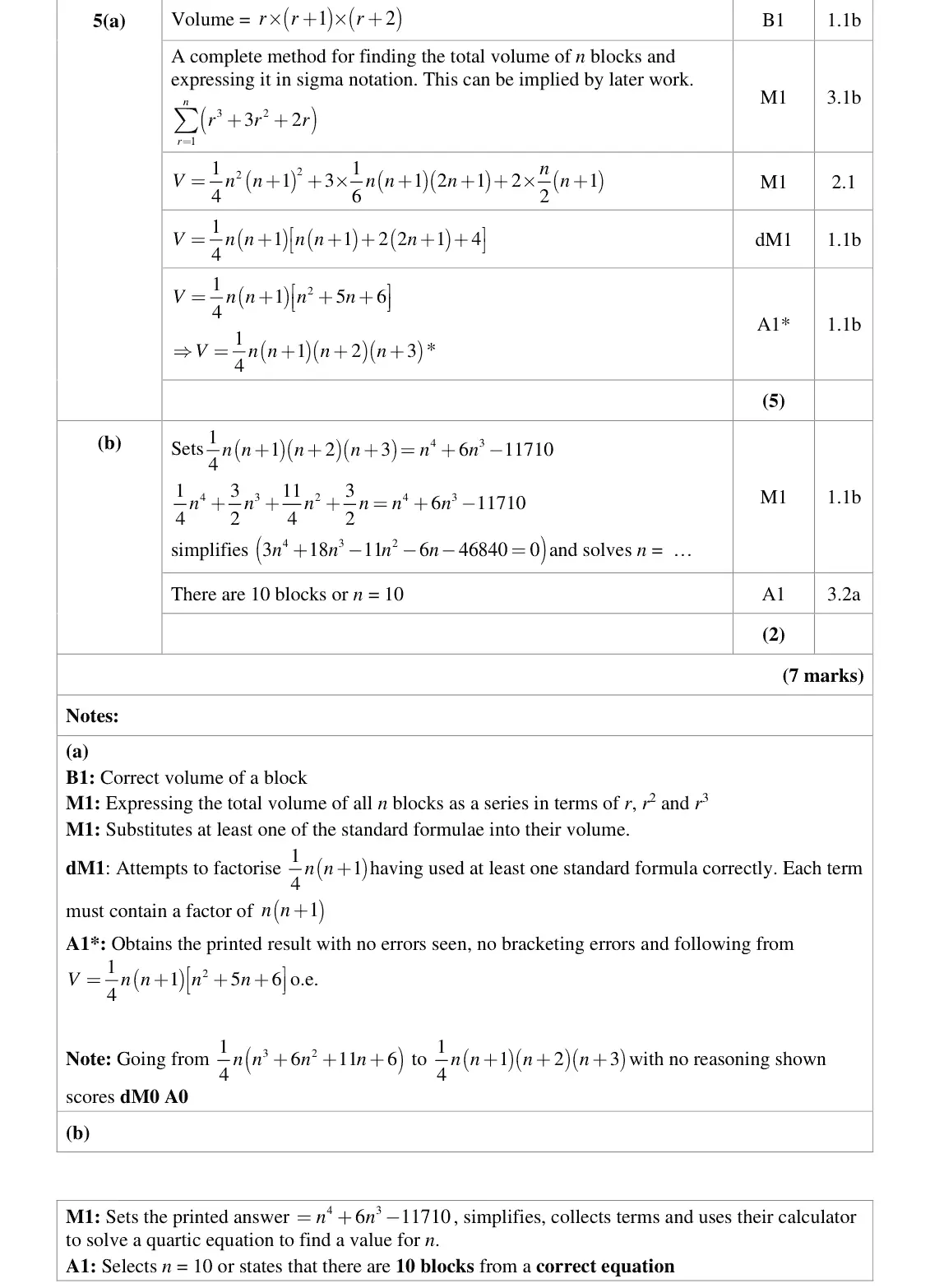
5(a) Series: standard sums and the method of differences 5 —
5(b) Series: standard sums and the method of differences 2 —
6(i) Linear transformations and invariant points and lines 3 —
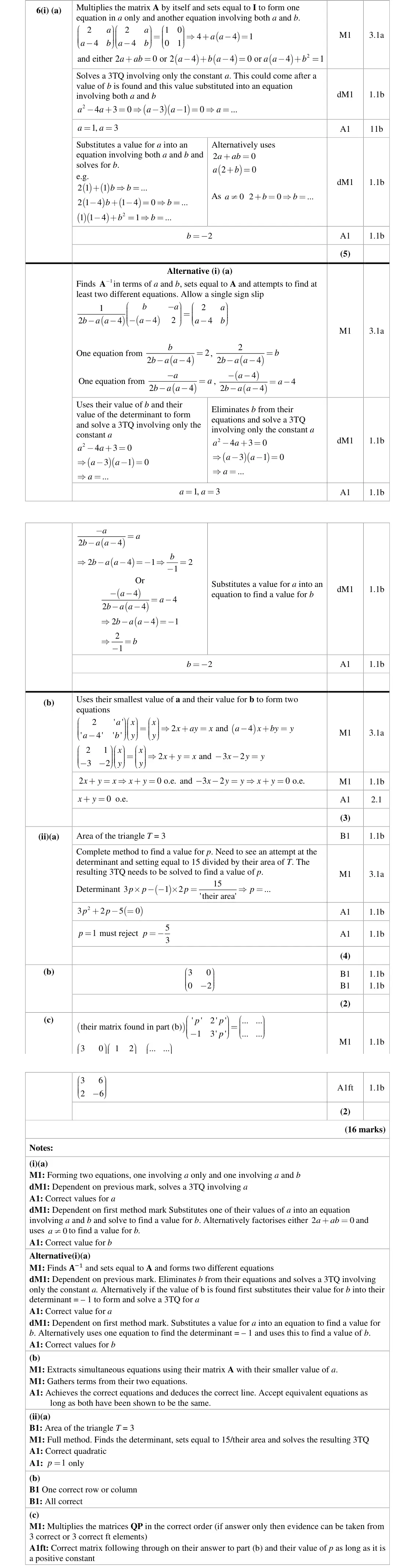
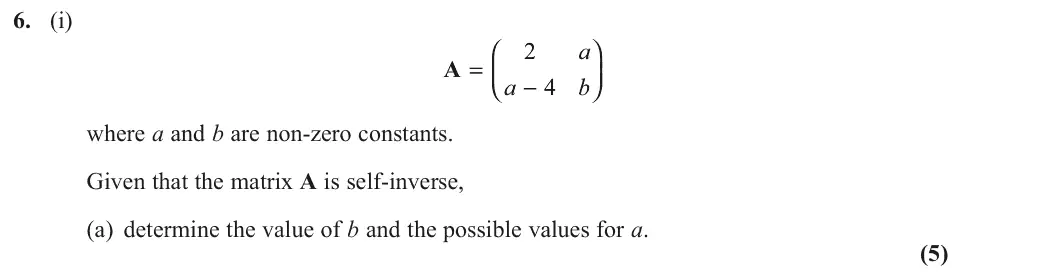
6(i)(a) Matrices: multiplication, determinants and inverses 5 —
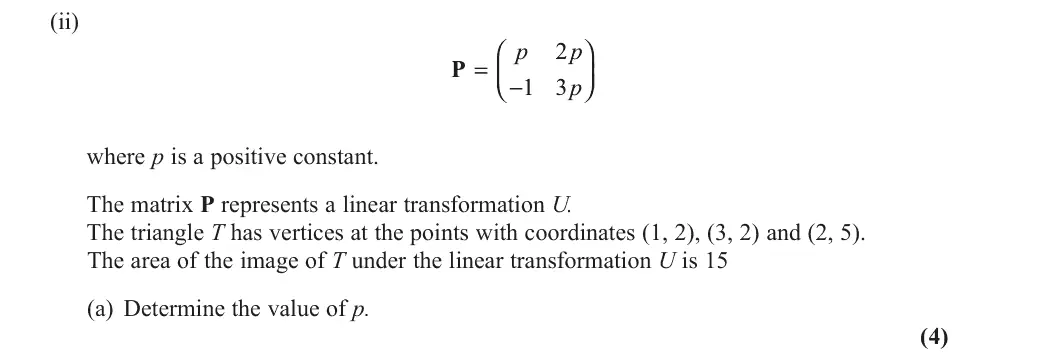
6(ii)(a) Matrices: multiplication, determinants and inverses 4 —
6(ii)(b) Linear transformations and invariant points and lines 2 —
6(ii)(c) Linear transformations and invariant points and lines, Matrices: multiplication, determinants and inverses 2 —
7 Complex numbers: arithmetic, conjugates, roots of polynomials and Argand diagrams, Roots of polynomials 6 —
8 Proof by induction 6 —
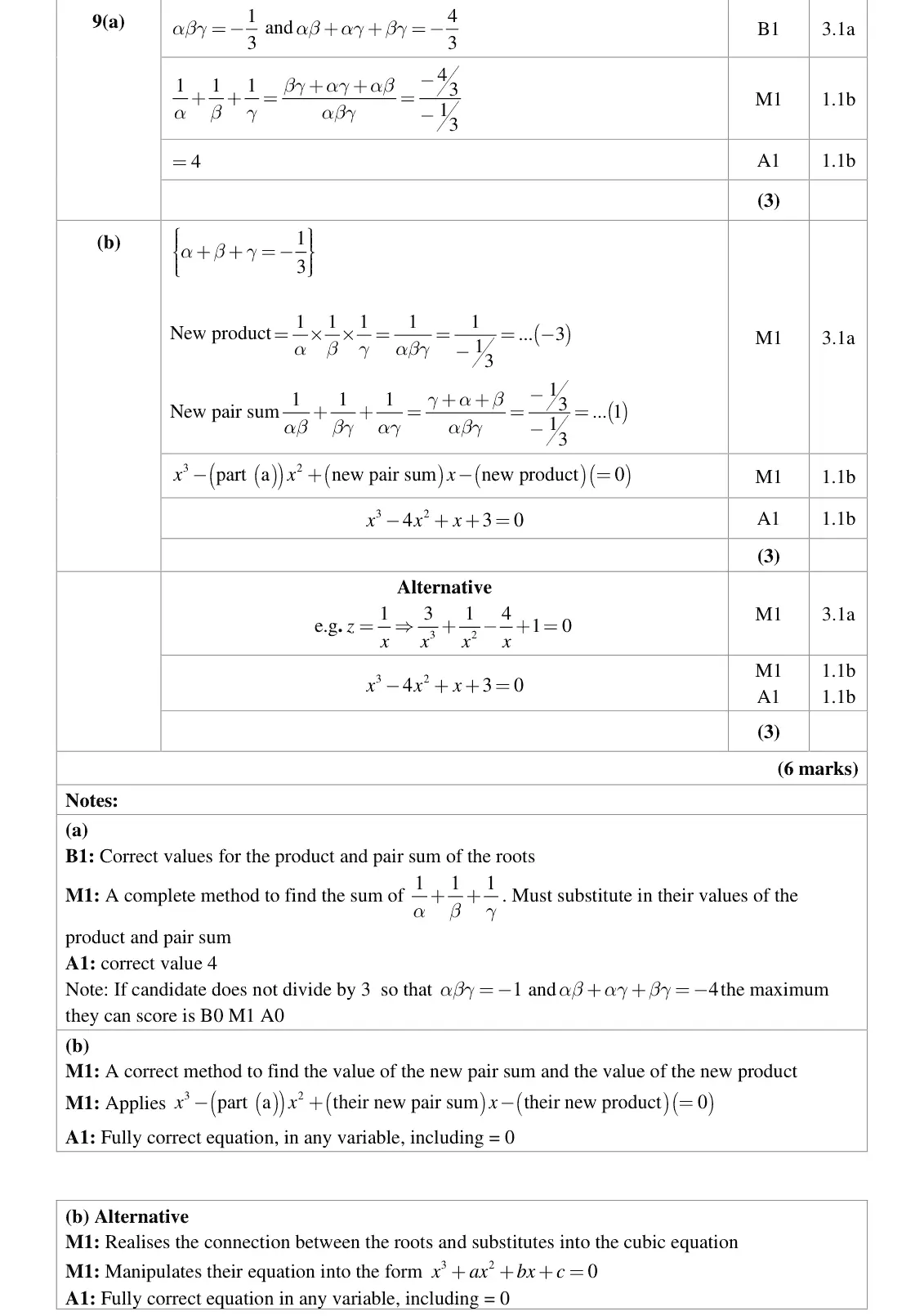
9(a) Roots of polynomials 3 —
9(b) Roots of polynomials 3 —
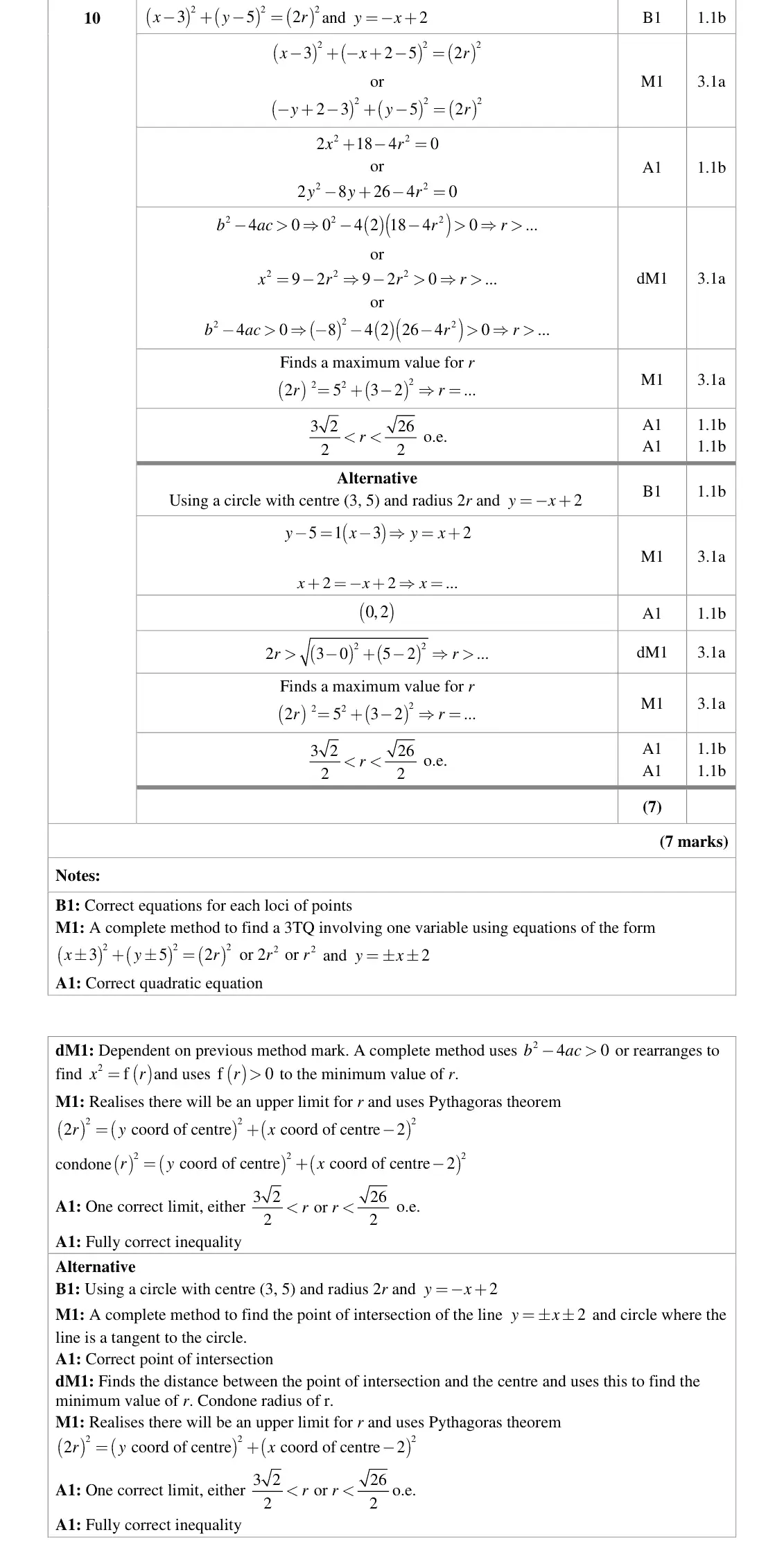
10 Loci in the Argand diagram 7 —

The questions

1(a)1(b)1(c)2(a)2(b)34(a)4(b)4(c)4(d)4(e)4(f)5(a)5(b)6(i)6(i)(a)6(ii)(a)6(ii)(b)6(ii)(c)789(a)9(b)10
Oct 2020 · AS Paper 1 (Core Pure) · Q1(a) 2 marks matricesthree equations three unknowns
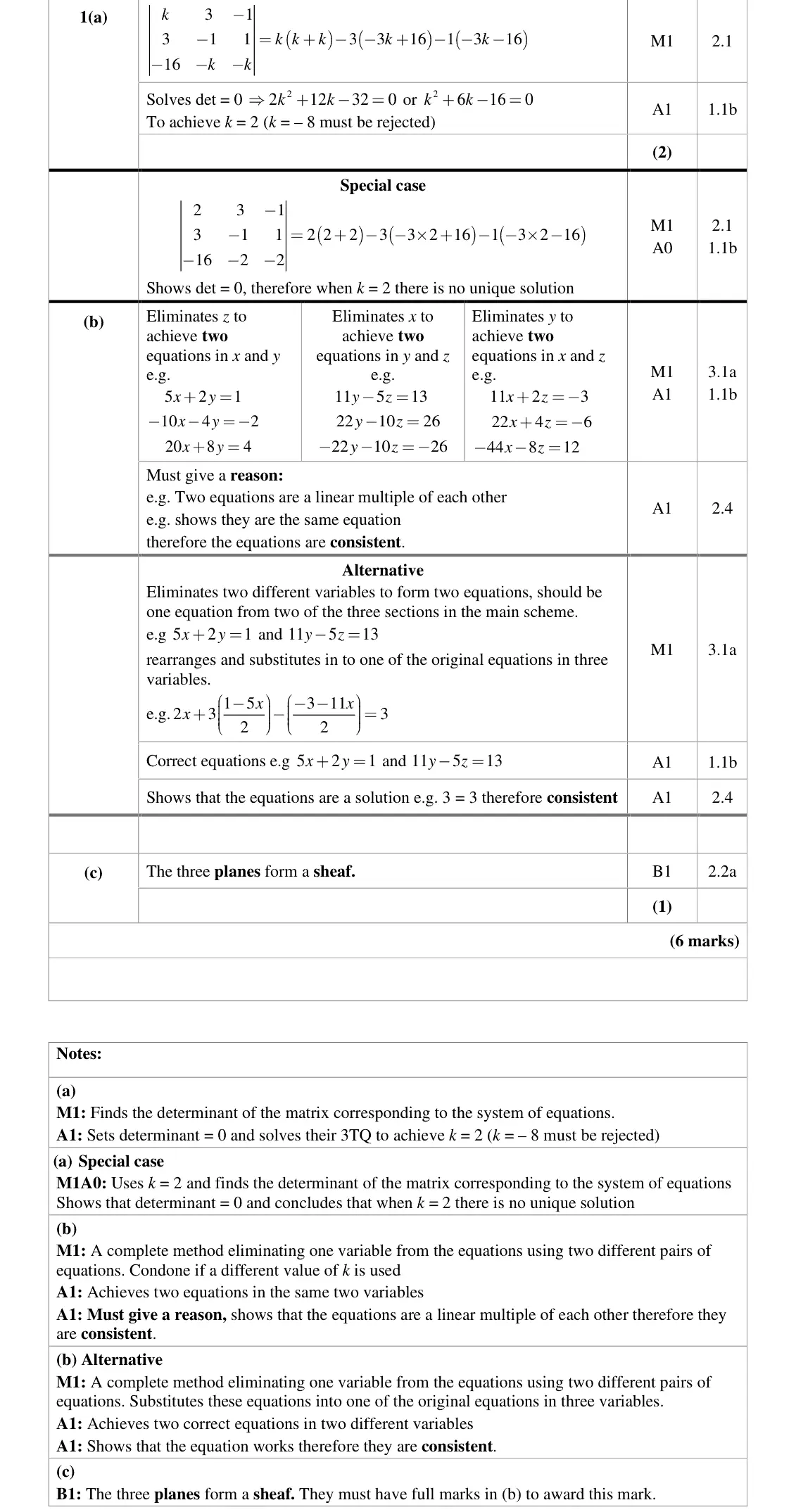
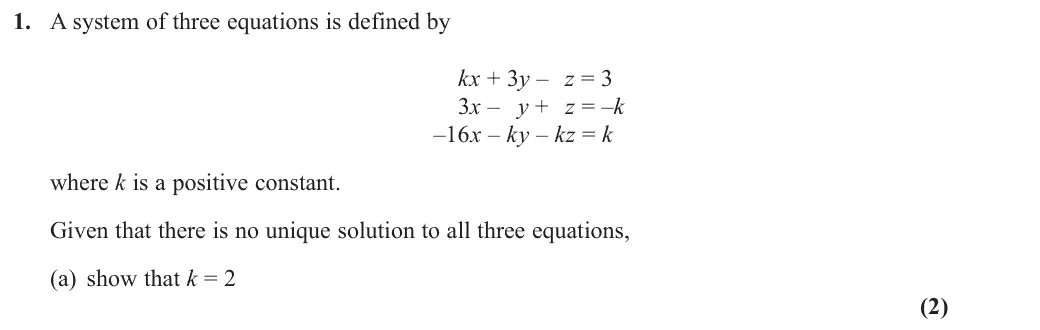
1. A system of three equations is defined by kx + 3y – z = 3 3x – y + z = –k –16x – ky – kz = k where k is a positive constant. Given that there is no unique solution to all three equations, (a) show that k = 2 (2)
Oct 2020 · AS Paper 1 (Core Pure) · Q1(b) 3 marks three equations three unknowns
Using k = 2 (b) determine whether the three equations are consistent, justifying your answer. (3)
Oct 2020 · AS Paper 1 (Core Pure) · Q1(c) 1 mark three equations three unknowns
(c) Interpret the answer to part (b) geometrically. (1)
Oct 2020 · AS Paper 1 (Core Pure) · Q2(a) 2 marks modulus argument form
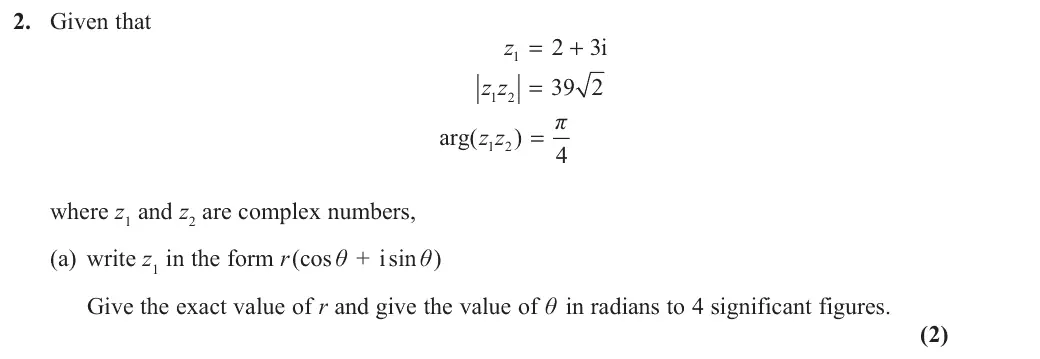
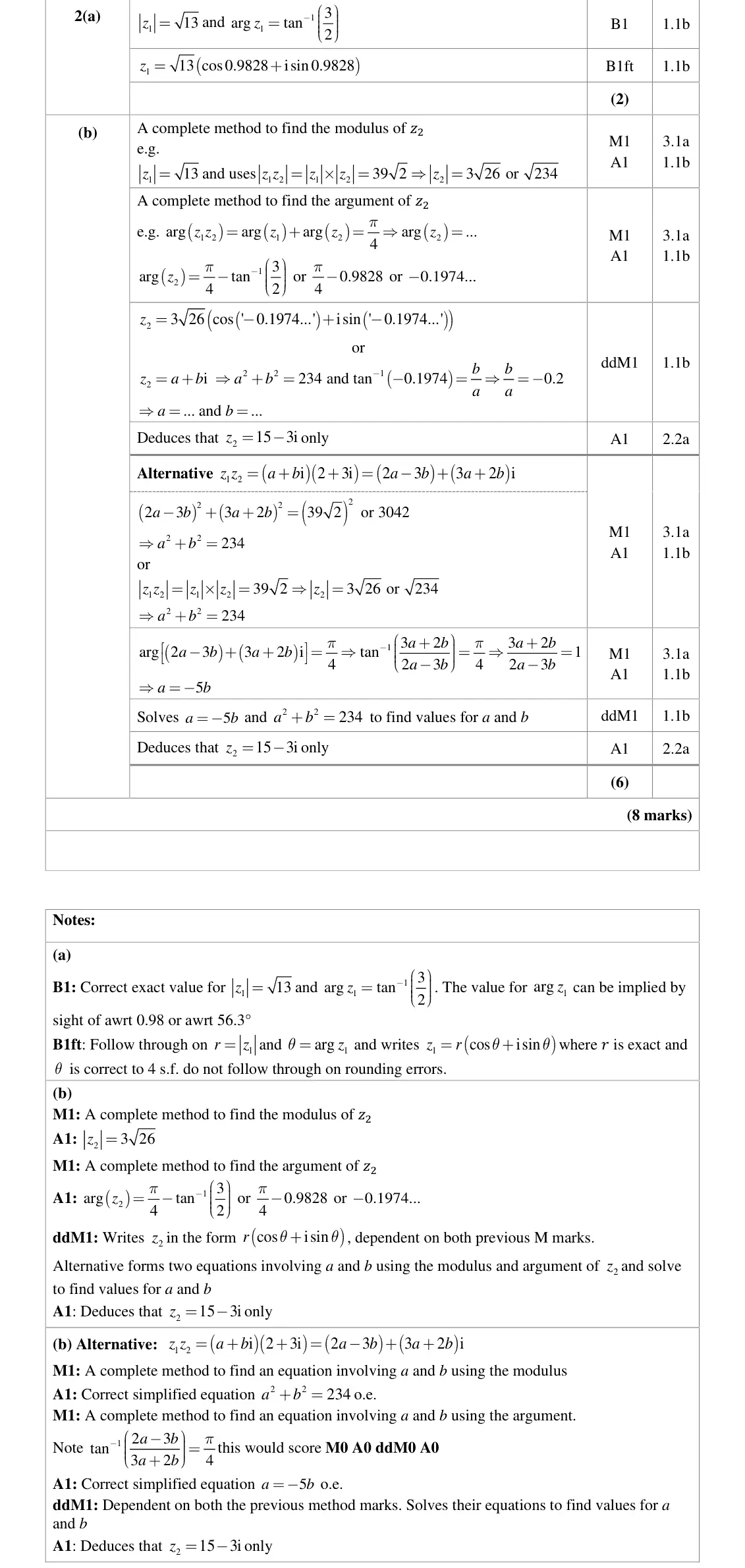
2. Given that z = + 3i z z = 39 2 1 2 pi z z = arg( ) 1 2 where z1 and z2 are complex numbers, (a) write z1 in the form r(cos theta + i sin theta ) Give the exact value of r and give the value of theta in radians to 4 significant figures. (2)
Oct 2020 · AS Paper 1 (Core Pure) · Q2(b) 6 marks modulus argument form
(b) Find z2 giving your answer in the form a + ib where a and b are integers. (6)
Oct 2020 · AS Paper 1 (Core Pure) · Q3 5 marks volumes of revolution
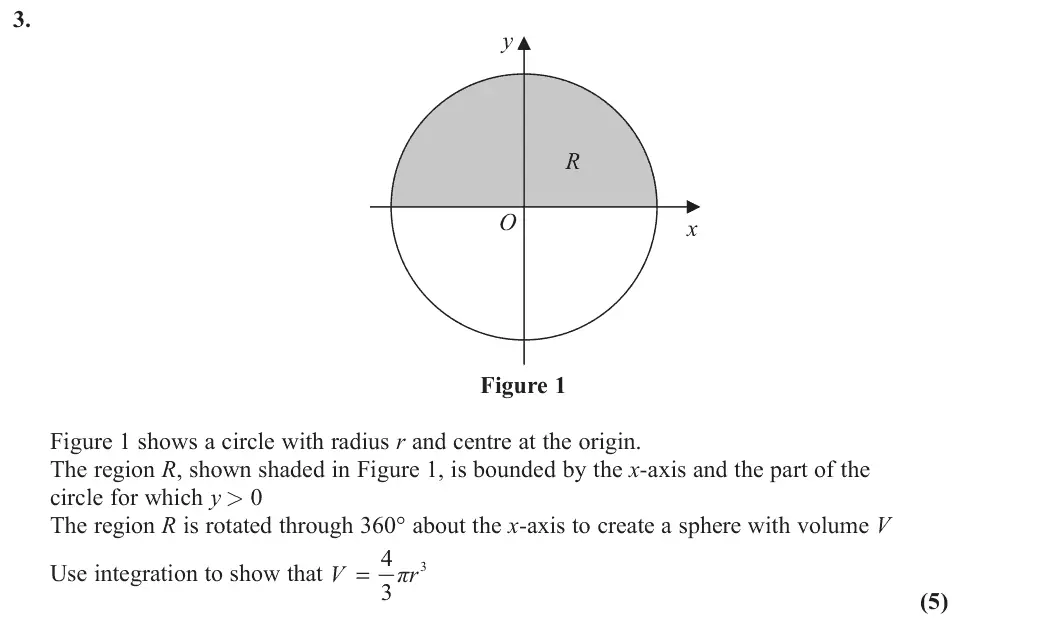
3. y R x Figure 1 Figure 1 shows a circle with radius r and centre at the origin. The region R, shown shaded in Figure 1, is bounded by the x-axis and the part of the circle for which y > 0 The region R is rotated through 360° about the x-axis to create a sphere with volume V Use integration to show that V = pi r (5)
Oct 2020 · AS Paper 1 (Core Pure) · Q4(a) 3 marks vectors lines and planes
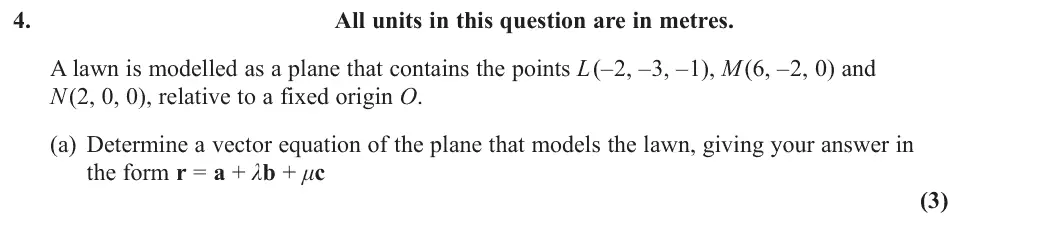
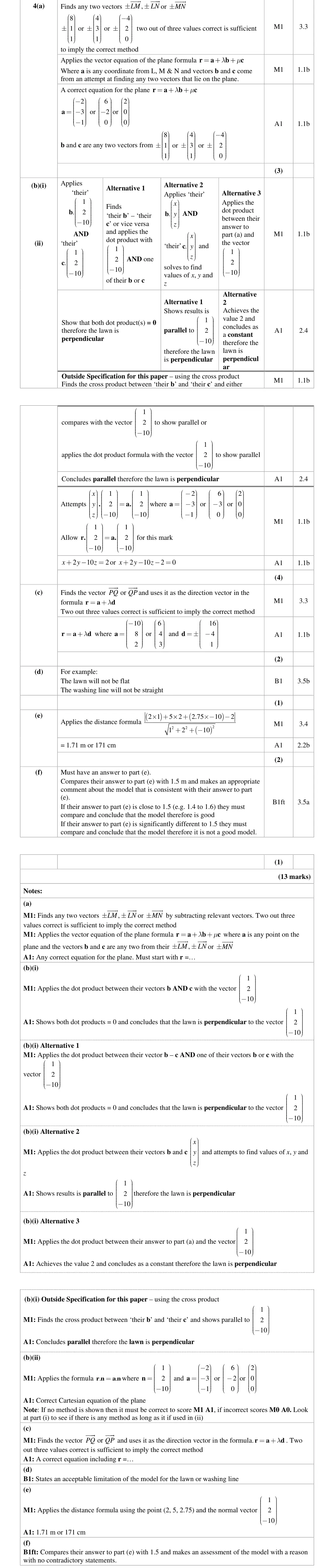
4. All units in this question are in metres. A lawn is modelled as a plane that contains the points L (–2, –3, –1), M (6, –2, 0) and N (2, 0, 0), relative to a fixed origin O. (a) Determine a vector equation of the plane that models the lawn, giving your answer in the form r = a + λb + μc (3)
Oct 2020 · AS Paper 1 (Core Pure) · Q4(b) 4 marks vectors lines and planes
(b) (i) Show that, according to the model, the lawn is perpendicular to the vector - (ii) Hence determine a Cartesian equation of the plane that models the lawn. (4)
Oct 2020 · AS Paper 1 (Core Pure) · Q4(c) 2 marks vectors lines and planes
There are two posts set in the lawn. There is a washing line between the two posts. The washing line is modelled as a straight line through points at the top of each post with coordinates P (–10, 8, 2) and Q (6, 4, 3). (c) Determine a vector equation of the line that models the washing line. (2)
Oct 2020 · AS Paper 1 (Core Pure) · Q4(d) 1 mark vectors lines and planes
(d) State a limitation of one of the models. (1)
Oct 2020 · AS Paper 1 (Core Pure) · Q4(e) 2 marks vectors intersections and distances
The point R (2, 5, 2.75) lies on the washing line. (e) Determine, according to the model, the shortest distance from the point R to the lawn, giving your answer to the nearest cm. (2)
Oct 2020 · AS Paper 1 (Core Pure) · Q4(f) 1 mark vectors intersections and distances
Given that the shortest distance from the point R to the lawn is actually 1.5 m, (f) use your answer to part (e) to evaluate the model, explaining your reasoning. (1)
Oct 2020 · AS Paper 1 (Core Pure) · Q5(a) 5 marks series and method of differences
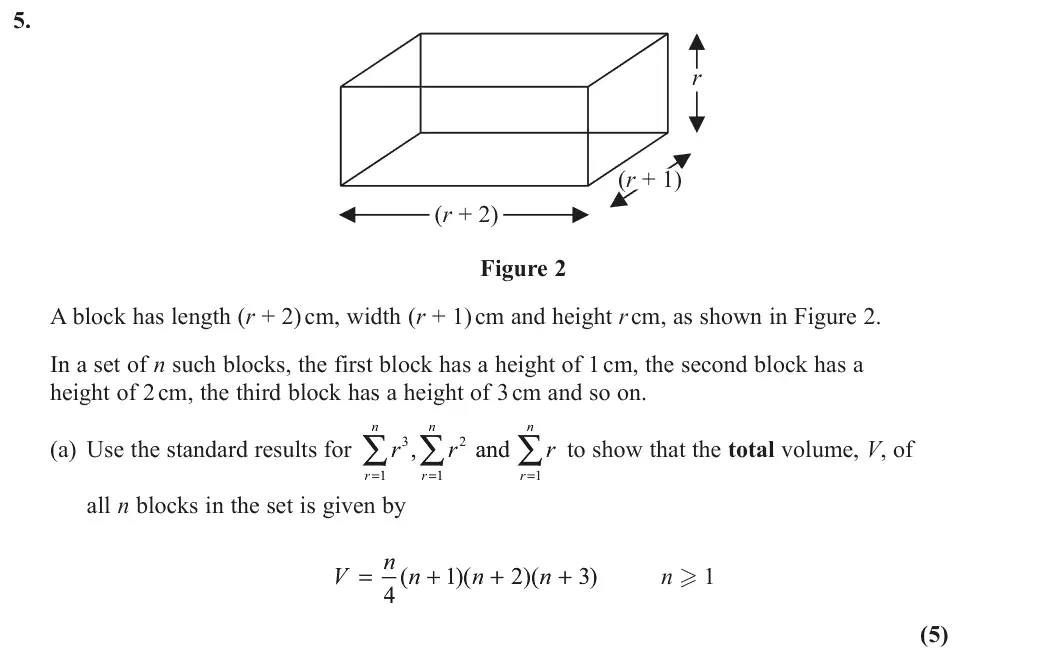
5. r (r + 1) (r + 2) Figure 2 A block has length (r + 2) cm, width (r + 1) cm and height r cm, as shown in Figure 2. In a set of n such blocks, the first block has a height of 1 cm, the second block has a height of 2 cm, the third block has a height of 3 cm and so on. n n n ∑ ∑ ∑ (a) Use the standard results for to show that the total volume, V, of r , r and r r = r = r = all n blocks in the set is given by n n V = + n + n + n 1 ( )( )( ) (5)
Oct 2020 · AS Paper 1 (Core Pure) · Q5(b) 2 marks series and method of differences
Given that the total volume of all n blocks is (n4 + 6n3 – 11 710) cm3 (b) determine how many blocks make up the set. (2)
Oct 2020 · AS Paper 1 (Core Pure) · Q6(i) 3 marks linear transformations
The matrix A represents a linear transformation M. Using the smaller value of a from part (a), EbF $show=that=the=invariant=points=of=the=linear=transformation=M form a line, stating the equation of this line. (3)
Oct 2020 · AS Paper 1 (Core Pure) · Q6(i)(a) 5 marks matrices
6. (i) a A = a - b where a and b are non-zero constants. Given that the matrix A is self-inverse, (a) determine the value of b and the possible values for a. (5)
Oct 2020 · AS Paper 1 (Core Pure) · Q6(ii)(a) 4 marks matrices
(ii) p p P = - p where p is a positive constant. The matrix P represents a linear transformation U. The triangle T has vertices at the points with coordinates (1, 2), (3, 2) and (2, 5). The area of the image of T under the linear transformation U is 15 (a) Determine the value of p. (4)
Oct 2020 · AS Paper 1 (Core Pure) · Q6(ii)(b) 2 marks linear transformations
The transformation V consists of a stretch scale factor 3 parallel to the x‑axis with the y-axis invariant followed by a stretch scale factor –2 parallel to the y‑axis with the x-axis invariant. The transformation V is represented by the matrix Q. (b) Write down the matrix Q. (2)
Oct 2020 · AS Paper 1 (Core Pure) · Q6(ii)(c) 2 marks linear transformationsmatrices
Given that U followed by V is the transformation W, which is represented by the matrix R, (c) find the matrix R. (2)
Oct 2020 · AS Paper 1 (Core Pure) · Q7 6 marks complex numbersroots of polynomials
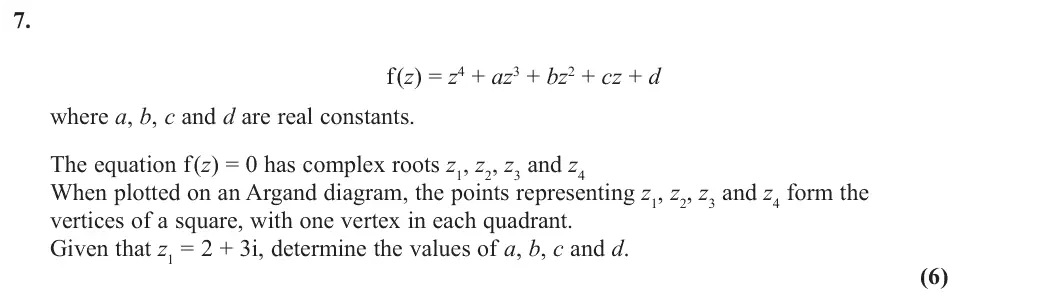
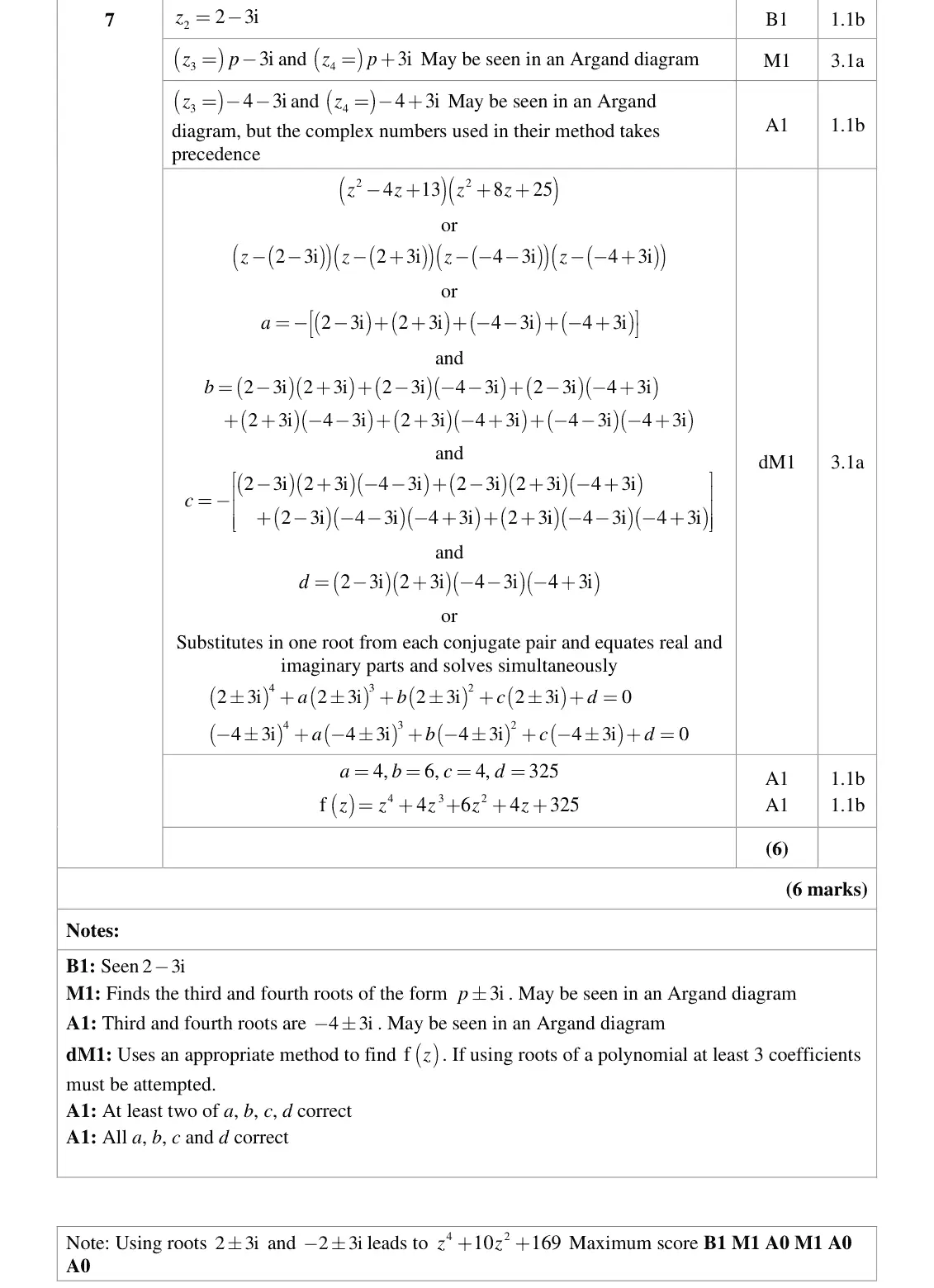
7. f(z) = z4 + az3 + bz2 + cz + d where a, b, c and d are real constants. The equation f(z) = 0 has complex roots z1, z2, z3 and z4 When plotted on an Argand diagram, the points representing z1, z2, z3 and z4 form the vertices of a square, with one vertex in each quadrant. Given that z1 = 2 + 3i, determine the values of a, b, c and d. (6)
Oct 2020 · AS Paper 1 (Core Pure) · Q8 6 marks proof by induction
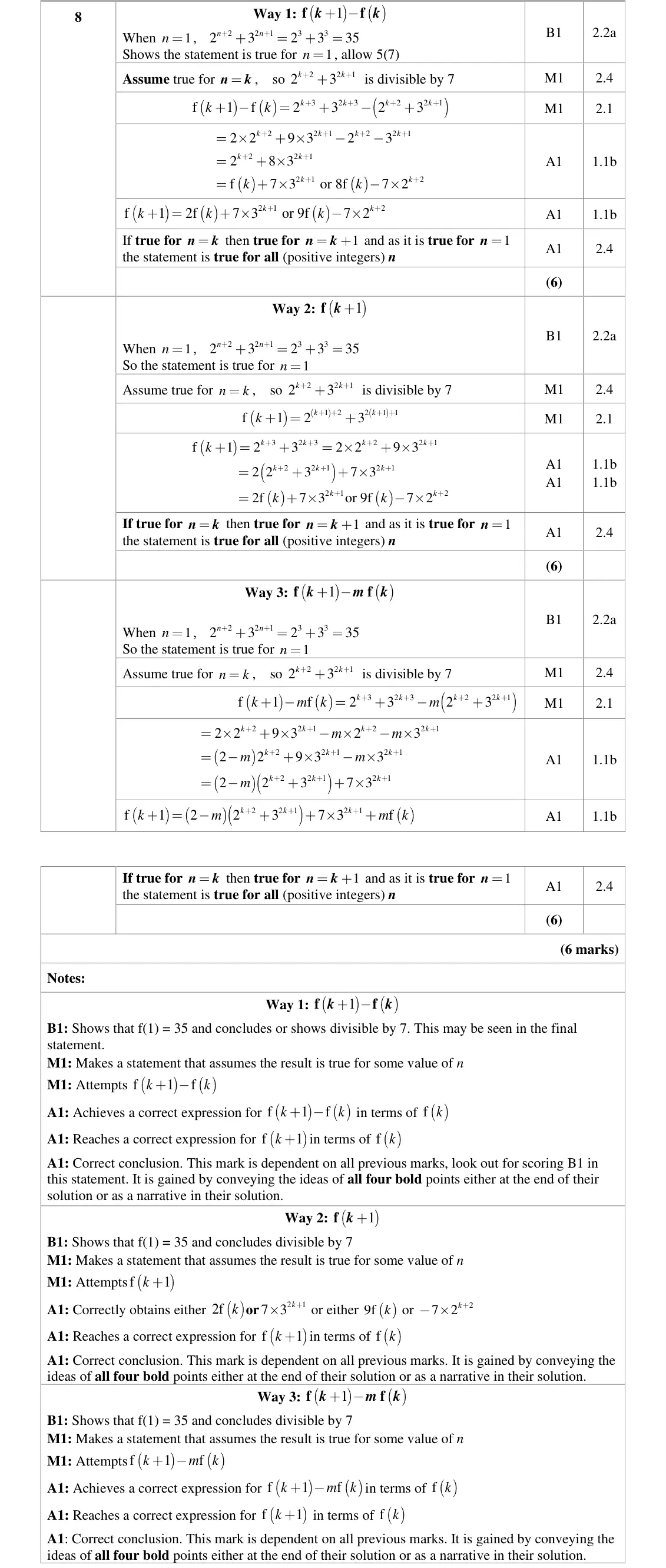
8. Prove by induction that, for n ∈ + f(n) = 2n + 2 + 32n + 1 is divisible by 7 (6)
Oct 2020 · AS Paper 1 (Core Pure) · Q9(a) 3 marks roots of polynomials
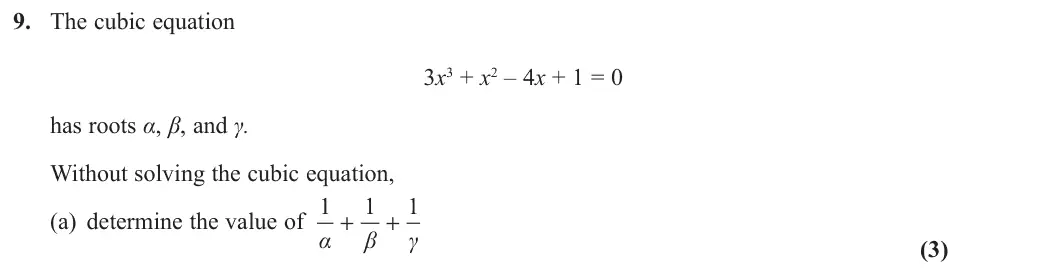
9. The cubic equation 3x3 + x2 – 4x + 1 = 0 has roots alpha , beta , and γ. Without solving the cubic equation, (a) determine the value of 1 + + alpha beta γ (3)
Oct 2020 · AS Paper 1 (Core Pure) · Q9(b) 3 marks roots of polynomials
(b) find a cubic equation that has roots 1 , giving your answer in the form , and alpha beta γ x3 + ax2 + bx + c = 0, where a, b and c are integers to be determined. (3)
Oct 2020 · AS Paper 1 (Core Pure) · Q10 7 marks loci in the argand diagram
10. Given that there are two distinct complex numbers z that satisfy pi { } z z - - = r ∩ z z - = : 5i :arg( 2) determine the exact range of values for the real constant r. (7)

Find an Edexcel Further Maths tutor

Want this paper marked and gone through with a Further Maths tutor? Message us.

Prefer email? Send an enquiry

If you are under 18, please include a parent's contact details. Enquiries go to enquiries@alevelfurthermathstutor.com and are deleted once handled.