June 2025: A level Paper 01: Core Pure Mathematics 1

75 marks · 23 question parts · Question paper, mark scheme and examiner's report on Pearson's site

Question by question

QTopicMarksDifficulty
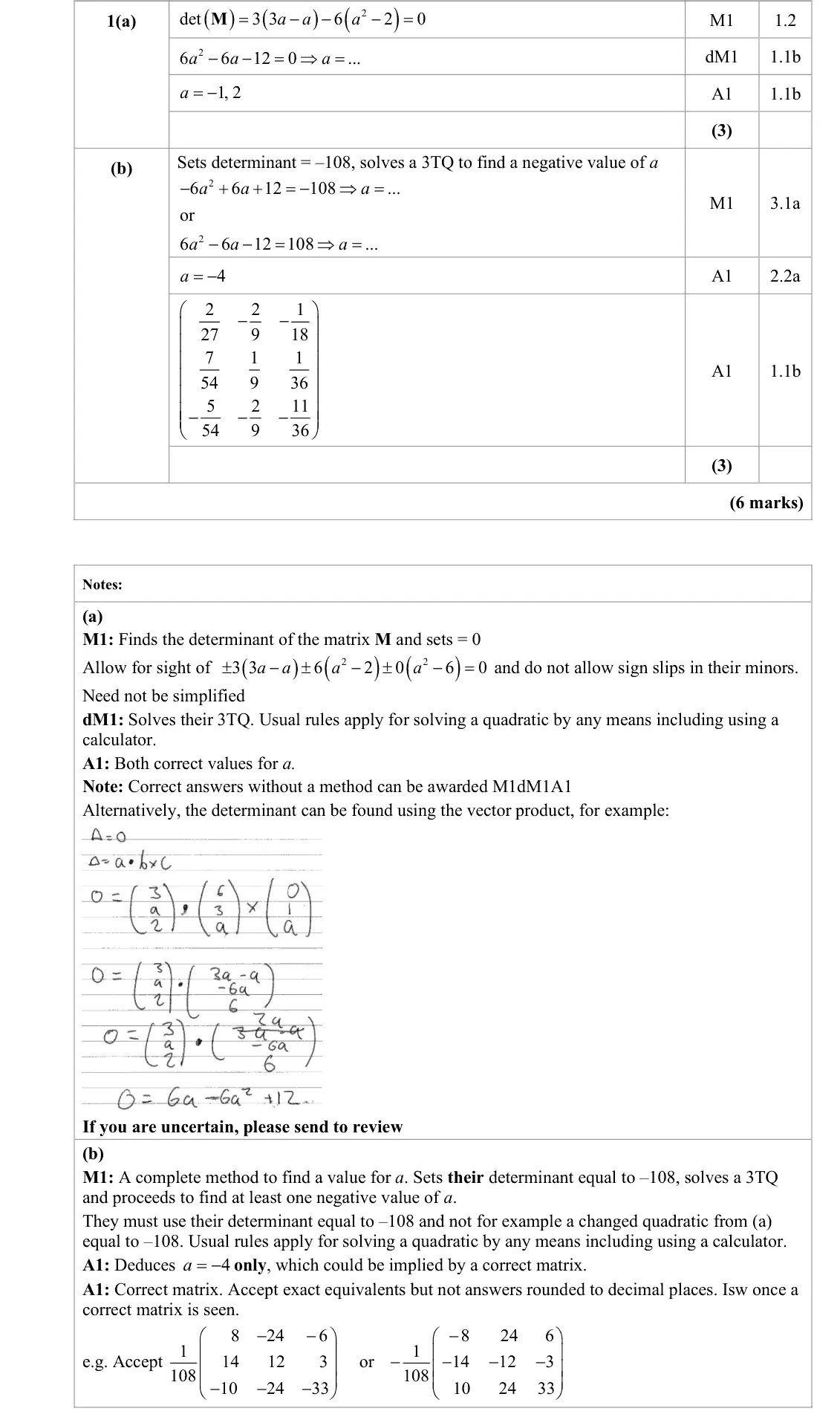
1(a) Matrices: multiplication, determinants and inverses 3 —
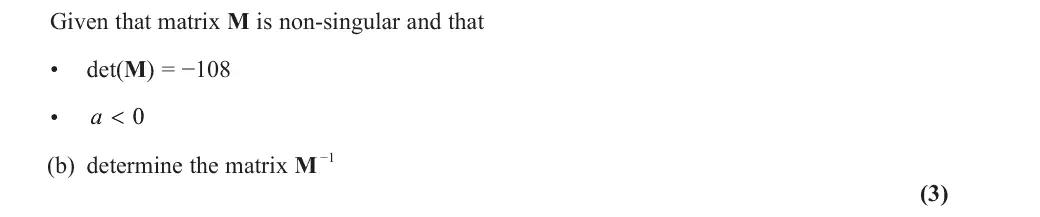
1(b) Matrices: multiplication, determinants and inverses 3 —
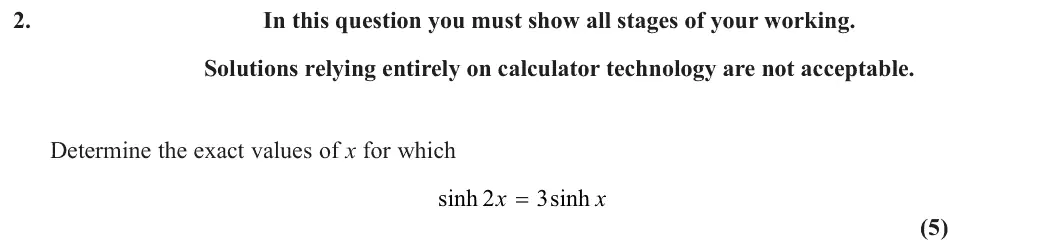
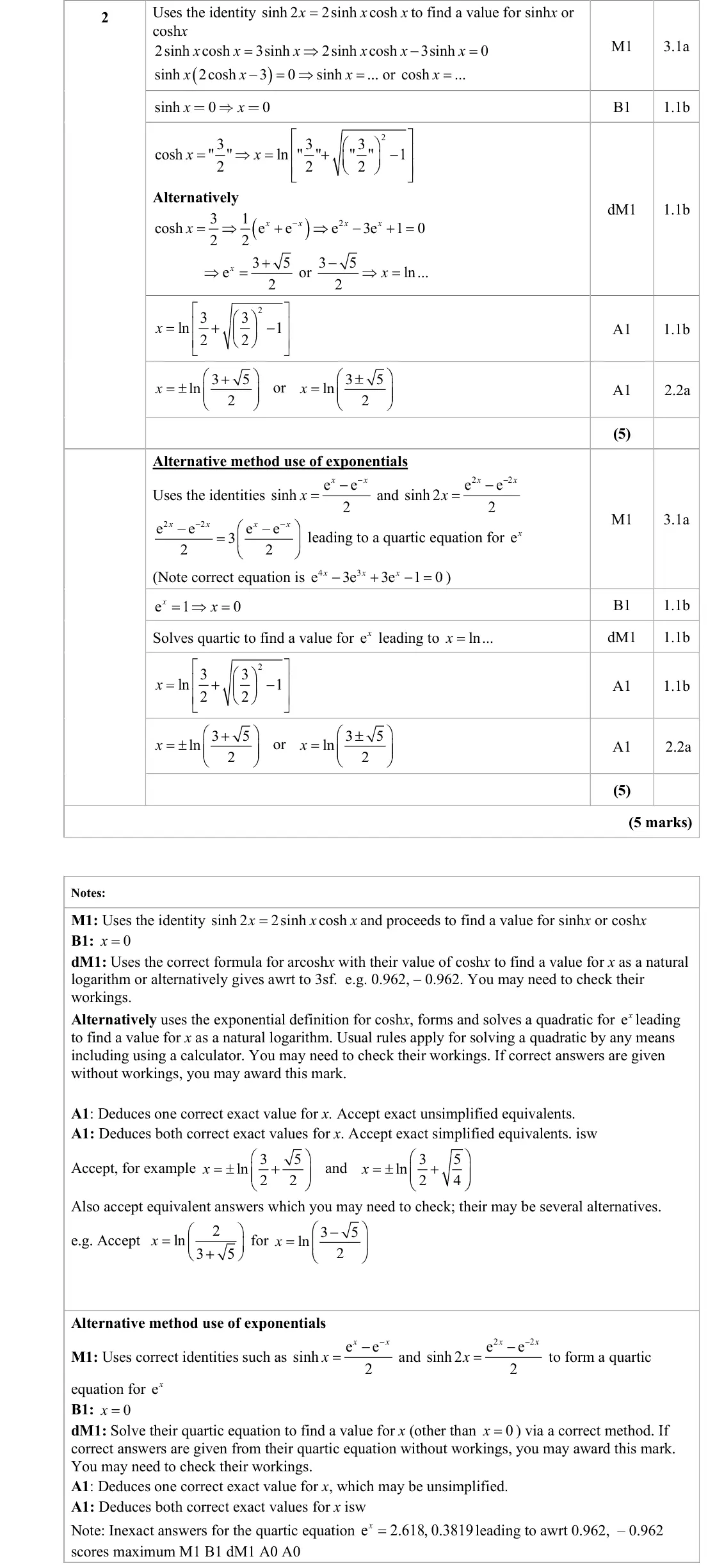
2 Hyperbolic functions 5 —
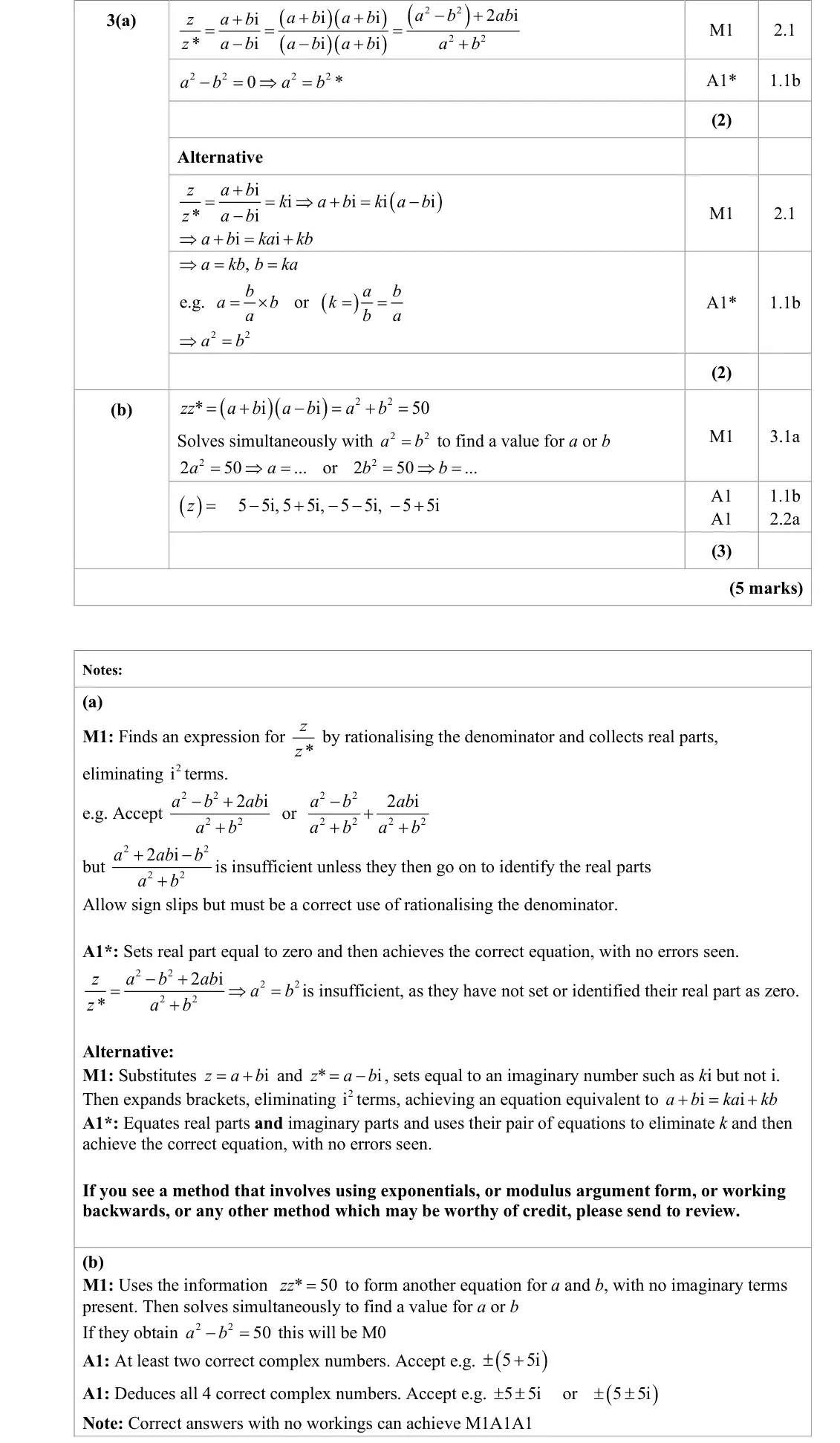
3(a) Complex numbers: arithmetic, conjugates, roots of polynomials and Argand diagrams 2 —
3(b) Complex numbers: arithmetic, conjugates, roots of polynomials and Argand diagrams 3 —
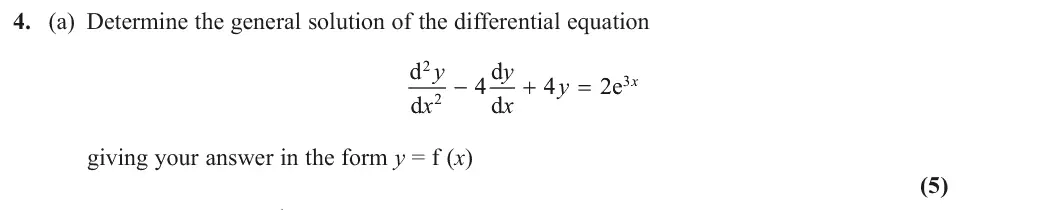
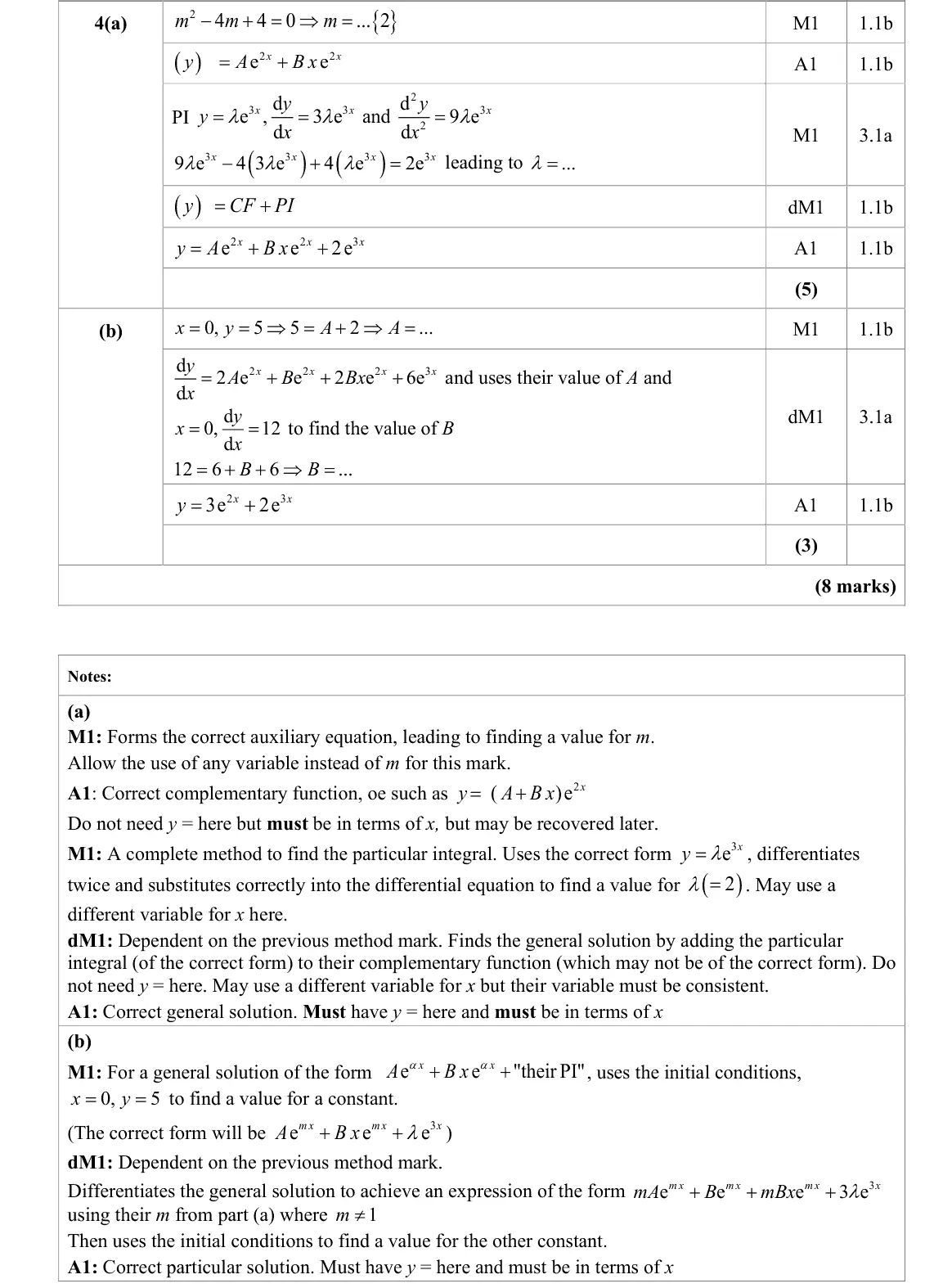
4(a) Second-order differential equations 5 —
4(b) First-order differential equations: integrating factors and modelling 3 —
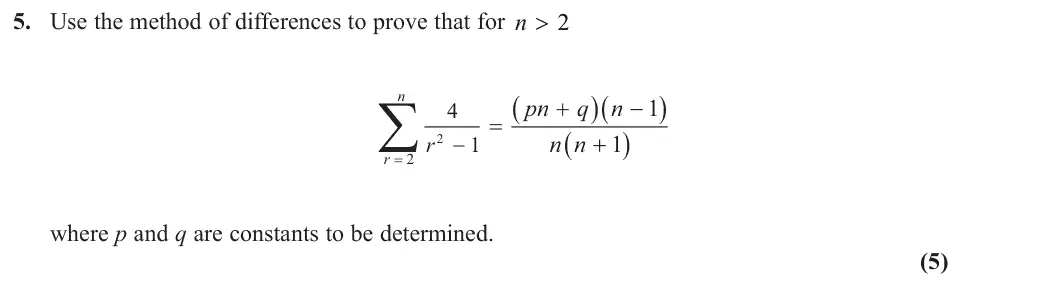
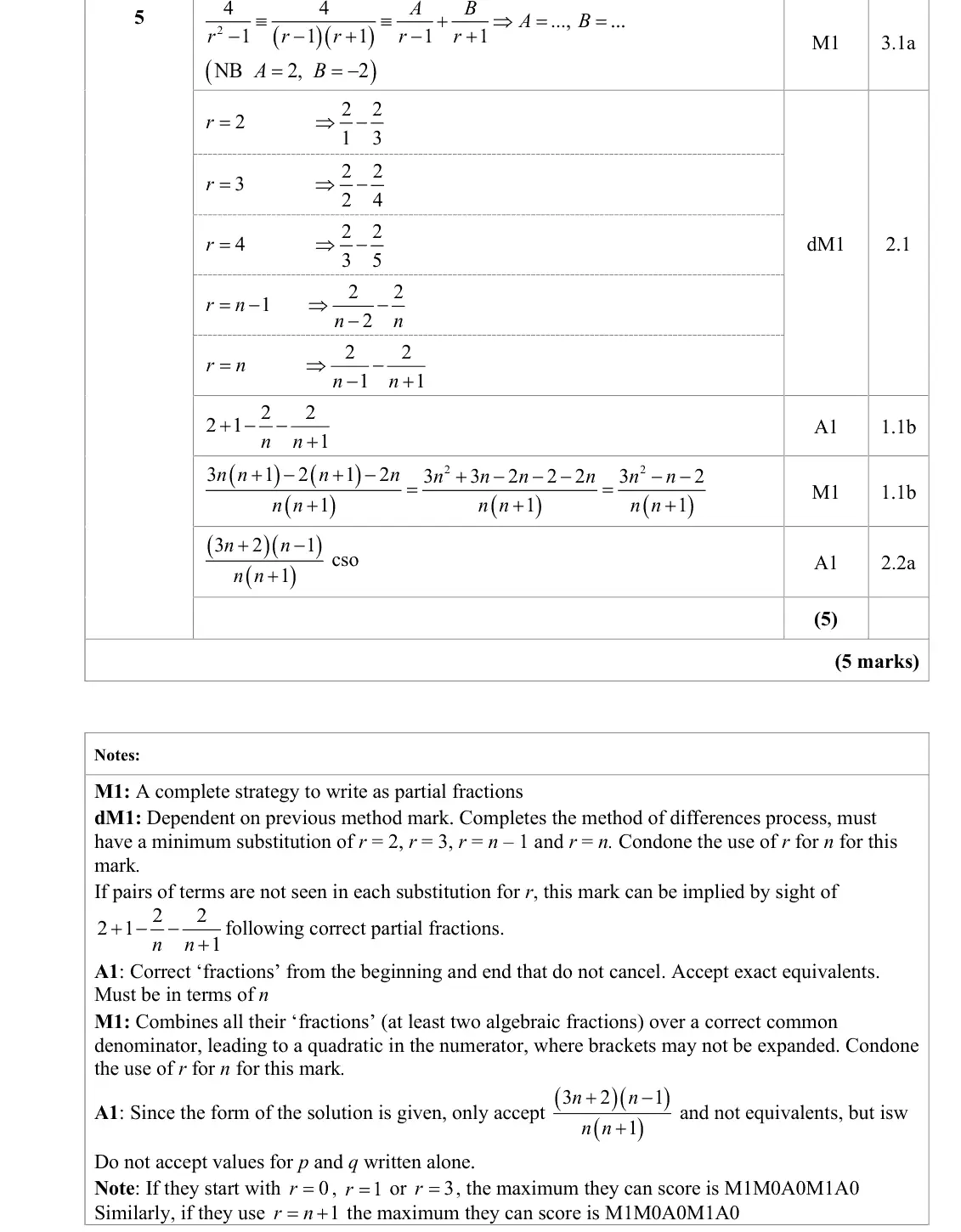
5 Series: standard sums and the method of differences 5 —
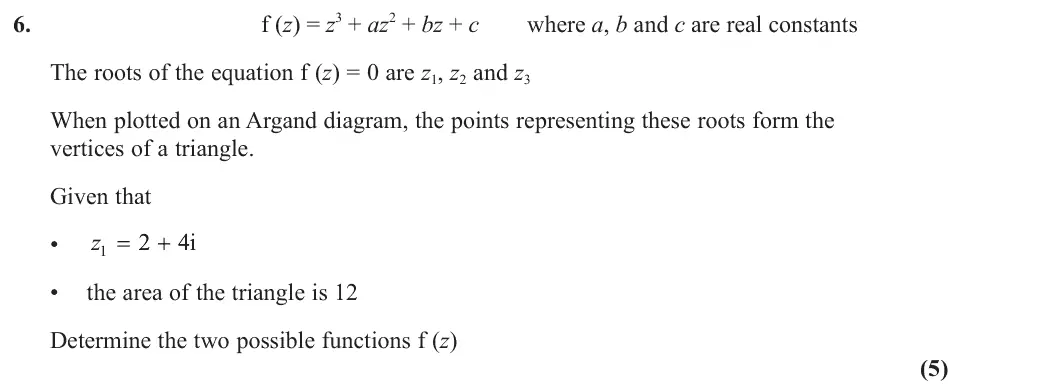
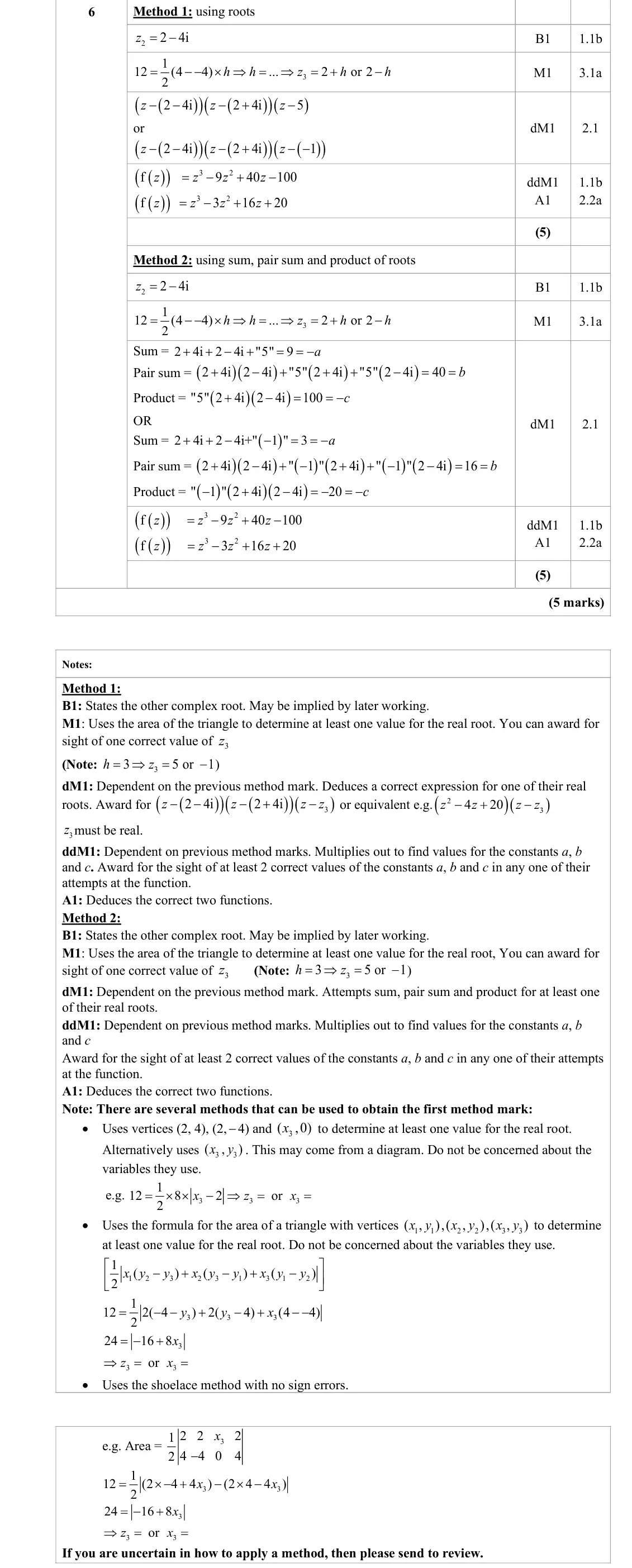
6 Complex numbers: arithmetic, conjugates, roots of polynomials and Argand diagrams, Roots of polynomials 5 —
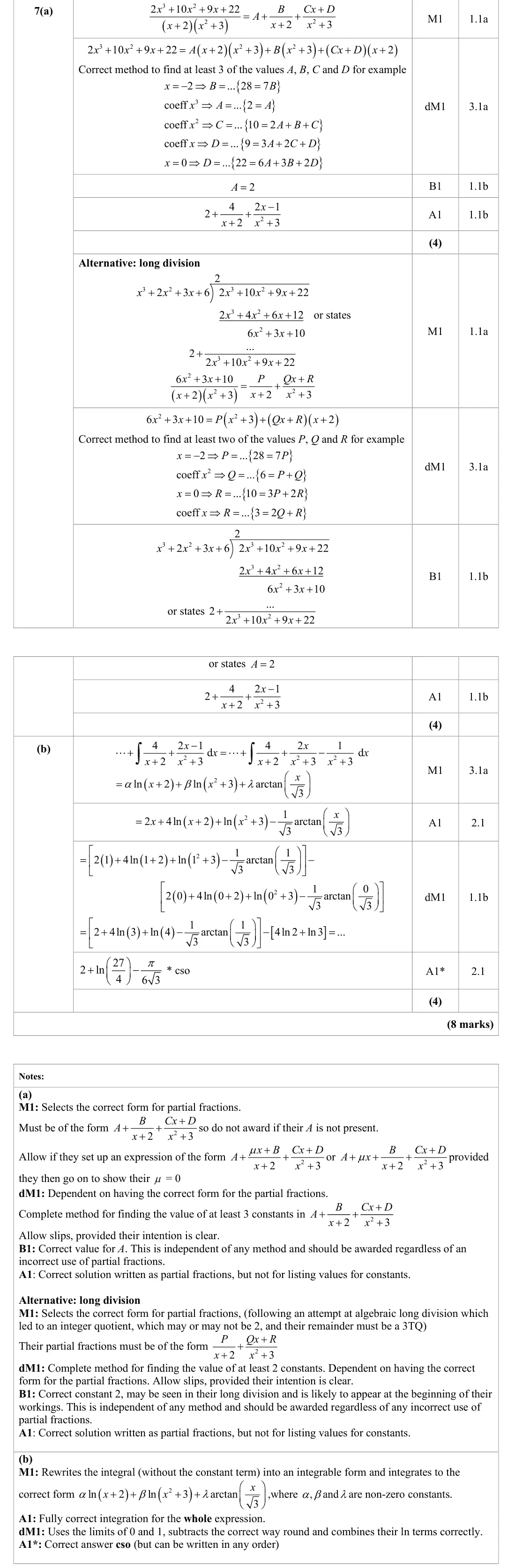
7(a) Integration with partial fractions 4 —
7(b) Integration with partial fractions, Calculus with inverse trigonometric functions 4 —
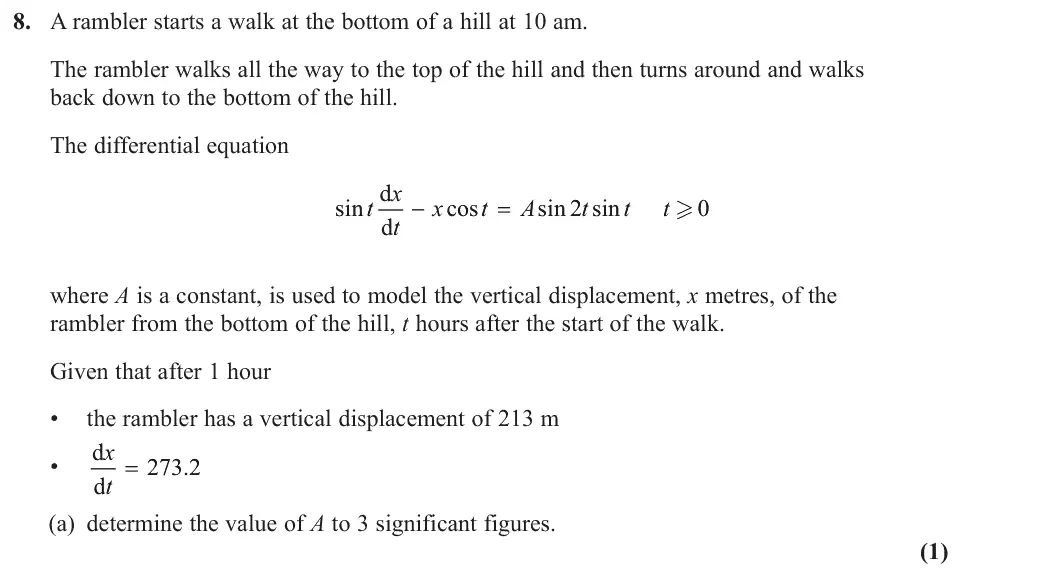
8(a) First-order differential equations: integrating factors and modelling 1 —
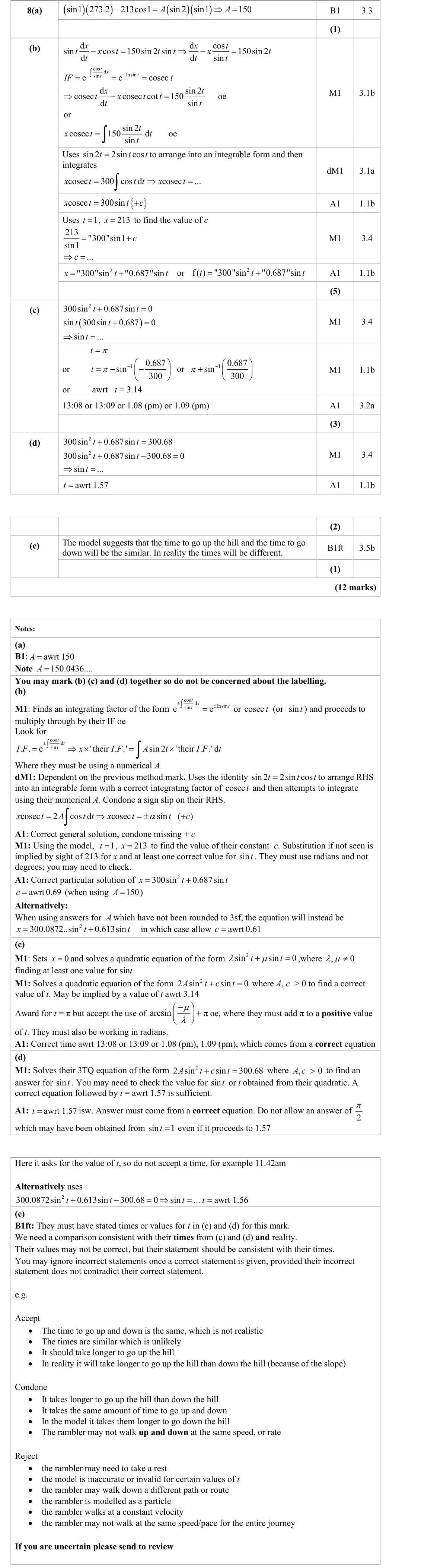
8(b) First-order differential equations: integrating factors and modelling 5 —
8(c) First-order differential equations: integrating factors and modelling 3 —
8(d) First-order differential equations: integrating factors and modelling 2 —
8(e) First-order differential equations: integrating factors and modelling 1 —
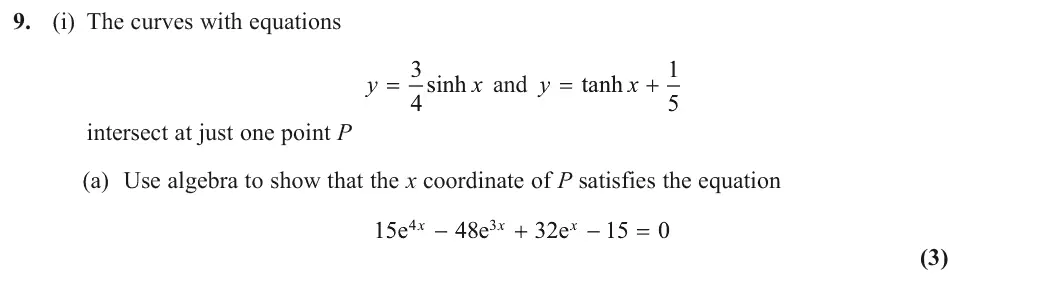
9(i)(a) Hyperbolic functions 3 —
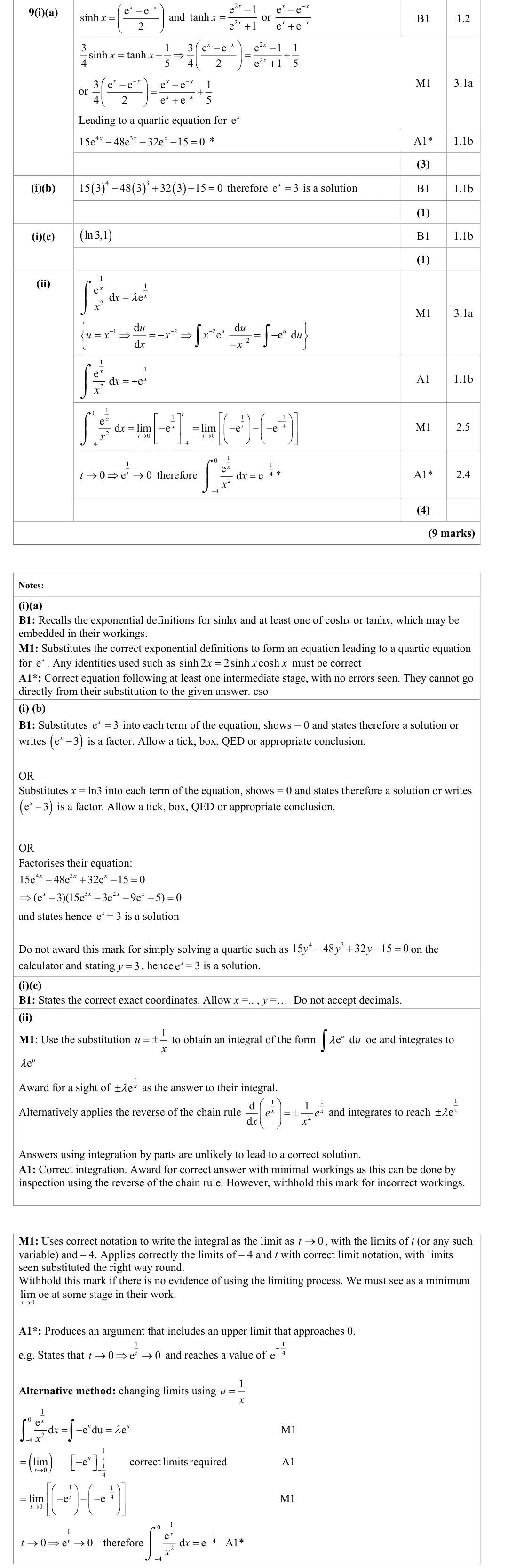
9(i)(b) Hyperbolic functions 1 —
9(i)(c) Hyperbolic functions 1 —
9(ii) Improper integrals and the mean value of a function 4 —
10(a) De Moivre's theorem and exponential form 5 —
10(b) Volumes of revolution 5 —
10(c) Volumes of revolution 2 —

The questions

1(a)1(b)23(a)3(b)4(a)4(b)567(a)7(b)8(a)8(b)8(c)8(d)8(e)9(i)(a)9(i)(b)9(i)(c)9(ii)10(a)10(b)10(c)
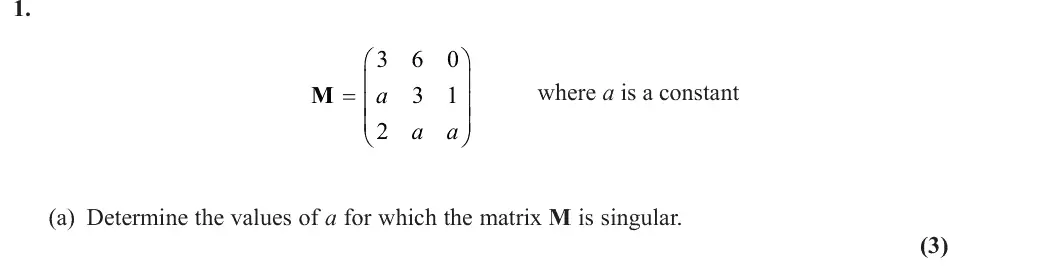
June 2025 · Paper 1 (Core Pure 1) · Q1(a) 3 marks matrices
1. ; where a is a constant M O a a a : (a) Determine the values of a for which the matrix M is singular. (3)
June 2025 · Paper 1 (Core Pure 1) · Q1(b) 3 marks matrices
Given that matrix M is non-singular and that • det(M) = -108 a < 0 • (b) determine the matrix M -1 (3)
June 2025 · Paper 1 (Core Pure 1) · Q2 5 marks hyperbolic functions
2. In this question you must show all stages of your working. Solutions relying entirely on calculator technology are not acceptable. Determine the exact values of x for which x = x sinh sinh (5)
June 2025 · Paper 1 (Core Pure 1) · Q3(a) 2 marks complex numbers
3. The complex number z a 1 i where a and b are real constants. b Given that z z* is purely imaginary, (a) show that a = b (2)
June 2025 · Paper 1 (Core Pure 1) · Q3(b) 3 marks complex numbers
Given also that zz* = 50 (b) determine the possible complex numbers z (3)
June 2025 · Paper 1 (Core Pure 1) · Q4(a) 5 marks second order differential equations
4. (a) Determine the general solution of the differential equation y y d d y e x x x d d giving your answer in the form y = f (x) (5)
June 2025 · Paper 1 (Core Pure 1) · Q4(b) 3 marks first order differential equations
Given that y = 5 and d y x = 12 when x = 0 d (b) determine the particular solution of the differential equation. (3)
June 2025 · Paper 1 (Core Pure 1) · Q5 5 marks series and method of differences
5. Use the method of differences to prove that for n > 2 n pn q n n n r r where p and q are constants to be determined. (5)
June 2025 · Paper 1 (Core Pure 1) · Q6 5 marks complex numbersroots of polynomials
6. f (z) = z3 + az2 + bz + c where a, b and c are real constants The roots of the equation f (z) = 0 are z1, z2 and z3 When plotted on an Argand diagram, the points representing these roots form the vertices of a triangle. Given that z1 1 i • • the area of the triangle is 12 Determine the two possible functions f (z) (5)
June 2025 · Paper 1 (Core Pure 1) · Q7(a) 4 marks partial fractions integration
7. (a) Express x x x / / x x in partial fractions. (4)
June 2025 · Paper 1 (Core Pure 1) · Q7(b) 4 marks partial fractions integrationinverse trig calculus
(b) Hence, show that 1 x x x ϖ d x ln x x 6 3 (4)
June 2025 · Paper 1 (Core Pure 1) · Q8(a) 1 mark first order differential equations
8. A rambler starts a walk at the bottom of a hill at 10 am. The rambler walks all the way to the top of the hill and then turns around and walks back down to the bottom of the hill. The differential equation t x d t 0 sin d 3 x cos t A sin t sin t t where A is a constant, is used to model the vertical displacement, x metres, of the rambler from the bottom of the hill, t hours after the start of the walk. Given that after 1 hour • the rambler has a vertical displacement of 213 m d x • t = 273 2. d (a) determine the value of A to 3 significant figures. (1)
June 2025 · Paper 1 (Core Pure 1) · Q8(b) 5 marks first order differential equations
(b) Hence, determine the particular solution of the differential equation, giving your answer in the form x = f (t) (5)
June 2025 · Paper 1 (Core Pure 1) · Q8(c) 3 marks first order differential equations
(c) Use the model to determine the time at which the rambler will return to the bottom of the hill. (3)
June 2025 · Paper 1 (Core Pure 1) · Q8(d) 2 marks first order differential equations
Given that the vertical displacement of the top of the hill is 300.68 m (d) use the model to find the value of t when the rambler reaches the top of the hill. (2)
June 2025 · Paper 1 (Core Pure 1) · Q8(e) 1 mark first order differential equations
(e) Using your answers to parts (c) and (d), give a limitation of the model. (1)
June 2025 · Paper 1 (Core Pure 1) · Q9(i)(a) 3 marks hyperbolic functions
9. (i) The curves with equations = 3 and y y 4 sinh x tanh x intersect at just one point P (a) Use algebra to show that the x coordinate of P satisfies the equation 15e x e x e x (3)
June 2025 · Paper 1 (Core Pure 1) · Q9(i)(b) 1 mark hyperbolic functions
(b) Show that ex = 3 is a solution of this equation. (1)
June 2025 · Paper 1 (Core Pure 1) · Q9(i)(c) 1 mark hyperbolic functions
(c) Hence state the exact coordinates of P. (1)
June 2025 · Paper 1 (Core Pure 1) · Q9(ii) 4 marks improper integrals and mean value
(ii) Show that (4)
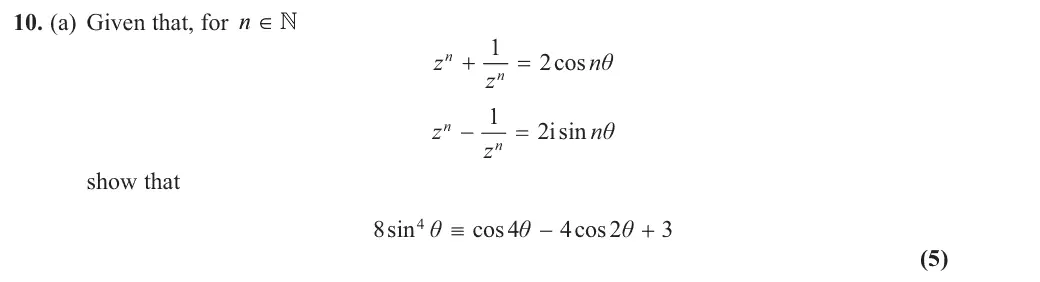
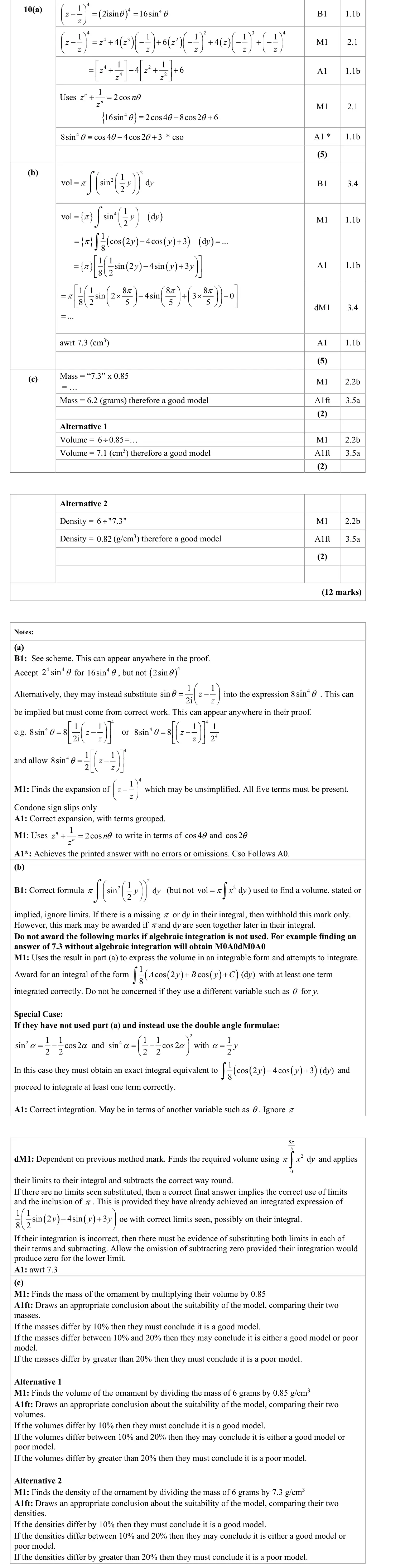
June 2025 · Paper 1 (Core Pure 1) · Q10(a) 5 marks de moivres theorem
10. (a) Given that, for n ∈ z n 2cos theta n z n z 2isin theta n n z n show that theta theta theta sin cos cos (5)
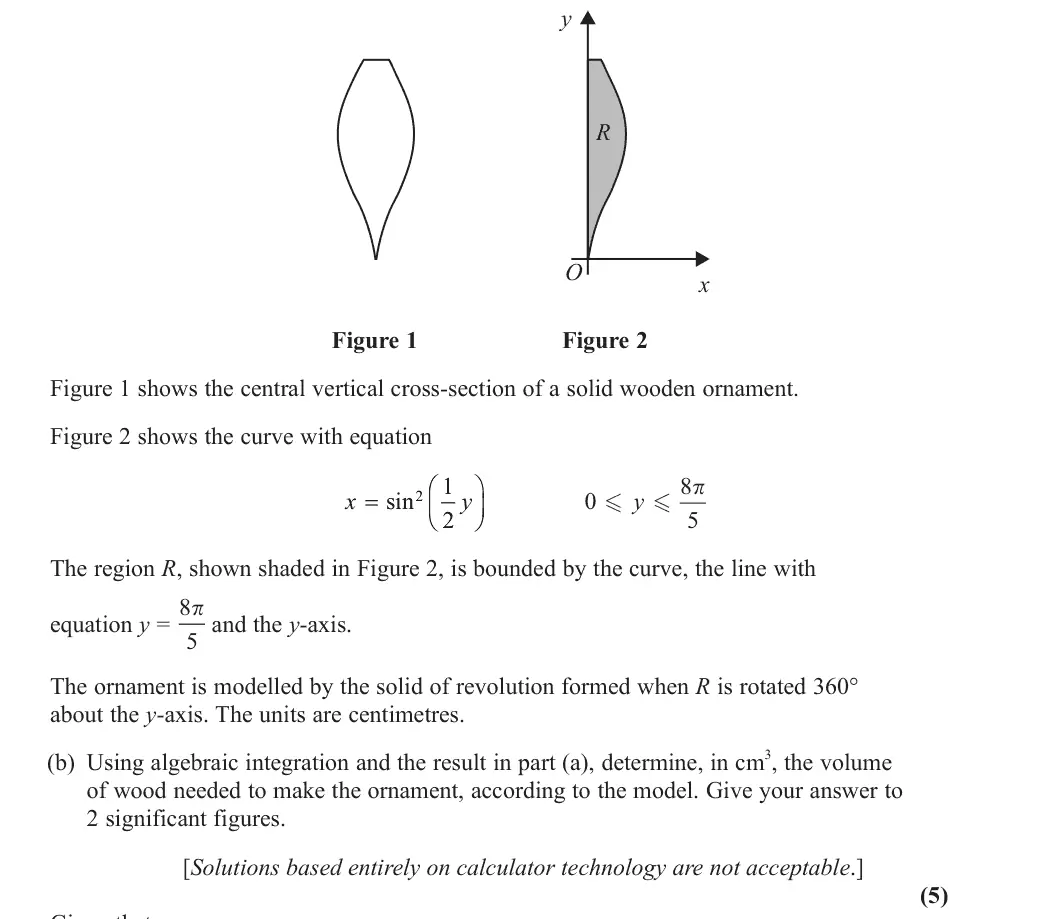
June 2025 · Paper 1 (Core Pure 1) · Q10(b) 5 marks volumes of revolution
y R x Figure 1 Figure 2 Figure 1 shows the central vertical cross-section of a solid wooden ornament. Figure 2 shows the curve with equation sin2 1 ϖ ; x y < y < :9 The region R, shown shaded in Figure 2, is bounded by the curve, the line with equation y = 8 ϖ and the y-axis. The ornament is modelled by the solid of revolution formed when R is rotated 360° about the y-axis. The units are centimetres. (b) Using algebraic integration and the result in part (a), determine, in cm3, the volume of wood needed to make the ornament, according to the model. Give your answer to 2 significant figures. [Solutions based entirely on calculator technology are not acceptable.] (5)
June 2025 · Paper 1 (Core Pure 1) · Q10(c) 2 marks volumes of revolution
Given that • the density of the wood is 0.85 g/cm3 • the mass of the ornament is 6 grams (c) comment on the suitability of the model. (2)

Find an Edexcel Further Maths tutor

Want this paper marked and gone through with a Further Maths tutor? Message us.

Prefer email? Send an enquiry

If you are under 18, please include a parent's contact details. Enquiries go to enquiries@alevelfurthermathstutor.com and are deleted once handled.