Nov 2021: A level Paper 01: Core Pure Mathematics 1

75 marks · 25 question parts · Question paper, mark scheme and examiner's report on Pearson's site

Question by question

QTopicMarksDifficulty
1(a) Linear transformations and invariant points and lines, Matrices: multiplication, determinants and inverses 4 —
1(b) Matrices: multiplication, determinants and inverses 2 —
2(a) Maclaurin series 2 —
2(b) Maclaurin series 3 —
2(c) Maclaurin series 1 —
2(d) Maclaurin series 1 —
3 Roots of polynomials 6 Medium
4(i) Matrices: multiplication, determinants and inverses 2 Easy
4(ii) Matrices: multiplication, determinants and inverses 3 Medium
4(iii) Matrices: multiplication, determinants and inverses 4 Medium
5(i) Improper integrals and the mean value of a function 3 Hard
5(ii)(a) Improper integrals and the mean value of a function 3 Hard
5(ii)(b) Improper integrals and the mean value of a function 1 Medium
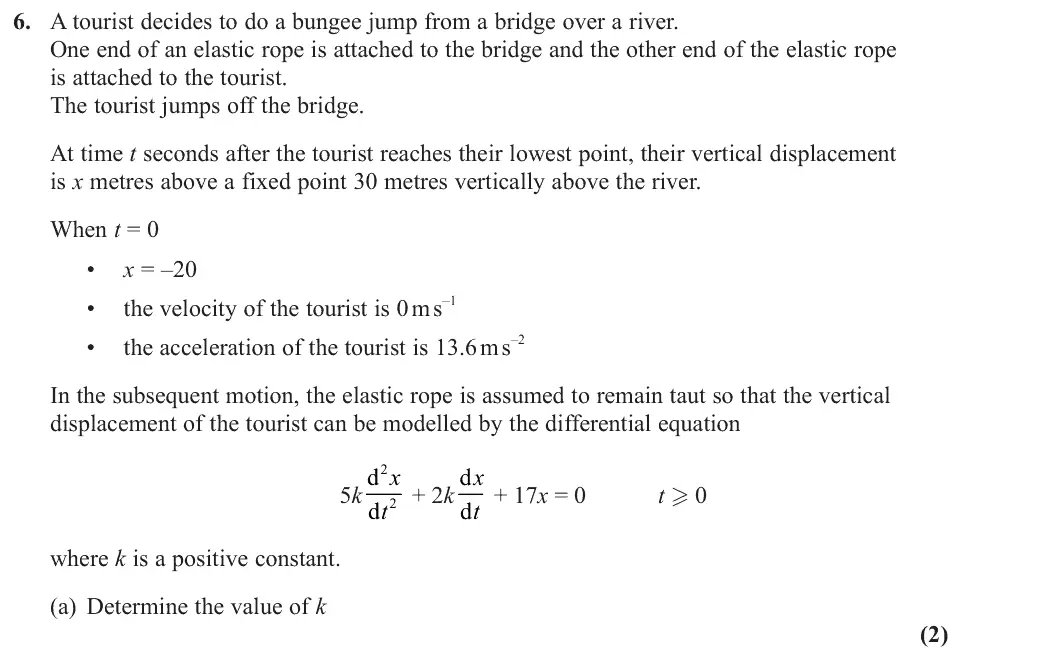
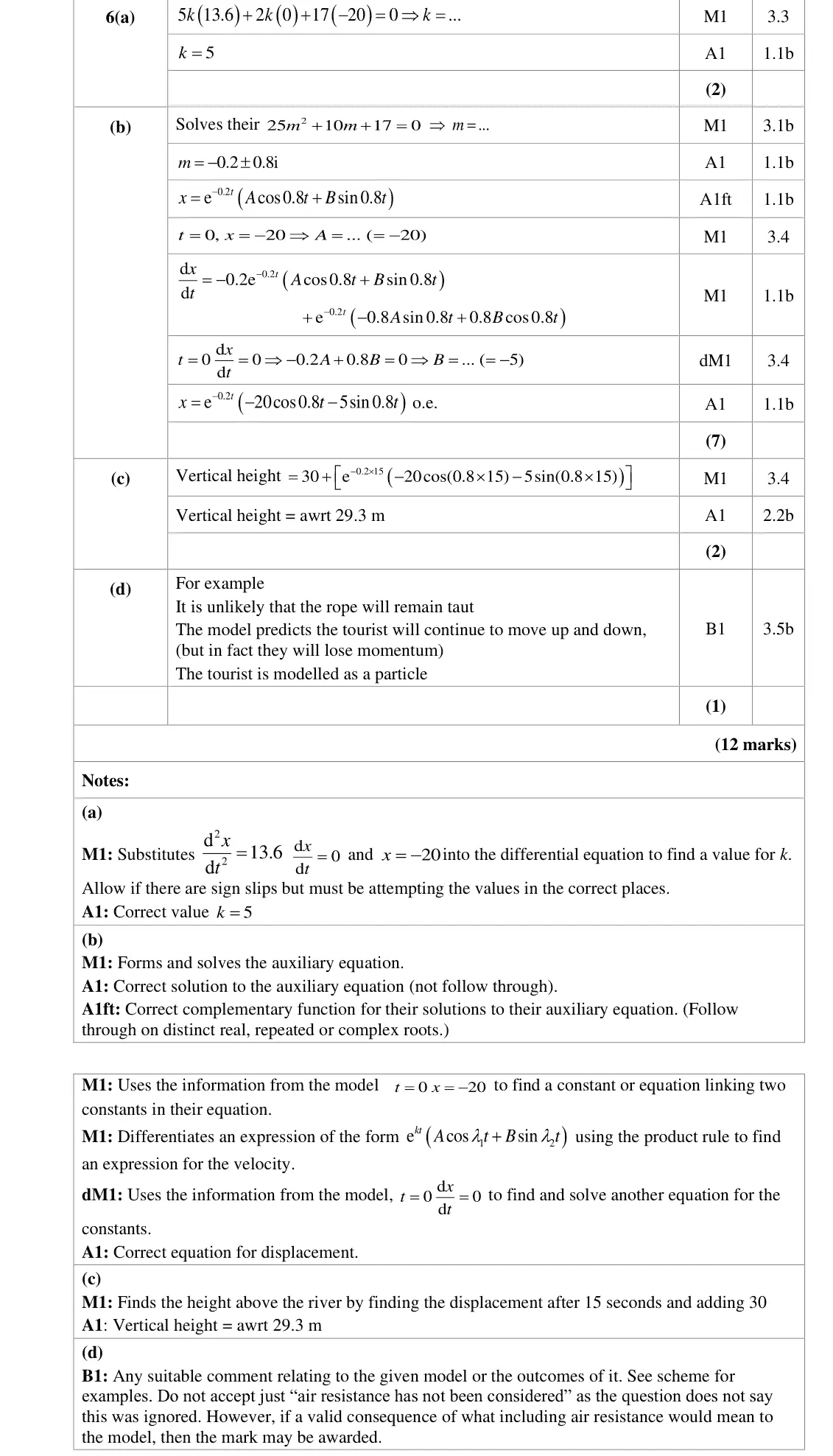
6(a) Simple harmonic motion and damped oscillations 2 —
6(b) Second-order differential equations, First-order differential equations: integrating factors and modelling, Simple harmonic motion and damped oscillations 7 —
6(c) Simple harmonic motion and damped oscillations 2 Medium
6(d) Simple harmonic motion and damped oscillations 1 —
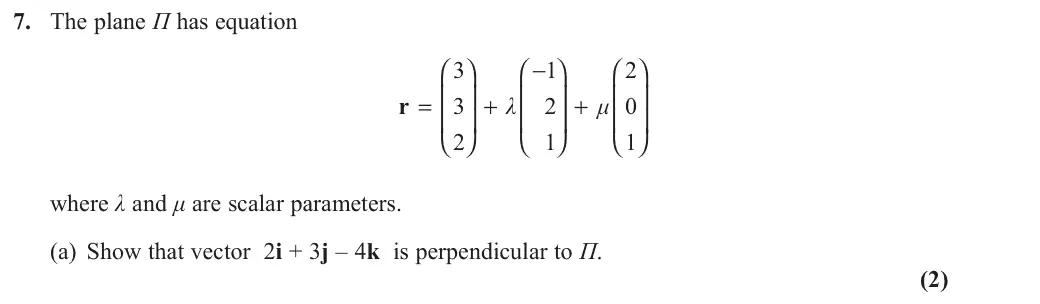
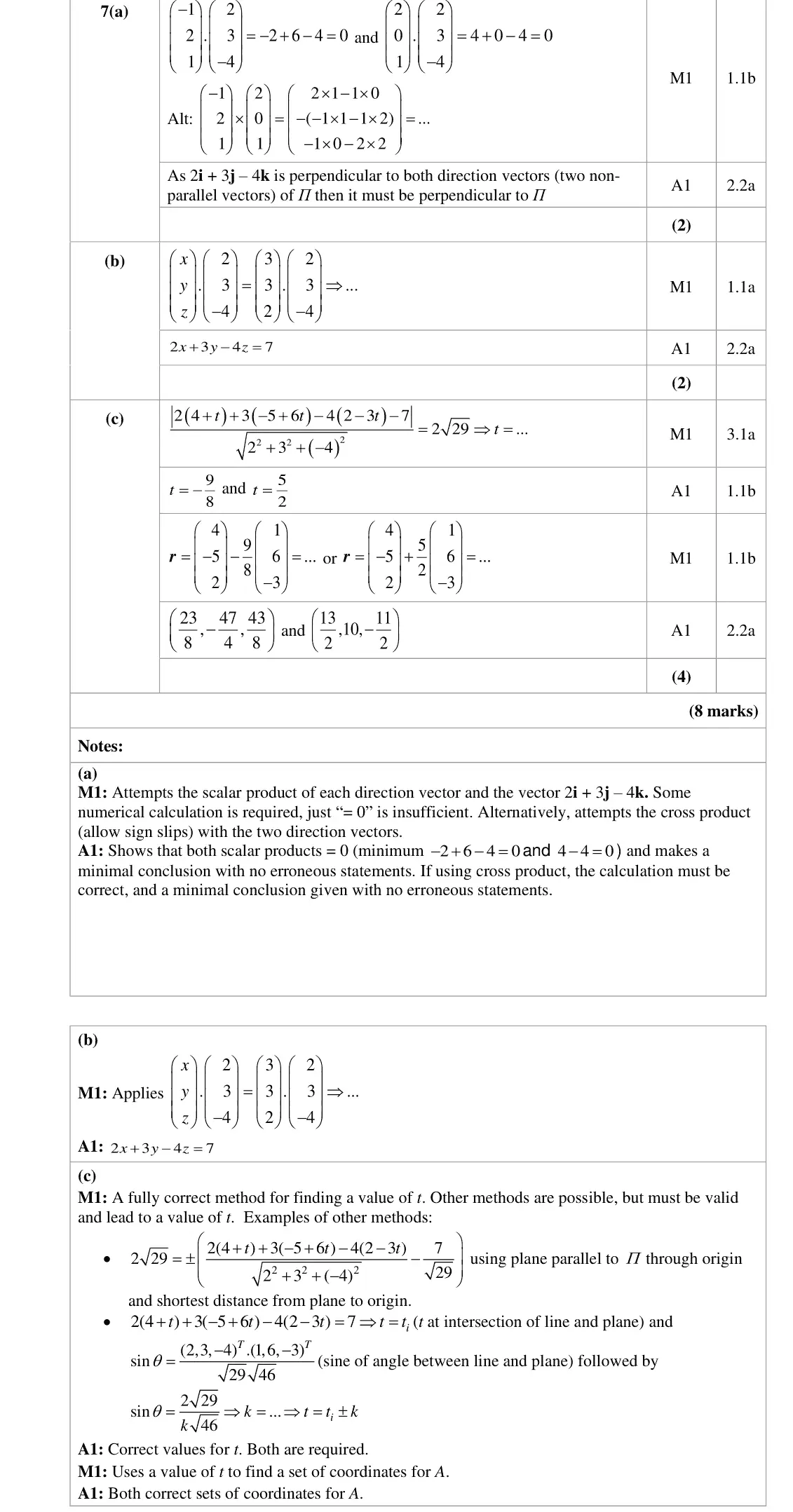
7(a) Vectors: equations of lines and planes, scalar product 2 Medium
7(b) Vectors: equations of lines and planes, scalar product 2 Medium
7(c) Vectors: intersections, angles and shortest distances 4 Medium
8(a) First-order differential equations: integrating factors and modelling 2 Medium
8(b) First-order differential equations: integrating factors and modelling 6 Medium
8(c) First-order differential equations: integrating factors and modelling 1 —
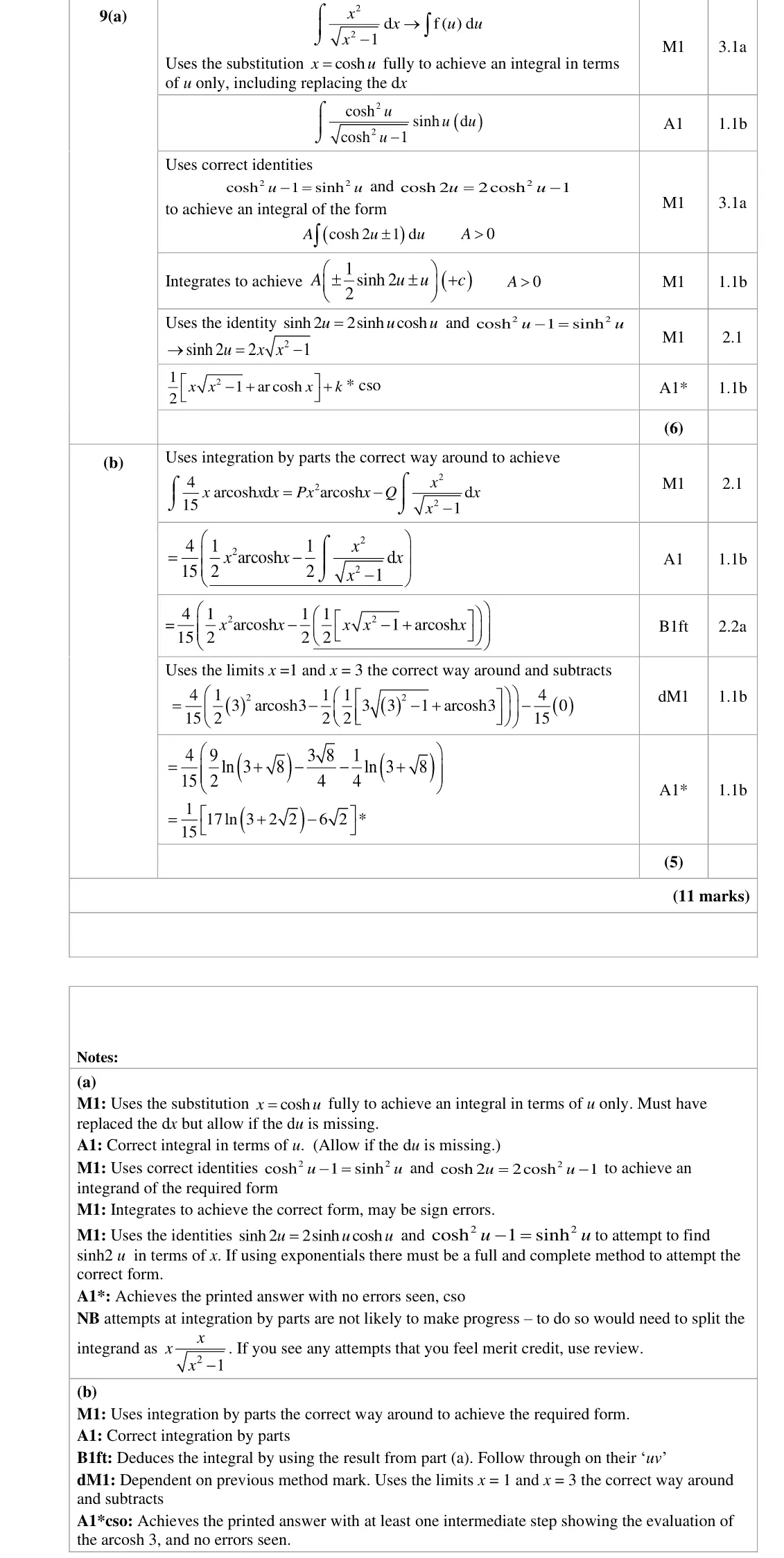
9(a) Hyperbolic functions 6 Hard
9(b) Hyperbolic functions 5 —

The questions

1(a)1(b)2(a)2(b)2(c)2(d)34(i)4(ii)4(iii)5(i)5(ii)(a)5(ii)(b)6(a)6(b)6(c)6(d)7(a)7(b)7(c)8(a)8(b)8(c)9(a)9(b)
Nov 2021 · Paper 1 (Core Pure 1) · Q1(a) 4 marks linear transformationsmatrices
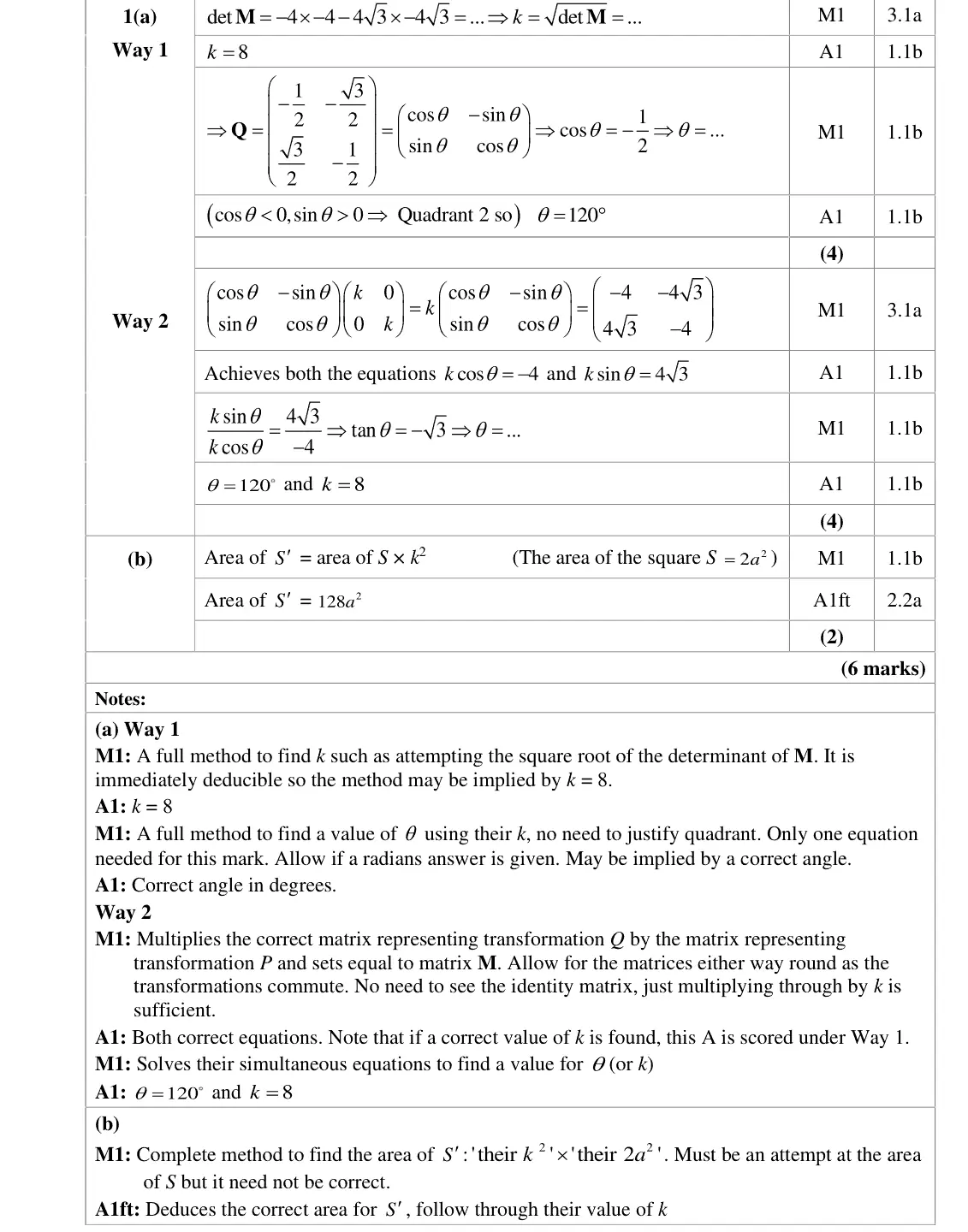
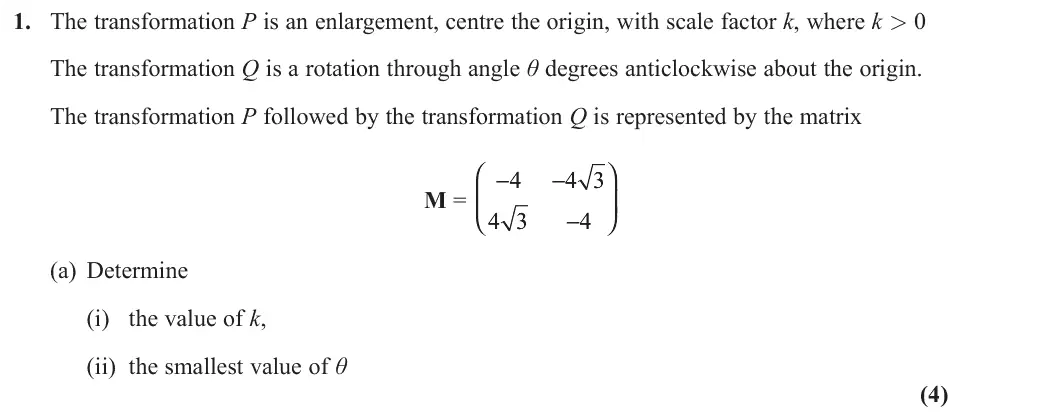
1. The transformation P is an enlargement, centre the origin, with scale factor k, where k > 0 The transformation Q is a rotation through angle theta degrees anticlockwise about the origin. The transformation P followed by the transformation Q is represented by the matrix - - 4 3 M = 4 3 - (a) Determine (i) the value of k, (ii) the smallest value of theta (4)
Nov 2021 · Paper 1 (Core Pure 1) · Q1(b) 2 marks matrices
A square S has vertices at the points with coordinates (0, 0), (a, –a), (2a, 0) and (a, a) where a is a constant. The square S is transformed to the square S′ by the transformation represented by M. (b) Determine, in terms of a, the area of S′ (2)
Nov 2021 · Paper 1 (Core Pure 1) · Q2(a) 2 marks maclaurin series
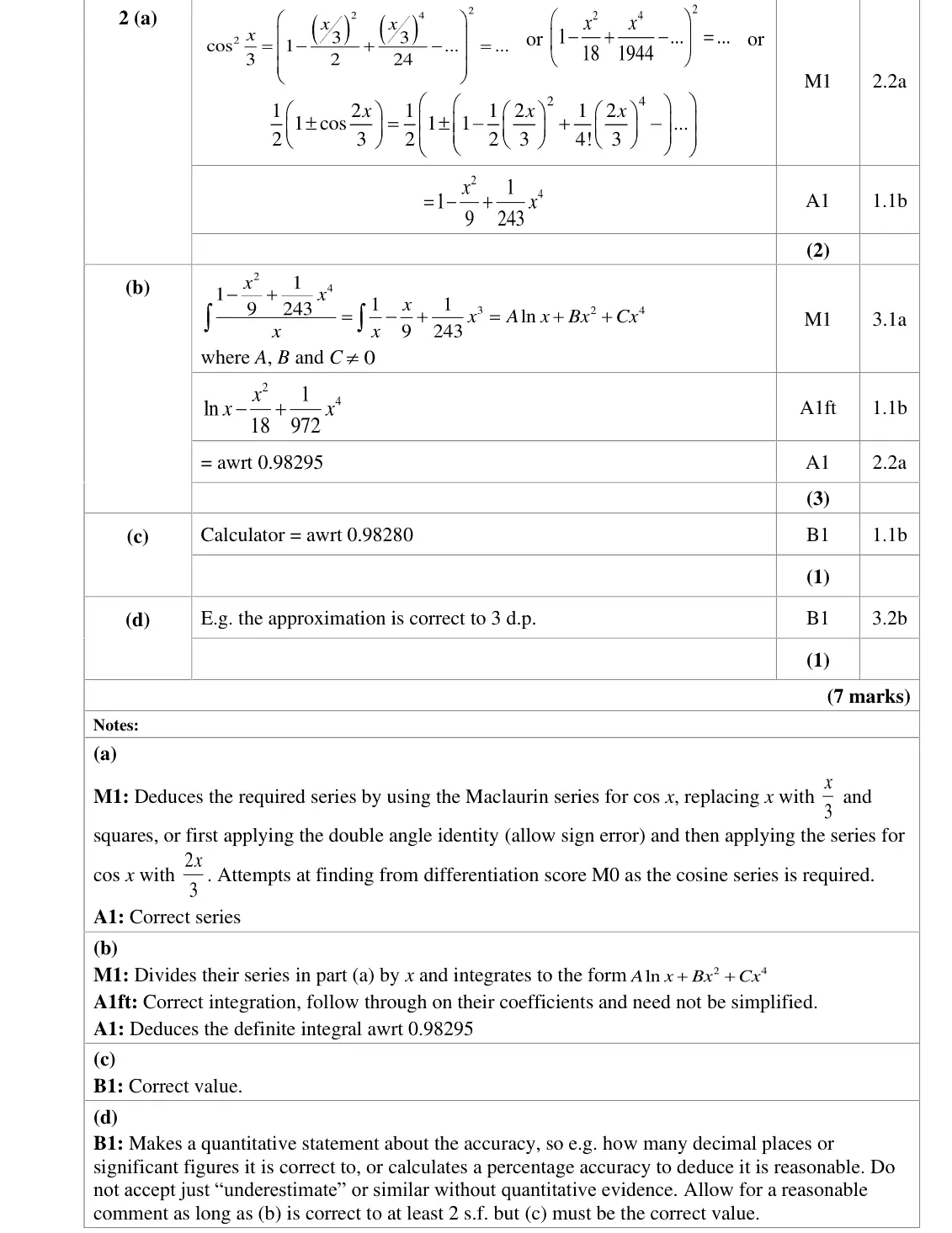
2. (a) Use the Maclaurin series expansion for cos x to determine the series expansion of x cos2 in ascending powers of x, up to and including the term in x Give each term in simplest form. (2)
Nov 2021 · Paper 1 (Core Pure 1) · Q2(b) 3 marks maclaurin series
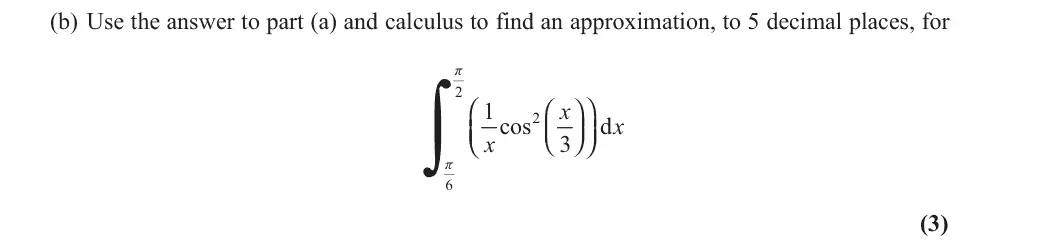
(b) Use the answer to part (a) and calculus to find an approximation, to 5 decimal places, for pi ∫ x 1 cos x d x pi (3)
Nov 2021 · Paper 1 (Core Pure 1) · Q2(c) 1 mark maclaurin series
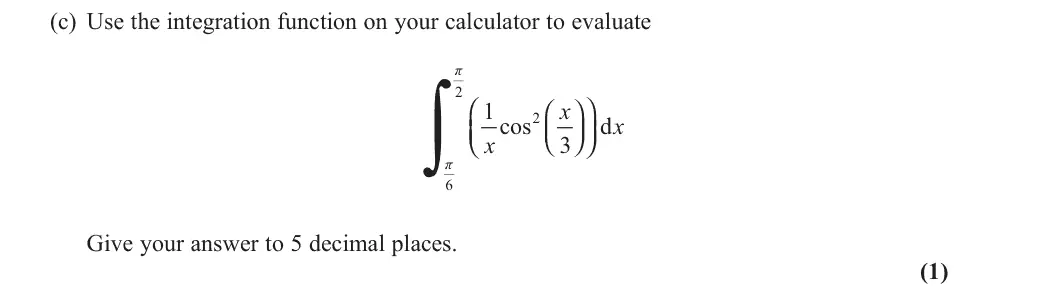
(c) Use the integration function on your calculator to evaluate pi ∫ 1 cos x x d x pi Give your answer to 5 decimal places. (1)
Nov 2021 · Paper 1 (Core Pure 1) · Q2(d) 1 mark maclaurin series
(d) Assuming that the calculator answer in part (c) is accurate to 5 decimal places, comment on the accuracy of the approximation found in part (b). (1)
Nov 2021 · Paper 1 (Core Pure 1) · Q3 6 marks Medium roots of polynomials
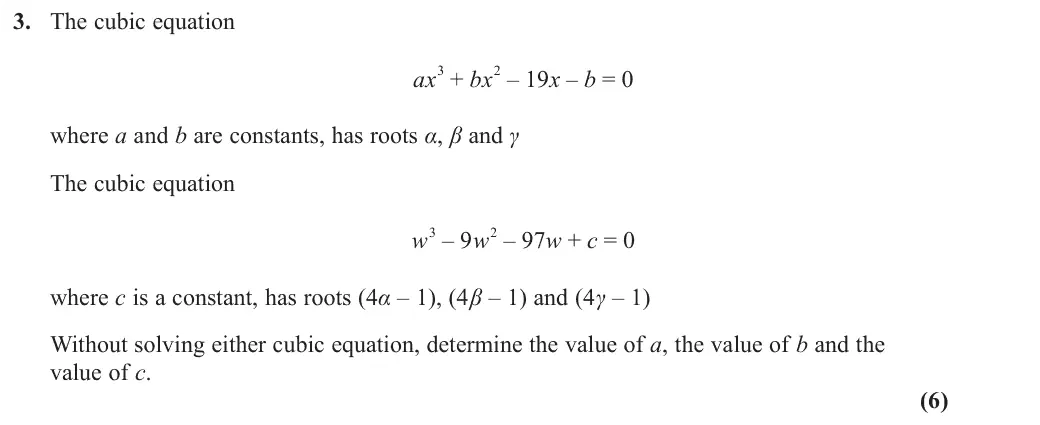
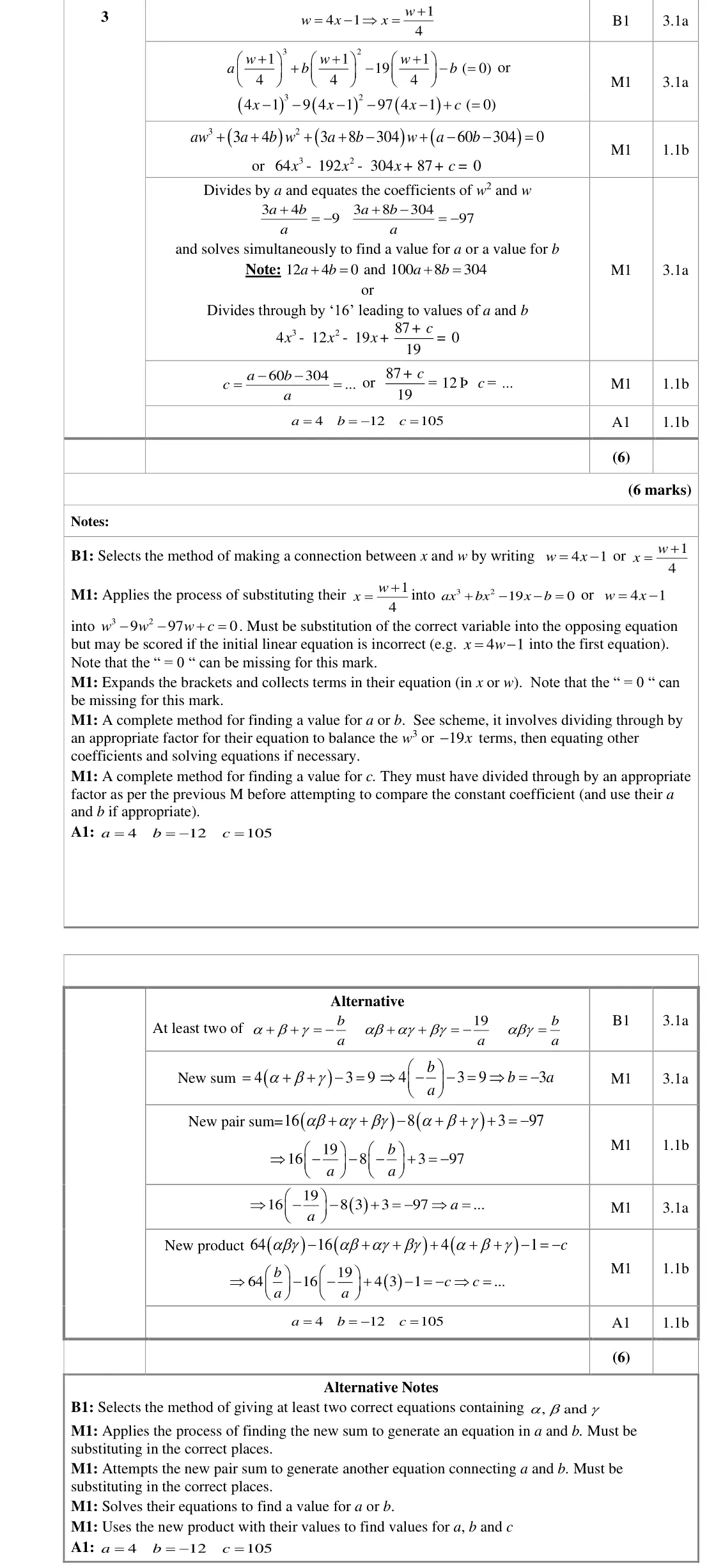
3. The cubic equation 3 + bx 2 – 19x – b = 0 ax where a and b are constants, has roots alpha , beta and γ The cubic equation 3 – 9w 2 – 97w + c = 0 w where c is a constant, has roots (4 alpha – 1), (4 beta – 1) and (4γ – 1) Without solving either cubic equation, determine the value of a, the value of b and the value of c. (6)
Nov 2021 · Paper 1 (Core Pure 1) · Q4(i) 2 marks Easy matrices
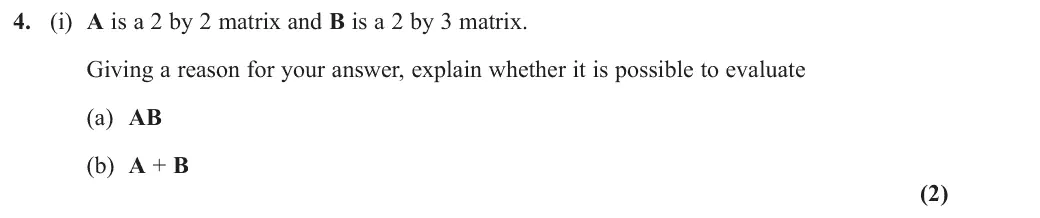
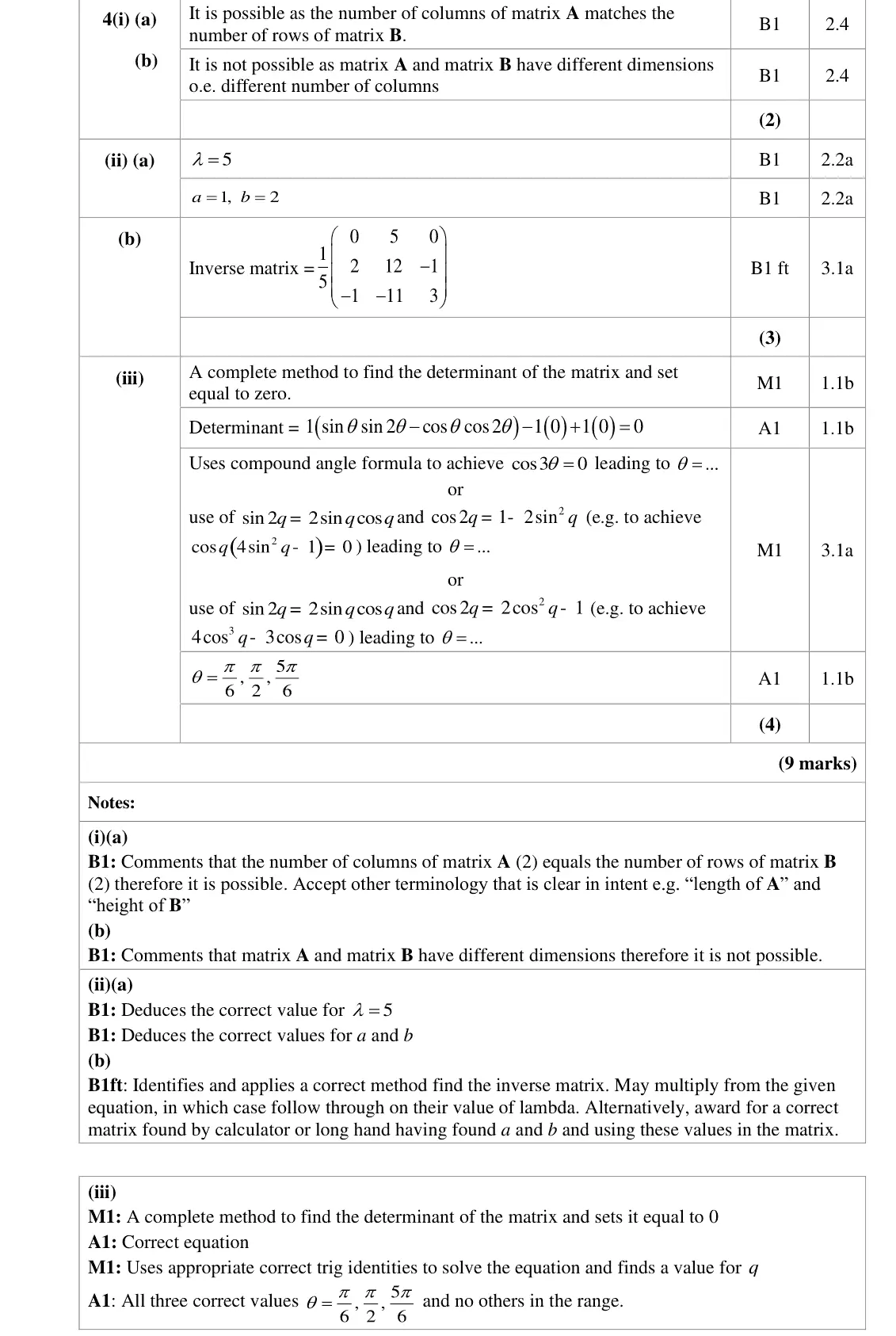
4. (i) A is a 2 by 2 matrix and B is a 2 by 3 matrix. Giving a reason for your answer, explain whether it is possible to evaluate (a) AB (b) A + B (2)
Nov 2021 · Paper 1 (Core Pure 1) · Q4(ii) 3 marks Medium matrices
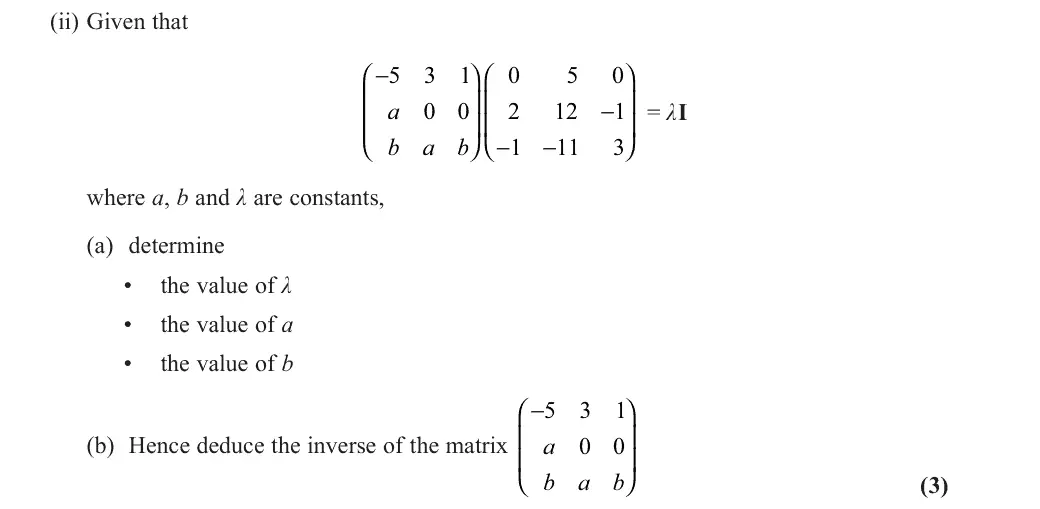
(ii) Given that - a - = λI b a b - - where a, b and λ are constants, (a) determine • the value of λ • the value of a • the value of b - (b) Hence deduce the inverse of the matrix a b a b (3)
Nov 2021 · Paper 1 (Core Pure 1) · Q4(iii) 4 marks Medium matrices
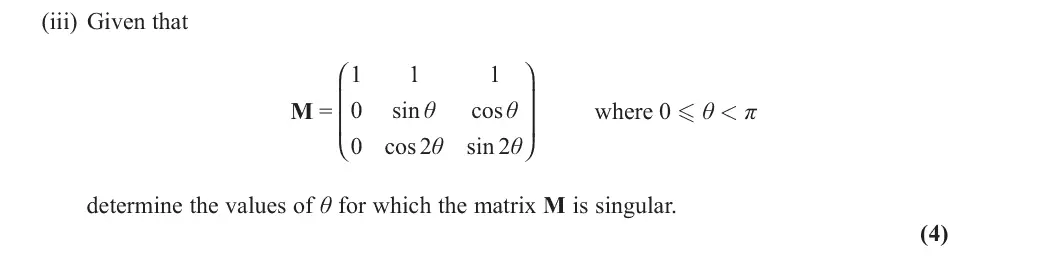
(iii) Given that M = sin theta cos theta where 0 theta < pi cos2 theta sin 2 theta determine the values of theta for which the matrix M is singular. (4)
Nov 2021 · Paper 1 (Core Pure 1) · Q5(i) 3 marks Hard improper integrals and mean value
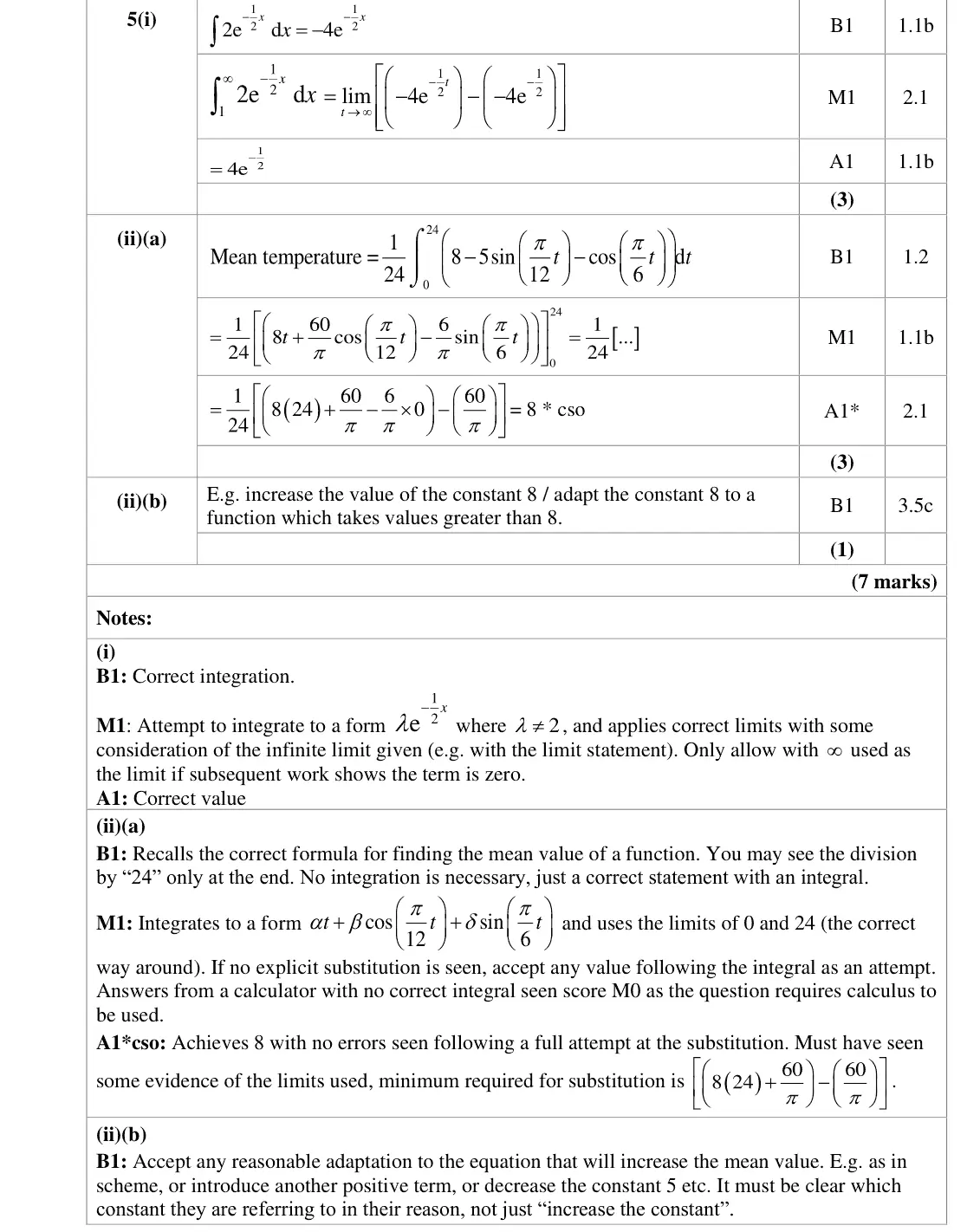
5. (i) Evaluate the improper integral ∞ ∫ - x x e d (3)
Nov 2021 · Paper 1 (Core Pure 1) · Q5(ii)(a) 3 marks Hard improper integrals and mean value
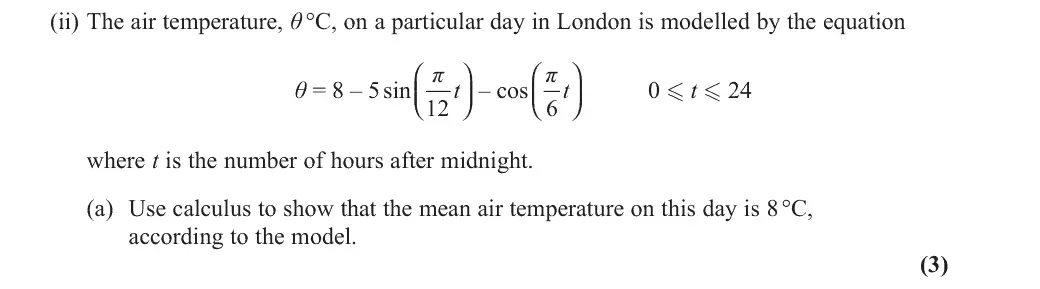
(ii) The air temperature, theta °C, on a particular day in London is modelled by the equation pi t pi t theta = 8 – 5 sin 12 – cos 6 0 t 24 where t is the number of hours after midnight. (a) Use calculus to show that the mean air temperature on this day is 8 °C, according to the model. (3)
Nov 2021 · Paper 1 (Core Pure 1) · Q5(ii)(b) 1 mark Medium improper integrals and mean value
Given that the actual mean air temperature recorded on this day was higher than 8 °C, (b) explain how the model could be refined. (1)
Nov 2021 · Paper 1 (Core Pure 1) · Q6(a) 2 marks simple harmonic motion and damping
6. A tourist decides to do a bungee jump from a bridge over a river. One end of an elastic rope is attached to the bridge and the other end of the elastic rope is attached to the tourist. The tourist jumps off the bridge. At time t seconds after the tourist reaches their lowest point, their vertical displacement is x metres above a fixed point 30 metres vertically above the river. When t = 0 • x = –20 –1 • the velocity of the tourist is 0 m s • the acceleration of the tourist is 13.6 m s –2 In the subsequent motion, the elastic rope is assumed to remain taut so that the vertical displacement of the tourist can be modelled by the differential equation t + 2k d x x 5k d t + 17x = 0 t 0 d d where k is a positive constant. (a) Determine the value of k (2)
(b) Determine the particular solution to the differential equation. (7)
Nov 2021 · Paper 1 (Core Pure 1) · Q6(c) 2 marks Medium simple harmonic motion and damping
(c) Hence find, according to the model, the vertical height of the tourist above the river 15 seconds after they have reached their lowest point. (2)
Nov 2021 · Paper 1 (Core Pure 1) · Q6(d) 1 mark simple harmonic motion and damping
(d) Give a limitation of the model. (1)
Nov 2021 · Paper 1 (Core Pure 1) · Q7(a) 2 marks Medium vectors lines and planes
7. The plane Π has equation - r = + λ + μ where λ and μ are scalar parameters. (a) Show that vector 2i + 3j – 4k is perpendicular to Π. (2)
Nov 2021 · Paper 1 (Core Pure 1) · Q7(b) 2 marks Medium vectors lines and planes
(b) Hence find a Cartesian equation of Π. (2)
Nov 2021 · Paper 1 (Core Pure 1) · Q7(c) 4 marks Medium vectors intersections and distances
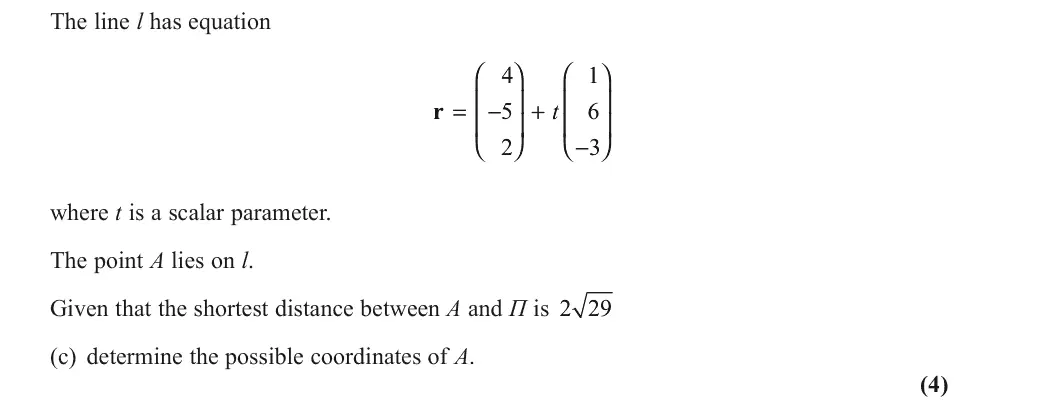
The line l has equation r = - + t - where t is a scalar parameter. The point A lies on l. Given that the shortest distance between A and Π is 2 29 (c) determine the possible coordinates of A. (4)
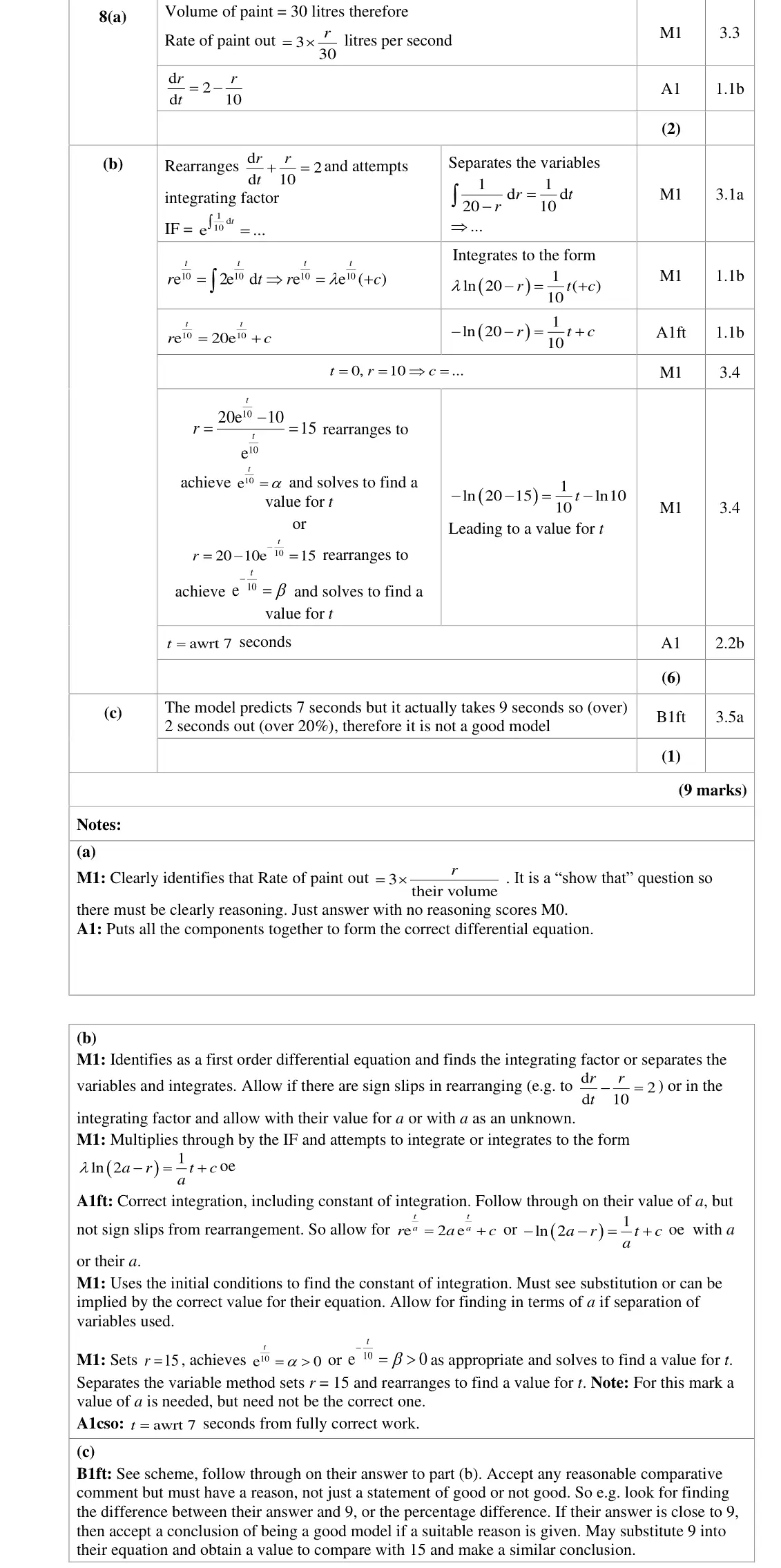
Nov 2021 · Paper 1 (Core Pure 1) · Q8(a) 2 marks Medium first order differential equations
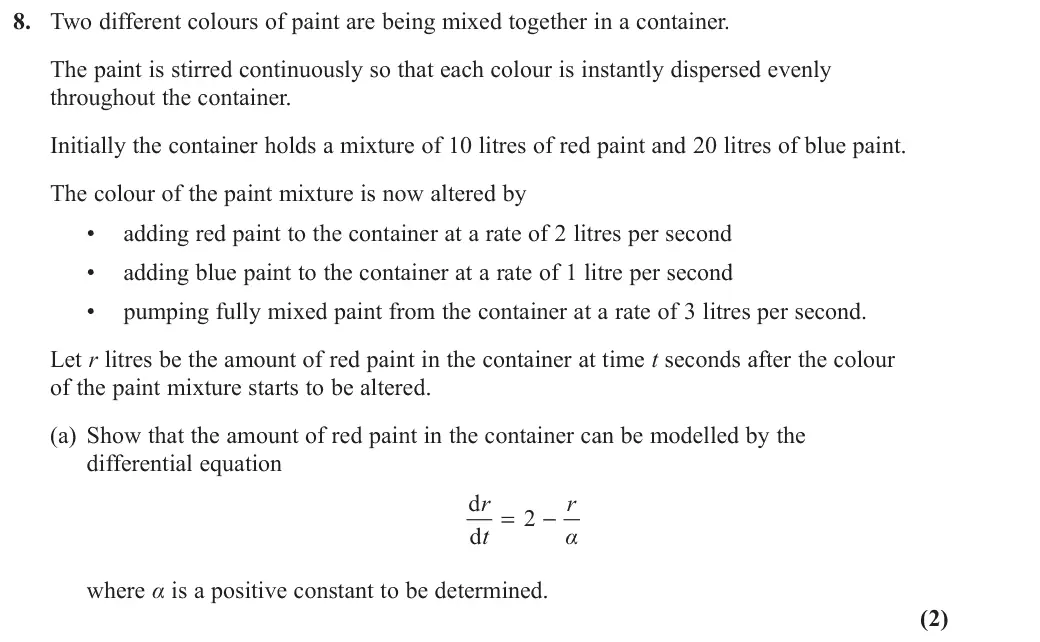
8. Two different colours of paint are being mixed together in a container. The paint is stirred continuously so that each colour is instantly dispersed evenly throughout the container. Initially the container holds a mixture of 10 litres of red paint and 20 litres of blue paint. The colour of the paint mixture is now altered by • adding red paint to the container at a rate of 2 litres per second • adding blue paint to the container at a rate of 1 litre per second • pumping fully mixed paint from the container at a rate of 3 litres per second. Let r litres be the amount of red paint in the container at time t seconds after the colour of the paint mixture starts to be altered. (a) Show that the amount of red paint in the container can be modelled by the differential equation r r d = - d t alpha where alpha is a positive constant to be determined. (2)
Nov 2021 · Paper 1 (Core Pure 1) · Q8(b) 6 marks Medium first order differential equations
(b) By solving the differential equation, determine how long it will take for the mixture of paint in the container to consist of equal amounts of red paint and blue paint, according to the model. Give your answer to the nearest second. (6)
Nov 2021 · Paper 1 (Core Pure 1) · Q8(c) 1 mark first order differential equations
It actually takes 9 seconds for the mixture of paint in the container to consist of equal amounts of red paint and blue paint. (c) Use this information to evaluate the model, giving a reason for your answer. (1)
Nov 2021 · Paper 1 (Core Pure 1) · Q9(a) 6 marks Hard hyperbolic functions
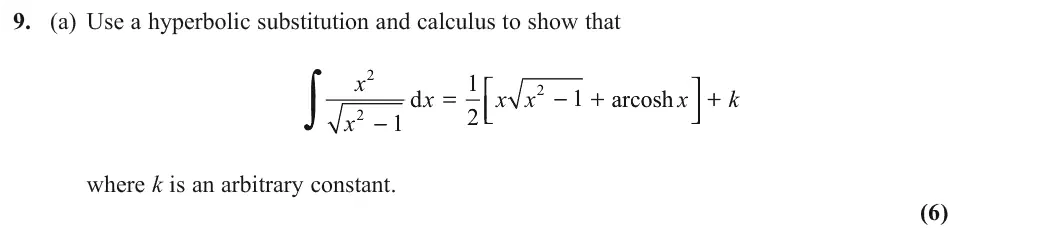
9. (a) Use a hyperbolic substitution and calculus to show that ∫ x d x = x x - + arcosh x + k x - where k is an arbitrary constant. (6)
Nov 2021 · Paper 1 (Core Pure 1) · Q9(b) 5 marks hyperbolic functions
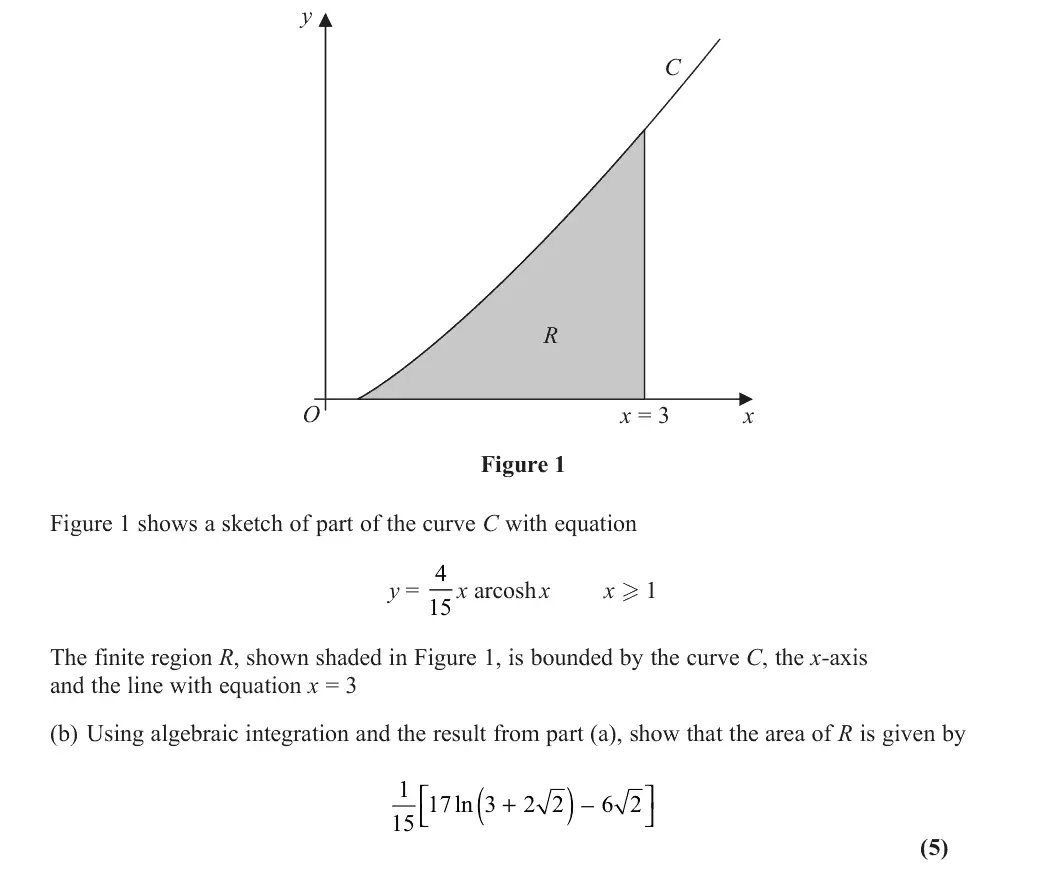
y C R x = 3 x Figure 1 Figure 1 shows a sketch of part of the curve C with equation y = 4 15 x arcosh x x 1 The finite region R, shown shaded in Figure 1, is bounded by the curve C, the x‑axis and the line with equation x = 3 (b) Using algebraic integration and the result from part (a), show that the area of R is given by ( ) - 15 17 ln + 2 2 6 2 (5)

Find an Edexcel Further Maths tutor

Want this paper marked and gone through with a Further Maths tutor? Message us.

Prefer email? Send an enquiry

If you are under 18, please include a parent's contact details. Enquiries go to enquiries@alevelfurthermathstutor.com and are deleted once handled.