June 2022: A level Paper 01: Core Pure Mathematics 1

75 marks · 26 question parts · Question paper, mark scheme and examiner's report on Pearson's site

Question by question

QTopicMarksDifficulty
1(a) Complex numbers: arithmetic, conjugates, roots of polynomials and Argand diagrams 1 —
1(b) Complex numbers: arithmetic, conjugates, roots of polynomials and Argand diagrams, Roots of polynomials 4 —
1(c) Complex numbers: arithmetic, conjugates, roots of polynomials and Argand diagrams 1 —
2 Hyperbolic functions 4 Easy
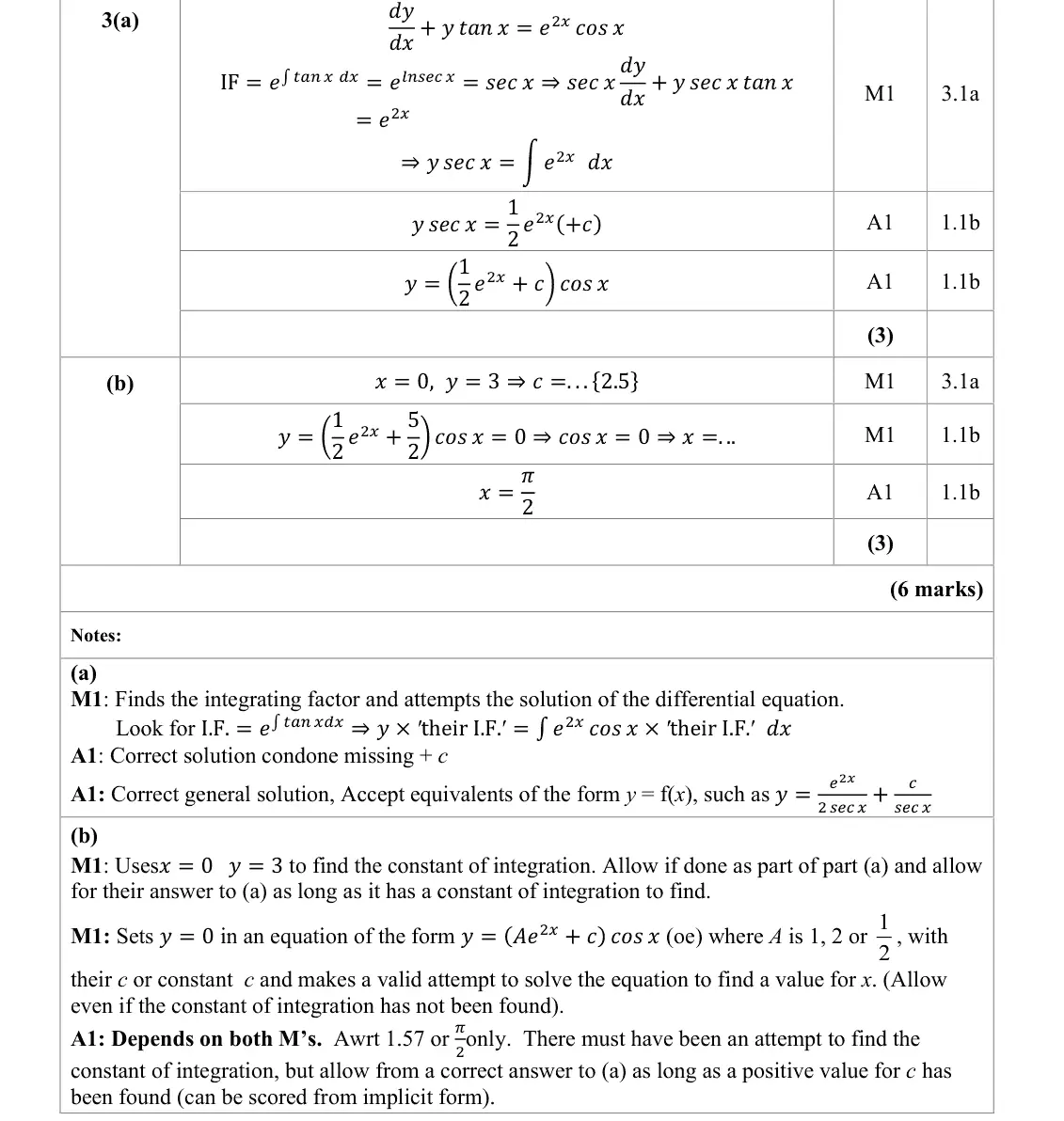
3(a) First-order differential equations: integrating factors and modelling 3 Easy
3(b) First-order differential equations: integrating factors and modelling 3 Easy
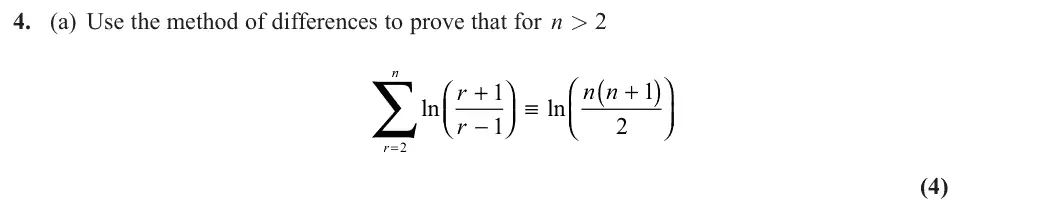
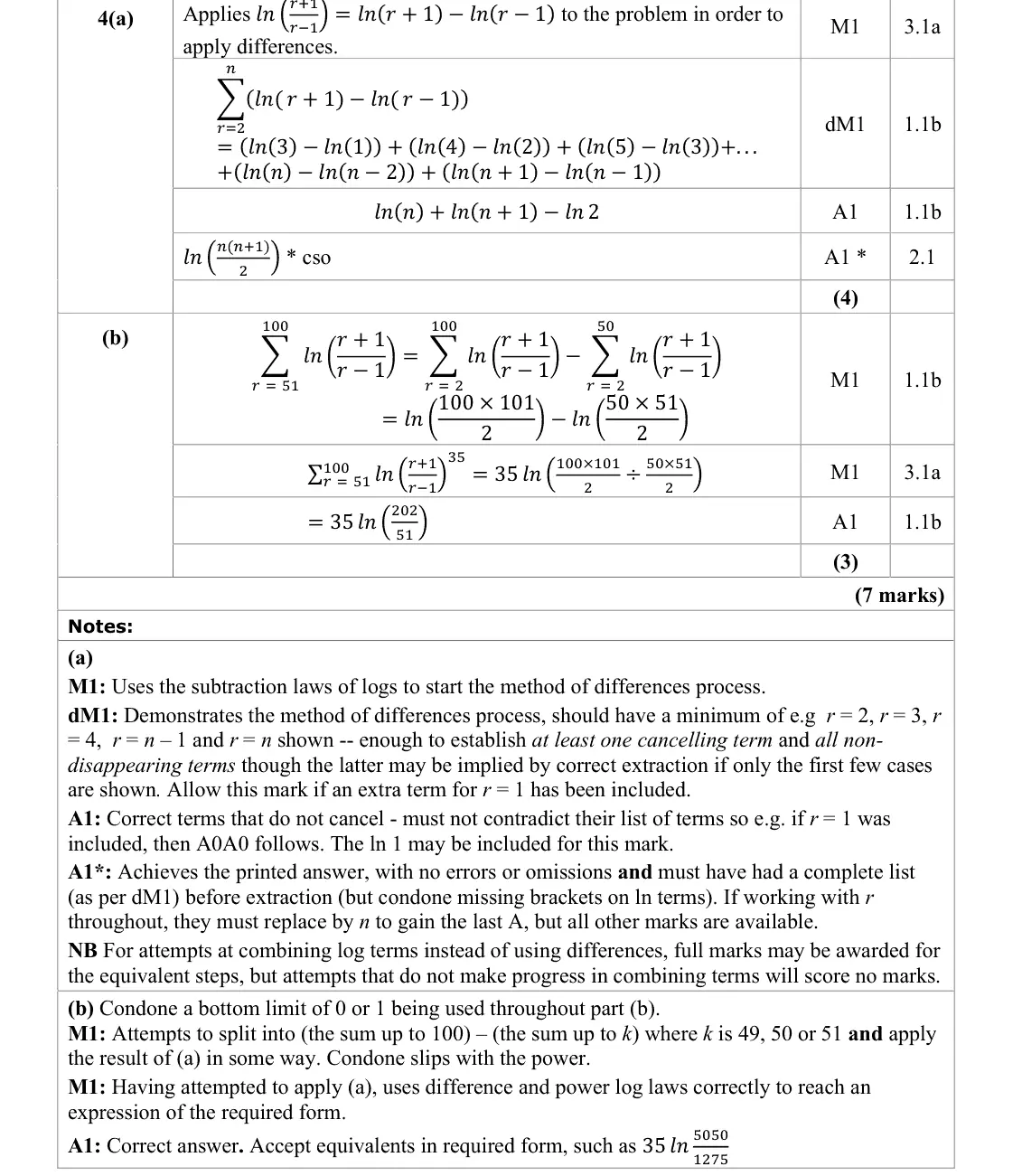
4(a) Series: standard sums and the method of differences 4 —
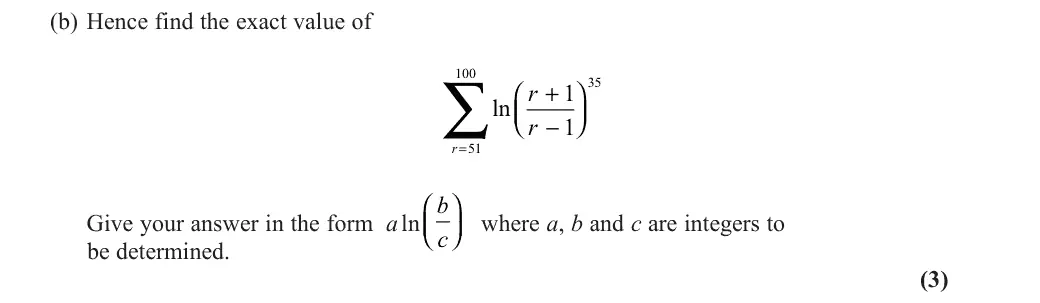
4(b) Series: standard sums and the method of differences 3 —
5(a) Matrices: multiplication, determinants and inverses 2 Easy
5(b) Matrices: multiplication, determinants and inverses 4 —
6(a) Integration with partial fractions 3 Easy
6(b) Integration with partial fractions, Calculus with inverse trigonometric functions 4 Easy
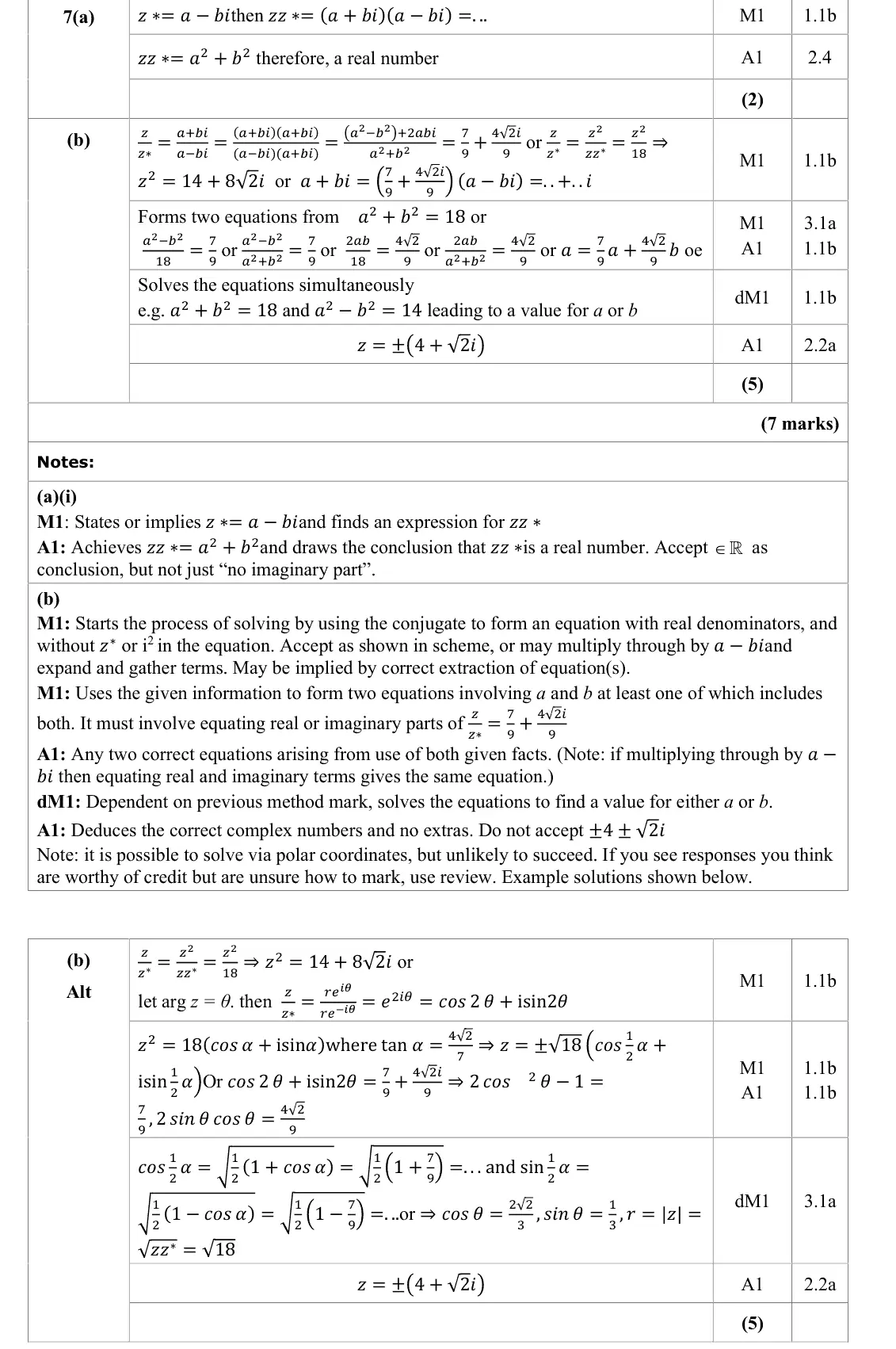
7(a) Complex numbers: arithmetic, conjugates, roots of polynomials and Argand diagrams 2 Easy
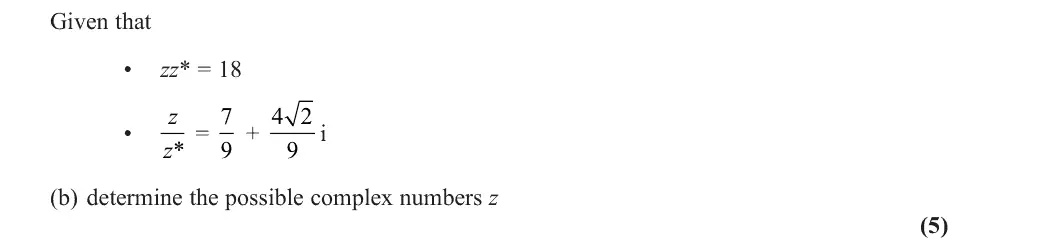
7(b) Complex numbers: arithmetic, conjugates, roots of polynomials and Argand diagrams 5 Easy
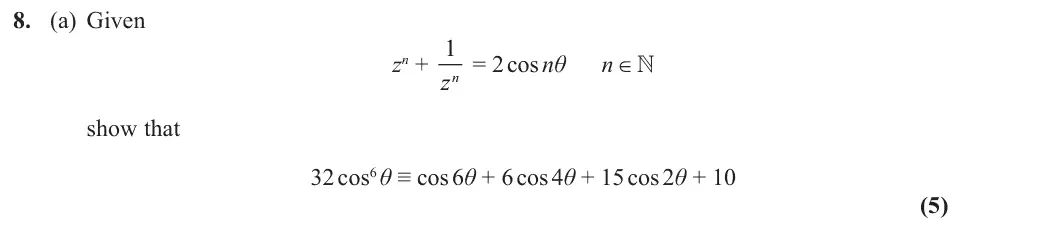
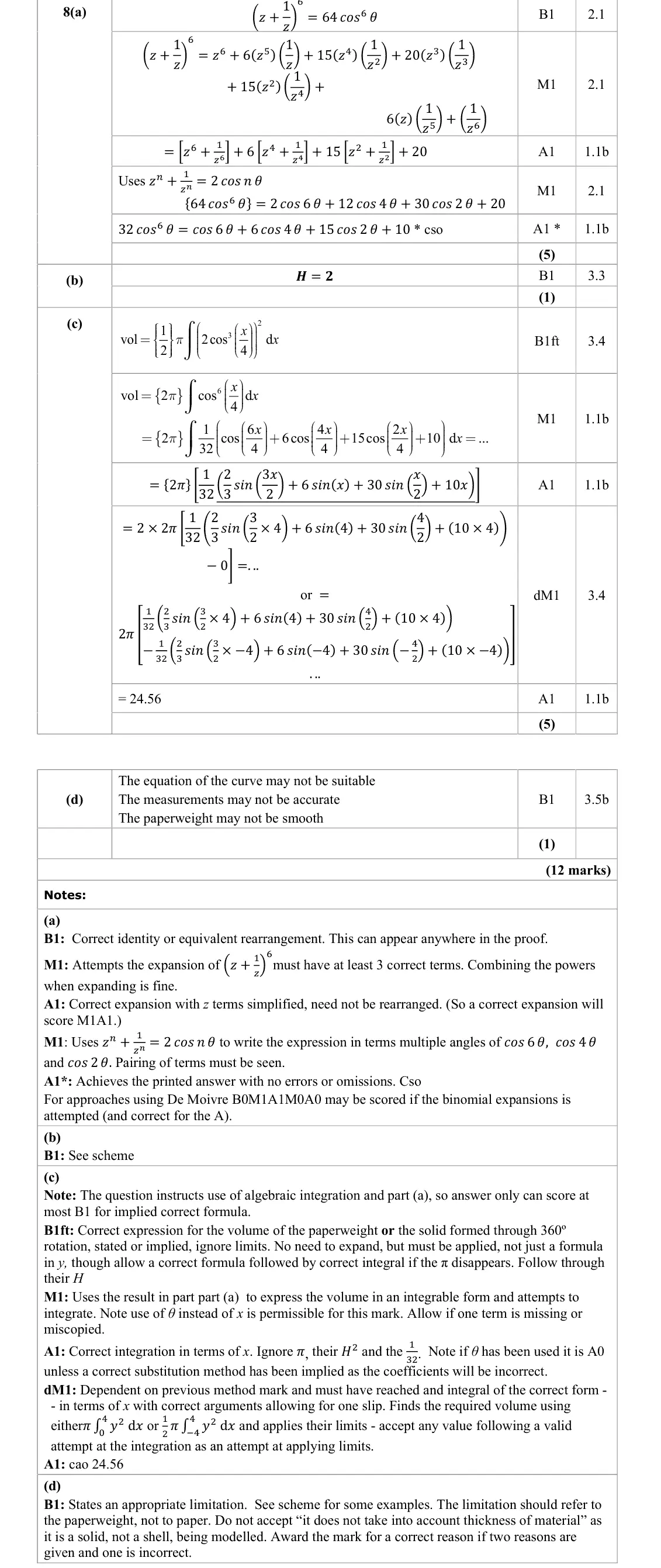
8(a) De Moivre's theorem and exponential form 5 Medium
8(b) Volumes of revolution 1 Hard
8(c) Volumes of revolution, De Moivre's theorem and exponential form 5 Medium
8(d) Volumes of revolution 1 Hard
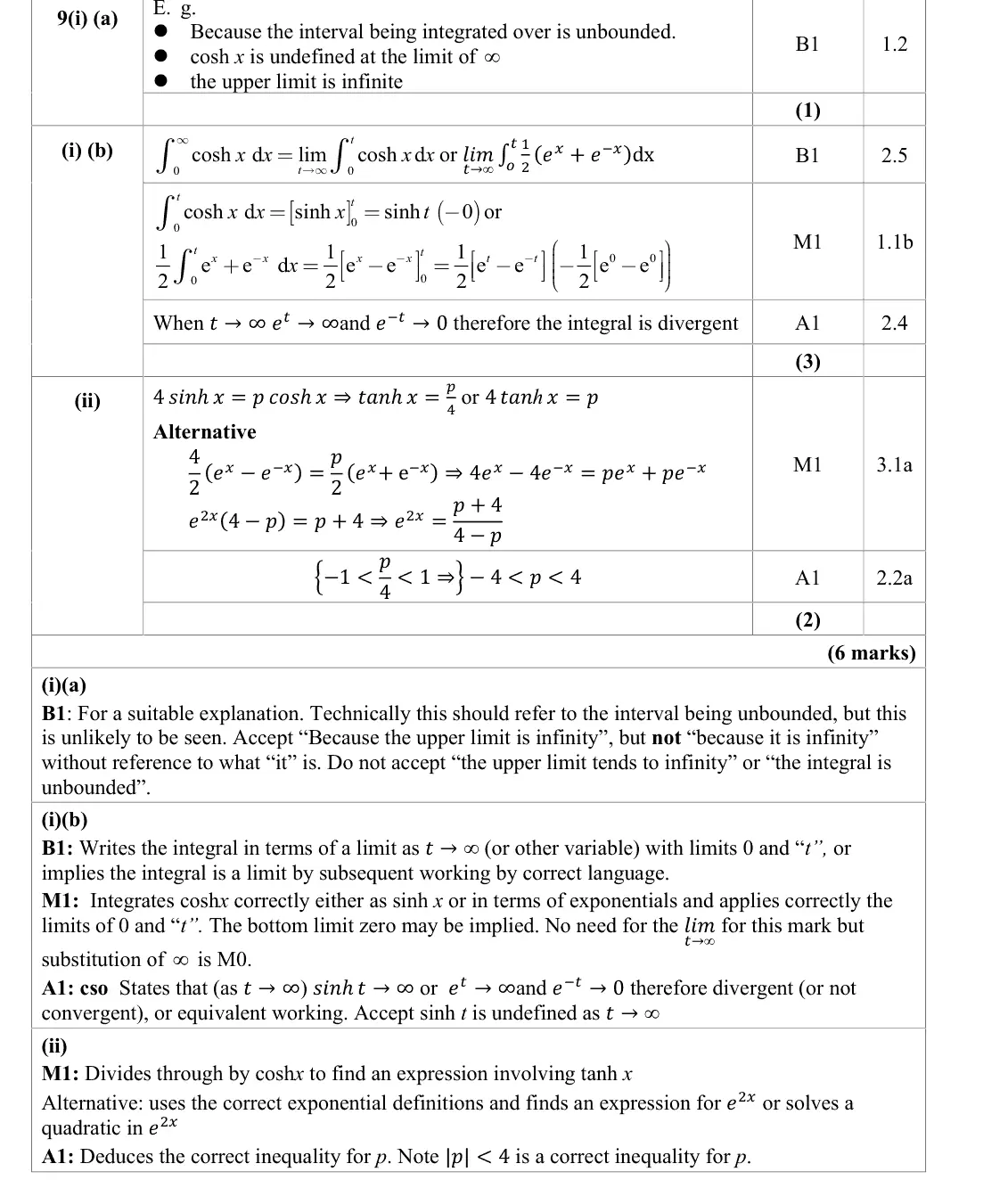
9(i)(a) Improper integrals and the mean value of a function 1 Easy
9(i)(b) Improper integrals and the mean value of a function, Hyperbolic functions 3 Easy
9(ii) Hyperbolic functions 2 Easy
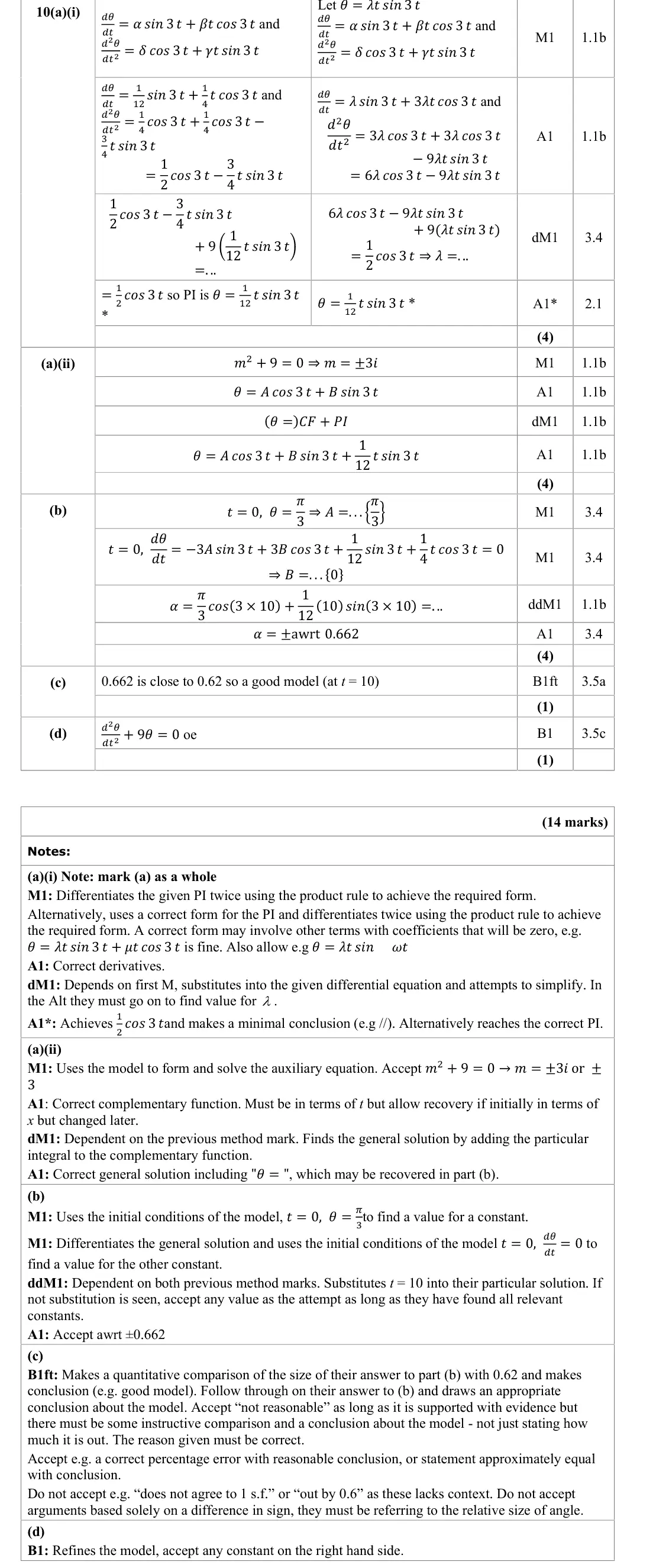
10(a)(i) Second-order differential equations, Simple harmonic motion and damped oscillations 4 —
10(a)(ii) Second-order differential equations 4 —
10(b) First-order differential equations: integrating factors and modelling, Simple harmonic motion and damped oscillations 4 —
10(c) Simple harmonic motion and damped oscillations 1 —
10(d) Simple harmonic motion and damped oscillations 1 —

The questions

1(a)1(b)1(c)23(a)3(b)4(a)4(b)5(a)5(b)6(a)6(b)7(a)7(b)8(a)8(b)8(c)8(d)9(i)(a)9(i)(b)9(ii)10(a)(i)10(a)(ii)10(b)10(c)10(d)
June 2022 · Paper 1 (Core Pure 1) · Q1(a) 1 mark complex numbers
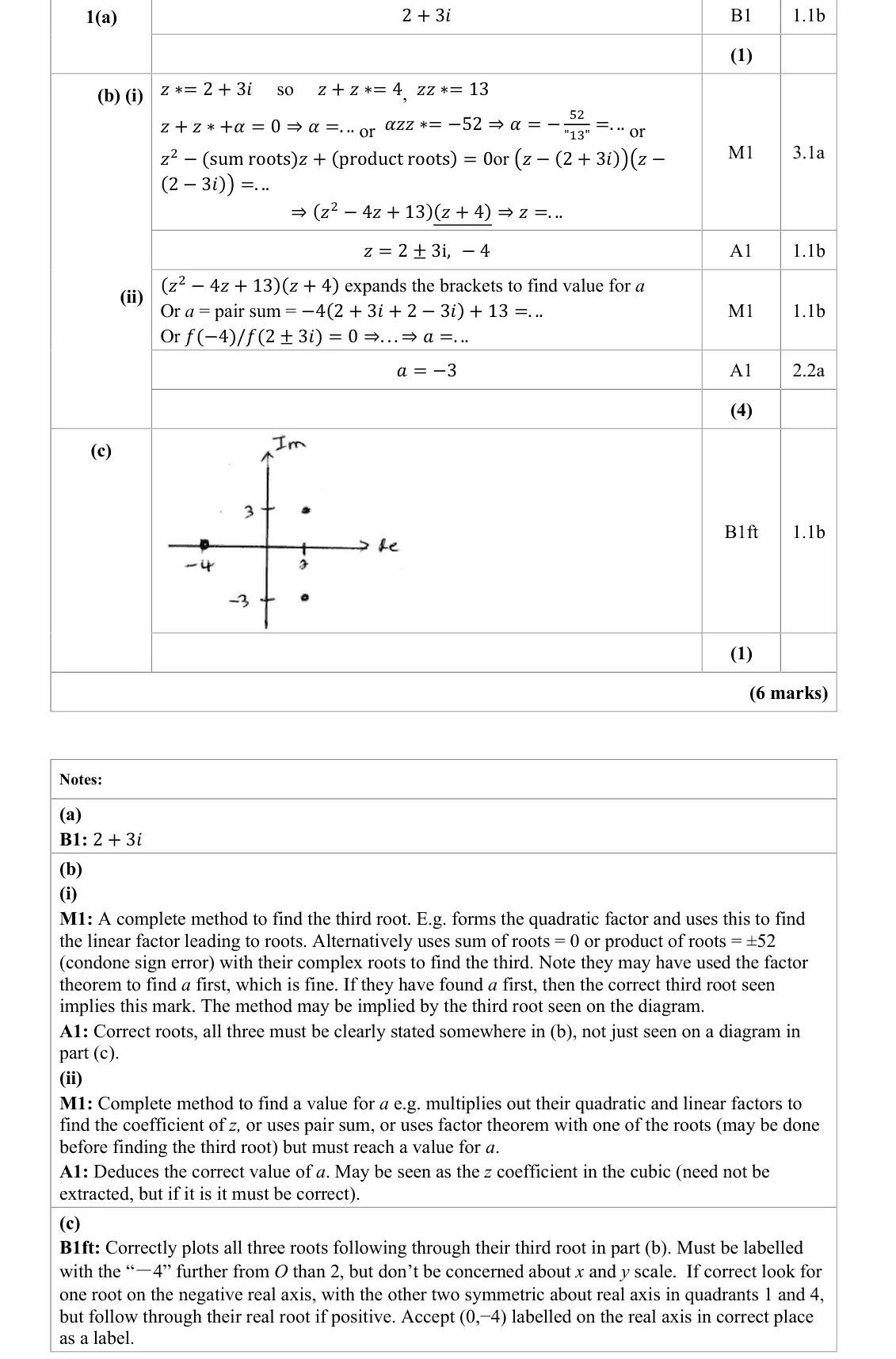
1. f(z) = z3 + az + 52 where a is a real constant Given that 2 – 3i is a root of the equation f(z) = 0 (a) write down the other complex root. (1)
June 2022 · Paper 1 (Core Pure 1) · Q1(b) 4 marks complex numbersroots of polynomials
(b) Hence (i) solve completely f(z) = 0 (ii) determine the value of a (4)
June 2022 · Paper 1 (Core Pure 1) · Q1(c) 1 mark complex numbers
(c) Show all the roots of the equation f(z) = 0 on a single Argand diagram. (1)
June 2022 · Paper 1 (Core Pure 1) · Q2 4 marks Easy hyperbolic functions
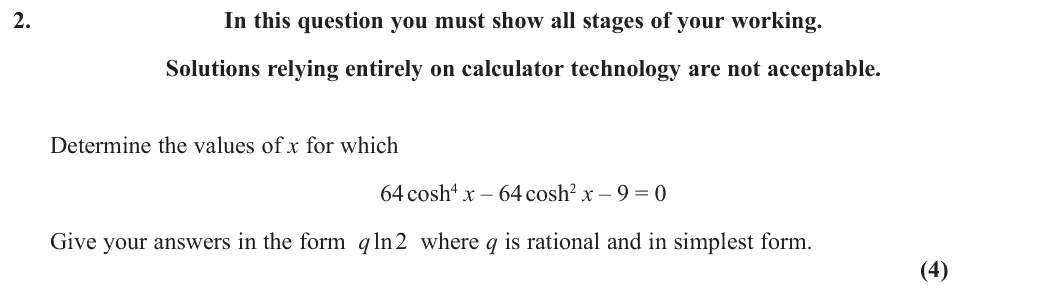
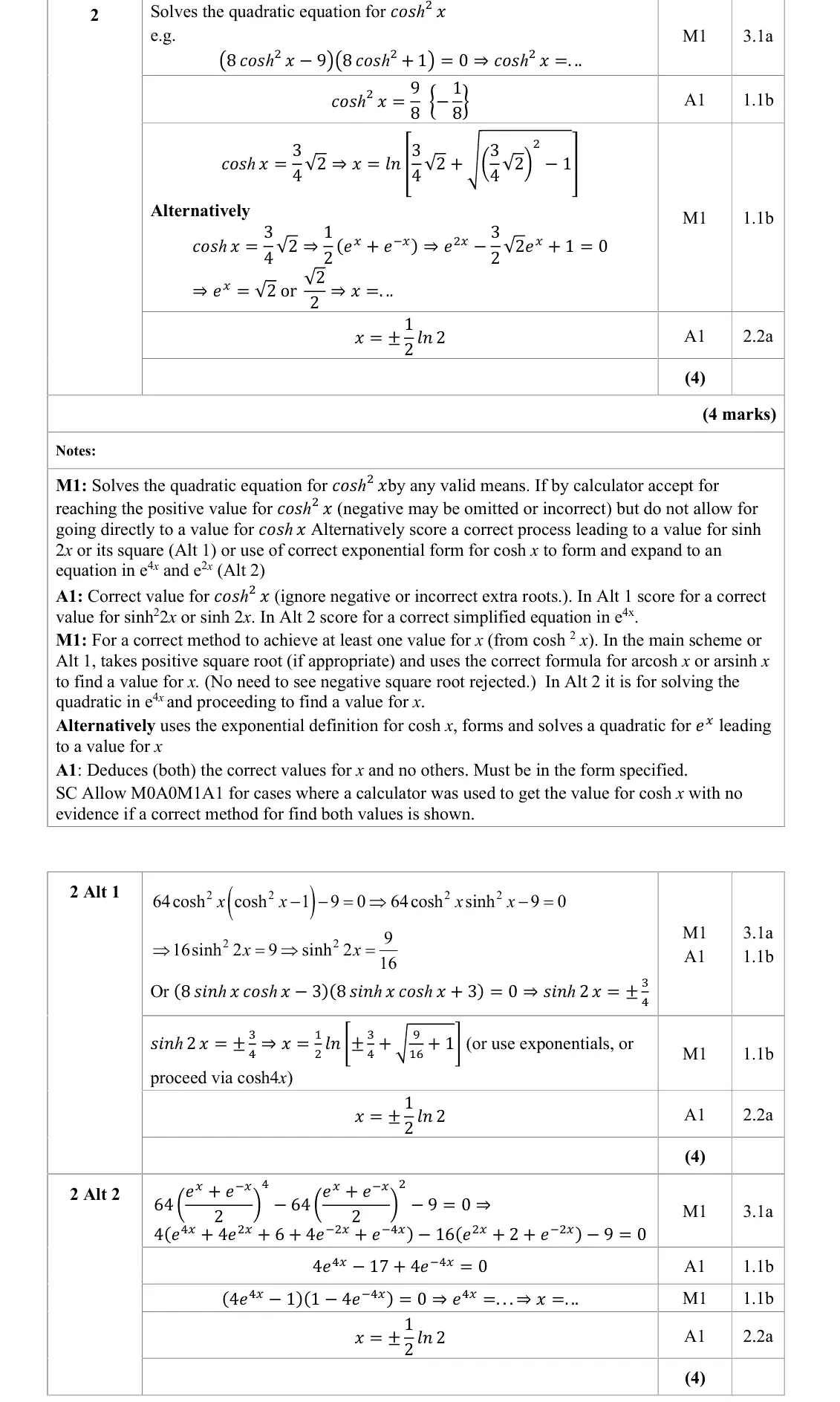
2. In this question you must show all stages of your working. Solutions relying entirely on calculator technology are not acceptable. Determine the values of x for which 64 cosh4 x – 64 cosh2 x – 9 = 0 Give your answers in the form q ln 2 where q is rational and in simplest form. (4)
June 2022 · Paper 1 (Core Pure 1) · Q3(a) 3 marks Easy first order differential equations
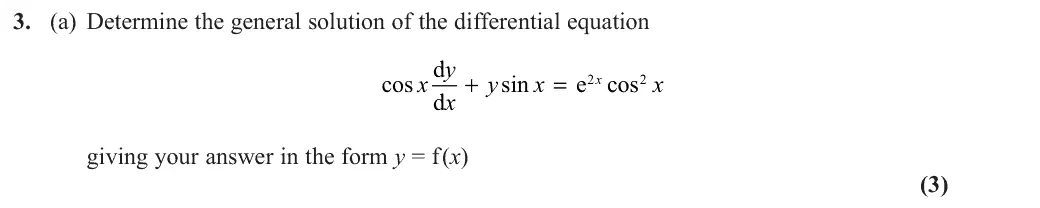
3. (a) Determine the general solution of the differential equation x y d cos + y sin x = e cos x x d x giving your answer in the form y = f(x) (3)
June 2022 · Paper 1 (Core Pure 1) · Q3(b) 3 marks Easy first order differential equations
Given that y = 3 when x = 0 (b) determine the smallest positive value of x for which y = 0 (3)
June 2022 · Paper 1 (Core Pure 1) · Q4(a) 4 marks series and method of differences
4. (a) Use the method of differences to prove that for n > 2 n =∑ ( ) r + n n + ≡ ln ln r - r (4)
June 2022 · Paper 1 (Core Pure 1) · Q4(b) 3 marks series and method of differences
(b) Hence find the exact value of =∑ ln r + r - r Give your answer in the form a ln b where a, b and c are integers to c be determined. (3)
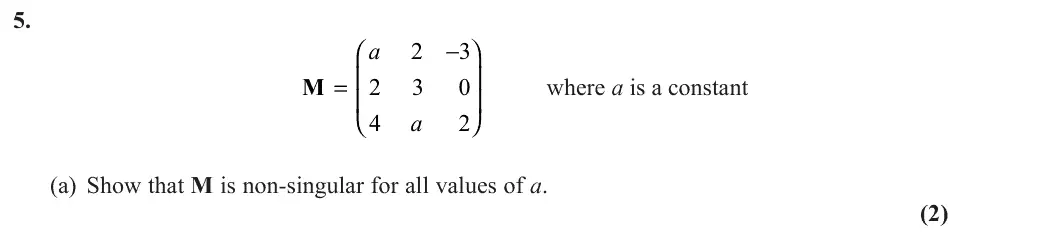
June 2022 · Paper 1 (Core Pure 1) · Q5(a) 2 marks Easy matrices
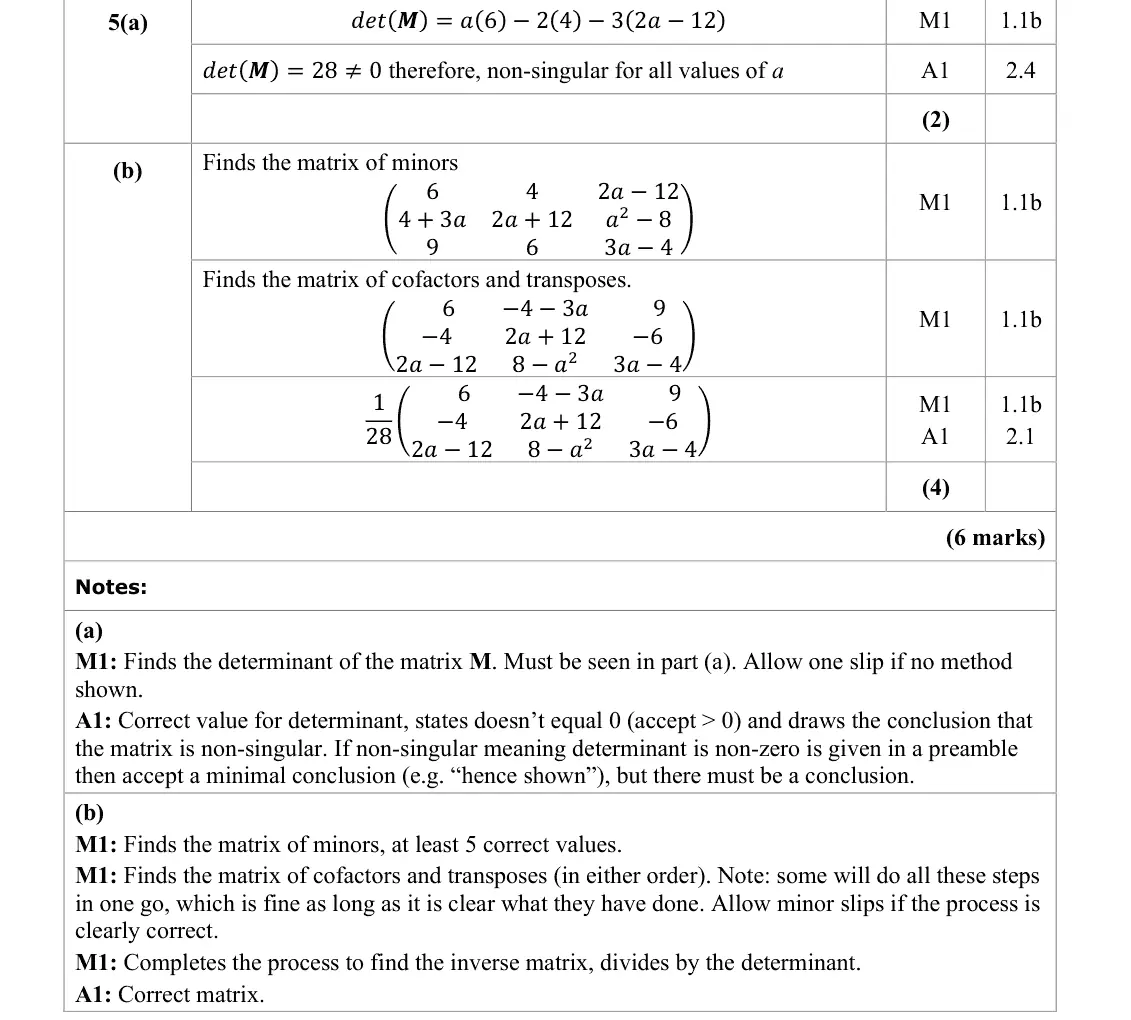
5. a - M = where a is a constant a (a) Show that M is non-singular for all values of a. (2)
June 2022 · Paper 1 (Core Pure 1) · Q5(b) 4 marks matrices
(b) Determine, in terms of a, M–1 (4)
June 2022 · Paper 1 (Core Pure 1) · Q6(a) 3 marks Easy partial fractions integration
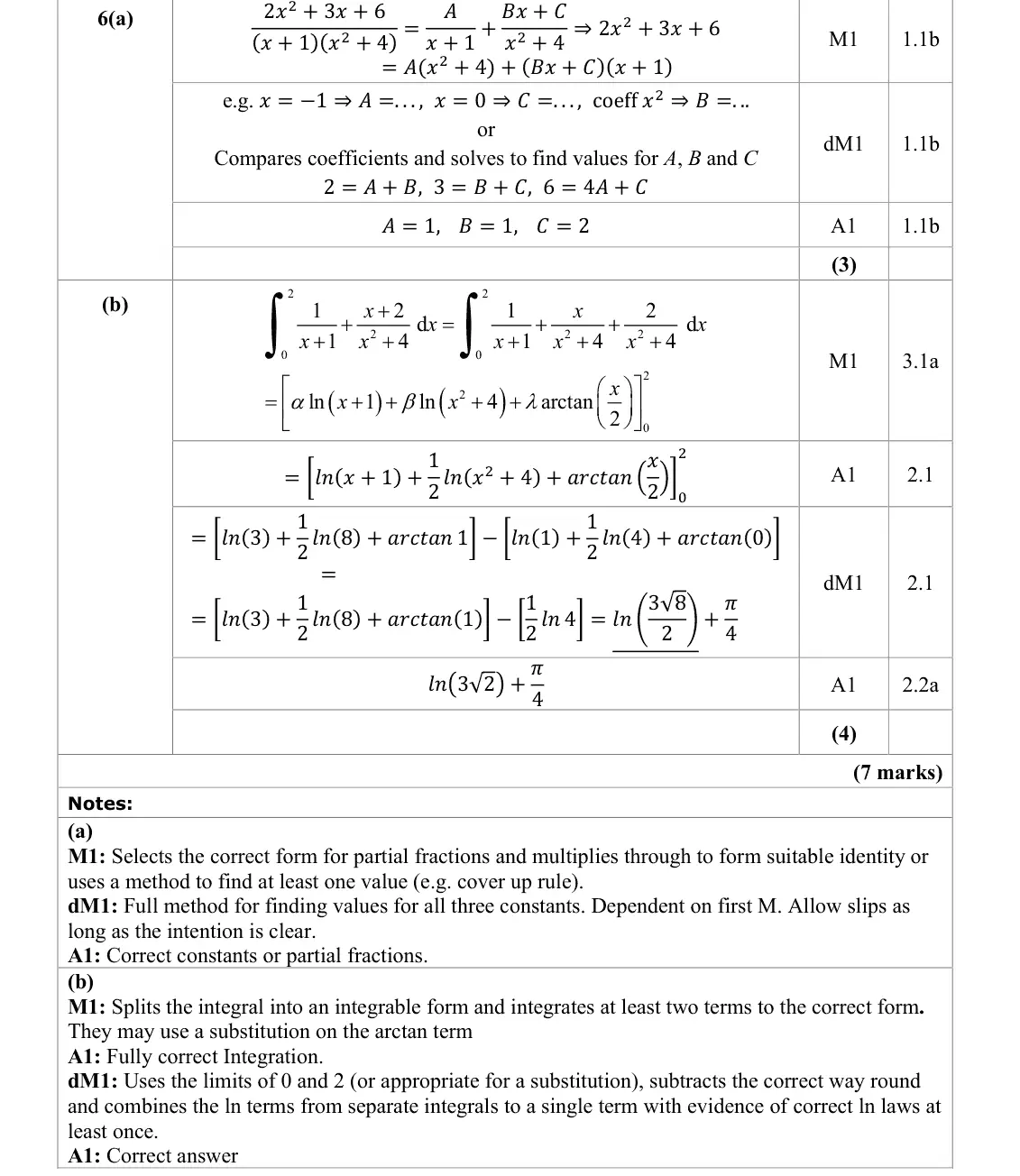
6. (a) Express as partial fractions x + x + ( ) ( ) x x + + (3)
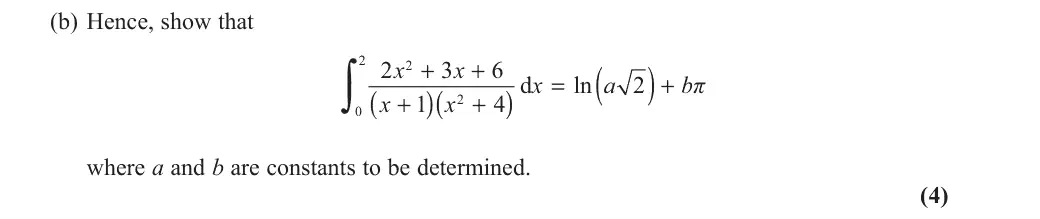
June 2022 · Paper 1 (Core Pure 1) · Q6(b) 4 marks Easy partial fractions integrationinverse trig calculus
(b) Hence, show that x x ( ) ∫ + + 6 d x = a + b pi ln ( )( ) x x + + where a and b are constants to be determined. (4)
June 2022 · Paper 1 (Core Pure 1) · Q7(a) 2 marks Easy complex numbers
7. Given that z = a + bi is a complex number where a and b are real constants, (a) show that zz* is a real number. (2)
June 2022 · Paper 1 (Core Pure 1) · Q7(b) 5 marks Easy complex numbers
Given that • zz* = 18 z* = 7 z 9 + 4 2 • i (b) determine the possible complex numbers z (5)
June 2022 · Paper 1 (Core Pure 1) · Q8(a) 5 marks Medium de moivres theorem
8. (a) Given zn + 1 zn = 2 cos n theta n ∈ show that 32 cos6 theta ≡ cos 6 theta + 6 cos 4 theta + 15 cos 2 theta + 10 (5)
June 2022 · Paper 1 (Core Pure 1) · Q8(b) 1 mark Hard volumes of revolution
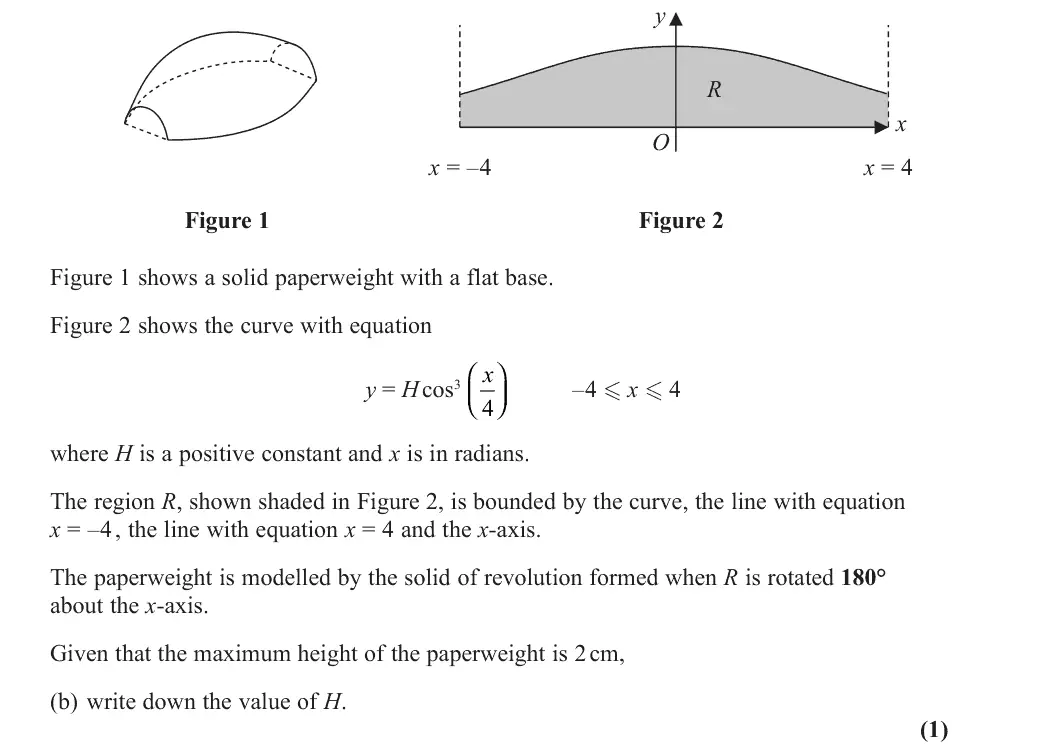
y R x x = –4 x = 4 Figure 1 Figure 2 Figure 1 shows a solid paperweight with a flat base. Figure 2 shows the curve with equation y = H cos3 x –4 x 4 where H is a positive constant and x is in radians. The region R, shown shaded in Figure 2, is bounded by the curve, the line with equation x = –4 , the line with equation x = 4 and the x-axis. The paperweight is modelled by the solid of revolution formed when R is rotated 180° about the x-axis. Given that the maximum height of the paperweight is 2 cm, (b) write down the value of H. (1)
June 2022 · Paper 1 (Core Pure 1) · Q8(c) 5 marks Medium volumes of revolutionde moivres theorem
(c) Using algebraic integration and the result in part (a), determine, in cm3 , the volume of the paperweight, according to the model. Give your answer to 2 decimal places. [Solutions based entirely on calculator technology are not acceptable.] (5)
June 2022 · Paper 1 (Core Pure 1) · Q8(d) 1 mark Hard volumes of revolution
(d) State a limitation of the model. (1)
June 2022 · Paper 1 (Core Pure 1) · Q9(i)(a) 1 mark Easy improper integrals and mean value
∞∫ 9. (i) (a) Explain why cosh x x d is an improper integral. (1)
June 2022 · Paper 1 (Core Pure 1) · Q9(i)(b) 3 marks Easy improper integrals and mean valuehyperbolic functions
∞∫ (b) Show that cosh x x d is divergent. (3)
June 2022 · Paper 1 (Core Pure 1) · Q9(ii) 2 marks Easy hyperbolic functions
(ii) 4 sinh x = p cosh x where p is a real constant Given that this equation has real solutions, determine the range of possible values for p (2)
June 2022 · Paper 1 (Core Pure 1) · Q10(a)(i) 4 marks second order differential equationssimple harmonic motion and damping
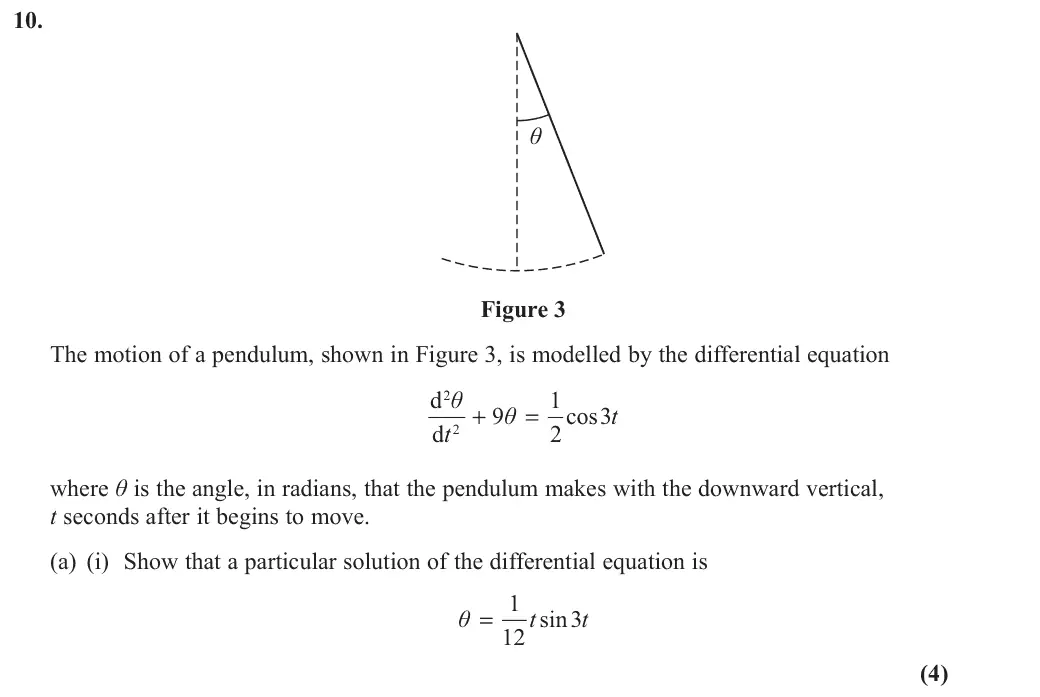
10. theta Figure 3 The motion of a pendulum, shown in Figure 3, is modelled by the differential equation theta d + theta = cos3 t t d where theta is the angle, in radians, that the pendulum makes with the downward vertical, t seconds after it begins to move. (a) (i) Show that a particular solution of the differential equation is 1 sin3 theta = t t (4)
June 2022 · Paper 1 (Core Pure 1) · Q10(a)(ii) 4 marks second order differential equations
(ii) Hence, find the general solution of the differential equation. (4)
June 2022 · Paper 1 (Core Pure 1) · Q10(b) 4 marks first order differential equationssimple harmonic motion and damping
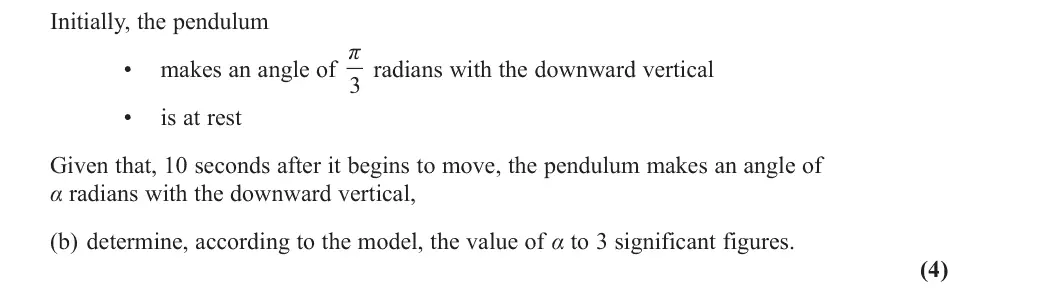
Initially, the pendulum pi radians with the downward vertical • makes an angle of 3 • is at rest Given that, 10 seconds after it begins to move, the pendulum makes an angle of alpha radians with the downward vertical, (b) determine, according to the model, the value of alpha to 3 significant figures. (4)
June 2022 · Paper 1 (Core Pure 1) · Q10(c) 1 mark simple harmonic motion and damping
Given that the true value of alpha is 0.62 (c) evaluate the model. (1)
June 2022 · Paper 1 (Core Pure 1) · Q10(d) 1 mark simple harmonic motion and damping
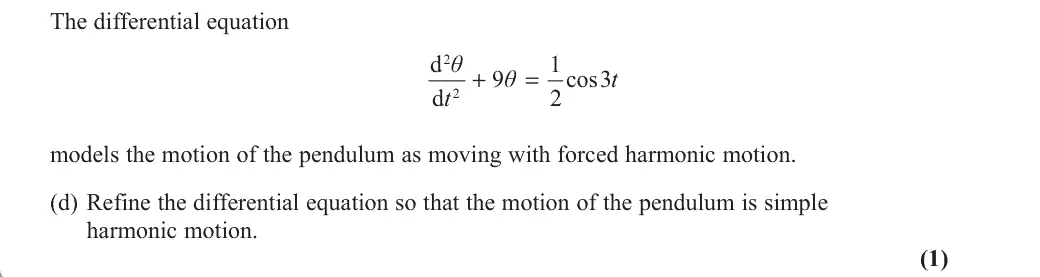
The differential equation d theta + theta = cos3 t d t models the motion of the pendulum as moving with forced harmonic motion. (d) Refine the differential equation so that the motion of the pendulum is simple harmonic motion. (1)

Find an Edexcel Further Maths tutor

Want this paper marked and gone through with a Further Maths tutor? Message us.

Prefer email? Send an enquiry

If you are under 18, please include a parent's contact details. Enquiries go to enquiries@alevelfurthermathstutor.com and are deleted once handled.