June 2025: A level Paper 02: Core Pure Mathematics 2

75 marks · 25 question parts · Question paper, mark scheme and examiner's report on Pearson's site

Question by question

QTopicMarksDifficulty
1(a) Modulus-argument form, Complex numbers: arithmetic, conjugates, roots of polynomials and Argand diagrams 3 —
1(b) Modulus-argument form 3 —
2(a) Vectors: intersections, angles and shortest distances 2 —
2(b) Vectors: equations of lines and planes, scalar product 2 —
2(c) Vectors: equations of lines and planes, scalar product 2 —
2(d) Vectors: equations of lines and planes, scalar product 1 —
2(e) Vectors: equations of lines and planes, scalar product 1 —
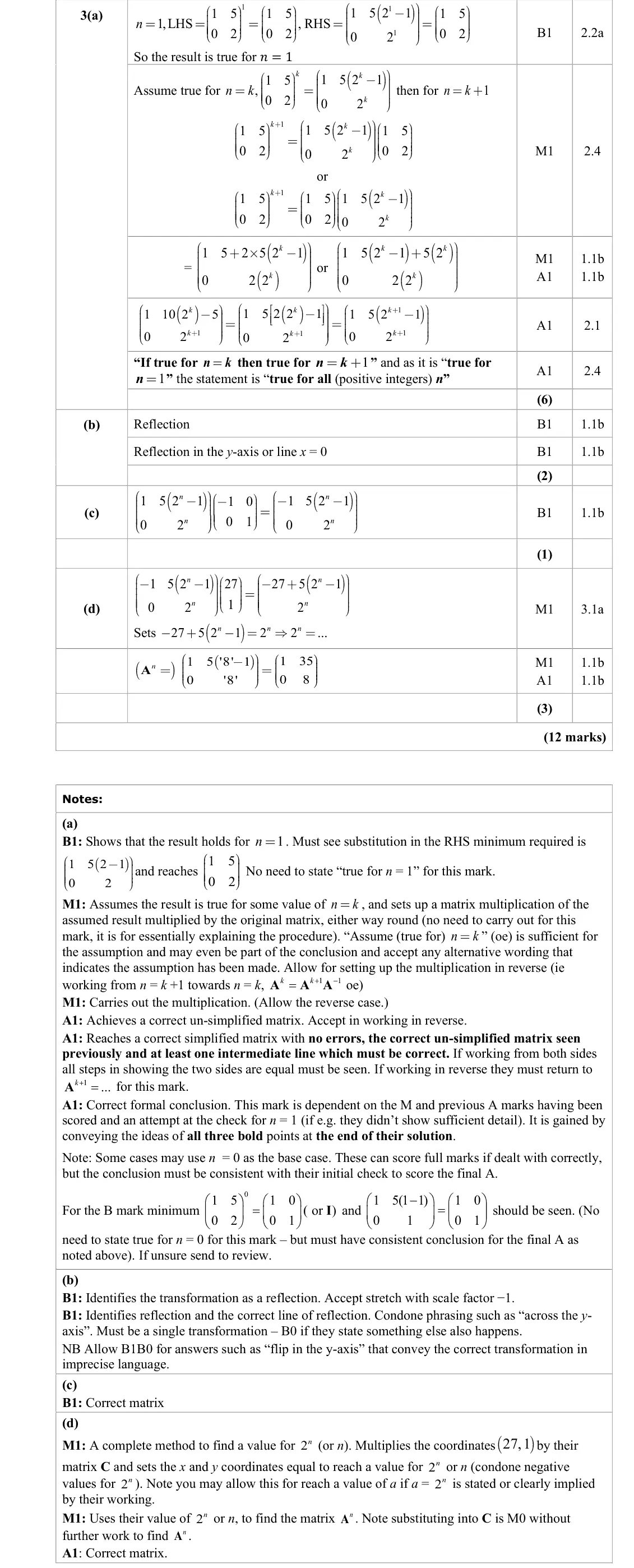
3(a) Proof by induction 6 —
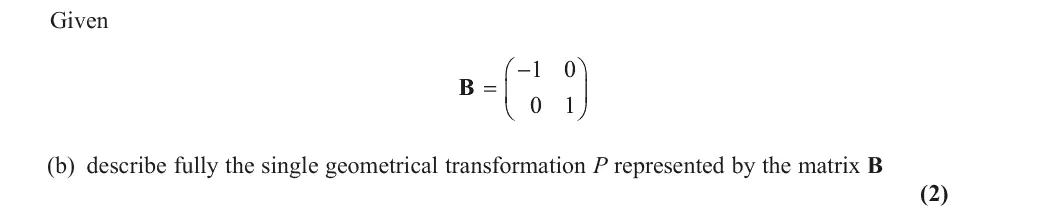
3(b) Linear transformations and invariant points and lines 2 —
3(c) Linear transformations and invariant points and lines, Matrices: multiplication, determinants and inverses 1 —
3(d) Linear transformations and invariant points and lines, Matrices: multiplication, determinants and inverses 3 —
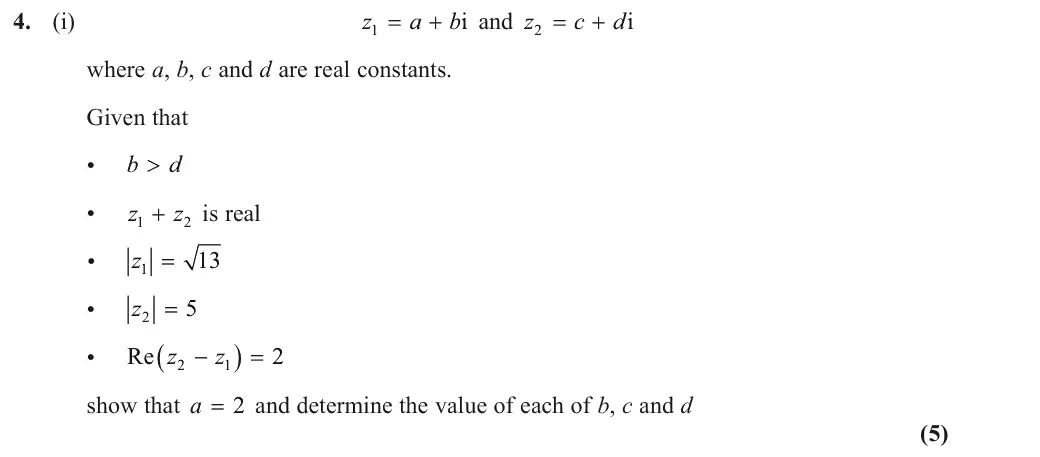
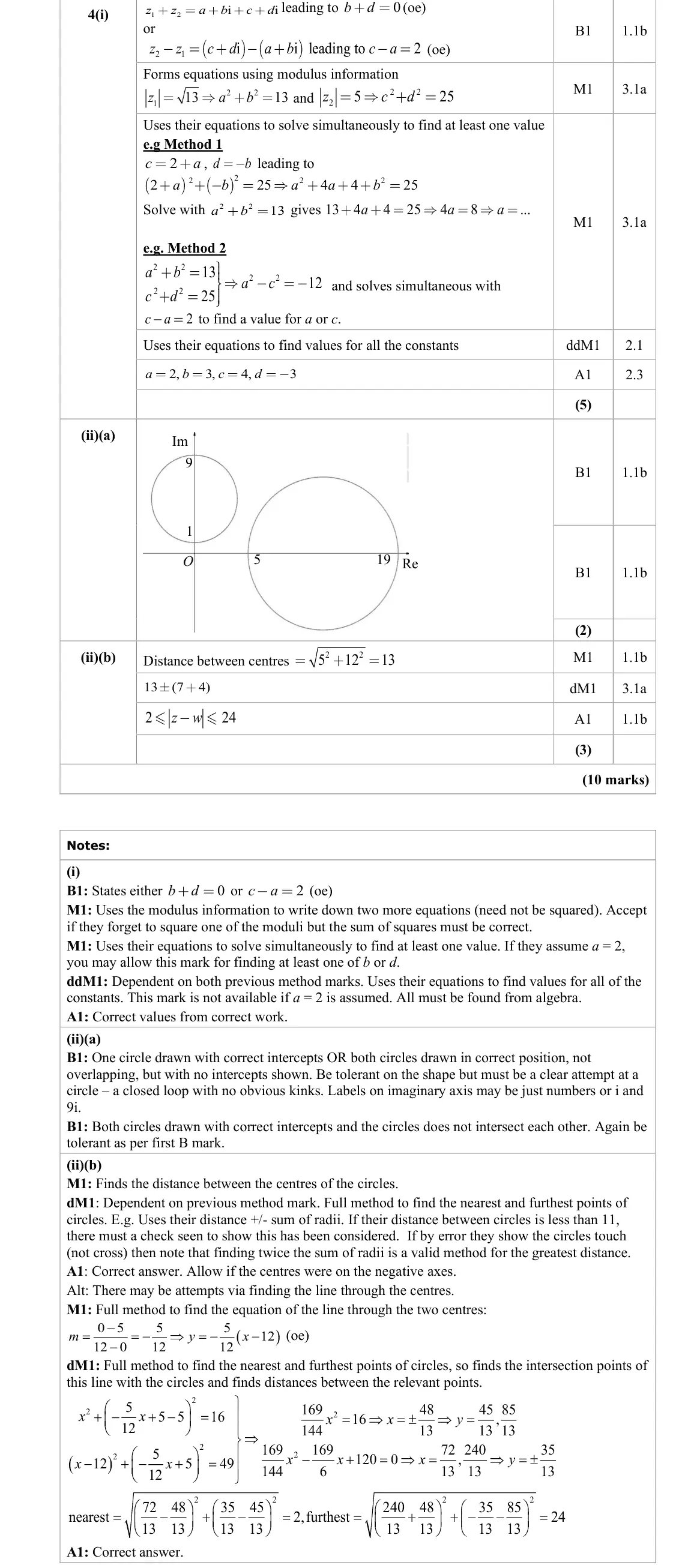
4(i) Complex numbers: arithmetic, conjugates, roots of polynomials and Argand diagrams 5 —
4(ii)(a) Loci in the Argand diagram, Complex numbers: arithmetic, conjugates, roots of polynomials and Argand diagrams 2 —
4(ii)(b) Loci in the Argand diagram 3 —
5 Three linear equations: solutions and planes 4 —
6(a) Roots of polynomials 3 —
6(b) Roots of polynomials 5 —
7(a) Polar coordinates: curves and areas 6 —
7(b) Polar coordinates: curves and areas 2 —
7(c) Polar coordinates: curves and areas 4 —
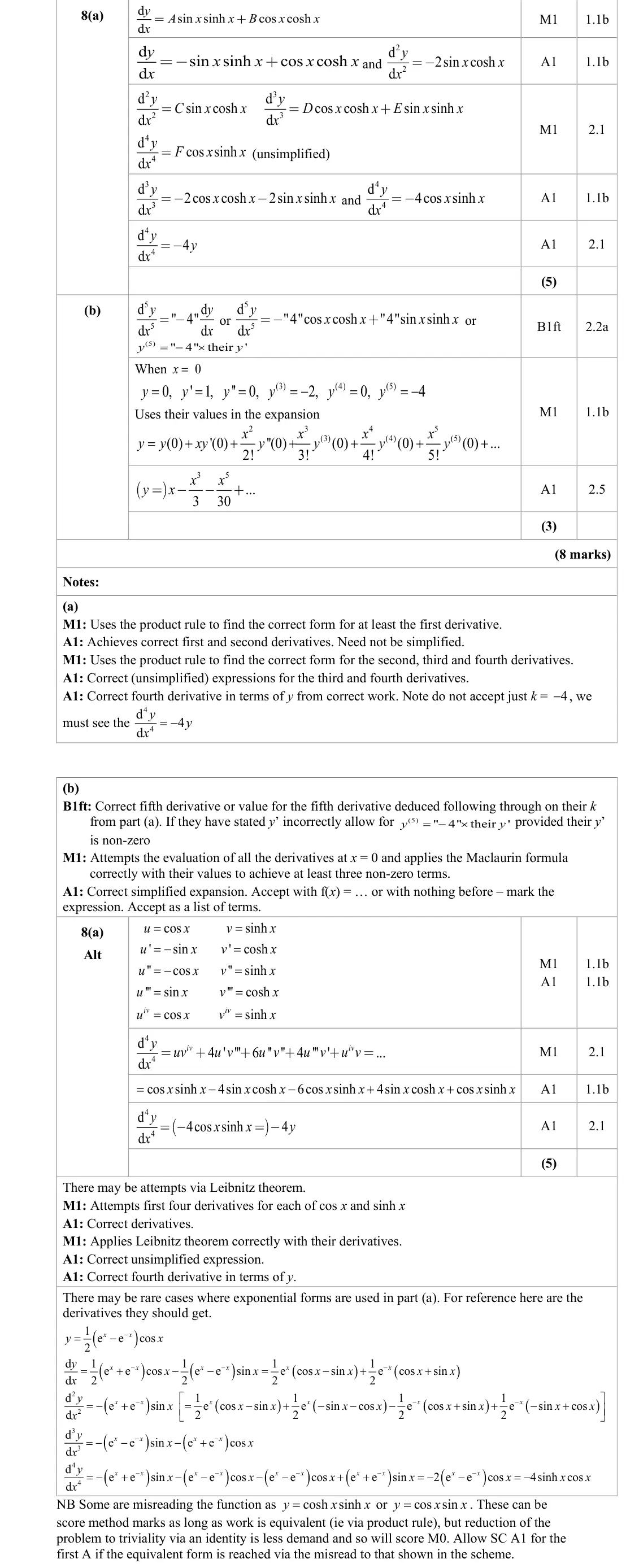
8(a) Hyperbolic functions 5 —
8(b) Maclaurin series 3 —
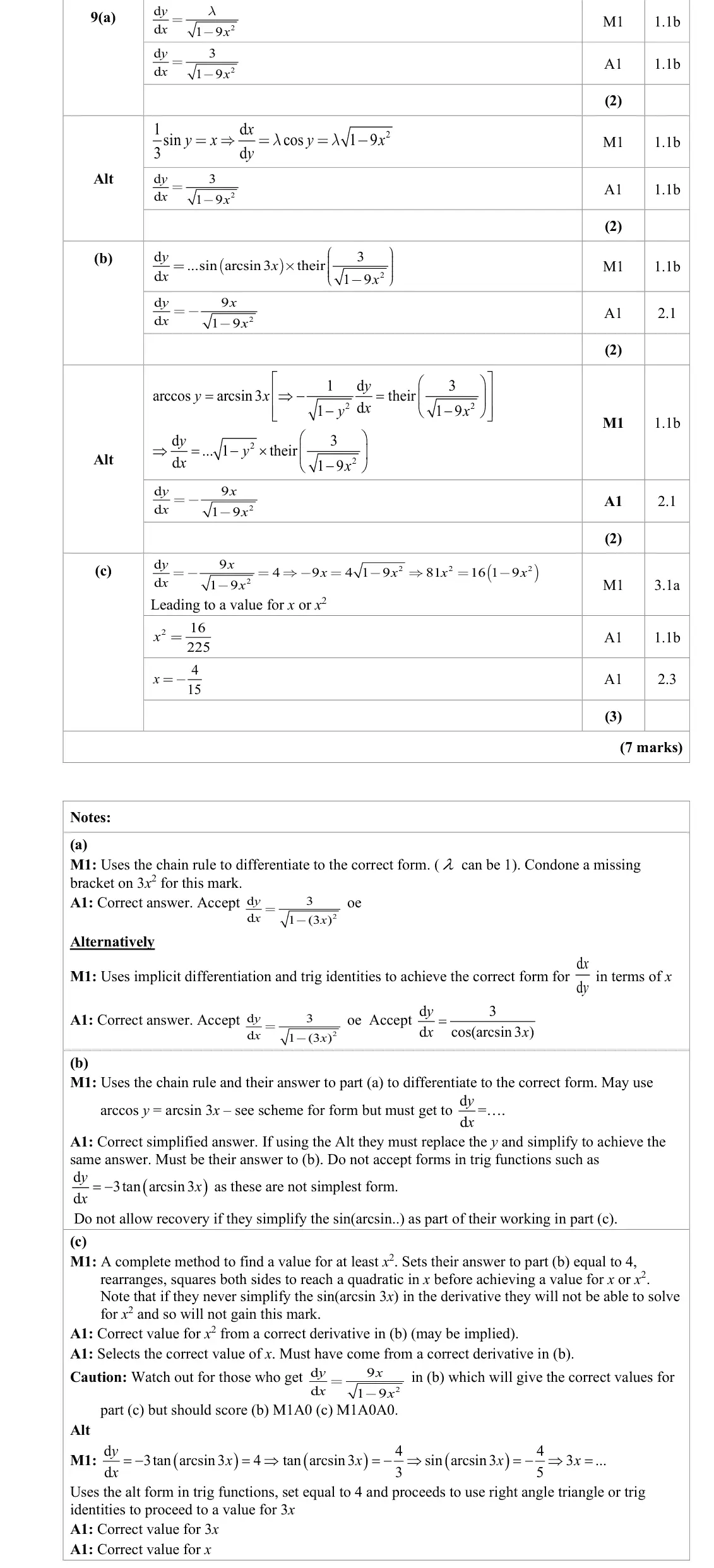
9(a) Calculus with inverse trigonometric functions 2 —
9(b) Calculus with inverse trigonometric functions 2 —
9(c) Calculus with inverse trigonometric functions 3 —

The questions

1(a)1(b)2(a)2(b)2(c)2(d)2(e)3(a)3(b)3(c)3(d)4(i)4(ii)(a)4(ii)(b)56(a)6(b)7(a)7(b)7(c)8(a)8(b)9(a)9(b)9(c)
June 2025 · Paper 2 (Core Pure 2) · Q1(a) 3 marks modulus argument formcomplex numbers
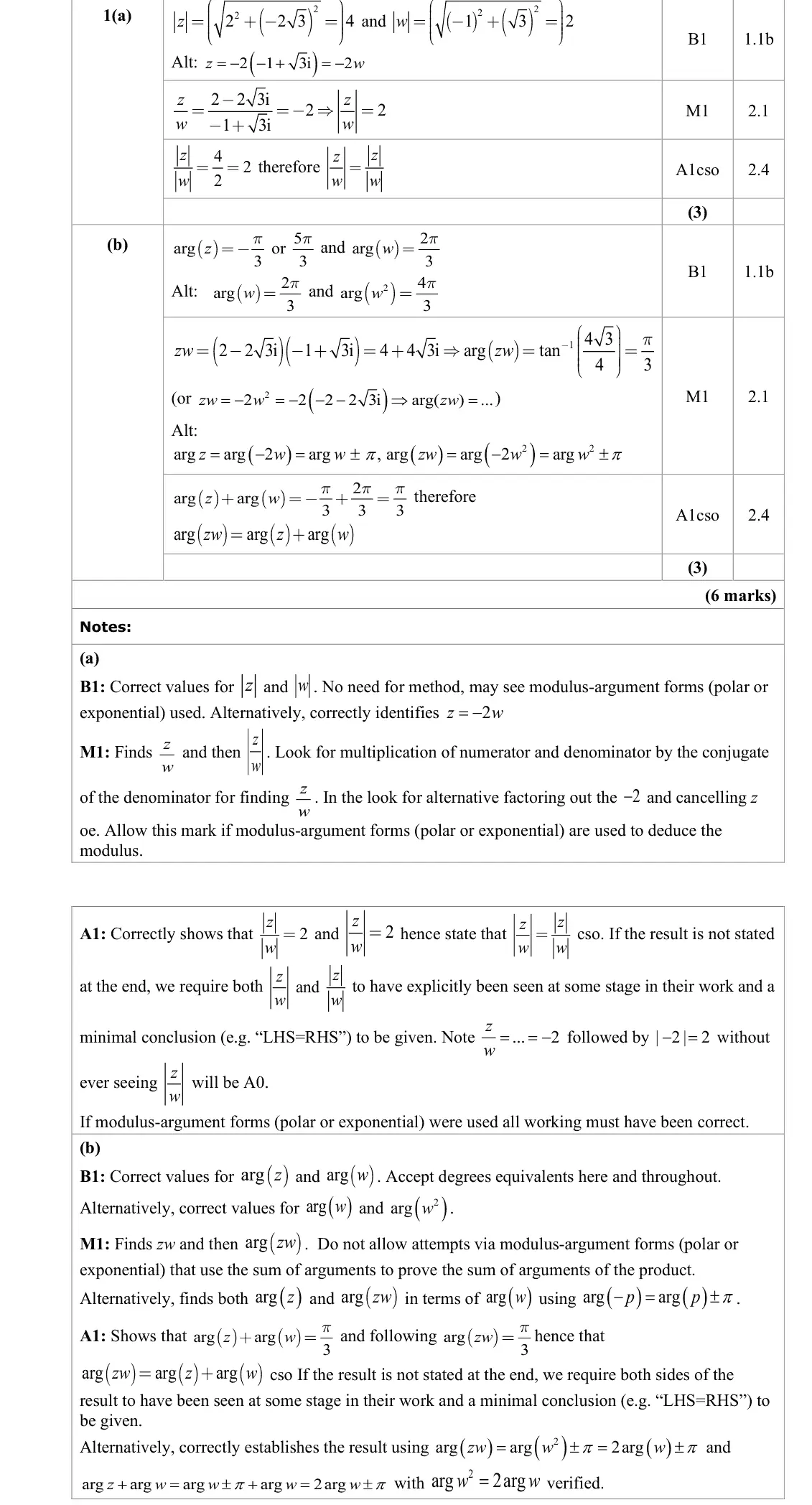
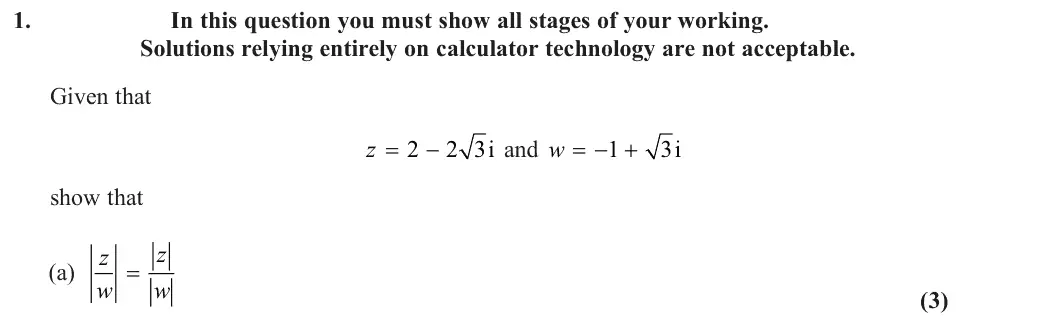
1. In this question you must show all stages of your working. Solutions relying entirely on calculator technology are not acceptable. Given that 2 3i and w O 3 1 z O 3i show that z (a) z = w w (3)
June 2025 · Paper 2 (Core Pure 2) · Q1(b) 3 marks modulus argument form
(b) arg( zw z w ) arg( ) arg( ) (3)
June 2025 · Paper 2 (Core Pure 2) · Q2(a) 2 marks vectors intersections and distances
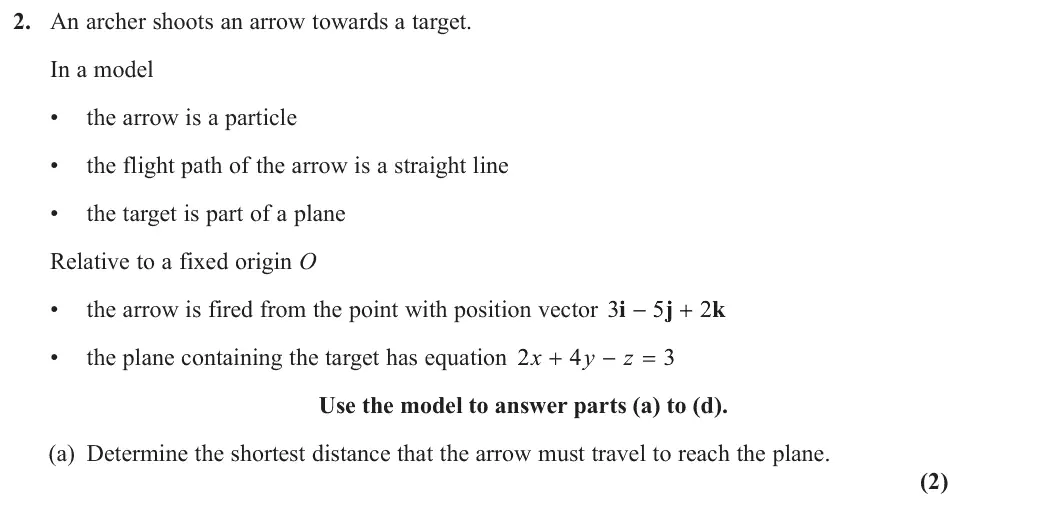
2. An archer shoots an arrow towards a target. In a model • the arrow is a particle • the flight path of the arrow is a straight line • the target is part of a plane Relative to a fixed origin O • the arrow is fired from the point with position vector 3 i j k • the plane containing the target has equation 2 x y z Use the model to answer parts (a) to (d). (a) Determine the shortest distance that the arrow must travel to reach the plane. (2)
June 2025 · Paper 2 (Core Pure 2) · Q2(b) 2 marks vectors lines and planes
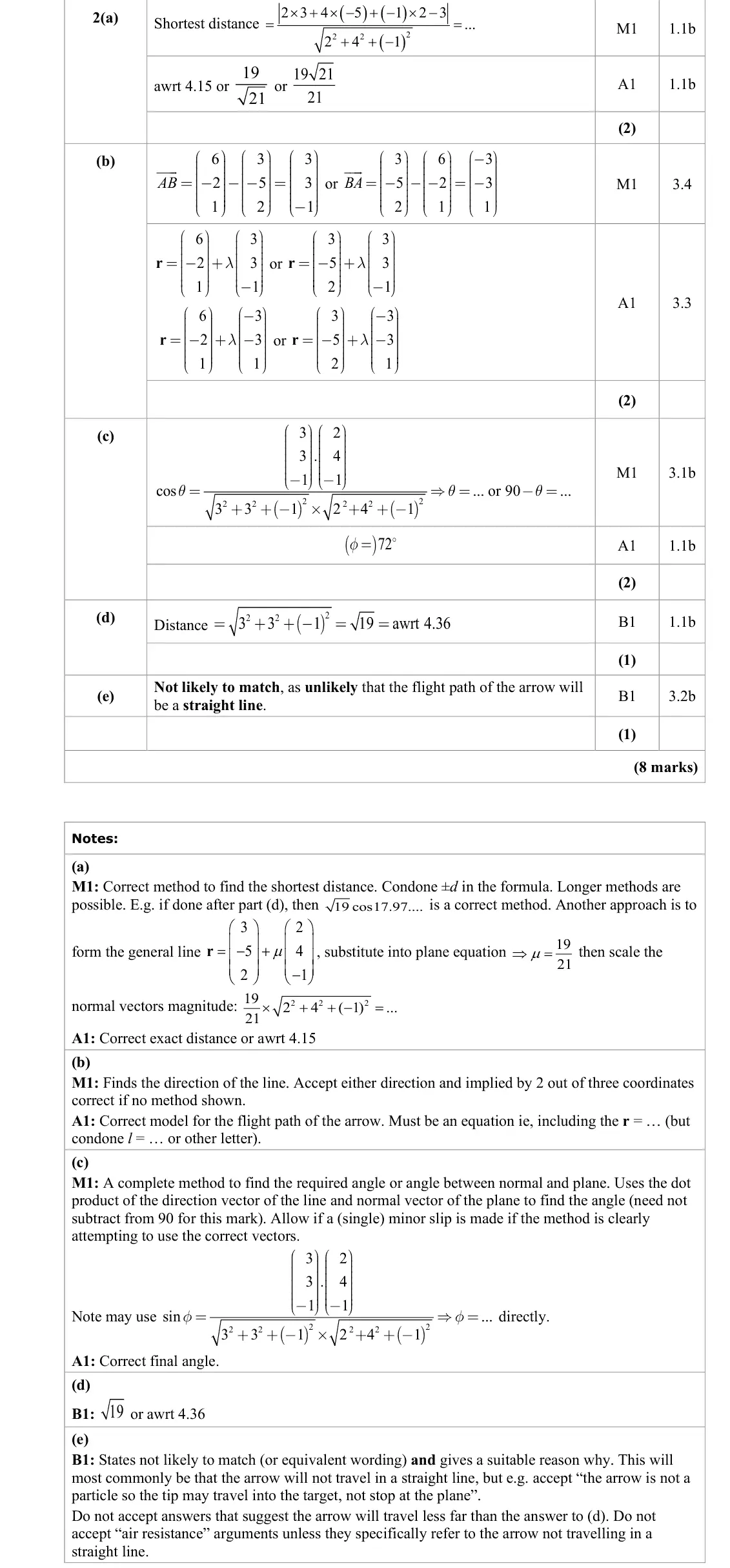
The arrow hits the target at the point with position vector 6 i j k (b) Determine a vector equation of the flight path of the arrow. (2)
June 2025 · Paper 2 (Core Pure 2) · Q2(c) 2 marks vectors lines and planes
(c) Determine the acute angle that the flight path of the arrow makes with the target. Give your answer to the nearest degree. (2)
June 2025 · Paper 2 (Core Pure 2) · Q2(d) 1 mark vectors lines and planes
(d) Determine the distance travelled by the arrow. (1)
June 2025 · Paper 2 (Core Pure 2) · Q2(e) 1 mark vectors lines and planes
(e) Comment on whether the actual distance travelled by the arrow is likely to match the answer to part (d), giving a reason for your answer. (1)
June 2025 · Paper 2 (Core Pure 2) · Q3(a) 6 marks proof by induction
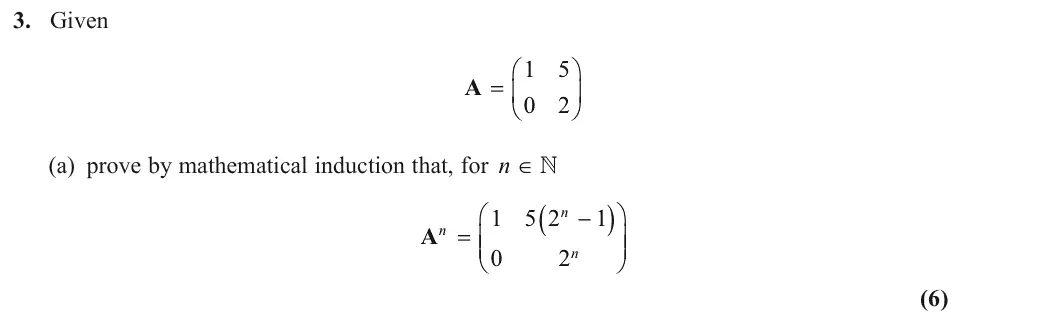
3. Given A O ; :9 (a) prove by mathematical induction that, for n ∈ / n 5 2 An n (6)
June 2025 · Paper 2 (Core Pure 2) · Q3(b) 2 marks linear transformations
Given : B O (b) describe fully the single geometrical transformation P represented by the matrix B (2)
June 2025 · Paper 2 (Core Pure 2) · Q3(c) 1 mark linear transformationsmatrices
The transformation Q is represented by the matrix An The transformation P followed by the transformation Q is the transformation R, which is represented by the matrix C (c) Determine C in terms of n (1)
June 2025 · Paper 2 (Core Pure 2) · Q3(d) 3 marks linear transformationsmatrices
Given that, for a particular value of n, the transformation R maps the point with coordinates (27, 1) to the point with coordinates (a, a), where a is a constant, (d) determine the matrix that represents the transformation Q (3)
June 2025 · Paper 2 (Core Pure 2) · Q4(i) 5 marks complex numbers
4. (i) z 1 O a 1 i and z b 2 O c d i where a, b, c and d are real constants. Given that b d • > • z + z is real • z1 = • z2 = / O • Re z z show that a = 2 and determine the value of each of b, c and d (5)
June 2025 · Paper 2 (Core Pure 2) · Q4(ii)(a) 2 marks loci in the argand diagramcomplex numbers
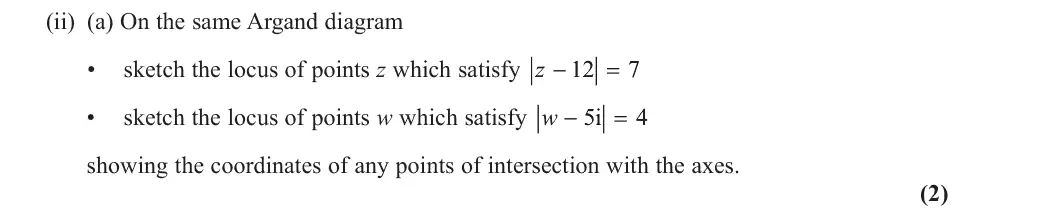
(ii) (a) On the same Argand diagram • sketch the locus of points z which satisfy z 3 • sketch the locus of points w which satisfy w 3 i showing the coordinates of any points of intersection with the axes. (2)
June 2025 · Paper 2 (Core Pure 2) · Q4(ii)(b) 3 marks loci in the argand diagram
(b) Determine the range of possible values of z - w (3)
June 2025 · Paper 2 (Core Pure 2) · Q5 4 marks three equations three unknowns
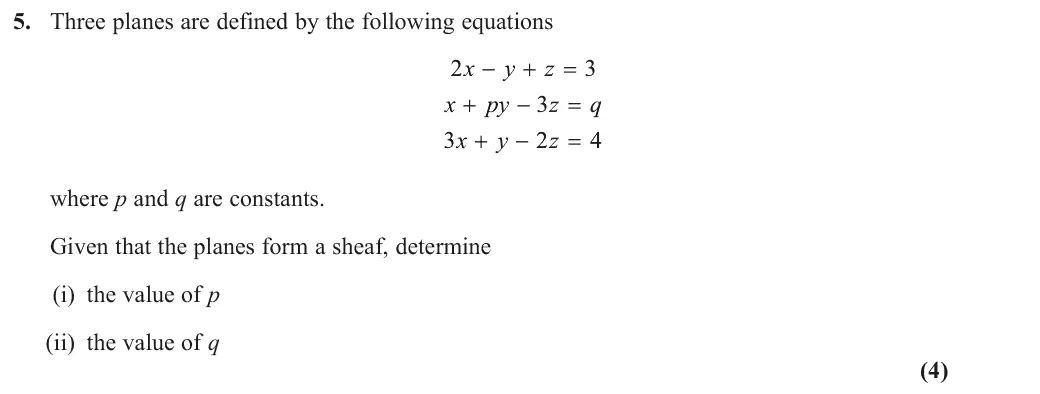
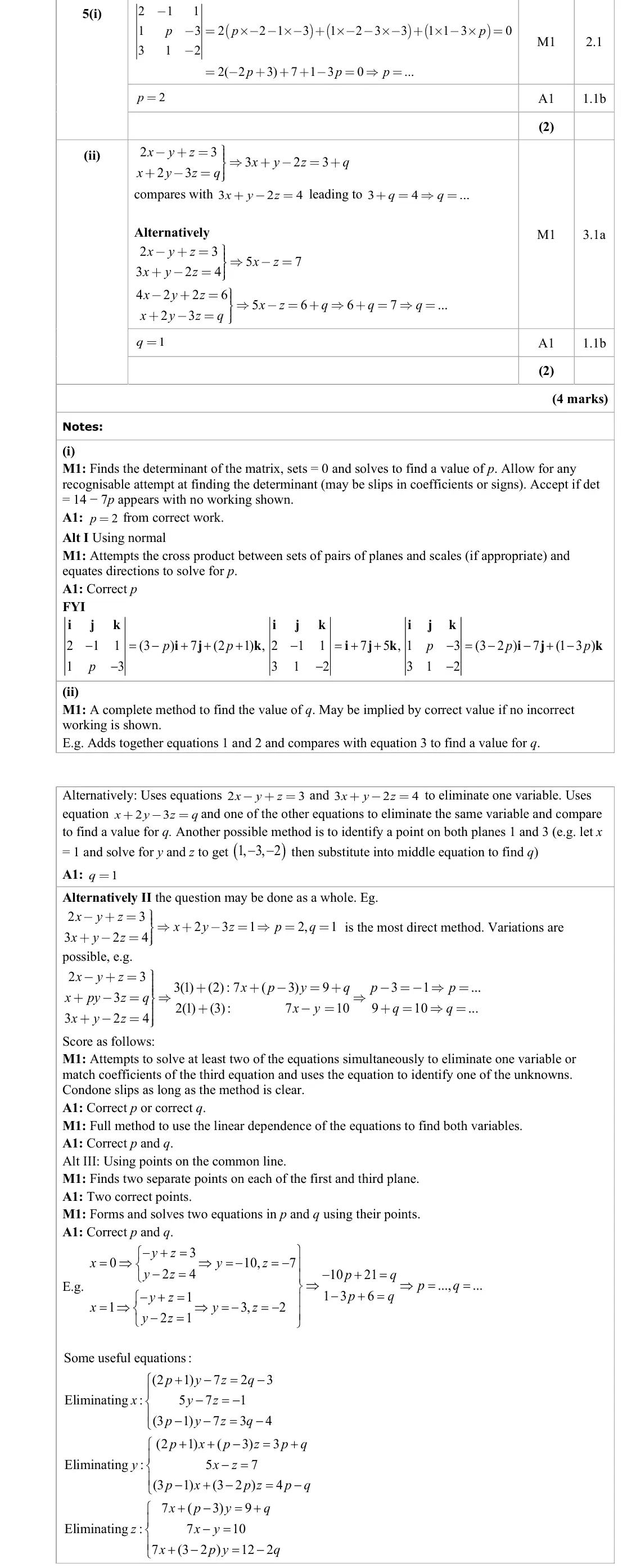
5. Three planes are defined by the following equations x y z x py z q x y z where p and q are constants. Given that the planes form a sheaf, determine (i) the value of p (ii) the value of q (4)
June 2025 · Paper 2 (Core Pure 2) · Q6(a) 3 marks roots of polynomials
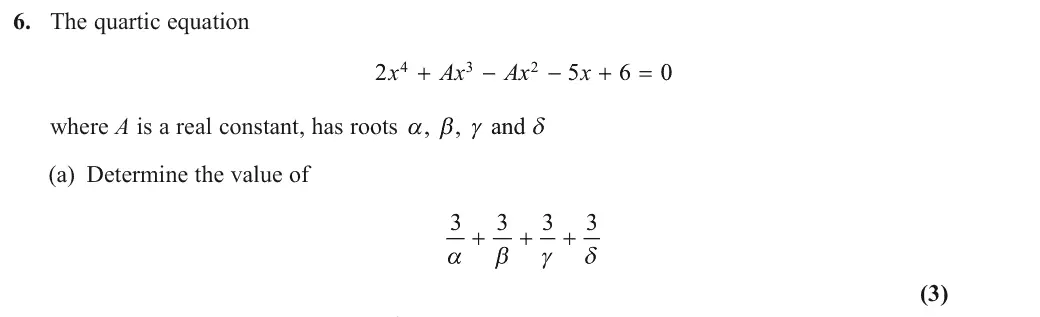
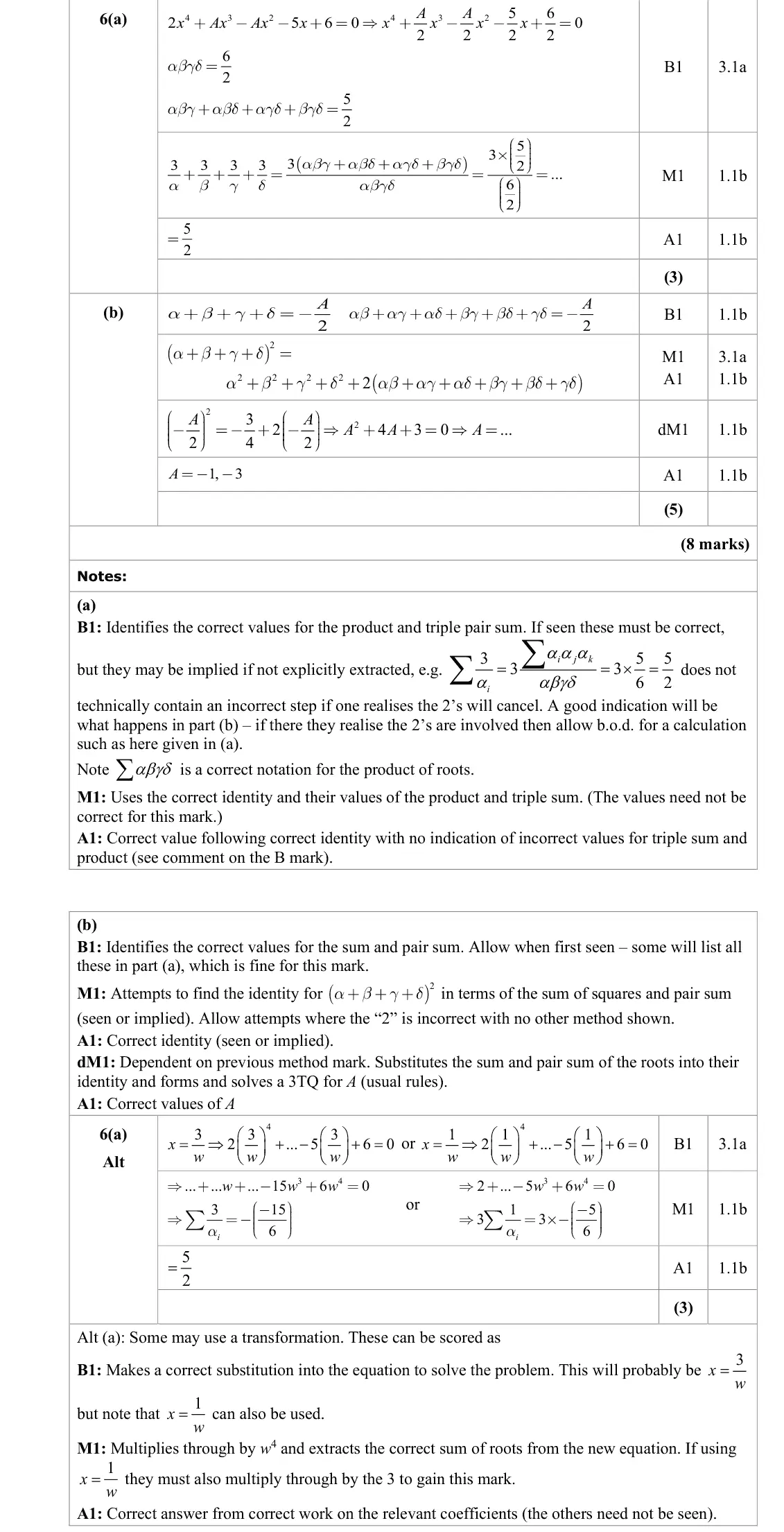
6. The quartic equation x Ax Ax x where A is a real constant, has roots Ü á í , , and è (a) Determine the value of Ü á í è (3)
June 2025 · Paper 2 (Core Pure 2) · Q6(b) 5 marks roots of polynomials
Given that Ü á í è O 3 (b) determine the possible values of A (5)
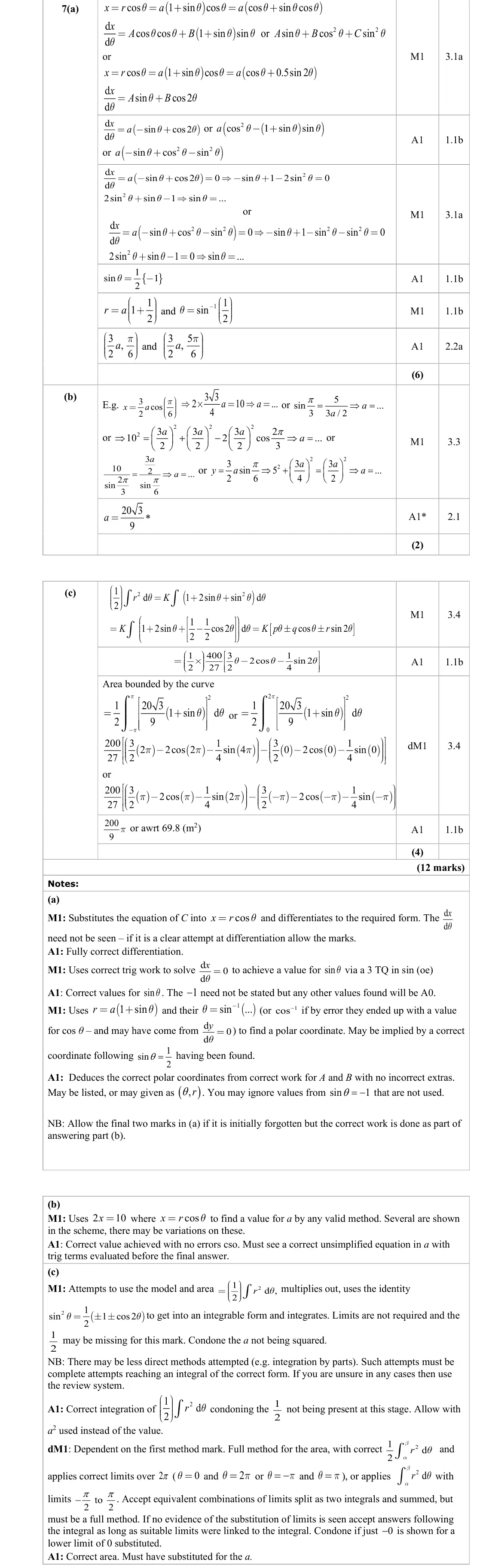
June 2025 · Paper 2 (Core Pure 2) · Q7(a) 6 marks polar coordinates
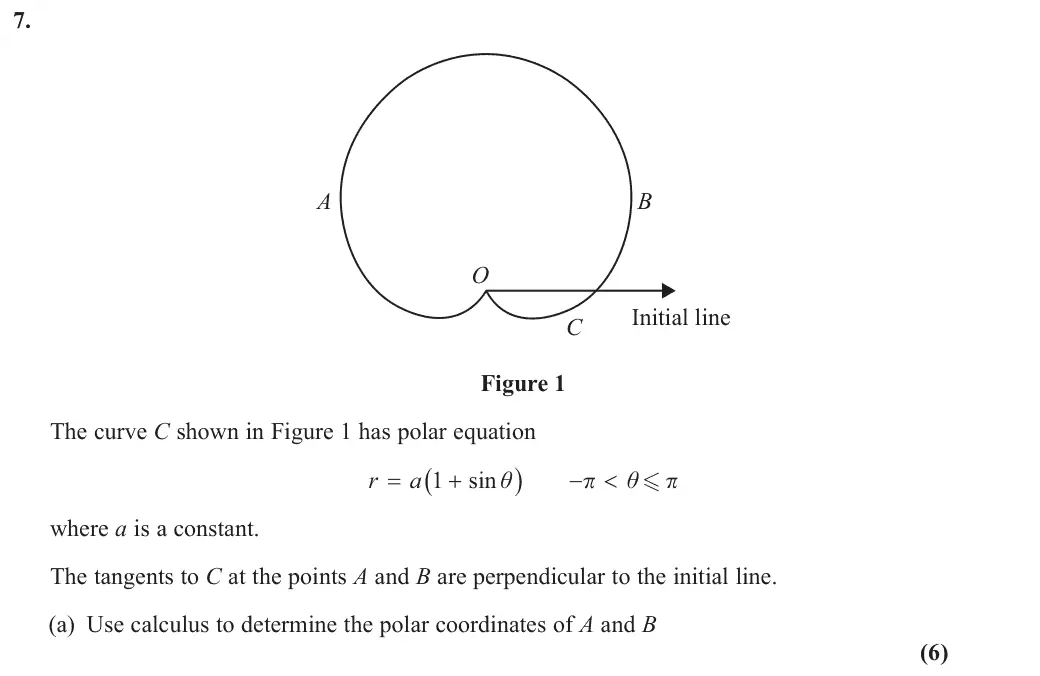
7. A B Initial line C Figure 1 The curve C shown in Figure 1 has polar equation r a 1 sin theta ϖ theta < ϖ where a is a constant. The tangents to C at the points A and B are perpendicular to the initial line. (a) Use calculus to determine the polar coordinates of A and B (6)
June 2025 · Paper 2 (Core Pure 2) · Q7(b) 2 marks polar coordinates
The curve C models the perimeter of the surface of a swimming pool. Given that, according to the model, the distance across the pool from A to B is 10 m, (b) show that a = 20 3 (2)
June 2025 · Paper 2 (Core Pure 2) · Q7(c) 4 marks polar coordinates
(c) Use algebraic integration to determine the surface area of the swimming pool, according to the model. (4)
June 2025 · Paper 2 (Core Pure 2) · Q8(a) 5 marks hyperbolic functions
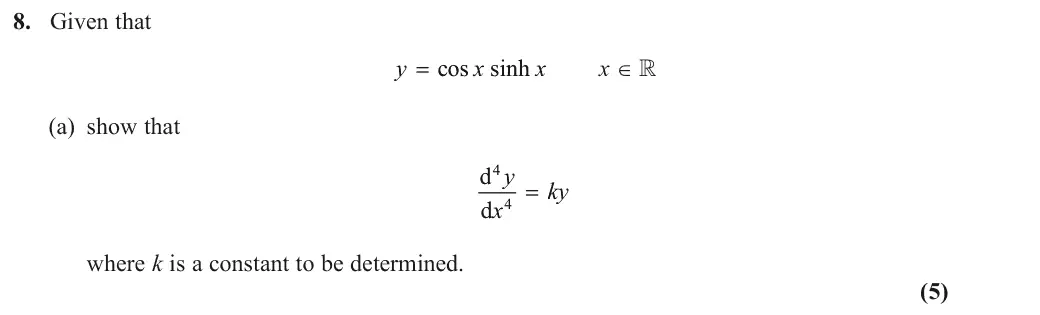
8. Given that y = cos x sinh x x=<=< (a) show that d y = ky d x where k is a constant to be determined. (5)
June 2025 · Paper 2 (Core Pure 2) · Q8(b) 3 marks maclaurin series
(b) Hence determine the first three non-zero terms of the Maclaurin series for y, giving each coefficient in simplest form. (3)
June 2025 · Paper 2 (Core Pure 2) · Q9(a) 2 marks inverse trig calculus
9. Given that -1 = arcsin3 y x x (a) determine d y x in terms of x d (2)
June 2025 · Paper 2 (Core Pure 2) · Q9(b) 2 marks inverse trig calculus
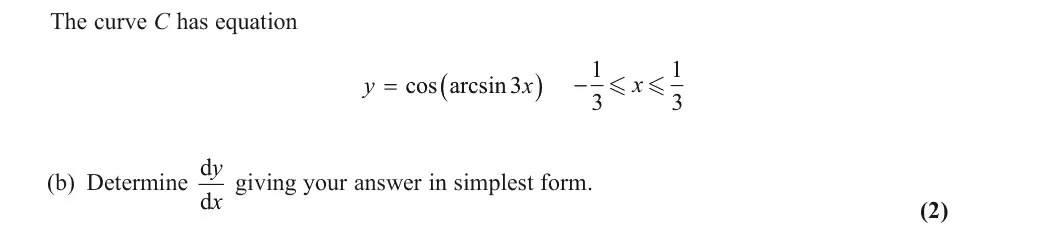
The curve C has equation -1 / x y cos arcsin3 x (b) Determine d y x giving your answer in simplest form. d (2)
June 2025 · Paper 2 (Core Pure 2) · Q9(c) 3 marks inverse trig calculus
(c) Hence determine the x coordinate of the point on C at which the gradient is 4 (3)

Find an Edexcel Further Maths tutor

Want this paper marked and gone through with a Further Maths tutor? Message us.

Prefer email? Send an enquiry

If you are under 18, please include a parent's contact details. Enquiries go to enquiries@alevelfurthermathstutor.com and are deleted once handled.