June 2024: A level Paper 02: Core Pure Mathematics 2

75 marks · 24 question parts · Question paper, mark scheme and examiner's report on Pearson's site

Question by question

QTopicMarksDifficulty
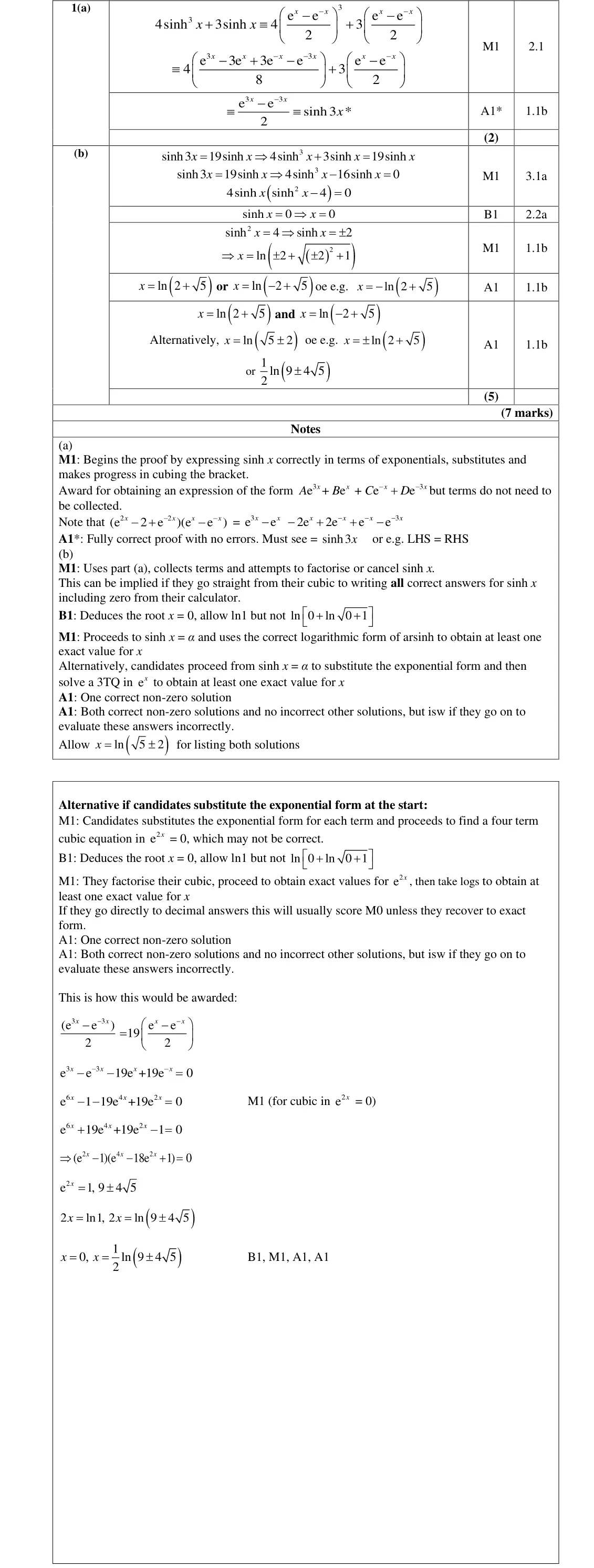
1(a) Hyperbolic functions 2 —
1(b) Hyperbolic functions 5 —
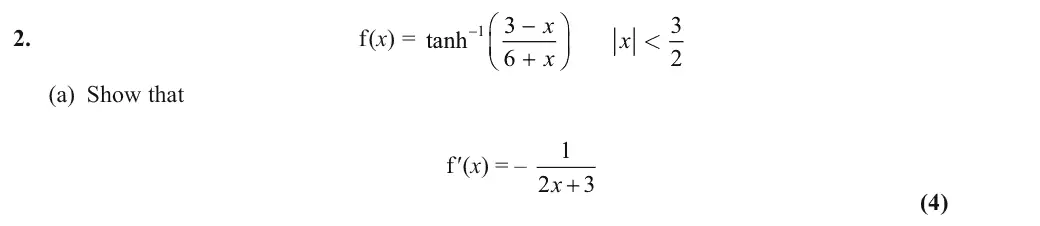
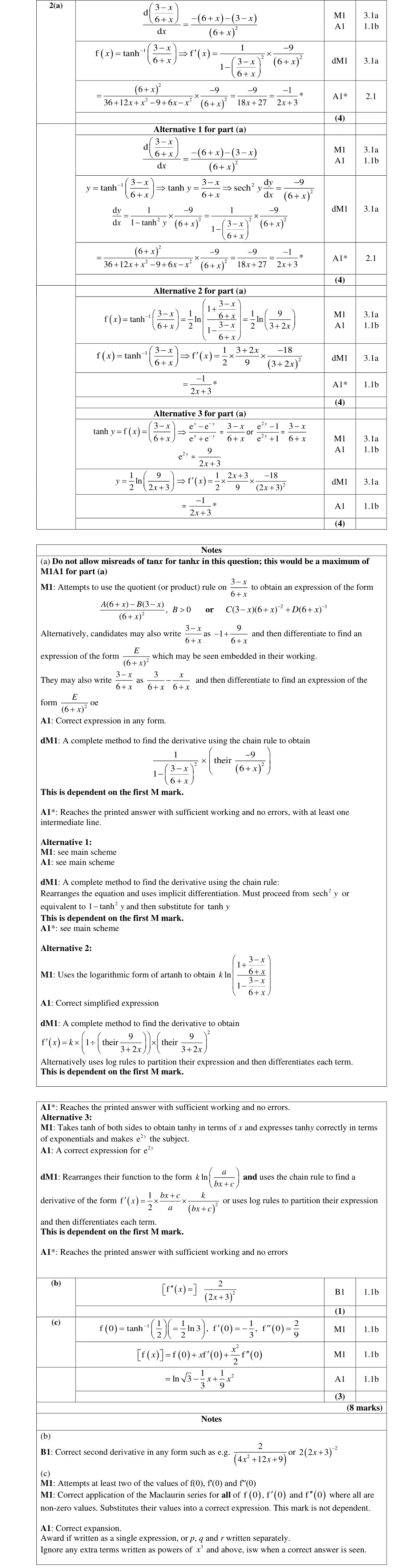
2(a) Hyperbolic functions 4 —
2(b) Hyperbolic functions 1 —
2(c) Maclaurin series 3 —
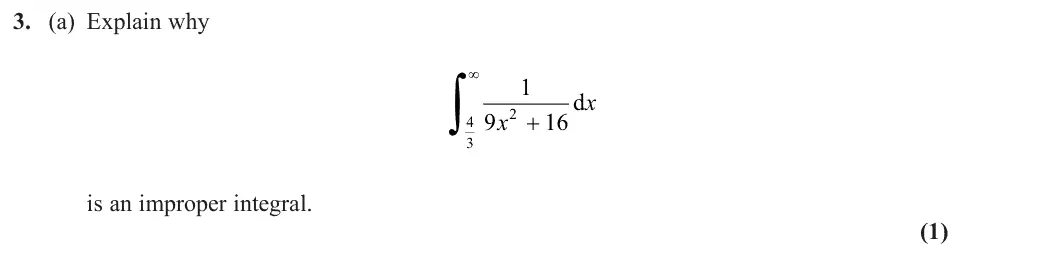
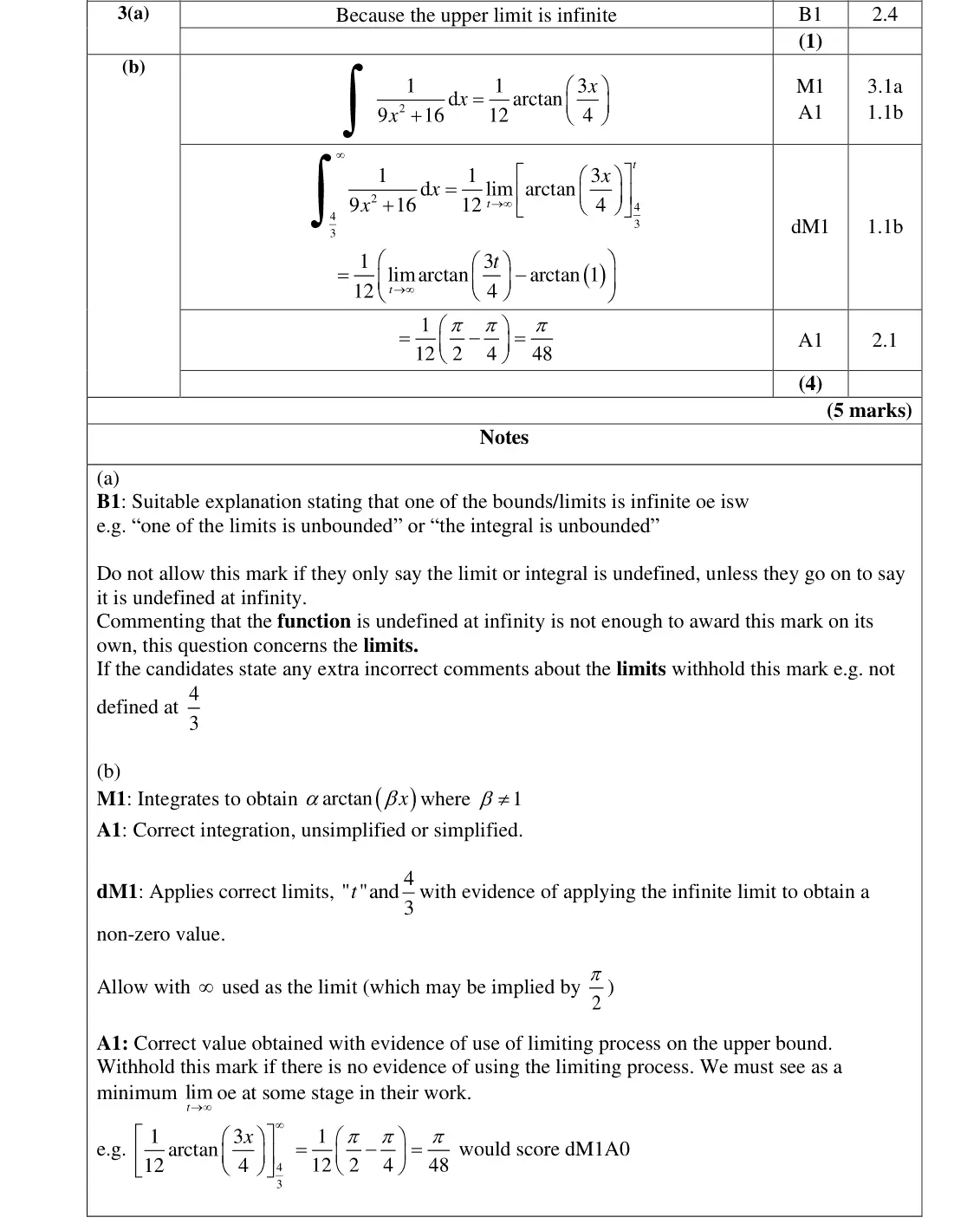
3(a) Improper integrals and the mean value of a function 1 —
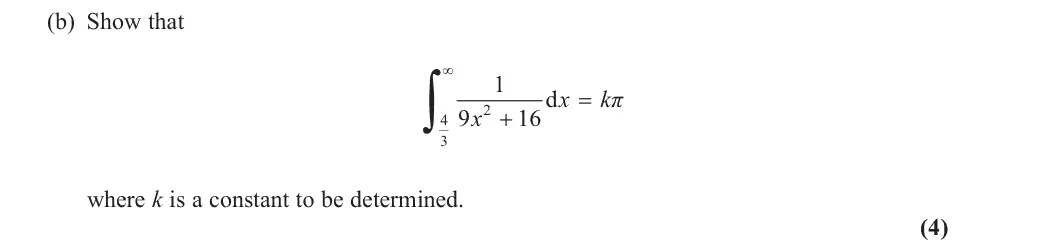
3(b) Improper integrals and the mean value of a function, Calculus with inverse trigonometric functions 4 —
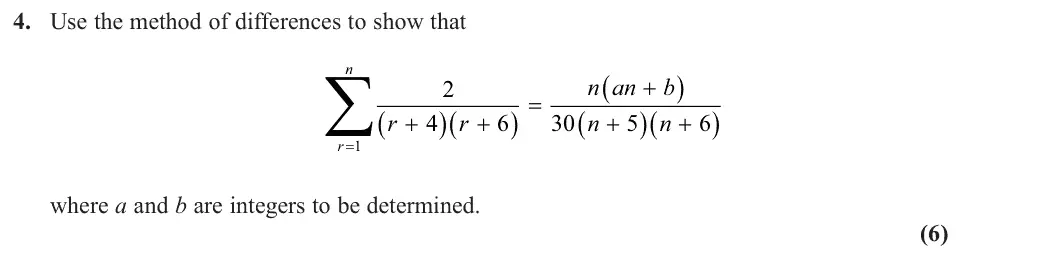
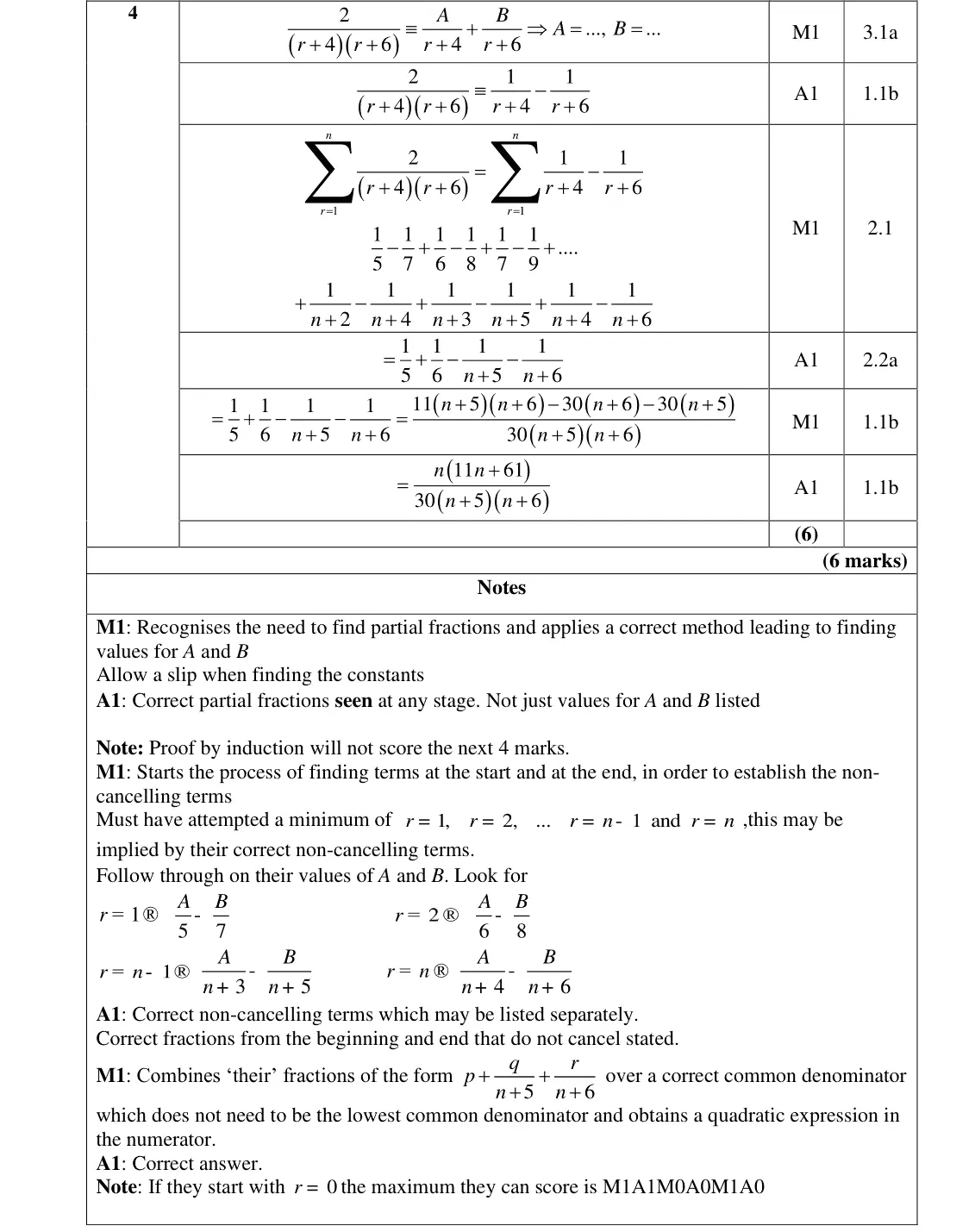
4 Series: standard sums and the method of differences 6 —
5(a) Loci in the Argand diagram 4 —
5(b) Loci in the Argand diagram 1 —
5(c) Loci in the Argand diagram 4 —
6(a) Second-order differential equations 6 —
6(b) First-order differential equations: integrating factors and modelling 3 —
6(c) First-order differential equations: integrating factors and modelling 4 —
6(d) First-order differential equations: integrating factors and modelling 1 —
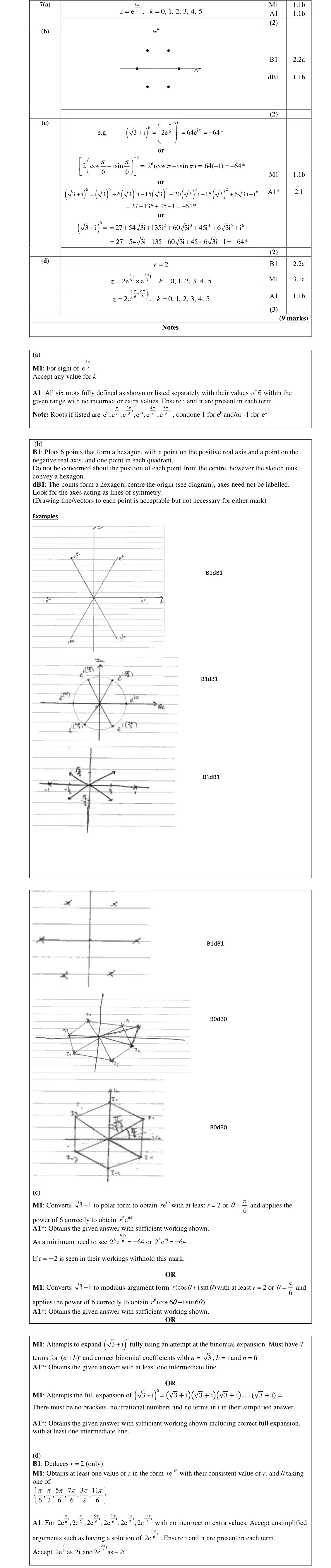
7(a) nth roots and roots of unity 2 —
7(b) nth roots and roots of unity, Complex numbers: arithmetic, conjugates, roots of polynomials and Argand diagrams 2 —
7(c) De Moivre's theorem and exponential form 2 —
7(d) nth roots and roots of unity 3 —
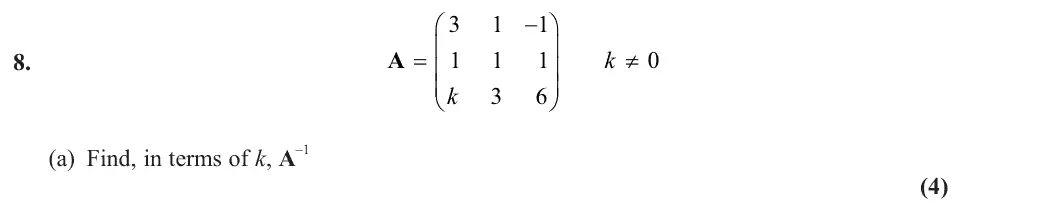
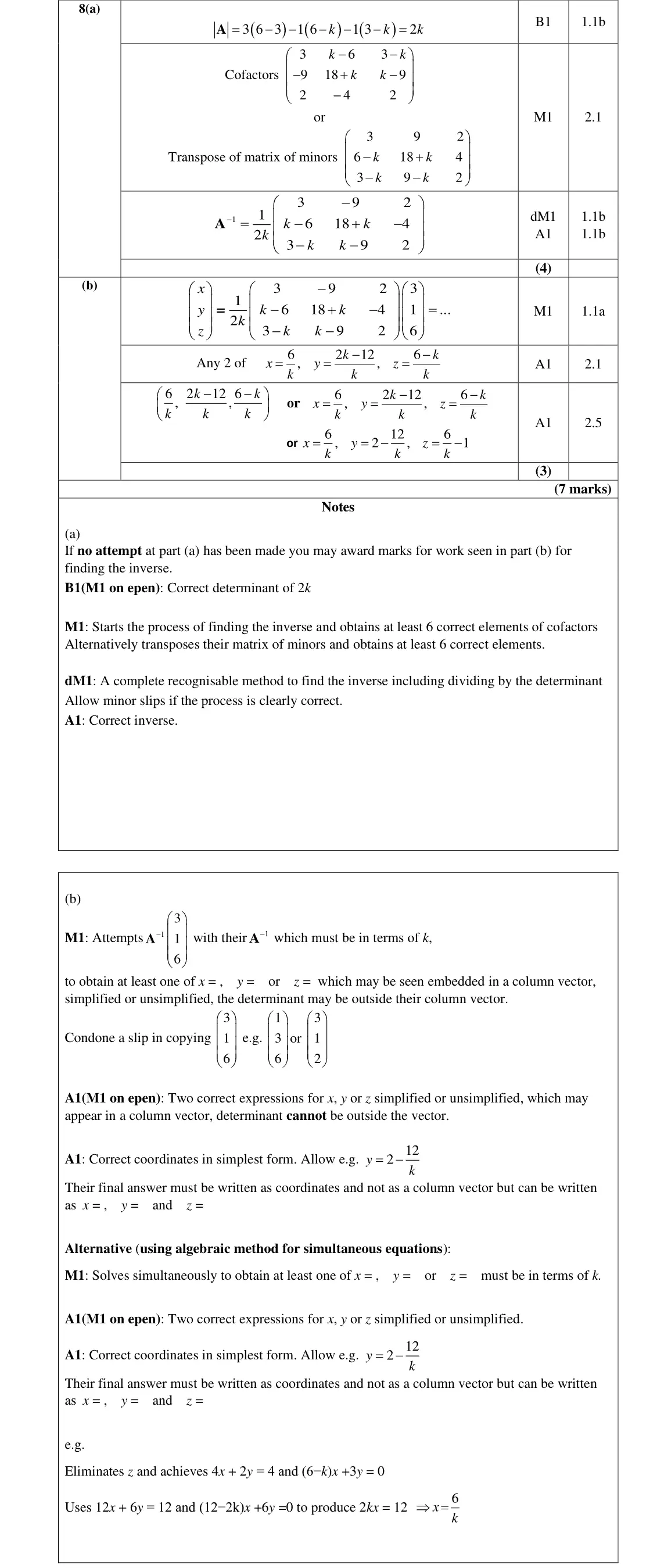
8(a) Matrices: multiplication, determinants and inverses 4 —
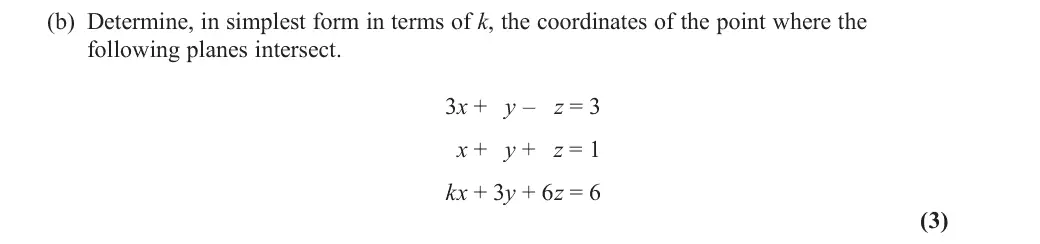
8(b) Three linear equations: solutions and planes 3 —
9(a) Volumes of revolution 2 —
9(b) Volumes of revolution 7 —
9(c) Volumes of revolution 1 —

The questions

1(a)1(b)2(a)2(b)2(c)3(a)3(b)45(a)5(b)5(c)6(a)6(b)6(c)6(d)7(a)7(b)7(c)7(d)8(a)8(b)9(a)9(b)9(c)
June 2024 · Paper 2 (Core Pure 2) · Q1(a) 2 marks hyperbolic functions
1. (a) Using the definition of sinh x in terms of exponentials, prove that sinh x sinh x ; sinh x (2)
June 2024 · Paper 2 (Core Pure 2) · Q1(b) 5 marks hyperbolic functions
(b) Hence solve the equation sinh x = sinh x giving your answers as simplified natural logarithms where appropriate. (5)
June 2024 · Paper 2 (Core Pure 2) · Q2(a) 4 marks hyperbolic functions
x : 2. f(x) = tanh3 x < x (a) Show that f′(x) = – x + (4)
June 2024 · Paper 2 (Core Pure 2) · Q2(b) 1 mark hyperbolic functions
(b) Hence determine f′′(x) (1)
June 2024 · Paper 2 (Core Pure 2) · Q2(c) 3 marks maclaurin series
2, is (c) Hence show that the Maclaurin series for f(x), up to and including the term in x ln p + qx + rx where p, q and r are constants to be determined. (3)
June 2024 · Paper 2 (Core Pure 2) · Q3(a) 1 mark improper integrals and mean value
3. (a) Explain why ; : d x x is an improper integral. (1)
June 2024 · Paper 2 (Core Pure 2) · Q3(b) 4 marks improper integrals and mean valueinverse trig calculus
(b) Show that < d x k pi x where k is a constant to be determined. (4)
June 2024 · Paper 2 (Core Pure 2) · Q4 6 marks series and method of differences
4. Use the method of differences to show that O8 n / n an b / / / / r r n n r where a and b are integers to be determined. (6)
June 2024 · Paper 2 (Core Pure 2) · Q5(a) 4 marks loci in the argand diagram
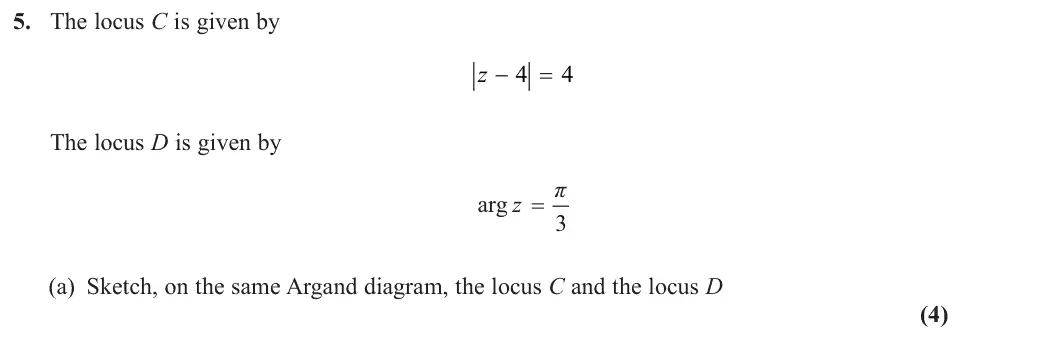
5. The locus C is given by z 3 The locus D is given by O pi arg z (a) Sketch, on the same Argand diagram, the locus C and the locus D (4)
June 2024 · Paper 2 (Core Pure 2) · Q5(b) 1 mark loci in the argand diagram
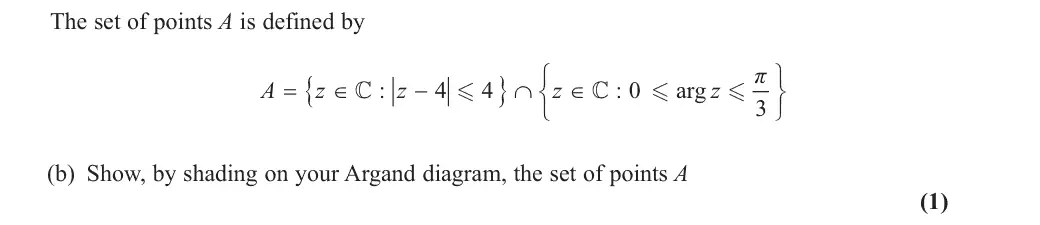
The set of points A is defined by pi : <= ¥ A z : z < z : 0 < arg z < < < (b) Show, by shading on your Argand diagram, the set of points A (1)
June 2024 · Paper 2 (Core Pure 2) · Q5(c) 4 marks loci in the argand diagram
(c) Find the area of the region defined by A, giving your answer in the form p pi q where p and q are constants to be determined. (4)
June 2024 · Paper 2 (Core Pure 2) · Q6(a) 6 marks second order differential equations
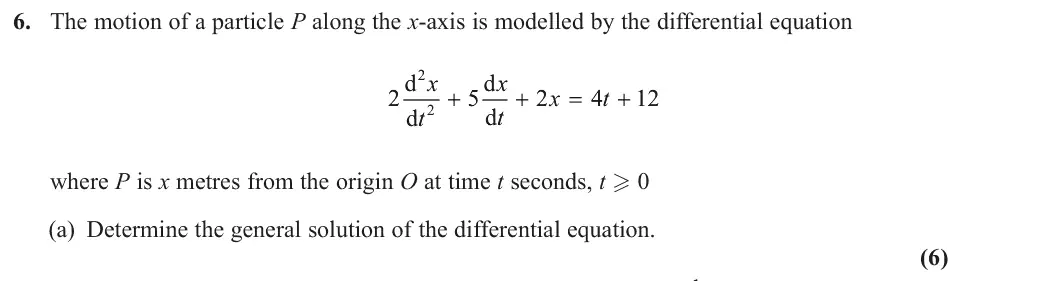
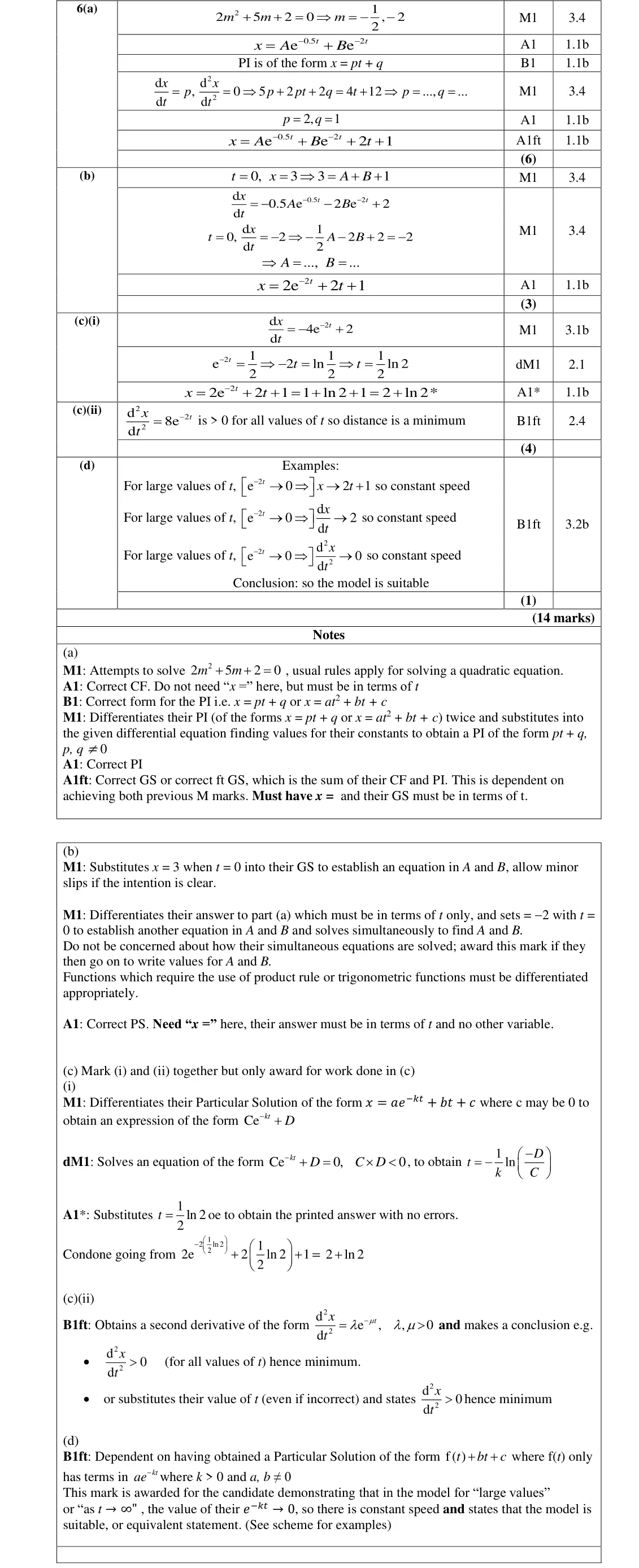
6. The motion of a particle P along the x-axis is modelled by the differential equation x x d d x t t d t d where P is x metres from the origin O at time t seconds, t 0 (a) Determine the general solution of the differential equation. (6)
June 2024 · Paper 2 (Core Pure 2) · Q6(b) 3 marks first order differential equations
(b) Hence determine the particular solution for which x = 3 and d x t = –2 when t = 0 d (3)
June 2024 · Paper 2 (Core Pure 2) · Q6(c) 4 marks first order differential equations
(c) (i) Show that, according to the model, the minimum distance between O and P is (2 + ln 2) metres. (ii) Justify that this distance is a minimum. (4)
June 2024 · Paper 2 (Core Pure 2) · Q6(d) 1 mark first order differential equations
For large values of t the particle is expected to move with constant speed. (d) Comment on the suitability of the model in light of this information. (1)
June 2024 · Paper 2 (Core Pure 2) · Q7(a) 2 marks roots of unity
7. (a) Determine the roots of the equation 6 = 1 z i theta where 0 theta < 2 pi giving your answers in the form e (2)
June 2024 · Paper 2 (Core Pure 2) · Q7(b) 2 marks roots of unitycomplex numbers
(b) Show the roots of the equation in part (a) on a single Argand diagram. (2)
June 2024 · Paper 2 (Core Pure 2) · Q7(c) 2 marks de moivres theorem
(c) Show that / O 3 i (2)
June 2024 · Paper 2 (Core Pure 2) · Q7(d) 3 marks roots of unity
(d) Hence, or otherwise, solve the equation 6 + 64 = 0 z giving your answers in the form re i theta where 0 theta < 2 pi (3)
June 2024 · Paper 2 (Core Pure 2) · Q8(a) 4 marks matrices
: A O k 8. k –1 (a) Find, in terms of k, A (4)
June 2024 · Paper 2 (Core Pure 2) · Q8(b) 3 marks three equations three unknowns
(b) Determine, in simplest form in terms of k, the coordinates of the point where the following planes intersect. 3x + y – z = 3 x + y + z = 1 kx + 3y + 6z = 6 (3)
June 2024 · Paper 2 (Core Pure 2) · Q9(a) 2 marks volumes of revolution
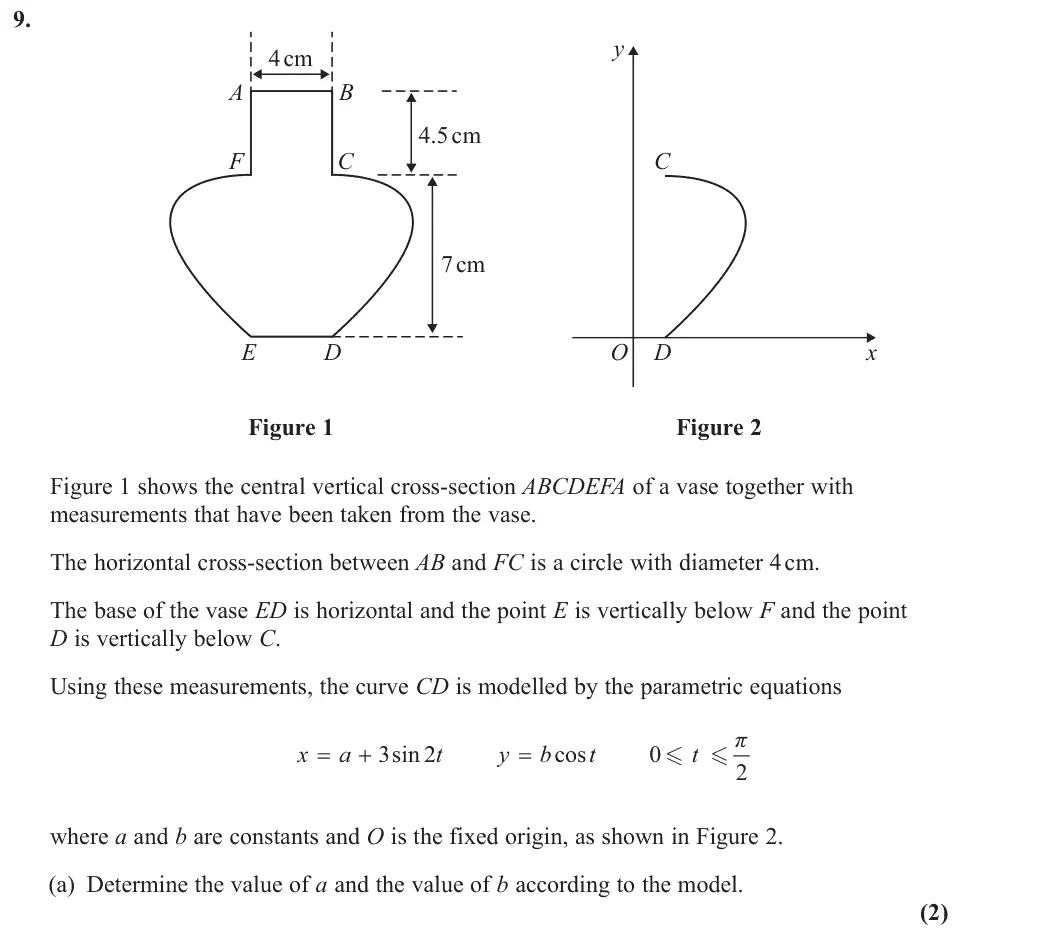
9. y 4 cm A B 4.5 cm F C C 7 cm E x Figure 1 Figure 2 Figure 1 shows the central vertical cross-section ABCDEFA of a vase together with measurements that have been taken from the vase. The horizontal cross-section between AB and FC is a circle with diameter 4 cm. The base of the vase ED is horizontal and the point E is vertically below F and the point D is vertically below C. Using these measurements, the curve CD is modelled by the parametric equations pi < < x a 3sin 2 t y b cos t t where a and b are constants and O is the fixed origin, as shown in Figure 2. (a) Determine the value of a and the value of b according to the model. (2)
June 2024 · Paper 2 (Core Pure 2) · Q9(b) 7 marks volumes of revolution
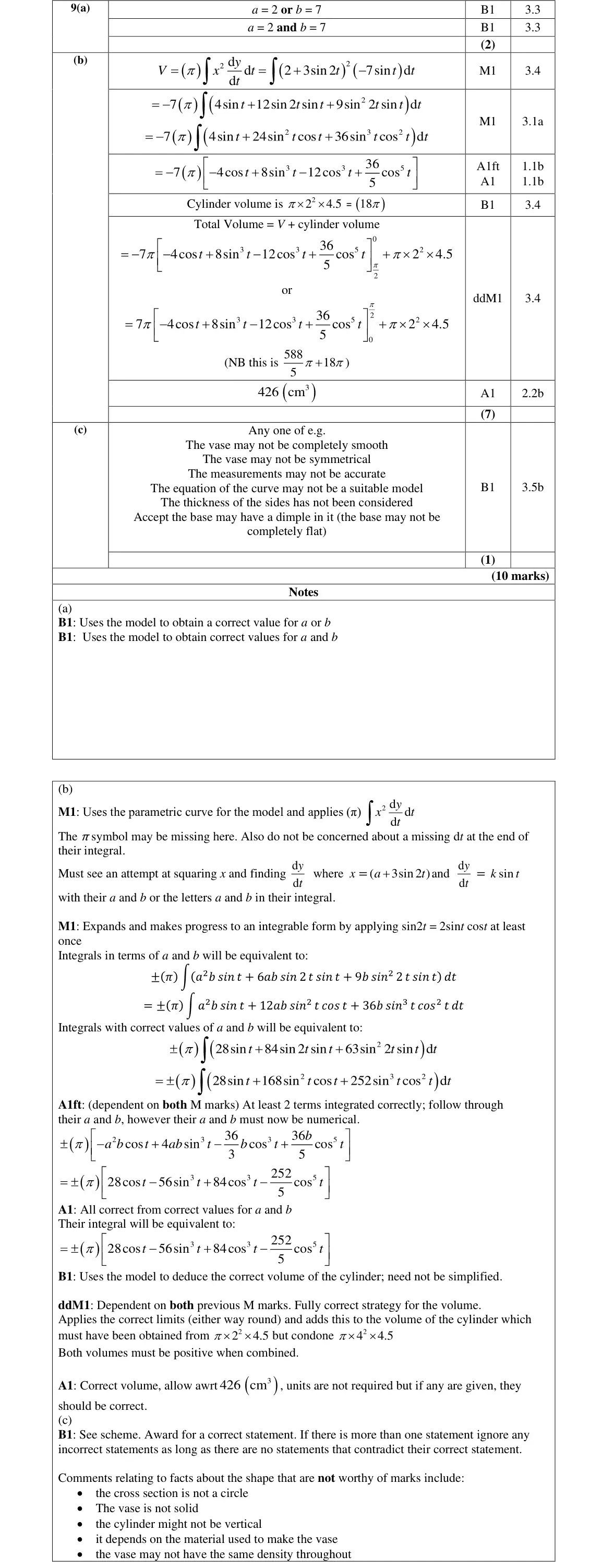
(b) Using algebraic integration and showing all your working, determine, according to the model, the volume of the vase, giving your answer to the nearest cm (7)
June 2024 · Paper 2 (Core Pure 2) · Q9(c) 1 mark volumes of revolution
(c) State a limitation of the model. (1)

Find an Edexcel Further Maths tutor

Want this paper marked and gone through with a Further Maths tutor? Message us.

Prefer email? Send an enquiry

If you are under 18, please include a parent's contact details. Enquiries go to enquiries@alevelfurthermathstutor.com and are deleted once handled.